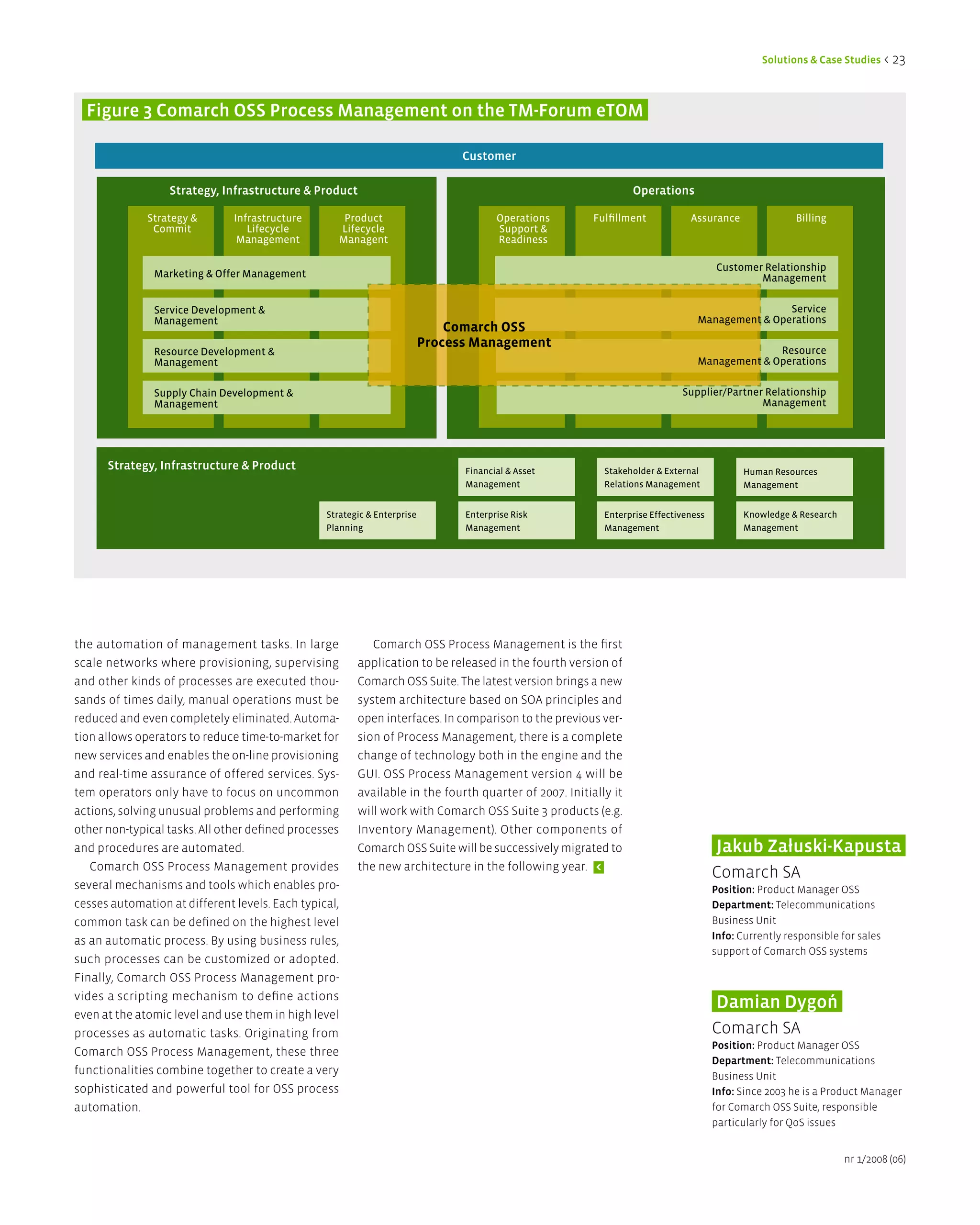

www.comarch.com                  n0 1/2008 (06)
                                             Comarch Telecommunications Business Unit
                                        Comarch Technology Review is a publication created
                                        by Comarch experts and specialists. It aims at assist-
                                        ing our customers and partners in obtaining in-depth
                                        information about market trends and developments,
                                        and the technological possibilities of addressing the
                                        most important issues.


in focus

Customers & ProduCts


>>   Comarch Product Catalog

>>   Convergence in Telecommunication

>>   On-premise CRM

>>   Why CRM does not deliver?
Are you bored with traditional tV?


Next Generation TV is coming!
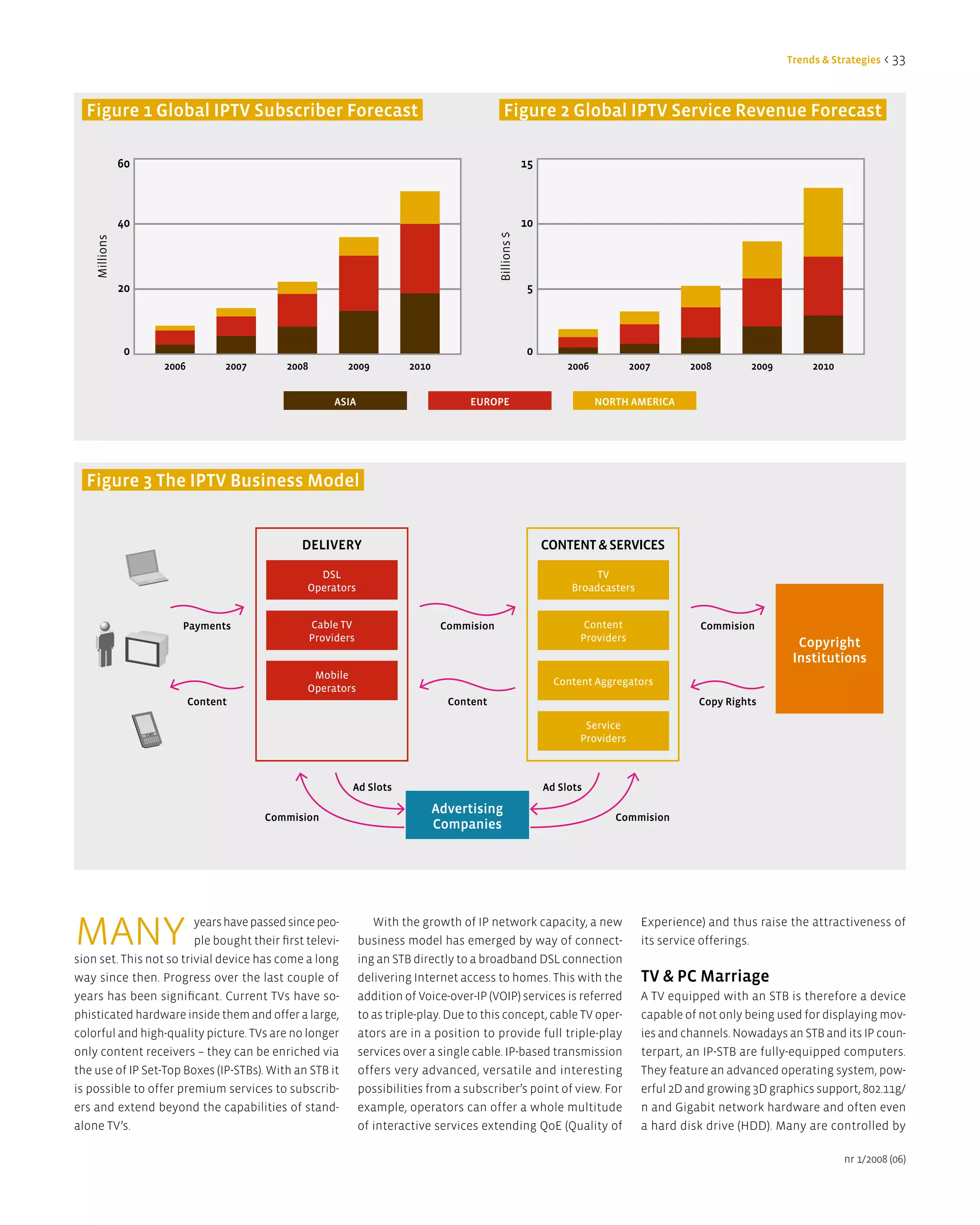
Comarch’s Next Generation TV (NGTV) solution allows       For operators, Comarch NGTV suite provides a complete              Learn more at
network operators to provide interactive TV services      IPTV middleware that is easy to integrate, customizable,       ngtv.comarch.com
across various devices including TV sets, mobile phones   reliable and cost-effective. It can be used for delivering
and personal computers.                                   various third-party interactive TV premium services. It also
                                                          supports open standards and integration with products of
For customers, our solution provides a next-generation    leading head-end, VOD, CAS/DRM and STB vendors.
experience with an extensive range of features such as
Electronic Programme Guide (EPG), Video-on-Demand         Comarch NGTV is the foundation for innovative busi-
(VOD), Music-on-Demand, online shopping, access to Pi-    ness models such as NGTV Ecosystem and Virtual NGTV
casa™ photo galleries online, personal TV profiles and    Operator, and acts as a bridge between Internet and TV
much more.                                                services.
Table of Contents < 3


in FOCUS                                                   SOlUTiOnS & CaSe STUdieS                                   TRendS & STRaTegieS
4.      Comarch Product Catalog                            20. Comarch OSS Suite 4                                    29. Comarch eSB
        Efficient Portfolio and Product                         Next generation OSS systems                                – True SOA
        Life-Cycle Management                                   are just around the corner                                 – A case of empowered integration
        Is Master Data Management (MDM) another buzz            OSS systems have never been as important as                Easy and effective integration – a myth or a real
        word, the next marketing slogan or a specific           they are today. Their importance will grow even            business requirement? Enterprise Service Bus
        idea to solve a real problem? MDM, also known           further with the rising popularity of Next Gen-            is mature enough to enhance integration pro-
        as Reference Data Management, is an IT disci-           eration Networks. Nowadays, operators can not              cesses by introducing: faster deployment, trans-
        pline that focuses on the management of ref-            even think about delivering services without               parent communication, control and scalabil-
        erence or master data that is shared by several         strong help from supporting systems. There                 ity. Yet a solution integrated using ESB remains
        disparate IT systems and groups.                        is no such army of people who can plan, pro-               open to other components, not necessarily origi-


8.
                                                                vision, deliver and bill these new services in a           nating from the same vendor. This ensures enter-
        Convergence in                                          matter of seconds.                                         prise business security and the independence


                                                           24. Comarch
                                                                                                                           of suppliers.
        Telecommunication
        Billing System perspective
        Only about 20 years ago, the telecommunica-
                                                                Fault Management in PTC                               32. next-generation TV
                                                                                                                           The revolution of user experience
        tion world was clearly defined. During these            Is your network expanding really quickly? Are the
                                                                competitors just waiting for your bad move? Do             Next-generation television is approaching! It
        days, an incumbent operator delivered a voice
                                                                the network outages cost you Millions? In that             is time to stop being merely a Network Opera-
        service based on a relatively simple technology
                                                                case it is high time to think about a unified Fault        tor and time to become a Multimedia Service
        dedicated for that purpose.
                                                                Management system tailored precisely to your               Enabler. This article shows how IPTV works and

14. On-premise CRM                                              needs!                                                     discusses the business model that lies behind
                                                                                                                           it.
        A sinking ship or a flying fortress?
        The CRM market has gone through its phases
                                                           26. Comarch Twilight                                       36. Service Centric OSS
                                                                Billing System perspective
        of hype, disappointment and recovery. Now                                                                          The first step of Next Generation
                                                                Operators are recognizing the market of wire-
        a returning wave of interest based on a more                                                                       OSS transformation
                                                                less Internet more and more often. Business
        realistic approach to customers and vendors
                                                                opportunities are evident however the cost of              Today, we see an increasing level of changes in
        offers reasonable alternatives to the big CRM
                                                                entering the market is high. With basic Internet           the telecommunications environment. We see
        implementations that have historically been
                                                                access services, enterprise class OSS/BSS solu-            a major shift from traditional, heavy architec-
        expensive, troublesome and time-consuming.
                                                                tions may become too cumbersome and too                    ture to next generation networks, with the ser-
        One such interesting alternative is CRM on-
                                                                expensive. Perhaps it is a good time to evaluate           vice layer separated from the networking equip-
        demand.
                                                                more cost-effective alternatives...                        ment. This change enables telecom providers to

18. Why CRM does not deliver?                                                                                              quickly and easily introduce new services to get
                                                                                                                           subscribers’ attention. As a result, the telecom-
        Surprisingly, telco operators continue to per-                                                                     munication services market is getting more and
        form miserably when it comes to: selling a prod-                                                                   more dynamic.
        uct to a customer who wants it badly, retaining
        a valuable customer who does not think about
        churning away, and acquiring a new customer
        who falls “straight into their hands”.


editor-in-Chief: Daniel Nosiadek                                                      Technology Review is a free publication available by subscription.
assistant editors: Łucja Burek, Radosław Czyrnek                                      The articles published here can be copied and reproduced only with
layout: Maciej Urbanek                                                                the knowledge and consent of the editors. The names of products
dTP&graphics: Magdalena Majkowska-Tracz                                               and companies mentioned are trade marks and trade names of their
Proofreading: Scott Reynolds                                                          producers.
Publisher: Comarch SA, Al. Jana Pawła II 39a, 31-864 Kraków
Tel. +48 12 64 61 000, Fax: +48 12 64 61 100, e-mail: marketing@comarch.pl
www.comarch.com
Print: Skleniarz Printing House, ul. J. Lea 118, 31-033 Kraków
Circulation: 1 000
4>   in Focus


Comarch Product Catalog
efficient Portfolio and Product life-Cycle Management


                                      Is Master Data Management (MDM) another
                                      buzz word, the next marketing slogan or
                                      a specific idea to solve a real problem? MDM,
                                      also known as Reference Data Management,
                                      is an IT discipline that focuses on the manage-
                                      ment of reference or master data that is shared
                                      by several disparate IT systems and groups.


technology review [www.comarch.com]
in Focus < 5


MDM                    is required to enable con-
                       sistent computing between
diverse system architectures and business func-
                                                        data spread out over their post-paid billing sys-
                                                        tem, CRM, pre-paid billing system, network, loyalty
                                                        system, logistics, warehouse, dealer management,
                                                                                                                systems or having complex data sharing processes
                                                                                                                among products, CPC becomes the central point
                                                                                                                for operators in the creation and modification of
tions. In this article we try to answer the ques-       commissioning, campaign management, recharge            products and offers.
tion: How do telco providers use the MDM para-          and voucher management and ERP.                            In a typical scenario, products are defined in
digm for Efficient Portfolio and Product Life-Cycle        To solve such a problem and to provide opera-        each of an operator’s systems independently or
Management?                                             tors with the support they need, the concept of         through complex synchronization. This results in
                                                        Master Data Management has emerged. Comarch             poor time to market. CPC can significantly change
a crucial problem                                       Product Catalog (CPC) implements this idea in the       this approach. For example, the CRM department
Today, telco providers, in particular incumbents        areas of portfolio and product management.              does not directly use the CRM GUI in order to cre-
and tier 1 and 2 operators, possess vast amounts                                                                ate new products but does this through CPC. The
of products and services. Meanwhile, competition        The idea behind CPC                                     same is true for billing administrators: the billing
on the telco market is focused rather on offer qual-    Comarch Product Catalog (CPC) is a central prod-        system receives information about new products
ity and time-to-market and not on prices. Conse-        uct repository for service providers. Information       from CPC. This dramatically reduces the time to
quently, this is why Portfolio and Product Life-Cycle   from CPC can be used by any other BSS/OSS system        market of new products and offers.
Management is a crucial problem for providers.          related to products and services such as a billing,
   This is a critical problem related to product and    CRM or provisioning system. CPC is a tool for defin-    Products and their components
offer management. Product and offer data must,          ing, storing and managing end-user products.            CPC collects information about which low level
in fact, be shared among multiple systems which            CPC acts as a master and central database for        services (network services) and which systems
are completely independent from each other. It is       products and offers for all of an operator’s systems.   realize particular business products. This means
common for operators to have product and offer          Instead of defining products and offers in several      that CPC allows for the creation of new products

                                                                                                                                                       nr 1/2008 (06)
6>   in Focus


  Figure 1 Central Product Repository

          Comarch Product Catalog                                                                                                                           Pre paid billing
                                                                                                                                                          Products and offers data
                                                                                                                    Vouchers
                                                                                                              Products and offers data
                                                                                                                                                            Post paid billing


                                                          Open and standard communication bus / OSS / J aPi
                                                                                                                                                          Products and offers data
                                                                                                                Pre paid billing
          Comarch Product Catalog                                                                             Products and offers data
                                                                                                                                                                   CRM
           Generic and complete products                                                                                                                  Products and offers data
                   and offers data
           Product livecycle management
                                                                                                                     logistic
                                                                                                              Products and offers data
                                                                                                                                                            Commissioning
                                                                                                                                                          Products and offers data
                                                                                                                  Warehouse
         Single GUI
                                                                                                              Products and offers data
                                                                                                                                                         dealer management
                       One master database
                                                                                                                                                          Products and offers data
                                                                                                                     loyalty
                                                                                                              Products and offers data
                                                                                                                                                                   eRP
                                                                                                                                                          Products and offers data


                                                        and offers based on small element “blocks”. Pro-                                 >   Testing
  Benefits                                              viders have a complete and current view of their                                 >   Publishing
 Fast introduction of new products – many ways of
                                                        products and offers on the market and also have                                  >   Service fulfillment and assurance
 creating new product specifications
                                                        knowledge about which systems are responsible                                    >   Service ordering
 High number of products in the manageable port-        for these products.                                                              >   Service activation
 folio – organized in folders with searching and ver-                                                                                    >   Service monitoring
 sioning capabilities                                   Product life-cycle management                                                    >   Service quality management
                                                        Moreover, CPC supports the product definition                                    >   Eliminating the product from the market
 easy adjustment of existing products – multiple
 ways of adjusting product specifications
                                                        process (i.e. the product lifecycle). CPC enables the                            >   Halting sales
                                                        monitoring and management of tasks flowing from                                  >   Halting support for the product
 Reduced product development costs – multiple           department to department and from person to per-
 ways of reusing existing product specifications        son. At each moment, providers have information                                  This is a long term process. As always, the time-to-
                                                        about the status of product development.                                         market paradigm is critical for this competitive
 lower system integration and operational costs
 – the implementation and utilization of a standard-
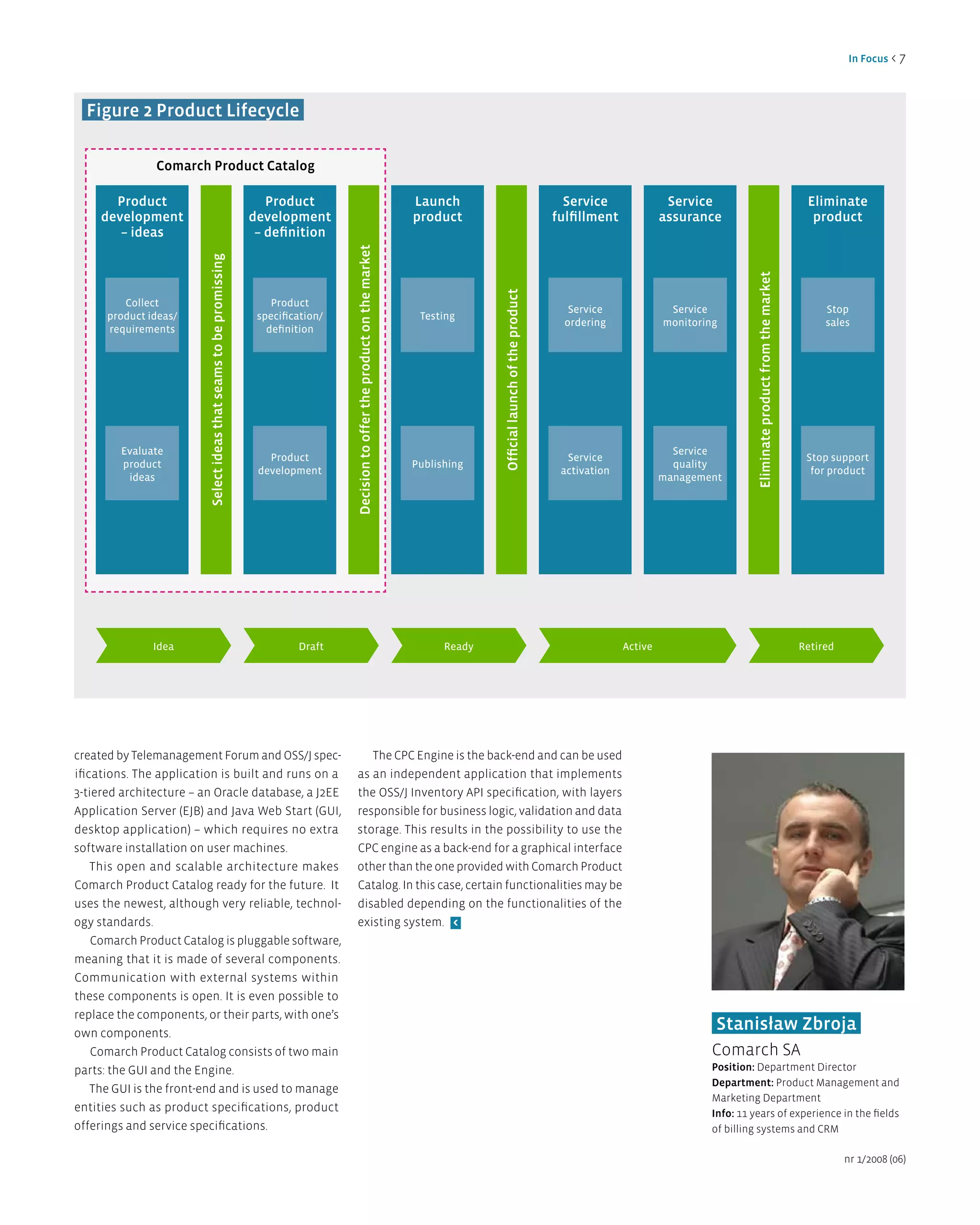
                                                           A typical product life cycle includes:                                        market. CPC actively supports the development
 ized API                                               > Product development                                                            phase of such lifecycles. CPC can help significantly
                                                        > Collect product ideas/requirements                                             shorten the product development phase.
                                                        > Evaluate product ideas
                                                        > Product specification/definition                                               architecture and industry
                                                        > Product development                                                            standards
                                                        > Product launch (begin offering it on the mar-                                  This solution is developed according to industry
                                                          ket)                                                                           standards such as Shared Information Data (SID)

technology review [www.comarch.com]
in Focus < 7


  Figure 2 Product lifecycle

               Comarch Product Catalog

       Product                                                         Product                                                      launch                                           Service               Service                                                eliminate
     development                                                    development                                                     product                                        fulfillment            assurance                                                product
        – ideas                                                      – definition


                                                                                      decision to offer the product on the market
                         Select ideas that seams to be promissing


                                                                                                                                                                                                                             eliminate product from the market
                                                                                                                                                  Official launch of the product
         Collect                                                        Product
                                                                                                                                                                                      Service              Service                                                    Stop
      product ideas/                                                 specification/                                                  Testing
                                                                                                                                                                                     ordering             monitoring                                                  sales
      requirements                                                     definition


        Evaluate                                                                                                                                                                                            Service
                                                                       Product                                                                                                       Service                                                                      Stop support
        product                                                                                                                     Publishing                                                              quality
                                                                     development                                                                                                    activation                                                                     for product
         ideas                                                                                                                                                                                            management


               Idea                                                          Draft                                                        Ready                                                  Active                                                          Retired


created by Telemanagement Forum and OSS/J spec-                                          The CPC Engine is the back-end and can be used
ifications. The application is built and runs on a                                    as an independent application that implements
3-tiered architecture – an Oracle database, a J2EE                                    the OSS/J Inventory API specification, with layers
Application Server (EJB) and Java Web Start (GUI,                                     responsible for business logic, validation and data
desktop application) – which requires no extra                                        storage. This results in the possibility to use the
software installation on user machines.                                               CPC engine as a back-end for a graphical interface
    This open and scalable architecture makes                                         other than the one provided with Comarch Product
Comarch Product Catalog ready for the future. It                                      Catalog. In this case, certain functionalities may be
uses the newest, although very reliable, technol-                                     disabled depending on the functionalities of the
ogy standards.                                                                        existing system. <
    Comarch Product Catalog is pluggable software,
meaning that it is made of several components.
Communication with external systems within
these components is open. It is even possible to
replace the components, or their parts, with one’s
own components.
                                                                                                                                                                                                                   Stanisław Zbroja
    Comarch Product Catalog consists of two main                                                                                                                                                                   Comarch SA
parts: the GUI and the Engine.                                                                                                                                                                                     Position: Department Director
                                                                                                                                                                                                                   department: Product Management and
    The GUI is the front-end and is used to manage
                                                                                                                                                                                                                   Marketing Department
entities such as product specifications, product                                                                                                                                                                   info: 11 years of experience in the fields
offerings and service specifications.                                                                                                                                                                              of billing systems and CRM

                                                                                                                                                                                                                                                                           nr 1/2008 (06)
8>   in Focus


Convergence
in Telecommunication
Billing System perspective


                                      Only about 20 years ago, the telecommunication
                                      world was clearly defined. During these days,
                                      an incumbent operator delivered a voice service
                                      based on a relatively simple technology dedicated
                                      for that purpose. A few years later,
                                      the introduction of mobile services brought about
                                      a major revolution.


technology review [www.comarch.com]
in Focus < 9


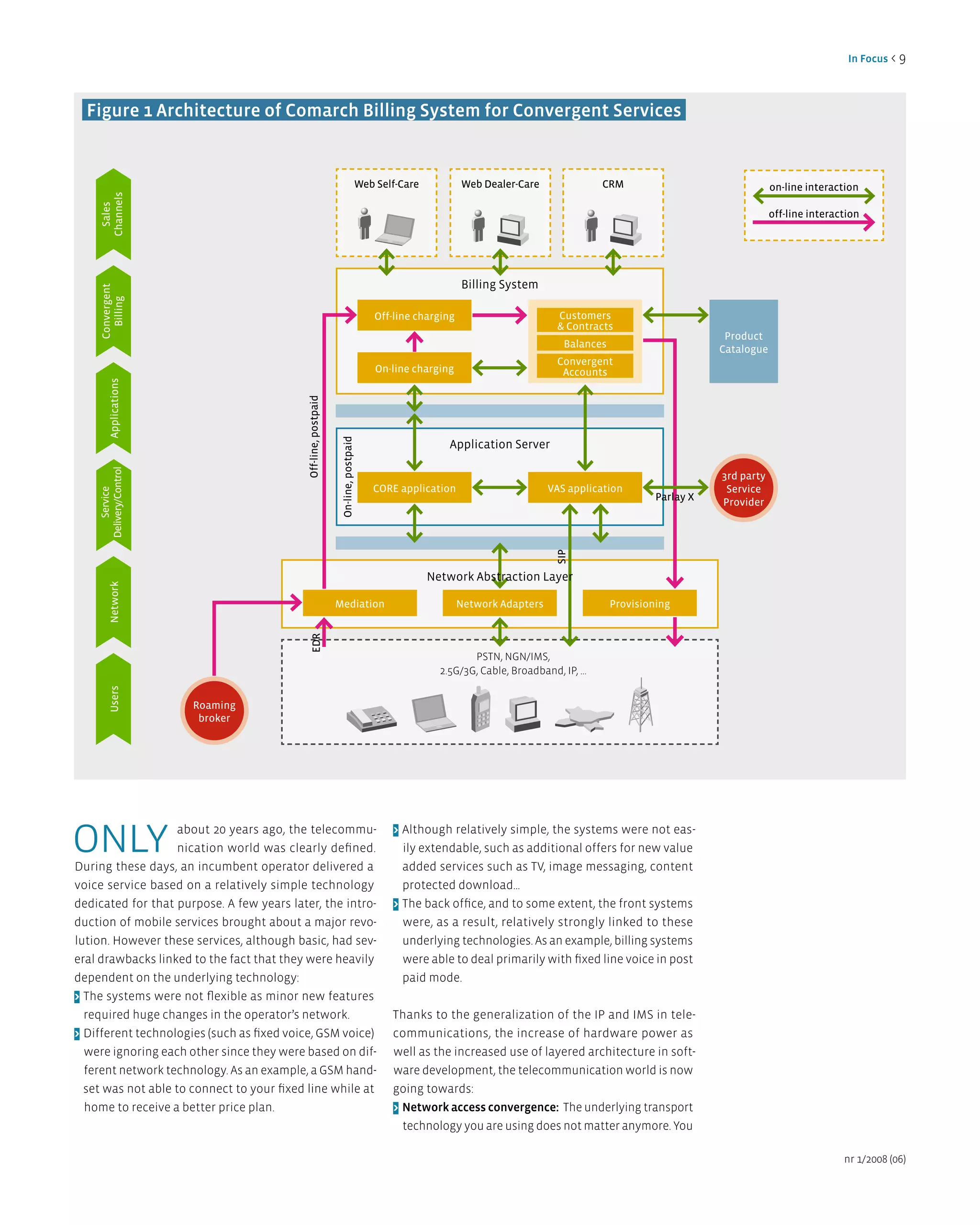
  Figure 1 architecture of Comarch Billing System for Convergent Services


                                                                                      Web Self-Care           Web Dealer-Care                CRM                               on-line interaction
    Channels
      Sales


                                                                                                                                                                               off-line interaction


                                                                                                              Billing System
    Convergent
      Billing


                                                                                          Off-line charging                        Customers
                                                                                                                                   & Contracts
                                                                                                                                                                    Product
                                                                                                                                    Balances                       Catalogue
                                                                                                                                   Convergent
                                                                                          On-line charging                          Accounts
          Applications


                                            Off-line, postpaid


                                                                  On-line, postpaid


                                                                                                          Application Server
    Delivery/Control


                                                                                                                                                                   3rd party
                                                                                         CORE application                        VAS application                    Service
         Service


                                                                                                                                                        Parlay X   Provider


                                                                                                                                  SIP
                                                                                                      Network Abstraction Layer
          Network


                                                                 Mediation                                    Network Adapters                 Provisioning
                                               EDR


                                                                                                               PSTN, NGN/IMS,
                                                                                                        2.5G/3G, Cable, Broadband, IP, ...
          Users


                         Roaming
                          broker


only                about 20 years ago, the telecommu-
                    nication world was clearly defined.
During these days, an incumbent operator delivered a
                                                                                             > Although relatively simple, the systems were not eas-
                                                                                               ily extendable, such as additional offers for new value
                                                                                               added services such as TV, image messaging, content
voice service based on a relatively simple technology                                          protected download…
dedicated for that purpose. A few years later, the intro-                                    > The back office, and to some extent, the front systems
duction of mobile services brought about a major revo-                                         were, as a result, relatively strongly linked to these
lution. However these services, although basic, had sev-                                       underlying technologies. As an example, billing systems
eral drawbacks linked to the fact that they were heavily                                       were able to deal primarily with fixed line voice in post
dependent on the underlying technology:                                                        paid mode.
> The systems were not flexible as minor new features
  required huge changes in the operator’s network.                                           Thanks to the generalization of the IP and IMS in tele-
> Different technologies (such as fixed voice, GSM voice)                                    communications, the increase of hardware power as
  were ignoring each other since they were based on dif-                                     well as the increased use of layered architecture in soft-
  ferent network technology. As an example, a GSM hand-                                      ware development, the telecommunication world is now
  set was not able to connect to your fixed line while at                                    going towards:
  home to receive a better price plan.                                                       > network access convergence: The underlying transport
                                                                                               technology you are using does not matter anymore. You

                                                                                                                                                                                               nr 1/2008 (06)
10 >   in Focus


  Figure 2 The evolution of Billing Systems


       Legacy Billing Solution Architecture                                                Next Generation Billing Solution Architecture


                                  Billing System                                                                                                   Billing System
                                                                                                                                                                                                Central
                                                                                                                                     Off-line charging                                        Reference
                                                    Customers
                                                                             3rd party                                                                                                           Data
                                                    & Contracts                                                                                                      Customers
                                                                              Service                                                                                                          (Product
                         Rating                                                                                                                                      & contracts               Catalog,
                                                     Product                 Provider
                                                                                                                                     On-line charging                                        Addresses, ...)
                                                    Catalogue


                                                                                            Off-line, postpaid
                                                                             3rd party
                                                                              Service
                                                                             Provider
                                                                                                                                                                                               3rd party
                                                                                                                                                                                                Service


                                                                                                                 On-line, postpaid
                  Mediation             Mediation                                                                                                Application Server
                                                                                                                                                                                               Provider
                                                                                                                                                 Missed
                                                                                                                                     Prepaid                   Prepaid
                                                                                                                                                   calls                       ...
                                                       Provisioning                                                                   voice                     GPRS
                                                      Provisioning
                                                      Provisioning                                                                              notification
          Mediation           Mediation                                        evolution                                                                                                 Parlay X


                                                                                                                                           Network Abstraction Layer
           PSTN                Mobile                  Broadband
                                                                                                                    Mediation                     Network Adapters            Provisioning

                      Cable                IP


                                                                                                                                                      PSTN, NGN/IMS,
                                                                                                                                               2.5G/3G, Cable, Broadband, IP, ...


                                                  can use the same handset for your mobile GSM/Wimax                                        increased convergence through better BSS and OSS prod-
                                                  or fixed line Wifi connection at home.                                                    ucts. This article aims at describing our approach.
                                                > new, innovative value added services. These value
                                                  added services are becoming so advanced that we are                                       The evolution of Billing Systems
                                                  now seeing a new form of convergence, industry con-                                       To achieve all modern telecommunication requirements
                                                  vergence through the merger of the telecommunica-                                         it was necessary to change service delivery architectures
                                                  tion, media and Internet industries into one.                                             as well as billing systems architectures. These changes
                                                > improved time to market as new services means modi-                                       cover many aspects like network unification, standards-
                                                  fying only a piece of software instead of upgrading a                                     based communication, a centralized product catalogue
                                                  full set of nationwide switches.                                                          and most importantly - real-time processing.
                                                > Front office and back office systems which are less and                                       Comarch Billing System for Convergent Services uses
                                                  less dependent on the underlying technology and more                                      modern multi-layered architecture and solves problems in
                                                  and more agile especially when it comes to configura-                                     many business layers of users and their terminals, access
                                                  tion updates or convergence management.                                                   networks, service delivery/control, services logic, conver-
                                                                                                                                            gent billing and sales channels.
                                                However, we at Comarch believe there is still room for
                                                improvement for increasing these trends and providing

technology review [www.comarch.com]
in Focus < 11


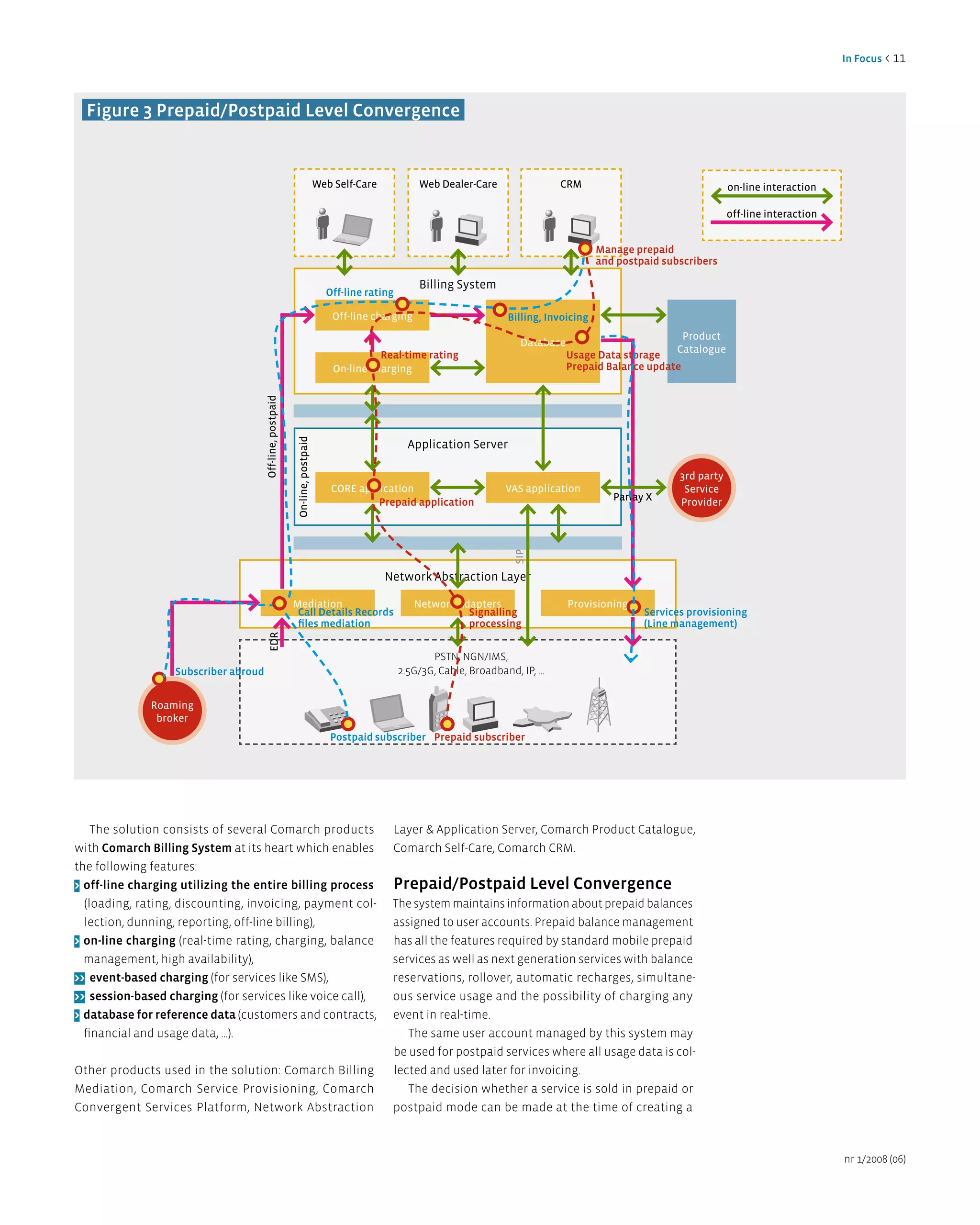
  Figure 3 Prepaid/Postpaid level Convergence


                                                                                 Web Self-Care           Web Dealer-Care                  CRM                                  on-line interaction

                                                                                                                                                                               off-line interaction


                                                                                                                                                   Manage prepaid
                                                                                                                                                   and postpaid subscribers

                                                                                                         Billing System
                                                                                   Off-line rating

                                                                                     Off-line charging                        Billing, invoicing
                                                                                                                                                                    Product
                                                                                                                                 Database
                                                                                                                                                                   Catalogue
                                                                                               Real-time rating                             Usage data storage
                                                                                     On-line charging                                       Prepaid Balance update
                                       Off-line, postpaid

                                                             On-line, postpaid


                                                                                                       Application Server

                                                                                                                                                                   3rd party
                                                                                    CORE application                         VAS application                        Service
                                                                                             Prepaid application                                      Parlay X     Provider
                                                                                                                               SIP


                                                                                                 Network Abstraction Layer

                                                            Mediation                                    Network Adapters                   Provisioning
                                                             Call details Records                                  Signalling                               Services provisioning
                                                             files mediation                                       processing                               (line management)
                                          EDR


                                                                                                            PSTN, NGN/IMS,
                   Subscriber abroud                                                                 2.5G/3G, Cable, Broadband, IP, ...


              Roaming
               broker
                                                                                    Postpaid subscriber Prepaid subscriber


    The solution consists of several Comarch products                                             Layer & Application Server, Comarch Product Catalogue,
with Comarch Billing System at its heart which enables                                            Comarch Self-Care, Comarch CRM.
the following features:
> off-line charging utilizing the entire billing process                                          Prepaid/Postpaid level Convergence
  (loading, rating, discounting, invoicing, payment col-                                          The system maintains information about prepaid balances
  lection, dunning, reporting, off-line billing),                                                 assigned to user accounts. Prepaid balance management
> on-line charging (real-time rating, charging, balance                                           has all the features required by standard mobile prepaid
  management, high availability),                                                                 services as well as next generation services with balance
>> event-based charging (for services like SMS),                                                  reservations, rollover, automatic recharges, simultane-
>> session-based charging (for services like voice call),                                         ous service usage and the possibility of charging any
> database for reference data (customers and contracts,                                           event in real-time.
  financial and usage data, …).                                                                      The same user account managed by this system may
                                                                                                  be used for postpaid services where all usage data is col-
Other products used in the solution: Comarch Billing                                              lected and used later for invoicing.
Mediation, Comarch Service Provisioning, Comarch                                                     The decision whether a service is sold in prepaid or
Convergent Services Platform, Network Abstraction                                                 postpaid mode can be made at the time of creating a


                                                                                                                                                                                                      nr 1/2008 (06)
12 >   in Focus


  Figure 4 Service level & Customer experience Convergence


                                                                   Web Self-Care          Web Dealer-Care               CRM                                     on-line interaction

                                                                                                                                                                off-line interaction


                                                                                                                                  Manage prepaid
                                                                                                                                  and postpaid subscribers

                                                                                          Billing System
                                                                    Off-line rating
                                                                                                                                                  Single bill
                                                                      Off-line charging                      Billing, invoicing

                                                                                                               Database
                                                                                 Real-time rating                         Usage data storage
                                                                       On-line charging                                   Prepaid Balance update
                          Off-line, postpaid

                                               On-line, postpaid


                                                                                      Application Server Payment gateway
                                                                                                               Content subscriptions            Parking payments

                                                                      CORE application
                                                                               Prepaid application
                                                                                                             VAS application
                                                                                                                                                                    P
                                                                                                              SIP


                                                                                   Network Abstraction Layer
                                                                                                             Signalling
                                               Mediation                                  Network Adapters              Provisioning
                                                                                                             processing
                             EDR


                                                                         PSTN, NGN/IMS, 2.5G/3G, Cable, Broadband, IP, ...

                                                                      Mobile voice service

                                                                   Video browsing service

                                                                    internet acces service


                                                                        sales offer. The same service may be offered many times              ity for offering multiple services and charging or billing
                                                                        in different models like prepaid, postpaid or postpaid               a user with a single invoice or by using a single prepaid
                                                                        with limits.                                                         account.
                                                                                                                                                The logic of each service is defined by an application
                                                                        Sales Channels                                                       deployed on the Application Server Layer. This layer con-
                                                                        Comarch Billing System for Convergent Services integrates            sists of two specialized Application Servers for core and
                                                                        applications for supporting multiple sales channels:                 value-added services.
                                                                        > Self-Care application for customer subscription & man-                A customer receives a single bill or uses a prepaid
                                                                          agement self service,                                              account for many mobile and non-mobile services such
                                                                        > Dealer-Care application for a dealer’s sales channel,              as voice, content, parking or ticket payments. The user
                                                                        > CRM system for Customer Relationship Management.                   may check his account status and services history in a
                                                                                                                                             single self-care application.
                                                                        Service level & Customer
                                                                        experience Convergence                                               Simultaneous multi-network
                                                                        Service level convergence allows carriers to rate and/or             mediation and provisioning
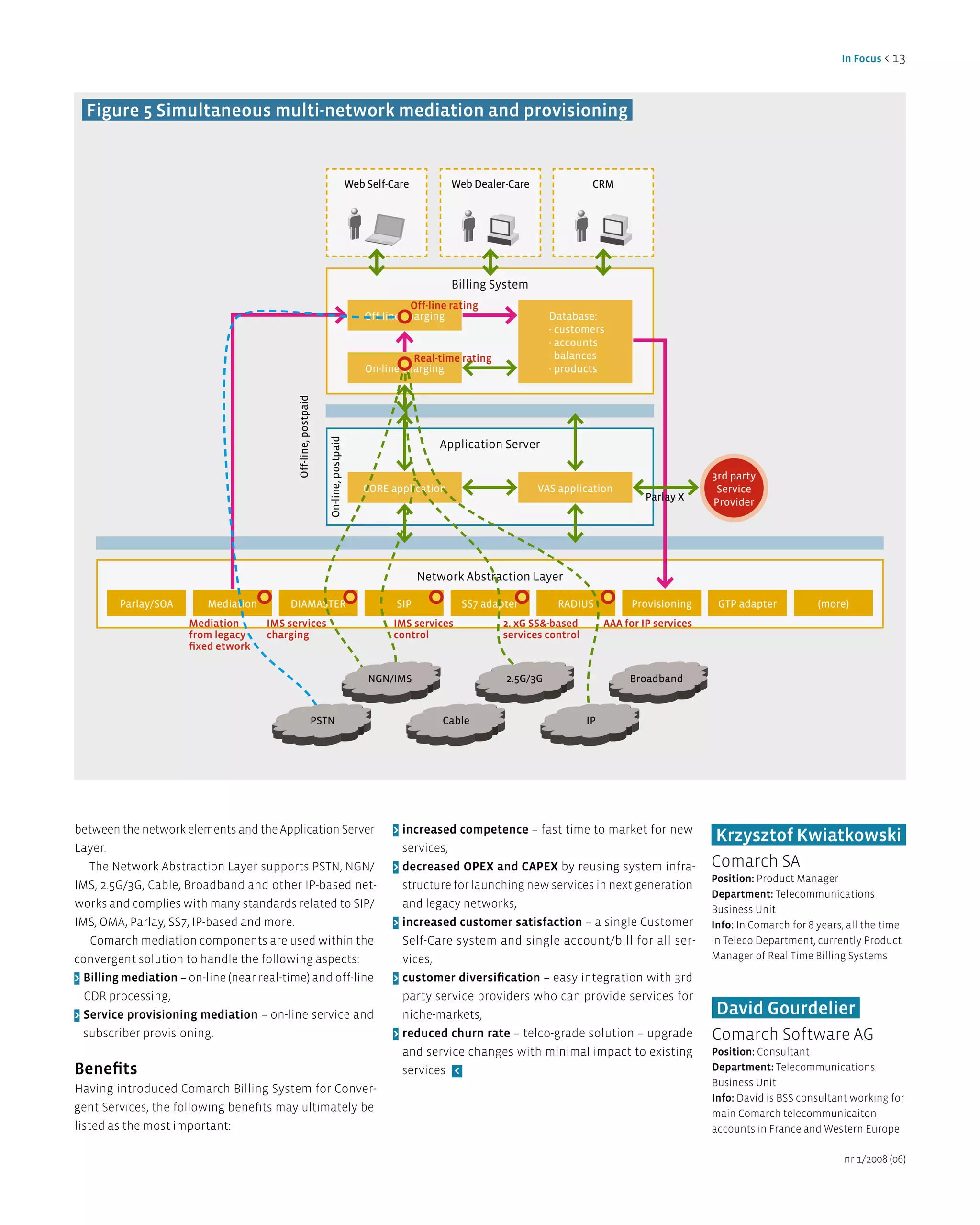
                                                                        bill any type of service in the same system with a sin-              The Network Abstraction Layer consists of a set of pro-
                                                                        gle point of management. It also enables the possibil-               tocol/network adapters which mediates in real-time

technology review [www.comarch.com]
in Focus < 13


  Figure 5 Simultaneous multi-network mediation and provisioning


                                                                                        Web Self-Care          Web Dealer-Care               CRM


                                                                                                               Billing System
                                                                                                      Off-line rating
                                                                                            Off-line charging                      Database:
                                                                                                                                   - customers
                                                                                                                                   - accounts
                                                                                                      Real-time rating             - balances
                                                                                            On-line charging                       - products
                                            Off-line, postpaid

                                                                    On-line, postpaid


                                                                                                            Application Server

                                                                                                                                                                       3rd party
                                                                                           CORE application                      VAS application                        Service
                                                                                                                                                         Parlay X      Provider


                                                                                                         Network Abstraction Layer

        Parlay/SOA        Mediation       DIAMASTER                                                SIP           SS7 adapter        RADIUS            Provisioning      GTP adapter           (more)
                      Mediation       iMS services                                                iMS services           2. xg SS&-based         aaa for iP services
                      from legacy     charging                                                    control                services control
                      fixed etwork


                                                                                            NGN/IMS                      2.5G/3G                      Broadband


                                                                 PSTN                                        Cable                          IP


between the network elements and the Application Server                                           > increased competence – fast time to market for new
                                                                                                                                                                       Krzysztof Kwiatkowski
Layer.                                                                                              services,
   The Network Abstraction Layer supports PSTN, NGN/                                              > decreased OPeX and CaPeX by reusing system infra-                  Comarch SA
                                                                                                                                                                       Position: Product Manager
IMS, 2.5G/3G, Cable, Broadband and other IP-based net-                                              structure for launching new services in next generation
                                                                                                                                                                       department: Telecommunications
works and complies with many standards related to SIP/                                              and legacy networks,                                               Business Unit
IMS, OMA, Parlay, SS7, IP-based and more.                                                         > increased customer satisfaction – a single Customer                info: In Comarch for 8 years, all the time
   Comarch mediation components are used within the                                                 Self-Care system and single account/bill for all ser-              in Teleco Department, currently Product
convergent solution to handle the following aspects:                                                vices,                                                             Manager of Real Time Billing Systems

> Billing mediation – on-line (near real-time) and off-line                                       > customer diversification – easy integration with 3rd
  CDR processing,                                                                                   party service providers who can provide services for
> Service provisioning mediation – on-line service and                                              niche-markets,                                                      david gourdelier
  subscriber provisioning.                                                                        > reduced churn rate – telco-grade solution – upgrade                Comarch Software AG
                                                                                                    and service changes with minimal impact to existing                Position: Consultant
Benefits                                                                                            services <                                                         department: Telecommunications
                                                                                                                                                                       Business Unit
Having introduced Comarch Billing System for Conver-
                                                                                                                                                                       info: David is BSS consultant working for
gent Services, the following benefits may ultimately be                                                                                                                main Comarch telecommunicaiton
listed as the most important:                                                                                                                                          accounts in France and Western Europe

                                                                                                                                                                                                    nr 1/2008 (06)
14 >   in Focus


On-premise CRM
a sinking ship or a flying fortress?


The CRM market has gone through its phases
of hype, disappointment and recovery.
Now a returning wave of interest based on
a more realistic approach to customers and ven-
dors offers reasonable alternatives to the big
CRM implementations that have historically been
expensive, troublesome and time-consuming. One
such interesting alternative is CRM on-demand.


technology review [www.comarch.com]
in Focus < 15


what                  is on-demand CRM? What are
                      the advantages and risks?
The do’s and don’ts? For a telecom operator, is on-
                                                       risk of failure. Eventually, even if a CRM system does
                                                       get successfully deployed, it is often used improp-
                                                       erly (if at all), not taking advantage of its strengths,
                                                                                                                  tional, often boiling down to a single misconcep-
                                                                                                                  tion, a misunderstanding of the CRM concept. The
                                                                                                                  CRM market had to fall.
demand worth considering?                              leading to results that are far from expected, espe-          But what can we say today? CRM is not dead -
                                                       cially in terms of return on investment.                   it may be bruised, but it’s back. Large-scale, long-
The rise and fall of CRM                                  These negative associations we may still have           term CRM initiatives are beginning to be approved
What comes to mind when you hear the acronym           of CRM aren’t coming out of nowhere. As of the end         again. Spending on open-source CRM is projected to
CRM? Is it: „a single view of a customer, driving      of 2002 Gartner, as well as several other analysts,        increase threefold, there is a comeback of in-house
customer satisfaction, enhancing the bottom line       informed us that 70% of all CRM projects fail. The         built CRM applications and vendors are transition-
by being better able to understand and fulfill cus-    top reasons for these failures include: lack of a          ing to new service-oriented architectures (source:
tomer needs”? These all sound promising. However,      strategic, enterprise wide approach with little or         Gartner 2006). Having learned their lesson, vendors
maybe you have other associations, ones more dif-      no board-level commitment, undefined success               as well as their clients are increasingly cautious
ficult to find in marketing brochures but more eas-    metrics, poor methodology and a focus on technol-          while attempting to reduce the risk associated
ily heard by listening to those actually involved in   ogy instead of customer and business processes.            with a CRM initiative by seeking new models and
CRM projects in recent years. They would say that      Clearly, most of the problems companies had with           approaches. On-demand CRM is one of the most
the hard reality is that CRM is a never-ending proj-   the implementation of CRM were not particularly            meaningful and influential new models.
ect, an initiative with a colossal budget and a high   technology-related. The problems were organiza-

                                                                                                                                                         nr 1/2008 (06)
16 > in Focus


                                                         Some like it hosted                                     is low, because the service provider takes it on and
  The future, or what the CRM                            The idea behind on-demand CRM (or in other words,       delivers guaranteed system availability and per-
  crystal ball told me:                                  hosted CRM) is simple: we don’t buy the software,       formance (usually providers agree to an SLA much
 “Dispersed CRM” – a single view of a customer, but      we buy the services – this is precisely the concept     more willingly than the internal IT departments of
 across multiple dispersed packages – a multi-sourc-
                                                         of Software-as-a-Service (SaaS) or Application Ser-     their customers). It is very easy to get users quickly
 ing and hybrid approach – on-demand solutions for
                                                         vice Providing - ASP (for various reasons ASP, like     up and running, a provider’s implementation pro-
 one or more service providers mixed with on-prem-
 ise installations.                                      CRM, also has negative connotations which is why        cesses are mostly uniform and are often repeated
                                                         the term SaaS tends to be used instead). We don’t       – deployment of a single department package takes
 Convergence of on-demand and on-premise - migra-        care about the technical details too much, the pro-     from 30 to 90 days. On demand CRM provides a lot
 tion between models will be possible (it is already
                                                         vider does. CRM software is available through the       of flexibility in upgrades – behind the scenes, devel-
 possible for some vendors), infrastructure will get
                                                         Internet and less often via a dedicated line. In on-    opers have on-line access to the system giving
 more and more robust and „invisible”, outsourc-
 ing will start to pay off not only on paper but also    demand CRM, multiple end-customers share the            them unprecedented possibilities for continuous
 in reality.                                             same hardware, databases and functionality with         software improvement. They can observe and track
                                                         various customization options (This is called the       usage patterns to optimize and automate the most
 Commoditization – The commoditization of CRM
                                                         multi-tenancy model. There is also a single-ten-        popular instances of use. When the amount of
 functional areas, such as sales force automation
                                                         ancy model, where each customer has his own             tasks, client base and data size grows, we don’t
 or customer service and support will be driven by
 on-demand vendors, the difference between their         database and server, but purists say that in such       need a complex process for explaining the need,
 offerings will be in their ability and willingness to   a case software cannot be considered as a service).     getting approval and purchasing additional hard-
 act globally, effectively customize software and        In this way, vendors achieve an economy of scale,       ware or technologies. We just let the provider know
 integrate with a customer’s systems. We will get
                                                         allowing them to set lower prices for services of       that we need additional users or functionality and
 cheaper, more rapidly implemented and more use-
                                                         guaranteed quality.                                     they assume the challenge and responsibility for
 ful CRM.
                                                             On-demand differs from traditional on-site or       which they receive a payment.
                                                         on-premise CRM when we purchase licenses and
 Knowing the negative connotations of the CRM            own the software (another possibility is when we        The third way
 term, and that it can be associated purely with a       own a home-grown application). Commonly, we             It seems on-demand CRM allows you to focus on
 technology investment, other terms begin to be          have to take care of all the technical details, main-   your customers and not on the technology while
 used instead:
                                                         tain the software and infrastructure, keep dedi-        relieving you from the risk and overhead of an on-
 > Customer Management,
                                                         cated IT personnel and train them so they don’t         premise approach. But is on-demand really this
 > Customer Centricity
 > Relationship Management,                              get behind. No two clients of a CRM vendor have         attractive? What’s the catch? As always, the devil
 > Relationship Marketing                                the same on-premise system. Usually only 30-50%         is in the details - what constitutes an advantage
 > Customer Experience Management                        of the enterprise CRM software is standard, the         can also pose a threat. Short deployment time is
 > Customer Service Excellence
                                                         rest represents customer specific functionality,        only a promise, getting the system to work could
 > Single view of a customer,
                                                         customization and integration. This is probably         take longer than expected because of problem-
 > Sales productivity growth
 > ...                                                   why it always takes so long to deploy an on-prem-       atic customization. Possibilities offered by the API
 However, behind all these different names there’s       ise CRM system – because 50% must be built from         are usually limited and once we want something
 a common concept of a business strategy whose           scratch! On-demand differs from on-premise in           more, we fall into the trap of an on-premise model
 outcomes optimize profitability, revenue and cus-
                                                         that it aims to make you switch-off the function-       – the vendor sends a team to work through a solu-
 tomer satisfaction by organizing around customer
                                                         ality you don’t need rather than build-up the func-     tion, extending the implementation time tremen-
 segments, promoting customer-satisfying behav-
 iors and implementing customer-centric processes        tionality you do (in the on-premise model). Which       dously. Moreover, upgrades can be tricky – and tend
 (source: Gartner).                                      approach sounds easier?                                 to break existing customization and integration,
                                                             Steve Ballmer, Microsoft CEO, recently said „peo-   which leads to abandoning valuable new function-
                                                         ple want hosted CRM”. Although some analysts see        ality. Some institutions may be wary of being over-
                                                         the future of on-demand CRM as not that bright          dependent on the service provider. They have all
                                                         (AMR Research predicts that even by 2009, hosted        the data which sometimes can be sensitive (banks,
                                                         CRM applications will account for only 12% of the       health care), difficult to protect from unauthor-
                                                         total U.S. CRM market) there definitely is something    ized access when out of your control and difficult
                                                         to it. Why do people want hosted CRM? Because it        to get back from the vendor should relations go
                                                         is low risk, low cost and high ROI. There is no enor-   south. Other organizations may feel like opting
                                                         mous up front investment and only a low monthly         for on-demand results in losing their competitive
                                                         rental fee with minimal or no service fees. The risk    advantage – everyone has the same software, so

technology review [www.comarch.com]
in Focus < 17


where’s the difference? However, the greatest prob-        able to react to changes in the market, have enor-       on-premise doomed? Definitely not. However on-
lem with on-demand CRM is the time scale. Surely,          mous IT costs and are unable to fully meet internal      demand is a warning sign to license vendors to get
we can achieve the lowest initial cost, the lowest         user and customer expectations.                          more realistic about CRM deployment costs and
risk, but all in the short term. In a three-year period,      On-demand is the perfect choice for small and         times. On-premise will continue to be the most
the cost can be the same for on-demand and on-             mid-sized companies able to function with stand-         popular type of deployment for large companies,
premise, yet in the on-demand model the organi-            ard processes and data structures, with no real-         with on-demand increasingly being chosen by less
zation doesn’t own the system, it can’t be custom-         time or complex integration requirements, no inter-      conservative telecoms as well as small and mid-
ized to grow along with the needs of the business.         nal IT support, yet who want a rapidly deployed          sized companies, including MVNOs. <
All in all, we might end up with our hands tied and        solution. On-demand is therefore a very interest-
a miserable ROI.                                           ing option to consider for MVNOs and start-ups.
    A mixed approach is the best method to avoid,          But what about larger telecom operators? Their
or at least compensate for most of the risks related       primary business imperative is growth signified by
to implementing CRM in either of the models: on-           partnership, innovation, cost control, risk manage-
premise and on-demand. There are at least three            ment and availability of talents. On-demand is defi-
blends of mixed approaches: the hybrid, “first             nitely a chance for cost control, risk compensation
host, then buy” and “first buy, then host”. Under          (or at least diversification) and an increased avail-
the hybrid model, companies could use hosted               ability of talent (as top talents continue to gather
CRM at one site, such as a small division, or a dis-       around global leaders). On-demand CRM might
tant office, while keeping the rest of the company         also be seen as a chance for innovation (when the
on an enterprise, on-premise CRM application. It is        vendor is offering outstanding and future-oriented
currently possible with Siebel, RightNow and SAP           solutions, which other vendors have yet to adopt)
solutions. The hybrid model can be applied not only        and partnership (this may be wishful thinking, but
to geographical locations, but to functional areas         major hosted CRM providers are struggling hard to
of CRM since many vendors offer specialized soft-          enter the lucrative telecommunications market and
ware packages. A company could use the hosted              have a real interest in building long-lasting, profit-
solution for sales automation or customer service          able partnerships). Having said that, it is still too
& support, and an on-premise application for the           early, and there is probably a good reason that most
rest. The best candidate for on-demand CRM is the          telecoms stay away from on-demand CRM. Nor-
area where requirements are changing least often,          mally, for telecom operators, customer relationship
where processes are rather stable and mature and           management is an area of strategic importance,
there is no need for a high degree of non-standard         and experiments aren’t welcome. Nevertheless,
customization or integration. In the “first host,          on-demand starts to be a relevant option. Gartner
then buy” approach, we initially buy on-demand             predicts that by 2007, 30 percent of new sales force
CRM services from a provider and if all goes well,         automation (SFA) production applications will be
we purchase the software and begin to manage               deployed as a service. So for most telecoms, maybe
it ourselves. This way, we benefit from the “low           the first shot at on-demand will be for SFA as it is
cost, low risk, high ROI” advantages during the first      perceived to be an easy, inexpensive and safe way
two or three years and afterwards, take over the           to try out an on-demand CRM deployment.
entire thing and benefit from the “greatest power,
flexibility, easier integration and customizability”.      Summary
The third approach is “first buy, then host”. This is      After a phase of disappointment, CRM is com-
when the on-premise solution, purchased or home-           ing back, perhaps under different names. The on-
grown software is outsourced together with the             demand model is becoming more and more popular
infrastructure. Although the system is a managed           with functionality beginning to reflect the most-
service rather than becoming on-demand, the same           wanted, tried-and-true features. At the same time,
                                                                                                                                  Paweł lamik
combined positive effects occur: cost reduction,           companies are ready to opt for a compromise and                       Comarch SA
increased quality of services, increased business          require merely the necessary integration and cus-                     Position: Business Solutions Manager
                                                                                                                                 department: Telecommunications
agility and less focus on technology and more focus        tomization. So, without a doubt, on-demand is here
                                                                                                                                 Business Unit
on the customers. These benefits will be particu-          to stay and represents a viable alternative to cum-                   info: Main fields of expertise: CRM
larly visible for large companies that are no longer       bersome and expensive licensed CRM projects. Is                       systems, BI and outsourcing

                                                                                                                                                           nr 1/2008 (06)
18 > in Focus


Why CRM
does not deliver*
* – sometimes


Surprisingly, telco operators
continue to perform miser-
                                      most                 telco operators pursue the
                                                           same strategic goals: increase
                                      revenue and retain customers. However, when
                                                                                             right then, the new tariff will be active as of next
                                                                                             month, thank you and have a nice day.”
                                                                                                What’s wrong with this? Well in short, the ques-
ably when it comes to: selling        a customer completely resigns from services or         tion “why?” was never asked. I had no reason to
a product to a customer who           considerably reduces their service usage, there        hide that I’ve made a decision to go for VoIP tele-
                                      is a negative impact on these. If there are more       phony services from a British provider and to keep
wants it badly, retaining a valu-     of such customers, the reduction in revenue and        the existing fixed-line from Operator A only in order
able customer who does not            the high costs for acquiring new customers to          to keep the existing number and to have a back-up
think about churning away, and        replace the ones who left becomes increasingly         line. Why should the operator need such informa-
                                      painful. Customers need to be well taken care of       tion? Firstly, this operator offers VoIP services, so
acquiring a new customer who          and sales needs to be well taken care of. It may       by having this information from me, they could
falls “straight into their hands”.    seem these conclusions are too obvious to even         try to cross-sell thereby saving revenue in the
The reason is operators’ inabil-      write about. Yet, I only wonder, how my own ex-        long term. Secondly, it can provide data for anal-
                                      perience as a former, as well as a potential, cus-     ysis (i.e. to analyze the scale of the phenomenon,
ity to gather information and         tomer of three different major Polish telecommu-       to develop the offer, to track market trends). The
properly leverage it, with the        nications providers proves these conclusions as        current assumption that Operator A has made is
use of CRM class systems.             merely theoretical.                                    that I have made a tariff downgrade and that I will
                                                                                             probably pay more if my usage remains the same
                                      Operator a – Partial revenue loss                      (however it won’t – this usage has left for good
                                      For over a dozen years, I’ve had a fixed line phone    to another operator). It is possible they think I’ve
                                      from this operator. Recently, I phoned the call-cen-   downgraded because I’m leaving the country for
                                      ter and asked for a tariff downgrade to the least      a long period of time.
                                      expensive possible level (ca. 50% less than the
                                      one I had). “This is certainly possible. Please note   Operator B – loss of a customer
                                      however, a charge for one minute is higher in the      (and revenue)
                                      cheaper tariff and there are no additional services    Until recently, I had cable television at home from
                                      which decrease the cost of calls (i.e. free minutes    one of the biggest cable TV providers. The origi-
                                      pack)”, the consultant warned me, “Looking at the      nal subscriber was my sister. However, after she
                                      calls you have made in the recent months, I sus-       moved out, I wanted to transfer the contract into
                                      pect that you will pay much higher bills, are you      my name. I phoned the call-center, provided my
                                      sure you want to downgrade? – Yes I am sure. – All     details – name, address – and told them about
                                                                                             the situation. I was told that what I wanted to do

technology review [www.comarch.com]
in Focus < 19


was certainly possible (they always say that), but     gather information, make use of
that I needed to pay a cession fee – equivalent to     knowledge                                                   Comarch CRM for Telecoms
about a one month subscription fee. For over 10        The operators described have one thing in com-             It is a comprehensive customer relationship man-
years, I have been regularly paying monthly bills      mon – they use customer service and CRM sys-               agement solution for operators and MVNOs. With
                                                                                                                  BI-enabled modules for Marketing, Sales, and Cus-
for one of the highest tariff variants. I declined to  tems, including the best in the world (operator A).
                                                                                                                  tomer Service our product helps increase revenue
make the cession and asked my sister to terminate      Did these systems fulfill their role well enough?          from new and existing customers, and improve re-
the contract. However, I was accustomed to this        To some extent, yes, they facilitated common               tention. The built-in Business Intelligence provides
operator and I already had the cable installed. Per- operations – registering subscriptions, answer-              contextual hints and drill-in dashboards, supporting
haps a little naively, I decided to register as a new  ing inquiries about prices, changing tariffs, termi-       timely and knowledge-driven decisions. Unlike the
                                                                                                                  one-size-fits-all solutions from traditional vendors,
customer, thinking they would treat a prospec- nating subscriptions. However, the systems neither
                                                                                                                  our lean and flexible solution was designed to fit an
tive customer better. Alas however, it turned out      helped retain a customer nor ensured sustained             operator’s existing data models and help express
there was an “installation” fee, also equivalent to    (or increased) revenue. Furthermore, they did not          their own differentiating processes with a built-in
about a one month’s subscription fee. “But listen, I   even gather information necessary to understand            workflow engine.
already have everything installed, there will be no “why”. In the examples reported, advanced or costly
installation, the cable is there, it is plugged in and techniques (loyalty programs, direct marketing, etc)
it was working only yesterday. Turning the signal      were not required to keep or acquire a customer.             Today, BPM and BI are increasingly popular con-
on for the cable doesn’t really cost that much does    For instance, what would be an appropriate reac-          cepts aimed at developing the capability of CRM to
it? – Yes, unfortunately we have such procedures.        tion in the case of operator A, to a customer will-     deliver the intended results: revenue growth and
There is always an installation fee.”                    ing to downgrade his tariff? Maybe the system’s         customer retention. This direction looks promis-
    By requiring these small, annoying fees, this        suggestion of “ask why”, with some area for input-      ing – in the fight for customers, a successful oper-
operator decidedly lost an entire stream of future       ting the customer’s answer. Additionally, further       ator’s CRM system will manage centralized and
revenue, which had been consistently flowing from        suggestions aimed at addressing the needs the           integrated customer data and turn it into knowl-
my address for years.                                    customer expressed while answering the “why”            edge with Business Intelligence while providing
                                                         question could be made. For operator B, the system      leverage by injecting it into business processes: in
Operator C – loss of a potential                         should have suggested overriding or reducing the        a BPM-driven process, appropriate data is gathered,
customer (and potential revenue)                         cession fee required from a good customer (based        which BI uses to deliver relevant, real time sugges-
However, it is difficult to live without television.     on a differentiated fee policy for each segment, i.e.   tions for “what to do”. This should help eliminate
I decided to buy services from a leading satellite       based on a customer’s lifetime value calculation).      the situations described in this article, making both
television operator. They offer the channels I’m         In the case of operator C, most likely the call-cen-    the customers and the operators happier. <
interested in and at a reasonable price. I phoned        ter employees were not sales oriented, however
their call-center to learn more about their offer        the system could have suggested “take his phone
and the details pertaining to the installation. I told   number, a mobile if possible”. As far as the flow of
them I was interested in quickly closing the deal,       leads from the web-site to the sales department
however the consultant didn’t ask for my phone           is concerned – automated detection and alarms
number or service details. They could have trans-        for overdue contacts, and better control of han-
ferred my data to a local partner who would possi-       dling leads from the sales department would be
bly take better care of a potential customer. Instead,   a possible solution.
I was merely instructed to look for the closest local
partner on their web page. I opened the web page         Summary
and found the contact form. I selected the “I am         Operators do what they can to secure themselves
interested in signing a deal” option and entered         from revenue and customer leakages, but they still
my data: e-mail, mobile phone and exactly what I         make simple errors. “Let’s manage our customers,
needed. I even received a confirmation e-mail stat-      so they wouldn’t want to leave us and would want
ing that within 48 hours somebody would contact          to buy more from us – let’s buy a CRM system” this
me (by the way, why not within 1 hour?). What hap-       is an idea most of them already brought to life
pened then? Nothing. There has been no contact           long ago. The idea that a CRM system alone is not
so far, and that was 16 days ago. Well, I guess I will   enough to manage customer relationships well,
try my luck with their competitors.                      we have known for a couple of years. CRM systems
   Obviously, this operator is not very interested       tend not to deliver on this promise. Why? There are
                                                                                                                                Paweł lamik
in acquiring new customers, the call-center is only      many different reasons. One of the main reasons                       Comarch SA
a cost center (not generating revenue) for this oper-    is that customer data is not integrated in a single                   Position: Business Solutions Manager
                                                                                                                               department: Telecommunications
ator, and when it comes to the web form that was         location and managed consistently, and even if
                                                                                                                               Business Unit
intended to generate leads, it only serves to gener-     it is somehow, it is not always turned into useful                    info: Main fields of expertise: CRM
ate the frustration of potential customers.              knowledge in day to day operations.                                   systems, BI and outsourcing

                                                                                                                                                           nr 1/2008 (06)
20 > Solutions & Case Studies


Comarch OSS Suite 4
next generation OSS systems are just around the corner


OSS systems have never been as important as
they are today. Their importance will grow even
further with the rising popularity of Next Genera-
tion Networks. Nowadays, operators can not even
think about delivering services without strong
help from supporting systems. There is no such
army of people who can plan, provision, deliver
and bill these new services in a matter of seconds.


technology review [www.comarch.com]
Solutions & Case Studies < 21


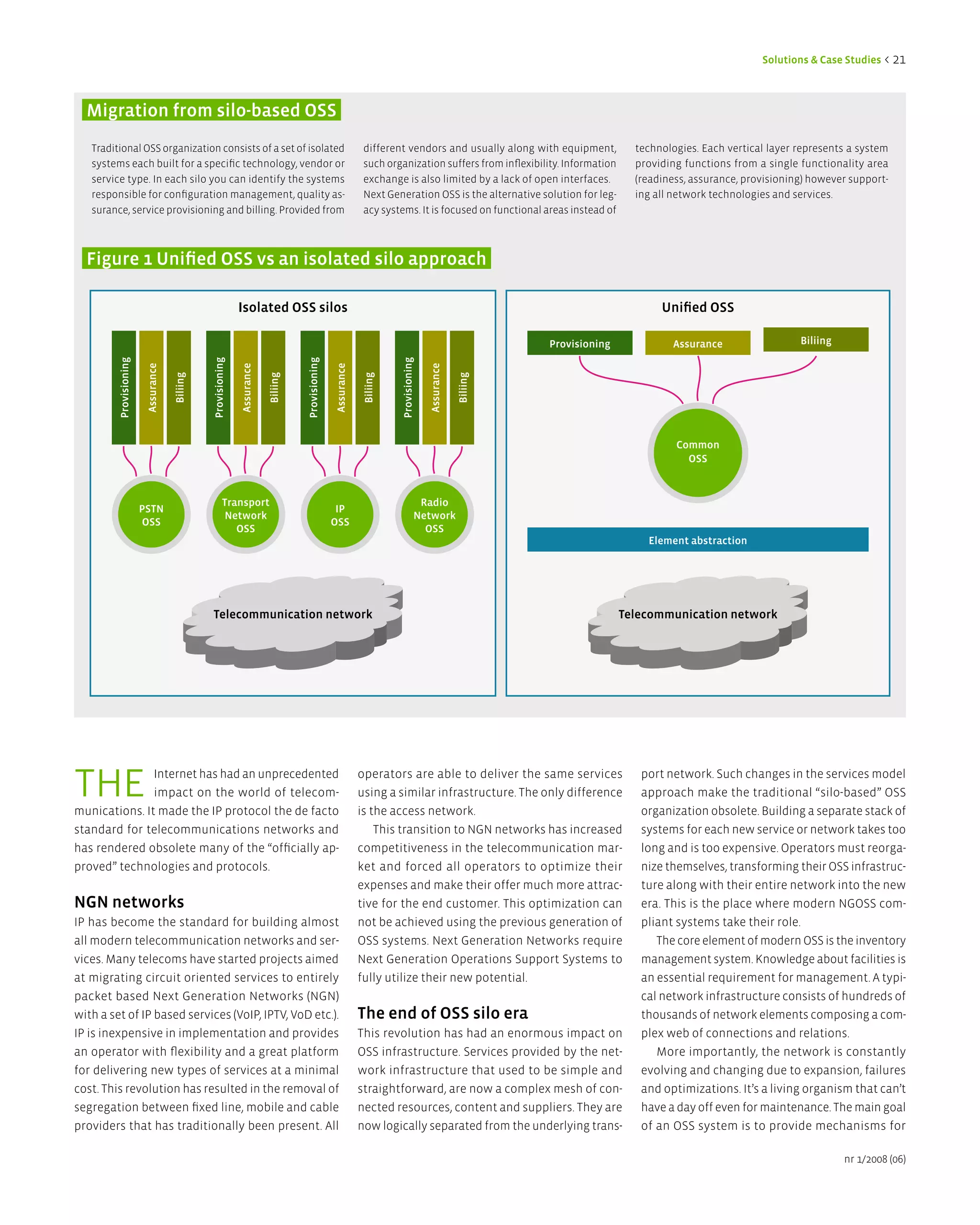
  Migration from silo-based OSS
   Traditional OSS organization consists of a set of isolated                                                   different vendors and usually along with equipment,             technologies. Each vertical layer represents a system
   systems each built for a specific technology, vendor or                                                      such organization suffers from inflexibility. Information       providing functions from a single functionality area
   service type. In each silo you can identify the systems                                                      exchange is also limited by a lack of open interfaces.          (readiness, assurance, provisioning) however support-
   responsible for configuration management, quality as-                                                        Next Generation OSS is the alternative solution for leg-        ing all network technologies and services.
   surance, service provisioning and billing. Provided from                                                     acy systems. It is focused on functional areas instead of


  Figure 1 Unified OSS vs an isolated silo approach

                                                              isolated OSS silos                                                                                                     Unified OSS

                                                                                                                                                               Provisioning            assurance                  Biliing
         Provisioning


                                               Provisioning


                                                                                    Provisioning


                                                                                                                          Provisioning
                         assurance


                                                              assurance


                                                                                                   assurance


                                                                                                                                         assurance
                                     Biliing


                                                                          Biliing


                                                                                                                Biliing


                                                                                                                                                     Biliing
                                                                                                                                                                                        Common
                                                                                                                                                                                          OSS


                                                       Transport                                                                      Radio
                        PSTn                                                                        iP
                                                       network                                                                       network
                        OSS                                                                        OSS
                                                          OSS                                                                          OSS
                                                                                                                                                                                  element abstraction


                                               Telecommunication network                                                                                                      Telecommunication network


the            Internet has had an unprecedented
               impact on the world of telecom-
munications. It made the IP protocol the de facto
                                                                                                               operators are able to deliver the same services
                                                                                                               using a similar infrastructure. The only difference
                                                                                                               is the access network.
                                                                                                                                                                                 port network. Such changes in the services model
                                                                                                                                                                                 approach make the traditional “silo-based” OSS
                                                                                                                                                                                 organization obsolete. Building a separate stack of
standard for telecommunications networks and                                                                       This transition to NGN networks has increased                 systems for each new service or network takes too
has rendered obsolete many of the “officially ap-                                                              competitiveness in the telecommunication mar-                     long and is too expensive. Operators must reorga-
proved” technologies and protocols.                                                                            ket and forced all operators to optimize their                    nize themselves, transforming their OSS infrastruc-
                                                                                                               expenses and make their offer much more attrac-                   ture along with their entire network into the new
ngn networks                                                                                                   tive for the end customer. This optimization can                  era. This is the place where modern NGOSS com-
IP has become the standard for building almost                                                                 not be achieved using the previous generation of                  pliant systems take their role.
all modern telecommunication networks and ser-                                                                 OSS systems. Next Generation Networks require                        The core element of modern OSS is the inventory
vices. Many telecoms have started projects aimed                                                               Next Generation Operations Support Systems to                     management system. Knowledge about facilities is
at migrating circuit oriented services to entirely                                                             fully utilize their new potential.                                an essential requirement for management. A typi-
packet based Next Generation Networks (NGN)                                                                                                                                      cal network infrastructure consists of hundreds of
with a set of IP based services (VoIP, IPTV, VoD etc.).                                                        The end of OSS silo era                                           thousands of network elements composing a com-
IP is inexpensive in implementation and provides                                                               This revolution has had an enormous impact on                     plex web of connections and relations.
an operator with flexibility and a great platform                                                              OSS infrastructure. Services provided by the net-                    More importantly, the network is constantly
for delivering new types of services at a minimal                                                              work infrastructure that used to be simple and                    evolving and changing due to expansion, failures
cost. This revolution has resulted in the removal of                                                           straightforward, are now a complex mesh of con-                   and optimizations. It’s a living organism that can’t
segregation between fixed line, mobile and cable                                                               nected resources, content and suppliers. They are                 have a day off even for maintenance. The main goal
providers that has traditionally been present. All                                                             now logically separated from the underlying trans-                of an OSS system is to provide mechanisms for

                                                                                                                                                                                                                            nr 1/2008 (06)
22 > Solutions & Case Studies


  Figure 2 Comarch OSS Suite

                                                                          Comarch OSS Suite


                                Operations Support                             Fulfillment                                  assurance
                                   & Readiness

                                                                Comarch OSS Process Management
       enterprise Service Bus


                                              Comarch inventory Management                                              Service assurance


                                                 Comarch Service Inventory                                          Service Level Management

                                                Comarch Network Inventory                                               Fault Management

                                   Auto-discovery &                           Provisioning                            Network Performance
                                    Reconciliation                                                                       Management


                                                                             OSS Mediation


managing this organism, providing functionalities     operators with functionalities necessary for the       of changes made to the device. This seamless inte-
which allow operators design services, delivering     optimal management of their network and ser-           gration greatly improves the efficiency of the OSS
them to the customers and assuring their qual-        vices. Comarch OSS Suite 3 was an inventory ori-       system. In most cases, operators do not need to use
ity. Additionally, OSS systems help maintain the      ented system - the fourth version of the Comarch       several systems to get all the required information
network, optimizing connections and exchanging        OSS Suite focuses on processes.                        or execute a crucial management task. Everything
information between external networks or sup-            Comarch OSS Suite 4 is aimed at helping oper-       can be controlled from one application. For inven-
pliers. All of these tasks are performed according    ators with the execution of management pro-            tory management, Comarch OSS Process Manage-
to well defined processes or procedures. Unfortu-     cesses from the Readiness, Fulfillment and Assur-      ment can use Comarch Inventory Management
nately, each operator has their own specific char-    ance areas in the services and resources layers        or third party inventory systems with standard
acteristics and organization. Lack of standard OSS    (see figure 2). The main element of the new suite is   based interfaces.
processes and procedures makes the implementa-        Comarch OSS Process Management, the business
tion of any business process management system        process management class system. As opposed to         Comarch OSS Process
a complex and expensive task.                         generic BPM systems, Comarch OSS Process Man-          Management
    The standardized approach for defining all man-   agement has been designed especially for manag-        Comarch OSS Process Management includes the
agement processes to be carried out by Telco oper-    ing the processes of Telco operators. It includes      implementation of the following processes:
ators have been proposed by TeleManagement            predefined processes and task definitions to drasti-   > incident and problem management,
Forum in the Enhanced Telecom Operations Map          cally reduce system deployment time. The strength      > change management,
(eTOM). Thanks to eTOM, all interested parties can    of Comarch OSS Process Management relies on            > configuration,
communicate in the same language. TM Forum’s          tight integration with the Inventory Management        > service activation,
eTOM describes management processes by divid-         System. All operations on inventory are controlled     > planning and building.
ing them into a number of areas in the four layers    by predefined processes. For example, the system
(customers, services, resources, suppliers) and at    can check which resources are used by given ser-       Furthermore, the above processes are extended by
several levels of details.                            vices and execute the proper sub-processes in order    several supporting processes such as information,
                                                      to provision the new service. During resource prob-    notices and approvals which greatly improve the
Comarch OSS Suite 4                                   lem resolution, the system operator can see if a       efficiency of the system.
Comarch OSS Suite 4 is a Next Generation OSS Sys-     given resource is affected, what the parameters           The second essential element Comarch OSS Pro-
tem. It is focused on NG networks and provides        of the device are as well as view the entire history   cess Management provides to Telco operators is

technology review [www.comarch.com]
Solutions & Case Studies < 23


  Figure 3 Comarch OSS Process Management on the TM-Forum eTOM

                                                                                Customer

                  Strategy, infrastructure & Product                                                            Operations

              Strategy &       Infrastructure        Product                           Operations      Fulfillment           Assurance                Billing
               Commit             Lifecycle         Lifecycle                          Support &
                                Management          Managent                           Readiness

                                                                                                                                    Customer Relationship
               Marketing & Offer Management                                                                                                 Management

               Service Development &                                                                                                           Service
               Management                                                                                                      Management & Operations
                                                                              Comarch OSS
                                                                          Process Management
               Resource Development &                                                                                                        Resource
               Management                                                                                                      Management & Operations

               Supply Chain Development &                                                                                  Supplier/Partner Relationship
               Management                                                                                                                  Management


      Strategy, infrastructure & Product                                        Financial & Asset        Stakeholder & External           Human Resources
                                                                                Management               Relations Management             Management


                                                 Strategic & Enterprise         Enterprise Risk          Enterprise Effectiveness         Knowledge & Research
                                                 Planning                       Management               Management                       Management


the automation of management tasks. In large               Comarch OSS Process Management is the first
scale networks where provisioning, supervising          application to be released in the fourth version of
and other kinds of processes are executed thou-         Comarch OSS Suite. The latest version brings a new
sands of times daily, manual operations must be         system architecture based on SOA principles and
reduced and even completely eliminated. Automa-         open interfaces. In comparison to the previous ver-
tion allows operators to reduce time-to-market for      sion of Process Management, there is a complete
new services and enables the on-line provisioning       change of technology both in the engine and the
and real-time assurance of offered services. Sys-       GUI. OSS Process Management version 4 will be
tem operators only have to focus on uncommon            available in the fourth quarter of 2007. Initially it
actions, solving unusual problems and performing        will work with Comarch OSS Suite 3 products (e.g.
other non-typical tasks. All other defined processes    Inventory Management). Other components of
and procedures are automated.                           Comarch OSS Suite will be successively migrated to                          Jakub Załuski-Kapusta
   Comarch OSS Process Management provides              the new architecture in the following year. <
                                                                                                                                    Comarch SA
several mechanisms and tools which enables pro-                                                                                     Position: Product Manager OSS
cesses automation at different levels. Each typical,                                                                                department: Telecommunications
common task can be defined on the highest level                                                                                     Business Unit
as an automatic process. By using business rules,                                                                                   info: Currently responsible for sales
                                                                                                                                    support of Comarch OSS systems
such processes can be customized or adopted.
Finally, Comarch OSS Process Management pro-
vides a scripting mechanism to define actions
                                                                                                                                    damian dygoń
even at the atomic level and use them in high level
processes as automatic tasks. Originating from                                                                                      Comarch SA
                                                                                                                                    Position: Product Manager OSS
Comarch OSS Process Management, these three
                                                                                                                                    department: Telecommunications
functionalities combine together to create a very                                                                                   Business Unit
sophisticated and powerful tool for OSS process                                                                                     info: Since 2003 he is a Product Manager
automation.                                                                                                                         for Comarch OSS Suite, responsible
                                                                                                                                    particularly for QoS issues


                                                                                                                                                                 nr 1/2008 (06)
24 > Solutions & Case Studies


Comarch Fault
Management in PTC

                                      Is your network expanding really quickly?
                                      Are the competitors just waiting for your
                                      bad move? Do the network outages cost
                                      you Millions? In that case it is high time to
                                      think about a unified Fault Management
                                      system tailored precisely to your needs!


technology review [www.comarch.com]
Solutions & Case Studies < 25


Catalysts for change                                      changing requirements, as well as fast implemen-
The implementation of Comarch Fault Manage-               tation of requested additions to the system.             Service Management Unit Manager at Technology
ment in Polska Telefonia Cyfrowa had solid busi-                                                                   Operations Support department
                                                                                                                   Polska Telefonia Cyfrowa (PTC)
ness and technological justification. Over the past       The solution                                             At PTC we needed a sophisticated and open Umbrel-
several years we have been witnessing a series            The Comarch Fault Management module moni-                la Management System, which would perform the
of revolutionary changes related to the telecom-          tors all the existing network elements constitut-        central role in our Technology Operations Center.
munication market. Therefore, in order to repulse         ing the network infrastructure. It receives, displays    After the pilot phase with four selected products we
constant pressure from competitors, the operator          and efficiently tracks alarms, all of which allows       chose Comarch OSS Suite to implement our Fault
                                                                                                                   Management System. We can recommend Comarch
must quickly react to the situation on the market,        users to manage potentially debilitating network
                                                                                                                   as a reliable company with professional and expe-
while accommodating for the rapid growth of the           problems quickly and effectively. The system also        rienced staff. We are convinced that Comarch OSS
company itself.                                           enables users to fully configure the way that alarms     Suite is a modern and flexible solution that will en-
   Taking all this into account, a unified, fully scal-   are processed. This is done through the creation         able us to achieve rapid time-to-market with next
able and configurable fault management and ser-           of rules utilized by the built-in correlation engine.    generation services management.

vice monitoring solution, seamlessly integrating          This feature speeds up identification of failures and
                                                                                                                   Dariusz Antoniewicz
with existing systems, is one of the crucial keys to      allows users to allocate tasks according to internal
the company’s success.                                    company processes (integration with the Trouble
                                                          Ticketing system).
The challenges                                               In PTC the Fault Management system required          > seamless integration with existing systems,
PTC required an easily configurable and extend-           on-line integration with the existing network and       > full automation of fault management tasks,
able solution acting as an “umbrella” over a series       service inventories. Accordingly, the collected           including correlation and the handling of Trou-
of already implemented proprietary management             alarms regarding network elements were addi-              ble Tickets,
systems. At the time of the project’s kick-off, PTC’s     tionally mapped to particular services in order to      > future-proof design (easy adaptation to accom-
network consisted of more than 15,000 network             reflect and present their actual state. As for the        modate new management systems).
elements of over 30 different types from differ-          presentation of gathered data, a sophisticated
ent vendors. Consequently, these elements were            alarm visualization interface was provided. It is       Thanks to its wide scope of functionalities, Comarch
managed by a number of separate, vendor-spe-              capable of presenting both current as well as his-      Fault Management is a sure step towards better
cific applications.                                       torical alarms. Apart from displaying a plain list      network management. <
    The main aim here was to unify and simplify           of alarms, it is possible to use maps to visualize
the management process by providing a common              the status of the network infrastructure as well as
interface to handle all devices and to correlate and      services. The system offers a GIS map based visu-
subsequently present data (events) gathered by            alization, a logical and hierarchical layout as well
the existing systems in one consistent view. This,        as a floor plan view of the network and the faulty
however, required synchronization with existing           elements within. This detailed view enables users
external systems and data bases. Therefore the            to obtain a maximum amount of information on
solution had to include a number of specific data         the exact location of faulty elements that can be
adapters, most of which needed to be created from         further passed onto members of technical crews
scratch based on the analysis of the proprietary          in order to speed up repairs.
protocols employed.                                          Additionally, PTC was provided with an advanced
                                                          reporting tool that facilitates performing thorough
edging out the competition                                network analysis, and consequently taking appro-
PTC placed their trust in Comarch’s state-of-the-art      priate measures in order to improve the network’s
OSS Suite, specifically the Comarch Fault Manage-         performance and reliability.
ment module — based on a cutting-edge technol-
ogy solution for ongoing fault issues inside an           Business and operational benefits
operator’s networks. Comarch was able to pro-             The crucial benefits following the implementa-
vide a flexible, cost-effective solution employing        tion of the Comarch Fault Management solution
                                                                                                                                 Michał Zajączkowski
the newest technologies and fulfilling all of the         included:                                                             Comarch SA
customer’s requirements.                                  > improvement of network reliability,                                 Position: OSS Solution Manager
                                                                                                                                department: Telecommunications
   The strongest aspect of Comarch’s offer was the        > centralized and unified control across all network
                                                                                                                                Business Unit
possibility to precisely tailor the solution to cus-        domains,                                                            info: Currently responsible for building
tomer needs and the quick reaction to frequently          > quality monitoring of complex services,                             up OSS solutions for Comarch customers

                                                                                                                                                            nr 1/2008 (06)
26 > Solutions & Case Studies


Twilight –
the dawn of the
new OSS/BSS


                                      Operators are recognizing the market of wireless
                                      Internet more and more often. Business opportu-
                                      nities are evident however the cost of entering
                                      the market is high. With basic Internet access
                                      services, enterprise class OSS/BSS solutions may
                                      become too cumbersome and too expensive.
                                      Perhaps it is a good time to evaluate more
                                      cost-effective alternatives...


technology review [www.comarch.com]
Solutions & Case Studies < 27


What is the reality
of the internet today?
Will it be shaped by network enthusiasts, as in the
70’s? The romantic era of the Internet pioneers who
established the first BSS has long since passed by.
The Internet during this time was a collection of
links and hosts managed by a group of enthusiasts
– just to note that for the first 10 years of opera-
tions, the network reached 111+ hosts. The first
commercial use of the Internet only happened in
the early 90’s and from then, the domination of
the Internet by large telecoms slowly began. This
process was further enforced by the high costs of
infrastructure and the activity of regulatory offices,
which required telecommunication licenses.
   However, in recent years we have seen changes
shake the telecommunication market. Deregula-
tion efforts, the availability of unlicensed band-
                                                           1   Twilight Inventory
width and widely available inexpensive transmis-
sion equipment spawned numerous enterprises
investing in wireless Internet access networks. They
can be compared to the early Internet enthusiasts,
exploiting new technologies and a DIY approach
in order to built alternative infrastructures. They
cover each fragment of space not yet occupied by
large providers and provide both bandwidth, for
those who simply can’t have Internet from other
sources, and competitive access, for those who
just like to have a choice.


WiSP – easy money?
The idea of running a WISP may be compelling, and
starting the business may indeed be smooth and
promising. It is quite easy to setup the first antenna,
get a few customers and a broadband uplink etc.
However, the trouble begins when you have tens
of access points, hundreds of customers, when you
start contemplating value added services and per-
                                                           2   Twilight coverage map
haps VoIP. It is precisely then that a simple invoic-
ing application mixed with MRTG and manual, CLI-
based management will not work. There are too             Value for the money                                     tailored to the needs of your business, rather than
many devices, there are too many invoices to print,       After some research, a handful of enquiries and a       a sophisticated enterprise-class OSS/BSS suite pre-
and you simply don’t know what is going on in your        few presentations from ambitious sales represen-        pared to meet all the challenges of the global tele-
network. It’s the time for another investment.            tatives, you end up with the feeling that the 6-digit   com industry. You can spend perhaps a few bucks
   What you need is OSS/BSS software, and as usual        price tag attached to the solution and the several      per customer in order to automate payment pro-
when you want to find something, you entrust the          months of system implementation are something           cesses, perform simple invoicing and optimize your
task to your friends named Google... Voila! You’ve        you simply cannot afford. It seems like everyone        network management. And you don’t want to wait
just found a bunch of advanced systems, with              offers you a heavy-duty, 18-wheeler Mack Truck,         3-8 months to have it installed and configured. You
excellent references, ready to go! There’s nothing        when you could just as well get by with a Ford          are looking for something different.
better you could dream of!                                pickup. You are looking for a simplified product,

                                                                                                                                                         nr 1/2008 (06)
28 > Solutions & Case Studies


  Twilight of the gods – Ragnarök
 In Norse mythology, Ragnarök (“Twilight of the
 Gods”) is the battle at the end of the world. It will
 be waged between the Æsir, led by Odin, and the
 various forces of the Jötnar, including Loki. Not only
 will most of the gods, giants and creatures involved
 in this apocalyptic conflagration perish, but almost
 everything in the universe will be torn asunder. In
 Viking warrior societies, dying in battle is the high-
 est honor a man can attain. One earns an afterlife in
 Hell by dying in bed. One earns a place in Valhalla by
 dying, with honor, in battle. This is carried over into
 the worship of a pantheon in which the gods them-
 selves will one day die in battle at Ragnarök.


                                                            3   Twilight Customer Care


                                                           OSS/BSS Twilight                                          > low hardware requirements (the basic version,
                                                           This is where Comarch Twilight comes in handy.              without online charging, can run on virtually any
                                                           This product built in a lightweight, flexible architec-     home PC),
                                                           ture supporting OSA and ESB architectures, offers         > short integration time (approx. 2 weeks in most
                                                           all the functionality necessary for running small           cases),
                                                           and medium WISPs while maintaining excellent              > limited 3rd party licenses (Oracle SE One required
                                                           TCO per subscriber, making it affordable for virtu-         for online charging).
                                                           ally any enterprise. Based on 10 years of OSS/BSS
                                                           production experience, Twilight has been care-            Why Twilight?
                                                           fully designed to meet the demands of small and           The advantage of Twilight over traditional OSS/
                                                           medium WISPs – including:                                 BSS systems lies in the fact that it is probably the
                                                           > support for the most important OSS/BSS areas,           only product offering tightly coupled OSS and BSS
                                                           > Performance Management (with a look & feel              while at the same time is affordable for small and
                                                             similar to the popular MRTG tool),                      medium WISPs. Tailored to the needs of WISPs with
                                                           > Fault Management & Trouble Ticketing,                   multiple pre-configured features, yet flexible and
                                                           > Flexible, lightweight inventory,                        affordable, Twilight seems to be a good support for
                                                           > interactive network coverage/status map,                any modern WISP. Thanks to ESB integration it can
                                                           > Customer Care portal,                                   be easily upgraded, module by module if need be,
Michał Przybylski                                          > Self Care portal,                                       as your business grows. There is no need for large
Comarch SA                                                 > billing & invoicing,                                    investments – you can pay as needed as you grow,
Position: Telco Consultant                                 > pre-integrated payment gateway,                         rather than spending a fortune upfront with the
department: Telecommunications                             > online charging (allowing for pay-per-use, pay-         hope that it will not ruin your business.
Business Unit
                                                             per-minute charging),                                      More information about Twilight can be found
info: Michal works as a consultant and
product manager in Telecommunication
                                                           > support for VoIP integration (pre-integrated soft-      at http://twilight.comarch.com <
Business Unit                                                switch, PBX),

technology review [www.comarch.com]
Trends & Strategies < 29


Comarch eSB
> True SOa
> a case of empowered integration


Easy and effective integration – a myth or a real
business requirement? Enterprise Service Bus is
mature enough to enhance integration processes
by introducing: faster deployment, transparent
communication, control and scalability. Yet a solu-
tion integrated using ESB remains open to other
components, not necessarily originating from
the same vendor. This ensures enterprise busi-
ness security and the independence of suppliers.


The enterprise Service Bus concept                    components of complex, heterogeneous and often       Basic functionality
Enterprise Service Bus is often used as a market-     geographically distributed systems. The original     Describing all the functions of Comarch ESB would
ing term, a modern catch-phrase (not a standard!)     assumption of Comarch ESB was to allow seam-         exceed the limits of this magazine. As much is inher-
describing the architecture designed for easy and     less communication between components work-          ited from common ESB architecture, there are sig-
efficient systems integration. While there is great   ing in different environments and exploiting dif-    nificant amounts of related reading on the Inter-
interest in such systems, ESB remains a relatively    ferent interfaces by using an event-driven engine    net. In this article, we would like to focus on the
uncommon integration solution for contemporary        and message transmission mechanisms.                 most important ones, including those specific to
telecommunication systems.                               Technically speaking, ESB enables the effective   the Comarch solution:
   Comarch Enterprise Service Bus (also called        communication of software components by pro-         > mediation – Comarch ESB can accept messages
Comarch ESB) is Comarch’s contribution to the         viding common interfaces, abstracting the called       in virtually any format and translate them to
main body of ESB implementations. Comarch             functions and services and decoupling them from        the internal format to be further used for mes-
ESB has been thought of as middleware software        the transport medium.                                  sage processing; functional components of the
responsible for communication between individual                                                             Comarch solution are, by default, equipped with

                                                                                                                                                   nr 1/2008 (06)
30 > Trends & Strategies


  Figure 1 Sample eSB integration

                              BS                                              Work Flow                                            Self Care

                        ORACLEAQ


                      OracleAQ provider                                      RMI provider                                    Hibernate provider

             In                               Out                In                             Out                   In                            Out
                           Corelation                                          Corelation                                        Corelation
        Transformer                       Transformer       Transformer                     Transformer          Transformer                    Transformer


          Inbound                          Outbound           Inbound                        Outbound              Inbound                        Outbound
           Router                           router             Router                         router                Router                         router


          Inbound                          Outbound              Inbound               Outbound                                            Inbound
           Router                           router                Router                router                                              Router


             In                               Out                                                                                             In
                           Corelation                                     Virtual Service
        Transformer                       Transformer                                                                                    Transformer


                           X provider                                                                                                   SOAP provider


                        3rd party CRM                                                                                                    3rd party CRM


                                                        > virtual services – the system allows the creation     from unusual subscriber behavior to odd network
(*) The MDS project is a research project co-financed     of virtual, complex services built with basic func-   alarms patterns and more generally known forms
by the European Commission. The goal of the proj-         tions provided by integrated components;              of misuse). This objective is achieved by creating
ect is to research innovative techniques for misuse     > enhanced large data management mechanisms             several AI-empowered systems, concurrently pro-
detection in telecommunication networks.
                                                          – this is a functionality designed for the telecom-   cessing and correlating the real network.
Project partners include:                                 munication environment; it increases the effec-
TZI - Universität Bremen (DE),                            tiveness of large data transfer by decoupling         Challenge
Bournemouth University (UK),                              transport and transport control functions.            The challenge of the integration task is due to the
University of Bradford (UK),                                                                                    fact that each organization has developed their
Polska Telefonia Cyfrowa (PL),
Comarch (PL)
                                                        Real world scenario                                     module using technologies related to their exper-
                                                        Comarch ESB has been selected as the basic inte-        tise. As such, it is no wonder that the Fault Man-
                                                        gration component of a complex, next-generation         agement (FM) and Performance Management
                                                        Fraud Detection System realized by the European         (PM) parts are written in Java, the Fraud Detec-
                                                        consortium of research organizations within the         tion (FD) module is provided in C++ while the GUI
  an ESB interface and a set of basic functions         research project called Misuse Detection System*,       has been developed in .Net technology. To add to
  required for integration;                             co-financed by the European Community. The proj-        the complexity, the solution integrates the existing
> persistent and reliable message delivery –            ect is managed by Comarch and supported by a            Comarch Matrix system (performance, alarms, SLA
  Comarch ESB is compatible with a variety of mes-      large Polish mobile service provider.                   management) and a mass data repository (CDRs,
  saging engines, supporting ActiveMQ, SonicMQ,            The main objective of the system is to provide       alarms, performance data).
  JBossMQ, FioranoMQ, IBM WebSphereMQ, etc.             innovative AI technologies for streamlining analysis       Integration of such a system is anything but a
> flexible invocation models – synchronous, asyn-       and correlation of mass telecommunication data.         straightforward task. We have faced many chal-
  chronous, one-way, unicast/multicast communi-         The analysis ultimately results in the detection and    lenges:
  cation is supported;                                  localization of new fraud (very broadly defined,

technology review [www.comarch.com]
Trends & Strategies < 31


  Figure 2 eSB message passing and Virtual Service concept

                                                                                                                                                              GUI


                                                                                            COMARCH ESB
                        Virtual Service [3]
                                                                                                                                            SOaP [2]
                                                                                        Message Broker System

              Check                                                                           Start learning process [4]
               for
             Data [5]
                                     Create
                                                                                                                                                                      System
                                                                                              Return learning status [8]                                             monitoring
                                    learning
                                     set [6]                          Start                                                                                        & management
                                                                 learning using
                                                                learning set [7]


                ESB plugin [1]            Large data handling        ESB plugin                 ESB plugin                 ESB plugin                   ESB plugin
                        Heartbeat


                                                                            Heartbeat


                                                                                                      Heartbeat


                                                                                                                                Heartbeat


                                                                                                                                                              Heartbeat
                                             Bulk data
                                          download & upload


                                                                                                                                                            Matrix
                   FMS DB                                               FM AI                    FD/BP AI                    PM AI                     Alarm Repository


> heterogeneity of operating systems (both Win-                    oped during integration and provides high level
  dows and Linux machines were in use),                            functions to external systems.
> heterogeneous interfaces (each team imple-                          Figure 2 illustrates this case: GUI analytics define
  mented interfaces to their specifications, using                 a high level command called “Start learning pro-
  selected technology. No common interface speci-                  cess”[4]. They do not care how this function is per-
  fication has been mandated),                                     formed by other systems. The resulting process is
> geographical distribution of the teams and their                 that the GUI will issue this command to the integra-
  operating environment,                                           tion bus. The message containing this request will
> individual communication concepts (synchro-                      be routed internally and forwarded to the appro-
  nous, asynchronous...).                                          priate plugin, where the internal plugin’s logic [3]
                                                                   decomposes it into the following set of commands
This environment is particularly interesting in an                 (executed asynchronously):
ESB implementation, since it very closely resem-                   > check if data is available[5],
bles the heterogeneous environment of a typical                    > create learning set[6],
telecom operator.                                                  > start learning process on a particular learning
                                                                     set[7].
The solution
ESB has become the communication core of the                       The aforementioned actions are managed by the
system. The ESB plugin[1] has been developed for                   virtual service plugin, and upon completion, the
each integrated system in order to translate the                   plugin returns the high level operation results to
original commands from native system interfaces                    the GUI[8].
to internal ESB message format. While a majority of                   Comarch ESB is also equipped with a Large Data
the systems require the development of dedicated                   Handling plugin, which optimizes the manipula-                                          Michał Przybylski
plugins, the GUI will communicate with other sys-                  tion of bulk file transfers. This is a function typical                                Comarch SA
tems using the standard SOAP[2] plugin.                            for a Telco environment, which ensures that mas-                                       Position: Telco Consultant
    Plugins are also responsible for registering and               sive amounts of data (such as Call Details Records,                                    department: Telecommunications
                                                                                                                                                          Business Unit
monitoring components’ health (including the so                    raw performance data, etc.) are serviced using a
                                                                                                                                                          info: Michal works as a consultant and
called heartbeats). Another type of plugin is the                  dedicated channel rather than the general ESB                                          product manager in Telecommunication
“virtual service”[3] plugin, which is usually devel-               mechanisms. <                                                                          Business Unit

                                                                                                                                                                                     nr 1/2008 (06)
32 > Trends & Strategies


next-generation TV
The revolution of user experience


                                      Next-generation television is approaching! It
                                      is time to stop being merely a Network Opera-
                                      tor and time to become a Multimedia Service
                                      Enabler. This article shows how IPTV works and
                                      discusses the business model that lies behind it.


technology review [www.comarch.com]
Trends & Strategies < 33


  Figure 1 global iPTV Subscriber Forecast                                                      Figure 2 global iPTV Service Revenue Forecast

               60                                                                                         15


               40                                                                                         10


                                                                                             Billions $
    Millions


               20                                                                                          5


                0                                                                                          0
                    2006         2007       2008          2009           2010                                       2006          2007       2008       2009        2010


                                                        aSia                          eUROPe                               nORTH aMeRiCa


  Figure 3 The iPTV Business Model


                                               deliVeRY                                                        COnTenT & SeRViCeS

                                                  DSL                                                                    TV
                                                Operators                                                           Broadcasters


                       Payments                    Cable TV                      Commision                             Content                 Commision
                                                   Providers                                                          Providers
                                                                                                                                                                 Copyright
                                                                                                                                                                institutions
                                                 Mobile
                                                                                                                 Content Aggregators
                                                Operators
                           Content                                                Content                                                     Copy Rights

                                                                                                                       Service
                                                                                                                      Providers


                                                           ad Slots                                            ad Slots

                                                                                advertising
                                        Commision                                                                             Commision
                                                                                Companies


many                     years have passed since peo-
                         ple bought their first televi-
sion set. This not so trivial device has come a long
                                                                  With the growth of IP network capacity, a new
                                                               business model has emerged by way of connect-
                                                               ing an STB directly to a broadband DSL connection
                                                                                                                                    Experience) and thus raise the attractiveness of
                                                                                                                                    its service offerings.


way since then. Progress over the last couple of               delivering Internet access to homes. This with the                   TV & PC Marriage
years has been significant. Current TVs have so-               addition of Voice-over-IP (VOIP) services is referred                A TV equipped with an STB is therefore a device
phisticated hardware inside them and offer a large,            to as triple-play. Due to this concept, cable TV oper-               capable of not only being used for displaying mov-
colorful and high-quality picture. TVs are no longer           ators are in a position to provide full triple-play                  ies and channels. Nowadays an STB and its IP coun-
only content receivers – they can be enriched via              services over a single cable. IP-based transmission                  terpart, an IP-STB are fully-equipped computers.
the use of IP Set-Top Boxes (IP-STBs). With an STB it          offers very advanced, versatile and interesting                      They feature an advanced operating system, pow-
is possible to offer premium services to subscrib-             possibilities from a subscriber’s point of view. For                 erful 2D and growing 3D graphics support, 802.11g/
ers and extend beyond the capabilities of stand-               example, operators can offer a whole multitude                       n and Gigabit network hardware and often even
alone TV’s.                                                    of interactive services extending QoE (Quality of                    a hard disk drive (HDD). Many are controlled by

                                                                                                                                                                           nr 1/2008 (06)
34 > Trends & Strategies


  Figure 4 an example of a simplified iPTV infrastructure


                                            iP Set-Top Box


                                                                                                 VOiP
                   TV
                                                   dSl Modem


                                                                                                                     Vod Server

                Computer


                 Phone
                                                                                                    interactive Services         Service & Content
                                                         BSS/OSS                                                                Management System


                                                                                               Streaming
                                                                                                 Server                Signal
                                                                                                                      encoder


a remote controller, but optionally may be used         a gateway to powerful multiplayer online gaming.        How to start
in conjunction with a wireless keyboard.                Payments for such games can utilize the pay-per-        What is required to launch IPTV?
                                                        play billing model.                                     > Set-Top Boxes,
infotainment                                                                                                    > A well-designed network infrastructure,
Within the near future, IPTV will become the center     Market forecasts                                        > Video Distribution hardware,
of home entertainment. Combined benefits from           According to the IPTV Global Forecast 2006-2010         > Content,
large screens, network capabilities, application        published by Multimedia Research Group, the num-        > Services.
programming and high-quality content provide            ber of global IPTV subscribers will grow from 8 mil-
unlimited possibilities for IPTV application devel-     lion in 2006 to above 50 million in 2010. The com-      The process of launching IPTV services on a net-
opers and service providers.                            pound annual growth rate is expected at 58%.            work includes: deciding what will be offered to
   Many video-based interactive, revenue generat-           The figure above shows that the estimated           subscribers, the analysis of network capabilities to
ing services can be implemented, for example:           global IPTV revenue forecast was about $1.7 bil-        define necessary changes that need to be applied
> Information portals,                                  lion in 2006 and is expected to grow to $12.8 bil-      in order to fully support high-quality video trans-
> Online Shops,                                         lion in 2010.                                           mission but also redesign and rebuild the existing
> Lotteries ,                                               The report suggests that prospects for IPTV in      network infrastructure, deployment of the neces-
> Gambling,                                             Asia have resulted in a higher forecast as compared     sary IPTV hardware and finally the launch of the
> Multiplayer Games,                                    to that of North America, due to the significant        service.
> Home-banking.                                         delays of IPTV deployments in the United States.           IPTV service delivery requires an Internet Group
                                                        In the second figure we see that Asia is generating     Management Protocol (IGMP) enabled network
Future possibilities will enable users to share their   lower revenue due to lower average prices.              infrastructure. This is necessary for delivering mul-
documents, photos and music with others. They               We can distinguish three basic entities in the      ticast transmissions between video servers and
will also be able to create their own TV channels       IPTV business model: the Subscriber, the Opera-         IP-STB’s. Unicast is the sending of data to a single
and broadcast them to an open or closed group of        tor and the Content Provider. In addition, optional     destination or node. In contrast, multicast is the
friends. People will be able to participate in inter-   entities may be Advertising Companies or Service        delivery of data to a group of destination nodes
active TV shows just by sitting in front of their       Providers. We depict these and the flow of money        simultaneously instead of individually in a sequen-
screen.                                                 and content in the attached figure, which details       tial manner. This makes for more efficient use of
   Another interesting issue is IPTV-based gaming.      the business model.                                     network bandwidth. A variety of core and tree
We can predict select IP-STB’s eventually converg-                                                              based multicast routing protocols exist to enable
ing into gaming capable consoles or becoming                                                                    this paradigm.

technology review [www.comarch.com]
Trends & Strategies < 35


  Figure 5 examples of interactive iPTV-based services


    Personal TV-page services                                Telemedicine services                              Interactive TV shows with gambling
                                                                                                                “UEFA EURO 2012 is trademark of Union of
                                                                                                                European Football Associations. It was used
                                                                                                                only for illustration purpose”


    Multiplayer games – an example based                     Home-banking services
    on SecondLife.com


   Most IPTV services therefore utilize multicast        tions will converge and the role of an IP-STB may
transmissions for delivering broadcast data to           be equally handled by a smartphone.
a group of IP-STB’s, these normally grouped by               Such IP-STB equivalent could be wirelessly con-
locality or type and identified via their unique IP      nected to a large screen or a video headset. Notice
address. Unicast is however used for delivering          that despite the device changing, the business
Video-on-Demand services.                                model and opportunities remain the same. There
                                                         is a definite future for businesses which decide to
The phenomenon of convergence                            take on IPTV as part of their portfolio.
When viewing the above devices, we notice the dif-
ferences between them constantly fading i.e. most        Conclusions
devices now include a colorful screen, extended          IPTV provides network operators with an excellent
keyboard or control input functionality and ever         opportunity to make their business more profit-
powerful microprocessors to power new and excit-         able. Generating revenue from the delivery of inter-
ing application paradigms. Most of them also sup-        active services and interesting content requires
port multiple wireless or cable data transmission        cooperation with an entire network of IPTV com-
and thus enable the implementation of video based        panies. Consequently, it is very important to work
services. Of course there are limitations between        with an experienced partner who has both the
them such as connection bandwidth capability and         knowledge and vision to succeed. <
screen size and resolution - but these will gradually
be overcome and from a CTO perspective, video ser-
vices are de facto deliverable to both mobile and
home users. The Return On Investment (ROI) which                                                                   Łukasz luzar
stems from businesses pursuing this opportunity                                                                   Comarch SA
holds potential.                                                                                                  Position: Product Manager
                                                                                                                  department: Telecommunications
What about the future?                                                                                            Business Unit
                                                                                                                  info: Currently responsible for two
Judging by the progress made in mobile technolo-
                                                                                                                  products in VAS area: Comarch Next
gies and growing network bandwidth, we may pre-                                                                   Generation TV and Comarch Convergent
dict that in the not so distant future, existing solu-                                                            Services Platform

                                                                                                                                                    nr 1/2008 (06)
36 > Trends & Strategies


Service-Centric OSS
The first step of next generation OSS transformation


Today, we see an increasing level of changes in
the telecommunications environment. We see a
major shift from traditional, heavy architecture to
next generation networks, with the service layer
separated from the networking equipment. This
change enables telecom providers to quickly and
easily introduce new services to get subscribers’
attention. As a result, the telecommunication ser-
vices market is getting more and more dynamic.


technology review [www.comarch.com]
Trends & Strategies < 37


  Figure 1 Service-Centric OSS in the eTOM Business Processes Model

                eTOM Model – Operatoins area

                  Customer Relationship Management                                           BSS


                   Service Management & Operations
                                                                                    Service – Centric OSS
                  Resource Management & Operations


              Supplier/Partner Relationship Management                                       BSS


  Figure 2 Handling a customer complaint in a traditional and Service-Centric environment


                                    Helpdesk                                                                                     Helpdesk


               Internet service interrupted for customer John Smith                                         Internet service interrupted for customer John Smith


                                        ?
                                                                                                      Internet service interrupted for user John Smith caused by
                          Router WRT-385, port 162 failed
                                                                                                                    Router WRT-385, port 162 failed


                Network                       Resource – Centric OSS                                         Network                        Service – Centric OSS


everyday                                 we can see
                                         new emerg-
ing services, and service lifecycles are getting short-
                                                            within the network. Introduction of multi-layer
                                                            network architecture simplifies the development
                                                            and introduction of advanced services, but hides
                                                                                                                        quantity and importance of the affected services
                                                                                                                        usually determines the severity of the network fail-
                                                                                                                        ure. Therefore in a next generation network, exact
er. This situation introduces new requirements for          the relationship between services provided and              information about the service state is essential for
Operations Support Systems. Only tools that are             network resources used.                                     network management and operation. With more
flexible enough to keep pace with the reality of dy-           In the case of a telephone switch failure, manual        advanced services offered, the structure of services
namically changing service management are able              identification of affected customers and services           can become even more complicated.
to help an operator manage this live environment            was feasible. All customers directly connected to
of network resources and services.                          the affected ports were cut off from the voice ser-         Service Modeling
                                                            vice. In a next generation network, the relationship        In a modern telecom network, services are becom-
The challenge                                               between the equipment and provided services is              ing increasingly separated from particular devices
The move from traditional architecture into a next-         much less straightforward. In the case of an edge           operating in the network. Therefore, network-level
generation telecommunications network intro-                router failure, it is not a simple task to determine        information is not sufficient for quick and effi-
duces additional problems into network manage-              which services are affected by this failure. Ser-           cient evaluation of provided services. While ser-
ment and operation. In the traditional architecture,        vices offered over an IP network can vary, from             vices are becoming more complicated, network-
services provided were embedded in the network-             basic residential Internet access, to highly critical       level information, while still necessary, is becoming
ing equipment. Analysis of services was easy and            IP VPN for enterprise customers. Since these ser-           less relevant to the service condition. It is no lon-
straightforward. But in modern networks, services           vices are not provided directly by the edge router          ger sufficient to analyze the performance of each
are no longer associated with a single device in the        itself, it is usually difficult to quickly determine        device separately. While the amount of informa-
network. Instead, each service is composed from             the set of affected services. As these are the ser-         tion collected from network devices is sufficient
resources provided by many devices operating                vices that are sold directly to the subscriber, the         to describe the condition of a network, it is not

                                                                                                                                                                    nr 1/2008 (06)
38 > Trends & Strategies


  Figure 3 Service activation in a Service-Centric OSS environment


                                                     Check Resource                                                                           Create Customer
                     Request Received                                              Create Order                 Reserve Resources
                                                       Avilability                                                                                Account


                                                                                                                                               Activate Service

                                                                            Service – centric OSS


                                                                                                                                              Notify Customer


                                                                Service                       Resource
                                                               Database                       Database

                                                                                                                                                Start Service
                                                                                                                                                 Monitoring


directly usable for monitoring the service condi-        ture and resources used directly into the network       Scenario 1: Incident Management
tion. The system operator is simply overwhelmed          management system. When the structure of the            Within a traditional, resource-centric OSS approach,
by the amount of network-level information and           services is kept in the network management sys-         when a complaint about a service disruption is
is unable to see the big picture and know the con-       tem as a part of the system knowledge, network          received from a customer, network operators have
dition of the services directly from the network         management is able to automatically analyze the         to analyze the structure of the affected service and
management system.                                       state and performance of the services using net-        check each utilized network element for poten-
    The only solution for this requirement is to inte-   work level data received from the fault manage-         tial problems. Previously, when offered services
grate service modeling in the network monitoring         ment and performance management system.                 were static and relatively simple, it was possible
system. The main aim of the service modeling sys-           Service inventory has been a part of operators’      to quickly analyze the condition of a specific ser-
tem is to put knowledge regarding service struc-         management systems for some time. But the addi-         vice based on the system operator’s experience. In
                                                         tional value provided by service modeling is in its     today’s world, telecom services are far more com-
                                                         ability to associate services with resources used,      plicated and change on a monthly basis. Therefore,
                                                         and to analyze the internal structure of each ser-      it is impossible for the operator to analyze the ser-
                                                         vice. The service modeling approach is based on the     vice structure and condition without the help of a
                                                         systems used in the IT environment, adapted to the      network management system (Figure 2). Service-
                                                         needs of telecom operators. With the introduction       Centric OSS enables online business impact analy-
                                                         of all-IP networks and IMS as the cornerstones of       sis of network failures, problem prioritization as a
                                                         new generation networks, telecom services have          function of business value and SLA monitoring.
                                                         become more similar to services provided by com-        Figure 2 Handling a customer complaint in a tradi-
                                                         puter networks.                                         tional and Service-Centric environment


                                                         Service-Centric OSS vs. eTOM                            Scenario 2: Service Activation
                                                         Service-Centric OSS can be mapped into several          Service-Centric OSS enables end-to-end control over
                                                         applications from the enhanced Telecom Opera-           the service activation process (Figure 3). Checking
                                                         tions Map (eTOM). The solution operates in two lay-     resource availability, resource reservation, ser-
                                                         ers: Resources and Services, and interfaces with BSS    vice activation and initiation of monitoring are
Małgorzata Kwatera                                       in order to provide seamless integration with the       all subtasks of the same end-to-end process. With
Comarch SA                                               supplier/partner management, customer manage-           a flexible data model that enables the creation
Position: OSS Solution Manager                           ment and product management layers. Thus, Ser-          of new service templates on-the-fly, the service
department: Telecommunications                           vice-Centric OSS enables filling in the gap between     activation process can be accelerated in order to
Sector                                                   the network and the business as detailed in Fig-        keep pace with the requirements of customers no
info: Currently responsible for building
                                                         ure 1. Real life advantages from the Service-Cen-       longer content to wait for their services to be up
up solutions for Comarch customers,
she also takes part in major implementa-
                                                         tric OSS architecture can be seen in the scenarios      and running. <
tions of Comarch’s OSS/BSS systems                       described below.

technology review [www.comarch.com]
Comarch oss suite 4


Speed up the operational process
We are currently in the dawn of a new era in telecom-       projects over the past 15 years. The main objectives for          Learn more at
munications. Introduction of Next Generation Networks       the new version include management via layers of in-
and growing market competitiveness is forcing opera-        formation and implementation of eTOM and ITIL-based           oss4.comarch.com
tors to extend their offer with more sophisticated and      processes. In moving OSS capabilities to the next level,
attractive services at lower prices. OSS systems are the    Comarch offers standardized process based management
most essential enablers of success for this new strategy.   of utilized resources and provided services. Comarch OSS
Short time to market and high quality of service can not    Suite 4 will provide a unique way to manage and monitor
be achieved without cutting-edge process driven OSS         services directly from the OSS level, enabling operators to
infrastructure. Understanding these trends, Comarch is      effectively operate in new market conditions.
launching a 4th version of its OSS Suite. The new version
builds upon experiences acquired through numerous
Comarch Crm for telecoms


Become truly customer-centric
 Comarch CRM for Telecoms is a comprehensive customer    for sales, marketing and customer service, in a single,                 Learn more at
relationship management solution for operators as well   integrated suite. The built-in Business Intelligence pro-
as MVNOs who need to execute marketing campaigns         vides contextual hints and drill-in dashboards, support-     crmtelecoms.comarch.com
in a structured and cost-effective manner, drive sales   ing timely and knowledge-driven decisions. Unlike the
towards stable revenue growth and deliver a seamless     one-size-fits-all solutions from traditional vendors, our
customer experience across multiple customer service     lean and flexible solution was designed to fit your exist-
channels. Comarch CRM for Telecoms provides a unique     ing data models and help express your processes with a
breadth of CRM functionality, with BI-enabled modules    built-in workflow engine.

Technology Review | In Focus: Customers & Product

  • 1.
    www.comarch.com n0 1/2008 (06) Comarch Telecommunications Business Unit Comarch Technology Review is a publication created by Comarch experts and specialists. It aims at assist- ing our customers and partners in obtaining in-depth information about market trends and developments, and the technological possibilities of addressing the most important issues. in focus Customers & ProduCts >> Comarch Product Catalog >> Convergence in Telecommunication >> On-premise CRM >> Why CRM does not deliver?
  • 2.
    Are you boredwith traditional tV? Next Generation TV is coming! Comarch’s Next Generation TV (NGTV) solution allows For operators, Comarch NGTV suite provides a complete Learn more at network operators to provide interactive TV services IPTV middleware that is easy to integrate, customizable, ngtv.comarch.com across various devices including TV sets, mobile phones reliable and cost-effective. It can be used for delivering and personal computers. various third-party interactive TV premium services. It also supports open standards and integration with products of For customers, our solution provides a next-generation leading head-end, VOD, CAS/DRM and STB vendors. experience with an extensive range of features such as Electronic Programme Guide (EPG), Video-on-Demand Comarch NGTV is the foundation for innovative busi- (VOD), Music-on-Demand, online shopping, access to Pi- ness models such as NGTV Ecosystem and Virtual NGTV casa™ photo galleries online, personal TV profiles and Operator, and acts as a bridge between Internet and TV much more. services.
  • 3.
    Table of Contents< 3 in FOCUS SOlUTiOnS & CaSe STUdieS TRendS & STRaTegieS 4. Comarch Product Catalog 20. Comarch OSS Suite 4 29. Comarch eSB Efficient Portfolio and Product Next generation OSS systems – True SOA Life-Cycle Management are just around the corner – A case of empowered integration Is Master Data Management (MDM) another buzz OSS systems have never been as important as Easy and effective integration – a myth or a real word, the next marketing slogan or a specific they are today. Their importance will grow even business requirement? Enterprise Service Bus idea to solve a real problem? MDM, also known further with the rising popularity of Next Gen- is mature enough to enhance integration pro- as Reference Data Management, is an IT disci- eration Networks. Nowadays, operators can not cesses by introducing: faster deployment, trans- pline that focuses on the management of ref- even think about delivering services without parent communication, control and scalabil- erence or master data that is shared by several strong help from supporting systems. There ity. Yet a solution integrated using ESB remains disparate IT systems and groups. is no such army of people who can plan, pro- open to other components, not necessarily origi- 8. vision, deliver and bill these new services in a nating from the same vendor. This ensures enter- Convergence in matter of seconds. prise business security and the independence 24. Comarch of suppliers. Telecommunication Billing System perspective Only about 20 years ago, the telecommunica- Fault Management in PTC 32. next-generation TV The revolution of user experience tion world was clearly defined. During these Is your network expanding really quickly? Are the competitors just waiting for your bad move? Do Next-generation television is approaching! It days, an incumbent operator delivered a voice the network outages cost you Millions? In that is time to stop being merely a Network Opera- service based on a relatively simple technology case it is high time to think about a unified Fault tor and time to become a Multimedia Service dedicated for that purpose. Management system tailored precisely to your Enabler. This article shows how IPTV works and 14. On-premise CRM needs! discusses the business model that lies behind it. A sinking ship or a flying fortress? The CRM market has gone through its phases 26. Comarch Twilight 36. Service Centric OSS Billing System perspective of hype, disappointment and recovery. Now The first step of Next Generation Operators are recognizing the market of wire- a returning wave of interest based on a more OSS transformation less Internet more and more often. Business realistic approach to customers and vendors opportunities are evident however the cost of Today, we see an increasing level of changes in offers reasonable alternatives to the big CRM entering the market is high. With basic Internet the telecommunications environment. We see implementations that have historically been access services, enterprise class OSS/BSS solu- a major shift from traditional, heavy architec- expensive, troublesome and time-consuming. tions may become too cumbersome and too ture to next generation networks, with the ser- One such interesting alternative is CRM on- expensive. Perhaps it is a good time to evaluate vice layer separated from the networking equip- demand. more cost-effective alternatives... ment. This change enables telecom providers to 18. Why CRM does not deliver? quickly and easily introduce new services to get subscribers’ attention. As a result, the telecom- Surprisingly, telco operators continue to per- munication services market is getting more and form miserably when it comes to: selling a prod- more dynamic. uct to a customer who wants it badly, retaining a valuable customer who does not think about churning away, and acquiring a new customer who falls “straight into their hands”. editor-in-Chief: Daniel Nosiadek Technology Review is a free publication available by subscription. assistant editors: Łucja Burek, Radosław Czyrnek The articles published here can be copied and reproduced only with layout: Maciej Urbanek the knowledge and consent of the editors. The names of products dTP&graphics: Magdalena Majkowska-Tracz and companies mentioned are trade marks and trade names of their Proofreading: Scott Reynolds producers. Publisher: Comarch SA, Al. Jana Pawła II 39a, 31-864 Kraków Tel. +48 12 64 61 000, Fax: +48 12 64 61 100, e-mail: marketing@comarch.pl www.comarch.com Print: Skleniarz Printing House, ul. J. Lea 118, 31-033 Kraków Circulation: 1 000
  • 4.
    4> in Focus Comarch Product Catalog efficient Portfolio and Product life-Cycle Management Is Master Data Management (MDM) another buzz word, the next marketing slogan or a specific idea to solve a real problem? MDM, also known as Reference Data Management, is an IT discipline that focuses on the manage- ment of reference or master data that is shared by several disparate IT systems and groups. technology review [www.comarch.com]
  • 5.
    in Focus <5 MDM is required to enable con- sistent computing between diverse system architectures and business func- data spread out over their post-paid billing sys- tem, CRM, pre-paid billing system, network, loyalty system, logistics, warehouse, dealer management, systems or having complex data sharing processes among products, CPC becomes the central point for operators in the creation and modification of tions. In this article we try to answer the ques- commissioning, campaign management, recharge products and offers. tion: How do telco providers use the MDM para- and voucher management and ERP. In a typical scenario, products are defined in digm for Efficient Portfolio and Product Life-Cycle To solve such a problem and to provide opera- each of an operator’s systems independently or Management? tors with the support they need, the concept of through complex synchronization. This results in Master Data Management has emerged. Comarch poor time to market. CPC can significantly change a crucial problem Product Catalog (CPC) implements this idea in the this approach. For example, the CRM department Today, telco providers, in particular incumbents areas of portfolio and product management. does not directly use the CRM GUI in order to cre- and tier 1 and 2 operators, possess vast amounts ate new products but does this through CPC. The of products and services. Meanwhile, competition The idea behind CPC same is true for billing administrators: the billing on the telco market is focused rather on offer qual- Comarch Product Catalog (CPC) is a central prod- system receives information about new products ity and time-to-market and not on prices. Conse- uct repository for service providers. Information from CPC. This dramatically reduces the time to quently, this is why Portfolio and Product Life-Cycle from CPC can be used by any other BSS/OSS system market of new products and offers. Management is a crucial problem for providers. related to products and services such as a billing, This is a critical problem related to product and CRM or provisioning system. CPC is a tool for defin- Products and their components offer management. Product and offer data must, ing, storing and managing end-user products. CPC collects information about which low level in fact, be shared among multiple systems which CPC acts as a master and central database for services (network services) and which systems are completely independent from each other. It is products and offers for all of an operator’s systems. realize particular business products. This means common for operators to have product and offer Instead of defining products and offers in several that CPC allows for the creation of new products nr 1/2008 (06)
  • 6.
    6> in Focus Figure 1 Central Product Repository Comarch Product Catalog Pre paid billing Products and offers data Vouchers Products and offers data Post paid billing Open and standard communication bus / OSS / J aPi Products and offers data Pre paid billing Comarch Product Catalog Products and offers data CRM Generic and complete products Products and offers data and offers data Product livecycle management logistic Products and offers data Commissioning Products and offers data Warehouse Single GUI Products and offers data dealer management One master database Products and offers data loyalty Products and offers data eRP Products and offers data and offers based on small element “blocks”. Pro- > Testing Benefits viders have a complete and current view of their > Publishing Fast introduction of new products – many ways of products and offers on the market and also have > Service fulfillment and assurance creating new product specifications knowledge about which systems are responsible > Service ordering High number of products in the manageable port- for these products. > Service activation folio – organized in folders with searching and ver- > Service monitoring sioning capabilities Product life-cycle management > Service quality management Moreover, CPC supports the product definition > Eliminating the product from the market easy adjustment of existing products – multiple ways of adjusting product specifications process (i.e. the product lifecycle). CPC enables the > Halting sales monitoring and management of tasks flowing from > Halting support for the product Reduced product development costs – multiple department to department and from person to per- ways of reusing existing product specifications son. At each moment, providers have information This is a long term process. As always, the time-to- about the status of product development. market paradigm is critical for this competitive lower system integration and operational costs – the implementation and utilization of a standard- A typical product life cycle includes: market. CPC actively supports the development ized API > Product development phase of such lifecycles. CPC can help significantly > Collect product ideas/requirements shorten the product development phase. > Evaluate product ideas > Product specification/definition architecture and industry > Product development standards > Product launch (begin offering it on the mar- This solution is developed according to industry ket) standards such as Shared Information Data (SID) technology review [www.comarch.com]
  • 7.
    in Focus <7 Figure 2 Product lifecycle Comarch Product Catalog Product Product launch Service Service eliminate development development product fulfillment assurance product – ideas – definition decision to offer the product on the market Select ideas that seams to be promissing eliminate product from the market Official launch of the product Collect Product Service Service Stop product ideas/ specification/ Testing ordering monitoring sales requirements definition Evaluate Service Product Service Stop support product Publishing quality development activation for product ideas management Idea Draft Ready Active Retired created by Telemanagement Forum and OSS/J spec- The CPC Engine is the back-end and can be used ifications. The application is built and runs on a as an independent application that implements 3-tiered architecture – an Oracle database, a J2EE the OSS/J Inventory API specification, with layers Application Server (EJB) and Java Web Start (GUI, responsible for business logic, validation and data desktop application) – which requires no extra storage. This results in the possibility to use the software installation on user machines. CPC engine as a back-end for a graphical interface This open and scalable architecture makes other than the one provided with Comarch Product Comarch Product Catalog ready for the future. It Catalog. In this case, certain functionalities may be uses the newest, although very reliable, technol- disabled depending on the functionalities of the ogy standards. existing system. < Comarch Product Catalog is pluggable software, meaning that it is made of several components. Communication with external systems within these components is open. It is even possible to replace the components, or their parts, with one’s own components. Stanisław Zbroja Comarch Product Catalog consists of two main Comarch SA parts: the GUI and the Engine. Position: Department Director department: Product Management and The GUI is the front-end and is used to manage Marketing Department entities such as product specifications, product info: 11 years of experience in the fields offerings and service specifications. of billing systems and CRM nr 1/2008 (06)
  • 8.
    8> in Focus Convergence in Telecommunication Billing System perspective Only about 20 years ago, the telecommunication world was clearly defined. During these days, an incumbent operator delivered a voice service based on a relatively simple technology dedicated for that purpose. A few years later, the introduction of mobile services brought about a major revolution. technology review [www.comarch.com]
  • 9.
    in Focus <9 Figure 1 architecture of Comarch Billing System for Convergent Services Web Self-Care Web Dealer-Care CRM on-line interaction Channels Sales off-line interaction Billing System Convergent Billing Off-line charging Customers & Contracts Product Balances Catalogue Convergent On-line charging Accounts Applications Off-line, postpaid On-line, postpaid Application Server Delivery/Control 3rd party CORE application VAS application Service Service Parlay X Provider SIP Network Abstraction Layer Network Mediation Network Adapters Provisioning EDR PSTN, NGN/IMS, 2.5G/3G, Cable, Broadband, IP, ... Users Roaming broker only about 20 years ago, the telecommu- nication world was clearly defined. During these days, an incumbent operator delivered a > Although relatively simple, the systems were not eas- ily extendable, such as additional offers for new value added services such as TV, image messaging, content voice service based on a relatively simple technology protected download… dedicated for that purpose. A few years later, the intro- > The back office, and to some extent, the front systems duction of mobile services brought about a major revo- were, as a result, relatively strongly linked to these lution. However these services, although basic, had sev- underlying technologies. As an example, billing systems eral drawbacks linked to the fact that they were heavily were able to deal primarily with fixed line voice in post dependent on the underlying technology: paid mode. > The systems were not flexible as minor new features required huge changes in the operator’s network. Thanks to the generalization of the IP and IMS in tele- > Different technologies (such as fixed voice, GSM voice) communications, the increase of hardware power as were ignoring each other since they were based on dif- well as the increased use of layered architecture in soft- ferent network technology. As an example, a GSM hand- ware development, the telecommunication world is now set was not able to connect to your fixed line while at going towards: home to receive a better price plan. > network access convergence: The underlying transport technology you are using does not matter anymore. You nr 1/2008 (06)
  • 10.
    10 > in Focus Figure 2 The evolution of Billing Systems Legacy Billing Solution Architecture Next Generation Billing Solution Architecture Billing System Billing System Central Off-line charging Reference Customers 3rd party Data & Contracts Customers Service (Product Rating & contracts Catalog, Product Provider On-line charging Addresses, ...) Catalogue Off-line, postpaid 3rd party Service Provider 3rd party Service On-line, postpaid Mediation Mediation Application Server Provider Missed Prepaid Prepaid calls ... Provisioning voice GPRS Provisioning Provisioning notification Mediation Mediation evolution Parlay X Network Abstraction Layer PSTN Mobile Broadband Mediation Network Adapters Provisioning Cable IP PSTN, NGN/IMS, 2.5G/3G, Cable, Broadband, IP, ... can use the same handset for your mobile GSM/Wimax increased convergence through better BSS and OSS prod- or fixed line Wifi connection at home. ucts. This article aims at describing our approach. > new, innovative value added services. These value added services are becoming so advanced that we are The evolution of Billing Systems now seeing a new form of convergence, industry con- To achieve all modern telecommunication requirements vergence through the merger of the telecommunica- it was necessary to change service delivery architectures tion, media and Internet industries into one. as well as billing systems architectures. These changes > improved time to market as new services means modi- cover many aspects like network unification, standards- fying only a piece of software instead of upgrading a based communication, a centralized product catalogue full set of nationwide switches. and most importantly - real-time processing. > Front office and back office systems which are less and Comarch Billing System for Convergent Services uses less dependent on the underlying technology and more modern multi-layered architecture and solves problems in and more agile especially when it comes to configura- many business layers of users and their terminals, access tion updates or convergence management. networks, service delivery/control, services logic, conver- gent billing and sales channels. However, we at Comarch believe there is still room for improvement for increasing these trends and providing technology review [www.comarch.com]
  • 11.
    in Focus <11 Figure 3 Prepaid/Postpaid level Convergence Web Self-Care Web Dealer-Care CRM on-line interaction off-line interaction Manage prepaid and postpaid subscribers Billing System Off-line rating Off-line charging Billing, invoicing Product Database Catalogue Real-time rating Usage data storage On-line charging Prepaid Balance update Off-line, postpaid On-line, postpaid Application Server 3rd party CORE application VAS application Service Prepaid application Parlay X Provider SIP Network Abstraction Layer Mediation Network Adapters Provisioning Call details Records Signalling Services provisioning files mediation processing (line management) EDR PSTN, NGN/IMS, Subscriber abroud 2.5G/3G, Cable, Broadband, IP, ... Roaming broker Postpaid subscriber Prepaid subscriber The solution consists of several Comarch products Layer & Application Server, Comarch Product Catalogue, with Comarch Billing System at its heart which enables Comarch Self-Care, Comarch CRM. the following features: > off-line charging utilizing the entire billing process Prepaid/Postpaid level Convergence (loading, rating, discounting, invoicing, payment col- The system maintains information about prepaid balances lection, dunning, reporting, off-line billing), assigned to user accounts. Prepaid balance management > on-line charging (real-time rating, charging, balance has all the features required by standard mobile prepaid management, high availability), services as well as next generation services with balance >> event-based charging (for services like SMS), reservations, rollover, automatic recharges, simultane- >> session-based charging (for services like voice call), ous service usage and the possibility of charging any > database for reference data (customers and contracts, event in real-time. financial and usage data, …). The same user account managed by this system may be used for postpaid services where all usage data is col- Other products used in the solution: Comarch Billing lected and used later for invoicing. Mediation, Comarch Service Provisioning, Comarch The decision whether a service is sold in prepaid or Convergent Services Platform, Network Abstraction postpaid mode can be made at the time of creating a nr 1/2008 (06)
  • 12.
    12 > in Focus Figure 4 Service level & Customer experience Convergence Web Self-Care Web Dealer-Care CRM on-line interaction off-line interaction Manage prepaid and postpaid subscribers Billing System Off-line rating Single bill Off-line charging Billing, invoicing Database Real-time rating Usage data storage On-line charging Prepaid Balance update Off-line, postpaid On-line, postpaid Application Server Payment gateway Content subscriptions Parking payments CORE application Prepaid application VAS application P SIP Network Abstraction Layer Signalling Mediation Network Adapters Provisioning processing EDR PSTN, NGN/IMS, 2.5G/3G, Cable, Broadband, IP, ... Mobile voice service Video browsing service internet acces service sales offer. The same service may be offered many times ity for offering multiple services and charging or billing in different models like prepaid, postpaid or postpaid a user with a single invoice or by using a single prepaid with limits. account. The logic of each service is defined by an application Sales Channels deployed on the Application Server Layer. This layer con- Comarch Billing System for Convergent Services integrates sists of two specialized Application Servers for core and applications for supporting multiple sales channels: value-added services. > Self-Care application for customer subscription & man- A customer receives a single bill or uses a prepaid agement self service, account for many mobile and non-mobile services such > Dealer-Care application for a dealer’s sales channel, as voice, content, parking or ticket payments. The user > CRM system for Customer Relationship Management. may check his account status and services history in a single self-care application. Service level & Customer experience Convergence Simultaneous multi-network Service level convergence allows carriers to rate and/or mediation and provisioning bill any type of service in the same system with a sin- The Network Abstraction Layer consists of a set of pro- gle point of management. It also enables the possibil- tocol/network adapters which mediates in real-time technology review [www.comarch.com]
  • 13.
    in Focus <13 Figure 5 Simultaneous multi-network mediation and provisioning Web Self-Care Web Dealer-Care CRM Billing System Off-line rating Off-line charging Database: - customers - accounts Real-time rating - balances On-line charging - products Off-line, postpaid On-line, postpaid Application Server 3rd party CORE application VAS application Service Parlay X Provider Network Abstraction Layer Parlay/SOA Mediation DIAMASTER SIP SS7 adapter RADIUS Provisioning GTP adapter (more) Mediation iMS services iMS services 2. xg SS&-based aaa for iP services from legacy charging control services control fixed etwork NGN/IMS 2.5G/3G Broadband PSTN Cable IP between the network elements and the Application Server > increased competence – fast time to market for new Krzysztof Kwiatkowski Layer. services, The Network Abstraction Layer supports PSTN, NGN/ > decreased OPeX and CaPeX by reusing system infra- Comarch SA Position: Product Manager IMS, 2.5G/3G, Cable, Broadband and other IP-based net- structure for launching new services in next generation department: Telecommunications works and complies with many standards related to SIP/ and legacy networks, Business Unit IMS, OMA, Parlay, SS7, IP-based and more. > increased customer satisfaction – a single Customer info: In Comarch for 8 years, all the time Comarch mediation components are used within the Self-Care system and single account/bill for all ser- in Teleco Department, currently Product convergent solution to handle the following aspects: vices, Manager of Real Time Billing Systems > Billing mediation – on-line (near real-time) and off-line > customer diversification – easy integration with 3rd CDR processing, party service providers who can provide services for > Service provisioning mediation – on-line service and niche-markets, david gourdelier subscriber provisioning. > reduced churn rate – telco-grade solution – upgrade Comarch Software AG and service changes with minimal impact to existing Position: Consultant Benefits services < department: Telecommunications Business Unit Having introduced Comarch Billing System for Conver- info: David is BSS consultant working for gent Services, the following benefits may ultimately be main Comarch telecommunicaiton listed as the most important: accounts in France and Western Europe nr 1/2008 (06)
  • 14.
    14 > in Focus On-premise CRM a sinking ship or a flying fortress? The CRM market has gone through its phases of hype, disappointment and recovery. Now a returning wave of interest based on a more realistic approach to customers and ven- dors offers reasonable alternatives to the big CRM implementations that have historically been expensive, troublesome and time-consuming. One such interesting alternative is CRM on-demand. technology review [www.comarch.com]
  • 15.
    in Focus <15 what is on-demand CRM? What are the advantages and risks? The do’s and don’ts? For a telecom operator, is on- risk of failure. Eventually, even if a CRM system does get successfully deployed, it is often used improp- erly (if at all), not taking advantage of its strengths, tional, often boiling down to a single misconcep- tion, a misunderstanding of the CRM concept. The CRM market had to fall. demand worth considering? leading to results that are far from expected, espe- But what can we say today? CRM is not dead - cially in terms of return on investment. it may be bruised, but it’s back. Large-scale, long- The rise and fall of CRM These negative associations we may still have term CRM initiatives are beginning to be approved What comes to mind when you hear the acronym of CRM aren’t coming out of nowhere. As of the end again. Spending on open-source CRM is projected to CRM? Is it: „a single view of a customer, driving of 2002 Gartner, as well as several other analysts, increase threefold, there is a comeback of in-house customer satisfaction, enhancing the bottom line informed us that 70% of all CRM projects fail. The built CRM applications and vendors are transition- by being better able to understand and fulfill cus- top reasons for these failures include: lack of a ing to new service-oriented architectures (source: tomer needs”? These all sound promising. However, strategic, enterprise wide approach with little or Gartner 2006). Having learned their lesson, vendors maybe you have other associations, ones more dif- no board-level commitment, undefined success as well as their clients are increasingly cautious ficult to find in marketing brochures but more eas- metrics, poor methodology and a focus on technol- while attempting to reduce the risk associated ily heard by listening to those actually involved in ogy instead of customer and business processes. with a CRM initiative by seeking new models and CRM projects in recent years. They would say that Clearly, most of the problems companies had with approaches. On-demand CRM is one of the most the hard reality is that CRM is a never-ending proj- the implementation of CRM were not particularly meaningful and influential new models. ect, an initiative with a colossal budget and a high technology-related. The problems were organiza- nr 1/2008 (06)
  • 16.
    16 > inFocus Some like it hosted is low, because the service provider takes it on and The future, or what the CRM The idea behind on-demand CRM (or in other words, delivers guaranteed system availability and per- crystal ball told me: hosted CRM) is simple: we don’t buy the software, formance (usually providers agree to an SLA much “Dispersed CRM” – a single view of a customer, but we buy the services – this is precisely the concept more willingly than the internal IT departments of across multiple dispersed packages – a multi-sourc- of Software-as-a-Service (SaaS) or Application Ser- their customers). It is very easy to get users quickly ing and hybrid approach – on-demand solutions for vice Providing - ASP (for various reasons ASP, like up and running, a provider’s implementation pro- one or more service providers mixed with on-prem- ise installations. CRM, also has negative connotations which is why cesses are mostly uniform and are often repeated the term SaaS tends to be used instead). We don’t – deployment of a single department package takes Convergence of on-demand and on-premise - migra- care about the technical details too much, the pro- from 30 to 90 days. On demand CRM provides a lot tion between models will be possible (it is already vider does. CRM software is available through the of flexibility in upgrades – behind the scenes, devel- possible for some vendors), infrastructure will get Internet and less often via a dedicated line. In on- opers have on-line access to the system giving more and more robust and „invisible”, outsourc- ing will start to pay off not only on paper but also demand CRM, multiple end-customers share the them unprecedented possibilities for continuous in reality. same hardware, databases and functionality with software improvement. They can observe and track various customization options (This is called the usage patterns to optimize and automate the most Commoditization – The commoditization of CRM multi-tenancy model. There is also a single-ten- popular instances of use. When the amount of functional areas, such as sales force automation ancy model, where each customer has his own tasks, client base and data size grows, we don’t or customer service and support will be driven by on-demand vendors, the difference between their database and server, but purists say that in such need a complex process for explaining the need, offerings will be in their ability and willingness to a case software cannot be considered as a service). getting approval and purchasing additional hard- act globally, effectively customize software and In this way, vendors achieve an economy of scale, ware or technologies. We just let the provider know integrate with a customer’s systems. We will get allowing them to set lower prices for services of that we need additional users or functionality and cheaper, more rapidly implemented and more use- guaranteed quality. they assume the challenge and responsibility for ful CRM. On-demand differs from traditional on-site or which they receive a payment. on-premise CRM when we purchase licenses and Knowing the negative connotations of the CRM own the software (another possibility is when we The third way term, and that it can be associated purely with a own a home-grown application). Commonly, we It seems on-demand CRM allows you to focus on technology investment, other terms begin to be have to take care of all the technical details, main- your customers and not on the technology while used instead: tain the software and infrastructure, keep dedi- relieving you from the risk and overhead of an on- > Customer Management, cated IT personnel and train them so they don’t premise approach. But is on-demand really this > Customer Centricity > Relationship Management, get behind. No two clients of a CRM vendor have attractive? What’s the catch? As always, the devil > Relationship Marketing the same on-premise system. Usually only 30-50% is in the details - what constitutes an advantage > Customer Experience Management of the enterprise CRM software is standard, the can also pose a threat. Short deployment time is > Customer Service Excellence rest represents customer specific functionality, only a promise, getting the system to work could > Single view of a customer, customization and integration. This is probably take longer than expected because of problem- > Sales productivity growth > ... why it always takes so long to deploy an on-prem- atic customization. Possibilities offered by the API However, behind all these different names there’s ise CRM system – because 50% must be built from are usually limited and once we want something a common concept of a business strategy whose scratch! On-demand differs from on-premise in more, we fall into the trap of an on-premise model outcomes optimize profitability, revenue and cus- that it aims to make you switch-off the function- – the vendor sends a team to work through a solu- tomer satisfaction by organizing around customer ality you don’t need rather than build-up the func- tion, extending the implementation time tremen- segments, promoting customer-satisfying behav- iors and implementing customer-centric processes tionality you do (in the on-premise model). Which dously. Moreover, upgrades can be tricky – and tend (source: Gartner). approach sounds easier? to break existing customization and integration, Steve Ballmer, Microsoft CEO, recently said „peo- which leads to abandoning valuable new function- ple want hosted CRM”. Although some analysts see ality. Some institutions may be wary of being over- the future of on-demand CRM as not that bright dependent on the service provider. They have all (AMR Research predicts that even by 2009, hosted the data which sometimes can be sensitive (banks, CRM applications will account for only 12% of the health care), difficult to protect from unauthor- total U.S. CRM market) there definitely is something ized access when out of your control and difficult to it. Why do people want hosted CRM? Because it to get back from the vendor should relations go is low risk, low cost and high ROI. There is no enor- south. Other organizations may feel like opting mous up front investment and only a low monthly for on-demand results in losing their competitive rental fee with minimal or no service fees. The risk advantage – everyone has the same software, so technology review [www.comarch.com]
  • 17.
    in Focus <17 where’s the difference? However, the greatest prob- able to react to changes in the market, have enor- on-premise doomed? Definitely not. However on- lem with on-demand CRM is the time scale. Surely, mous IT costs and are unable to fully meet internal demand is a warning sign to license vendors to get we can achieve the lowest initial cost, the lowest user and customer expectations. more realistic about CRM deployment costs and risk, but all in the short term. In a three-year period, On-demand is the perfect choice for small and times. On-premise will continue to be the most the cost can be the same for on-demand and on- mid-sized companies able to function with stand- popular type of deployment for large companies, premise, yet in the on-demand model the organi- ard processes and data structures, with no real- with on-demand increasingly being chosen by less zation doesn’t own the system, it can’t be custom- time or complex integration requirements, no inter- conservative telecoms as well as small and mid- ized to grow along with the needs of the business. nal IT support, yet who want a rapidly deployed sized companies, including MVNOs. < All in all, we might end up with our hands tied and solution. On-demand is therefore a very interest- a miserable ROI. ing option to consider for MVNOs and start-ups. A mixed approach is the best method to avoid, But what about larger telecom operators? Their or at least compensate for most of the risks related primary business imperative is growth signified by to implementing CRM in either of the models: on- partnership, innovation, cost control, risk manage- premise and on-demand. There are at least three ment and availability of talents. On-demand is defi- blends of mixed approaches: the hybrid, “first nitely a chance for cost control, risk compensation host, then buy” and “first buy, then host”. Under (or at least diversification) and an increased avail- the hybrid model, companies could use hosted ability of talent (as top talents continue to gather CRM at one site, such as a small division, or a dis- around global leaders). On-demand CRM might tant office, while keeping the rest of the company also be seen as a chance for innovation (when the on an enterprise, on-premise CRM application. It is vendor is offering outstanding and future-oriented currently possible with Siebel, RightNow and SAP solutions, which other vendors have yet to adopt) solutions. The hybrid model can be applied not only and partnership (this may be wishful thinking, but to geographical locations, but to functional areas major hosted CRM providers are struggling hard to of CRM since many vendors offer specialized soft- enter the lucrative telecommunications market and ware packages. A company could use the hosted have a real interest in building long-lasting, profit- solution for sales automation or customer service able partnerships). Having said that, it is still too & support, and an on-premise application for the early, and there is probably a good reason that most rest. The best candidate for on-demand CRM is the telecoms stay away from on-demand CRM. Nor- area where requirements are changing least often, mally, for telecom operators, customer relationship where processes are rather stable and mature and management is an area of strategic importance, there is no need for a high degree of non-standard and experiments aren’t welcome. Nevertheless, customization or integration. In the “first host, on-demand starts to be a relevant option. Gartner then buy” approach, we initially buy on-demand predicts that by 2007, 30 percent of new sales force CRM services from a provider and if all goes well, automation (SFA) production applications will be we purchase the software and begin to manage deployed as a service. So for most telecoms, maybe it ourselves. This way, we benefit from the “low the first shot at on-demand will be for SFA as it is cost, low risk, high ROI” advantages during the first perceived to be an easy, inexpensive and safe way two or three years and afterwards, take over the to try out an on-demand CRM deployment. entire thing and benefit from the “greatest power, flexibility, easier integration and customizability”. Summary The third approach is “first buy, then host”. This is After a phase of disappointment, CRM is com- when the on-premise solution, purchased or home- ing back, perhaps under different names. The on- grown software is outsourced together with the demand model is becoming more and more popular infrastructure. Although the system is a managed with functionality beginning to reflect the most- service rather than becoming on-demand, the same wanted, tried-and-true features. At the same time, Paweł lamik combined positive effects occur: cost reduction, companies are ready to opt for a compromise and Comarch SA increased quality of services, increased business require merely the necessary integration and cus- Position: Business Solutions Manager department: Telecommunications agility and less focus on technology and more focus tomization. So, without a doubt, on-demand is here Business Unit on the customers. These benefits will be particu- to stay and represents a viable alternative to cum- info: Main fields of expertise: CRM larly visible for large companies that are no longer bersome and expensive licensed CRM projects. Is systems, BI and outsourcing nr 1/2008 (06)
  • 18.
    18 > inFocus Why CRM does not deliver* * – sometimes Surprisingly, telco operators continue to perform miser- most telco operators pursue the same strategic goals: increase revenue and retain customers. However, when right then, the new tariff will be active as of next month, thank you and have a nice day.” What’s wrong with this? Well in short, the ques- ably when it comes to: selling a customer completely resigns from services or tion “why?” was never asked. I had no reason to a product to a customer who considerably reduces their service usage, there hide that I’ve made a decision to go for VoIP tele- is a negative impact on these. If there are more phony services from a British provider and to keep wants it badly, retaining a valu- of such customers, the reduction in revenue and the existing fixed-line from Operator A only in order able customer who does not the high costs for acquiring new customers to to keep the existing number and to have a back-up think about churning away, and replace the ones who left becomes increasingly line. Why should the operator need such informa- painful. Customers need to be well taken care of tion? Firstly, this operator offers VoIP services, so acquiring a new customer who and sales needs to be well taken care of. It may by having this information from me, they could falls “straight into their hands”. seem these conclusions are too obvious to even try to cross-sell thereby saving revenue in the The reason is operators’ inabil- write about. Yet, I only wonder, how my own ex- long term. Secondly, it can provide data for anal- perience as a former, as well as a potential, cus- ysis (i.e. to analyze the scale of the phenomenon, ity to gather information and tomer of three different major Polish telecommu- to develop the offer, to track market trends). The properly leverage it, with the nications providers proves these conclusions as current assumption that Operator A has made is use of CRM class systems. merely theoretical. that I have made a tariff downgrade and that I will probably pay more if my usage remains the same Operator a – Partial revenue loss (however it won’t – this usage has left for good For over a dozen years, I’ve had a fixed line phone to another operator). It is possible they think I’ve from this operator. Recently, I phoned the call-cen- downgraded because I’m leaving the country for ter and asked for a tariff downgrade to the least a long period of time. expensive possible level (ca. 50% less than the one I had). “This is certainly possible. Please note Operator B – loss of a customer however, a charge for one minute is higher in the (and revenue) cheaper tariff and there are no additional services Until recently, I had cable television at home from which decrease the cost of calls (i.e. free minutes one of the biggest cable TV providers. The origi- pack)”, the consultant warned me, “Looking at the nal subscriber was my sister. However, after she calls you have made in the recent months, I sus- moved out, I wanted to transfer the contract into pect that you will pay much higher bills, are you my name. I phoned the call-center, provided my sure you want to downgrade? – Yes I am sure. – All details – name, address – and told them about the situation. I was told that what I wanted to do technology review [www.comarch.com]
  • 19.
    in Focus <19 was certainly possible (they always say that), but gather information, make use of that I needed to pay a cession fee – equivalent to knowledge Comarch CRM for Telecoms about a one month subscription fee. For over 10 The operators described have one thing in com- It is a comprehensive customer relationship man- years, I have been regularly paying monthly bills mon – they use customer service and CRM sys- agement solution for operators and MVNOs. With BI-enabled modules for Marketing, Sales, and Cus- for one of the highest tariff variants. I declined to tems, including the best in the world (operator A). tomer Service our product helps increase revenue make the cession and asked my sister to terminate Did these systems fulfill their role well enough? from new and existing customers, and improve re- the contract. However, I was accustomed to this To some extent, yes, they facilitated common tention. The built-in Business Intelligence provides operator and I already had the cable installed. Per- operations – registering subscriptions, answer- contextual hints and drill-in dashboards, supporting haps a little naively, I decided to register as a new ing inquiries about prices, changing tariffs, termi- timely and knowledge-driven decisions. Unlike the one-size-fits-all solutions from traditional vendors, customer, thinking they would treat a prospec- nating subscriptions. However, the systems neither our lean and flexible solution was designed to fit an tive customer better. Alas however, it turned out helped retain a customer nor ensured sustained operator’s existing data models and help express there was an “installation” fee, also equivalent to (or increased) revenue. Furthermore, they did not their own differentiating processes with a built-in about a one month’s subscription fee. “But listen, I even gather information necessary to understand workflow engine. already have everything installed, there will be no “why”. In the examples reported, advanced or costly installation, the cable is there, it is plugged in and techniques (loyalty programs, direct marketing, etc) it was working only yesterday. Turning the signal were not required to keep or acquire a customer. Today, BPM and BI are increasingly popular con- on for the cable doesn’t really cost that much does For instance, what would be an appropriate reac- cepts aimed at developing the capability of CRM to it? – Yes, unfortunately we have such procedures. tion in the case of operator A, to a customer will- deliver the intended results: revenue growth and There is always an installation fee.” ing to downgrade his tariff? Maybe the system’s customer retention. This direction looks promis- By requiring these small, annoying fees, this suggestion of “ask why”, with some area for input- ing – in the fight for customers, a successful oper- operator decidedly lost an entire stream of future ting the customer’s answer. Additionally, further ator’s CRM system will manage centralized and revenue, which had been consistently flowing from suggestions aimed at addressing the needs the integrated customer data and turn it into knowl- my address for years. customer expressed while answering the “why” edge with Business Intelligence while providing question could be made. For operator B, the system leverage by injecting it into business processes: in Operator C – loss of a potential should have suggested overriding or reducing the a BPM-driven process, appropriate data is gathered, customer (and potential revenue) cession fee required from a good customer (based which BI uses to deliver relevant, real time sugges- However, it is difficult to live without television. on a differentiated fee policy for each segment, i.e. tions for “what to do”. This should help eliminate I decided to buy services from a leading satellite based on a customer’s lifetime value calculation). the situations described in this article, making both television operator. They offer the channels I’m In the case of operator C, most likely the call-cen- the customers and the operators happier. < interested in and at a reasonable price. I phoned ter employees were not sales oriented, however their call-center to learn more about their offer the system could have suggested “take his phone and the details pertaining to the installation. I told number, a mobile if possible”. As far as the flow of them I was interested in quickly closing the deal, leads from the web-site to the sales department however the consultant didn’t ask for my phone is concerned – automated detection and alarms number or service details. They could have trans- for overdue contacts, and better control of han- ferred my data to a local partner who would possi- dling leads from the sales department would be bly take better care of a potential customer. Instead, a possible solution. I was merely instructed to look for the closest local partner on their web page. I opened the web page Summary and found the contact form. I selected the “I am Operators do what they can to secure themselves interested in signing a deal” option and entered from revenue and customer leakages, but they still my data: e-mail, mobile phone and exactly what I make simple errors. “Let’s manage our customers, needed. I even received a confirmation e-mail stat- so they wouldn’t want to leave us and would want ing that within 48 hours somebody would contact to buy more from us – let’s buy a CRM system” this me (by the way, why not within 1 hour?). What hap- is an idea most of them already brought to life pened then? Nothing. There has been no contact long ago. The idea that a CRM system alone is not so far, and that was 16 days ago. Well, I guess I will enough to manage customer relationships well, try my luck with their competitors. we have known for a couple of years. CRM systems Obviously, this operator is not very interested tend not to deliver on this promise. Why? There are Paweł lamik in acquiring new customers, the call-center is only many different reasons. One of the main reasons Comarch SA a cost center (not generating revenue) for this oper- is that customer data is not integrated in a single Position: Business Solutions Manager department: Telecommunications ator, and when it comes to the web form that was location and managed consistently, and even if Business Unit intended to generate leads, it only serves to gener- it is somehow, it is not always turned into useful info: Main fields of expertise: CRM ate the frustration of potential customers. knowledge in day to day operations. systems, BI and outsourcing nr 1/2008 (06)
  • 20.
    20 > Solutions& Case Studies Comarch OSS Suite 4 next generation OSS systems are just around the corner OSS systems have never been as important as they are today. Their importance will grow even further with the rising popularity of Next Genera- tion Networks. Nowadays, operators can not even think about delivering services without strong help from supporting systems. There is no such army of people who can plan, provision, deliver and bill these new services in a matter of seconds. technology review [www.comarch.com]
  • 21.
    Solutions & CaseStudies < 21 Migration from silo-based OSS Traditional OSS organization consists of a set of isolated different vendors and usually along with equipment, technologies. Each vertical layer represents a system systems each built for a specific technology, vendor or such organization suffers from inflexibility. Information providing functions from a single functionality area service type. In each silo you can identify the systems exchange is also limited by a lack of open interfaces. (readiness, assurance, provisioning) however support- responsible for configuration management, quality as- Next Generation OSS is the alternative solution for leg- ing all network technologies and services. surance, service provisioning and billing. Provided from acy systems. It is focused on functional areas instead of Figure 1 Unified OSS vs an isolated silo approach isolated OSS silos Unified OSS Provisioning assurance Biliing Provisioning Provisioning Provisioning Provisioning assurance assurance assurance assurance Biliing Biliing Biliing Biliing Common OSS Transport Radio PSTn iP network network OSS OSS OSS OSS element abstraction Telecommunication network Telecommunication network the Internet has had an unprecedented impact on the world of telecom- munications. It made the IP protocol the de facto operators are able to deliver the same services using a similar infrastructure. The only difference is the access network. port network. Such changes in the services model approach make the traditional “silo-based” OSS organization obsolete. Building a separate stack of standard for telecommunications networks and This transition to NGN networks has increased systems for each new service or network takes too has rendered obsolete many of the “officially ap- competitiveness in the telecommunication mar- long and is too expensive. Operators must reorga- proved” technologies and protocols. ket and forced all operators to optimize their nize themselves, transforming their OSS infrastruc- expenses and make their offer much more attrac- ture along with their entire network into the new ngn networks tive for the end customer. This optimization can era. This is the place where modern NGOSS com- IP has become the standard for building almost not be achieved using the previous generation of pliant systems take their role. all modern telecommunication networks and ser- OSS systems. Next Generation Networks require The core element of modern OSS is the inventory vices. Many telecoms have started projects aimed Next Generation Operations Support Systems to management system. Knowledge about facilities is at migrating circuit oriented services to entirely fully utilize their new potential. an essential requirement for management. A typi- packet based Next Generation Networks (NGN) cal network infrastructure consists of hundreds of with a set of IP based services (VoIP, IPTV, VoD etc.). The end of OSS silo era thousands of network elements composing a com- IP is inexpensive in implementation and provides This revolution has had an enormous impact on plex web of connections and relations. an operator with flexibility and a great platform OSS infrastructure. Services provided by the net- More importantly, the network is constantly for delivering new types of services at a minimal work infrastructure that used to be simple and evolving and changing due to expansion, failures cost. This revolution has resulted in the removal of straightforward, are now a complex mesh of con- and optimizations. It’s a living organism that can’t segregation between fixed line, mobile and cable nected resources, content and suppliers. They are have a day off even for maintenance. The main goal providers that has traditionally been present. All now logically separated from the underlying trans- of an OSS system is to provide mechanisms for nr 1/2008 (06)
  • 22.
    22 > Solutions& Case Studies Figure 2 Comarch OSS Suite Comarch OSS Suite Operations Support Fulfillment assurance & Readiness Comarch OSS Process Management enterprise Service Bus Comarch inventory Management Service assurance Comarch Service Inventory Service Level Management Comarch Network Inventory Fault Management Auto-discovery & Provisioning Network Performance Reconciliation Management OSS Mediation managing this organism, providing functionalities operators with functionalities necessary for the of changes made to the device. This seamless inte- which allow operators design services, delivering optimal management of their network and ser- gration greatly improves the efficiency of the OSS them to the customers and assuring their qual- vices. Comarch OSS Suite 3 was an inventory ori- system. In most cases, operators do not need to use ity. Additionally, OSS systems help maintain the ented system - the fourth version of the Comarch several systems to get all the required information network, optimizing connections and exchanging OSS Suite focuses on processes. or execute a crucial management task. Everything information between external networks or sup- Comarch OSS Suite 4 is aimed at helping oper- can be controlled from one application. For inven- pliers. All of these tasks are performed according ators with the execution of management pro- tory management, Comarch OSS Process Manage- to well defined processes or procedures. Unfortu- cesses from the Readiness, Fulfillment and Assur- ment can use Comarch Inventory Management nately, each operator has their own specific char- ance areas in the services and resources layers or third party inventory systems with standard acteristics and organization. Lack of standard OSS (see figure 2). The main element of the new suite is based interfaces. processes and procedures makes the implementa- Comarch OSS Process Management, the business tion of any business process management system process management class system. As opposed to Comarch OSS Process a complex and expensive task. generic BPM systems, Comarch OSS Process Man- Management The standardized approach for defining all man- agement has been designed especially for manag- Comarch OSS Process Management includes the agement processes to be carried out by Telco oper- ing the processes of Telco operators. It includes implementation of the following processes: ators have been proposed by TeleManagement predefined processes and task definitions to drasti- > incident and problem management, Forum in the Enhanced Telecom Operations Map cally reduce system deployment time. The strength > change management, (eTOM). Thanks to eTOM, all interested parties can of Comarch OSS Process Management relies on > configuration, communicate in the same language. TM Forum’s tight integration with the Inventory Management > service activation, eTOM describes management processes by divid- System. All operations on inventory are controlled > planning and building. ing them into a number of areas in the four layers by predefined processes. For example, the system (customers, services, resources, suppliers) and at can check which resources are used by given ser- Furthermore, the above processes are extended by several levels of details. vices and execute the proper sub-processes in order several supporting processes such as information, to provision the new service. During resource prob- notices and approvals which greatly improve the Comarch OSS Suite 4 lem resolution, the system operator can see if a efficiency of the system. Comarch OSS Suite 4 is a Next Generation OSS Sys- given resource is affected, what the parameters The second essential element Comarch OSS Pro- tem. It is focused on NG networks and provides of the device are as well as view the entire history cess Management provides to Telco operators is technology review [www.comarch.com]
  • 23.
    Solutions & CaseStudies < 23 Figure 3 Comarch OSS Process Management on the TM-Forum eTOM Customer Strategy, infrastructure & Product Operations Strategy & Infrastructure Product Operations Fulfillment Assurance Billing Commit Lifecycle Lifecycle Support & Management Managent Readiness Customer Relationship Marketing & Offer Management Management Service Development & Service Management Management & Operations Comarch OSS Process Management Resource Development & Resource Management Management & Operations Supply Chain Development & Supplier/Partner Relationship Management Management Strategy, infrastructure & Product Financial & Asset Stakeholder & External Human Resources Management Relations Management Management Strategic & Enterprise Enterprise Risk Enterprise Effectiveness Knowledge & Research Planning Management Management Management the automation of management tasks. In large Comarch OSS Process Management is the first scale networks where provisioning, supervising application to be released in the fourth version of and other kinds of processes are executed thou- Comarch OSS Suite. The latest version brings a new sands of times daily, manual operations must be system architecture based on SOA principles and reduced and even completely eliminated. Automa- open interfaces. In comparison to the previous ver- tion allows operators to reduce time-to-market for sion of Process Management, there is a complete new services and enables the on-line provisioning change of technology both in the engine and the and real-time assurance of offered services. Sys- GUI. OSS Process Management version 4 will be tem operators only have to focus on uncommon available in the fourth quarter of 2007. Initially it actions, solving unusual problems and performing will work with Comarch OSS Suite 3 products (e.g. other non-typical tasks. All other defined processes Inventory Management). Other components of and procedures are automated. Comarch OSS Suite will be successively migrated to Jakub Załuski-Kapusta Comarch OSS Process Management provides the new architecture in the following year. < Comarch SA several mechanisms and tools which enables pro- Position: Product Manager OSS cesses automation at different levels. Each typical, department: Telecommunications common task can be defined on the highest level Business Unit as an automatic process. By using business rules, info: Currently responsible for sales support of Comarch OSS systems such processes can be customized or adopted. Finally, Comarch OSS Process Management pro- vides a scripting mechanism to define actions damian dygoń even at the atomic level and use them in high level processes as automatic tasks. Originating from Comarch SA Position: Product Manager OSS Comarch OSS Process Management, these three department: Telecommunications functionalities combine together to create a very Business Unit sophisticated and powerful tool for OSS process info: Since 2003 he is a Product Manager automation. for Comarch OSS Suite, responsible particularly for QoS issues nr 1/2008 (06)
  • 24.
    24 > Solutions& Case Studies Comarch Fault Management in PTC Is your network expanding really quickly? Are the competitors just waiting for your bad move? Do the network outages cost you Millions? In that case it is high time to think about a unified Fault Management system tailored precisely to your needs! technology review [www.comarch.com]
  • 25.
    Solutions & CaseStudies < 25 Catalysts for change changing requirements, as well as fast implemen- The implementation of Comarch Fault Manage- tation of requested additions to the system. Service Management Unit Manager at Technology ment in Polska Telefonia Cyfrowa had solid busi- Operations Support department Polska Telefonia Cyfrowa (PTC) ness and technological justification. Over the past The solution At PTC we needed a sophisticated and open Umbrel- several years we have been witnessing a series The Comarch Fault Management module moni- la Management System, which would perform the of revolutionary changes related to the telecom- tors all the existing network elements constitut- central role in our Technology Operations Center. munication market. Therefore, in order to repulse ing the network infrastructure. It receives, displays After the pilot phase with four selected products we constant pressure from competitors, the operator and efficiently tracks alarms, all of which allows chose Comarch OSS Suite to implement our Fault Management System. We can recommend Comarch must quickly react to the situation on the market, users to manage potentially debilitating network as a reliable company with professional and expe- while accommodating for the rapid growth of the problems quickly and effectively. The system also rienced staff. We are convinced that Comarch OSS company itself. enables users to fully configure the way that alarms Suite is a modern and flexible solution that will en- Taking all this into account, a unified, fully scal- are processed. This is done through the creation able us to achieve rapid time-to-market with next able and configurable fault management and ser- of rules utilized by the built-in correlation engine. generation services management. vice monitoring solution, seamlessly integrating This feature speeds up identification of failures and Dariusz Antoniewicz with existing systems, is one of the crucial keys to allows users to allocate tasks according to internal the company’s success. company processes (integration with the Trouble Ticketing system). The challenges In PTC the Fault Management system required > seamless integration with existing systems, PTC required an easily configurable and extend- on-line integration with the existing network and > full automation of fault management tasks, able solution acting as an “umbrella” over a series service inventories. Accordingly, the collected including correlation and the handling of Trou- of already implemented proprietary management alarms regarding network elements were addi- ble Tickets, systems. At the time of the project’s kick-off, PTC’s tionally mapped to particular services in order to > future-proof design (easy adaptation to accom- network consisted of more than 15,000 network reflect and present their actual state. As for the modate new management systems). elements of over 30 different types from differ- presentation of gathered data, a sophisticated ent vendors. Consequently, these elements were alarm visualization interface was provided. It is Thanks to its wide scope of functionalities, Comarch managed by a number of separate, vendor-spe- capable of presenting both current as well as his- Fault Management is a sure step towards better cific applications. torical alarms. Apart from displaying a plain list network management. < The main aim here was to unify and simplify of alarms, it is possible to use maps to visualize the management process by providing a common the status of the network infrastructure as well as interface to handle all devices and to correlate and services. The system offers a GIS map based visu- subsequently present data (events) gathered by alization, a logical and hierarchical layout as well the existing systems in one consistent view. This, as a floor plan view of the network and the faulty however, required synchronization with existing elements within. This detailed view enables users external systems and data bases. Therefore the to obtain a maximum amount of information on solution had to include a number of specific data the exact location of faulty elements that can be adapters, most of which needed to be created from further passed onto members of technical crews scratch based on the analysis of the proprietary in order to speed up repairs. protocols employed. Additionally, PTC was provided with an advanced reporting tool that facilitates performing thorough edging out the competition network analysis, and consequently taking appro- PTC placed their trust in Comarch’s state-of-the-art priate measures in order to improve the network’s OSS Suite, specifically the Comarch Fault Manage- performance and reliability. ment module — based on a cutting-edge technol- ogy solution for ongoing fault issues inside an Business and operational benefits operator’s networks. Comarch was able to pro- The crucial benefits following the implementa- vide a flexible, cost-effective solution employing tion of the Comarch Fault Management solution Michał Zajączkowski the newest technologies and fulfilling all of the included: Comarch SA customer’s requirements. > improvement of network reliability, Position: OSS Solution Manager department: Telecommunications The strongest aspect of Comarch’s offer was the > centralized and unified control across all network Business Unit possibility to precisely tailor the solution to cus- domains, info: Currently responsible for building tomer needs and the quick reaction to frequently > quality monitoring of complex services, up OSS solutions for Comarch customers nr 1/2008 (06)
  • 26.
    26 > Solutions& Case Studies Twilight – the dawn of the new OSS/BSS Operators are recognizing the market of wireless Internet more and more often. Business opportu- nities are evident however the cost of entering the market is high. With basic Internet access services, enterprise class OSS/BSS solutions may become too cumbersome and too expensive. Perhaps it is a good time to evaluate more cost-effective alternatives... technology review [www.comarch.com]
  • 27.
    Solutions & CaseStudies < 27 What is the reality of the internet today? Will it be shaped by network enthusiasts, as in the 70’s? The romantic era of the Internet pioneers who established the first BSS has long since passed by. The Internet during this time was a collection of links and hosts managed by a group of enthusiasts – just to note that for the first 10 years of opera- tions, the network reached 111+ hosts. The first commercial use of the Internet only happened in the early 90’s and from then, the domination of the Internet by large telecoms slowly began. This process was further enforced by the high costs of infrastructure and the activity of regulatory offices, which required telecommunication licenses. However, in recent years we have seen changes shake the telecommunication market. Deregula- tion efforts, the availability of unlicensed band- 1 Twilight Inventory width and widely available inexpensive transmis- sion equipment spawned numerous enterprises investing in wireless Internet access networks. They can be compared to the early Internet enthusiasts, exploiting new technologies and a DIY approach in order to built alternative infrastructures. They cover each fragment of space not yet occupied by large providers and provide both bandwidth, for those who simply can’t have Internet from other sources, and competitive access, for those who just like to have a choice. WiSP – easy money? The idea of running a WISP may be compelling, and starting the business may indeed be smooth and promising. It is quite easy to setup the first antenna, get a few customers and a broadband uplink etc. However, the trouble begins when you have tens of access points, hundreds of customers, when you start contemplating value added services and per- 2 Twilight coverage map haps VoIP. It is precisely then that a simple invoic- ing application mixed with MRTG and manual, CLI- based management will not work. There are too Value for the money tailored to the needs of your business, rather than many devices, there are too many invoices to print, After some research, a handful of enquiries and a a sophisticated enterprise-class OSS/BSS suite pre- and you simply don’t know what is going on in your few presentations from ambitious sales represen- pared to meet all the challenges of the global tele- network. It’s the time for another investment. tatives, you end up with the feeling that the 6-digit com industry. You can spend perhaps a few bucks What you need is OSS/BSS software, and as usual price tag attached to the solution and the several per customer in order to automate payment pro- when you want to find something, you entrust the months of system implementation are something cesses, perform simple invoicing and optimize your task to your friends named Google... Voila! You’ve you simply cannot afford. It seems like everyone network management. And you don’t want to wait just found a bunch of advanced systems, with offers you a heavy-duty, 18-wheeler Mack Truck, 3-8 months to have it installed and configured. You excellent references, ready to go! There’s nothing when you could just as well get by with a Ford are looking for something different. better you could dream of! pickup. You are looking for a simplified product, nr 1/2008 (06)
  • 28.
    28 > Solutions& Case Studies Twilight of the gods – Ragnarök In Norse mythology, Ragnarök (“Twilight of the Gods”) is the battle at the end of the world. It will be waged between the Æsir, led by Odin, and the various forces of the Jötnar, including Loki. Not only will most of the gods, giants and creatures involved in this apocalyptic conflagration perish, but almost everything in the universe will be torn asunder. In Viking warrior societies, dying in battle is the high- est honor a man can attain. One earns an afterlife in Hell by dying in bed. One earns a place in Valhalla by dying, with honor, in battle. This is carried over into the worship of a pantheon in which the gods them- selves will one day die in battle at Ragnarök. 3 Twilight Customer Care OSS/BSS Twilight > low hardware requirements (the basic version, This is where Comarch Twilight comes in handy. without online charging, can run on virtually any This product built in a lightweight, flexible architec- home PC), ture supporting OSA and ESB architectures, offers > short integration time (approx. 2 weeks in most all the functionality necessary for running small cases), and medium WISPs while maintaining excellent > limited 3rd party licenses (Oracle SE One required TCO per subscriber, making it affordable for virtu- for online charging). ally any enterprise. Based on 10 years of OSS/BSS production experience, Twilight has been care- Why Twilight? fully designed to meet the demands of small and The advantage of Twilight over traditional OSS/ medium WISPs – including: BSS systems lies in the fact that it is probably the > support for the most important OSS/BSS areas, only product offering tightly coupled OSS and BSS > Performance Management (with a look & feel while at the same time is affordable for small and similar to the popular MRTG tool), medium WISPs. Tailored to the needs of WISPs with > Fault Management & Trouble Ticketing, multiple pre-configured features, yet flexible and > Flexible, lightweight inventory, affordable, Twilight seems to be a good support for > interactive network coverage/status map, any modern WISP. Thanks to ESB integration it can > Customer Care portal, be easily upgraded, module by module if need be, Michał Przybylski > Self Care portal, as your business grows. There is no need for large Comarch SA > billing & invoicing, investments – you can pay as needed as you grow, Position: Telco Consultant > pre-integrated payment gateway, rather than spending a fortune upfront with the department: Telecommunications > online charging (allowing for pay-per-use, pay- hope that it will not ruin your business. Business Unit per-minute charging), More information about Twilight can be found info: Michal works as a consultant and product manager in Telecommunication > support for VoIP integration (pre-integrated soft- at http://twilight.comarch.com < Business Unit switch, PBX), technology review [www.comarch.com]
  • 29.
    Trends & Strategies< 29 Comarch eSB > True SOa > a case of empowered integration Easy and effective integration – a myth or a real business requirement? Enterprise Service Bus is mature enough to enhance integration processes by introducing: faster deployment, transparent communication, control and scalability. Yet a solu- tion integrated using ESB remains open to other components, not necessarily originating from the same vendor. This ensures enterprise busi- ness security and the independence of suppliers. The enterprise Service Bus concept components of complex, heterogeneous and often Basic functionality Enterprise Service Bus is often used as a market- geographically distributed systems. The original Describing all the functions of Comarch ESB would ing term, a modern catch-phrase (not a standard!) assumption of Comarch ESB was to allow seam- exceed the limits of this magazine. As much is inher- describing the architecture designed for easy and less communication between components work- ited from common ESB architecture, there are sig- efficient systems integration. While there is great ing in different environments and exploiting dif- nificant amounts of related reading on the Inter- interest in such systems, ESB remains a relatively ferent interfaces by using an event-driven engine net. In this article, we would like to focus on the uncommon integration solution for contemporary and message transmission mechanisms. most important ones, including those specific to telecommunication systems. Technically speaking, ESB enables the effective the Comarch solution: Comarch Enterprise Service Bus (also called communication of software components by pro- > mediation – Comarch ESB can accept messages Comarch ESB) is Comarch’s contribution to the viding common interfaces, abstracting the called in virtually any format and translate them to main body of ESB implementations. Comarch functions and services and decoupling them from the internal format to be further used for mes- ESB has been thought of as middleware software the transport medium. sage processing; functional components of the responsible for communication between individual Comarch solution are, by default, equipped with nr 1/2008 (06)
  • 30.
    30 > Trends& Strategies Figure 1 Sample eSB integration BS Work Flow Self Care ORACLEAQ OracleAQ provider RMI provider Hibernate provider In Out In Out In Out Corelation Corelation Corelation Transformer Transformer Transformer Transformer Transformer Transformer Inbound Outbound Inbound Outbound Inbound Outbound Router router Router router Router router Inbound Outbound Inbound Outbound Inbound Router router Router router Router In Out In Corelation Virtual Service Transformer Transformer Transformer X provider SOAP provider 3rd party CRM 3rd party CRM > virtual services – the system allows the creation from unusual subscriber behavior to odd network (*) The MDS project is a research project co-financed of virtual, complex services built with basic func- alarms patterns and more generally known forms by the European Commission. The goal of the proj- tions provided by integrated components; of misuse). This objective is achieved by creating ect is to research innovative techniques for misuse > enhanced large data management mechanisms several AI-empowered systems, concurrently pro- detection in telecommunication networks. – this is a functionality designed for the telecom- cessing and correlating the real network. Project partners include: munication environment; it increases the effec- TZI - Universität Bremen (DE), tiveness of large data transfer by decoupling Challenge Bournemouth University (UK), transport and transport control functions. The challenge of the integration task is due to the University of Bradford (UK), fact that each organization has developed their Polska Telefonia Cyfrowa (PL), Comarch (PL) Real world scenario module using technologies related to their exper- Comarch ESB has been selected as the basic inte- tise. As such, it is no wonder that the Fault Man- gration component of a complex, next-generation agement (FM) and Performance Management Fraud Detection System realized by the European (PM) parts are written in Java, the Fraud Detec- consortium of research organizations within the tion (FD) module is provided in C++ while the GUI an ESB interface and a set of basic functions research project called Misuse Detection System*, has been developed in .Net technology. To add to required for integration; co-financed by the European Community. The proj- the complexity, the solution integrates the existing > persistent and reliable message delivery – ect is managed by Comarch and supported by a Comarch Matrix system (performance, alarms, SLA Comarch ESB is compatible with a variety of mes- large Polish mobile service provider. management) and a mass data repository (CDRs, saging engines, supporting ActiveMQ, SonicMQ, The main objective of the system is to provide alarms, performance data). JBossMQ, FioranoMQ, IBM WebSphereMQ, etc. innovative AI technologies for streamlining analysis Integration of such a system is anything but a > flexible invocation models – synchronous, asyn- and correlation of mass telecommunication data. straightforward task. We have faced many chal- chronous, one-way, unicast/multicast communi- The analysis ultimately results in the detection and lenges: cation is supported; localization of new fraud (very broadly defined, technology review [www.comarch.com]
  • 31.
    Trends & Strategies< 31 Figure 2 eSB message passing and Virtual Service concept GUI COMARCH ESB Virtual Service [3] SOaP [2] Message Broker System Check Start learning process [4] for Data [5] Create System Return learning status [8] monitoring learning set [6] Start & management learning using learning set [7] ESB plugin [1] Large data handling ESB plugin ESB plugin ESB plugin ESB plugin Heartbeat Heartbeat Heartbeat Heartbeat Heartbeat Bulk data download & upload Matrix FMS DB FM AI FD/BP AI PM AI Alarm Repository > heterogeneity of operating systems (both Win- oped during integration and provides high level dows and Linux machines were in use), functions to external systems. > heterogeneous interfaces (each team imple- Figure 2 illustrates this case: GUI analytics define mented interfaces to their specifications, using a high level command called “Start learning pro- selected technology. No common interface speci- cess”[4]. They do not care how this function is per- fication has been mandated), formed by other systems. The resulting process is > geographical distribution of the teams and their that the GUI will issue this command to the integra- operating environment, tion bus. The message containing this request will > individual communication concepts (synchro- be routed internally and forwarded to the appro- nous, asynchronous...). priate plugin, where the internal plugin’s logic [3] decomposes it into the following set of commands This environment is particularly interesting in an (executed asynchronously): ESB implementation, since it very closely resem- > check if data is available[5], bles the heterogeneous environment of a typical > create learning set[6], telecom operator. > start learning process on a particular learning set[7]. The solution ESB has become the communication core of the The aforementioned actions are managed by the system. The ESB plugin[1] has been developed for virtual service plugin, and upon completion, the each integrated system in order to translate the plugin returns the high level operation results to original commands from native system interfaces the GUI[8]. to internal ESB message format. While a majority of Comarch ESB is also equipped with a Large Data the systems require the development of dedicated Handling plugin, which optimizes the manipula- Michał Przybylski plugins, the GUI will communicate with other sys- tion of bulk file transfers. This is a function typical Comarch SA tems using the standard SOAP[2] plugin. for a Telco environment, which ensures that mas- Position: Telco Consultant Plugins are also responsible for registering and sive amounts of data (such as Call Details Records, department: Telecommunications Business Unit monitoring components’ health (including the so raw performance data, etc.) are serviced using a info: Michal works as a consultant and called heartbeats). Another type of plugin is the dedicated channel rather than the general ESB product manager in Telecommunication “virtual service”[3] plugin, which is usually devel- mechanisms. < Business Unit nr 1/2008 (06)
  • 32.
    32 > Trends& Strategies next-generation TV The revolution of user experience Next-generation television is approaching! It is time to stop being merely a Network Opera- tor and time to become a Multimedia Service Enabler. This article shows how IPTV works and discusses the business model that lies behind it. technology review [www.comarch.com]
  • 33.
    Trends & Strategies< 33 Figure 1 global iPTV Subscriber Forecast Figure 2 global iPTV Service Revenue Forecast 60 15 40 10 Billions $ Millions 20 5 0 0 2006 2007 2008 2009 2010 2006 2007 2008 2009 2010 aSia eUROPe nORTH aMeRiCa Figure 3 The iPTV Business Model deliVeRY COnTenT & SeRViCeS DSL TV Operators Broadcasters Payments Cable TV Commision Content Commision Providers Providers Copyright institutions Mobile Content Aggregators Operators Content Content Copy Rights Service Providers ad Slots ad Slots advertising Commision Commision Companies many years have passed since peo- ple bought their first televi- sion set. This not so trivial device has come a long With the growth of IP network capacity, a new business model has emerged by way of connect- ing an STB directly to a broadband DSL connection Experience) and thus raise the attractiveness of its service offerings. way since then. Progress over the last couple of delivering Internet access to homes. This with the TV & PC Marriage years has been significant. Current TVs have so- addition of Voice-over-IP (VOIP) services is referred A TV equipped with an STB is therefore a device phisticated hardware inside them and offer a large, to as triple-play. Due to this concept, cable TV oper- capable of not only being used for displaying mov- colorful and high-quality picture. TVs are no longer ators are in a position to provide full triple-play ies and channels. Nowadays an STB and its IP coun- only content receivers – they can be enriched via services over a single cable. IP-based transmission terpart, an IP-STB are fully-equipped computers. the use of IP Set-Top Boxes (IP-STBs). With an STB it offers very advanced, versatile and interesting They feature an advanced operating system, pow- is possible to offer premium services to subscrib- possibilities from a subscriber’s point of view. For erful 2D and growing 3D graphics support, 802.11g/ ers and extend beyond the capabilities of stand- example, operators can offer a whole multitude n and Gigabit network hardware and often even alone TV’s. of interactive services extending QoE (Quality of a hard disk drive (HDD). Many are controlled by nr 1/2008 (06)
  • 34.
    34 > Trends& Strategies Figure 4 an example of a simplified iPTV infrastructure iP Set-Top Box VOiP TV dSl Modem Vod Server Computer Phone interactive Services Service & Content BSS/OSS Management System Streaming Server Signal encoder a remote controller, but optionally may be used a gateway to powerful multiplayer online gaming. How to start in conjunction with a wireless keyboard. Payments for such games can utilize the pay-per- What is required to launch IPTV? play billing model. > Set-Top Boxes, infotainment > A well-designed network infrastructure, Within the near future, IPTV will become the center Market forecasts > Video Distribution hardware, of home entertainment. Combined benefits from According to the IPTV Global Forecast 2006-2010 > Content, large screens, network capabilities, application published by Multimedia Research Group, the num- > Services. programming and high-quality content provide ber of global IPTV subscribers will grow from 8 mil- unlimited possibilities for IPTV application devel- lion in 2006 to above 50 million in 2010. The com- The process of launching IPTV services on a net- opers and service providers. pound annual growth rate is expected at 58%. work includes: deciding what will be offered to Many video-based interactive, revenue generat- The figure above shows that the estimated subscribers, the analysis of network capabilities to ing services can be implemented, for example: global IPTV revenue forecast was about $1.7 bil- define necessary changes that need to be applied > Information portals, lion in 2006 and is expected to grow to $12.8 bil- in order to fully support high-quality video trans- > Online Shops, lion in 2010. mission but also redesign and rebuild the existing > Lotteries , The report suggests that prospects for IPTV in network infrastructure, deployment of the neces- > Gambling, Asia have resulted in a higher forecast as compared sary IPTV hardware and finally the launch of the > Multiplayer Games, to that of North America, due to the significant service. > Home-banking. delays of IPTV deployments in the United States. IPTV service delivery requires an Internet Group In the second figure we see that Asia is generating Management Protocol (IGMP) enabled network Future possibilities will enable users to share their lower revenue due to lower average prices. infrastructure. This is necessary for delivering mul- documents, photos and music with others. They We can distinguish three basic entities in the ticast transmissions between video servers and will also be able to create their own TV channels IPTV business model: the Subscriber, the Opera- IP-STB’s. Unicast is the sending of data to a single and broadcast them to an open or closed group of tor and the Content Provider. In addition, optional destination or node. In contrast, multicast is the friends. People will be able to participate in inter- entities may be Advertising Companies or Service delivery of data to a group of destination nodes active TV shows just by sitting in front of their Providers. We depict these and the flow of money simultaneously instead of individually in a sequen- screen. and content in the attached figure, which details tial manner. This makes for more efficient use of Another interesting issue is IPTV-based gaming. the business model. network bandwidth. A variety of core and tree We can predict select IP-STB’s eventually converg- based multicast routing protocols exist to enable ing into gaming capable consoles or becoming this paradigm. technology review [www.comarch.com]
  • 35.
    Trends & Strategies< 35 Figure 5 examples of interactive iPTV-based services Personal TV-page services Telemedicine services Interactive TV shows with gambling “UEFA EURO 2012 is trademark of Union of European Football Associations. It was used only for illustration purpose” Multiplayer games – an example based Home-banking services on SecondLife.com Most IPTV services therefore utilize multicast tions will converge and the role of an IP-STB may transmissions for delivering broadcast data to be equally handled by a smartphone. a group of IP-STB’s, these normally grouped by Such IP-STB equivalent could be wirelessly con- locality or type and identified via their unique IP nected to a large screen or a video headset. Notice address. Unicast is however used for delivering that despite the device changing, the business Video-on-Demand services. model and opportunities remain the same. There is a definite future for businesses which decide to The phenomenon of convergence take on IPTV as part of their portfolio. When viewing the above devices, we notice the dif- ferences between them constantly fading i.e. most Conclusions devices now include a colorful screen, extended IPTV provides network operators with an excellent keyboard or control input functionality and ever opportunity to make their business more profit- powerful microprocessors to power new and excit- able. Generating revenue from the delivery of inter- ing application paradigms. Most of them also sup- active services and interesting content requires port multiple wireless or cable data transmission cooperation with an entire network of IPTV com- and thus enable the implementation of video based panies. Consequently, it is very important to work services. Of course there are limitations between with an experienced partner who has both the them such as connection bandwidth capability and knowledge and vision to succeed. < screen size and resolution - but these will gradually be overcome and from a CTO perspective, video ser- vices are de facto deliverable to both mobile and home users. The Return On Investment (ROI) which Łukasz luzar stems from businesses pursuing this opportunity Comarch SA holds potential. Position: Product Manager department: Telecommunications What about the future? Business Unit info: Currently responsible for two Judging by the progress made in mobile technolo- products in VAS area: Comarch Next gies and growing network bandwidth, we may pre- Generation TV and Comarch Convergent dict that in the not so distant future, existing solu- Services Platform nr 1/2008 (06)
  • 36.
    36 > Trends& Strategies Service-Centric OSS The first step of next generation OSS transformation Today, we see an increasing level of changes in the telecommunications environment. We see a major shift from traditional, heavy architecture to next generation networks, with the service layer separated from the networking equipment. This change enables telecom providers to quickly and easily introduce new services to get subscribers’ attention. As a result, the telecommunication ser- vices market is getting more and more dynamic. technology review [www.comarch.com]
  • 37.
    Trends & Strategies< 37 Figure 1 Service-Centric OSS in the eTOM Business Processes Model eTOM Model – Operatoins area Customer Relationship Management BSS Service Management & Operations Service – Centric OSS Resource Management & Operations Supplier/Partner Relationship Management BSS Figure 2 Handling a customer complaint in a traditional and Service-Centric environment Helpdesk Helpdesk Internet service interrupted for customer John Smith Internet service interrupted for customer John Smith ? Internet service interrupted for user John Smith caused by Router WRT-385, port 162 failed Router WRT-385, port 162 failed Network Resource – Centric OSS Network Service – Centric OSS everyday we can see new emerg- ing services, and service lifecycles are getting short- within the network. Introduction of multi-layer network architecture simplifies the development and introduction of advanced services, but hides quantity and importance of the affected services usually determines the severity of the network fail- ure. Therefore in a next generation network, exact er. This situation introduces new requirements for the relationship between services provided and information about the service state is essential for Operations Support Systems. Only tools that are network resources used. network management and operation. With more flexible enough to keep pace with the reality of dy- In the case of a telephone switch failure, manual advanced services offered, the structure of services namically changing service management are able identification of affected customers and services can become even more complicated. to help an operator manage this live environment was feasible. All customers directly connected to of network resources and services. the affected ports were cut off from the voice ser- Service Modeling vice. In a next generation network, the relationship In a modern telecom network, services are becom- The challenge between the equipment and provided services is ing increasingly separated from particular devices The move from traditional architecture into a next- much less straightforward. In the case of an edge operating in the network. Therefore, network-level generation telecommunications network intro- router failure, it is not a simple task to determine information is not sufficient for quick and effi- duces additional problems into network manage- which services are affected by this failure. Ser- cient evaluation of provided services. While ser- ment and operation. In the traditional architecture, vices offered over an IP network can vary, from vices are becoming more complicated, network- services provided were embedded in the network- basic residential Internet access, to highly critical level information, while still necessary, is becoming ing equipment. Analysis of services was easy and IP VPN for enterprise customers. Since these ser- less relevant to the service condition. It is no lon- straightforward. But in modern networks, services vices are not provided directly by the edge router ger sufficient to analyze the performance of each are no longer associated with a single device in the itself, it is usually difficult to quickly determine device separately. While the amount of informa- network. Instead, each service is composed from the set of affected services. As these are the ser- tion collected from network devices is sufficient resources provided by many devices operating vices that are sold directly to the subscriber, the to describe the condition of a network, it is not nr 1/2008 (06)
  • 38.
    38 > Trends& Strategies Figure 3 Service activation in a Service-Centric OSS environment Check Resource Create Customer Request Received Create Order Reserve Resources Avilability Account Activate Service Service – centric OSS Notify Customer Service Resource Database Database Start Service Monitoring directly usable for monitoring the service condi- ture and resources used directly into the network Scenario 1: Incident Management tion. The system operator is simply overwhelmed management system. When the structure of the Within a traditional, resource-centric OSS approach, by the amount of network-level information and services is kept in the network management sys- when a complaint about a service disruption is is unable to see the big picture and know the con- tem as a part of the system knowledge, network received from a customer, network operators have dition of the services directly from the network management is able to automatically analyze the to analyze the structure of the affected service and management system. state and performance of the services using net- check each utilized network element for poten- The only solution for this requirement is to inte- work level data received from the fault manage- tial problems. Previously, when offered services grate service modeling in the network monitoring ment and performance management system. were static and relatively simple, it was possible system. The main aim of the service modeling sys- Service inventory has been a part of operators’ to quickly analyze the condition of a specific ser- tem is to put knowledge regarding service struc- management systems for some time. But the addi- vice based on the system operator’s experience. In tional value provided by service modeling is in its today’s world, telecom services are far more com- ability to associate services with resources used, plicated and change on a monthly basis. Therefore, and to analyze the internal structure of each ser- it is impossible for the operator to analyze the ser- vice. The service modeling approach is based on the vice structure and condition without the help of a systems used in the IT environment, adapted to the network management system (Figure 2). Service- needs of telecom operators. With the introduction Centric OSS enables online business impact analy- of all-IP networks and IMS as the cornerstones of sis of network failures, problem prioritization as a new generation networks, telecom services have function of business value and SLA monitoring. become more similar to services provided by com- Figure 2 Handling a customer complaint in a tradi- puter networks. tional and Service-Centric environment Service-Centric OSS vs. eTOM Scenario 2: Service Activation Service-Centric OSS can be mapped into several Service-Centric OSS enables end-to-end control over applications from the enhanced Telecom Opera- the service activation process (Figure 3). Checking tions Map (eTOM). The solution operates in two lay- resource availability, resource reservation, ser- ers: Resources and Services, and interfaces with BSS vice activation and initiation of monitoring are Małgorzata Kwatera in order to provide seamless integration with the all subtasks of the same end-to-end process. With Comarch SA supplier/partner management, customer manage- a flexible data model that enables the creation Position: OSS Solution Manager ment and product management layers. Thus, Ser- of new service templates on-the-fly, the service department: Telecommunications vice-Centric OSS enables filling in the gap between activation process can be accelerated in order to Sector the network and the business as detailed in Fig- keep pace with the requirements of customers no info: Currently responsible for building ure 1. Real life advantages from the Service-Cen- longer content to wait for their services to be up up solutions for Comarch customers, she also takes part in major implementa- tric OSS architecture can be seen in the scenarios and running. < tions of Comarch’s OSS/BSS systems described below. technology review [www.comarch.com]
  • 39.
    Comarch oss suite4 Speed up the operational process We are currently in the dawn of a new era in telecom- projects over the past 15 years. The main objectives for Learn more at munications. Introduction of Next Generation Networks the new version include management via layers of in- and growing market competitiveness is forcing opera- formation and implementation of eTOM and ITIL-based oss4.comarch.com tors to extend their offer with more sophisticated and processes. In moving OSS capabilities to the next level, attractive services at lower prices. OSS systems are the Comarch offers standardized process based management most essential enablers of success for this new strategy. of utilized resources and provided services. Comarch OSS Short time to market and high quality of service can not Suite 4 will provide a unique way to manage and monitor be achieved without cutting-edge process driven OSS services directly from the OSS level, enabling operators to infrastructure. Understanding these trends, Comarch is effectively operate in new market conditions. launching a 4th version of its OSS Suite. The new version builds upon experiences acquired through numerous
  • 40.
    Comarch Crm fortelecoms Become truly customer-centric Comarch CRM for Telecoms is a comprehensive customer for sales, marketing and customer service, in a single, Learn more at relationship management solution for operators as well integrated suite. The built-in Business Intelligence pro- as MVNOs who need to execute marketing campaigns vides contextual hints and drill-in dashboards, support- crmtelecoms.comarch.com in a structured and cost-effective manner, drive sales ing timely and knowledge-driven decisions. Unlike the towards stable revenue growth and deliver a seamless one-size-fits-all solutions from traditional vendors, our customer experience across multiple customer service lean and flexible solution was designed to fit your exist- channels. Comarch CRM for Telecoms provides a unique ing data models and help express your processes with a breadth of CRM functionality, with BI-enabled modules built-in workflow engine.