WHAT’S ON
IN VEGAS?
A-Z List of M2M Zone
Exhibitors and the
Conference Agenda
COMPARE &
CONTRAST
M2M tackles speed
to market and cost
control in Barcelona
P R O F I T F R O M A W O R L D O F CO N N E C T E D D E V I C E S
CEO GUIDE
SUPPLEMENT
M A Y 2 0 1 3
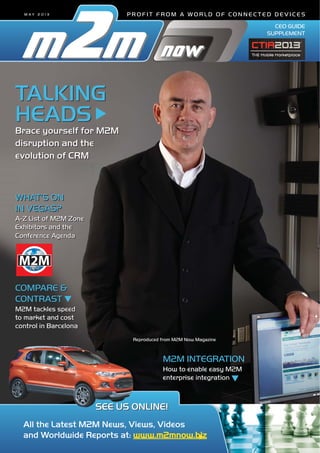
SEE US ONLINE!SEE US ONLINE!
All the Latest M2M News, Views, Videos
and Worldwide Reports at: www.m2mnow.biz
M
TALKING
HEADS
Brace yourself for M2M
disruption and the
evolution of CRM
TALKING
HEADS
Brace yourself for M2M
disruption and the
evolution of CRM
WHAT’S ON
IN VEGAS?
A-Z List of M2M Zone
Exhibitors and the
Conference Agenda
COMPARE &
CONTRAST
M2M tackles speed
to market and cost
control in Barcelona
M2M INTEGRATION
How to enable easy M2M
enterprise integration
M
M
M
Reproduced from M2M Now Magazine
M2M Now May 2013 C5CTIA 2013 GUIDE
The five billion devices in current circulation are
predicted to increase 10-fold by 2020. At the
moment those devices operate using some 10,000
different languages and protocols. With 27 years of
tribal knowledge in connecting devices across
vertical environments, beyond the core enterprise,
Digi’s expertise is in machine-to-device linguistics,
understanding the protocols and how to get your
networks communicating.
M2M Now: So, where will we see the real
business impact of M2M?
Joe Dunsmore: We’re going to see all kinds of
new ways to leverage M2M that will drive business
disruption and new revenue streams. It’s across the
verticals where the most interesting plays are being
enabled by M2M. Competitive advantage can be
realised from both process efficiencies and greater
customer intimacy.
For the companies that learn how to listen to their
machines, a whole realm of new service offerings
will be possible. Perhaps most significant, over time,
will include the reinvention of customer service.
M2CRM (Machine to Customer Relationship
Management) as we refer to it, can liberate product
data that will help you serve customers better and
unlock sources of productivity gain.
In terms of sectors, the benefits of connected cars
and smart meters are pretty well chronicled.
Beyond those we’re going to see really aggressive
deployment of solutions in key areas like
telemedicine, security and surveillance, construction
and fleet management that will really begin to drive
growth. M2M is starting to bring positive Return on
Investment (RoI), on expensive machinery. What’s
even more exciting is that the dramatic reductions
in costs of M2M hardware and connectivity,
combined with things we’re doing to make it easy
to deliver machine information right into a
company’s business processes, will open up M2M
benefits to whole new classes of equipment. We’ll
see M2M naturally extend over time through to
everyday pieces of equipment such as generators,
drills and chainsaws. Connected products will really
enhance the end customer’s experience, via real-
time data for predictive diagnostics (think of a
machine fixing itself, or telling you when something
needs to be replaced), usage data that can be
turned into operating tips and new product ideas
and probably entirely new business models. And
then think of the dramatic improvement possible in
business processes. If a company knows when their
products are going to fail, what does this mean for
spares management? How much more cost
effectively can customer service be provided? What
will warranty costs be when a company can prevent
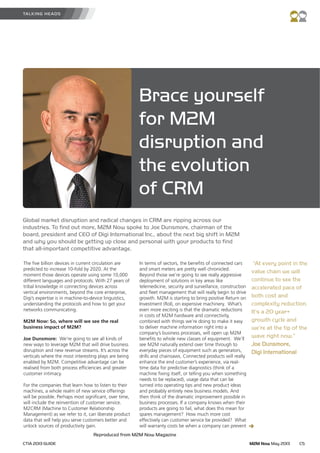
Global market disruption and radical changes in CRM are ripping across our
industries. To find out more, M2M Now spoke to Joe Dunsmore, chairman of the
board, president and CEO of Digi International Inc., about the next big shift in M2M
and why you should be getting up close and personal with your products to find
that all-important competitive advantage.
Brace yourself
for M2M
disruption and
the evolution
of CRM
“At every point in the
value chain we will
continue to see the
accelerated pace of
both cost and
complexity reduction.
It’s a 20 year+
growth cycle and
we’re at the tip of the
wave right now.”
Joe Dunsmore,
Digi International
TALKING HEADS
Reproduced from M2M Now Magazine
M2M Now May 2013C6 CTIA 2013 GUIDE
problems from happening, or know when products
are being used improperly? For those ready to
listen to their machines, I think it’s a very rich area
of opportunity.
M2M Now: What are the main drivers for
growth? Have you noticed any trends?
JD: I would venture to say that over the last three
or four years, at every point in the value chain,
we’ve seen reductions in cost and complexity. At
the access level, with cellular communications for
example, a few years ago we were seeing a US
standard price per device in the US$10 to $12 per
month ballpark, sometimes more, seldom less. Now
we’re seeing carrier quotes for some applications
for less than 50cents per device per month. And if
you look at 2G technology from just four or five
years ago, you paid about $125 for a hardware
module that supported 200Kb of throughput.
Today, $80-90 can buy you a 4G cellular module
with 40Mb of throughput. With the unprecedented
throughput levels, devices that were choking on
data five years ago and coughing on data today will
be breathing data in the future.
These fundamental dynamics are enabling all kinds
of new ways to think about how to leverage M2M.
Markets around the world are evolving in slightly
different ways. For example, a trend we’re seeing in
the US is taking the power of M2M to a new level
by integrating it into core business processes. We’re
working to help organisations understand that
implementing an M2M solution doesn’t have to
mean creating a whole new and expensive system.
In fact, the biggest opportunity is when you
integrate it to an existing scheme.
We now have players, like Digi with its Device
Cloud by Etherios, making it easy for someone
building an M2M application, be it a SaaS provider
or a company building their own, to connect
hundreds of thousands of products in a scalable,
secure, reliable way with value-add services for
storage and analytics without having to invest in
their own infrastructure.
M2M Now: How can M2M be integrated into
core business processes?
JD: When you talk about core business processes,
business platform integration is a major trend. The
first benefit we’ll see from M2CRM is with
customer service. Historically, customer service has
been reactive. You sell the product, you have a help
centre, you wait for a phone call from a customer
with a problem, and then you measure how fast
you respond to and solve the problem.
A company with connected products that knows
how to listen to them can completely flip this
model to become much more proactive… even
preventative. The first step is seeing when a
product fails and proactively calling the customer.
The next step is listening carefully to real time data
from the product, analyzing the data, and calling
the customer before the product is going to fail or
sending out a replacement before it fails. And the
full move to preventative applies new levels of
analytics to the data so the product or how it’s
being operated can be modified so it won’t fail.
So, the early opportunity here is to connect the
products to customer service platforms, to drive
that model in terms of downtime, customer service
efficiency, warranty and service costs.
However, that’s not it. There are many more
opportunities to really liberate data from products
and extend benefits beyond customer service.
For example, salesforce.com has a platform from
which they offer multiple different offerings
including Sales Cloud, Service Cloud, Marketing
Cloud and other collaboration capabilities like
Chatter. Salesforce has over a hundred thousand
customers worldwide. We can now plug data
directly into these different offerings. This kind of
data sharing helps bring down business silos. This
means that with real-time product performance
data, you can work more intimately with your
customers, get marketing and real-time usage data,
demographics, inventory, advanced segmentation
opportunities and better campaign reporting.
Liberated data can also identify and create up-sell
opportunities!
M2M Now: What competitive advantages
does a fully integrated M2M system give a
business?
JD: It’s all about making machines work better.
While it’s still early days, in terms of the kinds of
really enriched M2M deployments that we’re going
to see over time, we’re nearing a market inflection
point. In the past, it’s been the big players that
were able to make huge proprietary end-to-end
investments for their systems.
What companies like Digi are doing is bringing
down the barriers to deployment, with our Device
Cloud and on-boarding capabilities, making it
much cheaper for organizations of all sizes to
deploy and get a positive RoI. So we’re seeing a lot
of disruptive technologies emerge as they become
more economically viable.
There will be all kinds of new revenue
opportunities; largely because we’ve enabled a lot
of really interesting companies with our M2M
capabilities.
“M2M will redefine
the notion of what
the product actually
is, and turn it into a
listening device.”
Joe Dunsmore,
Digi International
TALKING HEADS
M2M Now
Jargon Buster
RoI = Return on
Investment
SaaS = Software
as a Service
Reproduced from M2M Now Magazine
M2M Now May 2013 C7CTIA 2013 GUIDE
Take energy management for instance. One of our customer partners is
deploying an innovative energy management solution that takes into account
an individual household’s thermal characteristics and user preferences, in
addition to weather forecasts, to wirelessly adjust the thermostat frequently
and remotely. This can drive down consumption and decrease bills by up to
20% to 30%, while maintaining desired comfort levels.
Another example is the SmartSantander project in Spain that aims to deploy a
city-wide network of sensors, actuators, cameras and screens to offer useful
information to citizens and city management. Libelium sensors, networked by
Digi, have been deployed in more than 12,000 nodes across the city to
monitor and record environmental factors like noise, carbon monoxide levels,
temperature and humidity. Digi Mesh is the protocol that sends information
to a monitoring platform, which is then displayed in real time on an
interactive map that’s available to citizens. Magnetic fields can even detect
parking spaces and communicate them to a Smart Parking Platform to help
people find a space.
Yet another example is an air compressor company with 50,000 coin
operated tyre inflation machines at service stations. They faced two
problems. Knowing when machines were not working and making
sure that all the coins collected from the machines actually made it
back to the company. This application would never have worked
in the days of $10-12 per month cellular fees. We designed a
custom cellular connectivity module for their air compressors,
created an application based on Device Cloud that immediately
informs their customer service team when a machine is down
as well as linking into their financial system for accurate and
verifiable tracking of coins collected. From the simultaneous
improvement in revenue and reduction in service costs, the
RoI has been powerful with payback in less than a year.
At Digi, we’re putting an emphasis on cloud platform
integration because an integrated approach makes machine
communication a possibility for more organisations. With
better usage data and demographics you can become more
targeted with your marketing, and orientate your
organisation as a ‘customer company’ creating a
competitive advantage with data liberation.
Essentially what this means is reinventing the notion of
what the product is. By listening to your devices, and using
what they tell you, not only can you have a more efficient
customer service function with dramatically higher customer
satisfaction, but you can simultaneously create new revenue
opportunities and have much more timeline and insightful
input for product roadmaps. The companies that do this right
will create a long-term competitive advantage.
The Device Cloud by Etherios is a public cloud platform-as-a
service (PaaS) that provides application integration with device
networks. Supporting any device operating platform, it is
driving The Internet of ANYthing™, connecting any application,
anywhere, to anything, anywhere. The free Etherios Cloud
Connector™ is a software download that allows any M2M
device to be integrated with the Device Cloud.
Reproduced from M2M Now Magazine

Interview with Joe Dunsmore, Digi CEO

  • 1.
    WHAT’S ON IN VEGAS? A-ZList of M2M Zone Exhibitors and the Conference Agenda COMPARE & CONTRAST M2M tackles speed to market and cost control in Barcelona P R O F I T F R O M A W O R L D O F CO N N E C T E D D E V I C E S CEO GUIDE SUPPLEMENT M A Y 2 0 1 3 SEE US ONLINE!SEE US ONLINE! All the Latest M2M News, Views, Videos and Worldwide Reports at: www.m2mnow.biz M TALKING HEADS Brace yourself for M2M disruption and the evolution of CRM TALKING HEADS Brace yourself for M2M disruption and the evolution of CRM WHAT’S ON IN VEGAS? A-Z List of M2M Zone Exhibitors and the Conference Agenda COMPARE & CONTRAST M2M tackles speed to market and cost control in Barcelona M2M INTEGRATION How to enable easy M2M enterprise integration M M M Reproduced from M2M Now Magazine
  • 2.
    M2M Now May2013 C5CTIA 2013 GUIDE The five billion devices in current circulation are predicted to increase 10-fold by 2020. At the moment those devices operate using some 10,000 different languages and protocols. With 27 years of tribal knowledge in connecting devices across vertical environments, beyond the core enterprise, Digi’s expertise is in machine-to-device linguistics, understanding the protocols and how to get your networks communicating. M2M Now: So, where will we see the real business impact of M2M? Joe Dunsmore: We’re going to see all kinds of new ways to leverage M2M that will drive business disruption and new revenue streams. It’s across the verticals where the most interesting plays are being enabled by M2M. Competitive advantage can be realised from both process efficiencies and greater customer intimacy. For the companies that learn how to listen to their machines, a whole realm of new service offerings will be possible. Perhaps most significant, over time, will include the reinvention of customer service. M2CRM (Machine to Customer Relationship Management) as we refer to it, can liberate product data that will help you serve customers better and unlock sources of productivity gain. In terms of sectors, the benefits of connected cars and smart meters are pretty well chronicled. Beyond those we’re going to see really aggressive deployment of solutions in key areas like telemedicine, security and surveillance, construction and fleet management that will really begin to drive growth. M2M is starting to bring positive Return on Investment (RoI), on expensive machinery. What’s even more exciting is that the dramatic reductions in costs of M2M hardware and connectivity, combined with things we’re doing to make it easy to deliver machine information right into a company’s business processes, will open up M2M benefits to whole new classes of equipment. We’ll see M2M naturally extend over time through to everyday pieces of equipment such as generators, drills and chainsaws. Connected products will really enhance the end customer’s experience, via real- time data for predictive diagnostics (think of a machine fixing itself, or telling you when something needs to be replaced), usage data that can be turned into operating tips and new product ideas and probably entirely new business models. And then think of the dramatic improvement possible in business processes. If a company knows when their products are going to fail, what does this mean for spares management? How much more cost effectively can customer service be provided? What will warranty costs be when a company can prevent Global market disruption and radical changes in CRM are ripping across our industries. To find out more, M2M Now spoke to Joe Dunsmore, chairman of the board, president and CEO of Digi International Inc., about the next big shift in M2M and why you should be getting up close and personal with your products to find that all-important competitive advantage. Brace yourself for M2M disruption and the evolution of CRM “At every point in the value chain we will continue to see the accelerated pace of both cost and complexity reduction. It’s a 20 year+ growth cycle and we’re at the tip of the wave right now.” Joe Dunsmore, Digi International TALKING HEADS Reproduced from M2M Now Magazine
  • 3.
    M2M Now May2013C6 CTIA 2013 GUIDE problems from happening, or know when products are being used improperly? For those ready to listen to their machines, I think it’s a very rich area of opportunity. M2M Now: What are the main drivers for growth? Have you noticed any trends? JD: I would venture to say that over the last three or four years, at every point in the value chain, we’ve seen reductions in cost and complexity. At the access level, with cellular communications for example, a few years ago we were seeing a US standard price per device in the US$10 to $12 per month ballpark, sometimes more, seldom less. Now we’re seeing carrier quotes for some applications for less than 50cents per device per month. And if you look at 2G technology from just four or five years ago, you paid about $125 for a hardware module that supported 200Kb of throughput. Today, $80-90 can buy you a 4G cellular module with 40Mb of throughput. With the unprecedented throughput levels, devices that were choking on data five years ago and coughing on data today will be breathing data in the future. These fundamental dynamics are enabling all kinds of new ways to think about how to leverage M2M. Markets around the world are evolving in slightly different ways. For example, a trend we’re seeing in the US is taking the power of M2M to a new level by integrating it into core business processes. We’re working to help organisations understand that implementing an M2M solution doesn’t have to mean creating a whole new and expensive system. In fact, the biggest opportunity is when you integrate it to an existing scheme. We now have players, like Digi with its Device Cloud by Etherios, making it easy for someone building an M2M application, be it a SaaS provider or a company building their own, to connect hundreds of thousands of products in a scalable, secure, reliable way with value-add services for storage and analytics without having to invest in their own infrastructure. M2M Now: How can M2M be integrated into core business processes? JD: When you talk about core business processes, business platform integration is a major trend. The first benefit we’ll see from M2CRM is with customer service. Historically, customer service has been reactive. You sell the product, you have a help centre, you wait for a phone call from a customer with a problem, and then you measure how fast you respond to and solve the problem. A company with connected products that knows how to listen to them can completely flip this model to become much more proactive… even preventative. The first step is seeing when a product fails and proactively calling the customer. The next step is listening carefully to real time data from the product, analyzing the data, and calling the customer before the product is going to fail or sending out a replacement before it fails. And the full move to preventative applies new levels of analytics to the data so the product or how it’s being operated can be modified so it won’t fail. So, the early opportunity here is to connect the products to customer service platforms, to drive that model in terms of downtime, customer service efficiency, warranty and service costs. However, that’s not it. There are many more opportunities to really liberate data from products and extend benefits beyond customer service. For example, salesforce.com has a platform from which they offer multiple different offerings including Sales Cloud, Service Cloud, Marketing Cloud and other collaboration capabilities like Chatter. Salesforce has over a hundred thousand customers worldwide. We can now plug data directly into these different offerings. This kind of data sharing helps bring down business silos. This means that with real-time product performance data, you can work more intimately with your customers, get marketing and real-time usage data, demographics, inventory, advanced segmentation opportunities and better campaign reporting. Liberated data can also identify and create up-sell opportunities! M2M Now: What competitive advantages does a fully integrated M2M system give a business? JD: It’s all about making machines work better. While it’s still early days, in terms of the kinds of really enriched M2M deployments that we’re going to see over time, we’re nearing a market inflection point. In the past, it’s been the big players that were able to make huge proprietary end-to-end investments for their systems. What companies like Digi are doing is bringing down the barriers to deployment, with our Device Cloud and on-boarding capabilities, making it much cheaper for organizations of all sizes to deploy and get a positive RoI. So we’re seeing a lot of disruptive technologies emerge as they become more economically viable. There will be all kinds of new revenue opportunities; largely because we’ve enabled a lot of really interesting companies with our M2M capabilities. “M2M will redefine the notion of what the product actually is, and turn it into a listening device.” Joe Dunsmore, Digi International TALKING HEADS M2M Now Jargon Buster RoI = Return on Investment SaaS = Software as a Service Reproduced from M2M Now Magazine
  • 4.
    M2M Now May2013 C7CTIA 2013 GUIDE Take energy management for instance. One of our customer partners is deploying an innovative energy management solution that takes into account an individual household’s thermal characteristics and user preferences, in addition to weather forecasts, to wirelessly adjust the thermostat frequently and remotely. This can drive down consumption and decrease bills by up to 20% to 30%, while maintaining desired comfort levels. Another example is the SmartSantander project in Spain that aims to deploy a city-wide network of sensors, actuators, cameras and screens to offer useful information to citizens and city management. Libelium sensors, networked by Digi, have been deployed in more than 12,000 nodes across the city to monitor and record environmental factors like noise, carbon monoxide levels, temperature and humidity. Digi Mesh is the protocol that sends information to a monitoring platform, which is then displayed in real time on an interactive map that’s available to citizens. Magnetic fields can even detect parking spaces and communicate them to a Smart Parking Platform to help people find a space. Yet another example is an air compressor company with 50,000 coin operated tyre inflation machines at service stations. They faced two problems. Knowing when machines were not working and making sure that all the coins collected from the machines actually made it back to the company. This application would never have worked in the days of $10-12 per month cellular fees. We designed a custom cellular connectivity module for their air compressors, created an application based on Device Cloud that immediately informs their customer service team when a machine is down as well as linking into their financial system for accurate and verifiable tracking of coins collected. From the simultaneous improvement in revenue and reduction in service costs, the RoI has been powerful with payback in less than a year. At Digi, we’re putting an emphasis on cloud platform integration because an integrated approach makes machine communication a possibility for more organisations. With better usage data and demographics you can become more targeted with your marketing, and orientate your organisation as a ‘customer company’ creating a competitive advantage with data liberation. Essentially what this means is reinventing the notion of what the product is. By listening to your devices, and using what they tell you, not only can you have a more efficient customer service function with dramatically higher customer satisfaction, but you can simultaneously create new revenue opportunities and have much more timeline and insightful input for product roadmaps. The companies that do this right will create a long-term competitive advantage. The Device Cloud by Etherios is a public cloud platform-as-a service (PaaS) that provides application integration with device networks. Supporting any device operating platform, it is driving The Internet of ANYthing™, connecting any application, anywhere, to anything, anywhere. The free Etherios Cloud Connector™ is a software download that allows any M2M device to be integrated with the Device Cloud. Reproduced from M2M Now Magazine