CHARTS
 A Chart is a diagram or table displaying
detailed information regarding to a given
statistical data
Data markers
 The data points (data points: Individual values plotted in
a chart and represented by bars, columns, lines, pie or
doughnut slices, dots, and various other shapes called
data markers. Data markers of the same color constitute
a data series.) in a pie chart are displayed as a
percentage of the whole pie.
0
1
2
3
4
5
Category 1Category 2Category 3Category 4
Series 1
Series 2
Column chart
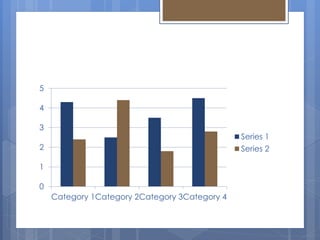
 Column charts are useful for showing data
changes over a period of time or for
illustrating comparisons among items.
 In column charts, categories are typically
organized along the horizontal axis and
values along the vertical axis.
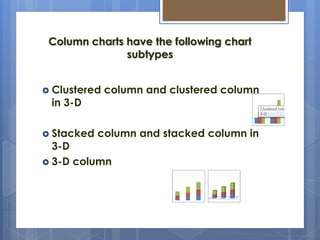
Column charts have the following chart
subtypes
 Clustered column and clustered column
in 3-D
 Stacked column and stacked column in
3-D
 3-D column
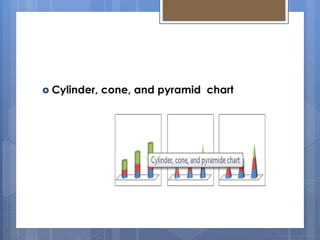
 Cylinder, cone, and pyramid chart
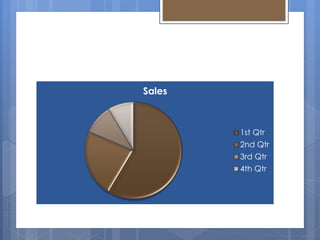
Sales
1st Qtr
2nd Qtr
3rd Qtr
4th Qtr
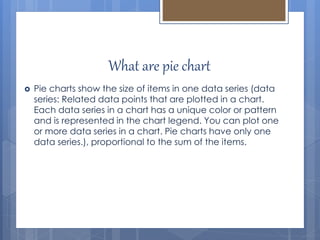
What are pie chart
 Pie charts show the size of items in one data series (data
series: Related data points that are plotted in a chart.
Each data series in a chart has a unique color or pattern
and is represented in the chart legend. You can plot one
or more data series in a chart. Pie charts have only one
data series.), proportional to the sum of the items.
When to use pie chart !!!!
 You only have one data series that you want
to plot.
 None of the values that you want to plot are
negative.
 Almost none of the values that you want to
plot are zero values.
 You do not have more than seven categories.
 The categories represent parts of the whole
pie.
0
1
2
3
4
5
6
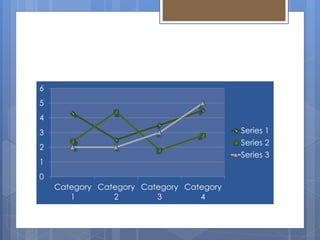
Category
1
Category
2
Category
3
Category
4
Series 1
Series 2
Series 3
Line chart
 Line charts can display continuous data
over time, set against a common scale,
and are therefore ideal for showing trends
in data at equal intervals.
When to use Line chart !!!!
 You should use a line chart if your
category labels are text, and are
representing evenly spaced values such
as months, quarters, or fiscal years.
Line charts have the following subtypes
 Line and line with markers
 Stacked line and stacked line with
markers
 3-D line
THANK YOU
Class 9-A

Column chart

  • 1.
  • 2.
     A Chartis a diagram or table displaying detailed information regarding to a given statistical data
  • 3.
    Data markers  Thedata points (data points: Individual values plotted in a chart and represented by bars, columns, lines, pie or doughnut slices, dots, and various other shapes called data markers. Data markers of the same color constitute a data series.) in a pie chart are displayed as a percentage of the whole pie.
  • 4.
    0 1 2 3 4 5 Category 1Category 2Category3Category 4 Series 1 Series 2
  • 5.
    Column chart  Columncharts are useful for showing data changes over a period of time or for illustrating comparisons among items.  In column charts, categories are typically organized along the horizontal axis and values along the vertical axis.
  • 6.
    Column charts havethe following chart subtypes  Clustered column and clustered column in 3-D  Stacked column and stacked column in 3-D  3-D column
  • 7.
     Cylinder, cone,and pyramid chart
  • 8.
  • 9.
    What are piechart  Pie charts show the size of items in one data series (data series: Related data points that are plotted in a chart. Each data series in a chart has a unique color or pattern and is represented in the chart legend. You can plot one or more data series in a chart. Pie charts have only one data series.), proportional to the sum of the items.
  • 10.
    When to usepie chart !!!!  You only have one data series that you want to plot.  None of the values that you want to plot are negative.  Almost none of the values that you want to plot are zero values.  You do not have more than seven categories.  The categories represent parts of the whole pie.
  • 11.
  • 12.
    Line chart  Linecharts can display continuous data over time, set against a common scale, and are therefore ideal for showing trends in data at equal intervals.
  • 13.
    When to useLine chart !!!!  You should use a line chart if your category labels are text, and are representing evenly spaced values such as months, quarters, or fiscal years.
  • 14.
    Line charts havethe following subtypes  Line and line with markers  Stacked line and stacked line with markers  3-D line
  • 15.