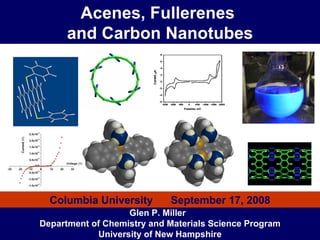
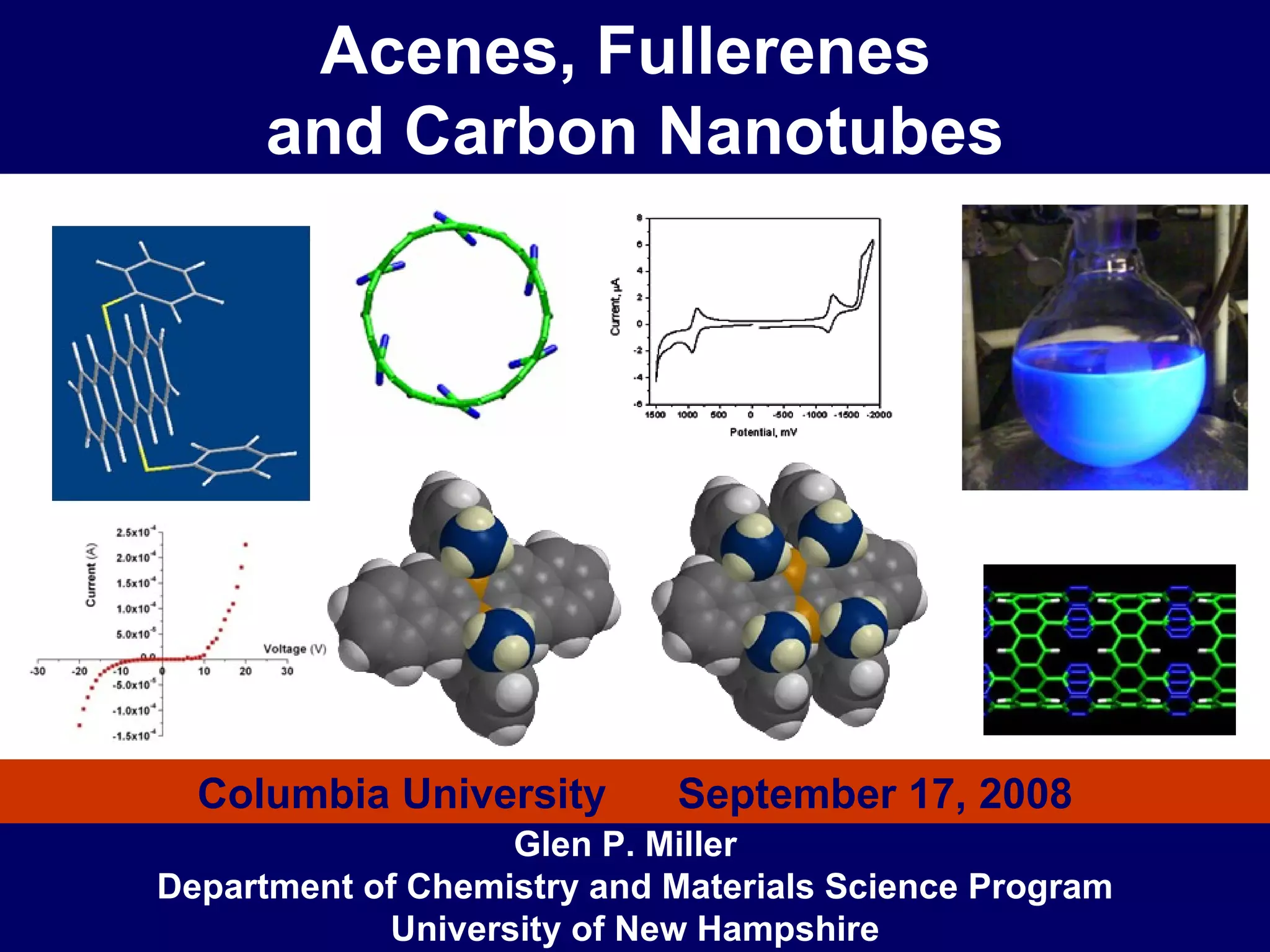
Acenes, Fullerenes  and Carbon Nanotubes Glen P. Miller  Department of Chemistry and Materials Science Program University of New Hampshire Columbia University  September 17, 2008
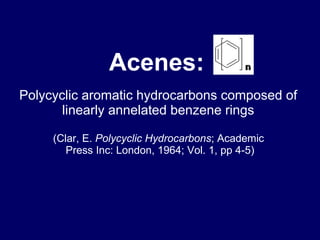
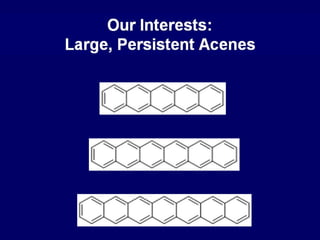
Acenes:  Polycyclic aromatic hydrocarbons composed of  linearly annelated benzene rings  (Clar, E.  Polycyclic Hydrocarbons ; Academic  Press Inc: London, 1964; Vol. 1, pp 4-5)
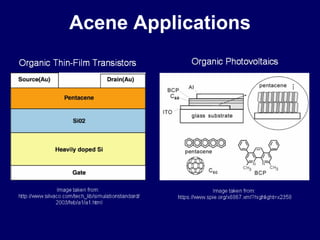
Acene Applications
 
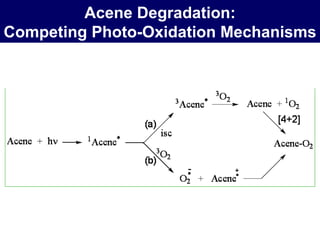
Acene Degradation: Competing Photo-Oxidation Mechanisms
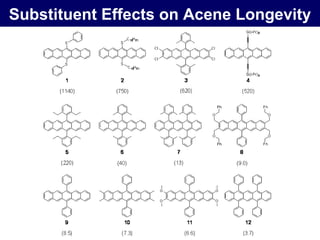
Substituent Effects on Acene Longevity
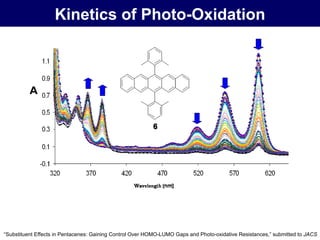
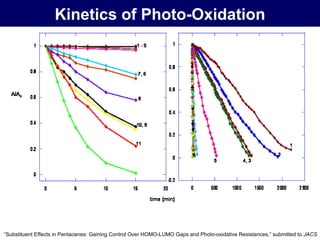
Kinetics of Photo-Oxidation “ Substituent Effects in Pentacenes: Gaining Control Over HOMO-LUMO Gaps and Photo-oxidative Resistances,” submitted to  JACS
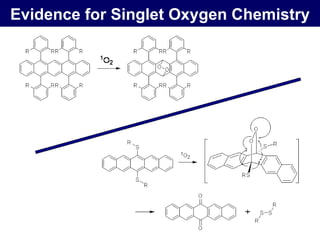
Evidence for Singlet Oxygen Chemistry
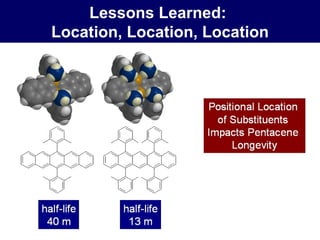
Lessons Learned:  Location, Location, Location
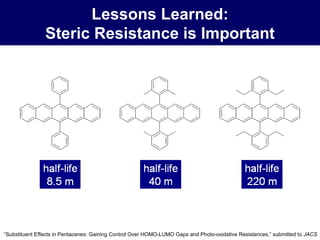
Lessons Learned: Steric Resistance is Important “ Substituent Effects in Pentacenes: Gaining Control Over HOMO-LUMO Gaps and Photo-oxidative Resistances,” submitted to  JACS
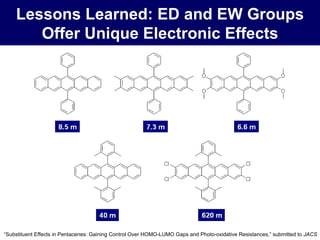
Lessons Learned: ED and EW Groups Offer Unique Electronic Effects “ Substituent Effects in Pentacenes: Gaining Control Over HOMO-LUMO Gaps and Photo-oxidative Resistances,” submitted to  JACS
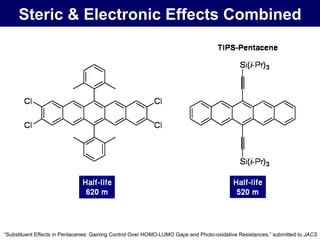
Steric & Electronic Effects Combined “ Substituent Effects in Pentacenes: Gaining Control Over HOMO-LUMO Gaps and Photo-oxidative Resistances,” submitted to  JACS
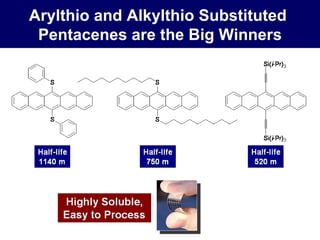
Arylthio and Alkylthio Substituted  Pentacenes are the Big Winners
Thin-Film Characteristics “ Substituent Effects in Pentacenes: Gaining Control Over HOMO-LUMO Gaps and Photo-oxidative Resistances,” submitted to  JACS
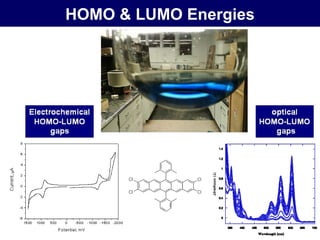
HOMO & LUMO Energies
HOMO & LUMO Energies and Gaps pentacene derivative (t 1/2 ) E 1/2  [O] a (mV) E 1/2  [red] a (mV) E HOMO (eV) E LUMO (eV) E g,EChem  (eV) low energy  max  (nm) E g,optical  (eV) c E HOMO,DFT , E LUMO,DFT (eV) E g,DFT  (eV) 1   (1140) 849, 1093 -1099 -5.17 -3.36 1.81 624, 575, 534 1.86 -5.20, -3.03 2.17 2   (750) 755, 936 -1229,  -1726 -5.07 -3.26 1.81 617, 570, 529 1.88 -5.08, -2.89 2.19 3   (620) 899 -1227 -5.21 -3.24 1.97 605, 559, 520 1.94 --- --- 4   (520) 789 -1054 -5.11 -3.42 1.69 643, 591, 548 1.81 -5.08, -3.07 2.01 5   (220) 713 -1485 -5.03 -2.99 2.04 605, 558, 520 1.95 --- --- 6   (40) 695 -1478 -5.01 -3.00 2.01 604, 557, 518 1.96 -4.93, -2.71 2.22 7   (13) 638, 1372 -1543 -4.95 -2.93 2.02 618, 569, 529 1.90 --- --- 8   (9.0) 627, 1224 -1430 -4.93 -3.07 1.86 600, 554, 515 1.93 --- --- 9   (8.5) 682 -1396 -5.00 -3.08 1.92 604, 558, 519 1.94 -4.86, -2.63 2.23 10   (7.3) 536, 1171 -1521 -4.86 -2.97 1.89 602, 556, 518 1.92 --- --- 11   (6.6) 464, 1081 -1651 -4.78 -2.84 1.94 583, 539, 501 2.01 --- --- 12   (3.7) 635, 1183 -1407 -4.95 -3.07 1.88 621, 573, 532 1.88 -4.80, -2.59 2.21 Pentacene (7.5) f 582, 537, 501 2.08 -2.67, -4.96 2.29
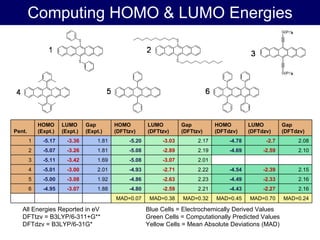
Computing HOMO & LUMO Energies Blue Cells = Electrochemically Derived Values Green Cells = Computationally Predicted Values Yellow Cells = Mean Absolute Deviations (MAD) All Energies Reported in eV  DFTtzv = B3LYP/6-311+G** DFTdzv = B3LYP/6-31G* Pent. HOMO (Expt.) LUMO (Expt.) Gap (Expt.) HOMO (DFTtzv) LUMO (DFTtzv) Gap (DFTtzv) HOMO (DFTdzv) LUMO (DFTdzv) Gap (DFTdzv) 1 -5.17 -3.36 1.81 -5.20 -3.03 2.17 -4.78 -2.7 2.08 2 -5.07 -3.26 1.81 -5.08 -2.89 2.19 -4.69 -2.59 2.10 3 -5.11 -3.42 1.69 -5.08 -3.07 2.01 4 -5.01 -3.00 2.01 -4.93 -2.71 2.22 -4.54 -2.39 2.15 5 -5.00 -3.08 1.92 -4.86 -2.63 2.23 -4.49 -2.33 2.16 6 -4.95 -3.07 1.88 -4.80 -2.59 2.21 -4.43 -2.27 2.16 MAD=0.07 MAD=0.38 MAD=0.32 MAD=0.45 MAD=0.70 MAD=0.24
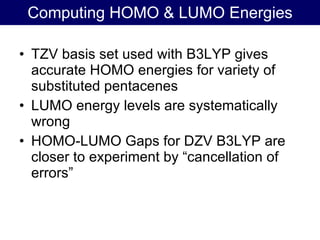
TZV basis set used with B3LYP gives accurate HOMO energies for variety of substituted pentacenes LUMO energy levels are systematically wrong HOMO-LUMO Gaps for DZV B3LYP are closer to experiment by “cancellation of errors” Computing HOMO & LUMO Energies
HOMO-LUMO Energy Gaps for [n]Acenes:  (n = 2-9) B3LYP/6-31G*
Comparing Basis-Sets for [n]Acenes:  6-31G* vs. 6-311+G** B3LYP/6-311+G**//B3LYP/6-31G* B3LYP/6-31G* Green = Closed-Shell Solutions Blue = Open-Shell Solutions Ring # [n] HOMO (eV) LUMO (eV) Gap 2 -6.14 -1.41 4.73 3 -5.57 -2.04 3.53 4 -5.20 -2.46 2.74 5 -4.94 -2.76 2.18 6 -4.74 -2.98 1.76 7 -6.72 -5.31 1.41 8 -6.02 -4.62 1.40 9 -6.72 -5.56 1.16 HOMO LUMO Gap  -6.09 -1.40 4.69 -5.53 -2.02 3.51 -5.16 -2.44 2.72 -4.90 -2.74 2.16 -4.71 -2.96 1.75 -4.70 -2.98 1.72 -4.67 -3.03 1.64 -4.62 -3.08 1.54
Comparing Basis-Sets for [n]Acenes:  6-31G* vs. 6-311+G** B3LYP/6-31G* Green = Closed-Shell Solutions Blue = Open-Shell Solutions B3LYP/6-311+G**//B3LYP/6-31G* Ring # [n] HOMO (eV) LUMO (eV) Gap 2 -6.14 -1.41 4.73 3 -5.57 -2.04 3.53 4 -5.20 -2.46 2.74 5 -4.94 -2.76 2.18 6 -4.74 -2.98 1.76 7 -4.74 -3.00 1.74 8 -4.70 -3.05 1.65 9 -4.66 -3.11 1.55 HOMO LUMO Gap  -6.09 -1.40 4.69 -5.53 -2.02 3.51 -5.16 -2.44 2.72 -4.90 -2.74 2.16 -4.71 -2.96 1.75 -4.70 -2.98 1.72 -4.67 -3.03 1.64 -4.62 -3.08 1.54
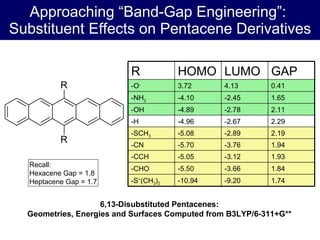
Approaching “Band-Gap Engineering”:  Substituent Effects on Pentacene Derivatives 6,13-Disubstituted Pentacenes: Geometries, Energies and Surfaces Computed from B3LYP/6-311+G** R HOMO LUMO GAP -O - 3.72 4.13 0.41 -NH 2 -4.10 -2.45 1.65 -OH -4.89 -2.78 2.11 -H -4.96 -2.67 2.29 -SCH 3 -5.08 -2.89 2.19 -CN -5.70 -3.76 1.94 -CCH -5.05 -3.12 1.93 -CHO -5.50 -3.66 1.84 -S + (CH 3 ) 2 -10.94 -9.20 1.74 Recall: Hexacene Gap = 1.8 Heptacene Gap = 1.7
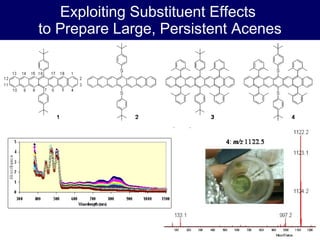
Exploiting Substituent Effects  to Prepare Large, Persistent Acenes
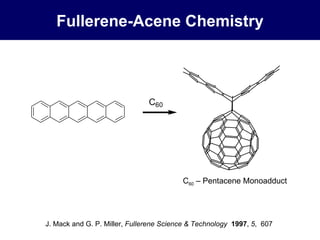
C 60  – Pentacene Monoadduct J. Mack and G. P. Miller,  Fullerene Science & Technology   1997 ,  5 ,  607  Fullerene-Acene Chemistry
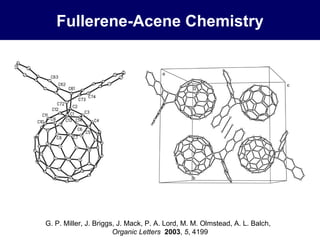
G. P. Miller, J. Briggs, J. Mack, P. A. Lord, M. M. Olmstead, A. L. Balch,  Organic Letters   2003 ,  5 , 4199 Fullerene-Acene Chemistry
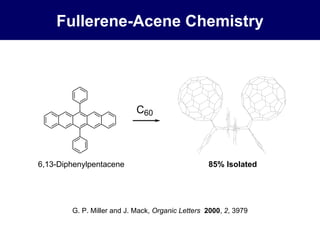
85% Isolated 6,13-Diphenylpentacene Fullerene-Acene Chemistry G. P. Miller and J. Mack,  Organic Letters   2000 ,  2 , 3979
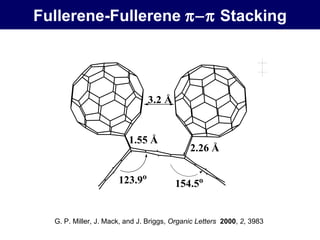
G. P. Miller, J. Mack, and J. Briggs,  Organic Letters   2000 ,  2 , 3983  Fullerene-Fullerene    Stacking
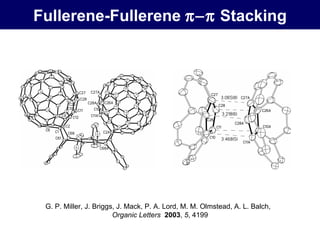
Fullerene-Fullerene    Stacking G. P. Miller, J. Briggs, J. Mack, P. A. Lord, M. M. Olmstead, A. L. Balch,  Organic Letters   2003 ,  5 , 4199
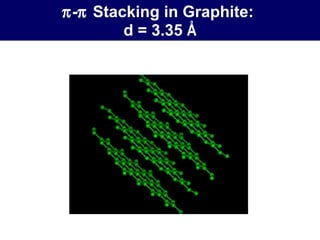
 -  Stacking in Graphite:  d = 3.35  Å
Spacial Dependence of  [60]Fullerene-[60]Fullerene   -  Stacking Interactions 1 1.1 G. P. Miller and J. Briggs,  Tetrahedron Letters   2004 ,  45 , 477
cis,cis- Tris[60]Fullerene Adduct G. P. Miller and J. Briggs,  Organic Letters   2003 ,  5 , 4203 More Fullerene-Acene Chemistry: Kaur, I. and Miller, G. P.,  New J. Chem .  2008 ,  32 , 459-463.  J. E. Rainbolt, G. P. Miller,  J. Org.  Chem.   2007 ,  72 , 3020–3030 J. Athans, J. B. Briggs, W. Jia, G. P. Miller,  J. Mat.  Chem.   2007 ,  17 , 2636–2641 J. Briggs and G. P. Miller,  Comptes Rendus Chimie   2006 ,  9 , 916
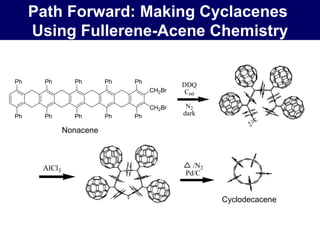
Nonacene Cyclodecacene Path Forward: Making Cyclacenes  Using Fullerene-Acene Chemistry
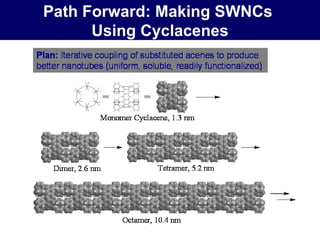
Path Forward: Making SWNCs  Using Cyclacenes
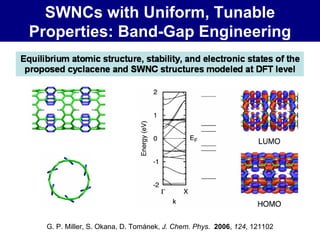
SWNCs with Uniform, Tunable Properties: Band-Gap Engineering G. P. Miller, S. Okana, D. Tománek,  J. Chem.  Phys .  2006 ,  124 , 121102
Other Nanostructured Carbons
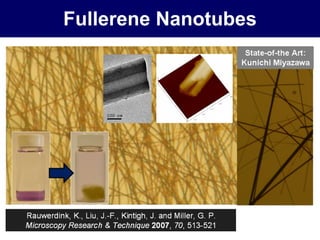
Fullerene Nanotubes
[60]Fullerene Nanotubes Rauwerdink, K., Liu, J.-F., Kintigh, J. and Miller, G. P.,  Microscopy Research & Technique ,  2007 ,  70 , 513-521
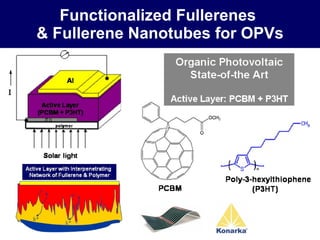
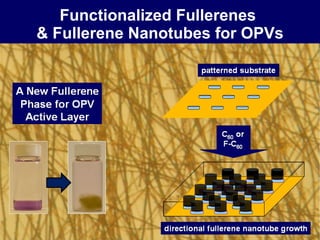
Functionalized Fullerenes  & Fullerene Nanotubes for OPVs
Acknowledgements

Seminar at Columbia 09-17-08

  • 1.
    Acenes, Fullerenes and Carbon Nanotubes Glen P. Miller Department of Chemistry and Materials Science Program University of New Hampshire Columbia University September 17, 2008
  • 2.
    Acenes: Polycyclicaromatic hydrocarbons composed of linearly annelated benzene rings (Clar, E. Polycyclic Hydrocarbons ; Academic Press Inc: London, 1964; Vol. 1, pp 4-5)
  • 3.
  • 4.
  • 5.
    Acene Degradation: CompetingPhoto-Oxidation Mechanisms
  • 6.
    Substituent Effects onAcene Longevity
  • 7.
    Kinetics of Photo-Oxidation“ Substituent Effects in Pentacenes: Gaining Control Over HOMO-LUMO Gaps and Photo-oxidative Resistances,” submitted to JACS
  • 8.
    Kinetics of Photo-Oxidation“ Substituent Effects in Pentacenes: Gaining Control Over HOMO-LUMO Gaps and Photo-oxidative Resistances,” submitted to JACS
  • 9.
    Evidence for SingletOxygen Chemistry
  • 10.
    Lessons Learned: Location, Location, Location
  • 11.
    Lessons Learned: StericResistance is Important “ Substituent Effects in Pentacenes: Gaining Control Over HOMO-LUMO Gaps and Photo-oxidative Resistances,” submitted to JACS
  • 12.
    Lessons Learned: EDand EW Groups Offer Unique Electronic Effects “ Substituent Effects in Pentacenes: Gaining Control Over HOMO-LUMO Gaps and Photo-oxidative Resistances,” submitted to JACS
  • 13.
    Steric & ElectronicEffects Combined “ Substituent Effects in Pentacenes: Gaining Control Over HOMO-LUMO Gaps and Photo-oxidative Resistances,” submitted to JACS
  • 14.
    Arylthio and AlkylthioSubstituted Pentacenes are the Big Winners
  • 15.
    Thin-Film Characteristics “Substituent Effects in Pentacenes: Gaining Control Over HOMO-LUMO Gaps and Photo-oxidative Resistances,” submitted to JACS
  • 16.
    HOMO & LUMOEnergies
  • 17.
    HOMO & LUMOEnergies and Gaps pentacene derivative (t 1/2 ) E 1/2 [O] a (mV) E 1/2 [red] a (mV) E HOMO (eV) E LUMO (eV) E g,EChem (eV) low energy  max (nm) E g,optical (eV) c E HOMO,DFT , E LUMO,DFT (eV) E g,DFT (eV) 1 (1140) 849, 1093 -1099 -5.17 -3.36 1.81 624, 575, 534 1.86 -5.20, -3.03 2.17 2 (750) 755, 936 -1229, -1726 -5.07 -3.26 1.81 617, 570, 529 1.88 -5.08, -2.89 2.19 3 (620) 899 -1227 -5.21 -3.24 1.97 605, 559, 520 1.94 --- --- 4 (520) 789 -1054 -5.11 -3.42 1.69 643, 591, 548 1.81 -5.08, -3.07 2.01 5 (220) 713 -1485 -5.03 -2.99 2.04 605, 558, 520 1.95 --- --- 6 (40) 695 -1478 -5.01 -3.00 2.01 604, 557, 518 1.96 -4.93, -2.71 2.22 7 (13) 638, 1372 -1543 -4.95 -2.93 2.02 618, 569, 529 1.90 --- --- 8 (9.0) 627, 1224 -1430 -4.93 -3.07 1.86 600, 554, 515 1.93 --- --- 9 (8.5) 682 -1396 -5.00 -3.08 1.92 604, 558, 519 1.94 -4.86, -2.63 2.23 10 (7.3) 536, 1171 -1521 -4.86 -2.97 1.89 602, 556, 518 1.92 --- --- 11 (6.6) 464, 1081 -1651 -4.78 -2.84 1.94 583, 539, 501 2.01 --- --- 12 (3.7) 635, 1183 -1407 -4.95 -3.07 1.88 621, 573, 532 1.88 -4.80, -2.59 2.21 Pentacene (7.5) f 582, 537, 501 2.08 -2.67, -4.96 2.29
  • 18.
    Computing HOMO &LUMO Energies Blue Cells = Electrochemically Derived Values Green Cells = Computationally Predicted Values Yellow Cells = Mean Absolute Deviations (MAD) All Energies Reported in eV DFTtzv = B3LYP/6-311+G** DFTdzv = B3LYP/6-31G* Pent. HOMO (Expt.) LUMO (Expt.) Gap (Expt.) HOMO (DFTtzv) LUMO (DFTtzv) Gap (DFTtzv) HOMO (DFTdzv) LUMO (DFTdzv) Gap (DFTdzv) 1 -5.17 -3.36 1.81 -5.20 -3.03 2.17 -4.78 -2.7 2.08 2 -5.07 -3.26 1.81 -5.08 -2.89 2.19 -4.69 -2.59 2.10 3 -5.11 -3.42 1.69 -5.08 -3.07 2.01 4 -5.01 -3.00 2.01 -4.93 -2.71 2.22 -4.54 -2.39 2.15 5 -5.00 -3.08 1.92 -4.86 -2.63 2.23 -4.49 -2.33 2.16 6 -4.95 -3.07 1.88 -4.80 -2.59 2.21 -4.43 -2.27 2.16 MAD=0.07 MAD=0.38 MAD=0.32 MAD=0.45 MAD=0.70 MAD=0.24
  • 19.
    TZV basis setused with B3LYP gives accurate HOMO energies for variety of substituted pentacenes LUMO energy levels are systematically wrong HOMO-LUMO Gaps for DZV B3LYP are closer to experiment by “cancellation of errors” Computing HOMO & LUMO Energies
  • 20.
    HOMO-LUMO Energy Gapsfor [n]Acenes: (n = 2-9) B3LYP/6-31G*
  • 21.
    Comparing Basis-Sets for[n]Acenes: 6-31G* vs. 6-311+G** B3LYP/6-311+G**//B3LYP/6-31G* B3LYP/6-31G* Green = Closed-Shell Solutions Blue = Open-Shell Solutions Ring # [n] HOMO (eV) LUMO (eV) Gap 2 -6.14 -1.41 4.73 3 -5.57 -2.04 3.53 4 -5.20 -2.46 2.74 5 -4.94 -2.76 2.18 6 -4.74 -2.98 1.76 7 -6.72 -5.31 1.41 8 -6.02 -4.62 1.40 9 -6.72 -5.56 1.16 HOMO LUMO Gap -6.09 -1.40 4.69 -5.53 -2.02 3.51 -5.16 -2.44 2.72 -4.90 -2.74 2.16 -4.71 -2.96 1.75 -4.70 -2.98 1.72 -4.67 -3.03 1.64 -4.62 -3.08 1.54
  • 22.
    Comparing Basis-Sets for[n]Acenes: 6-31G* vs. 6-311+G** B3LYP/6-31G* Green = Closed-Shell Solutions Blue = Open-Shell Solutions B3LYP/6-311+G**//B3LYP/6-31G* Ring # [n] HOMO (eV) LUMO (eV) Gap 2 -6.14 -1.41 4.73 3 -5.57 -2.04 3.53 4 -5.20 -2.46 2.74 5 -4.94 -2.76 2.18 6 -4.74 -2.98 1.76 7 -4.74 -3.00 1.74 8 -4.70 -3.05 1.65 9 -4.66 -3.11 1.55 HOMO LUMO Gap -6.09 -1.40 4.69 -5.53 -2.02 3.51 -5.16 -2.44 2.72 -4.90 -2.74 2.16 -4.71 -2.96 1.75 -4.70 -2.98 1.72 -4.67 -3.03 1.64 -4.62 -3.08 1.54
  • 23.
    Approaching “Band-Gap Engineering”: Substituent Effects on Pentacene Derivatives 6,13-Disubstituted Pentacenes: Geometries, Energies and Surfaces Computed from B3LYP/6-311+G** R HOMO LUMO GAP -O - 3.72 4.13 0.41 -NH 2 -4.10 -2.45 1.65 -OH -4.89 -2.78 2.11 -H -4.96 -2.67 2.29 -SCH 3 -5.08 -2.89 2.19 -CN -5.70 -3.76 1.94 -CCH -5.05 -3.12 1.93 -CHO -5.50 -3.66 1.84 -S + (CH 3 ) 2 -10.94 -9.20 1.74 Recall: Hexacene Gap = 1.8 Heptacene Gap = 1.7
  • 24.
    Exploiting Substituent Effects to Prepare Large, Persistent Acenes
  • 25.
    C 60 – Pentacene Monoadduct J. Mack and G. P. Miller, Fullerene Science & Technology 1997 , 5 , 607 Fullerene-Acene Chemistry
  • 26.
    G. P. Miller,J. Briggs, J. Mack, P. A. Lord, M. M. Olmstead, A. L. Balch, Organic Letters 2003 , 5 , 4199 Fullerene-Acene Chemistry
  • 27.
    85% Isolated 6,13-DiphenylpentaceneFullerene-Acene Chemistry G. P. Miller and J. Mack, Organic Letters 2000 , 2 , 3979
  • 28.
    G. P. Miller,J. Mack, and J. Briggs, Organic Letters 2000 , 2 , 3983 Fullerene-Fullerene  Stacking
  • 29.
    Fullerene-Fullerene  Stacking G. P. Miller, J. Briggs, J. Mack, P. A. Lord, M. M. Olmstead, A. L. Balch, Organic Letters 2003 , 5 , 4199
  • 30.
     - Stacking in Graphite: d = 3.35 Å
  • 31.
    Spacial Dependence of [60]Fullerene-[60]Fullerene  -  Stacking Interactions 1 1.1 G. P. Miller and J. Briggs, Tetrahedron Letters 2004 , 45 , 477
  • 32.
    cis,cis- Tris[60]Fullerene AdductG. P. Miller and J. Briggs, Organic Letters 2003 , 5 , 4203 More Fullerene-Acene Chemistry: Kaur, I. and Miller, G. P., New J. Chem . 2008 , 32 , 459-463. J. E. Rainbolt, G. P. Miller, J. Org. Chem. 2007 , 72 , 3020–3030 J. Athans, J. B. Briggs, W. Jia, G. P. Miller, J. Mat. Chem. 2007 , 17 , 2636–2641 J. Briggs and G. P. Miller, Comptes Rendus Chimie 2006 , 9 , 916
  • 33.
    Nonacene Cyclodecacene PathForward: Making Cyclacenes Using Fullerene-Acene Chemistry
  • 34.
    Path Forward: MakingSWNCs Using Cyclacenes
  • 35.
    SWNCs with Uniform,Tunable Properties: Band-Gap Engineering G. P. Miller, S. Okana, D. Tománek, J. Chem. Phys . 2006 , 124 , 121102
  • 36.
  • 37.
  • 38.
    [60]Fullerene Nanotubes Rauwerdink,K., Liu, J.-F., Kintigh, J. and Miller, G. P., Microscopy Research & Technique , 2007 , 70 , 513-521
  • 39.
    Functionalized Fullerenes & Fullerene Nanotubes for OPVs
  • 40.
    Functionalized Fullerenes & Fullerene Nanotubes for OPVs
  • 41.