
“Study of Graphene based coin cell-type
symmetric supercapacitor”
BY

Mr. Girish Sambhaji Gund
M. Sc.
UNDER THE GUIDANCE OF

Prof. C. D. Lokhande
M. Sc., Ph. D.
THIN FILM PHYSICS LABORATORY,
DEPARTMENT OF PHYSICS, SHIVAJI UNIVERSITY,
KOLHAPUR - 416 004 (INDIA)

2013
Plan of Presentation
Objectives
Introduction to supercapacitor

 Why graphene?
 Graphene thin films by screen printing
 Characterization of graphene thin films

 Device fabrication and performance evaluation of coin cell-type
symmetric device based on graphene thin films in non-aqueous
electrolyte

 Demonstration
 Conclusions
Objectives
To develop efficient, small size and low cost energy storage
device in order to employ in portable electronics.
The use of carbon based electrode material in supercapacitor as its
abundant in nature with the intention to replace toxic and high cost
RuO2 and IrO2.
Supercapacitors
A Supercapacitor is an electrochemical capacitor that has an high
energy density and capacitance compare to ordinary capacitor.


APPLICATIONS



ADVANTAGES OVER BATTERIES

1.

Power Electronics

1.

Very high rates of charge and

2.

Telecommunication
Devices

discharge
2.

Little degradation over hundreds of
thousands of cycles

3.

Satellites

4.

Standby Power Systems

3.

Good reversibility

5. Electrical Hybrid Vehicles

4.

Low toxicity of materials used.

5.

High cycle efficiency (95% or more)
Types of Supercapacitor
 Electric Double layer capacitors (EDLCs): The storage
mechanism involves charge separation at electrode – electrolyte interface
(carbon based).

 Pseudocapacitors: Pseudocapacitance arises from reversible Faradaic
reactions occurring at the electrode, and is denoted as ‘pseudo’-capacitance
in order to differentiate it from electrostatic capacitance.

Requirements for Supercapacitive electrode:





High conductivity
Large surface area
Good chemical stability
Good reversibility

Materials used for supercapacitors




Carbon
Transition Metal Oxides
Conducting Polymers (Polyaniline, Polypyrrole etc)
Why Graphene?
 Among the all carbon allotropes, graphene has an attractive view because
of the,


High electrical conductivity



High specific surface area



High mechanical strength



High chemical stability
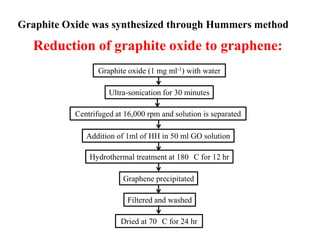
Graphite Oxide was synthesized through Hummers method

Reduction of graphite oxide to graphene:
Graphite oxide (1 mg ml-1) with water
Ultra-sonication for 30 minutes
Centrifuged at 16,000 rpm and solution is separated
Addition of 1ml of HH in 50 ml GO solution

Hydrothermal treatment at 180 C for 12 hr
Graphene precipitated

Filtered and washed
Dried at 70 C for 24 hr
Graphene thin film through Screen printing
method :
Paste = Graphene (90%) + Tr-X-100 (10%)

Squeegee blade

Graphene thin film

Screen
Structural and Morphological measurements:
BET Study:
Fabrication of coin cell-type symmetric supercapacitor
device:
Electrochemical measurements:
81 F g-1

36 F g-1

ESR = 85.2 Ω cm-2
Rct = 121.3 Ω cm-2

S.E. = 24.5 Whkg-1
S.P. = 10 kWkg-1
Conclusions
 Successfully fabricated coin cell-type symmetric supercapacitor
based on graphene thin film with economical construction route.
 Electrochemical measurements exhibits boost up performance of
graphene based coin cell-type symmetric supercapacitor device,
like specific capacitance of 81 Fg-1, specific energy of 24.5 Whkg-1
and specific power of 10 kWkg-1.
 The obtained performance can be further enhanced through using
composite electrode material of graphene and metal oxides or
polymers or both.
Acknowledgement

 Department of Physics, Shivaji University, Kolhapur.
DAE-BRNS, Mumbai.
116 girish

116 girish

  • 1.
    “Study of Graphenebased coin cell-type symmetric supercapacitor” BY Mr. Girish Sambhaji Gund M. Sc. UNDER THE GUIDANCE OF Prof. C. D. Lokhande M. Sc., Ph. D. THIN FILM PHYSICS LABORATORY, DEPARTMENT OF PHYSICS, SHIVAJI UNIVERSITY, KOLHAPUR - 416 004 (INDIA) 2013
  • 2.
    Plan of Presentation Objectives Introductionto supercapacitor  Why graphene?  Graphene thin films by screen printing  Characterization of graphene thin films  Device fabrication and performance evaluation of coin cell-type symmetric device based on graphene thin films in non-aqueous electrolyte  Demonstration  Conclusions
  • 3.
    Objectives To develop efficient,small size and low cost energy storage device in order to employ in portable electronics. The use of carbon based electrode material in supercapacitor as its abundant in nature with the intention to replace toxic and high cost RuO2 and IrO2.
  • 4.
    Supercapacitors A Supercapacitor isan electrochemical capacitor that has an high energy density and capacitance compare to ordinary capacitor.  APPLICATIONS  ADVANTAGES OVER BATTERIES 1. Power Electronics 1. Very high rates of charge and 2. Telecommunication Devices discharge 2. Little degradation over hundreds of thousands of cycles 3. Satellites 4. Standby Power Systems 3. Good reversibility 5. Electrical Hybrid Vehicles 4. Low toxicity of materials used. 5. High cycle efficiency (95% or more)
  • 5.
    Types of Supercapacitor Electric Double layer capacitors (EDLCs): The storage mechanism involves charge separation at electrode – electrolyte interface (carbon based).  Pseudocapacitors: Pseudocapacitance arises from reversible Faradaic reactions occurring at the electrode, and is denoted as ‘pseudo’-capacitance in order to differentiate it from electrostatic capacitance. Requirements for Supercapacitive electrode:     High conductivity Large surface area Good chemical stability Good reversibility Materials used for supercapacitors    Carbon Transition Metal Oxides Conducting Polymers (Polyaniline, Polypyrrole etc)
  • 6.
    Why Graphene?  Amongthe all carbon allotropes, graphene has an attractive view because of the,  High electrical conductivity  High specific surface area  High mechanical strength  High chemical stability
  • 7.
    Graphite Oxide wassynthesized through Hummers method Reduction of graphite oxide to graphene: Graphite oxide (1 mg ml-1) with water Ultra-sonication for 30 minutes Centrifuged at 16,000 rpm and solution is separated Addition of 1ml of HH in 50 ml GO solution Hydrothermal treatment at 180 C for 12 hr Graphene precipitated Filtered and washed Dried at 70 C for 24 hr
  • 8.
    Graphene thin filmthrough Screen printing method : Paste = Graphene (90%) + Tr-X-100 (10%) Squeegee blade Graphene thin film Screen
  • 9.
  • 10.
  • 11.
    Fabrication of coincell-type symmetric supercapacitor device:
  • 12.
    Electrochemical measurements: 81 Fg-1 36 F g-1 ESR = 85.2 Ω cm-2 Rct = 121.3 Ω cm-2 S.E. = 24.5 Whkg-1 S.P. = 10 kWkg-1
  • 14.
    Conclusions  Successfully fabricatedcoin cell-type symmetric supercapacitor based on graphene thin film with economical construction route.  Electrochemical measurements exhibits boost up performance of graphene based coin cell-type symmetric supercapacitor device, like specific capacitance of 81 Fg-1, specific energy of 24.5 Whkg-1 and specific power of 10 kWkg-1.  The obtained performance can be further enhanced through using composite electrode material of graphene and metal oxides or polymers or both.
  • 15.
    Acknowledgement  Department ofPhysics, Shivaji University, Kolhapur. DAE-BRNS, Mumbai.