Using Maestro and Gaussian 09 in the Qualitative analysis of
Endiynes (enyne-allenes)
Abstract
By Dr. Robert D. Craig,Ph.D.
-8,10,11 trihydroxy- 9- Bicyclo(7:2:2)undec 2- yne,4-ene,6-yne
Students in my group have carried out DFT and various Analytical techniques to study an
enyne-allene OR Enediyne- C11H5O4. Mapping the synthesize of C11H5O4 was done with alpha-
butanone. The FT-NMR (1
H and 13
C) and FT-Raman were obtained . The spectra was adequate to
analyze and were compared to literature values. The Mulliken, Lowdin, and NBO analysis were also
carried out on the enediynes. Students became familiar with DFT analysis , and using the molecule,
completed with respect each instrument (UV-VIS, FT-NMR, and FT-IR) using the B-3-YLP/6-311++(2p,3d),
MP2, and RHF-STO-3G-basis sets. The calculated HOMO and LUMO values were compared with spectra
taken on the Cary Fluorescence spectrophotometer.
Introduction
Ref 1
Enediynes undergo a Bergman cyclization reaction to form the labile 1,4-didehy-
drobenzene (p-benzyne) biradical. (1-3) The energetics of this reaction and the related
Schreiner–Pascal reaction as well as that of the Myers–Saito and Schmittel reactions of enyne-
allenes are discussed on the basis of a variety of quantum chemical and available experimental
results. (4-6)The computational investigation of enediynes has been beneficial for both
experimentalists and theoreticians because it has led to new synthetic challenges and new
computational methodologies. The computer-assisted drug design of new antitumor antibiotics
based on the biological activity of natural enediynes in now very popular for the understanding
of catalyzed enediyne reactions
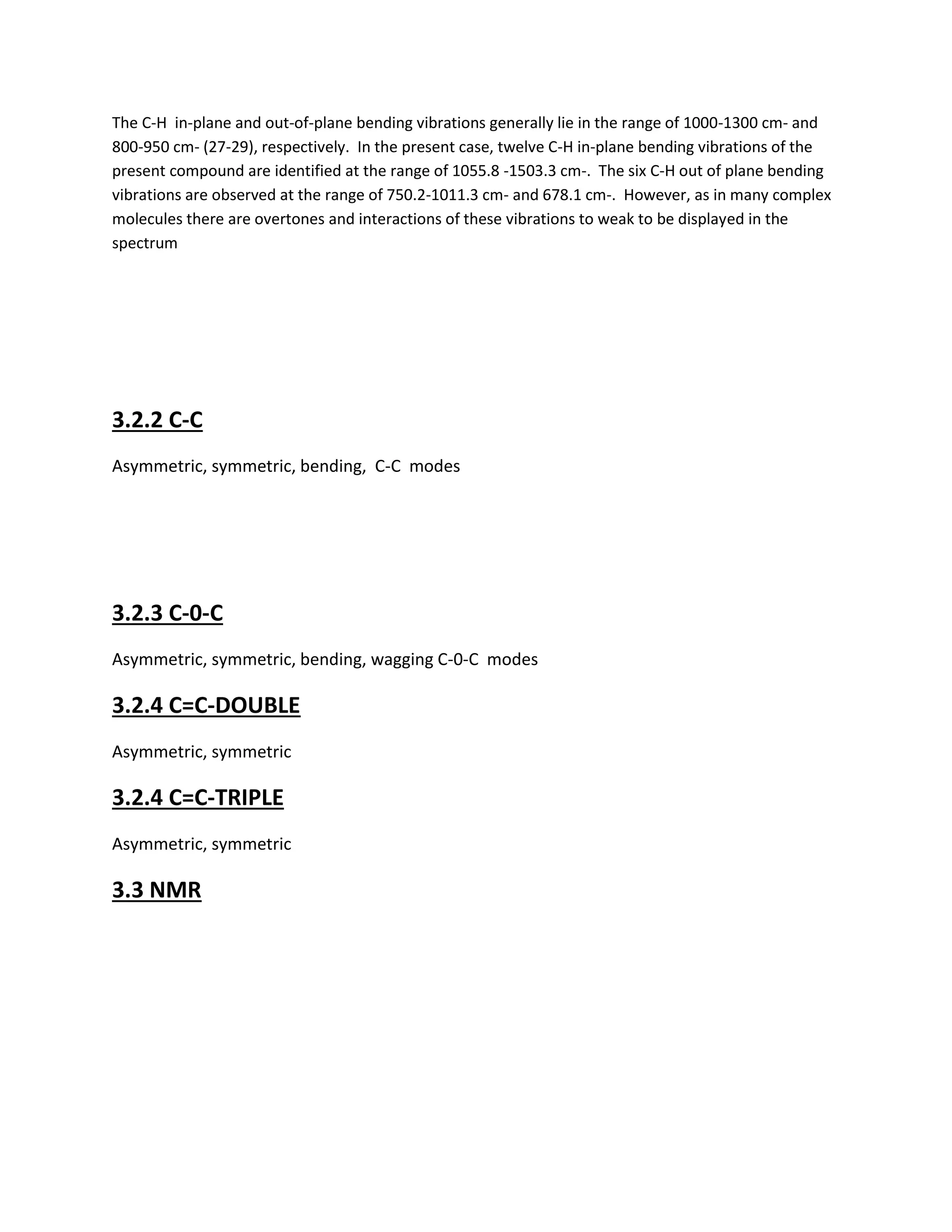
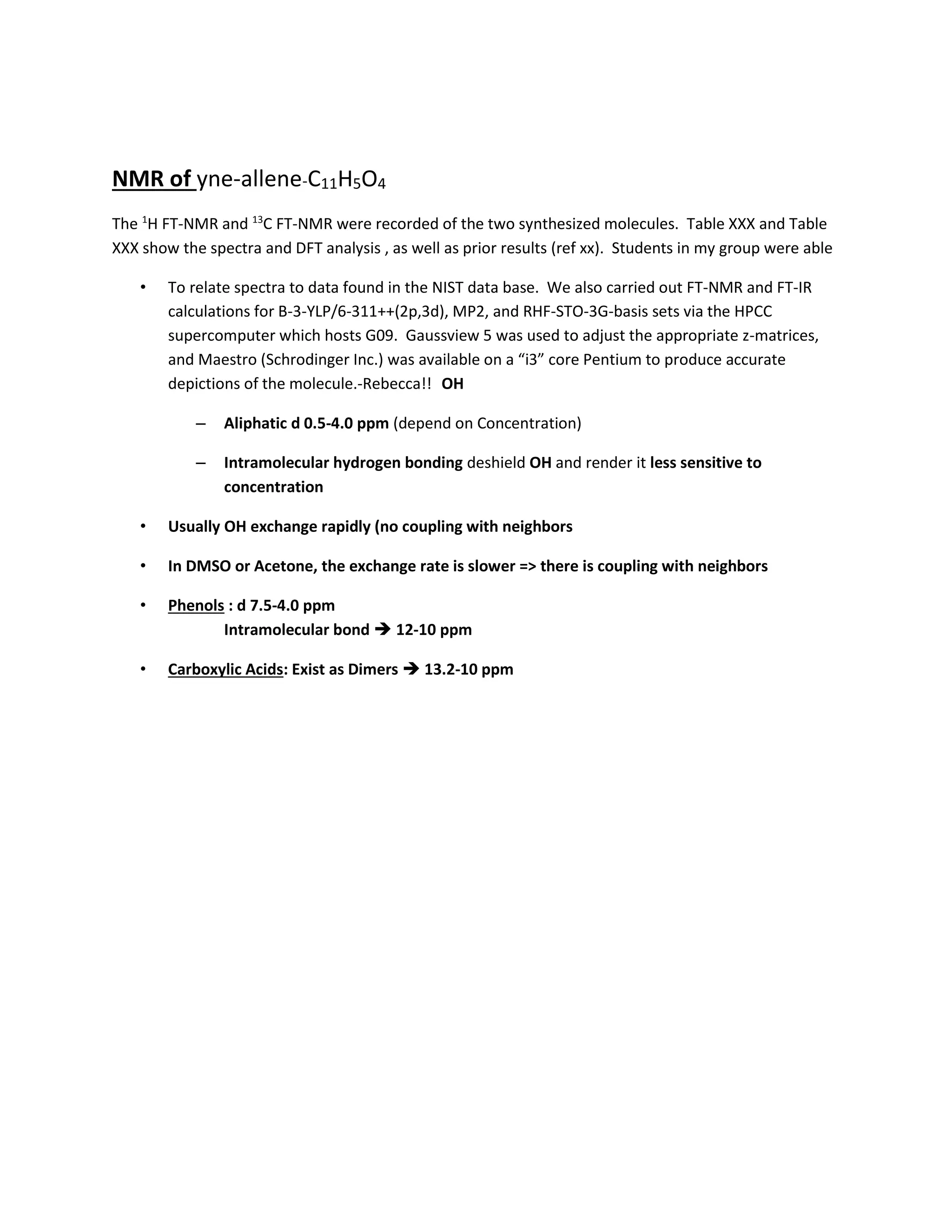
Figure one shows Bicyclo(7:2:2)deca 2,4,6-yne-allene-8,10,11 triol -THIS IS J5-NEED 11 PREFIX
Bicyclo[7:2:2] triol molecule 72- C11H5O4 and Molecule 73- C17H11O4
Ref 2
These two molecules are compared as to the stability of the enyne-allene, with the distance of the
triple bond.
2. computational Methods
This protocol is intended to provide chemists who discover or make new organic compounds
with a valuable tool for validating the structural assignments of those new chemical entities.
Experimental 1
H and/or 13
C NMR spectral data and its proper interpretation for the compound of
interest is required as a starting point. The approach involves the following steps: (i) using
molecular mechanics calculations (with, e.g., Maestro) to generate a suitable structure; (ii) using
density functional theory (DFT) calculations (with, e.g., Gaussian 09) to determine optimal
geometry, infrared absorptions and chemical shifts (iii) comparing the computed chemical shifts
for two or more candidate structures with experimental data to determine the best fit.
Below in Table xx, is a brief summary of the steps
Table XX:
1. first obtaining computational data for your molecule of interest
1. Draw your biologically significant molecule using Maestro by Schrodinger (i3 processor is fine)
2. produce an "SDF" file
3. open the SDF file in Avogadro-run the Geometry optimization
4. send the Geometry optimized z-matrix to Gaussian 09 (HPCC "Bob")
5 run the FT-IR, Raman, conformation analysis, and FT NMR using the B-3-YLP/6-311++(2p,3d), MP2,
and RHF-STO-3G-basis sets
6. You can run PC Gamess/Firefly and "MASK" to get adequate HOMO and LUMO and VPE on an "i3" Core
3. Results and discussion
3.1 geometry
3.2 the vibrational frequencies
3.2.1 C-H
Bicyclo(7:2:2) 2,4,6-yne-allene-4,12,16 triol has aromatic ring structures that can easily be
determined due to relation of the C-H and C=C-C ring vibrations. For simplicity, the modes of
the vibrations of aromatic compounds are considered as separate C-H and C-C vibrations. The
C-H stretching occurs above 3000 cm-and is typically exhibited as a multiplicity of weak to
moderate bands, compared with that of aliphatic C-H stretching (25). The C-H stretch
vibrations of an aliphatic ring (26) are expected in the region of 3000- 3120 cm-. the calculated
values of the target molecule have been found to be 3223.5, 3223.0, 3207.7, 3207.6, 3159.6
and 3187.7 cm- at the using the B-3-YLP/6-311++(2p,3d) level of calculation.
The theorectical computed C-H vibrations by the B-3-YLP/6-311++(2p,3d), are reported here, as this
molecule has no been synthesized
The C-H in-plane and out-of-plane bending vibrations generally lie in the range of 1000-1300 cm- and
800-950 cm- (27-29), respectively. In the present case, twelve C-H in-plane bending vibrations of the
present compound are identified at the range of 1055.8 -1503.3 cm-. The six C-H out of plane bending
vibrations are observed at the range of 750.2-1011.3 cm- and 678.1 cm-. However, as in many complex
molecules there are overtones and interactions of these vibrations to weak to be displayed in the
spectrum
3.2.2 C-C
Asymmetric, symmetric, bending, C-C modes
3.2.3 C-0-C
Asymmetric, symmetric, bending, wagging C-0-C modes
3.2.4 C=C-DOUBLE
Asymmetric, symmetric
3.2.4 C=C-TRIPLE
Asymmetric, symmetric
3.3 NMR
NMR of yne-allene-C11H5O4
The 1
H FT-NMR and 13
C FT-NMR were recorded of the two synthesized molecules. Table XXX and Table
XXX show the spectra and DFT analysis , as well as prior results (ref xx). Students in my group were able
• To relate spectra to data found in the NIST data base. We also carried out FT-NMR and FT-IR
calculations for B-3-YLP/6-311++(2p,3d), MP2, and RHF-STO-3G-basis sets via the HPCC
supercomputer which hosts G09. Gaussview 5 was used to adjust the appropriate z-matrices,
and Maestro (Schrodinger Inc.) was available on a “i3” core Pentium to produce accurate
depictions of the molecule.-Rebecca!! OH
– Aliphatic d 0.5-4.0 ppm (depend on Concentration)
– Intramolecular hydrogen bonding deshield OH and render it less sensitive to
concentration
• Usually OH exchange rapidly (no coupling with neighbors
• In DMSO or Acetone, the exchange rate is slower => there is coupling with neighbors
• Phenols : d 7.5-4.0 ppm
Intramolecular bond  12-10 ppm
• Carboxylic Acids: Exist as Dimers  13.2-10 ppm
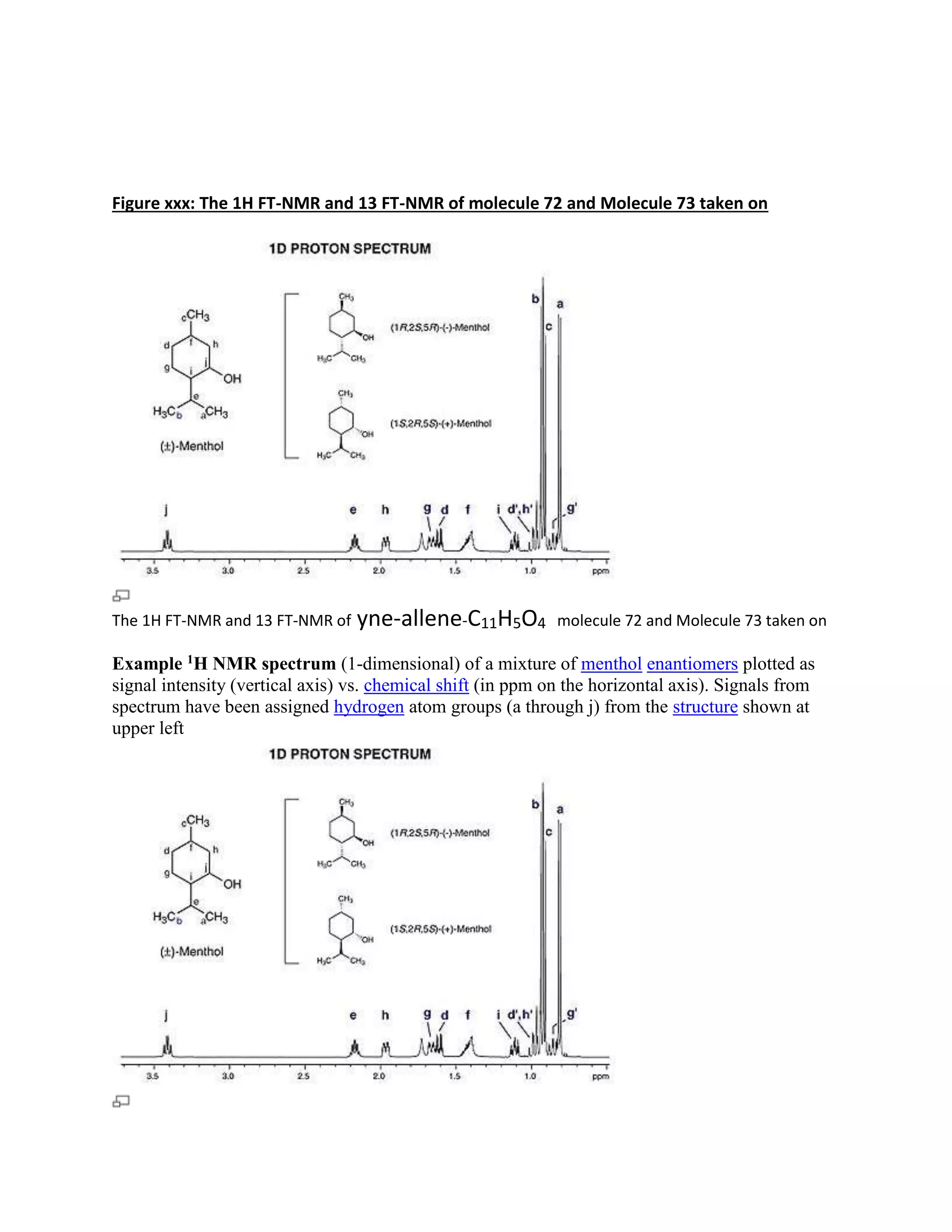
Figure xxx: The 1H FT-NMR and 13 FT-NMR of molecule 72 and Molecule 73 taken on
The 1H FT-NMR and 13 FT-NMR of yne-allene-C11H5O4 molecule 72 and Molecule 73 taken on
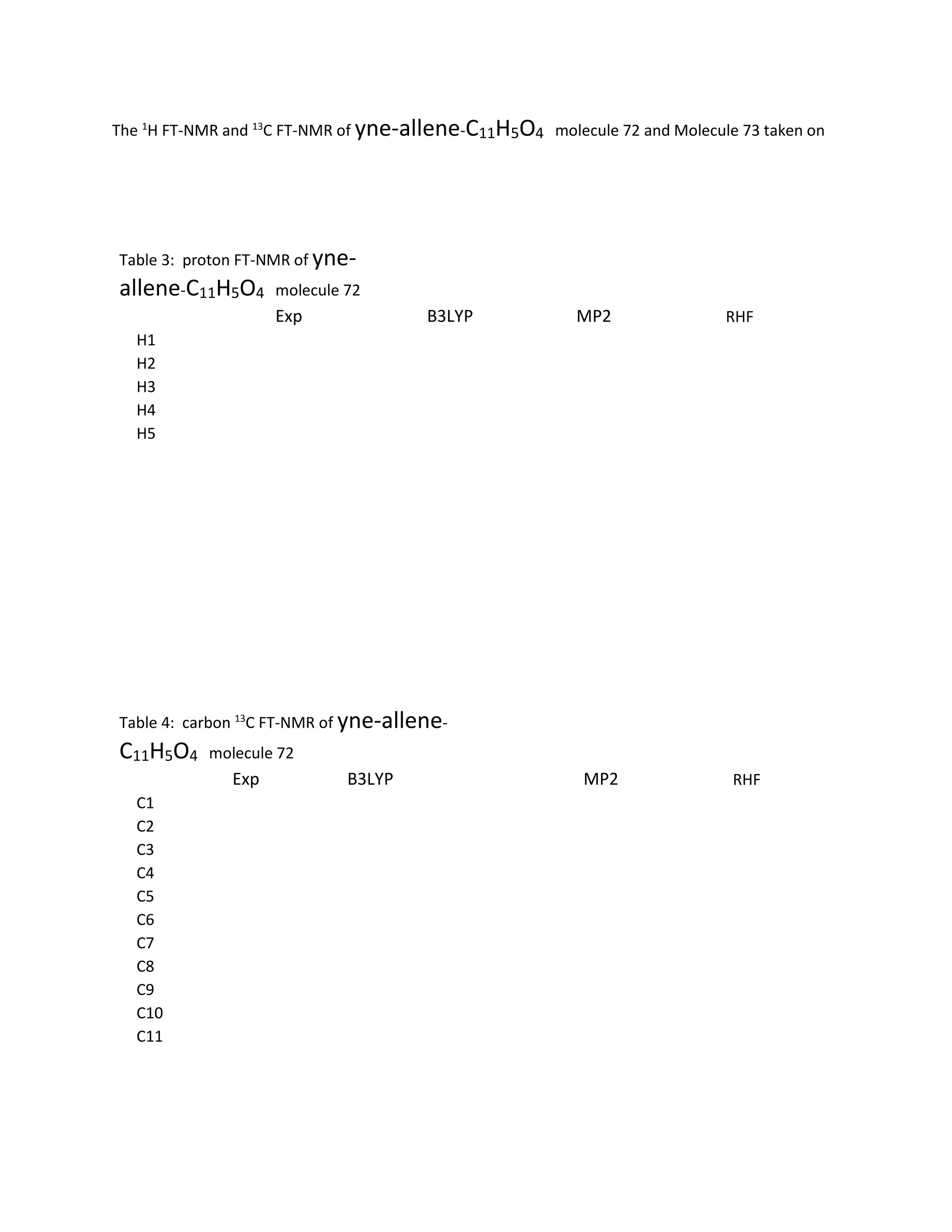
Example 1H NMR spectrum (1-dimensional) of a mixture of menthol enantiomers plotted as
signal intensity (vertical axis) vs. chemical shift (in ppm on the horizontal axis). Signals from
spectrum have been assigned hydrogen atom groups (a through j) from the structure shown at
upper left
The 1
H FT-NMR and 13
C FT-NMR of yne-allene-C11H5O4 molecule 72 and Molecule 73 taken on
Table 3: proton FT-NMR of yne-
allene-C11H5O4 molecule 72
Exp B3LYP MP2 RHF
H1
H2
H3
H4
H5
Table 4: carbon 13
C FT-NMR of yne-allene-
C11H5O4 molecule 72
Exp B3LYP MP2 RHF
C1
C2
C3
C4
C5
C6
C7
C8
C9
C10
C11
UV-Vis of yne-allene-C11H5O4 Molecule 72
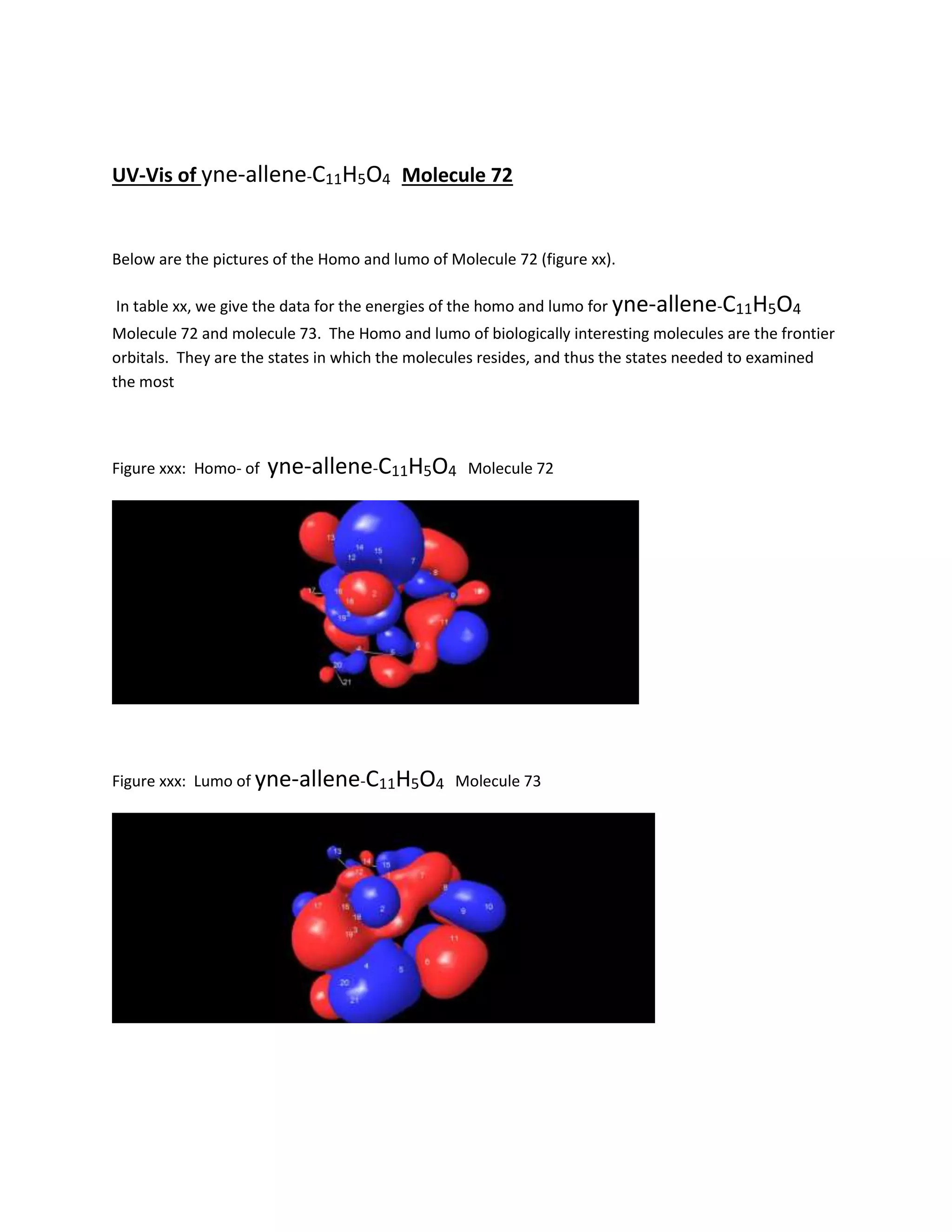
Below are the pictures of the Homo and lumo of Molecule 72 (figure xx).
In table xx, we give the data for the energies of the homo and lumo for yne-allene-C11H5O4
Molecule 72 and molecule 73. The Homo and lumo of biologically interesting molecules are the frontier
orbitals. They are the states in which the molecules resides, and thus the states needed to examined
the most
Figure xxx: Homo- of yne-allene-C11H5O4 Molecule 72
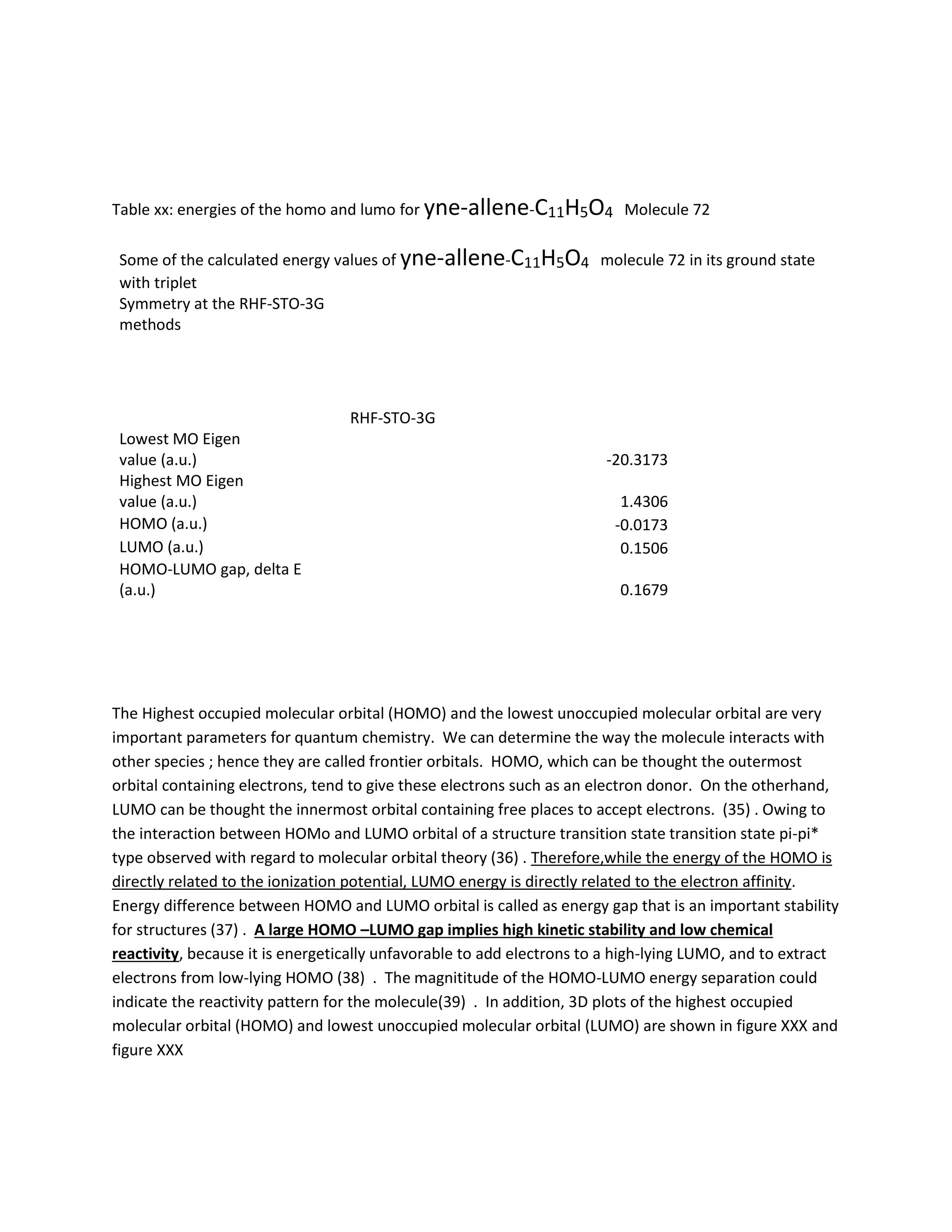
Figure xxx: Lumo of yne-allene-C11H5O4 Molecule 73
Table xx: energies of the homo and lumo for yne-allene-C11H5O4 Molecule 72
Some of the calculated energy values of yne-allene-C11H5O4 molecule 72 in its ground state
with triplet
Symmetry at the RHF-STO-3G
methods
RHF-STO-3G
Lowest MO Eigen
value (a.u.) -20.3173
Highest MO Eigen
value (a.u.) 1.4306
HOMO (a.u.) -0.0173
LUMO (a.u.) 0.1506
HOMO-LUMO gap, delta E
(a.u.) 0.1679
The Highest occupied molecular orbital (HOMO) and the lowest unoccupied molecular orbital are very
important parameters for quantum chemistry. We can determine the way the molecule interacts with
other species ; hence they are called frontier orbitals. HOMO, which can be thought the outermost
orbital containing electrons, tend to give these electrons such as an electron donor. On the otherhand,
LUMO can be thought the innermost orbital containing free places to accept electrons. (35) . Owing to
the interaction between HOMo and LUMO orbital of a structure transition state transition state pi-pi*
type observed with regard to molecular orbital theory (36) . Therefore,while the energy of the HOMO is
directly related to the ionization potential, LUMO energy is directly related to the electron affinity.
Energy difference between HOMO and LUMO orbital is called as energy gap that is an important stability
for structures (37) . A large HOMO –LUMO gap implies high kinetic stability and low chemical
reactivity, because it is energetically unfavorable to add electrons to a high-lying LUMO, and to extract
electrons from low-lying HOMO (38) . The magnititude of the HOMO-LUMO energy separation could
indicate the reactivity pattern for the molecule(39) . In addition, 3D plots of the highest occupied
molecular orbital (HOMO) and lowest unoccupied molecular orbital (LUMO) are shown in figure XXX and
figure XXX
NBO ANALSIS OF yne-allene-C11H5O4 MOLECULE 72
Mulliken atomic charges:
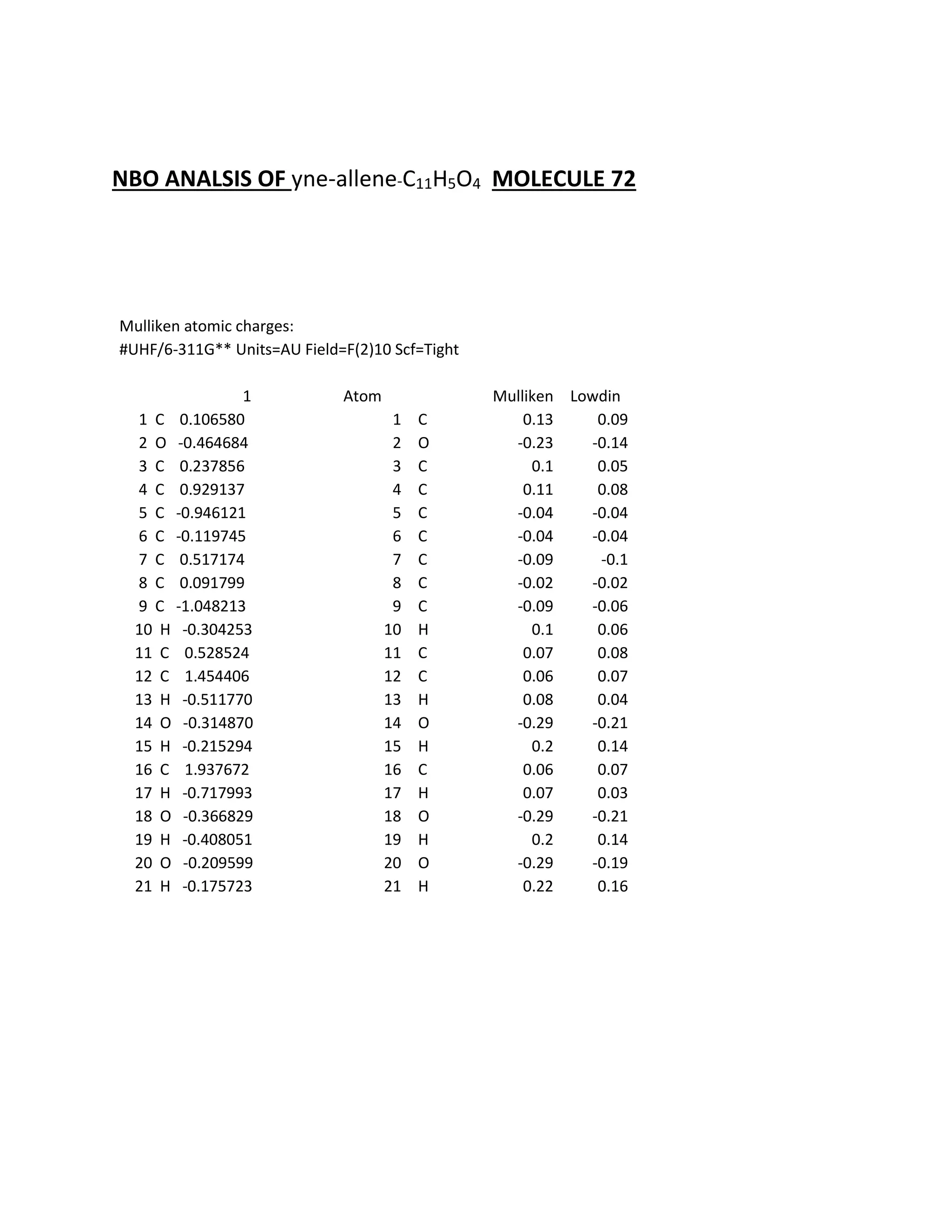
#UHF/6-311G** Units=AU Field=F(2)10 Scf=Tight
1 Atom Mulliken Lowdin
1 C 0.106580 1 C 0.13 0.09
2 O -0.464684 2 O -0.23 -0.14
3 C 0.237856 3 C 0.1 0.05
4 C 0.929137 4 C 0.11 0.08
5 C -0.946121 5 C -0.04 -0.04
6 C -0.119745 6 C -0.04 -0.04
7 C 0.517174 7 C -0.09 -0.1
8 C 0.091799 8 C -0.02 -0.02
9 C -1.048213 9 C -0.09 -0.06
10 H -0.304253 10 H 0.1 0.06
11 C 0.528524 11 C 0.07 0.08
12 C 1.454406 12 C 0.06 0.07
13 H -0.511770 13 H 0.08 0.04
14 O -0.314870 14 O -0.29 -0.21
15 H -0.215294 15 H 0.2 0.14
16 C 1.937672 16 C 0.06 0.07
17 H -0.717993 17 H 0.07 0.03
18 O -0.366829 18 O -0.29 -0.21
19 H -0.408051 19 H 0.2 0.14
20 O -0.209599 20 O -0.29 -0.19
21 H -0.175723 21 H 0.22 0.16
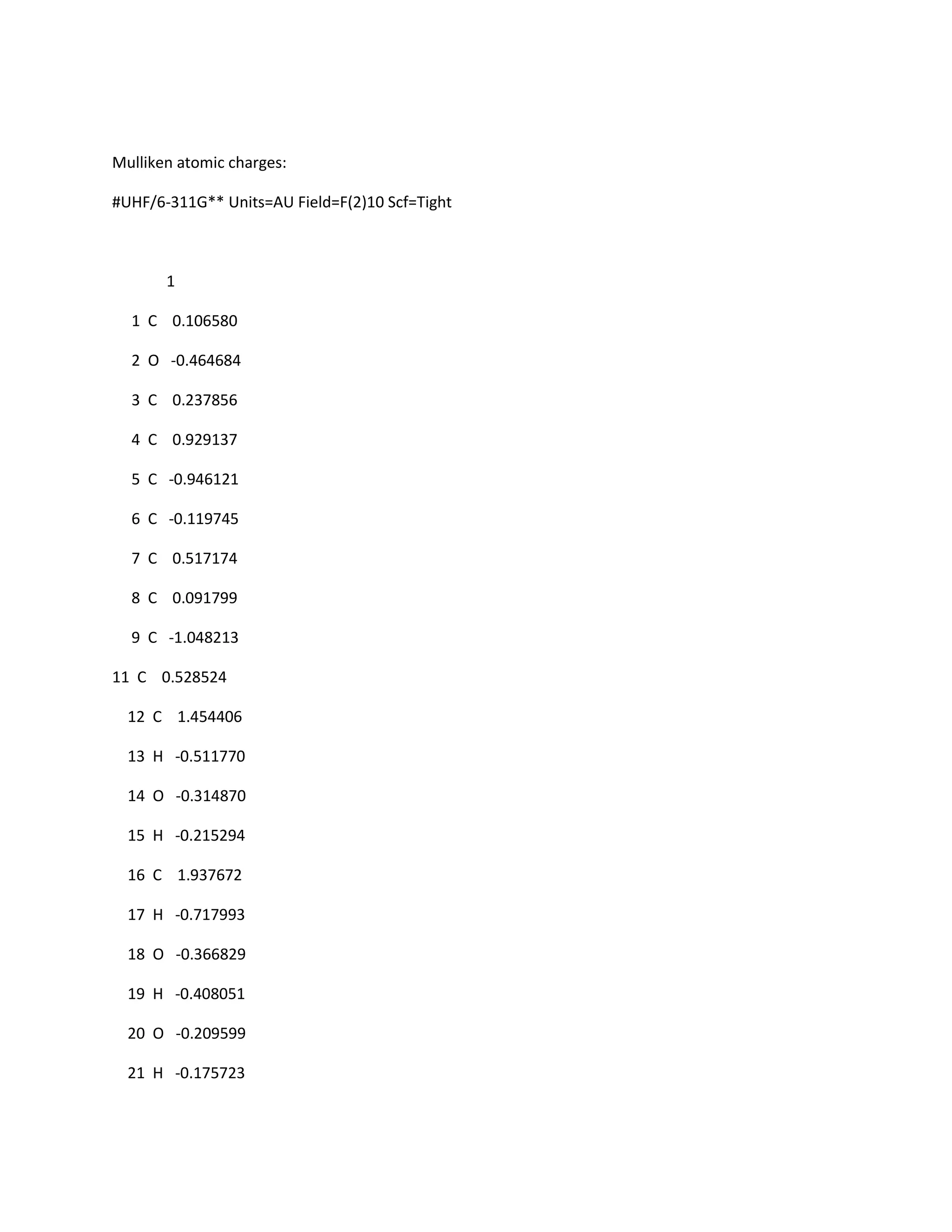
Mulliken atomic charges:
#UHF/6-311G** Units=AU Field=F(2)10 Scf=Tight
1
1 C 0.106580
2 O -0.464684
3 C 0.237856
4 C 0.929137
5 C -0.946121
6 C -0.119745
7 C 0.517174
8 C 0.091799
9 C -1.048213
11 C 0.528524
12 C 1.454406
13 H -0.511770
14 O -0.314870
15 H -0.215294
16 C 1.937672
17 H -0.717993
18 O -0.366829
19 H -0.408051
20 O -0.209599
21 H -0.175723
CALCULATED BOND DISTANCES AND EXPERIEMENTAL X-RAY DATA
UV -VIS
Next is the spectrum taken by our group of Bicyclo(7:2:2) 2,4,6-yne-allene-4,12,16 triol on the Cary
Flourescence spectrophometer. Figure xxx is shown first. It shows pi to pi* transitions of the 1,9 diene,3
–yne-doca-aryne ring
Figure xxx: Flourescence of molecule Bicyclo(7:2:2) 2,4,6-yne-allene-9,10,13 triol
taken on the Cary Flourescence spectrophometer
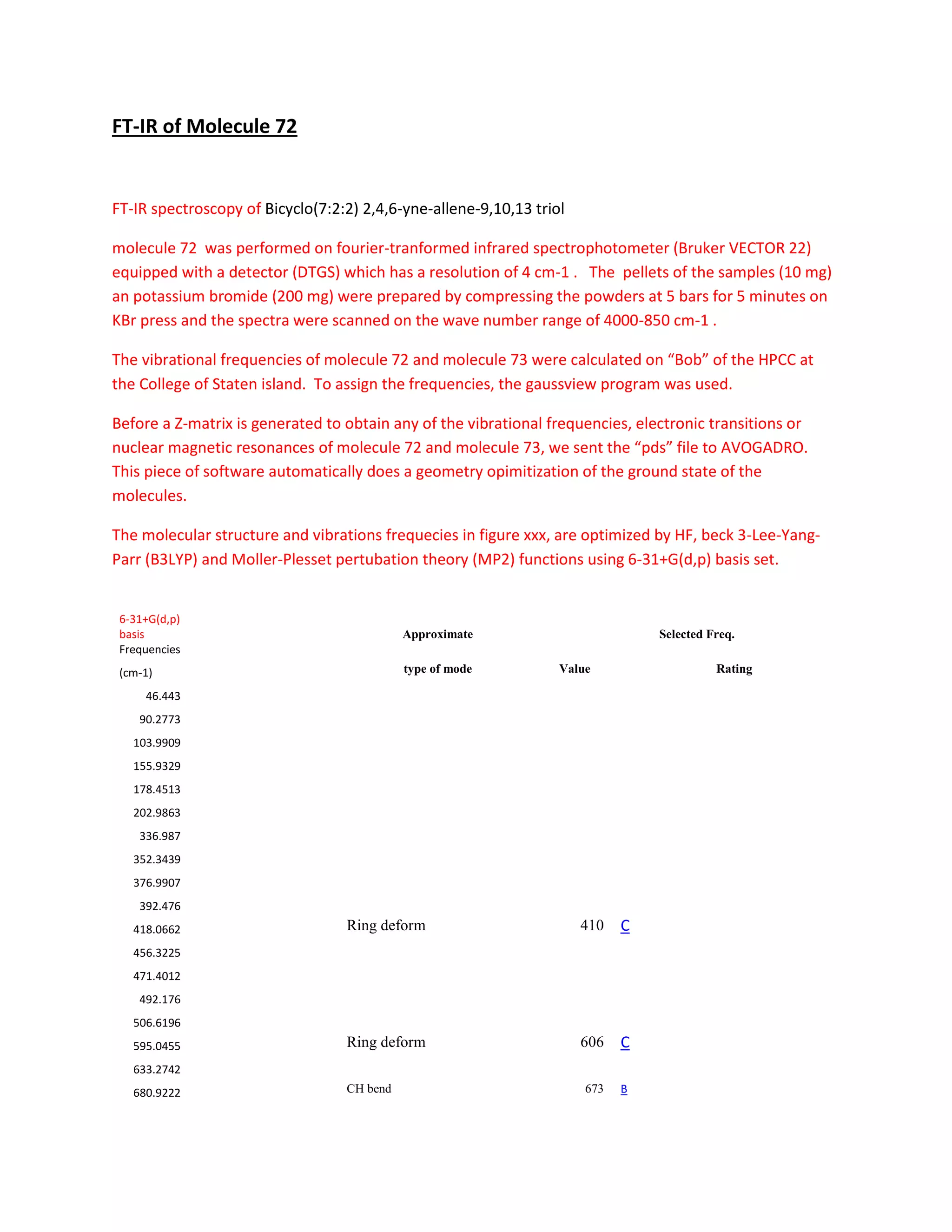
FT-IR of Molecule 72
FT-IR spectroscopy of Bicyclo(7:2:2) 2,4,6-yne-allene-9,10,13 triol
molecule 72 was performed on fourier-tranformed infrared spectrophotometer (Bruker VECTOR 22)
equipped with a detector (DTGS) which has a resolution of 4 cm-1 . The pellets of the samples (10 mg)
an potassium bromide (200 mg) were prepared by compressing the powders at 5 bars for 5 minutes on
KBr press and the spectra were scanned on the wave number range of 4000-850 cm-1 .
The vibrational frequencies of molecule 72 and molecule 73 were calculated on “Bob” of the HPCC at
the College of Staten island. To assign the frequencies, the gaussview program was used.
Before a Z-matrix is generated to obtain any of the vibrational frequencies, electronic transitions or
nuclear magnetic resonances of molecule 72 and molecule 73, we sent the “pds” file to AVOGADRO.
This piece of software automatically does a geometry opimitization of the ground state of the
molecules.
The molecular structure and vibrations frequecies in figure xxx, are optimized by HF, beck 3-Lee-Yang-
Parr (B3LYP) and Moller-Plesset pertubation theory (MP2) functions using 6-31+G(d,p) basis set.
6-31+G(d,p)
basis
Frequencies
Approximate Selected Freq.
(cm-1) type of mode Value Rating
46.443
90.2773
103.9909
155.9329
178.4513
202.9863
336.987
352.3439
376.9907
392.476
418.0662 Ring deform 410 C
456.3225
471.4012
492.176
506.6196
595.0455 Ring deform 606 C
633.2742
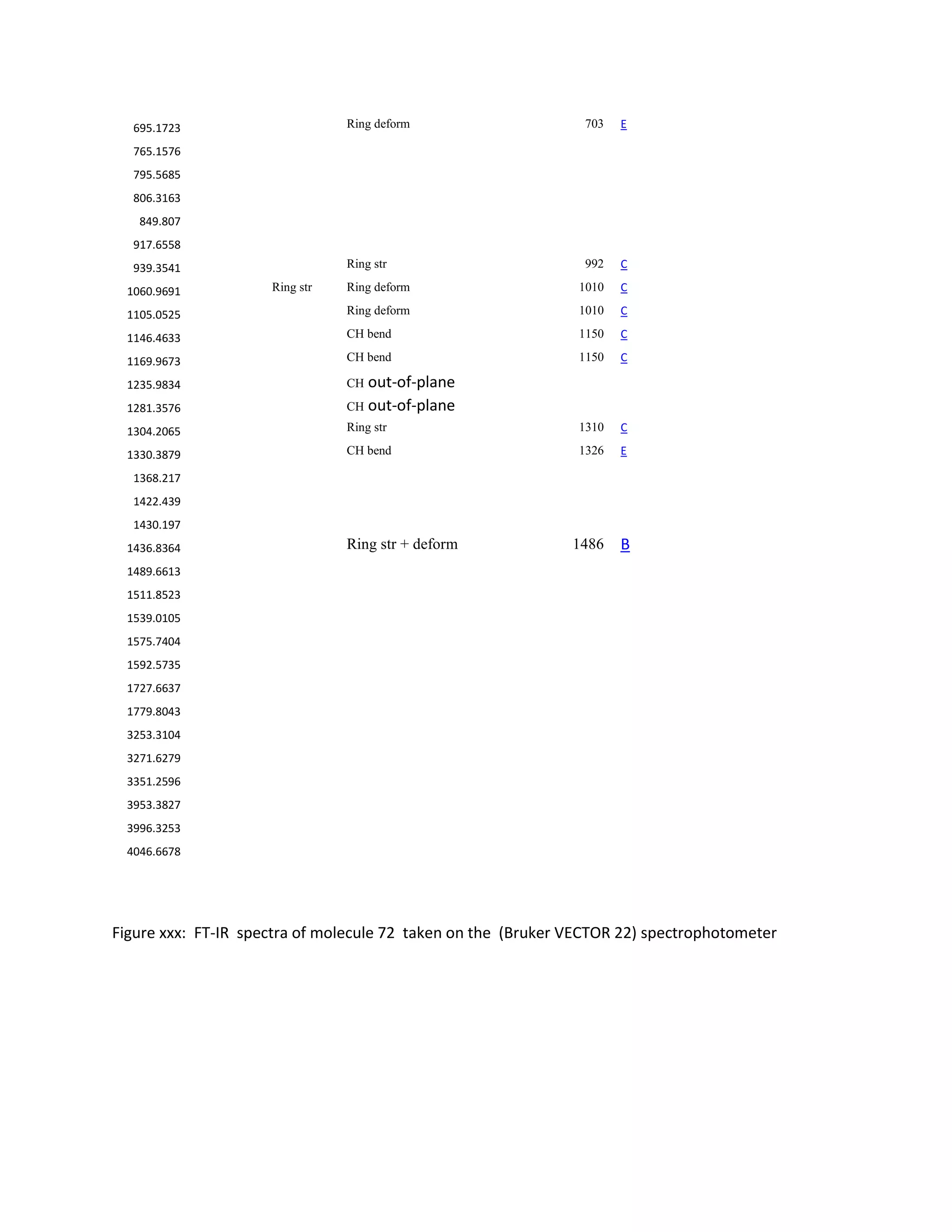
680.9222 CH bend 673 B
695.1723 Ring deform 703 E
765.1576
795.5685
806.3163
849.807
917.6558
939.3541 Ring str 992 C
1060.9691 Ring str Ring deform 1010 C
1105.0525 Ring deform 1010 C
1146.4633 CH bend 1150 C
1169.9673 CH bend 1150 C
1235.9834 CH out-of-plane
1281.3576 CH out-of-plane
1304.2065 Ring str 1310 C
1330.3879 CH bend 1326 E
1368.217
1422.439
1430.197
1436.8364 Ring str + deform 1486 B
1489.6613
1511.8523
1539.0105
1575.7404
1592.5735
1727.6637
1779.8043
3253.3104
3271.6279
3351.2596
3953.3827
3996.3253
4046.6678
Figure xxx: FT-IR spectra of molecule 72 taken on the (Bruker VECTOR 22) spectrophotometer
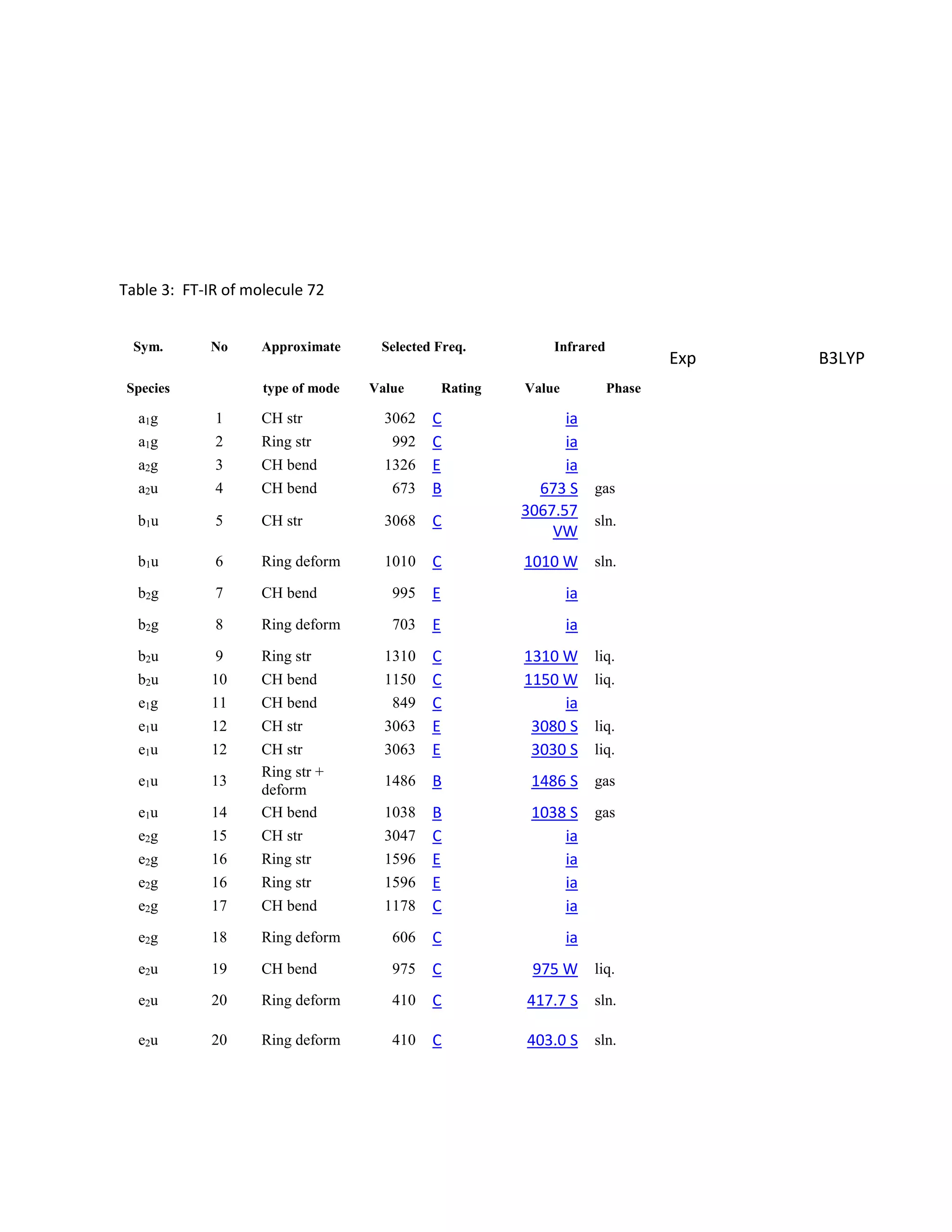
Table 3: FT-IR of molecule 72
Sym. No Approximate Selected Freq. Infrared
Exp B3LYP
Species type of mode Value Rating Value Phase
a1g 1 CH str 3062 C ia
a1g 2 Ring str 992 C ia
a2g 3 CH bend 1326 E ia
a2u 4 CH bend 673 B 673 S gas
b1u 5 CH str 3068 C
3067.57
VW
sln.
b1u 6 Ring deform 1010 C 1010 W sln.
b2g 7 CH bend 995 E ia
b2g 8 Ring deform 703 E ia
b2u 9 Ring str 1310 C 1310 W liq.
b2u 10 CH bend 1150 C 1150 W liq.
e1g 11 CH bend 849 C ia
e1u 12 CH str 3063 E 3080 S liq.
e1u 12 CH str 3063 E 3030 S liq.
e1u 13
Ring str +
deform
1486 B 1486 S gas
e1u 14 CH bend 1038 B 1038 S gas
e2g 15 CH str 3047 C ia
e2g 16 Ring str 1596 E ia
e2g 17 CH bend 1178 C ia
e2g 18 Ring deform 606 C ia
e2u 19 CH bend 975 C 975 W liq.
e2u 20 Ring deform 410 C 417.7 S sln.
e2u 20 Ring deform 410 C 403.0 S sln.
References
Ref 1
Elfi Kraka, Dieter Cremer, ”Enediynes, enyne‐allenes, their reactions, and beyond”, Corros. Sci. 50 (2013)
1174
Published Online: Oct 08 2013
DOI: 10.1002/wcms.1174
 How to cite this article
Ref 1
Masahiro Hirama, Kimio Akiyama, Parthasarathi Das, Takashi Mita, Martin J Lear, Kyo-Ichiro Iida, Itaru Sato,
Fumihiko Yoshimura, Toyonobu Usuki, Shozo Tero-Kubota
DIRECT OBSERVATION OF ESR SPECTRA OF BICYCLIC NINE-MEMBERED ENEDIYNES AT
AMBIENT TEMPERATURE
Thioxanane paper
(35) G.Gece, Corros. Sci. 50 (2008) 2981.
(36) K. Fukui, Theory of Orientation and Stereoselection, Springer-Verlag, Berlin
1975, see also: K.Fukui, Science 218 (1987) 747.
(37) D.F. V. Lewis, C. Loannides, D.V Parke, Xenobiotica 24 (1994) 401.
(38) B. Chattophadhyay, S. Basu, P. Chakraborty, S.K. Choudhury, A.K.
Mukherjee, M. Mukherjee, J.Mol. Structu 932 (2009) 90.
7. Willoughby, P. H., Jansma, M. J. & Hoye, T. R A guide to small-molecule structure
assignment through computation of (1
H and 13
C) NMR chemical shifts. Nature Protocols 9, 643–
660 (2014)
7. Willoughby, P. H., Jansma, M. J. & Hoye, T. R.
Qualitative and  dft analysis of endiynes

Qualitative and dft analysis of endiynes

  • 1.
    Using Maestro andGaussian 09 in the Qualitative analysis of Endiynes (enyne-allenes) Abstract By Dr. Robert D. Craig,Ph.D. -8,10,11 trihydroxy- 9- Bicyclo(7:2:2)undec 2- yne,4-ene,6-yne Students in my group have carried out DFT and various Analytical techniques to study an enyne-allene OR Enediyne- C11H5O4. Mapping the synthesize of C11H5O4 was done with alpha- butanone. The FT-NMR (1 H and 13 C) and FT-Raman were obtained . The spectra was adequate to analyze and were compared to literature values. The Mulliken, Lowdin, and NBO analysis were also carried out on the enediynes. Students became familiar with DFT analysis , and using the molecule, completed with respect each instrument (UV-VIS, FT-NMR, and FT-IR) using the B-3-YLP/6-311++(2p,3d), MP2, and RHF-STO-3G-basis sets. The calculated HOMO and LUMO values were compared with spectra taken on the Cary Fluorescence spectrophotometer. Introduction Ref 1 Enediynes undergo a Bergman cyclization reaction to form the labile 1,4-didehy- drobenzene (p-benzyne) biradical. (1-3) The energetics of this reaction and the related Schreiner–Pascal reaction as well as that of the Myers–Saito and Schmittel reactions of enyne- allenes are discussed on the basis of a variety of quantum chemical and available experimental results. (4-6)The computational investigation of enediynes has been beneficial for both experimentalists and theoreticians because it has led to new synthetic challenges and new computational methodologies. The computer-assisted drug design of new antitumor antibiotics based on the biological activity of natural enediynes in now very popular for the understanding of catalyzed enediyne reactions Figure one shows Bicyclo(7:2:2)deca 2,4,6-yne-allene-8,10,11 triol -THIS IS J5-NEED 11 PREFIX Bicyclo[7:2:2] triol molecule 72- C11H5O4 and Molecule 73- C17H11O4
  • 2.
    Ref 2 These twomolecules are compared as to the stability of the enyne-allene, with the distance of the triple bond. 2. computational Methods This protocol is intended to provide chemists who discover or make new organic compounds with a valuable tool for validating the structural assignments of those new chemical entities. Experimental 1 H and/or 13 C NMR spectral data and its proper interpretation for the compound of interest is required as a starting point. The approach involves the following steps: (i) using molecular mechanics calculations (with, e.g., Maestro) to generate a suitable structure; (ii) using density functional theory (DFT) calculations (with, e.g., Gaussian 09) to determine optimal geometry, infrared absorptions and chemical shifts (iii) comparing the computed chemical shifts for two or more candidate structures with experimental data to determine the best fit. Below in Table xx, is a brief summary of the steps
  • 3.
    Table XX: 1. firstobtaining computational data for your molecule of interest 1. Draw your biologically significant molecule using Maestro by Schrodinger (i3 processor is fine) 2. produce an "SDF" file 3. open the SDF file in Avogadro-run the Geometry optimization 4. send the Geometry optimized z-matrix to Gaussian 09 (HPCC "Bob") 5 run the FT-IR, Raman, conformation analysis, and FT NMR using the B-3-YLP/6-311++(2p,3d), MP2, and RHF-STO-3G-basis sets 6. You can run PC Gamess/Firefly and "MASK" to get adequate HOMO and LUMO and VPE on an "i3" Core 3. Results and discussion 3.1 geometry 3.2 the vibrational frequencies 3.2.1 C-H Bicyclo(7:2:2) 2,4,6-yne-allene-4,12,16 triol has aromatic ring structures that can easily be determined due to relation of the C-H and C=C-C ring vibrations. For simplicity, the modes of the vibrations of aromatic compounds are considered as separate C-H and C-C vibrations. The C-H stretching occurs above 3000 cm-and is typically exhibited as a multiplicity of weak to moderate bands, compared with that of aliphatic C-H stretching (25). The C-H stretch vibrations of an aliphatic ring (26) are expected in the region of 3000- 3120 cm-. the calculated values of the target molecule have been found to be 3223.5, 3223.0, 3207.7, 3207.6, 3159.6 and 3187.7 cm- at the using the B-3-YLP/6-311++(2p,3d) level of calculation. The theorectical computed C-H vibrations by the B-3-YLP/6-311++(2p,3d), are reported here, as this molecule has no been synthesized
  • 4.
    The C-H in-planeand out-of-plane bending vibrations generally lie in the range of 1000-1300 cm- and 800-950 cm- (27-29), respectively. In the present case, twelve C-H in-plane bending vibrations of the present compound are identified at the range of 1055.8 -1503.3 cm-. The six C-H out of plane bending vibrations are observed at the range of 750.2-1011.3 cm- and 678.1 cm-. However, as in many complex molecules there are overtones and interactions of these vibrations to weak to be displayed in the spectrum 3.2.2 C-C Asymmetric, symmetric, bending, C-C modes 3.2.3 C-0-C Asymmetric, symmetric, bending, wagging C-0-C modes 3.2.4 C=C-DOUBLE Asymmetric, symmetric 3.2.4 C=C-TRIPLE Asymmetric, symmetric 3.3 NMR
  • 5.
    NMR of yne-allene-C11H5O4 The1 H FT-NMR and 13 C FT-NMR were recorded of the two synthesized molecules. Table XXX and Table XXX show the spectra and DFT analysis , as well as prior results (ref xx). Students in my group were able • To relate spectra to data found in the NIST data base. We also carried out FT-NMR and FT-IR calculations for B-3-YLP/6-311++(2p,3d), MP2, and RHF-STO-3G-basis sets via the HPCC supercomputer which hosts G09. Gaussview 5 was used to adjust the appropriate z-matrices, and Maestro (Schrodinger Inc.) was available on a “i3” core Pentium to produce accurate depictions of the molecule.-Rebecca!! OH – Aliphatic d 0.5-4.0 ppm (depend on Concentration) – Intramolecular hydrogen bonding deshield OH and render it less sensitive to concentration • Usually OH exchange rapidly (no coupling with neighbors • In DMSO or Acetone, the exchange rate is slower => there is coupling with neighbors • Phenols : d 7.5-4.0 ppm Intramolecular bond  12-10 ppm • Carboxylic Acids: Exist as Dimers  13.2-10 ppm
  • 6.
    Figure xxx: The1H FT-NMR and 13 FT-NMR of molecule 72 and Molecule 73 taken on The 1H FT-NMR and 13 FT-NMR of yne-allene-C11H5O4 molecule 72 and Molecule 73 taken on Example 1H NMR spectrum (1-dimensional) of a mixture of menthol enantiomers plotted as signal intensity (vertical axis) vs. chemical shift (in ppm on the horizontal axis). Signals from spectrum have been assigned hydrogen atom groups (a through j) from the structure shown at upper left
  • 7.
    The 1 H FT-NMRand 13 C FT-NMR of yne-allene-C11H5O4 molecule 72 and Molecule 73 taken on Table 3: proton FT-NMR of yne- allene-C11H5O4 molecule 72 Exp B3LYP MP2 RHF H1 H2 H3 H4 H5 Table 4: carbon 13 C FT-NMR of yne-allene- C11H5O4 molecule 72 Exp B3LYP MP2 RHF C1 C2 C3 C4 C5 C6 C7 C8 C9 C10 C11
  • 8.
    UV-Vis of yne-allene-C11H5O4Molecule 72 Below are the pictures of the Homo and lumo of Molecule 72 (figure xx). In table xx, we give the data for the energies of the homo and lumo for yne-allene-C11H5O4 Molecule 72 and molecule 73. The Homo and lumo of biologically interesting molecules are the frontier orbitals. They are the states in which the molecules resides, and thus the states needed to examined the most Figure xxx: Homo- of yne-allene-C11H5O4 Molecule 72 Figure xxx: Lumo of yne-allene-C11H5O4 Molecule 73
  • 9.
    Table xx: energiesof the homo and lumo for yne-allene-C11H5O4 Molecule 72 Some of the calculated energy values of yne-allene-C11H5O4 molecule 72 in its ground state with triplet Symmetry at the RHF-STO-3G methods RHF-STO-3G Lowest MO Eigen value (a.u.) -20.3173 Highest MO Eigen value (a.u.) 1.4306 HOMO (a.u.) -0.0173 LUMO (a.u.) 0.1506 HOMO-LUMO gap, delta E (a.u.) 0.1679 The Highest occupied molecular orbital (HOMO) and the lowest unoccupied molecular orbital are very important parameters for quantum chemistry. We can determine the way the molecule interacts with other species ; hence they are called frontier orbitals. HOMO, which can be thought the outermost orbital containing electrons, tend to give these electrons such as an electron donor. On the otherhand, LUMO can be thought the innermost orbital containing free places to accept electrons. (35) . Owing to the interaction between HOMo and LUMO orbital of a structure transition state transition state pi-pi* type observed with regard to molecular orbital theory (36) . Therefore,while the energy of the HOMO is directly related to the ionization potential, LUMO energy is directly related to the electron affinity. Energy difference between HOMO and LUMO orbital is called as energy gap that is an important stability for structures (37) . A large HOMO –LUMO gap implies high kinetic stability and low chemical reactivity, because it is energetically unfavorable to add electrons to a high-lying LUMO, and to extract electrons from low-lying HOMO (38) . The magnititude of the HOMO-LUMO energy separation could indicate the reactivity pattern for the molecule(39) . In addition, 3D plots of the highest occupied molecular orbital (HOMO) and lowest unoccupied molecular orbital (LUMO) are shown in figure XXX and figure XXX
  • 10.
    NBO ANALSIS OFyne-allene-C11H5O4 MOLECULE 72 Mulliken atomic charges: #UHF/6-311G** Units=AU Field=F(2)10 Scf=Tight 1 Atom Mulliken Lowdin 1 C 0.106580 1 C 0.13 0.09 2 O -0.464684 2 O -0.23 -0.14 3 C 0.237856 3 C 0.1 0.05 4 C 0.929137 4 C 0.11 0.08 5 C -0.946121 5 C -0.04 -0.04 6 C -0.119745 6 C -0.04 -0.04 7 C 0.517174 7 C -0.09 -0.1 8 C 0.091799 8 C -0.02 -0.02 9 C -1.048213 9 C -0.09 -0.06 10 H -0.304253 10 H 0.1 0.06 11 C 0.528524 11 C 0.07 0.08 12 C 1.454406 12 C 0.06 0.07 13 H -0.511770 13 H 0.08 0.04 14 O -0.314870 14 O -0.29 -0.21 15 H -0.215294 15 H 0.2 0.14 16 C 1.937672 16 C 0.06 0.07 17 H -0.717993 17 H 0.07 0.03 18 O -0.366829 18 O -0.29 -0.21 19 H -0.408051 19 H 0.2 0.14 20 O -0.209599 20 O -0.29 -0.19 21 H -0.175723 21 H 0.22 0.16
  • 11.
    Mulliken atomic charges: #UHF/6-311G**Units=AU Field=F(2)10 Scf=Tight 1 1 C 0.106580 2 O -0.464684 3 C 0.237856 4 C 0.929137 5 C -0.946121 6 C -0.119745 7 C 0.517174 8 C 0.091799 9 C -1.048213 11 C 0.528524 12 C 1.454406 13 H -0.511770 14 O -0.314870 15 H -0.215294 16 C 1.937672 17 H -0.717993 18 O -0.366829 19 H -0.408051 20 O -0.209599 21 H -0.175723
  • 12.
    CALCULATED BOND DISTANCESAND EXPERIEMENTAL X-RAY DATA UV -VIS Next is the spectrum taken by our group of Bicyclo(7:2:2) 2,4,6-yne-allene-4,12,16 triol on the Cary Flourescence spectrophometer. Figure xxx is shown first. It shows pi to pi* transitions of the 1,9 diene,3 –yne-doca-aryne ring Figure xxx: Flourescence of molecule Bicyclo(7:2:2) 2,4,6-yne-allene-9,10,13 triol taken on the Cary Flourescence spectrophometer
  • 13.
    FT-IR of Molecule72 FT-IR spectroscopy of Bicyclo(7:2:2) 2,4,6-yne-allene-9,10,13 triol molecule 72 was performed on fourier-tranformed infrared spectrophotometer (Bruker VECTOR 22) equipped with a detector (DTGS) which has a resolution of 4 cm-1 . The pellets of the samples (10 mg) an potassium bromide (200 mg) were prepared by compressing the powders at 5 bars for 5 minutes on KBr press and the spectra were scanned on the wave number range of 4000-850 cm-1 . The vibrational frequencies of molecule 72 and molecule 73 were calculated on “Bob” of the HPCC at the College of Staten island. To assign the frequencies, the gaussview program was used. Before a Z-matrix is generated to obtain any of the vibrational frequencies, electronic transitions or nuclear magnetic resonances of molecule 72 and molecule 73, we sent the “pds” file to AVOGADRO. This piece of software automatically does a geometry opimitization of the ground state of the molecules. The molecular structure and vibrations frequecies in figure xxx, are optimized by HF, beck 3-Lee-Yang- Parr (B3LYP) and Moller-Plesset pertubation theory (MP2) functions using 6-31+G(d,p) basis set. 6-31+G(d,p) basis Frequencies Approximate Selected Freq. (cm-1) type of mode Value Rating 46.443 90.2773 103.9909 155.9329 178.4513 202.9863 336.987 352.3439 376.9907 392.476 418.0662 Ring deform 410 C 456.3225 471.4012 492.176 506.6196 595.0455 Ring deform 606 C 633.2742 680.9222 CH bend 673 B
  • 14.
    695.1723 Ring deform703 E 765.1576 795.5685 806.3163 849.807 917.6558 939.3541 Ring str 992 C 1060.9691 Ring str Ring deform 1010 C 1105.0525 Ring deform 1010 C 1146.4633 CH bend 1150 C 1169.9673 CH bend 1150 C 1235.9834 CH out-of-plane 1281.3576 CH out-of-plane 1304.2065 Ring str 1310 C 1330.3879 CH bend 1326 E 1368.217 1422.439 1430.197 1436.8364 Ring str + deform 1486 B 1489.6613 1511.8523 1539.0105 1575.7404 1592.5735 1727.6637 1779.8043 3253.3104 3271.6279 3351.2596 3953.3827 3996.3253 4046.6678 Figure xxx: FT-IR spectra of molecule 72 taken on the (Bruker VECTOR 22) spectrophotometer
  • 15.
    Table 3: FT-IRof molecule 72 Sym. No Approximate Selected Freq. Infrared Exp B3LYP Species type of mode Value Rating Value Phase a1g 1 CH str 3062 C ia a1g 2 Ring str 992 C ia a2g 3 CH bend 1326 E ia a2u 4 CH bend 673 B 673 S gas b1u 5 CH str 3068 C 3067.57 VW sln. b1u 6 Ring deform 1010 C 1010 W sln. b2g 7 CH bend 995 E ia b2g 8 Ring deform 703 E ia b2u 9 Ring str 1310 C 1310 W liq. b2u 10 CH bend 1150 C 1150 W liq. e1g 11 CH bend 849 C ia e1u 12 CH str 3063 E 3080 S liq. e1u 12 CH str 3063 E 3030 S liq. e1u 13 Ring str + deform 1486 B 1486 S gas e1u 14 CH bend 1038 B 1038 S gas e2g 15 CH str 3047 C ia e2g 16 Ring str 1596 E ia e2g 16 Ring str 1596 E ia e2g 17 CH bend 1178 C ia e2g 18 Ring deform 606 C ia e2u 19 CH bend 975 C 975 W liq. e2u 20 Ring deform 410 C 417.7 S sln. e2u 20 Ring deform 410 C 403.0 S sln.
  • 17.
    References Ref 1 Elfi Kraka,Dieter Cremer, ”Enediynes, enyne‐allenes, their reactions, and beyond”, Corros. Sci. 50 (2013) 1174 Published Online: Oct 08 2013 DOI: 10.1002/wcms.1174  How to cite this article Ref 1 Masahiro Hirama, Kimio Akiyama, Parthasarathi Das, Takashi Mita, Martin J Lear, Kyo-Ichiro Iida, Itaru Sato, Fumihiko Yoshimura, Toyonobu Usuki, Shozo Tero-Kubota DIRECT OBSERVATION OF ESR SPECTRA OF BICYCLIC NINE-MEMBERED ENEDIYNES AT AMBIENT TEMPERATURE Thioxanane paper (35) G.Gece, Corros. Sci. 50 (2008) 2981. (36) K. Fukui, Theory of Orientation and Stereoselection, Springer-Verlag, Berlin 1975, see also: K.Fukui, Science 218 (1987) 747. (37) D.F. V. Lewis, C. Loannides, D.V Parke, Xenobiotica 24 (1994) 401. (38) B. Chattophadhyay, S. Basu, P. Chakraborty, S.K. Choudhury, A.K. Mukherjee, M. Mukherjee, J.Mol. Structu 932 (2009) 90. 7. Willoughby, P. H., Jansma, M. J. & Hoye, T. R A guide to small-molecule structure assignment through computation of (1 H and 13 C) NMR chemical shifts. Nature Protocols 9, 643– 660 (2014) 7. Willoughby, P. H., Jansma, M. J. & Hoye, T. R.