TRANSFER
PRINTING
1
 Not the dominant printing method
Only 3-4% of fabric printing
Over 25% of garment printing
 But Technology/Process Fit is good
2
Most textile transfers are printed onto
paper,
which fits well with inkjet (and e-stat,
copier) capabilities
Established analogue user base &
market
Transfer Equipment is widely available
and installed
Digital transfer market has started and is
growing
3
4
Application of Transfer Printing
• Carpet Tiles
• Polyester Fabrics - Home Furnishings ,
Microfibres.
• Outdoor Banners (Mesh) & Building Wraps,
Flags.
• Scarves & Ties
• Garment Transfers (T-shirts, Sportswear)
• Work wear & Garment Labeling
5
This concept starts from the commercial
introduction of disperse dyes in 1924.
The first commercial method of transfer
printing was patented in France to NOËL
DE PLASSE of LAINIÈRE DE ROUBAIX”
known as sublistatic heat transfer printing
Historical development
6
When Mr.Deplasse received complaints from
customers about the fastness problems.
 During ironing he realized that at high temp.
disperse dyes can be transferred to white back
grounds.
In 1968 the situation is more favorable for
transfer printing due to the growth of polyester
was increasing than any other fibres.
Historical development
7
Transfer printing gives solid blocks of color
with very sharp lines to the edges –
Transfer printing provides a more cost-
effective solution than embroidery, whilst
giving bolder, clearer lettering than screen
printing
Printings which require immediate response
( because of short setup time compared to
screens, embroidery)
When to choose transfer printing?
8
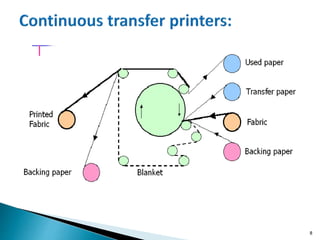
 In this system the paper and fabric pass face
to face around the heated cylinder
 A backing paper in full width is run in
between fabric and blanket to prevent the
blanket from making off.
 The contact between the paper and the
heated surface is maintained by light
pressure from the endless blanket.
9
10
Sublimation transfer printing:
 Mainly suitable for transfer printing of
synthetic fibres specially polyester with
disperse dyes.
Vapour phase printing in which heating at
180 degree centigrade to 220 degree centigrade
is involved
Methods of transfer printing:
11
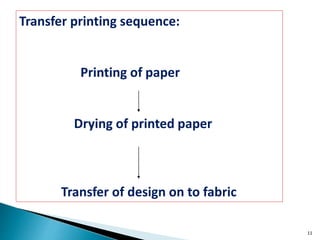
Transfer printing sequence:
Printing of paper
Drying of printed paper
Transfer of design on to fabric
 Melt Transfer
 Film Release System
 Semi-Wet Process
 Vapor Transfer System
12
13
The printing results are influenced to a great
extent by the following parameters and
should be examined very carefully.
• Paper
• Substrate
• Dye stuff
• Sublimation properties
• Temperature and time during print transfer
Factors affecting transfer printing
14
• Ability to rapidly respond to clients demand
• Minimum semi skilled labor required
• No pollution or effluence
• Efficient energy consumption
• Economical production: No after washing
necessary, short runs. Hardly any seconds
• Complete dry system
• Specialty applications of transfer
– Sublimation transfer process well suited to
some difficult-to-print applications
ADVANTAGES OF TRANSFER PRINTING
15
• Applicable only to hydrophobic fibers
• Limited number of dyes needing special
formulations,
• Expensive paper
• Need of longer runs of the same design for
economy
• Width restriction
The limitations of the process
16
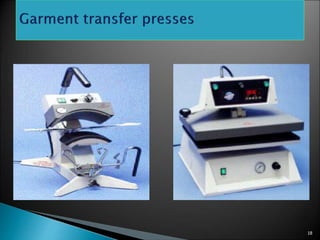
Machines for transfer printing are essentially hot pressing
the fabric is placed on a flat bed press.
 the paper is placed on the fabric
 heat pressed to get the transfer with in 15-30 sec at
180-220 degree centigrade.
 After transfer printing, the fabric is ready for marketing
without any other finishing process.
Transfer printing machinery:
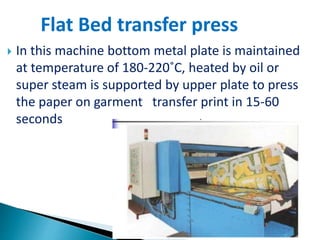
 In this machine bottom metal plate is maintained
at temperature of 180-220˚C, heated by oil or
super steam is supported by upper plate to press
the paper on garment transfer print in 15-60
seconds
Flat Bed transfer press
18
19
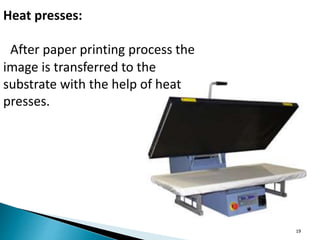
Heat presses:
After paper printing process the
image is transferred to the
substrate with the help of heat
presses.
 Transfer printing has several advantages for certain
applications.
 Transfer printing is well developed technique due to the
mass usage of polyester fibres and the development of
disperse dyes.
 Generally we can say that, transfer printing is cheaper
than embroidery but more expensive than screen
printing.
 In spite of many limitations of substrates and dye classes
transfer printing is promising for many applications in
the digital age
20
Advantages
21

Transfer printing ppt

  • 1.
  • 2.
     Not thedominant printing method Only 3-4% of fabric printing Over 25% of garment printing  But Technology/Process Fit is good 2
  • 3.
    Most textile transfersare printed onto paper, which fits well with inkjet (and e-stat, copier) capabilities Established analogue user base & market Transfer Equipment is widely available and installed Digital transfer market has started and is growing 3
  • 4.
    4 Application of TransferPrinting • Carpet Tiles • Polyester Fabrics - Home Furnishings , Microfibres. • Outdoor Banners (Mesh) & Building Wraps, Flags. • Scarves & Ties • Garment Transfers (T-shirts, Sportswear) • Work wear & Garment Labeling
  • 5.
    5 This concept startsfrom the commercial introduction of disperse dyes in 1924. The first commercial method of transfer printing was patented in France to NOËL DE PLASSE of LAINIÈRE DE ROUBAIX” known as sublistatic heat transfer printing Historical development
  • 6.
    6 When Mr.Deplasse receivedcomplaints from customers about the fastness problems.  During ironing he realized that at high temp. disperse dyes can be transferred to white back grounds. In 1968 the situation is more favorable for transfer printing due to the growth of polyester was increasing than any other fibres. Historical development
  • 7.
    7 Transfer printing givessolid blocks of color with very sharp lines to the edges – Transfer printing provides a more cost- effective solution than embroidery, whilst giving bolder, clearer lettering than screen printing Printings which require immediate response ( because of short setup time compared to screens, embroidery) When to choose transfer printing?
  • 8.
  • 9.
     In thissystem the paper and fabric pass face to face around the heated cylinder  A backing paper in full width is run in between fabric and blanket to prevent the blanket from making off.  The contact between the paper and the heated surface is maintained by light pressure from the endless blanket. 9
  • 10.
    10 Sublimation transfer printing: Mainly suitable for transfer printing of synthetic fibres specially polyester with disperse dyes. Vapour phase printing in which heating at 180 degree centigrade to 220 degree centigrade is involved Methods of transfer printing:
  • 11.
    11 Transfer printing sequence: Printingof paper Drying of printed paper Transfer of design on to fabric
  • 12.
     Melt Transfer Film Release System  Semi-Wet Process  Vapor Transfer System 12
  • 13.
    13 The printing resultsare influenced to a great extent by the following parameters and should be examined very carefully. • Paper • Substrate • Dye stuff • Sublimation properties • Temperature and time during print transfer Factors affecting transfer printing
  • 14.
    14 • Ability torapidly respond to clients demand • Minimum semi skilled labor required • No pollution or effluence • Efficient energy consumption • Economical production: No after washing necessary, short runs. Hardly any seconds • Complete dry system • Specialty applications of transfer – Sublimation transfer process well suited to some difficult-to-print applications ADVANTAGES OF TRANSFER PRINTING
  • 15.
    15 • Applicable onlyto hydrophobic fibers • Limited number of dyes needing special formulations, • Expensive paper • Need of longer runs of the same design for economy • Width restriction The limitations of the process
  • 16.
    16 Machines for transferprinting are essentially hot pressing the fabric is placed on a flat bed press.  the paper is placed on the fabric  heat pressed to get the transfer with in 15-30 sec at 180-220 degree centigrade.  After transfer printing, the fabric is ready for marketing without any other finishing process. Transfer printing machinery:
  • 17.
     In thismachine bottom metal plate is maintained at temperature of 180-220˚C, heated by oil or super steam is supported by upper plate to press the paper on garment transfer print in 15-60 seconds Flat Bed transfer press
  • 18.
  • 19.
    19 Heat presses: After paperprinting process the image is transferred to the substrate with the help of heat presses.
  • 20.
     Transfer printinghas several advantages for certain applications.  Transfer printing is well developed technique due to the mass usage of polyester fibres and the development of disperse dyes.  Generally we can say that, transfer printing is cheaper than embroidery but more expensive than screen printing.  In spite of many limitations of substrates and dye classes transfer printing is promising for many applications in the digital age 20 Advantages
  • 21.