COLOUR MATCH 2015
ADVANCED COURSE IN MATCH PREDICTION
(July 9-10, 2015)
Wool Research Association
(Linked to Ministry of Textiles, Govt. of India)
P.O. Sandoz Baug, Kolshet Road,
Thane- 400607, Maharashtra
Computer Colour Matching is an established tool. If anyone wants to learn how to get the
Colour “Right First Time” with colour matching system, he/she need to attend the advance course
for understanding the science and technology of colour. Here is an opportunity for all to revise colour
theory as well as knowledge and skill of colour matching.
Wool Research Association (WRA) has developed the latest internet based colour matching system
for textile applications. It is introduced in small, medium and large Mills. It is a low cost affordable
solution for small and medium textile processors. They have to buy low cost affordable instrument
and connect their in-house PC to WRA website for getting the instant match. WRA has developed a
huge database of different substrates – processes – dyes combination. WRA is organizing this
program for training colourists and Managers in Dyeing Departments. WRA Colour experts and
Scientists will guide you for use of this system with practical demonstration.
Dr Narendra S Gangakhedkar who is having many years of experience in computer colour
matching will explain to you how to control your colouration processes and stop losses. With his vast
practical experience in industrial colour technology, you will learn how to select colourant in
formulation, specify colour tolerances for pass/fail of incoming raw materials such as dyes and
pigments, control finished colour products for meeting specifications of end users and inspect
manufacturing process for avoiding rejections. He is the author of two books on Colour Science -
namely "Understanding Computer Colour Matching" and “Understanding Science and
Technology of Colour ". These books were reviewed in the International Journal “Colour Research
and Application” and were highly appreciated for the contents and his sharing of industrial
experience.
Today, Indian companies have been exporting goods to US and European retailers who are
specifying stringent numerical colour tolerances and companies are finding it difficult to meet their
digital specifications for getting valuable repeat orders.
As colour quality is non-negotiable., you have to get the given colour right first time.
You don't just do it right, you have to do it better.
You have to lower the cost of colouration.
You have to invest in colour instrumentation and process control.
You have to educate and train your colourist for new colour technologies.
One need to attend this advance course for better understanding of computer colour matching
for textile applications.
Course covers how to develop a unique database for obtaining an “Instant Colour Match” and how to
use WRA COLOURMATCH. In special session on “Colour Clinic”, Dr Gangakhedkar and WRA
Colour Scientists will share their practical experience and offer solutions to your colour problems.
WHY THIS PROGRAM?
It is a continuous education program to revise/update you in colour science and technology. It is
a must for any colour expert / modern dyer / dyeing manager and anyone who is involved in
colour management. It is unique program offering the latest internet based digital colour match
and colour control.
If you are having CCM system, then this program will help you to increase effective use of your
system. You can also become user of WRA COLOURMATCH.
WHO SHOULD ATTEND?
* Textile Chemists and Colourists.
* Anyone who is responsible for colour management.
* Dye House Supervisors and Managers.
* R & D personnel
* Quality Assurance Officers, Supervisors and Managers.
* Technical Sales Representatives and Dye Application Specialists
* All those involved in Sales and Marketing of Colour Products.
* Project Managers, Entrepreneurs and those who would like to establish Modern Dye House
* Colour Instrument Manufacturers and Suppliers and CCM Software Developers
* B. Tech, M.Sc. M.Tech and PhD Students - Textiles / Dyes
COURSE CONTENTS
* Colour as numbers
* Metamerism -Matching Colours in different lighting conditions
* Numerical Pass / Fail and its relation to visual matching.
* Colour Theory, CIE System, New Colour Difference Equations - Advantages and
limitations
* Acceptability and Perceptibility of Colour Match
* Strength and Depth of Shade, Chromaticity and Strength of Dyes, Whiteness and
Yellowness Indices, Light Fastness Index, Latest Colour measuring spectrophotometers
including Portable Instruments, Checklist for selecting Colour Measuring
Spectrophotometers
* Theory and practices of computer colour matching, Concept used in Match Prediction,
Match prediction theory- Kubelka-Munk Theory
* Matching and Correction programs
* Colour control in Lab and production
* QC for retailers and specifiers
* Newly introduced CCM Software packages - Indian software packages
* datacolour * X-Rite * Minolta * Other Suppliers
* How to evaluate Colour Software Packages?
* New Developments based on Internet / Web Technologies
* Features of WRA COLOURMATCH service
* Databases * Library of Colours
* Why colours do not match?
* Role of Dyeing Variables in Match Prediction and Batch correction
* Expert System * Different Approaches for Lab and Production Batch Correction
Such as Feedback System, Optimization, Hard and Soft Correction, *Dyer's Interaction,
"What if?" approach
* How to use your system effectively in QC, Development, Production and marketing?
* People can make or break system
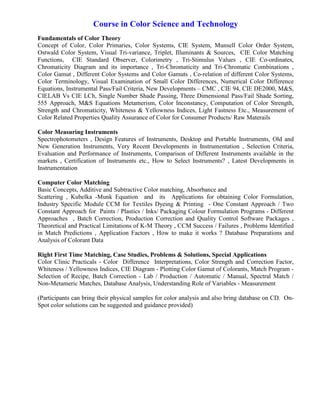
Course in Color Science and Technology
Fundamentals of Color Theory
Concept of Color, Color Primaries, Color Systems, CIE System, Munsell Color Order System,
Ostwald Color System, Visual Tri-variance, Triplet, Illuminants & Sources, CIE Color Matching
Functions, CIE Standard Observer, Colorimetry , Tri-Stimulus Values , CIE Co-ordinates,
Chromaticity Diagram and its importance , Tri-Chromaticity and Tri-Chromatic Combinations ,
Color Gamut , Different Color Systems and Color Gamuts , Co-relation of different Color Systems,
Color Terminology, Visual Examination of Small Color Differences, Numerical Color Difference
Equations, Instrumental Pass/Fail Criteria, New Developments – CMC , CIE 94, CIE DE2000, M&S,
CIELAB Vs CIE LCh, Single Number Shade Passing, Three Dimensional Pass/Fail Shade Sorting,
555 Approach, M&S Equations Metamerism, Color Inconstancy, Computation of Color Strength,
Strength and Chromaticity, Whiteness & Yellowness Indices, Light Fastness Etc., Measurement of
Color Related Properties Quality Assurance of Color for Consumer Products/ Raw Materails
Color Measuring Instruments
Spectrophotometers , Design Features of Instruments, Desktop and Portable Instruments, Old and
New Generation Instruments, Very Recent Developments in Instrumentation , Selection Criteria,
Evaluation and Performance of Instruments, Comparison of Different Instruments available in the
markets , Certification of Instruments etc., How to Select Instruments? , Latest Developments in
Instrumentation
Computer Color Matching
Basic Concepts, Additive and Subtractive Color matching, Absorbance and
Scattering , Kubelka -Munk Equation and its Applications for obtaining Color Formulation,
Industry Specific Module CCM for Textiles Dyeing & Printing - One Constant Approach / Two
Constant Approach for Paints / Plastics / Inks/ Packaging Colour Formulation Programs - Different
Approaches , Batch Correction, Production Correction and Quality Control Software Packages ,
Theoretical and Practical Limitations of K-M Theory , CCM Success / Failures , Problems Identified
in Match Predictions , Application Factors , How to make it works ? Database Preparations and
Analysis of Colorant Data
Right First Time Matching, Case Studies, Problems & Solutions, Special Applications
Color Clinic Practicals - Color Difference Interpretations, Color Strength and Correction Factor,
Whiteness / Yellowness Indices, CIE Diagram - Plotting Color Gamut of Colorants, Match Program -
Selection of Recipe, Batch Correction - Lab / Production / Automatic / Manual, Spectral Match /
Non-Metameric Matches, Database Analysis, Understanding Role of Variables - Measurement
(Participants can bring their physical samples for color analysis and also bring database on CD. On-
Spot color solutions can be suggested and guidance provided)
Registration Details
REGISTRATION FEES Rs. 5000.00 per person
This covers course Fees, Lunch, Tea / Coffee, course material and the copy of the encyclopedic
treatise on “Understanding Science and Technology of Colour” authored by Dr N S Gangakhedkar.
Fees do not cover the cost of lodging and boarding. Participant has to make his / or her own
arrangement for the stay, travel and transport.
Last Date of Registration JUNE 30th
, 2015
Payment By Demand Draft in favour of
“Wool Research Association”,
Payable at Mumbai.
Venue Wool Research Association
P.O. Sandoz Baug, Kolshet Road,
Thane- 400607, Maharashtra
Date July 9th
& 10th
2015
Time 10.00 am to 5.00 pm with one hour break for
Lunch.
Maximum limit 25 personnel (Registration first come basis)
Training Co-ordinator Smita Honade, Scientist
(sphonade@wraindia.com, 09167704068)
Neeraj Shrivastava, Scientist
(nshrivastava@wraindia.com, 09167425439)
Jayant Udakhe, Scientist
(judakhe@wraindia.com,
For further details contact Director
Wool Research Association
(Linked to Ministry of Textiles, Govt. of India)
P.O. Sandoz Baug, Kolshet Road,
Thane- 400607, Maharashtra
Tel.: 91-022-2531 4294/ 2586 8398
Fax: 91-022-2586 8365
E-mail: wra@wraindia.com
Website: www.wraindia.com

Course Content & Registration Details

  • 1.
    COLOUR MATCH 2015 ADVANCEDCOURSE IN MATCH PREDICTION (July 9-10, 2015) Wool Research Association (Linked to Ministry of Textiles, Govt. of India) P.O. Sandoz Baug, Kolshet Road, Thane- 400607, Maharashtra Computer Colour Matching is an established tool. If anyone wants to learn how to get the Colour “Right First Time” with colour matching system, he/she need to attend the advance course for understanding the science and technology of colour. Here is an opportunity for all to revise colour theory as well as knowledge and skill of colour matching. Wool Research Association (WRA) has developed the latest internet based colour matching system for textile applications. It is introduced in small, medium and large Mills. It is a low cost affordable solution for small and medium textile processors. They have to buy low cost affordable instrument and connect their in-house PC to WRA website for getting the instant match. WRA has developed a huge database of different substrates – processes – dyes combination. WRA is organizing this program for training colourists and Managers in Dyeing Departments. WRA Colour experts and Scientists will guide you for use of this system with practical demonstration. Dr Narendra S Gangakhedkar who is having many years of experience in computer colour matching will explain to you how to control your colouration processes and stop losses. With his vast practical experience in industrial colour technology, you will learn how to select colourant in formulation, specify colour tolerances for pass/fail of incoming raw materials such as dyes and pigments, control finished colour products for meeting specifications of end users and inspect manufacturing process for avoiding rejections. He is the author of two books on Colour Science - namely "Understanding Computer Colour Matching" and “Understanding Science and Technology of Colour ". These books were reviewed in the International Journal “Colour Research and Application” and were highly appreciated for the contents and his sharing of industrial experience. Today, Indian companies have been exporting goods to US and European retailers who are specifying stringent numerical colour tolerances and companies are finding it difficult to meet their digital specifications for getting valuable repeat orders. As colour quality is non-negotiable., you have to get the given colour right first time. You don't just do it right, you have to do it better. You have to lower the cost of colouration. You have to invest in colour instrumentation and process control. You have to educate and train your colourist for new colour technologies. One need to attend this advance course for better understanding of computer colour matching for textile applications. Course covers how to develop a unique database for obtaining an “Instant Colour Match” and how to use WRA COLOURMATCH. In special session on “Colour Clinic”, Dr Gangakhedkar and WRA Colour Scientists will share their practical experience and offer solutions to your colour problems.
  • 2.
    WHY THIS PROGRAM? Itis a continuous education program to revise/update you in colour science and technology. It is a must for any colour expert / modern dyer / dyeing manager and anyone who is involved in colour management. It is unique program offering the latest internet based digital colour match and colour control. If you are having CCM system, then this program will help you to increase effective use of your system. You can also become user of WRA COLOURMATCH. WHO SHOULD ATTEND? * Textile Chemists and Colourists. * Anyone who is responsible for colour management. * Dye House Supervisors and Managers. * R & D personnel * Quality Assurance Officers, Supervisors and Managers. * Technical Sales Representatives and Dye Application Specialists * All those involved in Sales and Marketing of Colour Products. * Project Managers, Entrepreneurs and those who would like to establish Modern Dye House * Colour Instrument Manufacturers and Suppliers and CCM Software Developers * B. Tech, M.Sc. M.Tech and PhD Students - Textiles / Dyes COURSE CONTENTS * Colour as numbers * Metamerism -Matching Colours in different lighting conditions * Numerical Pass / Fail and its relation to visual matching. * Colour Theory, CIE System, New Colour Difference Equations - Advantages and limitations * Acceptability and Perceptibility of Colour Match * Strength and Depth of Shade, Chromaticity and Strength of Dyes, Whiteness and Yellowness Indices, Light Fastness Index, Latest Colour measuring spectrophotometers including Portable Instruments, Checklist for selecting Colour Measuring Spectrophotometers * Theory and practices of computer colour matching, Concept used in Match Prediction, Match prediction theory- Kubelka-Munk Theory * Matching and Correction programs * Colour control in Lab and production * QC for retailers and specifiers * Newly introduced CCM Software packages - Indian software packages * datacolour * X-Rite * Minolta * Other Suppliers * How to evaluate Colour Software Packages? * New Developments based on Internet / Web Technologies * Features of WRA COLOURMATCH service * Databases * Library of Colours * Why colours do not match? * Role of Dyeing Variables in Match Prediction and Batch correction * Expert System * Different Approaches for Lab and Production Batch Correction Such as Feedback System, Optimization, Hard and Soft Correction, *Dyer's Interaction, "What if?" approach * How to use your system effectively in QC, Development, Production and marketing? * People can make or break system
  • 3.
    Course in ColorScience and Technology Fundamentals of Color Theory Concept of Color, Color Primaries, Color Systems, CIE System, Munsell Color Order System, Ostwald Color System, Visual Tri-variance, Triplet, Illuminants & Sources, CIE Color Matching Functions, CIE Standard Observer, Colorimetry , Tri-Stimulus Values , CIE Co-ordinates, Chromaticity Diagram and its importance , Tri-Chromaticity and Tri-Chromatic Combinations , Color Gamut , Different Color Systems and Color Gamuts , Co-relation of different Color Systems, Color Terminology, Visual Examination of Small Color Differences, Numerical Color Difference Equations, Instrumental Pass/Fail Criteria, New Developments – CMC , CIE 94, CIE DE2000, M&S, CIELAB Vs CIE LCh, Single Number Shade Passing, Three Dimensional Pass/Fail Shade Sorting, 555 Approach, M&S Equations Metamerism, Color Inconstancy, Computation of Color Strength, Strength and Chromaticity, Whiteness & Yellowness Indices, Light Fastness Etc., Measurement of Color Related Properties Quality Assurance of Color for Consumer Products/ Raw Materails Color Measuring Instruments Spectrophotometers , Design Features of Instruments, Desktop and Portable Instruments, Old and New Generation Instruments, Very Recent Developments in Instrumentation , Selection Criteria, Evaluation and Performance of Instruments, Comparison of Different Instruments available in the markets , Certification of Instruments etc., How to Select Instruments? , Latest Developments in Instrumentation Computer Color Matching Basic Concepts, Additive and Subtractive Color matching, Absorbance and Scattering , Kubelka -Munk Equation and its Applications for obtaining Color Formulation, Industry Specific Module CCM for Textiles Dyeing & Printing - One Constant Approach / Two Constant Approach for Paints / Plastics / Inks/ Packaging Colour Formulation Programs - Different Approaches , Batch Correction, Production Correction and Quality Control Software Packages , Theoretical and Practical Limitations of K-M Theory , CCM Success / Failures , Problems Identified in Match Predictions , Application Factors , How to make it works ? Database Preparations and Analysis of Colorant Data Right First Time Matching, Case Studies, Problems & Solutions, Special Applications Color Clinic Practicals - Color Difference Interpretations, Color Strength and Correction Factor, Whiteness / Yellowness Indices, CIE Diagram - Plotting Color Gamut of Colorants, Match Program - Selection of Recipe, Batch Correction - Lab / Production / Automatic / Manual, Spectral Match / Non-Metameric Matches, Database Analysis, Understanding Role of Variables - Measurement (Participants can bring their physical samples for color analysis and also bring database on CD. On- Spot color solutions can be suggested and guidance provided)
  • 4.
    Registration Details REGISTRATION FEESRs. 5000.00 per person This covers course Fees, Lunch, Tea / Coffee, course material and the copy of the encyclopedic treatise on “Understanding Science and Technology of Colour” authored by Dr N S Gangakhedkar. Fees do not cover the cost of lodging and boarding. Participant has to make his / or her own arrangement for the stay, travel and transport. Last Date of Registration JUNE 30th , 2015 Payment By Demand Draft in favour of “Wool Research Association”, Payable at Mumbai. Venue Wool Research Association P.O. Sandoz Baug, Kolshet Road, Thane- 400607, Maharashtra Date July 9th & 10th 2015 Time 10.00 am to 5.00 pm with one hour break for Lunch. Maximum limit 25 personnel (Registration first come basis) Training Co-ordinator Smita Honade, Scientist (sphonade@wraindia.com, 09167704068) Neeraj Shrivastava, Scientist (nshrivastava@wraindia.com, 09167425439) Jayant Udakhe, Scientist (judakhe@wraindia.com, For further details contact Director Wool Research Association (Linked to Ministry of Textiles, Govt. of India) P.O. Sandoz Baug, Kolshet Road, Thane- 400607, Maharashtra Tel.: 91-022-2531 4294/ 2586 8398 Fax: 91-022-2586 8365 E-mail: wra@wraindia.com Website: www.wraindia.com