Federal TVET Institute/University
Textile and Apparel Fashion Technology Division
Textile Technology Department
Digital color management, color gamut and rendering intent and
color communication
Advanced Textile Coloration and Color Measurement
Course Code: TXT 554
Submitted by
Meseret Bogale
ID MTR/236/12
Submitted to
Dr.Gurumurthy.B.R
Ph.D (textile technology) –instructor in textile technology
Submission Date 2020/2021
Addis Abeba Ethiopia
i
CERTIFICATION
This is to certify, that the seminar paper submitted by me is an outcome of my independent and
original work. I have duly acknowledged all the sources from which the ideas and extracts have
been taken. And I certify that the titled (Digital color management, color gamut and
rendering intent and color communication) is based on my own work carried out during the
course of our study under the supervision of Dr.Gurumurthy.B.RPh.D (textile technology)
instructor in textile technology. I assert the statements made and conclusions drawn are an
outcome of my seminar work.
Name ____________________________
Signature _________________________
Date ______________________________
ii
ACKNOWLEDGEMENTS
Firstly I would like to thank the alignment of God and his Mother helping me to do this seminar
and then I would like to thank Dr.Gurumurthy.B.R (Ph.D) textile technology instructor in textile
technology and course manager of Advanced Textile Coloration and Color Measurement who
gives this seminar to do, he gives his guidance and continually challenging me throughout this
seminar. I also extend to you my gratitude for bearing with me during my personal challenges.
I also thank Debre berhan poly technic college textile and garment department sectors for giving
a chance to use their internet access for doing this seminar
iii
TABLE OF CONTENTS
CERTIFICATION................................................................................................... i
ACKNOWLEDGEMENTS ................................................................................... ii
TABLE OF CONTENTS ...................................................................................... iii
List of Tables .................................................................................................................................. v
List of Figures................................................................................................................................ vi
List of Acronyms .......................................................................................................................... vii
ABSTRACT........................................................................................................................................ viii
1. INTRODUCTION.........................................................................................................................1
1.1. Definition of Colors....................................................................................................................1
2. OBJECTIVES.................................................................................................................................3
2.1. General Objective........................................................................................................................3
2.1.1. Specific objectives...................................................................................................................3
3. LITERATURE REVIEW .........................................................................................................4
3.1. Color in textile industry.............................................................................................................4
3.1.1. Colour Management and ICC........................................................................................ 4
3.1.2. Colour management in ink jet printing.......................................................................... 5
3.1.3. Color print production ................................................................................................... 5
3.2. Colour gamut in digital textile printing.................................................................................6
3.2.1. Gamut mapping ............................................................................................................. 6
3.2.2. Limitations of colour gamut .......................................................................................... 7
3.3. Color Rendering Intent..............................................................................................7
3.4. Colour Communication.............................................................................................8
3.4.1. Effective colour communication for industry................................................................ 8
3.4.2. Communication between Colour Measuring Instruments............................................. 9
3.4.3. Colour measurement, specification and prediction ....................................................... 9
3.4.4. Virtual Colour Communication..................................................................................... 9
3.4.5. Device dependent colour ............................................................................................. 10
3.4.6. Virtual Colour Communication in the Textile and Apparel Industry.......................... 10
iv
3.4.7. Colorimetry ............................................................................................................................11
3. EXPERIMENTAL AND METHODOLOGY.............................................................................12
3.1. Experimental work........................................................................................................................12
3.2. SRGB colour management................................................................................................. 13
3.3. CIE Tristimulus Values and Metamerism.......................................................................... 14
3.4. General numerical colour specifications............................................................................ 14
4. RESULTS AND DISCUSSION......................................................................................................15
4.1. Colour Measurement.......................................................................................................... 15
4.2. Colour Communication...................................................................................................... 15
4.3. Defining and Profiling Color.............................................................................................. 17
4.4. Color gamut in color management..................................................................................... 18
4.5. Color gamut and rendering indent...................................................................................... 18
4.6. Color Management Systems............................................................................................... 19
5. CONCLUSION............................................................................................20
6. REFERENCE ..............................................................................................21
v
List of Tables
Table 1: Colours of typical spectral bands and colours perceived after their absorption by a material
viewed in white light, Light absorbed by the material................................................................................19
vi
List of Figures
Figure 1.Object colours (left); additive mixing (middle) and subtractive mixing (right)............. 10
Figure 2. The wavelength of the colors ........................................................................................ 12
Figure 3. Colour measurement diagram........................................................................................ 13
Figure 4. Pantone‘s representation of hexa chrome vs.CMYK color gamut................................ 16
Figure 5. Diagram of CIE L*a*b color space............................................................................... 17
Figure 6. Color gamut................................................................................................................... 18
vii
List of Acronyms
NCS Natural Color System
CMS Color management system
R&D Research and development
ICC International Colour Consortium
PCS profile connection space
ASTM
CMYK
RGB
CIJ
DOD
CIE
SRGB
RIP
American Society for Testing and Materials
Cyan, Magenta, Yellow and Black
Red ,Green and Blue
Continuous Ink Jet
Drop‐on‐Demand Inkjet
Commission International de l'Eclairage
Standard Red, Green and Blue
Raster Image Processor
viii
ABSTRACT
The main purpose of the CMS is to provide a control system by which the measured colour data
of a design may be reliably and accurately transformed into output data for display on a monitor
or as input to a printer, so that the appearance of these outputs reliably represents that of the
input design to the observer. A CMS will often provide other useful features such as organizing
the `queue' of print jobs. The CMS may also provide means for communicating design and
colour data via the Internet. It is often the case, particularly with longer print runs, that the digital
design, having been sampled/proofed on a digital printer, is then screen printed with print pastes
containing completely different dyes. And also CMS may be to provide recipe predictions for the
conventional print production.
Digital image capture. Image is captured as a series of RGB (red, green and blue) cell responses
forming a matrix (digital camera) or raster pattern (scanner). Digital colour printer. Uses CMYK
(cyan, magenta, yellow and optionally black) printing ink primaries which, in most digital
printers, are jetted onto the substrate as a `super pixel' matrix of ink spots. Computer systems for
acquiring, displaying and printing colours digitally normally employ an overall colour
management system (CMS) to assist the transfer of colour data from image capture through to
the final printing system.
In modern commercial textile environments there is an increasing need for rapid and reliable
communication systems both internally (possibly between many geographical sites) and with
customers, specifies and suppliers. Colorimetric measurement data and Colour management data
such as equipment characterization and ICC profile information are very important in today‘s
digital world to manage color and communicate with the colors.
Keywords: digital color management, color gamut, color rendering intent, color communication,
digital textile printing.
1
1. INTRODUCTION
1.1. Definition of Colors
The color of a surface comes from the interpretation by the human visual system of the light
signal reflected or transmitted by the surface, especially its spectral distribution. By normalizing
the measured spectrum by a reference spectrum considered as the maximum signal (direct
incident light for transmittance measurements, and light scattered with a white standard for
reflectance measurements of the CIELAB color space is normally used. The coordinates—
lightness L, green/red coordinate a, and blue/yellow coordinate b can be derived from the
CIEXYZ tristimulus values by nonlinear relations[1].
The colour is one of the most important entities when a consumer purchases an item. Colour is
often the hardest to manage as its appearance and it is subjective and, now that most the
manufacturing of coloured goods are carried out over see, it will becomes increasingly harder to
control the color. The colour of an object depends on with the observer and the quality of the
light. The human beings have a poor color memory, so there is a mechanism help to
communicate with the color. The Color order systems have been used as extensively, and where
the specifier and the supplier each of them have a book of colors and each shades have a unique
reference[2].
Digital Colour display and communication systems are used successfully to complement the
spectrophotometer systems are using input devices, such as optical flatbed scanners and digital
cameras. The Images can be displayed on a calibrated monitor and colored either using
reflectance data from the spectrophotometer or by inputting color values. The advantage of such
systems are that it allow the specifier and the supplier to see the same appearance of a product as
well as having the numeric information, it allows quick and effective decisions will be made.
And The process of communications have to be managed and the information defined and
controlled[2]. The accuracy of Color between the original and final output being optimize using
the Color Management Systems (CMS). The term color managements refer to the use of
software‘s to automatically determine colour reproduction of the characteristics of the input
devices, monitors, and output devices, and also then automatically make the image settings
necessary for optimal color reproduction systems are very important[3].
2
One of the most abundant critical research and development (R&D) areas is the color gamut
analysis, particularly as new colourant sets, pretreatment formulas, and ink-jet heads are
developed. Effective and standard method of colour gamut analysis is needed for a number of
R&D and manufacturing scenarios. For example, if the company wishes to develop a six or
eight-colour ink set, using cyan, magenta, yellow, black (CMYK) as the base four colours,
decisions must be made as to which additional colours will provide the most impact on the
colour gamut[4].
ICC software allows the output profiles to contain four rendering intents - perceptual, absolute
colorimetric, relative colorimetric and saturation. It is possible that to store the intents as
forward lookup the relating profile connection space (PCS) to the device and as reverse lookup
tables relating PCS to the device and a reverse lookup tables relating device to PCS. The
profiles that are going to be used absolute colorimetric in color management systems. and
because we are going to verify the profiles on press with maximum of gamut spacing and
measured colorimetry for the range of color gamut and rendering intents on an object[5].
3
2. OBJECTIVES
2.1. General objective
The main objective of this seminar is to understand about digital color management, color gamut,
rendering intent and color communication in textile digital printing.
2.1.1. Specific objectives
 To study about color production and color quality control and assessment.
 To study about color communication in digital textile printers.
 Analysis and development of methods to characterize colour rendering, to predict colour and
to control colour in printed media.
 To determine accurate, repeatable color reproduction in digital color management.
 To study the role of color management in digital textile printing.
4
3. LITERATURE REVIEW
3.1. Color in textile industry
Colour is critical in the textile industry both in terms of meeting trends, client requirements and
obtaining consistent colour. The choices a designer makes about the colours in their designs may
come from trend forecasts or be dictated by the brand or textile agent the designer is working for.
Achieving the correct colours and meeting seasonal trends can ensure a product‘s success.
Digital screen colour, a mix of red, green and blue light known as additive colour, has a broader
colour range to printed colour, primarily a mix of cyan, magenta, yellow and black pigment
primaries known as subtractive colour. Whilst there are overlaps between the two colours spaces
there are many colours possible in one but not the other, thus out of gamut[6].
3.1.1. Colour Management and ICC
With the digitalization of the workflow in media production, there arises a demand for a more
effective colour control. The development of different colour management systems became the
solution. A control, based on mathematical equations, through the different conversion steps
became central. The development of such colour management systems very soon created the
need for a standard to be able to communicate colour profile data. The first systems developed
were all vendor specific. The International Colour Consortium (ICC), established in 1993 by
several of the leading companies in the prepress colour industry, created, promoted and
encouraged the standardization of an open, vendor-neutral, cross platform colour management
system architecture[7].
Development of electronic technology and the proliferation of low-cost colour imaging devices
allow more and more users to transfer images between devices (for example, from a computer
screen to a printer). Colour management enables this communication between devices minimal
loss of colour fidelity. This requires that devices be calibrated and characterized and a device
profile constructed for each device .the profile enables the mapping between the device-
independent colorimetric tristimulus data representing the output (CIEXYZ) and the device-
dependent coordinates (typically RGB or CMYK)[8].
5
3.1.2. Colour management in ink jet printing
Color is not a surface or an object. Color is the phenomenon of light reflected from a surface or
object as it is received by the eye and processed by the brain. Light and surfaces will vary, but
even the same conditions can result in differing mental interpretations and verbal descriptions by
a viewer. As the mental interpretation of a physical process, ―color is in the eye of the beholder,‖
and if there is more than one be holder, it is likely that their views will vary. This chapter aims to
detail those issues in color management relevant to printing on textiles by ink jet, rather than
being an exhaustive detailing of the entire field of color management. It considers both the
production of color and the perception of color with the need for individuals to agree on the
perception of a color when in a commercial situation and not all operating with calibrated
equipment. As even different parts of an office can change the perception of a color due to the
quality of the light in that area, this becomes particularly problematic when the individuals in
question are located in different parts of the world[9].
3.1.3. Color print production
One rarely asked but significant question is why one color must match another. Asking this
question allows for an appropriate allocation of resources according to the response, as there are
degrees of justification for expensive and extensive calibration practices. In ―batch matching,‖
there may be little or no allowance for difference and tolerance, particularly for applications such
as military parade uniforms or rolls of curtaining. In this case, calibration deserves the
appropriate amount of time, money, and attention. Some choose to recognize discrepancies
between processes and colors as part of the creative process and an inherent part of print
production. For color schemes, matching may be more relevant across the relative colors
contributing to the overall complimentary look, along with a fast and financially effective color
solution. Detailed color profiling also offers greater accuracy, but does not increase the overall
range of the color gamut. Profiling does not add different color gamuts together. It disregards
colors not reproducible by all, leaving the reduced range of only the shared hues; however,
avoiding calibrating will not change this[9].
6
3.2. Colour gamut in digital textile printing
A ―gamut‖ refers to the range of colors capable of being reproduced by any system of color
mixing. The gamuts of CMYK and RGB overlap; however, it is not an exact overlap, as each
system begins from different starting points. CMYK using its magenta and RGB using its red
will probably each mix a different color. Crucially, as these two systems work differently, they
can mimic each other rather than exactly reproduce each other‘s range of colors. In addition,
many printers use ―light‖ versions of the CMYK inks or an additional set of primaries, such as
red, orange, blue, and a deep or dark black to extend the range of possible colors. Many design
software programs use three variables in an interface, often in two steps to allow users to select
colors. These often correspond to three principle activities involved in producing a color.[9] And
in other words a colour gamut is the area enclosed by a colour space in three dimensions. It is
usual to represent the gamut of a colour reproduction system graphically as the range of colours
available in some device independent colour space. Often the gamut will be represented in only
two dimensions[10].
3.2.1. Gamut mapping
Gamut mapping is perhaps the most crucial part of colour management and research in this field
is extensive. The new gamut mapping algorithm for newsprint. The algorithm is derived from
analysis of high quality colour reproductions. Testing of the algorithms was performed in a
transparency to-newsprint workflow, assumed to be the most severe form of gamut compression
in commercial use. For each physical device in the colour imaging chain, there is a finite range
of colours that can be imaged on a given substrate, depending on factors such as the colorants
used, the densities at which they are imaged, the imaging characteristics of the device, and the
surface properties of the substrate[7].
Since the most notorious color gamut compressions involve reducing the total number of colors
that can be represented then going back to the original values is usually impossible. What has
been lost is lost. So it is best to delay any steps where gamut compression can occur to avoid
reducing the gamut of the data we have. It must be done for output to gamut reduced devices but
it is best to reduce your data in this way only in the last step. The gamut of a color space is the
total set of colors that can be represented within that color space. Typically a device CMYK
7
color space will represent less saturated and fewer colors than an RGB color space. When the
gamut of the source and destination color spaces differs a "gamut mapping" needs to be
performed. Those colors that cannot be represented in the destination need to be altered to colors
that can be represented.
3.2.2. Limitations of colour gamut
When converting colours from the gamut of the original or of the proof to the gamut of the print,
there is often a limit both in size and in shape. The available colour gamut is often smaller and
the conversion of colour values comprises some kind of decision as to what to do with those
colour values that fall outside of the available or reproducible gamut. When reproducing an
original image for printed media, there are certain limitations in the press that will influence the
available colour gamut. The press, with its certain characteristics, will limit the possibilities in
reproduction; the substrate used will limit the gamut, as will the inks or toners used. The
variations in the printing process itself heavily influence the print quality, not least the colour
rendering[7].
3.3. Color Rendering Intent
Rendering Intent: - A method for translating from one color space into another. Rendering
intents are necessary because of the different ―gamuts‖ of devices and Medias. There are four
main rendering intents in the ICC specification: Absolute Colorimetric Relative Colorimetric,
Perceptual, and Saturation. Which one you choose is crucial when gamuts are very different.
Color management provides another way to help in ―managing‖ gamut limitations. If a color
cannot be printed, a color management system helps us find the best replacement. The user can
select from different approaches to finding a replacement color. The methods used to find a
replacement are called rendering intents and typically the rendering intent for a color conversion
is specified in application. The ICC has specified four standard gamut compression schemes,
called rendering intents. The official terms for the rendering intents are perceptual, relative
colorimetric, absolute colorimetric, and saturation. Let‘s look at rendering intents as related to
different image types[11]
8
3.4. Colour Communication
The Colour talk filer supports all colour communication, storage and retrieval. Colours may be
saved either to the system's hard disk or to a 31/2 in floppy disk (which can be sent
through the mail). As colours are stored in terms of their screen CIE XYZ values, they
may be communicated to other Colour Talk systems without loss of fidelity. The filer also
provides another means to enter colours into the system. Using either floppy disk or a network
link, colours may be sent to and from the Coats CPS. This enables physical coloured
samples to be directly measured via the spectrophotometer (attached to the CPS) and be
subsequently reproduced on the screen. In addition, it allows for the prediction of dye
recipes for colours and colour palettes created using the system. Specifying only XYZ data
means that there are usually several possible recipes that can be used to match under
illuminant D65. However, these recipes may not match the target shade under other
lighting conditions. Another approach to the problem of colour constancy is to generate a
pseudo-reflectance curve. This information is ‗illuminant independent‘ meaning that the CPS
can use this to select only those recipes which match under several light sources.
However, it was felt that putting too many constraints on the prediction algorithm could
lead to failure to find any suitable recipe. Additionally, there is no guarantee that pseudo-
reflectance curves will produce a colour- constant shade. Although the representation used by
Colour Talk does not guarantee colour constancy, feedback is available (see later) from
the CPS which can be used to assess this property visually[12].
3.4.1. Effective colour communication for industry
How many times have you agreed to a colour design on a monitor, only to find that the final
version on your fabric is a totally different shade? The problem of mismatch between colours on
screen and on physical materials has been a focus on the result is the Colour Talk system, which
demonstrates that high colour fidelity and effective colour communication can be realized using
modern colour computer systems. Colour specification and communication are also problems for
industry. In practice, many physical colour specification systems (including Pantone, Natural
Color System (NCS) and Munsell Color System) are widely used by industry. Each system
consists of coloured chips arranged in some systematic fashion. Colour information can be
9
communicated using each system‗s own colour coordinates, such as value, chroma and hue (for
Munsell) or blackness, chromaticness and hue (NCS)[13].
3.4.2. Communication between Colour Measuring Instruments
Many people take it for granted that once a colour is measured (i.e. we can express it in numbers,
be they spectral reflectance, X, Y, Z tristimulus or CIELAB values, or some kind of colour
difference) we may freely communicate it, and the result will be perfect understanding of exactly
which colour we mean. Unfortunately, this is not so. There are always some differences between
measurements made on different instruments, even if we make sure that they are in perfect
operating conditions. The performance of colour measuring instruments may be specified
following the ASTM Standard Practice for Specifying and Verifying the Performance of Color-
Measuring Instruments. From the point of view of colour communication reproducibility is
extremely important, because we are generally comparing measurement results from different
locations, if possible between instruments of the same model[14].
3.4.3. Colour measurement, specification and prediction
At the highest levels of potential accuracy CIE L*a*b* colour co-ordinates can be confidently
measured and reproduced as product colours to within a just visible difference that are also
visually correct under more than one illuminant. In practical terms this means that under quality
control the basic CIE X, Y, Z co-ordinates of any given colour must be spectrally specified and
measured to three significant figures (or plus or minus one part in a thousand).This requirement
is demanding, it calls for best practice even from skilled production colorists, and the required
techniques lie well beyond the abilities of most of the other stakeholders in colour
management[15].
3.4.4. Virtual Colour Communication
Communicating colours by numbers is all very well, but what would really be nice is to show
you on your end of the line what I see here on my end which is what virtual colour
communication is all about. Nowadays this appears to be very simple: I have a digital camera or
a scanner, enter the colour (or a complex design of many colours) into some software, send the
file to you over the Internet, and you just see it on your monitor or print it out on your printer. As
10
we shall see, there is more to it than meets the eye (literally). If you ever tried to compare the
image you have on the monitor to the original you have just scanned in, or compare the print
from your printer to the monitor image, or the original you were very likely most disappointed
unless you are using colour management[14].
3.4.5. Device dependent colour
In today‘s world of digital imaging we can‘t really get even acceptable colour reproduction
across the media without colour management, and yet, it is a technique not at all well known, and
even less well understood. Why do we need colour management? To understand this rather
complex problem we have to first think about the different ways colours are produced. The mix
colours from three additive primaries red, green and blue (hence RGB), which works because
human colour perception is also based on RGB primaries, thus additive mixing obeys the laws of
psychophysics. Office printers produces colours by subtractive mixing (obeying the laws of
physics) based on three subtractive primaries yellow, magenta and cyan (hence YMC). For
technical reasons the great majority of these printers use a fourth colour, black (K), and therefore
we usually speak of the YMCK system. Here we are back again to an object colour, prints can be
characterized by their spectral reflectance curves, but these will inevitably be very different from
those of the originals[14].
Figure 1.Object colours (left); additive mixing (middle) and subtractive mixing (right)
3.4.6. Virtual Colour Communication in the Textile and Apparel Industry
In the previous section we have seen how digital communication works beyond traditional,
spectrophotometry-based colorimetry colour. New technologies in image capture and processing
11
together with the technology of colour management have made it possible to communicate not
only the colour of relatively large uniform spots (which may be measured on a conventional
instrument) but also that of complex images.
3.4.7. Colorimetry
To be able to communicate colour and what colour looks like, the special field of colour science,
namely colorimetry, was developed. The need to specify colour in numerical terms forced the
development of a definition of the physically defined stimulus in such a way that (a) when
viewed by an observer with normal color vision, under the same observing conditions, stimuli
with the same specifications look alike (i.e. Are in complete color-match). (b) Stimuli that look
alike have the same specification and (c) the numbers comprising the specifications are
continuous functions of the physical parameters defining the spectral radiant power distribution
of the stimulus.‖[7].
12
3. EXPERIMENTAL AND METHODOLOGY
The methodology used in this study includes:
 An overview of the history of colour, in order to communicate with colours digital textile
printing. And colour matching principles.
 Digital textile printing and colour management issues, in order to understand its
development from fabric and garment printing process;
 How digital colour management and color communication are being used in textile
printing.
An overview of basic colour theory and how colour is communicated is also included, in order to
understand what colour actually is and how this relates to colour matching in digital textile
printing.
3.1. Experimental work
By using different software‘s can be manage and communicate digital colors. Colour
management enables this communication between devices minimal loss of colour fidelity. This
requires that devices be calibrated and characterized and a device profile constructed for each
device. The wavelength of the complete visible spectrum between infrared and ultraviolet, range
from approximately 390 to 750 nm nanometers, billionths of a meter. Spectral wavelengths are
also frequently given in Å (angstroms, 10 nm) or °K (degrees Kelvin). While active upon the
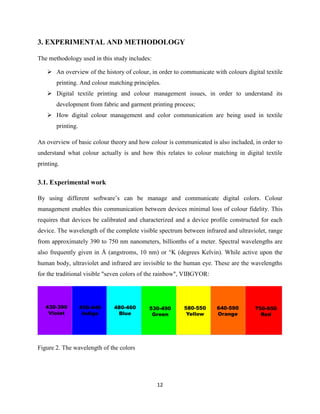
human body, ultraviolet and infrared are invisible to the human eye. These are the wavelengths
for the traditional visible "seven colors of the rainbow", VIBGYOR:
Figure 2. The wavelength of the colors
13
.
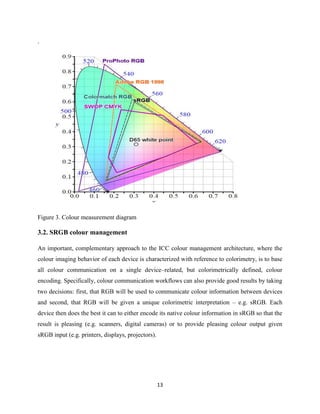
Figure 3. Colour measurement diagram
3.2. SRGB colour management
An important, complementary approach to the ICC colour management architecture, where the
colour imaging behavior of each device is characterized with reference to colorimetry, is to base
all colour communication on a single device–related, but colorimetrically defined, colour
encoding. Specifically, colour communication workflows can also provide good results by taking
two decisions: first, that RGB will be used to communicate colour information between devices
and second, that RGB will be given a unique colorimetric interpretation – e.g. sRGB. Each
device then does the best it can to either encode its native colour information in sRGB so that the
result is pleasing (e.g. scanners, digital cameras) or to provide pleasing colour output given
sRGB input (e.g. printers, displays, projectors).
14
3.3. CIE Tristimulus Values and Metamerism
Colour is three-dimensional; we can describe any colour with three attributes such as the
MUNSELL coordinates Hue, Value and Chroma, or the ones used in the NCS system: hue, white
content and black content. The CIE system of colour measurement reduces spectral data of
objects into three numbers called tristimulus values in such a way that the characteristics of the
illumination and the way a human observer perceives colours are also taken into
consideration[14].
3.4. General numerical colour specifications
Any colour may be specified by three coordinates that locate its position in a three-dimensional
colour space, which is, however, often represented graphically in two dimensions or as a planar
projection. There are a number of standard CIE (Commission International de l'Eclairage) colour
spaces, each varying in its overall uniformity and each having its own coordinates. Three
commonly used colour spaces are determined as follows: CIE xy colour coordinates: XYZ or
xyY (usually depicted as a 2-D, x/y plot). The total range of this colour space represents the
limits of human vision.
CIELAB colour coordinates: L*a*b*, a visually more uniform colour space usually displayed as
a 2-D, a*/b* plot.CIE LCH colour coordinates: LCH (lightness, chroma, hue) sometimes used as
an L/C plot to show the chromatic build-up of a particular colour.
15
4. RESULTS AND DISCUSSION
4.1. Colour Measurement
The process of colour measurement aids the achievement of accurate colour results. Individual
colours can be measured into a spectrophotometer, which once tested can be used to develop
colour standards. These colour standards can be used for design and then be communicated
between different systems and devices. Colour communication will only be successful when the
colour required is available in each system‘s colour gamut (achievable colours). Colour profiles
are generated to identify the achievable colours in one device.
4.2. Colour Communication
Colour management is used to communicate and translate to various inputs and output devices (a
scanner); however, each device will hold a different colour space. A scanner, for example, can be
dependent on the number of colours and, where appropriate, type of dye colours used. Colour
profiles are colour maps that identify the maximum performance of a single device. ICC
(International Color Consortium) profiles measure and translate colour from input to output
devices. These profiles can then be fed into the relevant software, for example a monitor profile
can be fed into Photoshop® enabling a better visual representation. If a colour is unachievable,
the profile will automatically change the colour to the nearest obtainable. Colour management
software provides the ability to generate colour profiles, and communicate between the different
input and output devices.
Two main components are needed to successful color management, no matter in offset printing
or in digital printing. These are the technology part (meaning to have the appropriate hardware
and software) and the proper education (understanding color management theory and the
workflow knowledge).Hardware is complicated, as it insists of different digital printing presses
(and there are literally hundreds of models), different ink sets, different ink types, different
substrates and so on. Color measuring devices are used to measure the resulting colors of ink
mixtures on the substrate.
16
Digital presses have a wider color gamut than the offset process. Because the offset gamut is still
the standard in many people's minds, this is often not understandable and is a more confusing
fact. Unlike offset, each digital press model has a difference color gamut. All are different from
offset. And it‘s even more complicated when considering also the spot colors reproduction and
not just the conventional CMYK colors. There is also a belief that because of the massive range
of applications, which is one of the key benefits of digital printing, this also makes it hard to
standardize.
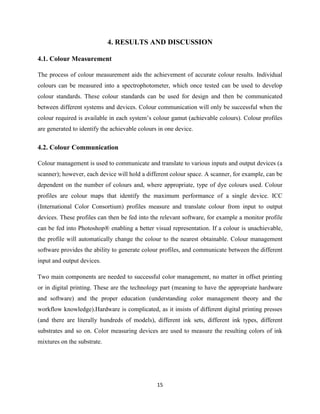
Figure 4. Pantone‘s representation of hexa chrome vs.CMYK color gamut
Hexachrome is a 6-color process printing system developed by Pantone, Inc. to address this
issue. In the core of Hexachrome, orange and green inks have been added to modify CMYK
inks. These additional colors help to reproduce more brilliant continuous-tone images. Pantone
states that the Hexachrome system is capable of accurately reproducing over 90% of the Pantone
Matching System Colors - almost twice the number that can be obtained using CMYK process
printing. The strongest complaints about digitally printed fabric from the textile industry are the
visible dither of colors and limited color gamuts compared to traditional textile screen printing.
With the introduction of 7, 8, and even 12-color digital printers into the market, these systems
come closer to achieving the results desired by the textile industry. As a general rule, the greater
the number of colors (not print heads) that are in a printer, the larger the number of colors that
can be reproduced. For example, a 12-color printer with 10 individual colors and 2 light shades
17
will provide a much larger color gamut than a 12-color printer using CMYK with light shades. It
is important, however, to have a balance of colorants to light shades to eliminate visible dither.
When using textile inks such as reactive, acid, or disperse, the full potential of these color spaces
are not realized until the colors have reacted with the fabric, which occurs during post-processing
such as steaming and washing[16].
4.3. Defining and Profiling Color
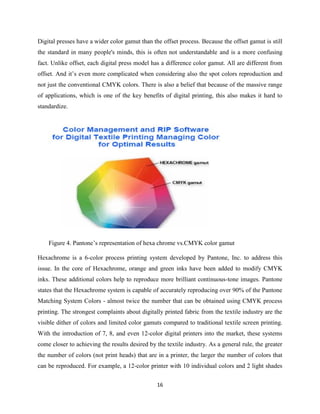
Figure 5. Diagram of CIE L*a*b color space
CIE L*a*b* color space is one of the color standards used by the textile industry. The CIE,
International Commission on Lighting, realized that every color the human eye perceives could
be defined using three numbers: L* indicates luminosity, lightness from white to black. The* and
b* are the chromaticity coordinates that indicate color directions: +a* is the red direction, -a* is
the green direction, +b* is the yellow direction, and b* is the blue direction. The center is
achromatic, hues of gray. As the a* and b* values increase and the point moves out from the
center, the chroma or purity of the color increases. The pythagorean distance between two color
points plotted in the color space relates to the visual color difference between those two points.
In this way, color variation between points and a standard may be expressed using numbers[16].
Color management and RIP software manage color by creating profiles or characterizations
specific to the printer, ink, fabric and any post-processing, such as steaming and washing. All of
these variables have an impact on color and each variation must be profiled to insure accurate
color match. When a design is printed, a profile is selected based on the printer/ink/media
18
combination to insure that the colors in the original design or target colors match the digitally
printed output.
4.4. Color gamut in color management
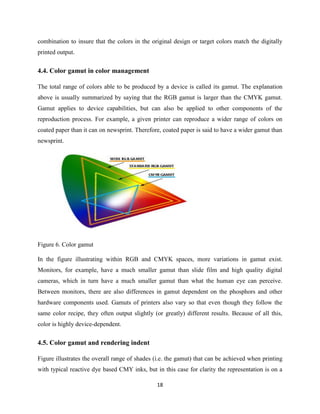
The total range of colors able to be produced by a device is called its gamut. The explanation
above is usually summarized by saying that the RGB gamut is larger than the CMYK gamut.
Gamut applies to device capabilities, but can also be applied to other components of the
reproduction process. For example, a given printer can reproduce a wider range of colors on
coated paper than it can on newsprint. Therefore, coated paper is said to have a wider gamut than
newsprint.
Figure 6. Color gamut
In the figure illustrating within RGB and CMYK spaces, more variations in gamut exist.
Monitors, for example, have a much smaller gamut than slide film and high quality digital
cameras, which in turn have a much smaller gamut than what the human eye can perceive.
Between monitors, there are also differences in gamut dependent on the phosphors and other
hardware components used. Gamuts of printers also vary so that even though they follow the
same color recipe, they often output slightly (or greatly) different results. Because of all this,
color is highly device-dependent.
4.5. Color gamut and rendering indent
Figure illustrates the overall range of shades (i.e. the gamut) that can be achieved when printing
with typical reactive dye based CMY inks, but in this case for clarity the representation is on a
19
CIELAB diagram in which the colour distribution is much more uniform than in a CIE
chromaticity plot. The extent of the gamut can be considerably expanded if additional inks,
comprising brighter primaries such as orange, yellowish-red, reddish-blue and yellowish-green,
are selected.
4.6. Color Management Systems.
A color management system (CMS) is a set of software tools which attempts to compensate for
the device dependent nature of color by mapping colors from a large gamut, like a monitor, to
the a device with a smaller gamut, like a printer. Though there will never be a perfect match
between RGB and CMYK output, the International Color Consortium (ICC) has minimized the
problem by establishing color standards. An ICC color management system has three
components:
1. A device-independent color space (CIE)
2. Device profiles that define the color characteristics of a particular device.
3. A Color Management Module (CMM) that converts color from one space to another using the
device
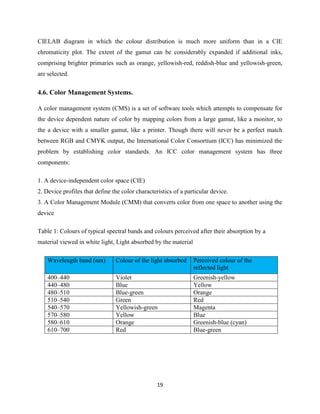
Table 1: Colours of typical spectral bands and colours perceived after their absorption by a
material viewed in white light, Light absorbed by the material
Wavelength band (nm) Colour of the light absorbed Perceived colour of the
reflected light
400–440 Violet Greenish-yellow
440–480 Blue Yellow
480–510 Blue-green Orange
510–540 Green Red
540–570 Yellowish-green Magenta
570–580 Yellow Blue
580–610 Orange Greenish-blue (cyan)
610–700 Red Blue-green
20
5. CONCLUSION
Digital technology enhances the use and management of colour in several critically important
ways which may be summarized under the headings of colour specification, colour prediction,
colour communication and colour visualization, verbal communication and in particular digital
communication may be enhanced by referring to systematically organized colour atlases such as
Pantone and Munsell which illustrate up to 7000 specific colours, each of which has an
unambiguous alpha-numeric designation. Communication by means of the CIE system of colour
co-ordinates is the final and most precise option. It is fully capable of quantifying all those
natural shades of green to an accuracy of 1 part in 5 million, given that you can actually measure
the characteristic with the same accuracy.
These transferable skills should also include a fundamental understanding of the intricacies of
colour management. In terms of colour matching, digital textile printing comes with its own
restrictions and requirements. A colour viewed on screen cannot be accurately reproduced if it is
not within the achievable colour range (or gamut) of the particular digital textile printer and
colorants being used.
Generally digital color management, color gamut, color rendering intent and color
communication Three basic components: print head, ink, medium Continuous Ink Jet (CIJ) and
Drop‐on‐Demand Inkjet (DOD) Ink Jet (DOD) CIJ‐Ink is applied by squirting the ink through
nozzles at a constant speed with a constant pressure applied.DOD‐Ink droplets are ejected only
when needed to form the image.
In modern commercial textile environments there is an increasing need for rapid and reliable
communication systems both internally (possibly between many geographical sites) and with
customers, specifies and suppliers. Colorimetric measurement data and Colour management data
such as equipment characterization and ICC profile information are very important in today‘s
digital world to manage color and communicate with the colors.
21
6. REFERENCE
[1] L. Simonot and M. J. J. A. Hébert, "Between additive and subtractive color mixings:
intermediate mixing models," vol. 31, pp. 58-66, 2014.
[2] S. J. O. Williams and L. Technology, "Practical colour management," vol. 38, pp. 399-
404, 2006.
[3] M. Strgar Kurečić, D. Agić, L. J. J. o. I. Mandić, and O. Sciences, "Color Management
implementation in Digital Photography," vol. 31, pp. 47-57, 2007.
[4] Y. Ding, L. Parrillo‐Chapman, and H. S. J. C. T. Freeman, "Developing the methodology
of colour gamut analysis and print quality evaluation for textile ink‐jet printing: Delphi
method," vol. 134, pp. 135-147, 2018.
[5] K. J. Pohnerkar, "Generating ICC Output Profiles for Different Substrates: Application
too a Shinohara Offset Press & Several Printers," 2003.
[6] B. Gooby, M. B. Gooby, and B. UWE, "The development of methodologies for designers
engaging with digital colour inkjet printing in textile design."
[7] M. Klaman, "Adpects on colour rendering, colour prediction and colour control in printed
media," Numerisk analys och datalogi, 2002.
[8] Y. Zhang, V. Cheung, S. Westland, and K. J. J. C. T. Beverley, "Colour management of a
low‐cost four‐colour ink‐jet printing system on textiles," vol. 125, pp. 29-35, 2009.
[9] D. Javoršek and A. J. C. T. Javoršek, "Colour management in digital textile printing,"
vol. 127, pp. 235-239, 2011.
[10] A. Ford and A. J. W. U. Roberts, London, "Colour space conversions," vol. 1998, pp. 1-
31, 1998.
[11] A. Sharma, Understanding color management: John Wiley & Sons, 2018.
[12] P. Rhodes, S. Scrivener, and M. J. D. Luo, "ColourTalk—a system for colour
communication," vol. 13, pp. 89-96, 1992.
[13] R. Luo, P. Rhodes, J. Xin, S. J. J. o. t. S. o. D. Scrivener, and Colourists, "Effective
colour communication for industry," vol. 108, pp. 516-520, 1992.
[14] R. J. R. o. D. I. Hirschler and S. M. Vol, "Electronic colour communication in the textile
and apparel industry," vol. 1, pp. 43-61, 2010.
[15] D. Oulton, "Technology for Colour Management," in Proceedings of the 1st International
Conference on Digital Technologies for the Textile Industries, 2013, p. 6.
22
[16] S. Gordon, "Color Mangement and RIP Software for Digital Textile Printing Managing
Color for Optimal esults," Published by [TC], vol. 2, 2001.

Seminar on color final

  • 1.
    Federal TVET Institute/University Textileand Apparel Fashion Technology Division Textile Technology Department Digital color management, color gamut and rendering intent and color communication Advanced Textile Coloration and Color Measurement Course Code: TXT 554 Submitted by Meseret Bogale ID MTR/236/12 Submitted to Dr.Gurumurthy.B.R Ph.D (textile technology) –instructor in textile technology Submission Date 2020/2021 Addis Abeba Ethiopia
  • 2.
    i CERTIFICATION This is tocertify, that the seminar paper submitted by me is an outcome of my independent and original work. I have duly acknowledged all the sources from which the ideas and extracts have been taken. And I certify that the titled (Digital color management, color gamut and rendering intent and color communication) is based on my own work carried out during the course of our study under the supervision of Dr.Gurumurthy.B.RPh.D (textile technology) instructor in textile technology. I assert the statements made and conclusions drawn are an outcome of my seminar work. Name ____________________________ Signature _________________________ Date ______________________________
  • 3.
    ii ACKNOWLEDGEMENTS Firstly I wouldlike to thank the alignment of God and his Mother helping me to do this seminar and then I would like to thank Dr.Gurumurthy.B.R (Ph.D) textile technology instructor in textile technology and course manager of Advanced Textile Coloration and Color Measurement who gives this seminar to do, he gives his guidance and continually challenging me throughout this seminar. I also extend to you my gratitude for bearing with me during my personal challenges. I also thank Debre berhan poly technic college textile and garment department sectors for giving a chance to use their internet access for doing this seminar
  • 4.
    iii TABLE OF CONTENTS CERTIFICATION...................................................................................................i ACKNOWLEDGEMENTS ................................................................................... ii TABLE OF CONTENTS ...................................................................................... iii List of Tables .................................................................................................................................. v List of Figures................................................................................................................................ vi List of Acronyms .......................................................................................................................... vii ABSTRACT........................................................................................................................................ viii 1. INTRODUCTION.........................................................................................................................1 1.1. Definition of Colors....................................................................................................................1 2. OBJECTIVES.................................................................................................................................3 2.1. General Objective........................................................................................................................3 2.1.1. Specific objectives...................................................................................................................3 3. LITERATURE REVIEW .........................................................................................................4 3.1. Color in textile industry.............................................................................................................4 3.1.1. Colour Management and ICC........................................................................................ 4 3.1.2. Colour management in ink jet printing.......................................................................... 5 3.1.3. Color print production ................................................................................................... 5 3.2. Colour gamut in digital textile printing.................................................................................6 3.2.1. Gamut mapping ............................................................................................................. 6 3.2.2. Limitations of colour gamut .......................................................................................... 7 3.3. Color Rendering Intent..............................................................................................7 3.4. Colour Communication.............................................................................................8 3.4.1. Effective colour communication for industry................................................................ 8 3.4.2. Communication between Colour Measuring Instruments............................................. 9 3.4.3. Colour measurement, specification and prediction ....................................................... 9 3.4.4. Virtual Colour Communication..................................................................................... 9 3.4.5. Device dependent colour ............................................................................................. 10 3.4.6. Virtual Colour Communication in the Textile and Apparel Industry.......................... 10
  • 5.
    iv 3.4.7. Colorimetry ............................................................................................................................11 3.EXPERIMENTAL AND METHODOLOGY.............................................................................12 3.1. Experimental work........................................................................................................................12 3.2. SRGB colour management................................................................................................. 13 3.3. CIE Tristimulus Values and Metamerism.......................................................................... 14 3.4. General numerical colour specifications............................................................................ 14 4. RESULTS AND DISCUSSION......................................................................................................15 4.1. Colour Measurement.......................................................................................................... 15 4.2. Colour Communication...................................................................................................... 15 4.3. Defining and Profiling Color.............................................................................................. 17 4.4. Color gamut in color management..................................................................................... 18 4.5. Color gamut and rendering indent...................................................................................... 18 4.6. Color Management Systems............................................................................................... 19 5. CONCLUSION............................................................................................20 6. REFERENCE ..............................................................................................21
  • 6.
    v List of Tables Table1: Colours of typical spectral bands and colours perceived after their absorption by a material viewed in white light, Light absorbed by the material................................................................................19
  • 7.
    vi List of Figures Figure1.Object colours (left); additive mixing (middle) and subtractive mixing (right)............. 10 Figure 2. The wavelength of the colors ........................................................................................ 12 Figure 3. Colour measurement diagram........................................................................................ 13 Figure 4. Pantone‘s representation of hexa chrome vs.CMYK color gamut................................ 16 Figure 5. Diagram of CIE L*a*b color space............................................................................... 17 Figure 6. Color gamut................................................................................................................... 18
  • 8.
    vii List of Acronyms NCSNatural Color System CMS Color management system R&D Research and development ICC International Colour Consortium PCS profile connection space ASTM CMYK RGB CIJ DOD CIE SRGB RIP American Society for Testing and Materials Cyan, Magenta, Yellow and Black Red ,Green and Blue Continuous Ink Jet Drop‐on‐Demand Inkjet Commission International de l'Eclairage Standard Red, Green and Blue Raster Image Processor
  • 9.
    viii ABSTRACT The main purposeof the CMS is to provide a control system by which the measured colour data of a design may be reliably and accurately transformed into output data for display on a monitor or as input to a printer, so that the appearance of these outputs reliably represents that of the input design to the observer. A CMS will often provide other useful features such as organizing the `queue' of print jobs. The CMS may also provide means for communicating design and colour data via the Internet. It is often the case, particularly with longer print runs, that the digital design, having been sampled/proofed on a digital printer, is then screen printed with print pastes containing completely different dyes. And also CMS may be to provide recipe predictions for the conventional print production. Digital image capture. Image is captured as a series of RGB (red, green and blue) cell responses forming a matrix (digital camera) or raster pattern (scanner). Digital colour printer. Uses CMYK (cyan, magenta, yellow and optionally black) printing ink primaries which, in most digital printers, are jetted onto the substrate as a `super pixel' matrix of ink spots. Computer systems for acquiring, displaying and printing colours digitally normally employ an overall colour management system (CMS) to assist the transfer of colour data from image capture through to the final printing system. In modern commercial textile environments there is an increasing need for rapid and reliable communication systems both internally (possibly between many geographical sites) and with customers, specifies and suppliers. Colorimetric measurement data and Colour management data such as equipment characterization and ICC profile information are very important in today‘s digital world to manage color and communicate with the colors. Keywords: digital color management, color gamut, color rendering intent, color communication, digital textile printing.
  • 10.
    1 1. INTRODUCTION 1.1. Definitionof Colors The color of a surface comes from the interpretation by the human visual system of the light signal reflected or transmitted by the surface, especially its spectral distribution. By normalizing the measured spectrum by a reference spectrum considered as the maximum signal (direct incident light for transmittance measurements, and light scattered with a white standard for reflectance measurements of the CIELAB color space is normally used. The coordinates— lightness L, green/red coordinate a, and blue/yellow coordinate b can be derived from the CIEXYZ tristimulus values by nonlinear relations[1]. The colour is one of the most important entities when a consumer purchases an item. Colour is often the hardest to manage as its appearance and it is subjective and, now that most the manufacturing of coloured goods are carried out over see, it will becomes increasingly harder to control the color. The colour of an object depends on with the observer and the quality of the light. The human beings have a poor color memory, so there is a mechanism help to communicate with the color. The Color order systems have been used as extensively, and where the specifier and the supplier each of them have a book of colors and each shades have a unique reference[2]. Digital Colour display and communication systems are used successfully to complement the spectrophotometer systems are using input devices, such as optical flatbed scanners and digital cameras. The Images can be displayed on a calibrated monitor and colored either using reflectance data from the spectrophotometer or by inputting color values. The advantage of such systems are that it allow the specifier and the supplier to see the same appearance of a product as well as having the numeric information, it allows quick and effective decisions will be made. And The process of communications have to be managed and the information defined and controlled[2]. The accuracy of Color between the original and final output being optimize using the Color Management Systems (CMS). The term color managements refer to the use of software‘s to automatically determine colour reproduction of the characteristics of the input devices, monitors, and output devices, and also then automatically make the image settings necessary for optimal color reproduction systems are very important[3].
  • 11.
    2 One of themost abundant critical research and development (R&D) areas is the color gamut analysis, particularly as new colourant sets, pretreatment formulas, and ink-jet heads are developed. Effective and standard method of colour gamut analysis is needed for a number of R&D and manufacturing scenarios. For example, if the company wishes to develop a six or eight-colour ink set, using cyan, magenta, yellow, black (CMYK) as the base four colours, decisions must be made as to which additional colours will provide the most impact on the colour gamut[4]. ICC software allows the output profiles to contain four rendering intents - perceptual, absolute colorimetric, relative colorimetric and saturation. It is possible that to store the intents as forward lookup the relating profile connection space (PCS) to the device and as reverse lookup tables relating PCS to the device and a reverse lookup tables relating device to PCS. The profiles that are going to be used absolute colorimetric in color management systems. and because we are going to verify the profiles on press with maximum of gamut spacing and measured colorimetry for the range of color gamut and rendering intents on an object[5].
  • 12.
    3 2. OBJECTIVES 2.1. Generalobjective The main objective of this seminar is to understand about digital color management, color gamut, rendering intent and color communication in textile digital printing. 2.1.1. Specific objectives  To study about color production and color quality control and assessment.  To study about color communication in digital textile printers.  Analysis and development of methods to characterize colour rendering, to predict colour and to control colour in printed media.  To determine accurate, repeatable color reproduction in digital color management.  To study the role of color management in digital textile printing.
  • 13.
    4 3. LITERATURE REVIEW 3.1.Color in textile industry Colour is critical in the textile industry both in terms of meeting trends, client requirements and obtaining consistent colour. The choices a designer makes about the colours in their designs may come from trend forecasts or be dictated by the brand or textile agent the designer is working for. Achieving the correct colours and meeting seasonal trends can ensure a product‘s success. Digital screen colour, a mix of red, green and blue light known as additive colour, has a broader colour range to printed colour, primarily a mix of cyan, magenta, yellow and black pigment primaries known as subtractive colour. Whilst there are overlaps between the two colours spaces there are many colours possible in one but not the other, thus out of gamut[6]. 3.1.1. Colour Management and ICC With the digitalization of the workflow in media production, there arises a demand for a more effective colour control. The development of different colour management systems became the solution. A control, based on mathematical equations, through the different conversion steps became central. The development of such colour management systems very soon created the need for a standard to be able to communicate colour profile data. The first systems developed were all vendor specific. The International Colour Consortium (ICC), established in 1993 by several of the leading companies in the prepress colour industry, created, promoted and encouraged the standardization of an open, vendor-neutral, cross platform colour management system architecture[7]. Development of electronic technology and the proliferation of low-cost colour imaging devices allow more and more users to transfer images between devices (for example, from a computer screen to a printer). Colour management enables this communication between devices minimal loss of colour fidelity. This requires that devices be calibrated and characterized and a device profile constructed for each device .the profile enables the mapping between the device- independent colorimetric tristimulus data representing the output (CIEXYZ) and the device- dependent coordinates (typically RGB or CMYK)[8].
  • 14.
    5 3.1.2. Colour managementin ink jet printing Color is not a surface or an object. Color is the phenomenon of light reflected from a surface or object as it is received by the eye and processed by the brain. Light and surfaces will vary, but even the same conditions can result in differing mental interpretations and verbal descriptions by a viewer. As the mental interpretation of a physical process, ―color is in the eye of the beholder,‖ and if there is more than one be holder, it is likely that their views will vary. This chapter aims to detail those issues in color management relevant to printing on textiles by ink jet, rather than being an exhaustive detailing of the entire field of color management. It considers both the production of color and the perception of color with the need for individuals to agree on the perception of a color when in a commercial situation and not all operating with calibrated equipment. As even different parts of an office can change the perception of a color due to the quality of the light in that area, this becomes particularly problematic when the individuals in question are located in different parts of the world[9]. 3.1.3. Color print production One rarely asked but significant question is why one color must match another. Asking this question allows for an appropriate allocation of resources according to the response, as there are degrees of justification for expensive and extensive calibration practices. In ―batch matching,‖ there may be little or no allowance for difference and tolerance, particularly for applications such as military parade uniforms or rolls of curtaining. In this case, calibration deserves the appropriate amount of time, money, and attention. Some choose to recognize discrepancies between processes and colors as part of the creative process and an inherent part of print production. For color schemes, matching may be more relevant across the relative colors contributing to the overall complimentary look, along with a fast and financially effective color solution. Detailed color profiling also offers greater accuracy, but does not increase the overall range of the color gamut. Profiling does not add different color gamuts together. It disregards colors not reproducible by all, leaving the reduced range of only the shared hues; however, avoiding calibrating will not change this[9].
  • 15.
    6 3.2. Colour gamutin digital textile printing A ―gamut‖ refers to the range of colors capable of being reproduced by any system of color mixing. The gamuts of CMYK and RGB overlap; however, it is not an exact overlap, as each system begins from different starting points. CMYK using its magenta and RGB using its red will probably each mix a different color. Crucially, as these two systems work differently, they can mimic each other rather than exactly reproduce each other‘s range of colors. In addition, many printers use ―light‖ versions of the CMYK inks or an additional set of primaries, such as red, orange, blue, and a deep or dark black to extend the range of possible colors. Many design software programs use three variables in an interface, often in two steps to allow users to select colors. These often correspond to three principle activities involved in producing a color.[9] And in other words a colour gamut is the area enclosed by a colour space in three dimensions. It is usual to represent the gamut of a colour reproduction system graphically as the range of colours available in some device independent colour space. Often the gamut will be represented in only two dimensions[10]. 3.2.1. Gamut mapping Gamut mapping is perhaps the most crucial part of colour management and research in this field is extensive. The new gamut mapping algorithm for newsprint. The algorithm is derived from analysis of high quality colour reproductions. Testing of the algorithms was performed in a transparency to-newsprint workflow, assumed to be the most severe form of gamut compression in commercial use. For each physical device in the colour imaging chain, there is a finite range of colours that can be imaged on a given substrate, depending on factors such as the colorants used, the densities at which they are imaged, the imaging characteristics of the device, and the surface properties of the substrate[7]. Since the most notorious color gamut compressions involve reducing the total number of colors that can be represented then going back to the original values is usually impossible. What has been lost is lost. So it is best to delay any steps where gamut compression can occur to avoid reducing the gamut of the data we have. It must be done for output to gamut reduced devices but it is best to reduce your data in this way only in the last step. The gamut of a color space is the total set of colors that can be represented within that color space. Typically a device CMYK
  • 16.
    7 color space willrepresent less saturated and fewer colors than an RGB color space. When the gamut of the source and destination color spaces differs a "gamut mapping" needs to be performed. Those colors that cannot be represented in the destination need to be altered to colors that can be represented. 3.2.2. Limitations of colour gamut When converting colours from the gamut of the original or of the proof to the gamut of the print, there is often a limit both in size and in shape. The available colour gamut is often smaller and the conversion of colour values comprises some kind of decision as to what to do with those colour values that fall outside of the available or reproducible gamut. When reproducing an original image for printed media, there are certain limitations in the press that will influence the available colour gamut. The press, with its certain characteristics, will limit the possibilities in reproduction; the substrate used will limit the gamut, as will the inks or toners used. The variations in the printing process itself heavily influence the print quality, not least the colour rendering[7]. 3.3. Color Rendering Intent Rendering Intent: - A method for translating from one color space into another. Rendering intents are necessary because of the different ―gamuts‖ of devices and Medias. There are four main rendering intents in the ICC specification: Absolute Colorimetric Relative Colorimetric, Perceptual, and Saturation. Which one you choose is crucial when gamuts are very different. Color management provides another way to help in ―managing‖ gamut limitations. If a color cannot be printed, a color management system helps us find the best replacement. The user can select from different approaches to finding a replacement color. The methods used to find a replacement are called rendering intents and typically the rendering intent for a color conversion is specified in application. The ICC has specified four standard gamut compression schemes, called rendering intents. The official terms for the rendering intents are perceptual, relative colorimetric, absolute colorimetric, and saturation. Let‘s look at rendering intents as related to different image types[11]
  • 17.
    8 3.4. Colour Communication TheColour talk filer supports all colour communication, storage and retrieval. Colours may be saved either to the system's hard disk or to a 31/2 in floppy disk (which can be sent through the mail). As colours are stored in terms of their screen CIE XYZ values, they may be communicated to other Colour Talk systems without loss of fidelity. The filer also provides another means to enter colours into the system. Using either floppy disk or a network link, colours may be sent to and from the Coats CPS. This enables physical coloured samples to be directly measured via the spectrophotometer (attached to the CPS) and be subsequently reproduced on the screen. In addition, it allows for the prediction of dye recipes for colours and colour palettes created using the system. Specifying only XYZ data means that there are usually several possible recipes that can be used to match under illuminant D65. However, these recipes may not match the target shade under other lighting conditions. Another approach to the problem of colour constancy is to generate a pseudo-reflectance curve. This information is ‗illuminant independent‘ meaning that the CPS can use this to select only those recipes which match under several light sources. However, it was felt that putting too many constraints on the prediction algorithm could lead to failure to find any suitable recipe. Additionally, there is no guarantee that pseudo- reflectance curves will produce a colour- constant shade. Although the representation used by Colour Talk does not guarantee colour constancy, feedback is available (see later) from the CPS which can be used to assess this property visually[12]. 3.4.1. Effective colour communication for industry How many times have you agreed to a colour design on a monitor, only to find that the final version on your fabric is a totally different shade? The problem of mismatch between colours on screen and on physical materials has been a focus on the result is the Colour Talk system, which demonstrates that high colour fidelity and effective colour communication can be realized using modern colour computer systems. Colour specification and communication are also problems for industry. In practice, many physical colour specification systems (including Pantone, Natural Color System (NCS) and Munsell Color System) are widely used by industry. Each system consists of coloured chips arranged in some systematic fashion. Colour information can be
  • 18.
    9 communicated using eachsystem‗s own colour coordinates, such as value, chroma and hue (for Munsell) or blackness, chromaticness and hue (NCS)[13]. 3.4.2. Communication between Colour Measuring Instruments Many people take it for granted that once a colour is measured (i.e. we can express it in numbers, be they spectral reflectance, X, Y, Z tristimulus or CIELAB values, or some kind of colour difference) we may freely communicate it, and the result will be perfect understanding of exactly which colour we mean. Unfortunately, this is not so. There are always some differences between measurements made on different instruments, even if we make sure that they are in perfect operating conditions. The performance of colour measuring instruments may be specified following the ASTM Standard Practice for Specifying and Verifying the Performance of Color- Measuring Instruments. From the point of view of colour communication reproducibility is extremely important, because we are generally comparing measurement results from different locations, if possible between instruments of the same model[14]. 3.4.3. Colour measurement, specification and prediction At the highest levels of potential accuracy CIE L*a*b* colour co-ordinates can be confidently measured and reproduced as product colours to within a just visible difference that are also visually correct under more than one illuminant. In practical terms this means that under quality control the basic CIE X, Y, Z co-ordinates of any given colour must be spectrally specified and measured to three significant figures (or plus or minus one part in a thousand).This requirement is demanding, it calls for best practice even from skilled production colorists, and the required techniques lie well beyond the abilities of most of the other stakeholders in colour management[15]. 3.4.4. Virtual Colour Communication Communicating colours by numbers is all very well, but what would really be nice is to show you on your end of the line what I see here on my end which is what virtual colour communication is all about. Nowadays this appears to be very simple: I have a digital camera or a scanner, enter the colour (or a complex design of many colours) into some software, send the file to you over the Internet, and you just see it on your monitor or print it out on your printer. As
  • 19.
    10 we shall see,there is more to it than meets the eye (literally). If you ever tried to compare the image you have on the monitor to the original you have just scanned in, or compare the print from your printer to the monitor image, or the original you were very likely most disappointed unless you are using colour management[14]. 3.4.5. Device dependent colour In today‘s world of digital imaging we can‘t really get even acceptable colour reproduction across the media without colour management, and yet, it is a technique not at all well known, and even less well understood. Why do we need colour management? To understand this rather complex problem we have to first think about the different ways colours are produced. The mix colours from three additive primaries red, green and blue (hence RGB), which works because human colour perception is also based on RGB primaries, thus additive mixing obeys the laws of psychophysics. Office printers produces colours by subtractive mixing (obeying the laws of physics) based on three subtractive primaries yellow, magenta and cyan (hence YMC). For technical reasons the great majority of these printers use a fourth colour, black (K), and therefore we usually speak of the YMCK system. Here we are back again to an object colour, prints can be characterized by their spectral reflectance curves, but these will inevitably be very different from those of the originals[14]. Figure 1.Object colours (left); additive mixing (middle) and subtractive mixing (right) 3.4.6. Virtual Colour Communication in the Textile and Apparel Industry In the previous section we have seen how digital communication works beyond traditional, spectrophotometry-based colorimetry colour. New technologies in image capture and processing
  • 20.
    11 together with thetechnology of colour management have made it possible to communicate not only the colour of relatively large uniform spots (which may be measured on a conventional instrument) but also that of complex images. 3.4.7. Colorimetry To be able to communicate colour and what colour looks like, the special field of colour science, namely colorimetry, was developed. The need to specify colour in numerical terms forced the development of a definition of the physically defined stimulus in such a way that (a) when viewed by an observer with normal color vision, under the same observing conditions, stimuli with the same specifications look alike (i.e. Are in complete color-match). (b) Stimuli that look alike have the same specification and (c) the numbers comprising the specifications are continuous functions of the physical parameters defining the spectral radiant power distribution of the stimulus.‖[7].
  • 21.
    12 3. EXPERIMENTAL ANDMETHODOLOGY The methodology used in this study includes:  An overview of the history of colour, in order to communicate with colours digital textile printing. And colour matching principles.  Digital textile printing and colour management issues, in order to understand its development from fabric and garment printing process;  How digital colour management and color communication are being used in textile printing. An overview of basic colour theory and how colour is communicated is also included, in order to understand what colour actually is and how this relates to colour matching in digital textile printing. 3.1. Experimental work By using different software‘s can be manage and communicate digital colors. Colour management enables this communication between devices minimal loss of colour fidelity. This requires that devices be calibrated and characterized and a device profile constructed for each device. The wavelength of the complete visible spectrum between infrared and ultraviolet, range from approximately 390 to 750 nm nanometers, billionths of a meter. Spectral wavelengths are also frequently given in Å (angstroms, 10 nm) or °K (degrees Kelvin). While active upon the human body, ultraviolet and infrared are invisible to the human eye. These are the wavelengths for the traditional visible "seven colors of the rainbow", VIBGYOR: Figure 2. The wavelength of the colors
  • 22.
    13 . Figure 3. Colourmeasurement diagram 3.2. SRGB colour management An important, complementary approach to the ICC colour management architecture, where the colour imaging behavior of each device is characterized with reference to colorimetry, is to base all colour communication on a single device–related, but colorimetrically defined, colour encoding. Specifically, colour communication workflows can also provide good results by taking two decisions: first, that RGB will be used to communicate colour information between devices and second, that RGB will be given a unique colorimetric interpretation – e.g. sRGB. Each device then does the best it can to either encode its native colour information in sRGB so that the result is pleasing (e.g. scanners, digital cameras) or to provide pleasing colour output given sRGB input (e.g. printers, displays, projectors).
  • 23.
    14 3.3. CIE TristimulusValues and Metamerism Colour is three-dimensional; we can describe any colour with three attributes such as the MUNSELL coordinates Hue, Value and Chroma, or the ones used in the NCS system: hue, white content and black content. The CIE system of colour measurement reduces spectral data of objects into three numbers called tristimulus values in such a way that the characteristics of the illumination and the way a human observer perceives colours are also taken into consideration[14]. 3.4. General numerical colour specifications Any colour may be specified by three coordinates that locate its position in a three-dimensional colour space, which is, however, often represented graphically in two dimensions or as a planar projection. There are a number of standard CIE (Commission International de l'Eclairage) colour spaces, each varying in its overall uniformity and each having its own coordinates. Three commonly used colour spaces are determined as follows: CIE xy colour coordinates: XYZ or xyY (usually depicted as a 2-D, x/y plot). The total range of this colour space represents the limits of human vision. CIELAB colour coordinates: L*a*b*, a visually more uniform colour space usually displayed as a 2-D, a*/b* plot.CIE LCH colour coordinates: LCH (lightness, chroma, hue) sometimes used as an L/C plot to show the chromatic build-up of a particular colour.
  • 24.
    15 4. RESULTS ANDDISCUSSION 4.1. Colour Measurement The process of colour measurement aids the achievement of accurate colour results. Individual colours can be measured into a spectrophotometer, which once tested can be used to develop colour standards. These colour standards can be used for design and then be communicated between different systems and devices. Colour communication will only be successful when the colour required is available in each system‘s colour gamut (achievable colours). Colour profiles are generated to identify the achievable colours in one device. 4.2. Colour Communication Colour management is used to communicate and translate to various inputs and output devices (a scanner); however, each device will hold a different colour space. A scanner, for example, can be dependent on the number of colours and, where appropriate, type of dye colours used. Colour profiles are colour maps that identify the maximum performance of a single device. ICC (International Color Consortium) profiles measure and translate colour from input to output devices. These profiles can then be fed into the relevant software, for example a monitor profile can be fed into Photoshop® enabling a better visual representation. If a colour is unachievable, the profile will automatically change the colour to the nearest obtainable. Colour management software provides the ability to generate colour profiles, and communicate between the different input and output devices. Two main components are needed to successful color management, no matter in offset printing or in digital printing. These are the technology part (meaning to have the appropriate hardware and software) and the proper education (understanding color management theory and the workflow knowledge).Hardware is complicated, as it insists of different digital printing presses (and there are literally hundreds of models), different ink sets, different ink types, different substrates and so on. Color measuring devices are used to measure the resulting colors of ink mixtures on the substrate.
  • 25.
    16 Digital presses havea wider color gamut than the offset process. Because the offset gamut is still the standard in many people's minds, this is often not understandable and is a more confusing fact. Unlike offset, each digital press model has a difference color gamut. All are different from offset. And it‘s even more complicated when considering also the spot colors reproduction and not just the conventional CMYK colors. There is also a belief that because of the massive range of applications, which is one of the key benefits of digital printing, this also makes it hard to standardize. Figure 4. Pantone‘s representation of hexa chrome vs.CMYK color gamut Hexachrome is a 6-color process printing system developed by Pantone, Inc. to address this issue. In the core of Hexachrome, orange and green inks have been added to modify CMYK inks. These additional colors help to reproduce more brilliant continuous-tone images. Pantone states that the Hexachrome system is capable of accurately reproducing over 90% of the Pantone Matching System Colors - almost twice the number that can be obtained using CMYK process printing. The strongest complaints about digitally printed fabric from the textile industry are the visible dither of colors and limited color gamuts compared to traditional textile screen printing. With the introduction of 7, 8, and even 12-color digital printers into the market, these systems come closer to achieving the results desired by the textile industry. As a general rule, the greater the number of colors (not print heads) that are in a printer, the larger the number of colors that can be reproduced. For example, a 12-color printer with 10 individual colors and 2 light shades
  • 26.
    17 will provide amuch larger color gamut than a 12-color printer using CMYK with light shades. It is important, however, to have a balance of colorants to light shades to eliminate visible dither. When using textile inks such as reactive, acid, or disperse, the full potential of these color spaces are not realized until the colors have reacted with the fabric, which occurs during post-processing such as steaming and washing[16]. 4.3. Defining and Profiling Color Figure 5. Diagram of CIE L*a*b color space CIE L*a*b* color space is one of the color standards used by the textile industry. The CIE, International Commission on Lighting, realized that every color the human eye perceives could be defined using three numbers: L* indicates luminosity, lightness from white to black. The* and b* are the chromaticity coordinates that indicate color directions: +a* is the red direction, -a* is the green direction, +b* is the yellow direction, and b* is the blue direction. The center is achromatic, hues of gray. As the a* and b* values increase and the point moves out from the center, the chroma or purity of the color increases. The pythagorean distance between two color points plotted in the color space relates to the visual color difference between those two points. In this way, color variation between points and a standard may be expressed using numbers[16]. Color management and RIP software manage color by creating profiles or characterizations specific to the printer, ink, fabric and any post-processing, such as steaming and washing. All of these variables have an impact on color and each variation must be profiled to insure accurate color match. When a design is printed, a profile is selected based on the printer/ink/media
  • 27.
    18 combination to insurethat the colors in the original design or target colors match the digitally printed output. 4.4. Color gamut in color management The total range of colors able to be produced by a device is called its gamut. The explanation above is usually summarized by saying that the RGB gamut is larger than the CMYK gamut. Gamut applies to device capabilities, but can also be applied to other components of the reproduction process. For example, a given printer can reproduce a wider range of colors on coated paper than it can on newsprint. Therefore, coated paper is said to have a wider gamut than newsprint. Figure 6. Color gamut In the figure illustrating within RGB and CMYK spaces, more variations in gamut exist. Monitors, for example, have a much smaller gamut than slide film and high quality digital cameras, which in turn have a much smaller gamut than what the human eye can perceive. Between monitors, there are also differences in gamut dependent on the phosphors and other hardware components used. Gamuts of printers also vary so that even though they follow the same color recipe, they often output slightly (or greatly) different results. Because of all this, color is highly device-dependent. 4.5. Color gamut and rendering indent Figure illustrates the overall range of shades (i.e. the gamut) that can be achieved when printing with typical reactive dye based CMY inks, but in this case for clarity the representation is on a
  • 28.
    19 CIELAB diagram inwhich the colour distribution is much more uniform than in a CIE chromaticity plot. The extent of the gamut can be considerably expanded if additional inks, comprising brighter primaries such as orange, yellowish-red, reddish-blue and yellowish-green, are selected. 4.6. Color Management Systems. A color management system (CMS) is a set of software tools which attempts to compensate for the device dependent nature of color by mapping colors from a large gamut, like a monitor, to the a device with a smaller gamut, like a printer. Though there will never be a perfect match between RGB and CMYK output, the International Color Consortium (ICC) has minimized the problem by establishing color standards. An ICC color management system has three components: 1. A device-independent color space (CIE) 2. Device profiles that define the color characteristics of a particular device. 3. A Color Management Module (CMM) that converts color from one space to another using the device Table 1: Colours of typical spectral bands and colours perceived after their absorption by a material viewed in white light, Light absorbed by the material Wavelength band (nm) Colour of the light absorbed Perceived colour of the reflected light 400–440 Violet Greenish-yellow 440–480 Blue Yellow 480–510 Blue-green Orange 510–540 Green Red 540–570 Yellowish-green Magenta 570–580 Yellow Blue 580–610 Orange Greenish-blue (cyan) 610–700 Red Blue-green
  • 29.
    20 5. CONCLUSION Digital technologyenhances the use and management of colour in several critically important ways which may be summarized under the headings of colour specification, colour prediction, colour communication and colour visualization, verbal communication and in particular digital communication may be enhanced by referring to systematically organized colour atlases such as Pantone and Munsell which illustrate up to 7000 specific colours, each of which has an unambiguous alpha-numeric designation. Communication by means of the CIE system of colour co-ordinates is the final and most precise option. It is fully capable of quantifying all those natural shades of green to an accuracy of 1 part in 5 million, given that you can actually measure the characteristic with the same accuracy. These transferable skills should also include a fundamental understanding of the intricacies of colour management. In terms of colour matching, digital textile printing comes with its own restrictions and requirements. A colour viewed on screen cannot be accurately reproduced if it is not within the achievable colour range (or gamut) of the particular digital textile printer and colorants being used. Generally digital color management, color gamut, color rendering intent and color communication Three basic components: print head, ink, medium Continuous Ink Jet (CIJ) and Drop‐on‐Demand Inkjet (DOD) Ink Jet (DOD) CIJ‐Ink is applied by squirting the ink through nozzles at a constant speed with a constant pressure applied.DOD‐Ink droplets are ejected only when needed to form the image. In modern commercial textile environments there is an increasing need for rapid and reliable communication systems both internally (possibly between many geographical sites) and with customers, specifies and suppliers. Colorimetric measurement data and Colour management data such as equipment characterization and ICC profile information are very important in today‘s digital world to manage color and communicate with the colors.
  • 30.
    21 6. REFERENCE [1] L.Simonot and M. J. J. A. Hébert, "Between additive and subtractive color mixings: intermediate mixing models," vol. 31, pp. 58-66, 2014. [2] S. J. O. Williams and L. Technology, "Practical colour management," vol. 38, pp. 399- 404, 2006. [3] M. Strgar Kurečić, D. Agić, L. J. J. o. I. Mandić, and O. Sciences, "Color Management implementation in Digital Photography," vol. 31, pp. 47-57, 2007. [4] Y. Ding, L. Parrillo‐Chapman, and H. S. J. C. T. Freeman, "Developing the methodology of colour gamut analysis and print quality evaluation for textile ink‐jet printing: Delphi method," vol. 134, pp. 135-147, 2018. [5] K. J. Pohnerkar, "Generating ICC Output Profiles for Different Substrates: Application too a Shinohara Offset Press & Several Printers," 2003. [6] B. Gooby, M. B. Gooby, and B. UWE, "The development of methodologies for designers engaging with digital colour inkjet printing in textile design." [7] M. Klaman, "Adpects on colour rendering, colour prediction and colour control in printed media," Numerisk analys och datalogi, 2002. [8] Y. Zhang, V. Cheung, S. Westland, and K. J. J. C. T. Beverley, "Colour management of a low‐cost four‐colour ink‐jet printing system on textiles," vol. 125, pp. 29-35, 2009. [9] D. Javoršek and A. J. C. T. Javoršek, "Colour management in digital textile printing," vol. 127, pp. 235-239, 2011. [10] A. Ford and A. J. W. U. Roberts, London, "Colour space conversions," vol. 1998, pp. 1- 31, 1998. [11] A. Sharma, Understanding color management: John Wiley & Sons, 2018. [12] P. Rhodes, S. Scrivener, and M. J. D. Luo, "ColourTalk—a system for colour communication," vol. 13, pp. 89-96, 1992. [13] R. Luo, P. Rhodes, J. Xin, S. J. J. o. t. S. o. D. Scrivener, and Colourists, "Effective colour communication for industry," vol. 108, pp. 516-520, 1992. [14] R. J. R. o. D. I. Hirschler and S. M. Vol, "Electronic colour communication in the textile and apparel industry," vol. 1, pp. 43-61, 2010. [15] D. Oulton, "Technology for Colour Management," in Proceedings of the 1st International Conference on Digital Technologies for the Textile Industries, 2013, p. 6.
  • 31.
    22 [16] S. Gordon,"Color Mangement and RIP Software for Digital Textile Printing Managing Color for Optimal esults," Published by [TC], vol. 2, 2001.