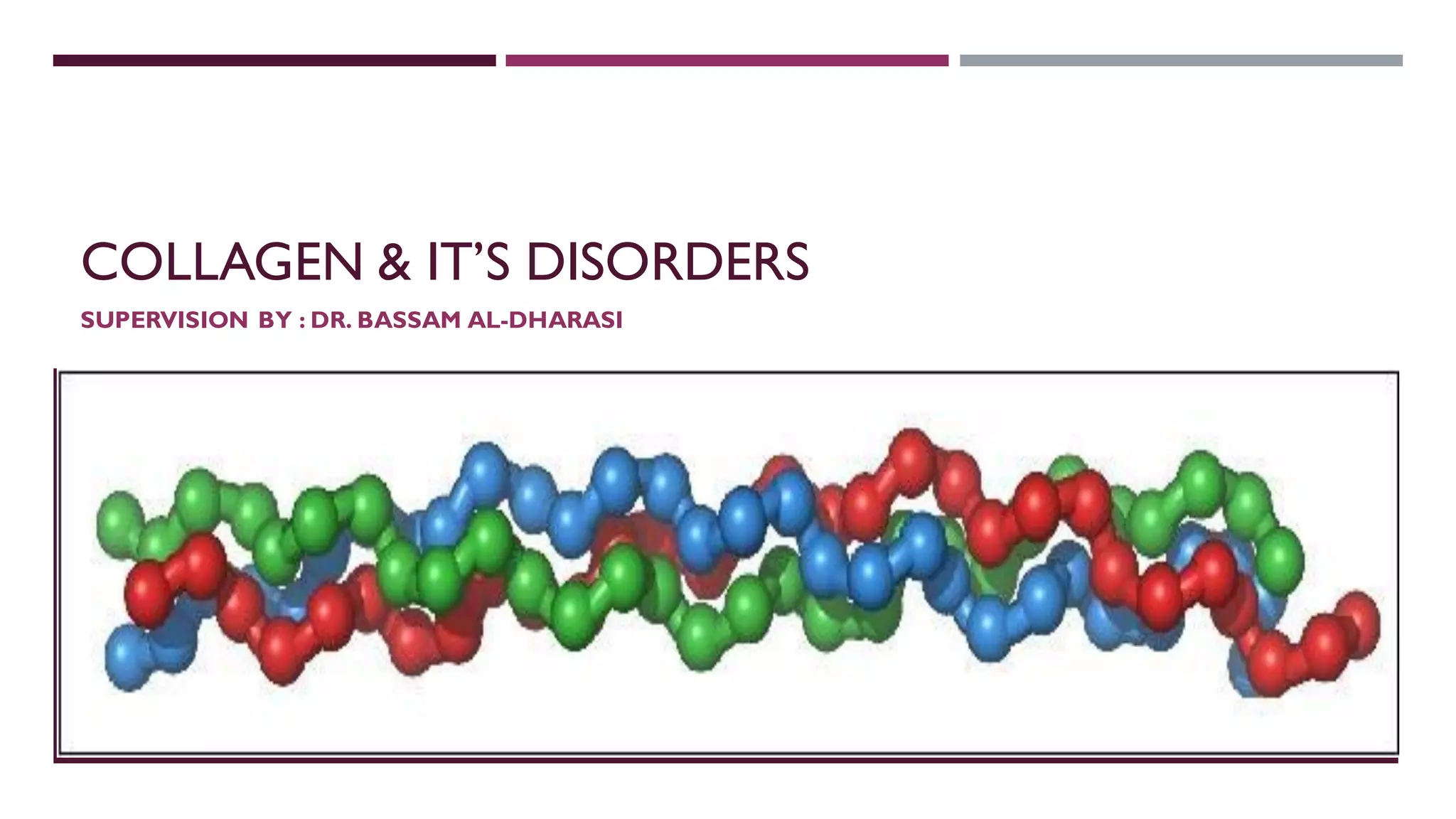
COLLAGEN & IT’S DISORDERS
SUPERVISION BY : DR. BASSAM AL-DHARASI
INTRODUCTION:
 Collagen is most abundant protein in mammals and accounts for 25-30% of
their protein content.
 Collagen is the main fibrous component of skin, bone, tendon and cartilage.
 Collagen comprises one- third of the total protein, accounts for three-
quarters of the dry weight of skin, and is the most prevalent component of the
extracellular matrix.
TYPES AND FUNCTIONS:
 28 types of collagen have been identified and described.The five most common types
are:
1. • Collagen I: skin,tendon,vascular ligature,organs,bone (main component of the organic
part of bone)
2. • Collagen II:cartilage (main component of cartilage)
3. • Collagen III:reticulate (main component of reticular fibers),commonly found alongside
type I.
4. • Collagen IV: forms basal lamina, the epithelium-secreted layer of the basement
membrane.
5. • CollagenV:cell surfaces,hair and placenta
BIOMEDICAL APPLICATIONS:
 Collagen is regarded as one of the most useful biomaterials.
 The excellent biocompatibility and safety due to its biological characteristics,
such as :
1. biodegradability
2. biocompatibility
3. weak antigenicity.
BIOMEDICAL APPLICATIONS:
 To repair tissues such as bone, tendon, ligament, skin, vascular and connective tissues.
 Tissue augmentation: For use in plastic surgery
 To enhance blood coagulation and platelet activation
 To enhance durability of allograft tissues.
 Can be used for the generation of bone substitutes, wound dressings, nerve regeneration.
 Artificial skin.
 For use as a researchtool to study diseases such as diabetes, aging and to evaluate drugs.
COLLAGEN DISORDERS :
 Collagenvascular diseases.
 Collagendiseases may be genetic, auto-immune or miscellaneouslike defects due to
nutritional deficiencies, drug induced defects etc.
 An inborn error of metabolism involving abnormal structureor metabolism of collagen results
in collagendisorders.
 All these affect the biosynthesis, assembly, post-translational modification, secretion, or
other processes involved in normal collagenproduction
COLLAGEN VASCULAR DISEASES:
 refers to a group of conditions that cause chronic inflammation in the connective tissues.
 There’s no cure for these diseases, but treatment can help manage symptoms
 Many collagen vascular diseases are autoimmune diseases, such as:
1. Ankylosing spondylitis.
2. Lupus (systemic lupus erythematosus).
3. Rheumatoid arthritis.
4. Scleroderma.
5. Sjögren syndrome.
6. Temporal arteritis.
COLLAGEN VASCULAR DISEASES
 genetic collagen vascular disease:
Genetic disorders occur because of mutations (changes) in specific genes. Examples of genetic
collagenvascular diseases include:
1. Ehlers-Danlos syndrome.
2. Marfan syndrome.
3. Osteogenesis imperfecta.
COLLAGEN DISORDERS GENERAL SYMPTOMS:
 _ Skin rash _ Fatigue_Muscle weakness and ache _ joint pain _ fever
 Other skin symptoms for specific conditions :
 Mouth ulcer (lupus)
 Dry eyes and mouth(lupus , rheumatoid arthritis )
 Malar rash ( lupus)
 Discoid rash( lupus)
 Hair loss ( lupus )
COLLAGEN DISORDERS GENERAL SYMPTOMS:
 Bumps of tissue at the joints ( RA , scleroderma )
 Thickening and hardening of the skin , open sores on the fingertips (
scleroderma)
 Reddish or purple oval patches on the abdomen ,back and chest that
develop a white center ( dermatomyositis)
 Long patches on the arm and legs ( morphea)
 Numb ,cool white and blue fingers and toes ( raynaud disaese )
COLLAGEN VASCULAR DISEASES SYMPTOMS:
 Collagenvascular disease symptoms can vary depending on what specific condition patients
have. In general, many collagenvascular diseases causesymptoms such as:
Fatigue.
fever.
Joint pain
Muscleaches.
Muscleweakness.
Skin rash
COLLAGEN DISORDERS DIAGNOSIS:
 Imagingtests : such as CT scansor X-rays,to look at bones or organs.
 Urinalysis: totest urinefor signs of an infection or to look for certain proteins.
 Blood test: to assesshormone levels and rule out other conditions that could causesimilarsymptoms.
 Echocardiogram: tocheck heart function and blood flow through heart.
 Biopsy: to examinea smallsampleof connective tissueunder a microscope.
COLLAGEN DISORDERS MANAGEMENT:
 Corticosteroids medicines to reduce inflammation and stabilize immune
system.
 Immunosuppressants medicines that safely lower immune system so it stops
attacking healthy tissues.
 Physical therapy to increase strength and range of motion and decrease
muscle or joint pain
COLLAGEN DISORDERS MANAGEMENT:
 steps at home to reduce symptomsor complications. Patientsmay:
1. Avoid sun damage by wearingbroad-spectrumsunscreen with at least 30 SPF every day.
2. Decrease overall sun exposure. Stay in the shade, wear protective clothing and remain indoorsduring
the sun’s peak hoursfrom 10 a.m. to 4 p.m.
3. Eat a nutritiousdiet with plenty of fruits and vegetables.
4. Exercise regularly,incorporatingboth resistancetrainingand aerobic exercise.
5. Reduce stress with healthy managementtools, such as talk therapy,journalingor meditation
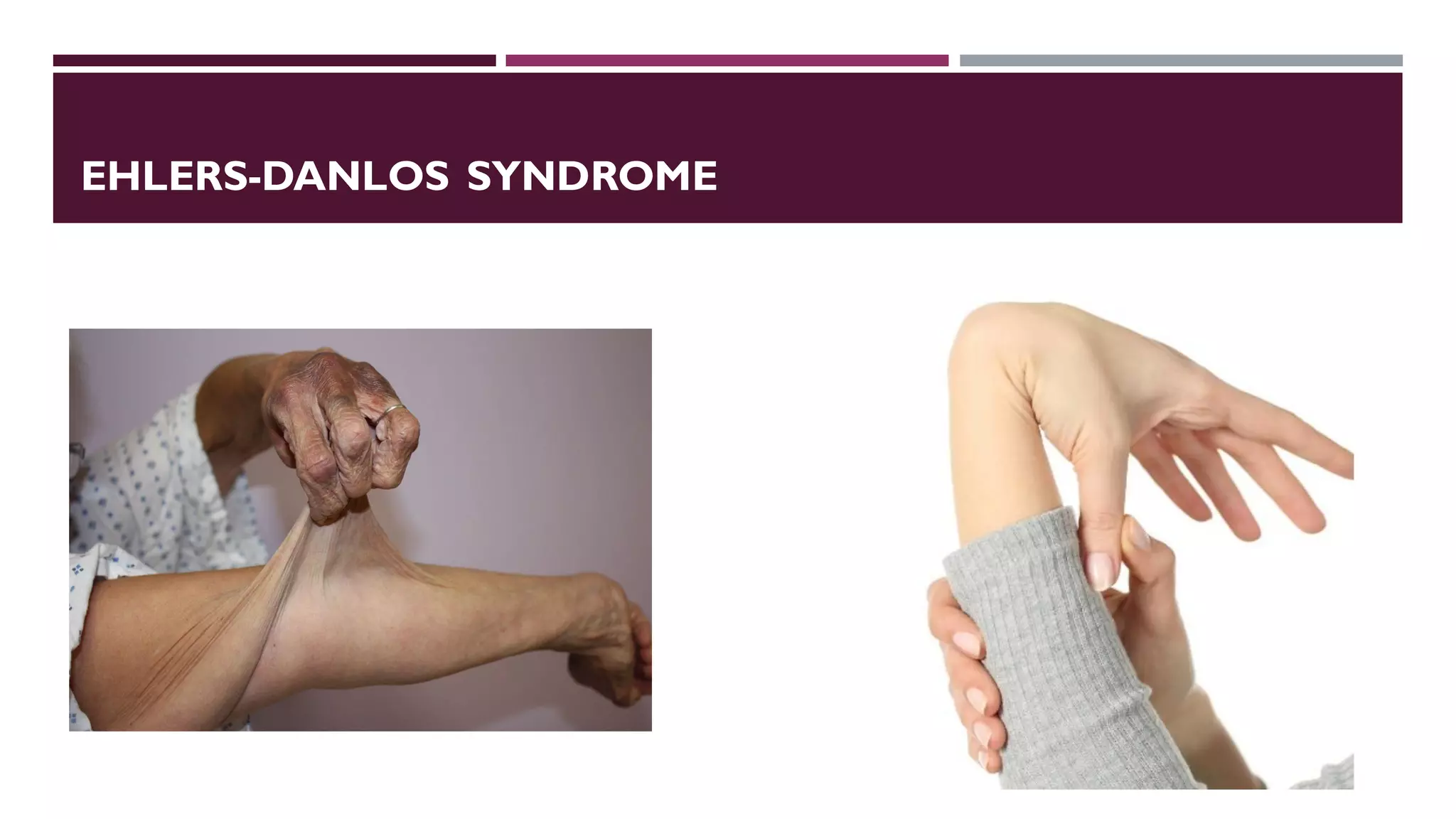
EHLERS-DANLOS SYNDROME
 Genetic defects of collagenbiosynthesis
and metabolism
 Heterogeneous inherited disorder
affecting musculoskeletal,skin and CV
system.
 C/B : stretchy skin, abnormal tissue
fragility, loosejoints or dislocation of
joints.
 Total 10 types are found.
 Type IV- most serious- tendency to rupture
arteries or bowel , Type VI- ocular rupture
EHLERS-DANLOS SYNDROME
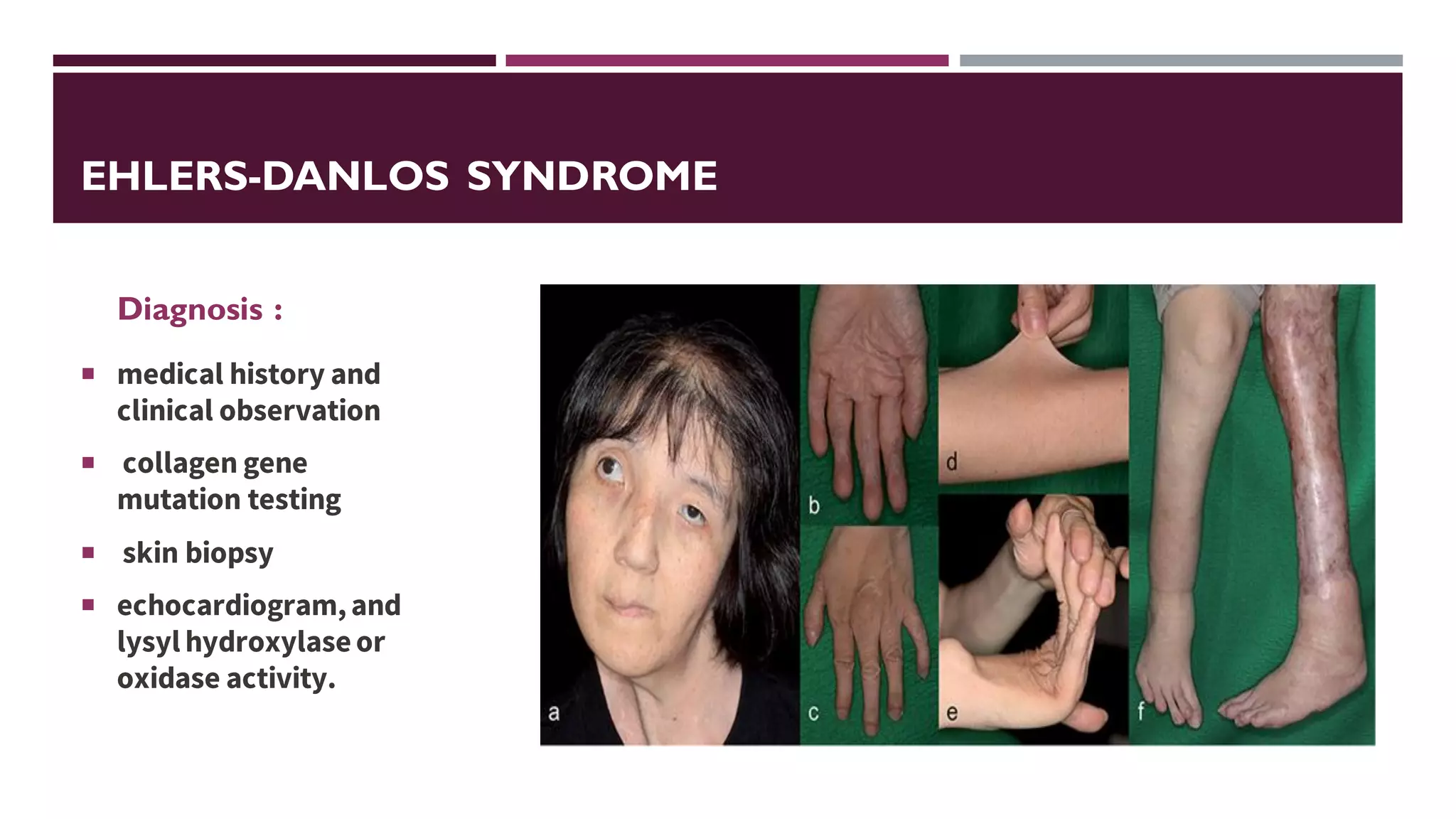
Diagnosis :
 medical history and
clinical observation
 collagen gene
mutation testing
 skin biopsy
 echocardiogram,and
lysyl hydroxylaseor
oxidase activity.
EHLERS-DANLOS SYNDROME
Deferential diagnosis:
 Marfan syndrome
Cutis laxa
EHLERS-DANLOS SYNDROME:
 Only symptomatic treatment
 Physiotherapy
 Orthotic treatment
 Surgery
 Treatment
SYSTEMIC LUPUS ERYTHEMATOSUS
Systemic lupus erythematosus :
 chronic autoimmunediseasethat can cause
swelling(inflammation)and pain throughoutthe
body.
 C/p : skin and sun sensitivities and rashes .
 Hair loss can alsobe a symptomofthis condition.
 Malar rash (red rash over their cheeksand the
bridge oftheir nose) ,
 discoid lupus (large red, circularrashes (plaques),
which may scar )
 Discoid lupus  Malar rash
SYSTEMIC LUPUS ERYTHEMATOSUS
Diagnosis
 Medical History andPhysical Exam
 Biopsy : to confirmthat patients havecutaneous lupus rather than
another skin condition, such as rosaceaor psoriasis, which cause
similar symptoms
 BloodTest
Treatment
 Reduce (or clear) the rashes, sores, and other skin
problems
 Relievesymptomslikeitch and pain
 Diminish flare-ups
 Preventscarring (some types of lupus can cause
scarring)
 Stop irreversiblehair loss (discoid lupus)
 Treat scarring (if has happened)
 Sun protections
 Medications ( corticosteroids,Antimalarial(
 Laser therapy
SCLERODERMA
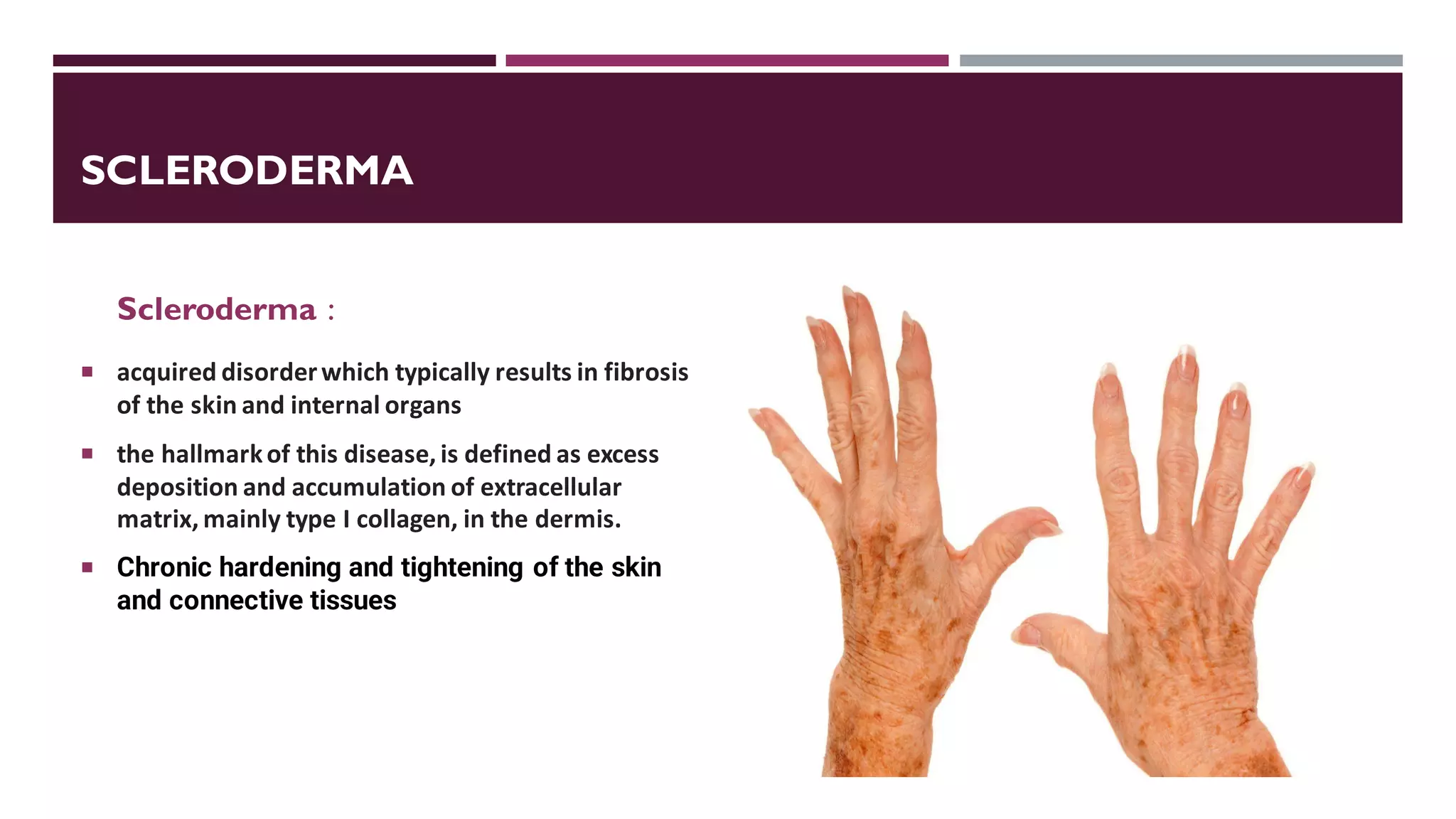
Scleroderma :
 acquired disorderwhich typically results in fibrosis
of the skin and internal organs
 the hallmarkof this disease, is defined as excess
deposition and accumulation of extracellular
matrix, mainly type I collagen, in the dermis.
 Chronic hardening and tightening of the skin
and connective tissues
SCLERODERMA
Diagnosis
 Medical History
 Physical exam
 Blood tests ( elevation levels of auto antibodies)
Treatment
There is no treatment that can cure or stop the overproductionof
collagenthat is characteristic of scleroderma.
Symptomatic treatment :
 Suppress the immune system.
 Preventinfections: Cleaning and protectionfrom the cold
may help prevent infectionof fingertip ulcers caused by
Raynaud's disease.
 Relieve pain
 Surgicaland other procedures :Stem celltransplants might
be an optionfor people who have severe symptoms
SJOGREN'S SYNDROME
 The common skin manifestation of Sjögren
syndrome include:
1. Dry, rough skin (xerosis), in 50% of patients
2. Reduced sweating (hypohidrosis)
3. Vaginal dryness
4. Small vessel vasculitis(in up to 30% of
patients with SS, usually affecting the legs)
5. Urticaria vasculitis.
SJOGREN’S SYNDROME
SJOGREN’S SYNDROME
Diagnosis
 Medical history and clinical observations
 Blood and urine tests, to look for the
presence of antibodies common in
Sjögren’s syndrome.
 Biopsy
Treatment
 Ointments
 Creams
 Hydroxychloroquine
 Methotrexate
EPIDERMOLYSIS BULLOSA
 Dystrophicform-mutation in COL7A1 gene of
Type VII collagen .
 Skin blisters seen.
EPIDERMOLYSIS BULLOSA
Symptoms:
 Fragile skin that blisters easily, especially on
the palms and feet.
 Nails that are thick or unformed.
 Blisters inside the mouth and throat.
 Scalp blistering and hair loss (scarring
alopecia)
 Skin that looks thin.
EPIDERMOLYSIS BULLOSA
Diagnosis
 Medical History
 Biopsy
 Blood test
Treatment
 wound care
 control of infection
 nutritional support
 and prevention and treatment of complications.
 painkillers,such as paracetamol, might be enough
for milder forms ,For more severe types , stronger
painkillerssuch as morphine
BETHLEM MYOPATHY
 Bethlem myopathy: is caused by dominant and
recessive mutations in the collagen VI genes
 Skin manifestationsinclude hyperkeratosispilaris
and keloid or “cigarette paper” scar formation
 slowly progressive muscle weakness and joint
stiffness
BETHLEM MYOPATHY
Diagnosis
 Medical History
 Clinical observation
 Biopsy
Treatment
 There is currently no cure for Bethlem
myopathy, but there are treatments to reduce
symptoms and maximize patients’ quality of
life:
1. Physiotherapy
2. Surgery
3. Occupational therapy
BY : GROUP (D) GIRLS
Speakers are:
‫عبداإلله‬‫خوله‬
‫مصطفى‬ ‫إيمان‬
‫قاسم‬‫عبدهللا‬ ‫هرة‬‫ز‬
Written by:
‫عادل‬ ‫نا‬‫ر‬
‫مختار‬ ‫ينب‬‫ز‬
‫عبدهللا‬ ‫ى‬‫نجو‬
‫أحمد‬‫ة‬‫ر‬‫سا‬

collagen and its disorders _.pdf

  • 1.
    COLLAGEN & IT’SDISORDERS SUPERVISION BY : DR. BASSAM AL-DHARASI
  • 2.
    INTRODUCTION:  Collagen ismost abundant protein in mammals and accounts for 25-30% of their protein content.  Collagen is the main fibrous component of skin, bone, tendon and cartilage.  Collagen comprises one- third of the total protein, accounts for three- quarters of the dry weight of skin, and is the most prevalent component of the extracellular matrix.
  • 3.
    TYPES AND FUNCTIONS: 28 types of collagen have been identified and described.The five most common types are: 1. • Collagen I: skin,tendon,vascular ligature,organs,bone (main component of the organic part of bone) 2. • Collagen II:cartilage (main component of cartilage) 3. • Collagen III:reticulate (main component of reticular fibers),commonly found alongside type I. 4. • Collagen IV: forms basal lamina, the epithelium-secreted layer of the basement membrane. 5. • CollagenV:cell surfaces,hair and placenta
  • 5.
    BIOMEDICAL APPLICATIONS:  Collagenis regarded as one of the most useful biomaterials.  The excellent biocompatibility and safety due to its biological characteristics, such as : 1. biodegradability 2. biocompatibility 3. weak antigenicity.
  • 6.
    BIOMEDICAL APPLICATIONS:  Torepair tissues such as bone, tendon, ligament, skin, vascular and connective tissues.  Tissue augmentation: For use in plastic surgery  To enhance blood coagulation and platelet activation  To enhance durability of allograft tissues.  Can be used for the generation of bone substitutes, wound dressings, nerve regeneration.  Artificial skin.  For use as a researchtool to study diseases such as diabetes, aging and to evaluate drugs.
  • 7.
    COLLAGEN DISORDERS : Collagenvascular diseases.  Collagendiseases may be genetic, auto-immune or miscellaneouslike defects due to nutritional deficiencies, drug induced defects etc.  An inborn error of metabolism involving abnormal structureor metabolism of collagen results in collagendisorders.  All these affect the biosynthesis, assembly, post-translational modification, secretion, or other processes involved in normal collagenproduction
  • 8.
    COLLAGEN VASCULAR DISEASES: refers to a group of conditions that cause chronic inflammation in the connective tissues.  There’s no cure for these diseases, but treatment can help manage symptoms  Many collagen vascular diseases are autoimmune diseases, such as: 1. Ankylosing spondylitis. 2. Lupus (systemic lupus erythematosus). 3. Rheumatoid arthritis. 4. Scleroderma. 5. Sjögren syndrome. 6. Temporal arteritis.
  • 9.
    COLLAGEN VASCULAR DISEASES genetic collagen vascular disease: Genetic disorders occur because of mutations (changes) in specific genes. Examples of genetic collagenvascular diseases include: 1. Ehlers-Danlos syndrome. 2. Marfan syndrome. 3. Osteogenesis imperfecta.
  • 10.
    COLLAGEN DISORDERS GENERALSYMPTOMS:  _ Skin rash _ Fatigue_Muscle weakness and ache _ joint pain _ fever  Other skin symptoms for specific conditions :  Mouth ulcer (lupus)  Dry eyes and mouth(lupus , rheumatoid arthritis )  Malar rash ( lupus)  Discoid rash( lupus)  Hair loss ( lupus )
  • 11.
    COLLAGEN DISORDERS GENERALSYMPTOMS:  Bumps of tissue at the joints ( RA , scleroderma )  Thickening and hardening of the skin , open sores on the fingertips ( scleroderma)  Reddish or purple oval patches on the abdomen ,back and chest that develop a white center ( dermatomyositis)  Long patches on the arm and legs ( morphea)  Numb ,cool white and blue fingers and toes ( raynaud disaese )
  • 12.
    COLLAGEN VASCULAR DISEASESSYMPTOMS:  Collagenvascular disease symptoms can vary depending on what specific condition patients have. In general, many collagenvascular diseases causesymptoms such as: Fatigue. fever. Joint pain Muscleaches. Muscleweakness. Skin rash
  • 13.
    COLLAGEN DISORDERS DIAGNOSIS: Imagingtests : such as CT scansor X-rays,to look at bones or organs.  Urinalysis: totest urinefor signs of an infection or to look for certain proteins.  Blood test: to assesshormone levels and rule out other conditions that could causesimilarsymptoms.  Echocardiogram: tocheck heart function and blood flow through heart.  Biopsy: to examinea smallsampleof connective tissueunder a microscope.
  • 14.
    COLLAGEN DISORDERS MANAGEMENT: Corticosteroids medicines to reduce inflammation and stabilize immune system.  Immunosuppressants medicines that safely lower immune system so it stops attacking healthy tissues.  Physical therapy to increase strength and range of motion and decrease muscle or joint pain
  • 15.
    COLLAGEN DISORDERS MANAGEMENT: steps at home to reduce symptomsor complications. Patientsmay: 1. Avoid sun damage by wearingbroad-spectrumsunscreen with at least 30 SPF every day. 2. Decrease overall sun exposure. Stay in the shade, wear protective clothing and remain indoorsduring the sun’s peak hoursfrom 10 a.m. to 4 p.m. 3. Eat a nutritiousdiet with plenty of fruits and vegetables. 4. Exercise regularly,incorporatingboth resistancetrainingand aerobic exercise. 5. Reduce stress with healthy managementtools, such as talk therapy,journalingor meditation
  • 16.
    EHLERS-DANLOS SYNDROME  Geneticdefects of collagenbiosynthesis and metabolism  Heterogeneous inherited disorder affecting musculoskeletal,skin and CV system.  C/B : stretchy skin, abnormal tissue fragility, loosejoints or dislocation of joints.  Total 10 types are found.  Type IV- most serious- tendency to rupture arteries or bowel , Type VI- ocular rupture
  • 17.
  • 18.
    EHLERS-DANLOS SYNDROME Diagnosis : medical history and clinical observation  collagen gene mutation testing  skin biopsy  echocardiogram,and lysyl hydroxylaseor oxidase activity.
  • 19.
  • 20.
    EHLERS-DANLOS SYNDROME:  Onlysymptomatic treatment  Physiotherapy  Orthotic treatment  Surgery  Treatment
  • 21.
    SYSTEMIC LUPUS ERYTHEMATOSUS Systemiclupus erythematosus :  chronic autoimmunediseasethat can cause swelling(inflammation)and pain throughoutthe body.  C/p : skin and sun sensitivities and rashes .  Hair loss can alsobe a symptomofthis condition.  Malar rash (red rash over their cheeksand the bridge oftheir nose) ,  discoid lupus (large red, circularrashes (plaques), which may scar )
  • 22.
     Discoid lupus Malar rash
  • 23.
    SYSTEMIC LUPUS ERYTHEMATOSUS Diagnosis Medical History andPhysical Exam  Biopsy : to confirmthat patients havecutaneous lupus rather than another skin condition, such as rosaceaor psoriasis, which cause similar symptoms  BloodTest Treatment  Reduce (or clear) the rashes, sores, and other skin problems  Relievesymptomslikeitch and pain  Diminish flare-ups  Preventscarring (some types of lupus can cause scarring)  Stop irreversiblehair loss (discoid lupus)  Treat scarring (if has happened)  Sun protections  Medications ( corticosteroids,Antimalarial(  Laser therapy
  • 24.
    SCLERODERMA Scleroderma :  acquireddisorderwhich typically results in fibrosis of the skin and internal organs  the hallmarkof this disease, is defined as excess deposition and accumulation of extracellular matrix, mainly type I collagen, in the dermis.  Chronic hardening and tightening of the skin and connective tissues
  • 26.
    SCLERODERMA Diagnosis  Medical History Physical exam  Blood tests ( elevation levels of auto antibodies) Treatment There is no treatment that can cure or stop the overproductionof collagenthat is characteristic of scleroderma. Symptomatic treatment :  Suppress the immune system.  Preventinfections: Cleaning and protectionfrom the cold may help prevent infectionof fingertip ulcers caused by Raynaud's disease.  Relieve pain  Surgicaland other procedures :Stem celltransplants might be an optionfor people who have severe symptoms
  • 27.
    SJOGREN'S SYNDROME  Thecommon skin manifestation of Sjögren syndrome include: 1. Dry, rough skin (xerosis), in 50% of patients 2. Reduced sweating (hypohidrosis) 3. Vaginal dryness 4. Small vessel vasculitis(in up to 30% of patients with SS, usually affecting the legs) 5. Urticaria vasculitis.
  • 28.
  • 29.
    SJOGREN’S SYNDROME Diagnosis  Medicalhistory and clinical observations  Blood and urine tests, to look for the presence of antibodies common in Sjögren’s syndrome.  Biopsy Treatment  Ointments  Creams  Hydroxychloroquine  Methotrexate
  • 30.
    EPIDERMOLYSIS BULLOSA  Dystrophicform-mutationin COL7A1 gene of Type VII collagen .  Skin blisters seen.
  • 31.
    EPIDERMOLYSIS BULLOSA Symptoms:  Fragileskin that blisters easily, especially on the palms and feet.  Nails that are thick or unformed.  Blisters inside the mouth and throat.  Scalp blistering and hair loss (scarring alopecia)  Skin that looks thin.
  • 32.
  • 33.
    EPIDERMOLYSIS BULLOSA Diagnosis  MedicalHistory  Biopsy  Blood test Treatment  wound care  control of infection  nutritional support  and prevention and treatment of complications.  painkillers,such as paracetamol, might be enough for milder forms ,For more severe types , stronger painkillerssuch as morphine
  • 34.
    BETHLEM MYOPATHY  Bethlemmyopathy: is caused by dominant and recessive mutations in the collagen VI genes  Skin manifestationsinclude hyperkeratosispilaris and keloid or “cigarette paper” scar formation  slowly progressive muscle weakness and joint stiffness
  • 35.
    BETHLEM MYOPATHY Diagnosis  MedicalHistory  Clinical observation  Biopsy Treatment  There is currently no cure for Bethlem myopathy, but there are treatments to reduce symptoms and maximize patients’ quality of life: 1. Physiotherapy 2. Surgery 3. Occupational therapy
  • 36.
    BY : GROUP(D) GIRLS Speakers are: ‫عبداإلله‬‫خوله‬ ‫مصطفى‬ ‫إيمان‬ ‫قاسم‬‫عبدهللا‬ ‫هرة‬‫ز‬ Written by: ‫عادل‬ ‫نا‬‫ر‬ ‫مختار‬ ‫ينب‬‫ز‬ ‫عبدهللا‬ ‫ى‬‫نجو‬ ‫أحمد‬‫ة‬‫ر‬‫سا‬