
COLLADA& WebGLWeb3D 2011(Paris)Rémi ArnaudScreampoint Inc
AgendaDéja-vu? (thx to Tony Parisi for the slides)COLLADAWebGLGoing from COLLADA to WebGL
“History repeats itself, first as tragedy, second as farce.”--Karl Marx
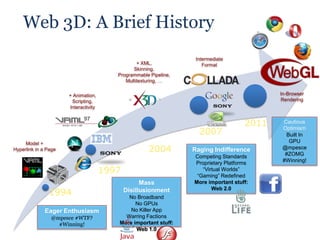
Web 3D: A Brief HistoryIntermediateFormat+ XML,Skinning,Programmable Pipeline,Multitexturing, …In-Browser Rendering+ Animation,Scripting,InteractivityCautious OptimismBuilt InGPU@mpesce #ZOMG #Winning!Model +Hyperlink in a PageRaging IndifferenceCompeting StandardsProprietary Platforms“Virtual Worlds”“Gaming” RedefinedMore important stuff:Web 2.0Mass DisillusionmentNo BroadbandNo GPUsNo Killer AppWarring FactionsMore important stuff: Web 1.0Eager Enthusiasm@mpesce #WTF? #Winning!
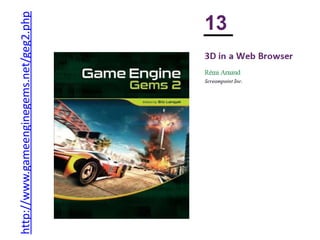
http://www.gameenginegems.net/geg2.php
WebGL and other technologies3D with Java (HW accelerated)OpenGL binding (JSR-231), OpenGL ES (JSR-184)Did not prevail3D with FlashPapervision3D, Sandy3D, Away3D and now HW acceleration with Molehill (available) http://labs.adobe.com/technologies/flashplatformruntimes/incubator/features/molehill.htmlBetween 1 and 2 Billions installations of flash player3D with plug-inUnity extremely popular. +500,000 SDK downloads, +50 Millions of plug-in downloadCross platform (iOS, Android, Xbox, Wii, PS3, …)Splendid world editing tool (includes scripting)Google Native ClientDirect access (with a protection layer) to OpenGL ES HW accelerationOther native apps… smartphones 600% growth, more and more users see internet only through their phone/tablet device.
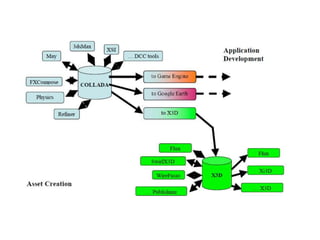
COLLADAXML encoding for 3D assets Geometry, Materials, Shaders, Animation, Skin/Bones, Physics, B-Rep*, IK*Intermediate format – for the tool chain(including conditioning / optimizer)Tool interchange format COLLADA available for most if not all modeling toolsCOLLADA & X3D white paperhttp://www.khronos.org/collada/presentations/Developing_Web_Applications_with_COLLADA_and_X3D.pdf* COLLADA 1.5
COLLADA is everywhereMax, Maya, Softimage (Autodesk dominance)through fbx sub-standard supportopencollada.org plug-insCinema4D, Lightwave, Blender, Modo …..Google warehouse, 3dviaGoogle Earth, SketchupMicrostation, AutoCAD, Catia …But not very well implementedNot a single adopter (conformance test)
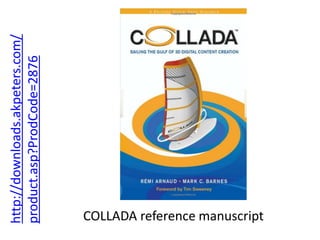
http://downloads.akpeters.com/product.asp?ProdCode=2876COLLADA reference manuscript
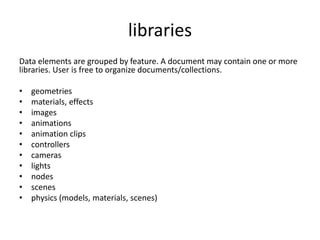
librariesData elements are grouped by feature. A document may contain one or more libraries. User is free to organize documents/collections.geometriesmaterials, effectsimagesanimationsanimation clipscontrollerscameraslightsnodesscenesphysics (models, materials, scenes)
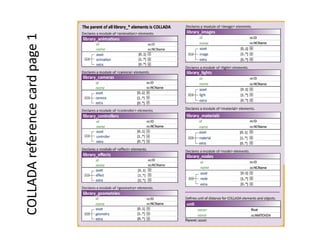
COLLADA reference card page 1
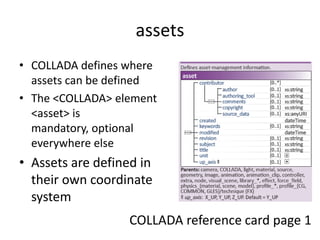
assetsCOLLADA defines where assets can be definedThe <COLLADA> element <asset> is mandatory, optional everywhere elseAssets are defined in their own coordinate systemCOLLADA reference card page 1
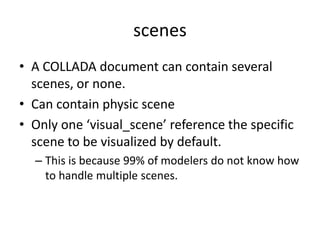
scenesA COLLADA document can contain several scenes, or none. Can contain physic sceneOnly one ‘visual_scene’ reference the specific scene to be visualized by default. This is because 99% of modelers do not know how to handle multiple scenes.
nodesNodes define a local coordinate system, hierarchy transformNodes have no semantic, they do not convey a specific action. (i.e. no LOD, switch… nodes)Maybe they should have been called ‘places’Transforms in a node are to applied in the same order they appear.
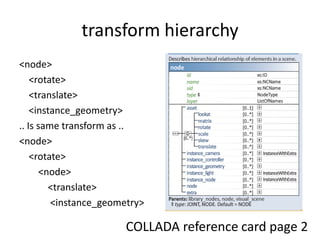
transform hierarchy<node>    <rotate>    <translate>   <instance_geometry>.. Is same transform as ..<node>    <rotate>        <node>            <translate>            <instance_geometry>COLLADA reference card page 2
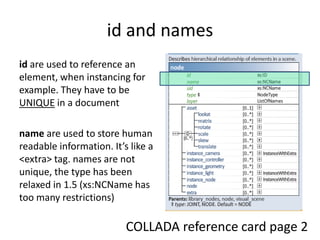
id and namesid are used to reference an element, when instancing for example. They have to be UNIQUE in a documentname are used to store human readable information. It’s like a <extra> tag. names are not unique, the type has been relaxed in 1.5 (xs:NCName has too many restrictions)COLLADA reference card page 2
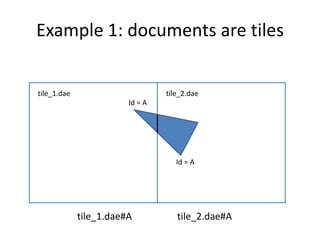
Example 1: documents are tilestile_1.daetile_2.daeId = AId = Atile_1.dae#A                   tile_2.dae#A
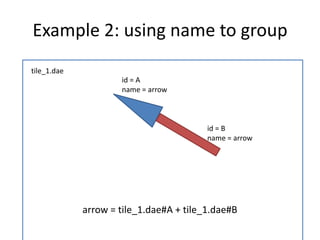
Example 2: using name to grouptile_1.daeid = Aname = arrowid = Bname = arrowarrow = tile_1.dae#A + tile_1.dae#B
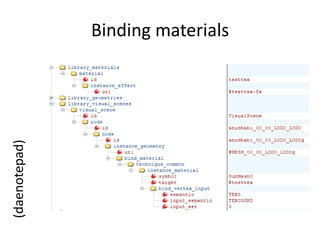
instancesInstances are basic building block of COLLADAnodes define local coordinate system where geometry is instancednodes, with their attached geometry can be instanced. They can be stored in the node library rather than enumerated in the sceneInstanced elements can be modified at binding pointe.g. material bind is done when instancing a geometry
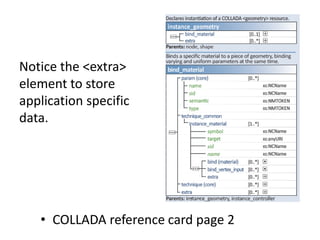
Notice the <extra> element to store application specific data. COLLADA reference card page 2
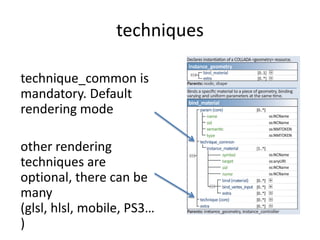
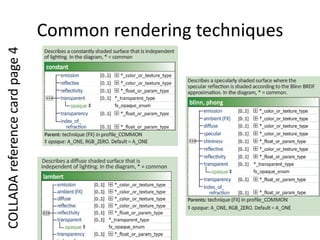
techniquestechnique_common is mandatory. Default rendering modeother rendering techniques are optional, there can be many (glsl, hlsl, mobile, PS3…)
Common rendering techniquesCOLLADA reference card page 4
Binding materials(daenotepad)
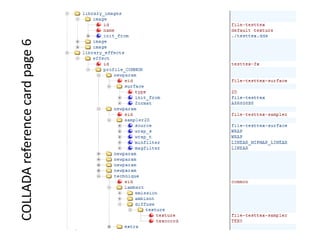
COLLADA reference card page 6
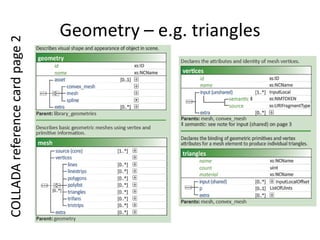
Geometry – e.g. trianglesCOLLADA reference card page 2
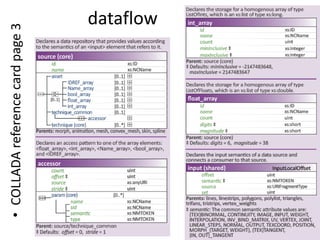
dataflowCOLLADA reference card page 3
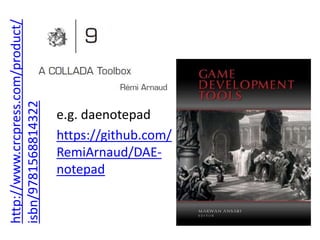
http://www.crcpress.com/product/isbn/9781568814322e.g. daenotepadhttps://github.com/RemiArnaud/DAE-notepad
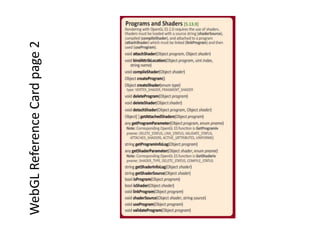
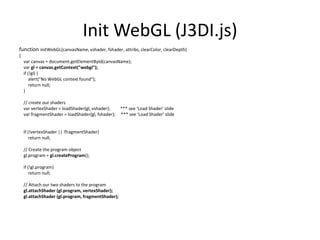
WebGLWebGL is OpenGL ES 2.0 for javascriptRendering with OpenGL ES 2.0 requires the use of shaders. Shadersmust be loaded with a source string (shaderSource), compiled (compileShader), and attached to a program (attachShader) which must be linked (linkProgram) and then used (useProgram).
WebGL Reference Card page 2
InitWebGL (J3DI.js)function initWebGL(canvasName, vshader, fshader, attribs, clearColor, clearDepth){var canvas = document.getElementById(canvasName);vargl = canvas.getContext("webgl");    if (!gl) {        alert("No WebGL context found");        return null;    }    // create our shadersvarvertexShader = loadShader(gl, vshader);         *** see ‘Load Shader’ slidevarfragmentShader = loadShader(gl, fshader);    *** see ‘Load Shader’ slide    if (!vertexShader || !fragmentShader)        return null;    // Create the program objectgl.program = gl.createProgram();    if (!gl.program)        return null;    // Attach our two shaders to the programgl.attachShader (gl.program, vertexShader);gl.attachShader (gl.program, fragmentShader);
 // Bind attributes    for (var i in attribs)gl.bindAttribLocation (gl.program, i, attribs[i]);    // Link the programgl.linkProgram(gl.program);    // Check the link statusvar linked = gl.getProgramParameter(gl.program, gl.LINK_STATUS);    if (!linked) {        // something went wrong with the linkvar error = gl.getProgramInfoLog (gl.program);        gl.console.log("Error in program linking:"+error);gl.deleteProgram(gl.program);gl.deleteProgram(fragmentShader);gl.deleteProgram(vertexShader);        return null;    }gl.useProgram(gl.program);gl.clearColor(clearColor[0], clearColor[1], clearColor[2], clearColor[3]);gl.clearDepth(clearDepth);gl.enable(gl.DEPTH_TEST);gl.enable(gl.BLEND);gl.blendFunc(gl.SRC_ALPHA, gl.ONE_MINUS_SRC_ALPHA);    return gl;}
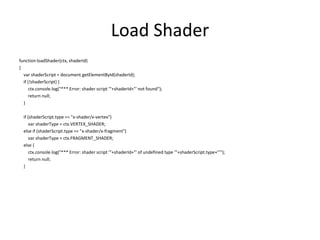
Load Shaderfunction loadShader(ctx, shaderId){varshaderScript = document.getElementById(shaderId);    if (!shaderScript) {        ctx.console.log("*** Error: shader script '"+shaderId+"' not found");        return null;    }    if (shaderScript.type == "x-shader/x-vertex")varshaderType = ctx.VERTEX_SHADER;    else if (shaderScript.type == "x-shader/x-fragment")varshaderType = ctx.FRAGMENT_SHADER;    else {        ctx.console.log("*** Error: shader script '"+shaderId+"' of undefined type '"+shaderScript.type+"'");        return null;    }
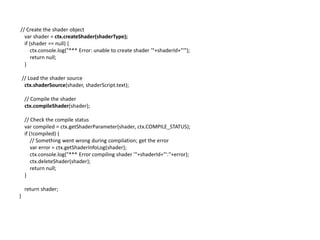
 // Create the shader objectvarshader = ctx.createShader(shaderType);    if (shader == null) {        ctx.console.log("*** Error: unable to create shader '"+shaderId+"'");        return null;}// Load the shader sourcectx.shaderSource(shader, shaderScript.text);    // Compile the shaderctx.compileShader(shader);    // Check the compile statusvar compiled = ctx.getShaderParameter(shader, ctx.COMPILE_STATUS);    if (!compiled) {        // Something went wrong during compilation; get the errorvar error = ctx.getShaderInfoLog(shader);        ctx.console.log("*** Error compiling shader '"+shaderId+"':"+error);ctx.deleteShader(shader);        return null;    }    return shader;}
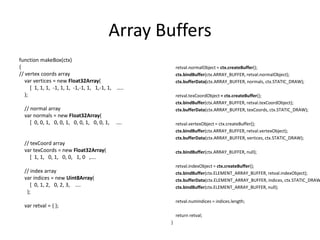
Array Buffersfunction makeBox(ctx){// vertex coords arrayvar vertices = new Float32Array(        [  1, 1, 1,  -1, 1, 1,  -1,-1, 1,   1,-1, 1,    …..    );    // normal arrayvarnormals = new Float32Array(        [  0, 0, 1,   0, 0, 1,   0, 0, 1,   0, 0, 1,     ….    // texCoord arrayvartexCoords = new Float32Array(        [  1, 1,   0, 1,   0, 0,   1, 0   ,….    // index arrayvar indices = new Uint8Array(        [  0, 1, 2,   0, 2, 3,    ….      );varretval = { };retval.normalObject = ctx.createBuffer();ctx.bindBuffer(ctx.ARRAY_BUFFER, retval.normalObject);ctx.bufferData(ctx.ARRAY_BUFFER, normals, ctx.STATIC_DRAW);retval.texCoordObject= ctx.createBuffer();ctx.bindBuffer(ctx.ARRAY_BUFFER, retval.texCoordObject);ctx.bufferData(ctx.ARRAY_BUFFER, texCoords, ctx.STATIC_DRAW);retval.vertexObject = ctx.createBuffer();ctx.bindBuffer(ctx.ARRAY_BUFFER, retval.vertexObject);ctx.bufferData(ctx.ARRAY_BUFFER, vertices, ctx.STATIC_DRAW);ctx.bindBuffer(ctx.ARRAY_BUFFER, null);retval.indexObject = ctx.createBuffer();ctx.bindBuffer(ctx.ELEMENT_ARRAY_BUFFER, retval.indexObject);ctx.bufferData(ctx.ELEMENT_ARRAY_BUFFER, indices, ctx.STATIC_DRAW);ctx.bindBuffer(ctx.ELEMENT_ARRAY_BUFFER, null);retval.numIndices = indices.length;    return retval;}
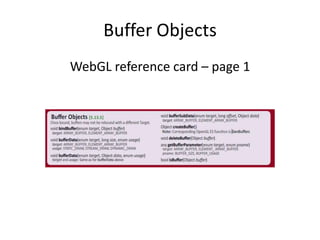
Buffer ObjectsWebGL reference card – page 1
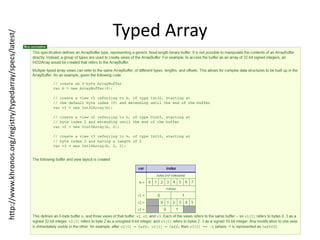
Typed Arrayhttp://www.khronos.org/registry/typedarray/specs/latest/
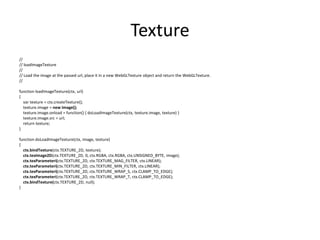
Texture//// loadImageTexture//// Load the image at the passed url, place it in a new WebGLTexture object and return the WebGLTexture.//function loadImageTexture(ctx, url){var texture = ctx.createTexture();texture.image = new Image();texture.image.onload = function() { doLoadImageTexture(ctx, texture.image, texture) }texture.image.src = url;    return texture;}function doLoadImageTexture(ctx, image, texture){ctx.bindTexture(ctx.TEXTURE_2D, texture);ctx.texImage2D(ctx.TEXTURE_2D, 0, ctx.RGBA, ctx.RGBA, ctx.UNSIGNED_BYTE, image);ctx.texParameteri(ctx.TEXTURE_2D, ctx.TEXTURE_MAG_FILTER, ctx.LINEAR);ctx.texParameteri(ctx.TEXTURE_2D, ctx.TEXTURE_MIN_FILTER, ctx.LINEAR);ctx.texParameteri(ctx.TEXTURE_2D, ctx.TEXTURE_WRAP_S, ctx.CLAMP_TO_EDGE);ctx.texParameteri(ctx.TEXTURE_2D, ctx.TEXTURE_WRAP_T, ctx.CLAMP_TO_EDGE);ctx.bindTexture(ctx.TEXTURE_2D, null);}
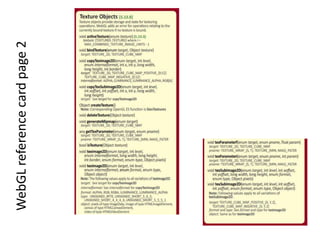
WebGL reference card page 2
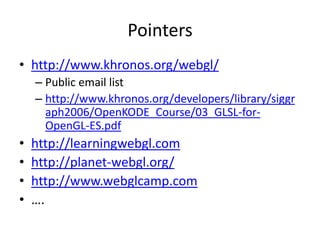
Pointershttp://www.khronos.org/webgl/Public email listhttp://www.khronos.org/developers/library/siggraph2006/OpenKODE_Course/03_GLSL-for-OpenGL-ES.pdfhttp://learningwebgl.comhttp://planet-webgl.org/http://www.webglcamp.com….
Middlewarehttps://github.com/greggman/tdlhttp://scenejs.org/https://github.com/mrdoob/three.js/http://alteredqualia.com/http://code.google.com/p/o3d/http://senchalabs.github.com/philogl/Lessonshttp://www.everyday3d.com/j3d/…..
Going from COLLADA to WebGL
Loading COLLADA (or X3D)Spore COLLADA viewer (client XML parser)xml.evaluate(XPATH)Javascript XML cheat sheet http://weblogs.asp.net/rrobbins/archive/2008/09/10/javascript-xml-cheat-sheet.aspxGoogle O3D – preprocessed to jsonhttp://code.google.com/p/o3d/wiki/ColladaConverterO3D mod – (client XML parser)2010 http://www.colladawebviewer.com/2011 http://capstone.azurenet.net/web3d/demo/Scene js – (server preprocessed)http://scenejs.wikispaces.com/scenejs-pycollada (server side python)http://pycollada.github.com/ (PyCollada)X3dom – (client DOM)X3D integrated in the Xhtml page http://www.x3dom.org/
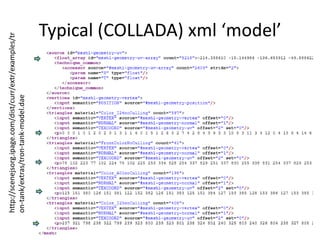
Typical (COLLADA) xml ‘model’http://scenejsorg.ipage.com/dist/curr/extr/examples/tron-tank/extras/tron-tank-model.dae
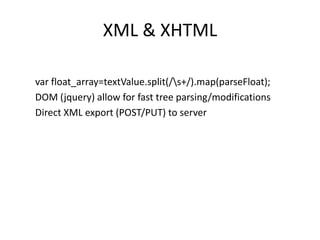
XML & XHTMLvarfloat_array=textValue.split(/\s+/).map(parseFloat); DOM (jquery) allow for fast tree parsing/modificationsDirect XML export (POST/PUT) to server
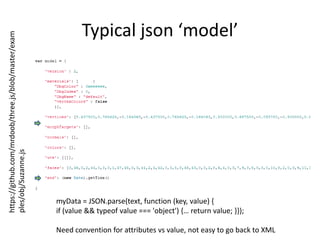
Typical json ‘model’https://github.com/mrdoob/three.js/blob/master/examples/obj/Suzanne.jsmyData = JSON.parse(text, function (key, value) { if (value && typeof value === 'object') {… return value; }});Need convention for attributes vs value, not easy to go back to XML
Typed Array loadingfunction onLoad(){   var canvas = document.getElementById("lesson01-canvas");   initGL(canvas);                                    varxmlhttp = new XMLHttpRequest();   xmlhttp.open("GET", "cube.bm", true);   xmlhttp.responseType = "arraybuffer";               xmlhttp.onload = function()    {      var buffer = xmlhttp.response;      gl.bindBuffer(gl.ARRAY_BUFFER, buffer);                      // Reading Data      var v1 = new Float32Array(buffer);                     alert(v[0]);  // This works fine.   }   xmlhttp.send();                        }
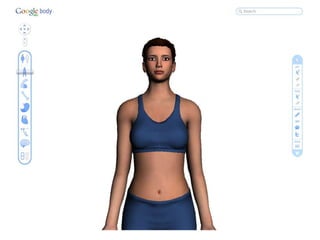
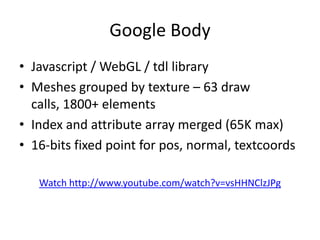
Google BodyJavascript / WebGL / tdl libraryMeshes grouped by texture – 63 draw calls, 1800+ elementsIndex and attribute array merged (65K max)16-bits fixed point for pos, normal, textcoordsWatch http://www.youtube.com/watch?v=vsHHNClzJPg
Simple, Fast, Compact Meshes for WebGLWon Chun (@won3d on Twitter)Google Web Search InfrastructureJSON / XML        :-(ASCII v. Binary    :-)Quantization        :-)Compression       :-)
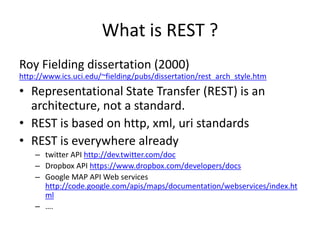
What is REST ?Roy Fielding dissertation (2000) http://www.ics.uci.edu/~fielding/pubs/dissertation/rest_arch_style.htmRepresentational State Transfer (REST) is an architecture, not a standard. REST is based on http, xml, uristandardsREST is everywhere alreadytwitter API http://dev.twitter.com/docDropbox API https://www.dropbox.com/developers/docsGoogle MAP API Web services http://code.google.com/apis/maps/documentation/webservices/index.html….
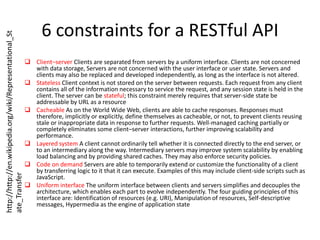
6 constraints for a RESTful APIClient–server Clients are separated from servers by a uniform interface. Clients are not concerned with data storage, Servers are not concerned with the user interface or user state. Servers and clients may also be replaced and developed independently, as long as the interface is not altered.
Stateless Client context is not stored on the server between requests. Each request from any client contains all of the information necessary to service the request, and any session state is held in the client. The server can be stateful; this constraint merely requires that server-side state be addressable by URL as a resource
Cacheable As on the World Wide Web, clients are able to cache responses. Responses must therefore, implicitly or explicitly, define themselves as cacheable, or not, to prevent clients reusing stale or inappropriate data in response to further requests. Well-managed caching partially or completely eliminates some client–server interactions, further improving scalability and performance.
Layered system A client cannot ordinarily tell whether it is connected directly to the end server, or to an intermediary along the way. Intermediary servers may improve system scalability by enabling load balancing and by providing shared caches. They may also enforce security policies.
Code on demand Servers are able to temporarily extend or customize the functionality of a client by transferring logic to it that it can execute. Examples of this may include client-side scripts such as JavaScript.
Uniform interface The uniform interface between clients and servers simplifies and decouples the architecture, which enables each part to evolve independently. The four guiding principles of this interface are:Identification of resources (e.g. URI), Manipulation of resources, Self-descriptive messages, Hypermedia as the engine of application statehttp://http://en.wikipedia.org/wiki/Representational_State_Transfer
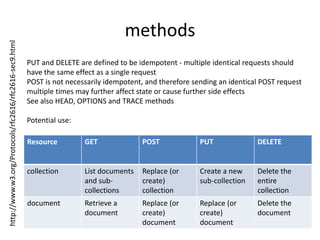
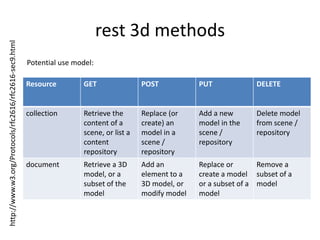
methodsPUT and DELETE are defined to be idempotent - multiple identical requests should have the same effect as a single requestPOST is not necessarily idempotent, and therefore sending an identical POST request multiple times may further affect state or cause further side effectsSee also HEAD, OPTIONS and TRACE methodsPotential use:http://www.w3.org/Protocols/rfc2616/rfc2616-sec9.html
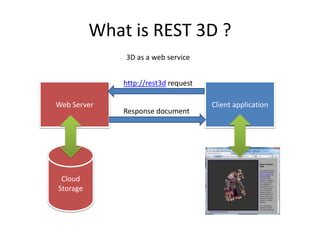
What is REST 3D ?3D as a web servicehttp://rest3d requestWeb ServerClient applicationResponse documentCloud Storage
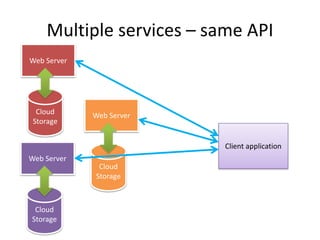
Multiple services – same APIWeb ServerWeb ServerWeb ServerClient applicationCloud StorageCloud StorageCloud Storage
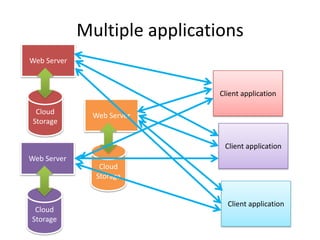
Multiple applicationsClient applicationWeb ServerWeb ServerWeb ServerClient applicationCloud StorageCloud StorageCloud StorageClient application
rest 3d methodsPotential use model:http://www.w3.org/Protocols/rfc2616/rfc2616-sec9.html
Use case 1 – content gatheringProgram interface to content repositories. Current state requires human in the loop, and content creation tool to explore the model.http://sketchup.google.com/3dwarehouse/http://www.3dvia.com/http://www.3dcadbrowser.com/http://www.3d02.com/http://www.turbosquid.com/…

COLLADA & WebGL

  • 1.
  • 2.
    AgendaDéja-vu? (thx toTony Parisi for the slides)COLLADAWebGLGoing from COLLADA to WebGL
  • 3.
    “History repeats itself,first as tragedy, second as farce.”--Karl Marx
  • 4.
    Web 3D: ABrief HistoryIntermediateFormat+ XML,Skinning,Programmable Pipeline,Multitexturing, …In-Browser Rendering+ Animation,Scripting,InteractivityCautious OptimismBuilt InGPU@mpesce #ZOMG #Winning!Model +Hyperlink in a PageRaging IndifferenceCompeting StandardsProprietary Platforms“Virtual Worlds”“Gaming” RedefinedMore important stuff:Web 2.0Mass DisillusionmentNo BroadbandNo GPUsNo Killer AppWarring FactionsMore important stuff: Web 1.0Eager Enthusiasm@mpesce #WTF? #Winning!
  • 5.
  • 6.
    WebGL and othertechnologies3D with Java (HW accelerated)OpenGL binding (JSR-231), OpenGL ES (JSR-184)Did not prevail3D with FlashPapervision3D, Sandy3D, Away3D and now HW acceleration with Molehill (available) http://labs.adobe.com/technologies/flashplatformruntimes/incubator/features/molehill.htmlBetween 1 and 2 Billions installations of flash player3D with plug-inUnity extremely popular. +500,000 SDK downloads, +50 Millions of plug-in downloadCross platform (iOS, Android, Xbox, Wii, PS3, …)Splendid world editing tool (includes scripting)Google Native ClientDirect access (with a protection layer) to OpenGL ES HW accelerationOther native apps… smartphones 600% growth, more and more users see internet only through their phone/tablet device.
  • 7.
    COLLADAXML encoding for3D assets Geometry, Materials, Shaders, Animation, Skin/Bones, Physics, B-Rep*, IK*Intermediate format – for the tool chain(including conditioning / optimizer)Tool interchange format COLLADA available for most if not all modeling toolsCOLLADA & X3D white paperhttp://www.khronos.org/collada/presentations/Developing_Web_Applications_with_COLLADA_and_X3D.pdf* COLLADA 1.5
  • 9.
    COLLADA is everywhereMax,Maya, Softimage (Autodesk dominance)through fbx sub-standard supportopencollada.org plug-insCinema4D, Lightwave, Blender, Modo …..Google warehouse, 3dviaGoogle Earth, SketchupMicrostation, AutoCAD, Catia …But not very well implementedNot a single adopter (conformance test)
  • 10.
  • 11.
    librariesData elements aregrouped by feature. A document may contain one or more libraries. User is free to organize documents/collections.geometriesmaterials, effectsimagesanimationsanimation clipscontrollerscameraslightsnodesscenesphysics (models, materials, scenes)
  • 12.
  • 13.
    assetsCOLLADA defines whereassets can be definedThe <COLLADA> element <asset> is mandatory, optional everywhere elseAssets are defined in their own coordinate systemCOLLADA reference card page 1
  • 14.
    scenesA COLLADA documentcan contain several scenes, or none. Can contain physic sceneOnly one ‘visual_scene’ reference the specific scene to be visualized by default. This is because 99% of modelers do not know how to handle multiple scenes.
  • 15.
    nodesNodes define alocal coordinate system, hierarchy transformNodes have no semantic, they do not convey a specific action. (i.e. no LOD, switch… nodes)Maybe they should have been called ‘places’Transforms in a node are to applied in the same order they appear.
  • 16.
    transform hierarchy<node> <rotate> <translate> <instance_geometry>.. Is same transform as ..<node> <rotate> <node> <translate> <instance_geometry>COLLADA reference card page 2
  • 17.
    id and namesidare used to reference an element, when instancing for example. They have to be UNIQUE in a documentname are used to store human readable information. It’s like a <extra> tag. names are not unique, the type has been relaxed in 1.5 (xs:NCName has too many restrictions)COLLADA reference card page 2
  • 18.
    Example 1: documentsare tilestile_1.daetile_2.daeId = AId = Atile_1.dae#A tile_2.dae#A
  • 19.
    Example 2: usingname to grouptile_1.daeid = Aname = arrowid = Bname = arrowarrow = tile_1.dae#A + tile_1.dae#B
  • 20.
    instancesInstances are basicbuilding block of COLLADAnodes define local coordinate system where geometry is instancednodes, with their attached geometry can be instanced. They can be stored in the node library rather than enumerated in the sceneInstanced elements can be modified at binding pointe.g. material bind is done when instancing a geometry
  • 21.
    Notice the <extra>element to store application specific data. COLLADA reference card page 2
  • 22.
    techniquestechnique_common is mandatory.Default rendering modeother rendering techniques are optional, there can be many (glsl, hlsl, mobile, PS3…)
  • 23.
  • 24.
  • 25.
  • 26.
    Geometry – e.g.trianglesCOLLADA reference card page 2
  • 27.
  • 28.
  • 29.
    WebGLWebGL is OpenGLES 2.0 for javascriptRendering with OpenGL ES 2.0 requires the use of shaders. Shadersmust be loaded with a source string (shaderSource), compiled (compileShader), and attached to a program (attachShader) which must be linked (linkProgram) and then used (useProgram).
  • 30.
  • 31.
    InitWebGL (J3DI.js)function initWebGL(canvasName,vshader, fshader, attribs, clearColor, clearDepth){var canvas = document.getElementById(canvasName);vargl = canvas.getContext("webgl"); if (!gl) { alert("No WebGL context found"); return null; } // create our shadersvarvertexShader = loadShader(gl, vshader); *** see ‘Load Shader’ slidevarfragmentShader = loadShader(gl, fshader); *** see ‘Load Shader’ slide if (!vertexShader || !fragmentShader) return null; // Create the program objectgl.program = gl.createProgram(); if (!gl.program) return null; // Attach our two shaders to the programgl.attachShader (gl.program, vertexShader);gl.attachShader (gl.program, fragmentShader);
  • 32.
    // Bindattributes for (var i in attribs)gl.bindAttribLocation (gl.program, i, attribs[i]); // Link the programgl.linkProgram(gl.program); // Check the link statusvar linked = gl.getProgramParameter(gl.program, gl.LINK_STATUS); if (!linked) { // something went wrong with the linkvar error = gl.getProgramInfoLog (gl.program); gl.console.log("Error in program linking:"+error);gl.deleteProgram(gl.program);gl.deleteProgram(fragmentShader);gl.deleteProgram(vertexShader); return null; }gl.useProgram(gl.program);gl.clearColor(clearColor[0], clearColor[1], clearColor[2], clearColor[3]);gl.clearDepth(clearDepth);gl.enable(gl.DEPTH_TEST);gl.enable(gl.BLEND);gl.blendFunc(gl.SRC_ALPHA, gl.ONE_MINUS_SRC_ALPHA); return gl;}
  • 33.
    Load Shaderfunction loadShader(ctx,shaderId){varshaderScript = document.getElementById(shaderId); if (!shaderScript) { ctx.console.log("*** Error: shader script '"+shaderId+"' not found"); return null; } if (shaderScript.type == "x-shader/x-vertex")varshaderType = ctx.VERTEX_SHADER; else if (shaderScript.type == "x-shader/x-fragment")varshaderType = ctx.FRAGMENT_SHADER; else { ctx.console.log("*** Error: shader script '"+shaderId+"' of undefined type '"+shaderScript.type+"'"); return null; }
  • 34.
    // Createthe shader objectvarshader = ctx.createShader(shaderType); if (shader == null) { ctx.console.log("*** Error: unable to create shader '"+shaderId+"'"); return null;}// Load the shader sourcectx.shaderSource(shader, shaderScript.text); // Compile the shaderctx.compileShader(shader); // Check the compile statusvar compiled = ctx.getShaderParameter(shader, ctx.COMPILE_STATUS); if (!compiled) { // Something went wrong during compilation; get the errorvar error = ctx.getShaderInfoLog(shader); ctx.console.log("*** Error compiling shader '"+shaderId+"':"+error);ctx.deleteShader(shader); return null; } return shader;}
  • 35.
    Array Buffersfunction makeBox(ctx){//vertex coords arrayvar vertices = new Float32Array( [ 1, 1, 1, -1, 1, 1, -1,-1, 1, 1,-1, 1, ….. ); // normal arrayvarnormals = new Float32Array( [ 0, 0, 1, 0, 0, 1, 0, 0, 1, 0, 0, 1, …. // texCoord arrayvartexCoords = new Float32Array( [ 1, 1, 0, 1, 0, 0, 1, 0 ,…. // index arrayvar indices = new Uint8Array( [ 0, 1, 2, 0, 2, 3, …. );varretval = { };retval.normalObject = ctx.createBuffer();ctx.bindBuffer(ctx.ARRAY_BUFFER, retval.normalObject);ctx.bufferData(ctx.ARRAY_BUFFER, normals, ctx.STATIC_DRAW);retval.texCoordObject= ctx.createBuffer();ctx.bindBuffer(ctx.ARRAY_BUFFER, retval.texCoordObject);ctx.bufferData(ctx.ARRAY_BUFFER, texCoords, ctx.STATIC_DRAW);retval.vertexObject = ctx.createBuffer();ctx.bindBuffer(ctx.ARRAY_BUFFER, retval.vertexObject);ctx.bufferData(ctx.ARRAY_BUFFER, vertices, ctx.STATIC_DRAW);ctx.bindBuffer(ctx.ARRAY_BUFFER, null);retval.indexObject = ctx.createBuffer();ctx.bindBuffer(ctx.ELEMENT_ARRAY_BUFFER, retval.indexObject);ctx.bufferData(ctx.ELEMENT_ARRAY_BUFFER, indices, ctx.STATIC_DRAW);ctx.bindBuffer(ctx.ELEMENT_ARRAY_BUFFER, null);retval.numIndices = indices.length; return retval;}
  • 36.
  • 37.
  • 38.
    Texture//// loadImageTexture//// Loadthe image at the passed url, place it in a new WebGLTexture object and return the WebGLTexture.//function loadImageTexture(ctx, url){var texture = ctx.createTexture();texture.image = new Image();texture.image.onload = function() { doLoadImageTexture(ctx, texture.image, texture) }texture.image.src = url; return texture;}function doLoadImageTexture(ctx, image, texture){ctx.bindTexture(ctx.TEXTURE_2D, texture);ctx.texImage2D(ctx.TEXTURE_2D, 0, ctx.RGBA, ctx.RGBA, ctx.UNSIGNED_BYTE, image);ctx.texParameteri(ctx.TEXTURE_2D, ctx.TEXTURE_MAG_FILTER, ctx.LINEAR);ctx.texParameteri(ctx.TEXTURE_2D, ctx.TEXTURE_MIN_FILTER, ctx.LINEAR);ctx.texParameteri(ctx.TEXTURE_2D, ctx.TEXTURE_WRAP_S, ctx.CLAMP_TO_EDGE);ctx.texParameteri(ctx.TEXTURE_2D, ctx.TEXTURE_WRAP_T, ctx.CLAMP_TO_EDGE);ctx.bindTexture(ctx.TEXTURE_2D, null);}
  • 39.
  • 40.
  • 41.
  • 42.
  • 43.
    Loading COLLADA (orX3D)Spore COLLADA viewer (client XML parser)xml.evaluate(XPATH)Javascript XML cheat sheet http://weblogs.asp.net/rrobbins/archive/2008/09/10/javascript-xml-cheat-sheet.aspxGoogle O3D – preprocessed to jsonhttp://code.google.com/p/o3d/wiki/ColladaConverterO3D mod – (client XML parser)2010 http://www.colladawebviewer.com/2011 http://capstone.azurenet.net/web3d/demo/Scene js – (server preprocessed)http://scenejs.wikispaces.com/scenejs-pycollada (server side python)http://pycollada.github.com/ (PyCollada)X3dom – (client DOM)X3D integrated in the Xhtml page http://www.x3dom.org/
  • 44.
    Typical (COLLADA) xml‘model’http://scenejsorg.ipage.com/dist/curr/extr/examples/tron-tank/extras/tron-tank-model.dae
  • 45.
    XML & XHTMLvarfloat_array=textValue.split(/\s+/).map(parseFloat);DOM (jquery) allow for fast tree parsing/modificationsDirect XML export (POST/PUT) to server
  • 46.
    Typical json ‘model’https://github.com/mrdoob/three.js/blob/master/examples/obj/Suzanne.jsmyData= JSON.parse(text, function (key, value) { if (value && typeof value === 'object') {… return value; }});Need convention for attributes vs value, not easy to go back to XML
  • 47.
    Typed Array loadingfunctiononLoad(){   var canvas = document.getElementById("lesson01-canvas");   initGL(canvas);                                    varxmlhttp = new XMLHttpRequest();   xmlhttp.open("GET", "cube.bm", true);   xmlhttp.responseType = "arraybuffer";               xmlhttp.onload = function()    {      var buffer = xmlhttp.response;      gl.bindBuffer(gl.ARRAY_BUFFER, buffer);                      // Reading Data      var v1 = new Float32Array(buffer);                     alert(v[0]);  // This works fine.   }   xmlhttp.send();                        }
  • 49.
    Google BodyJavascript /WebGL / tdl libraryMeshes grouped by texture – 63 draw calls, 1800+ elementsIndex and attribute array merged (65K max)16-bits fixed point for pos, normal, textcoordsWatch http://www.youtube.com/watch?v=vsHHNClzJPg
  • 50.
    Simple, Fast, CompactMeshes for WebGLWon Chun (@won3d on Twitter)Google Web Search InfrastructureJSON / XML        :-(ASCII v. Binary    :-)Quantization        :-)Compression :-)
  • 51.
    What is REST?Roy Fielding dissertation (2000) http://www.ics.uci.edu/~fielding/pubs/dissertation/rest_arch_style.htmRepresentational State Transfer (REST) is an architecture, not a standard. REST is based on http, xml, uristandardsREST is everywhere alreadytwitter API http://dev.twitter.com/docDropbox API https://www.dropbox.com/developers/docsGoogle MAP API Web services http://code.google.com/apis/maps/documentation/webservices/index.html….
  • 52.
    6 constraints fora RESTful APIClient–server Clients are separated from servers by a uniform interface. Clients are not concerned with data storage, Servers are not concerned with the user interface or user state. Servers and clients may also be replaced and developed independently, as long as the interface is not altered.
  • 53.
    Stateless Client contextis not stored on the server between requests. Each request from any client contains all of the information necessary to service the request, and any session state is held in the client. The server can be stateful; this constraint merely requires that server-side state be addressable by URL as a resource
  • 54.
    Cacheable As onthe World Wide Web, clients are able to cache responses. Responses must therefore, implicitly or explicitly, define themselves as cacheable, or not, to prevent clients reusing stale or inappropriate data in response to further requests. Well-managed caching partially or completely eliminates some client–server interactions, further improving scalability and performance.
  • 55.
    Layered system Aclient cannot ordinarily tell whether it is connected directly to the end server, or to an intermediary along the way. Intermediary servers may improve system scalability by enabling load balancing and by providing shared caches. They may also enforce security policies.
  • 56.
    Code on demandServers are able to temporarily extend or customize the functionality of a client by transferring logic to it that it can execute. Examples of this may include client-side scripts such as JavaScript.
  • 57.
    Uniform interface Theuniform interface between clients and servers simplifies and decouples the architecture, which enables each part to evolve independently. The four guiding principles of this interface are:Identification of resources (e.g. URI), Manipulation of resources, Self-descriptive messages, Hypermedia as the engine of application statehttp://http://en.wikipedia.org/wiki/Representational_State_Transfer
  • 58.
    methodsPUT and DELETEare defined to be idempotent - multiple identical requests should have the same effect as a single requestPOST is not necessarily idempotent, and therefore sending an identical POST request multiple times may further affect state or cause further side effectsSee also HEAD, OPTIONS and TRACE methodsPotential use:http://www.w3.org/Protocols/rfc2616/rfc2616-sec9.html
  • 59.
    What is REST3D ?3D as a web servicehttp://rest3d requestWeb ServerClient applicationResponse documentCloud Storage
  • 60.
    Multiple services –same APIWeb ServerWeb ServerWeb ServerClient applicationCloud StorageCloud StorageCloud Storage
  • 61.
    Multiple applicationsClient applicationWebServerWeb ServerWeb ServerClient applicationCloud StorageCloud StorageCloud StorageClient application
  • 62.
    rest 3d methodsPotentialuse model:http://www.w3.org/Protocols/rfc2616/rfc2616-sec9.html
  • 63.
    Use case 1– content gatheringProgram interface to content repositories. Current state requires human in the loop, and content creation tool to explore the model.http://sketchup.google.com/3dwarehouse/http://www.3dvia.com/http://www.3dcadbrowser.com/http://www.3d02.com/http://www.turbosquid.com/…
  • 64.
    Use case 1– content gatheringsearch – return models matching with metadata search
  • 65.
    browse – Avoiddownloading all the 3D models that matches the search, this feature provides information about the models such as number of polygons, date, tool used to create the model, …
  • 66.
    traverse – explorethe model hierarchy, and sub parts or/and categories.
  • 67.
    dependencies - listall the dependencies, for instance the list of textures, shaders, or other parts of the model
  • 68.
    filter – selectonly the parts needed by the client. Allows for texture/3D LOD selection, paging…
  • 69.
    download – getselected subset of the model in a specific format. Use case 2 – collaborative browsing/viewingsearch – return models matching with metadata search
  • 70.
    scene – Createa scene and position the models in the scene
  • 71.
    viewer – extendthe client with a viewer application (<embed>) of the created scene.
  • 72.
    collaborate – enablemultiple applications/users to interact with the scene
  • 73.
    store – storethe created scene for others to discover
  • 74.
    link– provide aURL to the sceneUse case 3 – content repositoryContent gathering API plus:create– add models to the content repository
  • 75.
    update – modifyan existing model
  • 76.
    version – serverlist all the different versions available, with metadata
  • 77.
    diff / merge– provide tools to show the difference between versions
  • 78.
    process – providetools to process the models, mesh optimization, texture atlas,
  • 79.
    convert – coverta model from one format to another as a web service.insert your use case hereJoin the discussion:http://groups.google.com/group/3d-resthttp://rest3d.org
  • 80.
    Leaving the RESTto YOU?Official web pagewww.rest3d.orgJoin the discussion:http://groups.google.com/group/3d-rest