#comdaybe
ECMAScript.next!
ECMAScript.wtf?
e-guidelines - HOWEST
@kevinderudder
ECMAScript.sext
ECMAScript sex
This is a JavaScript session
There will be code
@kevinderudder working for eGuidelines
and lecturer at the Technical University of
West Flanders.
Contact me on kevin@e-guidelines.be
Why this session
probably the most popular
programming language
JavaScriptis
probably the most misunderstood
programming language
JavaScriptis
I <3 JavaScript
GOAL
Intriguing JavaScript story
What’s new
Code, code and code
The intriguing JavaScript Story
19961995 20051999 2009 2011 20131992 1998
19961995 20051999 2009 2011 20131992 1998
Mocha
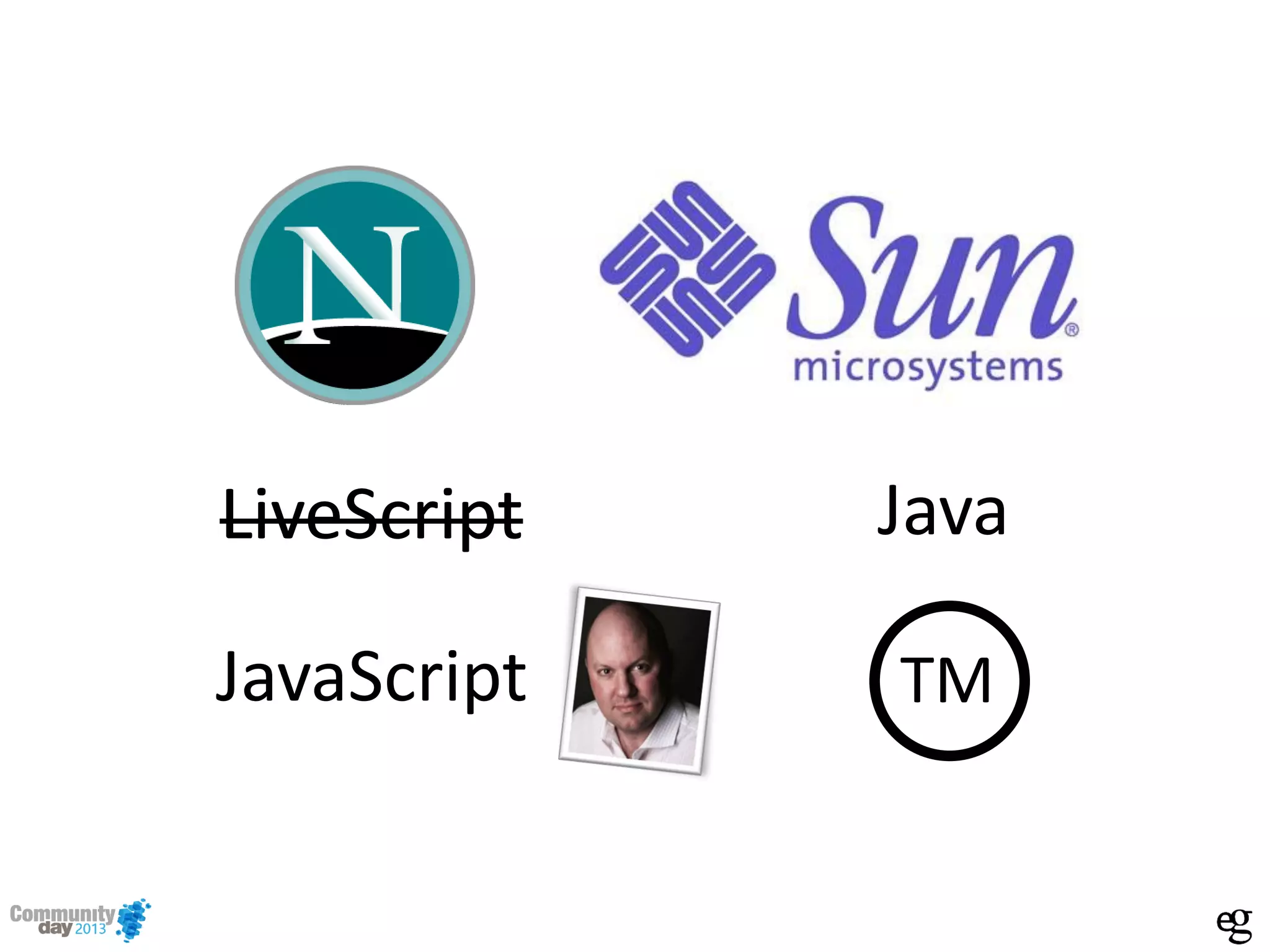
LiveScript
Mocha
19961995 20051999 2009 2011 20131992 1998
LiveScript
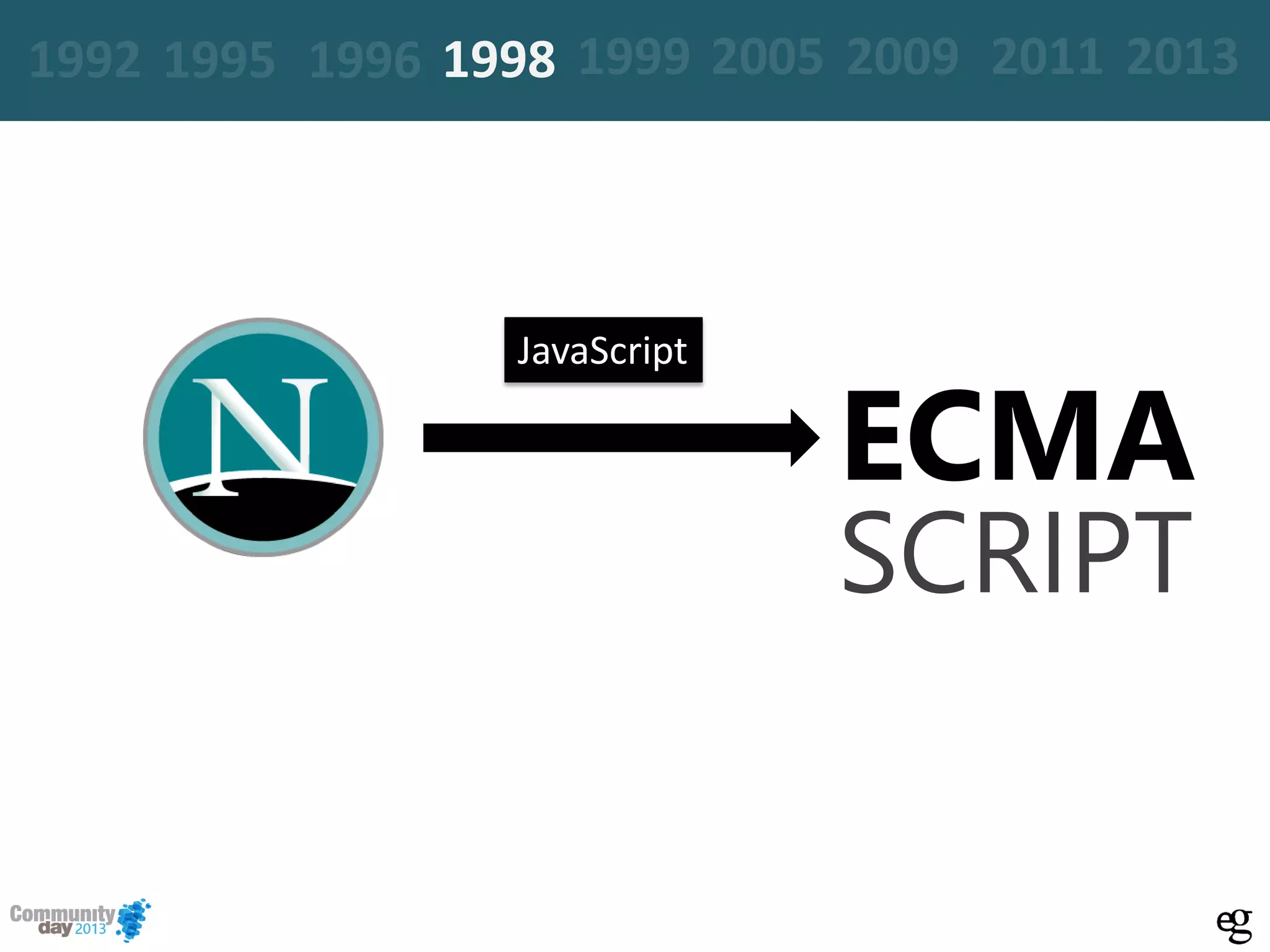
JavaScript
LiveScript
TM
Java
19961995 20051999 2009 2011 20131992 1998
JScript
19961995 20051999 2009 2011 20131992 1998
ECMA
JavaScript
SCRIPT
19961995 20051999 2009 2011 20131992 1998
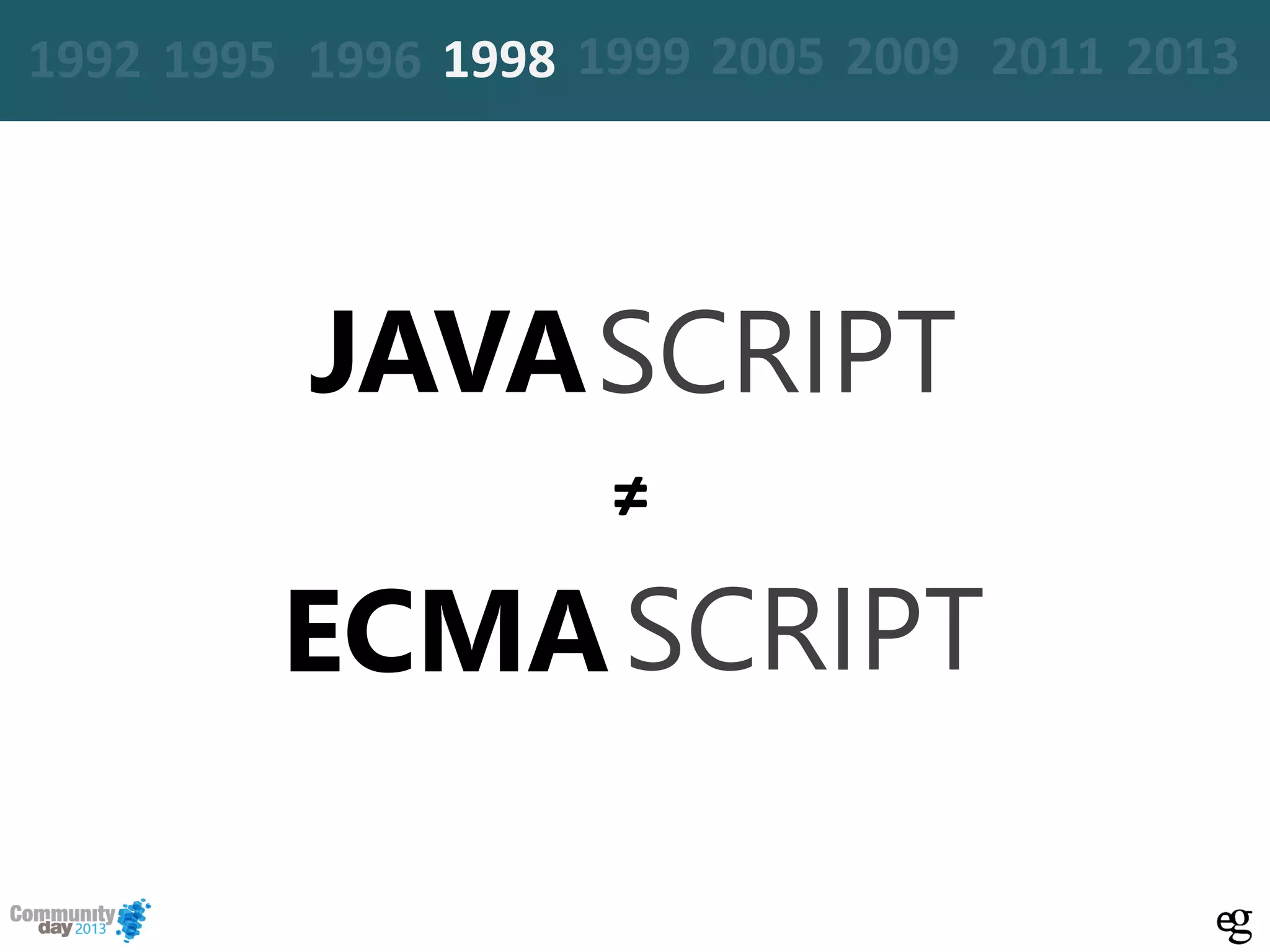
≠
JAVASCRIPT
ECMASCRIPT
19961995 20051999 2009 2011 20131992 1998
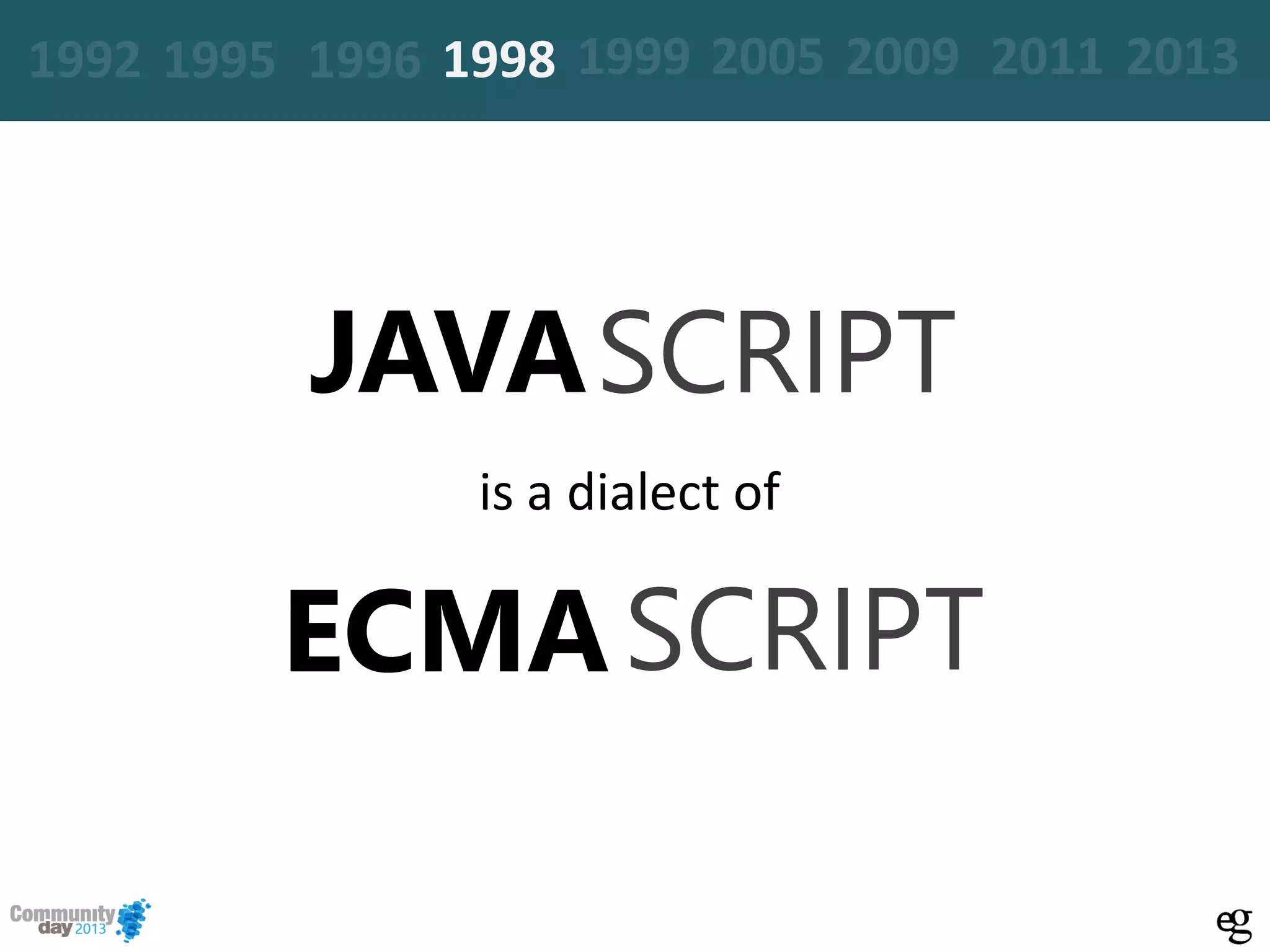
is a dialect of
JAVASCRIPT
ECMASCRIPT
19961995 20051999 2009 2011 20131992 1998
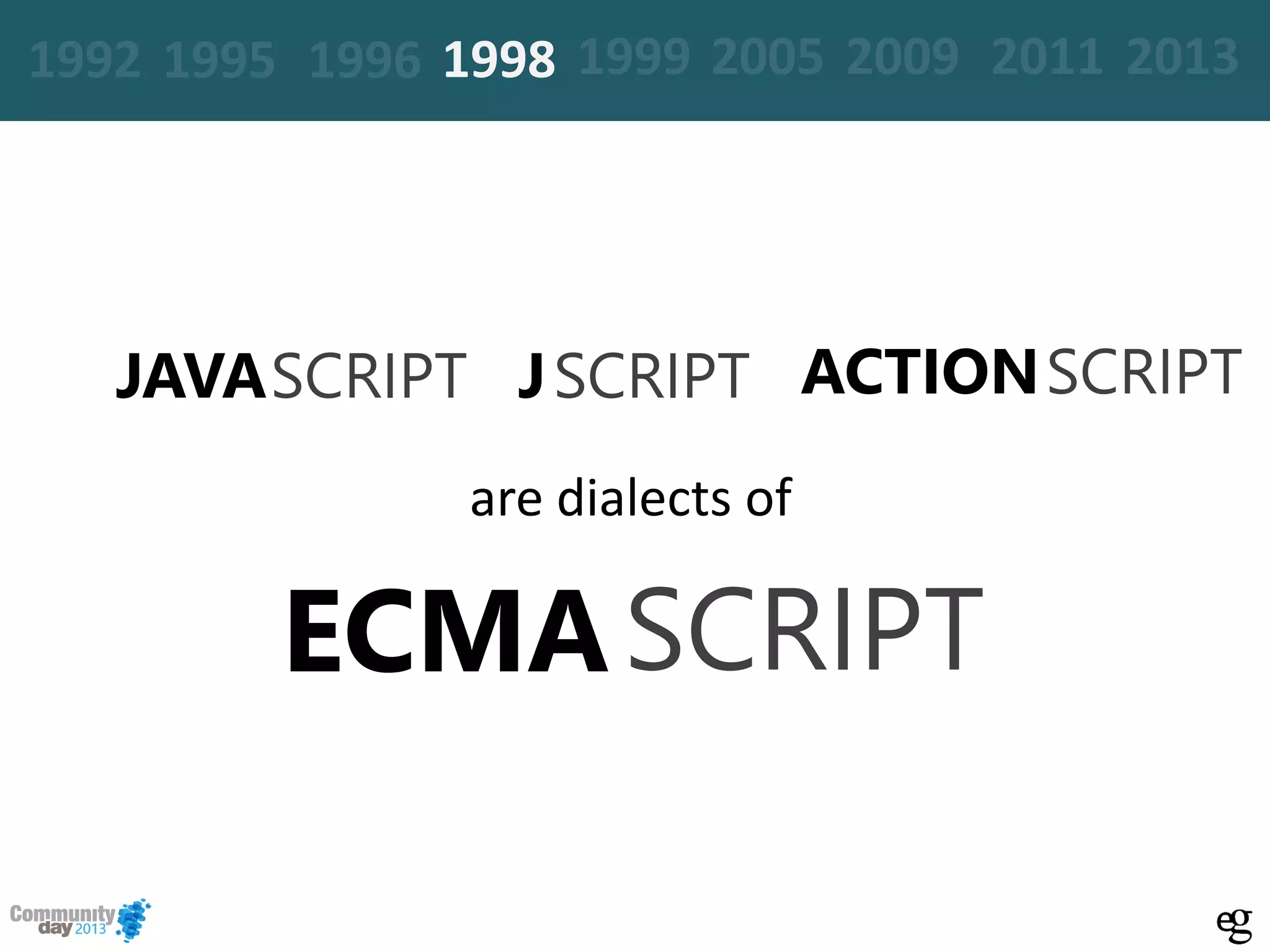
ECMASCRIPT
are dialects of
JAVASCRIPT JSCRIPT ACTIONSCRIPT
19961995 20051999 2009 2011 20131992 1998
ECMASCRIPT~
TC 39 controls what
will be included in
the spec
19961995 20051999 2009 2011 20131992 1998
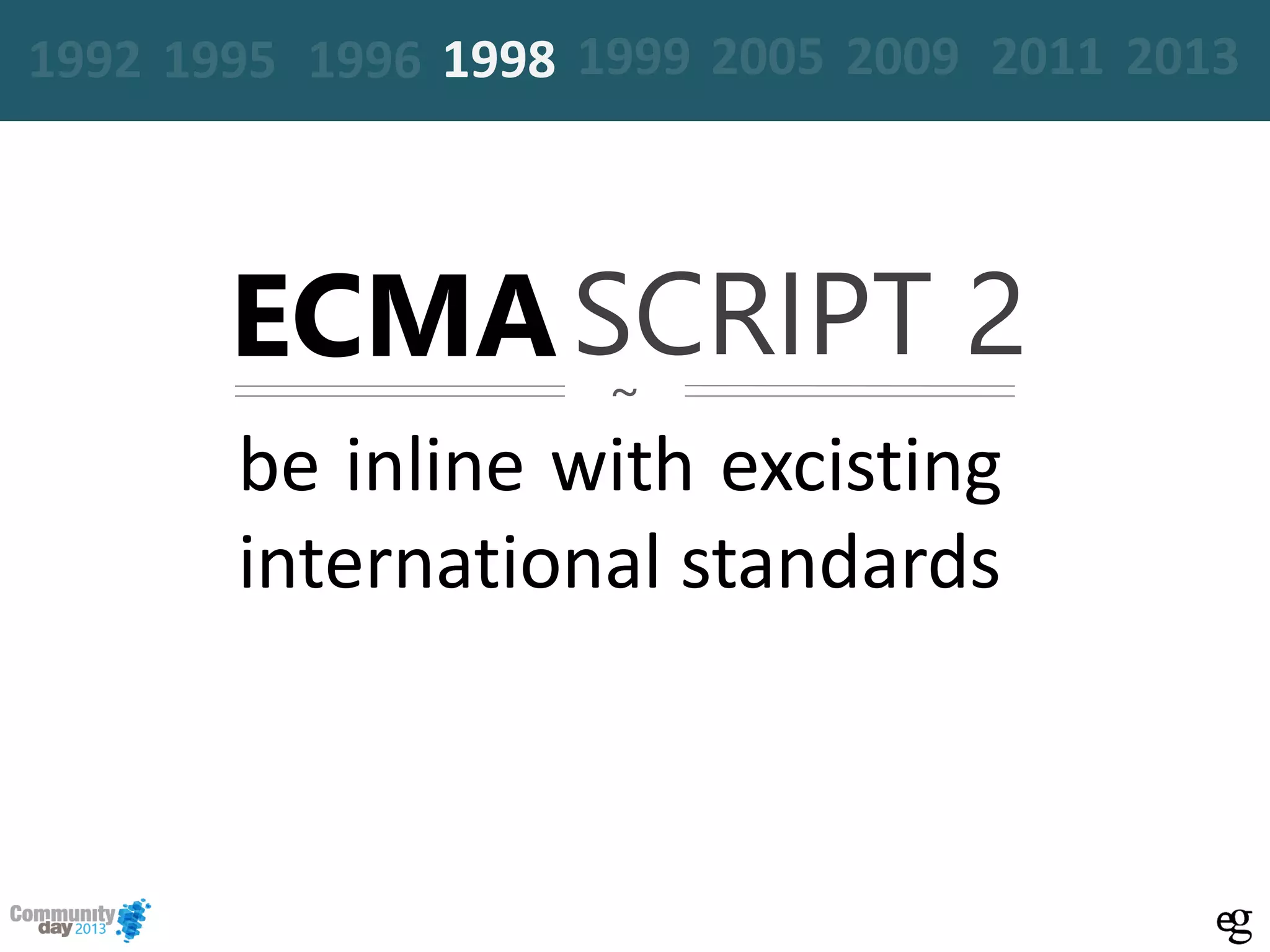
ECMASCRIPT 2
be inline with excisting
international standards
~
19961995 20051999 2009 2011 20131992 1998
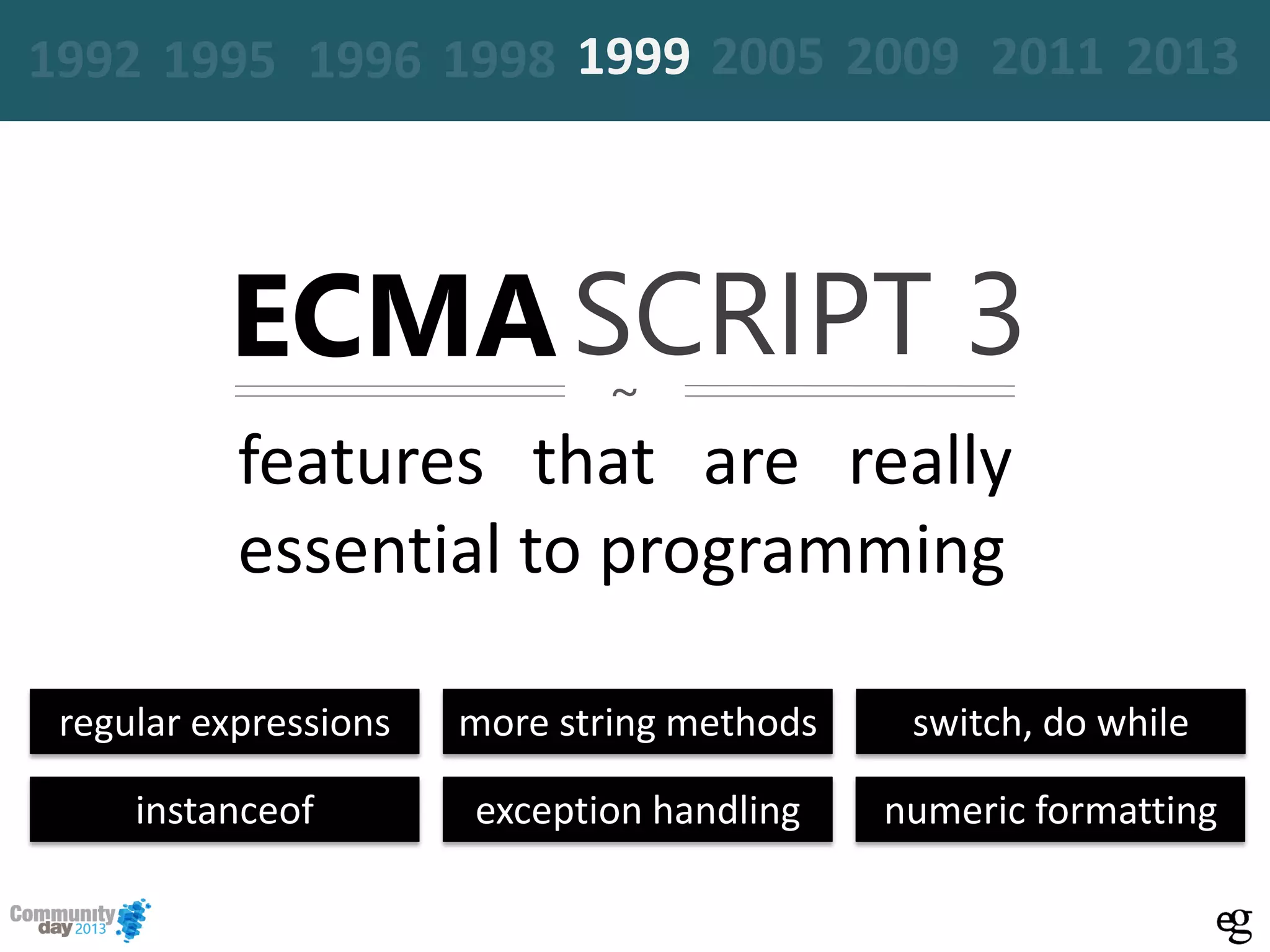
features that are really
essential to programming
regular expressions more string methods switch, do while
instanceof exception handling numeric formatting
~
ECMASCRIPT 3
19961995 20051999 2009 2011 20131992 1998
anticipated the future
~
ECMASCRIPT 4
19961995 20051999 2009 2011 20131992 1998
ECMASCRIPT 4~
Incompatible with ES 3
19961995 20051999 2009 2011 20131992 1998
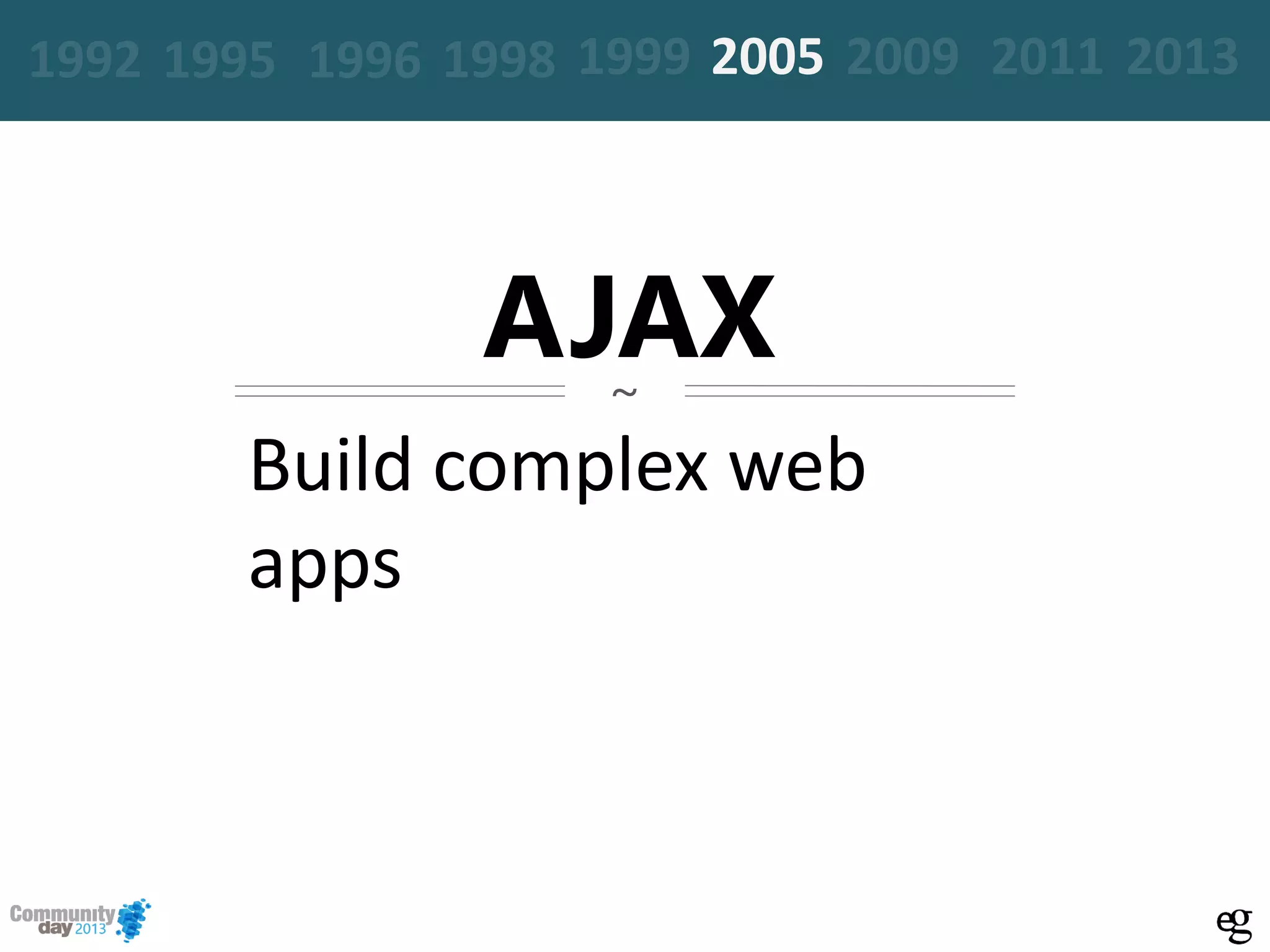
AJAX
Build complex web
apps
~
19961995 20051999 2009 2011 20131992 1998
Object.Create defineProperty Strict
Getter and setters json supportSemantic changes
~
ECMASCRIPT 5
19961995 20051999 2009 2011 20131992 1998
Revision of ES5
~
ECMASCRIPT 5.1
19961995 20051999 2009 2011 20131992 1998
~
also called ES.next
ECMASCRIPT 6
19961995 20051999 2009 2011 20131992 1998
~
compatible with ES5
ECMASCRIPT 6
19961995 20051999 2009 2011 20131992 1998
~
be a better language
ECMASCRIPT 6
19961995 20051999 2009 2011 20131992 1998
~
Final review of draft
in november 2013
ECMASCRIPT 6
19961995 20051999 2009 2011 20131992 1998
~
ECMA approval in
december 2014
ECMASCRIPT 6
19961995 20051999 2009 2011 20131992 1998
ECMAHARMONY
Superset of ES.next
future features in ES.next
or ES.next.next
~
19961995 20051999 2009 2011 20131992 1998
demo.
most ES.next features don’t work in your browser
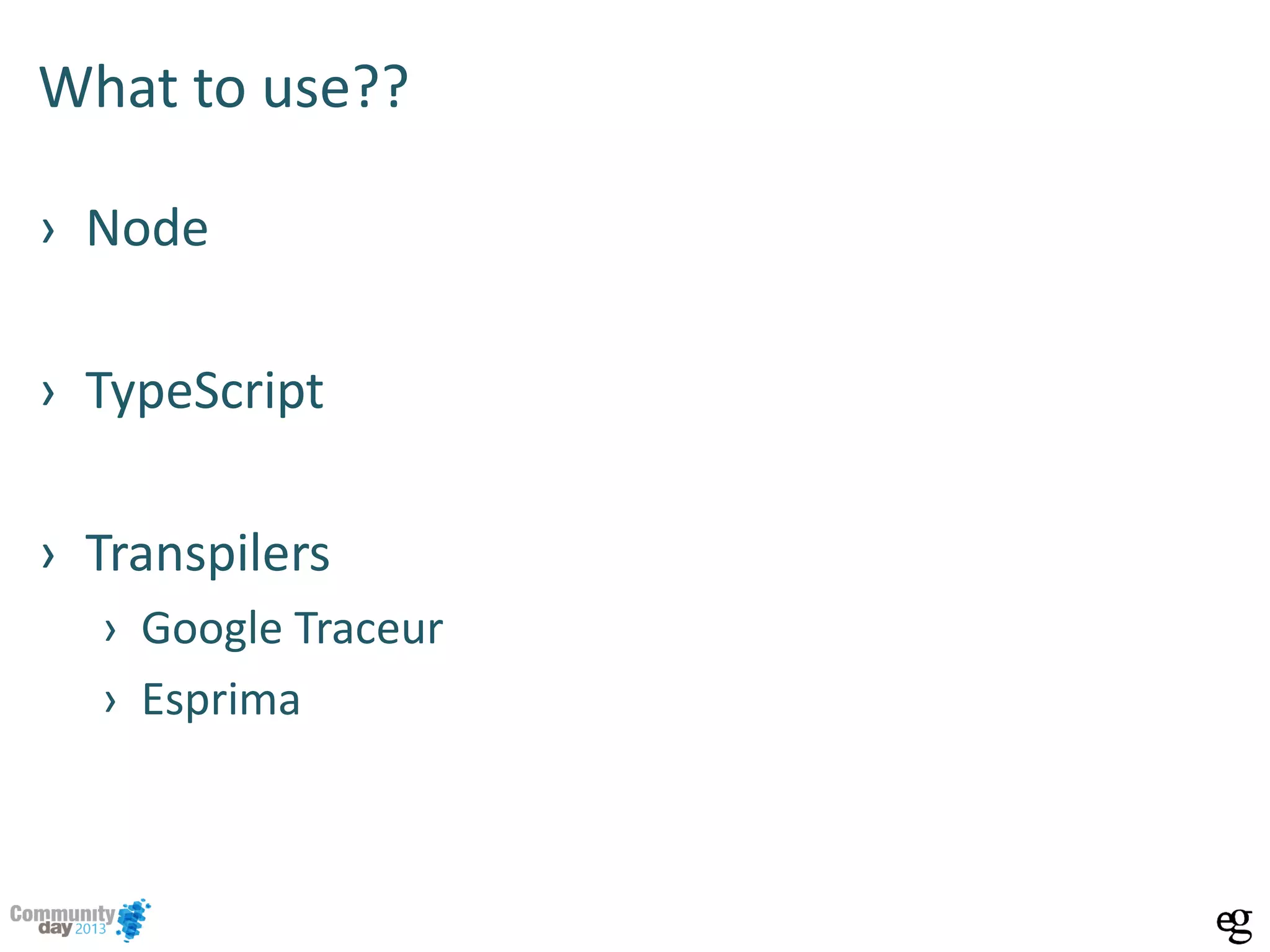
What to use??
› Node
› TypeScript
› Transpilers
› Google Traceur
› Esprima
http://kangax.github.io/es5-compat-table/es6/
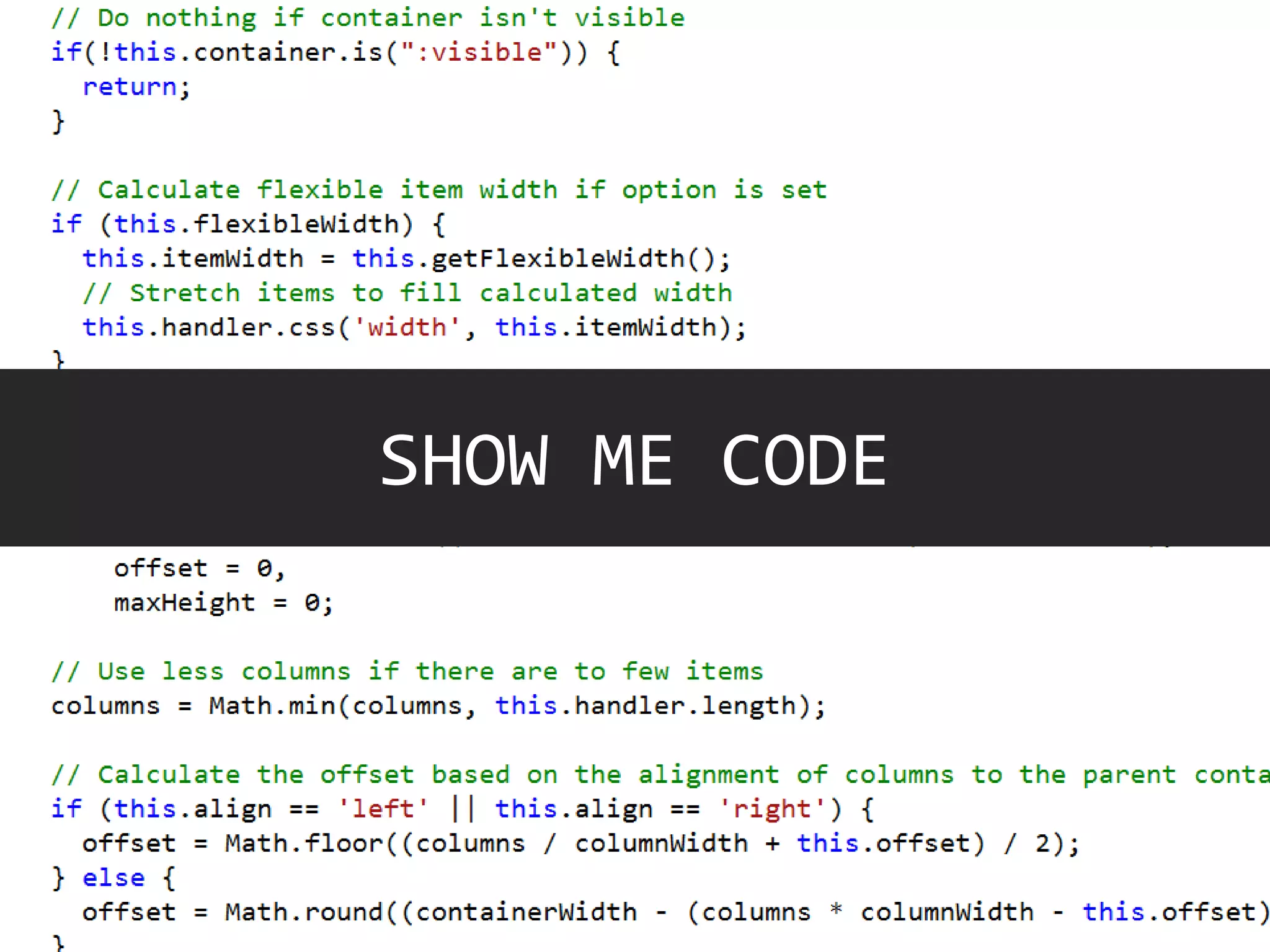
SHOW ME CODE
Features
• iterators
• const and let
• maps
• rest parameters
• generators
• shorthand literal syntax
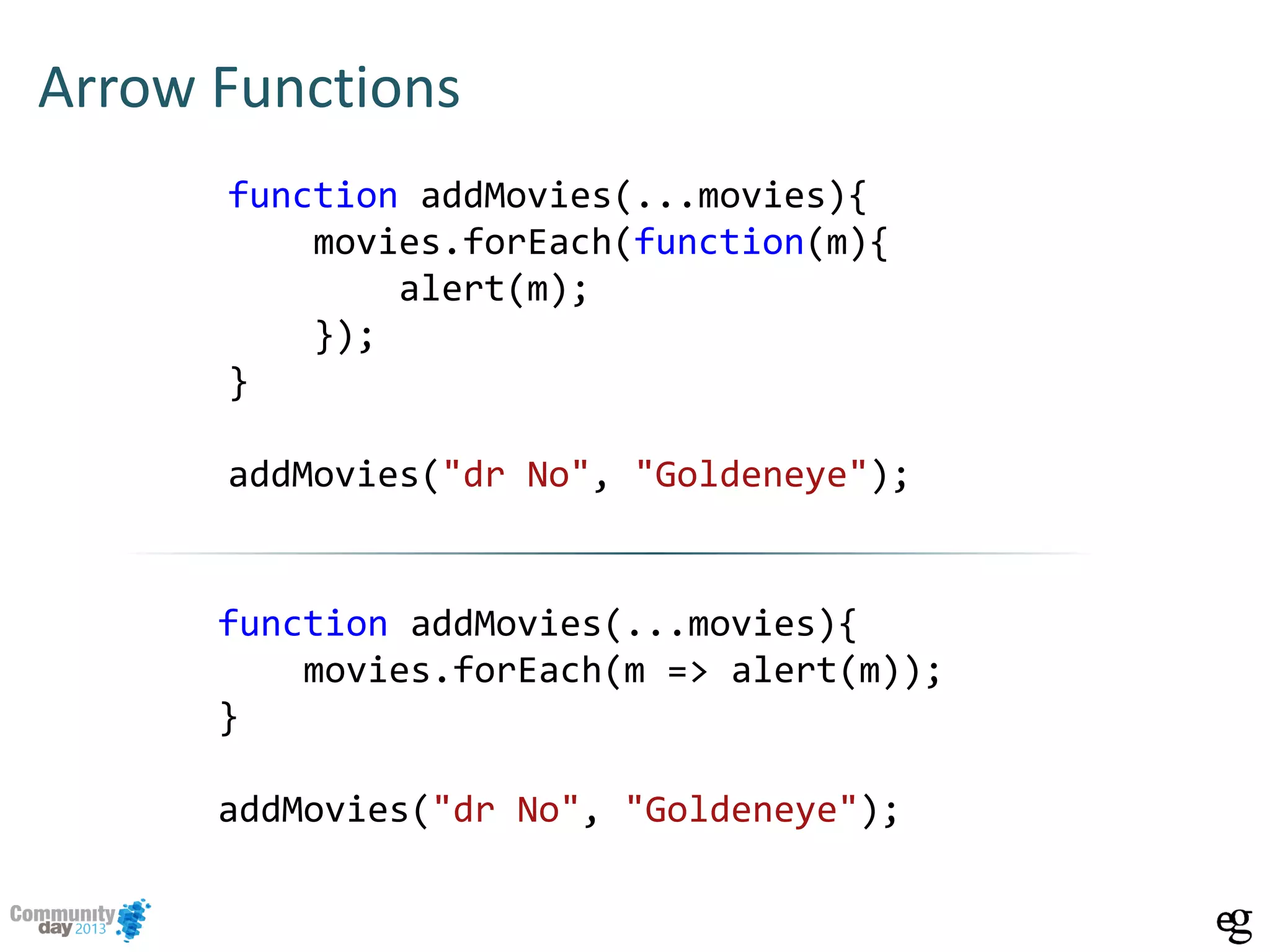
• arrow functions
• modules
• template strings
• classes
• symbols
• spread operator
• weakmaps
• new object methods
• default parameters
• binary data
…
about variables and scopes
ES 5: function scope
var jamesBondMovies = ["Goldeneye", "Dr No"];
function showMovies(){
var i = 0, l = jamesBondMovies.length;
for(; i < l ; i++){
alert(jamesBondMovies[i]);
}
alert(i);
alert(l);
}
showMovies();
› 2
› 2
ES.next: Block scope
› 2 new keywords: let and const
› let
› Creates a block scope variable
› const
› Like let but only readable after
declaration
let
var jamesBondMovies = ["Goldeneye", "Dr No"];
function showMovies(){
let i = 0, l = jamesBondMovies.length;
for(; i < l ; i++){
alert(jamesBondMovies[i]);
}
alert(i);
alert(l);
}
showMovies();
› i is not defined
› l is not defined
Shorthand Object Literal Syntax
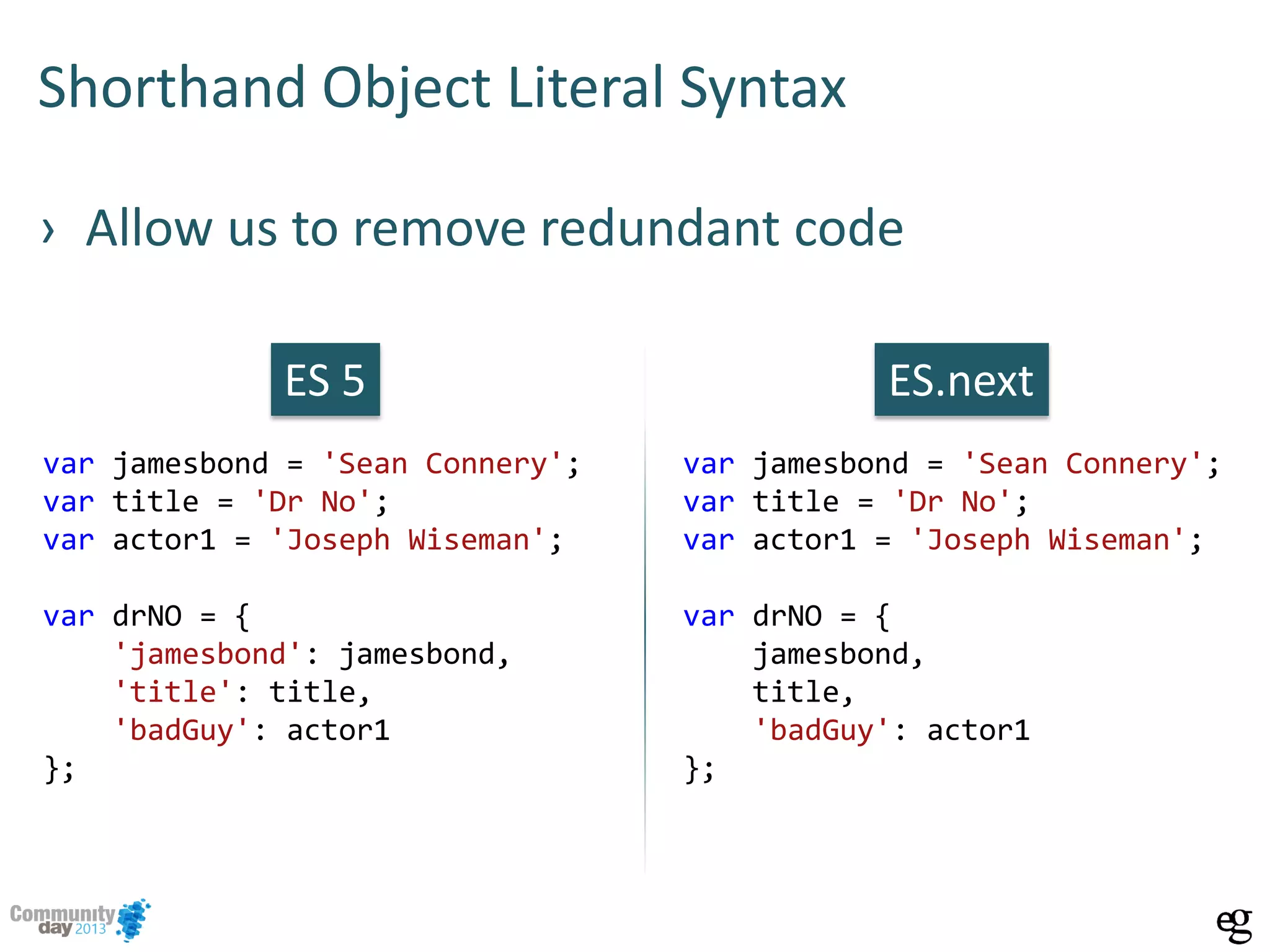
› Allow us to remove redundant code
var jamesbond = 'Sean Connery';
var title = 'Dr No';
var actor1 = 'Joseph Wiseman';
var drNO = {
'jamesbond': jamesbond,
'title': title,
'badGuy': actor1
};
var jamesbond = 'Sean Connery';
var title = 'Dr No';
var actor1 = 'Joseph Wiseman';
var drNO = {
jamesbond,
title,
'badGuy': actor1
};
ES 5 ES.next
Shorthand Object Literal Syntax
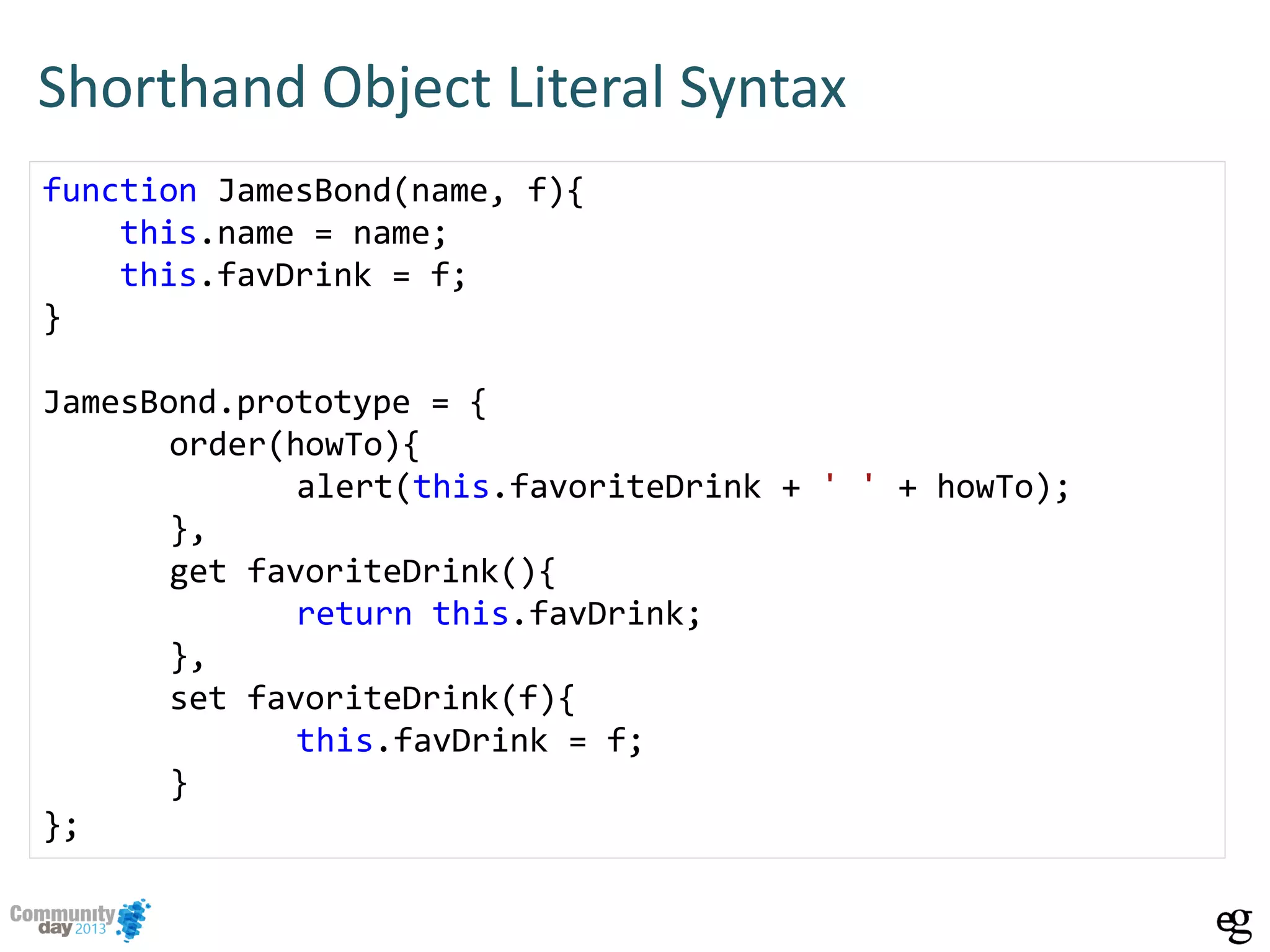
function JamesBond(name, f){
this.name = name;
this.favDrink = f;
}
JamesBond.prototype = {
order(howTo){
alert(this.favoriteDrink + ' ' + howTo);
},
get favoriteDrink(){
return this.favDrink;
},
set favoriteDrink(f){
this.favDrink = f;
}
};
Default Function Parameters
› Have optional function parameters by setting
default values
› The parameters are defined when the functions
are defined
Rest parameter
Function problem
› You never know how many arguments are being
passed to a function
› Use the arguments object to get all the arguments
› Arguments is not an array!!!
› Solution: rest parameter
› use ‘…’ to denote a variable number of arguments
Rest Parameters
› Pass a number of args to a named parameter
› Choos a name for your parameter
› Instead of using the arguments object
› Variabe name preceded with …
function addMovies(...movies){
movies.forEach(function(m){
alert(m);
});
}
addMovies("dr No", "Goldeneye");
addMovies("dr No", "licence to kill", "Goldfinger");
Rest Parameters
function JamesBond(name,
favoriteDrink,
...gadgets) {
for(var i = 0, l = gadgets.length;i<l;i++){
alert(gadgets[i]);
}
this.name = name;
this.favoriteDrink = favoriteDrink;
}
var sean = new JamesBond('Sean Connery',
'Martini',
'Watch with a laser',
'Aston Martin',
'Mojo');
Spread operator
Spread operator
› Opposite of rest parameters
› Pass number of arguments to function
function commentMovie(date, m, comment, by){
log("comment on '" + m+ "' by " + by + " on " + date);
}
function getComment(){
return ["Goldeneye", "my favorite", "kevin"];
}
commentMovie("20/06/2013", ...getComment());
Spread Operator
function Cocktail(name, type, ...ingredients){
alert(name + '(' + type + ')');
alert('ingredients');
alert(' ' + ingredients);
var i = 0, l = ingredients.length;
}
var vesper = ['shortdrink', 'lillet blanc, wodka, gin'];
var v = new Cocktail('Vesper Martini', ...vesper);
Spread operator and rest parameters combined
function Cocktail(name, type, ...ingredients){
alert(name + '(' + type + ')');
alert('ingredients');
alert(' ' + ingredients);
var i = 0, l = ingredients.length;
for(;i<l;i++){
alert(' ' + ingredients[i]);
}
}
var vesper = ['shortdrink','lillet','blanc','wodka','gin'];
var v = new Cocktail('Vesper Martini', ...vesper);
Classes
Classes
› A class is a representation of an object
› Blueprint to create objects
› Until now, we’ve faked it
› functions and prototypes to implement classes
Fake itfunction JamesBond(name, favoriteDrink) {
this.name = name;
this.favDrink = favoriteDrink;
}
JamesBond.prototype = {
/* PROPERTIES */
get favoriteDrink() { return this.favDrink },
set favoriteDrink(v) { this.favDrink = v },
/* BEHAVIOR */
orderDrink: function () { alert('order'); }
};
var daniel = new JamesBond('Daniel Craig', 'Vesper Martini');
alert(daniel.favoriteDrink);
daniel.orderDrink();
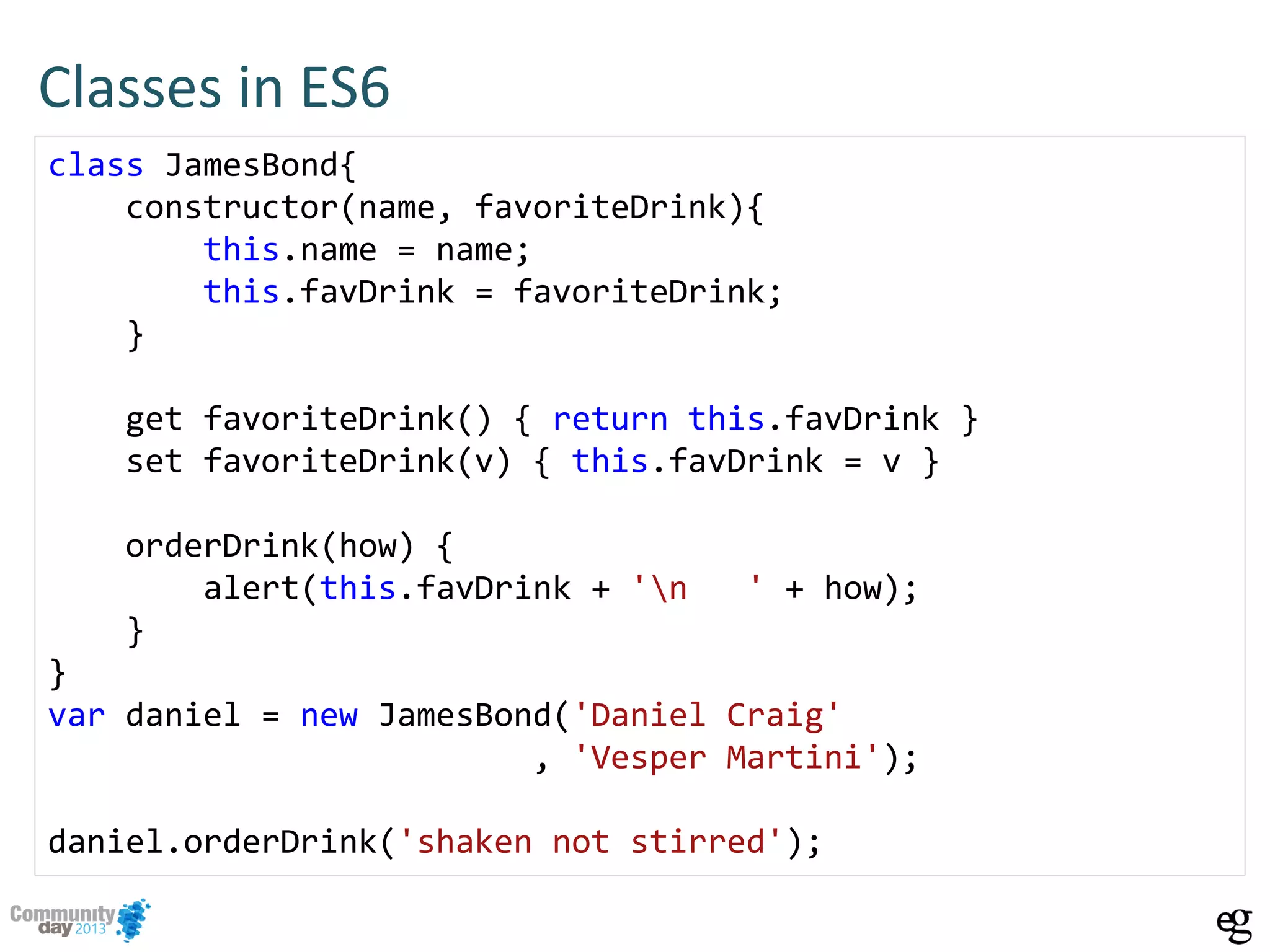
Classes in ES6
class JamesBond{
constructor(name, favoriteDrink){
this.name = name;
this.favDrink = favoriteDrink;
}
get favoriteDrink() { return this.favDrink }
set favoriteDrink(v) { this.favDrink = v }
orderDrink(how) {
alert(this.favDrink + 'n ' + how);
}
}
var daniel = new JamesBond('Daniel Craig'
, 'Vesper Martini');
daniel.orderDrink('shaken not stirred');
Extending classes
class Movie{
constructor(title){
this.title = title;
}
}
class jamesBondMovie extends Movie{
constructor(title, jamesBond, badGuy, omgGirl){
super(title);
this.jamesBond = jamesBond;
this.badGuy = badGuy;
this.omgGirl = omgGirl;
}
};
Modules
Modules
› Group functionality into a module
› Define which function you want to make available
externally
› Import module in your code
› Define which functionality you want to include
Modules
module helper{
export function print(array){
for(var a of array){
log(a);
}
}
}
import {print} from helper;
print(["Pierce","Sean"]);
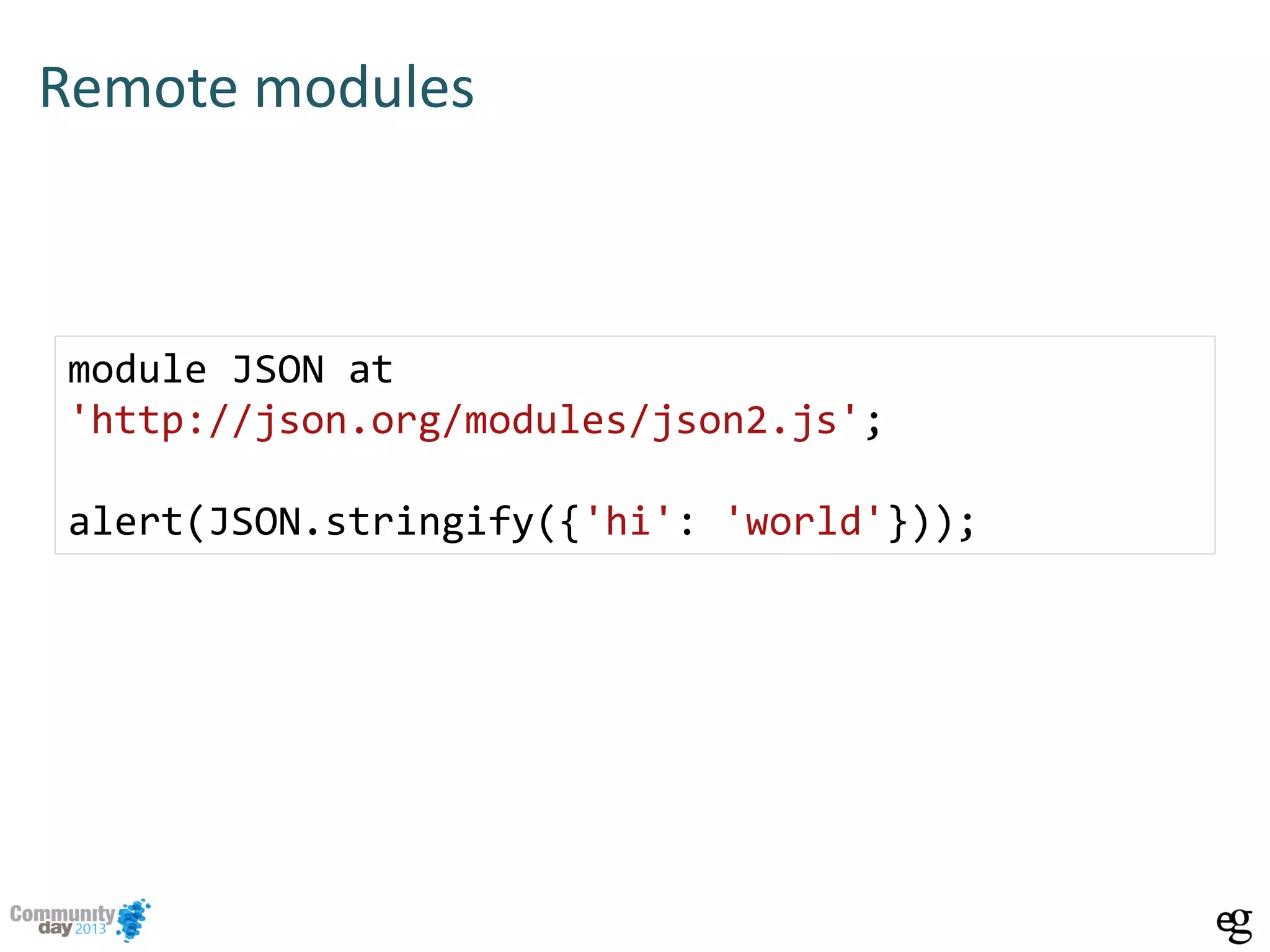
Remote modules
module JSON at
'http://json.org/modules/json2.js';
alert(JSON.stringify({'hi': 'world'}));
Module Loaders
› Dynamic API for loading modules in controlled
and selectively isolated contexts
Loader.load('http://json.org/modules/json2.js',
function(JSON) {
alert(JSON.stringify([0, {a: true}]));
});
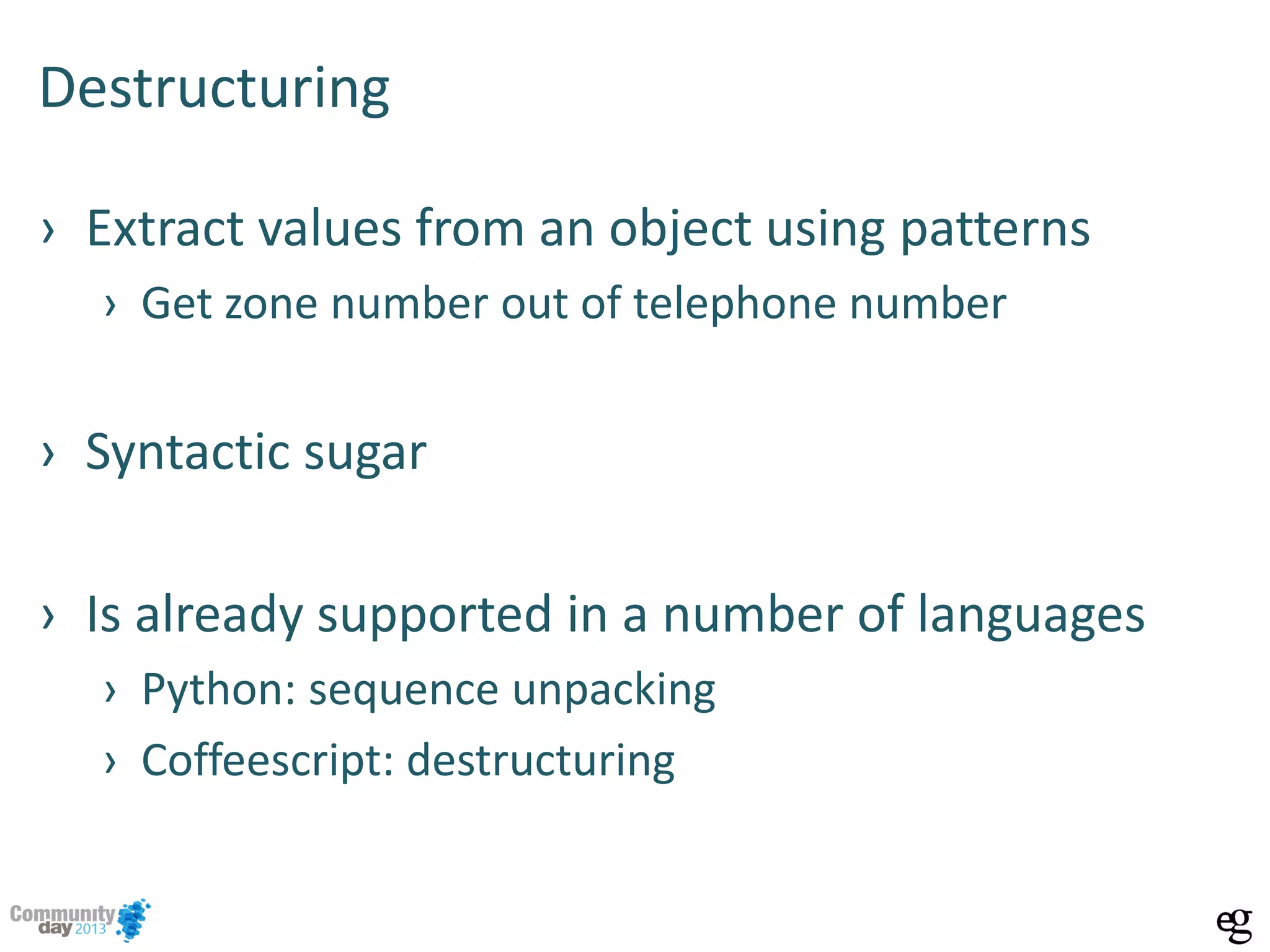
Destructuring
Destructuring
› Extract values from an object using patterns
› Get zone number out of telephone number
› Syntactic sugar
› Is already supported in a number of languages
› Python: sequence unpacking
› Coffeescript: destructuring
Array destructuring
› Variables can be initialized in one statement
› Swapping 2 variables
var [d, m, y] = [20,6,2013];
var d = 20, m = 6, y = 2013;
var [value1, value2] = [10, 30];
[value1, value2] = [value2, value1]
Good case: return multiple values
› Return multiple
function getMovieInfo(){
return ["Dr No", "Sean Connery", "Joseph Wiseman"];
}
var [title, jamesbond, badGuy] = getMovieInfo();
Object destructuring
› Similar to array pattern
› Map on object properties
var movie = { "name": "Sean Connery“
, "movie": "Dr No"};
var {name: actor, movie: title} = movie;
Object destructuring
movies.forEach(function({name: actor, movie: movie}){
// ...
});
Maps, WeakMaps and sets
Maps, WeakMaps and Sets
› Until now, Array was (is) the only type of
collection
› ES6 introduces 3 new types of collections
› Set:
› Map:
› WeakMap:
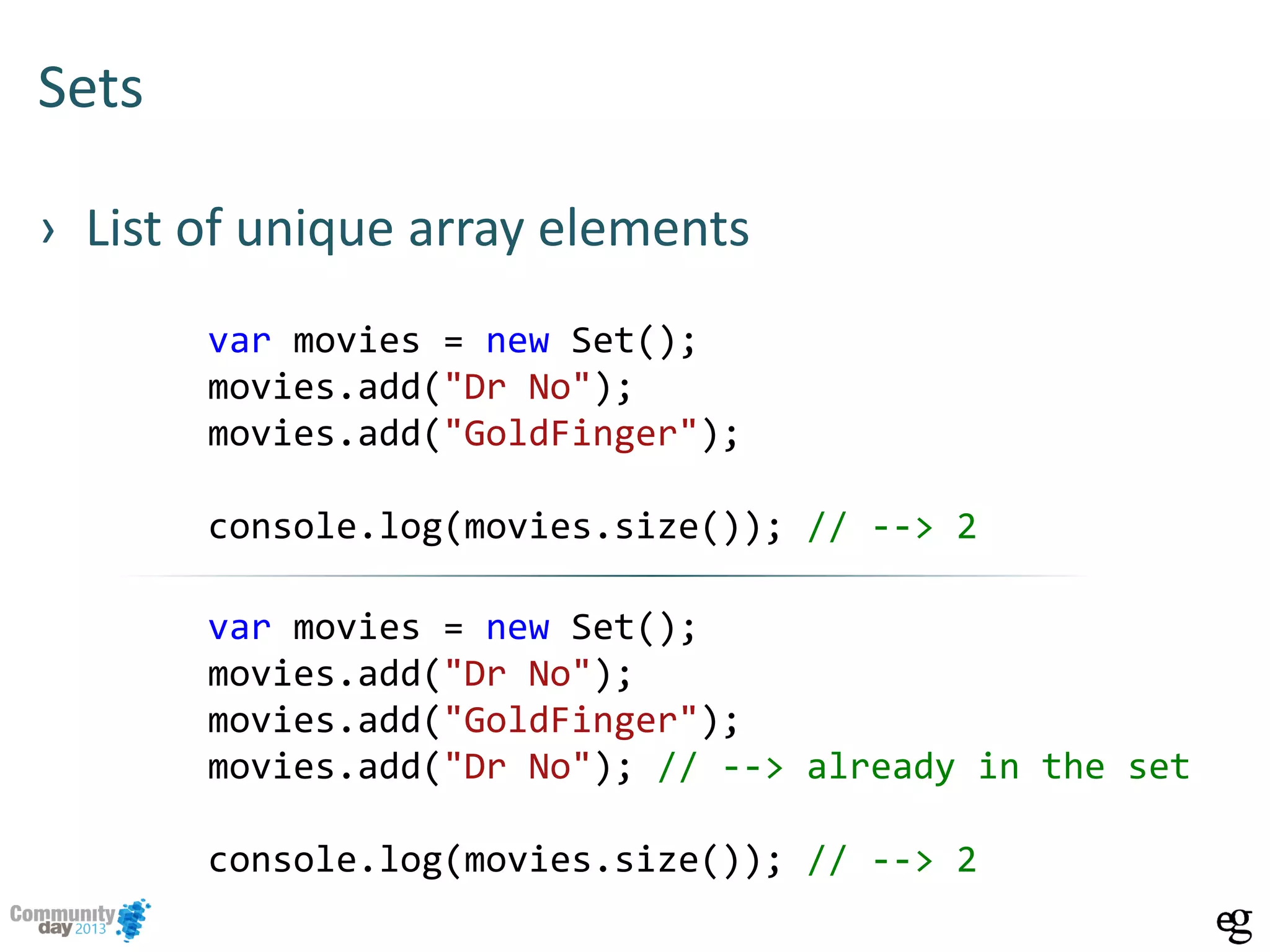
Sets
› List of unique array elements
var movies = new Set();
movies.add("Dr No");
movies.add("GoldFinger");
console.log(movies.size()); // --> 2
var movies = new Set();
movies.add("Dr No");
movies.add("GoldFinger");
movies.add("Dr No"); // --> already in the set
console.log(movies.size()); // --> 2
Maps
› Map a value to a unique key
› cfr: a Dictionary
var movies = new Map();
movies.set(1, "Dr No");
movies.set(2, "GoldFinger");
var m = movies.get(1);
movies.delete(2);
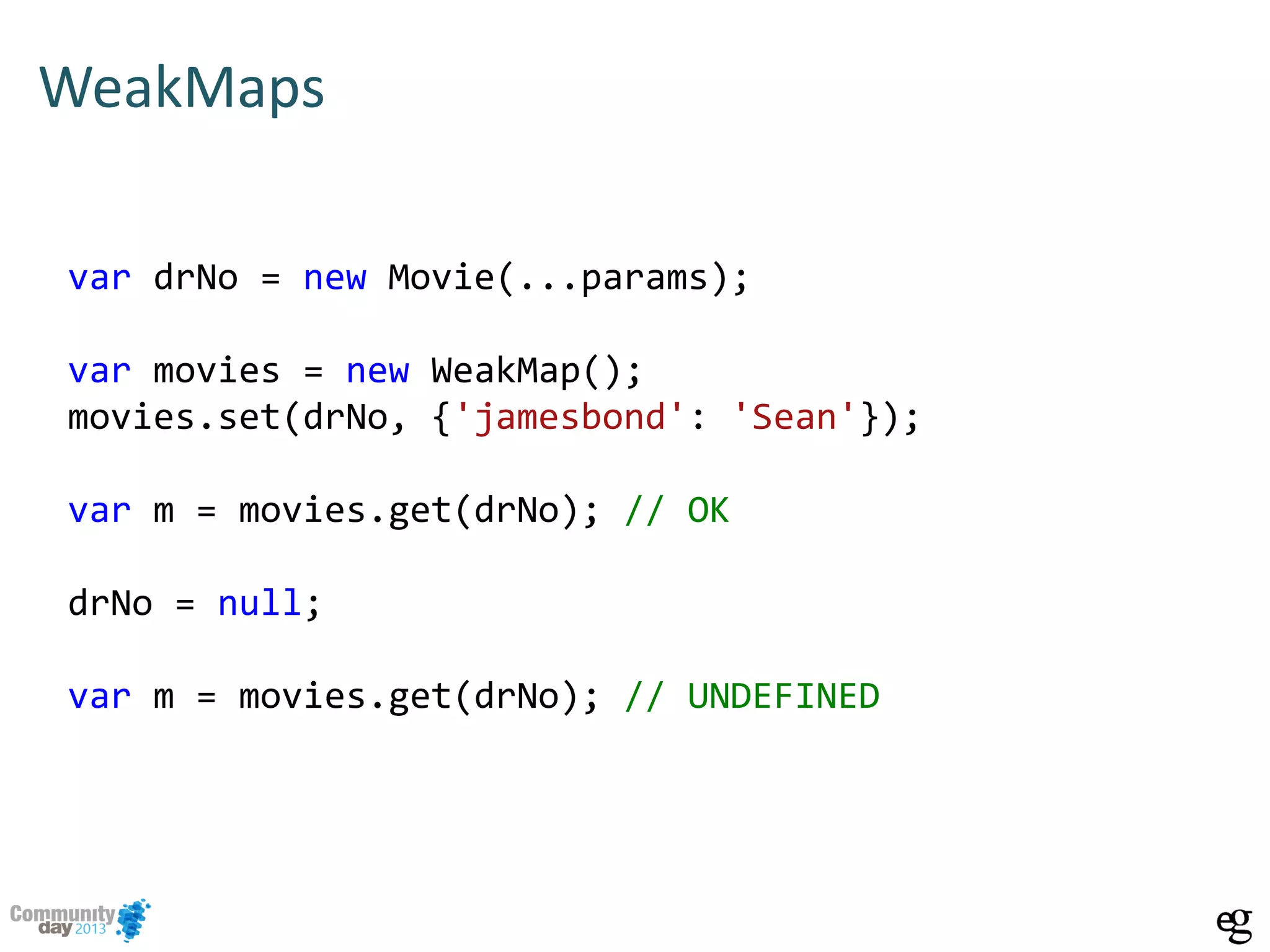
WeakMaps
› Like maps
› But: key must be an object
cannot be a primitive value
› When the reference gets garbage collected, the
weakmap will remove the item
WeakMaps
var drNo = new Movie(...params);
var movies = new WeakMap();
movies.set(drNo, {'jamesbond': 'Sean'});
var m = movies.get(drNo); // OK
drNo = null;
var m = movies.get(drNo); // UNDEFINED
Iterators
Iterators
› JavaScript has the for – in
› In an array, the for-in gives the indexes and not the
values
var actors = ["Sean", "Timothy", "Roger”];
for (var a in actors) {
alert(a); // 0,1,2
}
for-of
var actors = ["Sean", "Timothy", "Roger", "Pierce"];
for (var a of actors) {
alert(a); // 0,1,2,3
}
var movies = new Map();
movies.set(1, "Dr No");
movies.set(2, "GoldFinger");
for(var [id, title] n movies){
alert(title);
}
Arrow functions
Arrow Functions
› JavaScript developers frequently use function
expressions
$("#button").click(function(){ /*...*/ });
forEach(function(item){ /*...*/ });
Arrow Functions
function addMovies(...movies){
movies.forEach(function(m){
alert(m);
});
}
addMovies("dr No", "Goldeneye");
function addMovies(...movies){
movies.forEach(m => alert(m));
}
addMovies("dr No", "Goldeneye");
I’m sorry but no time for
• Iterators
• Symbols
• Binary data
• Tail-call optomization
• Proxies
• Reflection methods
• …
Other cool stuff
Q&A

Es.next