Models for Leadership and Collaboration Laleh Shahidi Jerry L. Talley
Identify risks and benefits of  a  collaborative working model Define the functional requirements for information  workers  to work and collaborate more efficiently and effectively Identify an inexpensive  technology  environment matched to processes and workers needs Acquire the skills required to work in a collaborative environment Understand the learning process unique to collaborative environments Course & Project Objectives
Strategy for Building Collaborative Environment Champion and sustain from the top down Statement of corporate mission Created VP of Collaboration Build and implement from the bottom up The course! Model and encourage middle to engage
Define 3 models of collaboration Each with a different leadership requirement Explore the benefits and risks of the 3 models across several common work processes Identify the  technology  environment to support collaboration in varying degrees Teach attendees how to initiate and support change to more collaborative work styles in their home work environment  Course Outline
The Traditional Model Clean, simple hierarchy of authority Well defined roles and responsibilities Distinct departmental boundaries
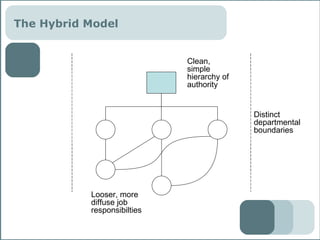
The Hybrid Model Clean, simple hierarchy of authority Looser, more diffuse job responsibilties Distinct departmental boundaries
The Network Model Shared, diffuse role of authority Looser, more diffuse job responsibilties Work overlaps departmental boundaries
Our Training Model:  Test Beds  These are the situations in which we could explore the implications and applicability of the different models: Production environment Project management situation Product launch process Product development Customer service Strategic planning effort Classroom teaching
Rationale for Course Strategy Training Technology People Process We want to give the appropriate focus on the people and processes issues rather than assume collaboration results from training in the right tools
Principles of Collaboration Do we have a shared goal? Do we know who's who? Do we build status based on our actions? Do we agree that our behavior can be regulated according to our shared values? Are we interacting in a shared space that is appropriate to our goals? Can we relate to each other in smaller numbers? Do we have easy ways to share ideas and information? Do we know who belongs and who doesn't Can we trade knowledge, support, ideas? Can we easily indicate our opinions and preferences? Can we track our evolution?
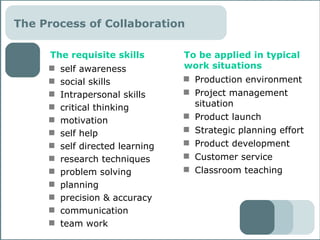
self awareness social skills Intrapersonal skills critical thinking motivation self help self directed learning research techniques problem solving planning precision & accuracy communication team work Production environment Project management situation Product launch Strategic planning effort Product development Customer service Classroom teaching The Process of Collaboration  The requisite skills To be applied in typical work situations
The Tools
Managing the Change Changing the work group New norms and values New operational patterns New roles  Changing the organization Supporting policies and structures New technical infrastructure Senior sponsorship Designate a change leader Create a shared need Define the desired future Mobilize commitment and engagement Monitor progress Make change endure Change systems, structures, and capabilities The Domains The Process

Models For Leadership and Collaboration

  • 1.
    Models for Leadershipand Collaboration Laleh Shahidi Jerry L. Talley
  • 2.
    Identify risks andbenefits of a collaborative working model Define the functional requirements for information workers to work and collaborate more efficiently and effectively Identify an inexpensive technology environment matched to processes and workers needs Acquire the skills required to work in a collaborative environment Understand the learning process unique to collaborative environments Course & Project Objectives
  • 3.
    Strategy for BuildingCollaborative Environment Champion and sustain from the top down Statement of corporate mission Created VP of Collaboration Build and implement from the bottom up The course! Model and encourage middle to engage
  • 4.
    Define 3 modelsof collaboration Each with a different leadership requirement Explore the benefits and risks of the 3 models across several common work processes Identify the technology environment to support collaboration in varying degrees Teach attendees how to initiate and support change to more collaborative work styles in their home work environment Course Outline
  • 5.
    The Traditional ModelClean, simple hierarchy of authority Well defined roles and responsibilities Distinct departmental boundaries
  • 6.
    The Hybrid ModelClean, simple hierarchy of authority Looser, more diffuse job responsibilties Distinct departmental boundaries
  • 7.
    The Network ModelShared, diffuse role of authority Looser, more diffuse job responsibilties Work overlaps departmental boundaries
  • 8.
    Our Training Model: Test Beds These are the situations in which we could explore the implications and applicability of the different models: Production environment Project management situation Product launch process Product development Customer service Strategic planning effort Classroom teaching
  • 9.
    Rationale for CourseStrategy Training Technology People Process We want to give the appropriate focus on the people and processes issues rather than assume collaboration results from training in the right tools
  • 10.
    Principles of CollaborationDo we have a shared goal? Do we know who's who? Do we build status based on our actions? Do we agree that our behavior can be regulated according to our shared values? Are we interacting in a shared space that is appropriate to our goals? Can we relate to each other in smaller numbers? Do we have easy ways to share ideas and information? Do we know who belongs and who doesn't Can we trade knowledge, support, ideas? Can we easily indicate our opinions and preferences? Can we track our evolution?
  • 11.
    self awareness socialskills Intrapersonal skills critical thinking motivation self help self directed learning research techniques problem solving planning precision & accuracy communication team work Production environment Project management situation Product launch Strategic planning effort Product development Customer service Classroom teaching The Process of Collaboration The requisite skills To be applied in typical work situations
  • 12.
  • 13.
    Managing the ChangeChanging the work group New norms and values New operational patterns New roles Changing the organization Supporting policies and structures New technical infrastructure Senior sponsorship Designate a change leader Create a shared need Define the desired future Mobilize commitment and engagement Monitor progress Make change endure Change systems, structures, and capabilities The Domains The Process

Editor's Notes

  • #6 In the Traditional Model, workers are organized in a clean hierarchy of authority and communication. Work roles are cleanly defined and workers are expected to perform their jobs as specified by their manager.
  • #7 In the Hybrid Model there is a manager over the entire network, but the roles within the network are more diffuse than in the Traditional Model. Evaluation is now based on more than simple job performance; employees are expected to cooperate, to share information and resources.
  • #8 In the Network Model the work group is now a network that extends across departmental boundaries. There is no single department head whose authority covers the entire effort. Workers are expected to not only perform their job function, but to contribute to a community.