Neural Graph Collaborative Filtering (2020)
Xiang Wang et al.
The 42nd International ACM SIGIR Conference on Research and Development in
Information Retrieval
Department of Industrial Engineering
Financial Engineering Lab
JunPyo Park
UNIST Financial Engineering Lab. 1
Contents
Neural Graph Collaborative Filtering
Recommender System
Collaborative Filtering
Latent Factor Model
Matrix Factorization
UNIST Financial Engineering Lab. 2
Contents
Neural Graph Collaborative Filtering
NCF
UNIST Financial Engineering Lab. 3
Contents
Neural Graph Collaborative Filtering
NGCF
UNIST Financial Engineering Lab. 4
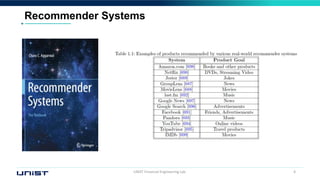
Recommender Systems
UNIST Financial Engineering Lab. 5
Recommender Systems
Goal - Increasing Product Sales
Relevance
Novelty
Serendipity
Diversity
Problem Formulation
Matrix Completion Problem
Top-k recommendation Problem
UNIST Financial Engineering Lab. 6
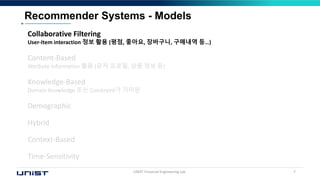
Recommender Systems - Models
Collaborative Filtering
User-Item interaction 정보 활용 (평점, 좋아요, 장바구니, 구매내역 등…)
Content-Based
Attribute information 활용 (유저 프로필, 상품 정보 등)
Knowledge-Based
Domain Knowledge 또는 Constraint가 가미된
Demographic
Hybrid
Context-Based
Time-Sensitivity
UNIST Financial Engineering Lab. 7
Recommender Systems - Models
Collaborative Filtering
User-Item interaction 정보 활용 (평점, 좋아요, 장바구니, 구매내역 등…)
Content-Based
Attribute information 활용 (유저 프로필, 상품 정보 등)
Knowledge-Based
Domain Knowledge 또는 Constraint가 가미된
Demographic
Hybrid
Context-Based
Time-Sensitivity
UNIST Financial Engineering Lab. 8
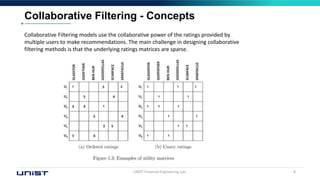
Collaborative Filtering - Concepts
Collaborative Filtering models use the collaborative power of the ratings provided by
multiple users to make recommendations. The main challenge in designing collaborative
filtering methods is that the underlying ratings matrices are sparse.
UNIST Financial Engineering Lab. 9
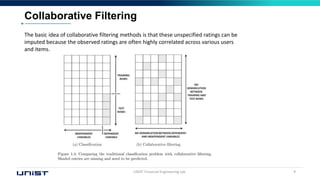
Collaborative Filtering
The basic idea of collaborative filtering methods is that these unspecified ratings can be
imputed because the observed ratings are often highly correlated across various users
and items.
UNIST Financial Engineering Lab. 10
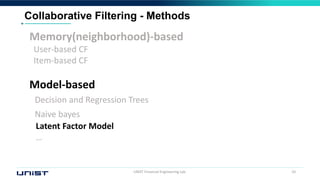
Collaborative Filtering - Methods
Memory(neighborhood)-based
User-based CF
Item-based CF
Model-based
Decision and Regression Trees
Naive bayes
Latent Factor Model
…
UNIST Financial Engineering Lab. 11
Latent Factor Model
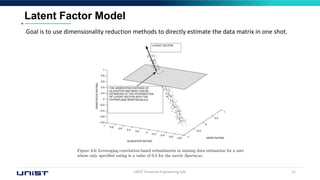
Goal is to use dimensionality reduction methods to directly estimate the data matrix in one shot.
UNIST Financial Engineering Lab. 12
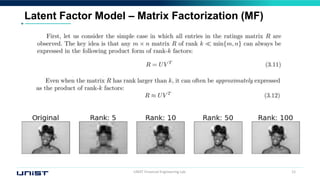
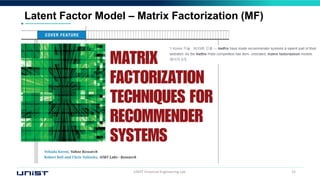
Latent Factor Model – Matrix Factorization (MF)
UNIST Financial Engineering Lab. 13
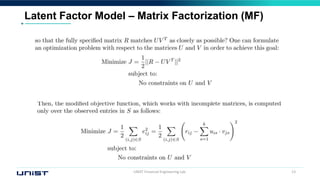
Latent Factor Model – Matrix Factorization (MF)
UNIST Financial Engineering Lab. 14
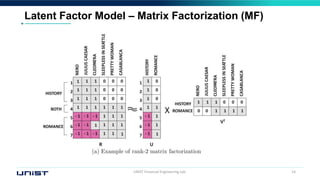
Latent Factor Model – Matrix Factorization (MF)
UNIST Financial Engineering Lab. 15
Latent Factor Model – Matrix Factorization (MF)
UNIST Financial Engineering Lab. 16
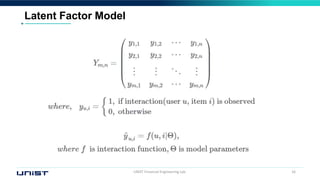
Latent Factor Model
UNIST Financial Engineering Lab. 17
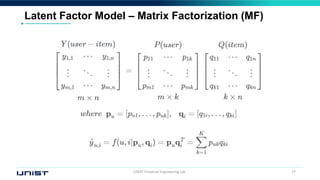
Latent Factor Model – Matrix Factorization (MF)
UNIST Financial Engineering Lab. 18
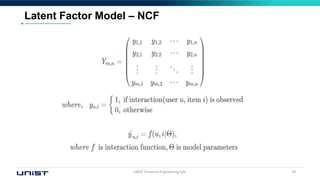
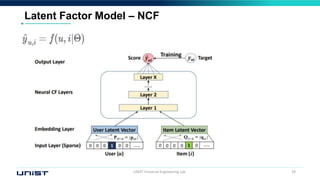
Latent Factor Model – NCF
UNIST Financial Engineering Lab. 19
Latent Factor Model – NCF
UNIST Financial Engineering Lab. 20
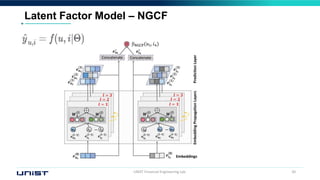
Latent Factor Model – NGCF
UNIST Financial Engineering Lab. 21
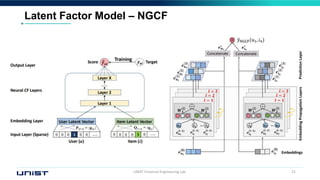
Latent Factor Model – NGCF
UNIST Financial Engineering Lab. 22
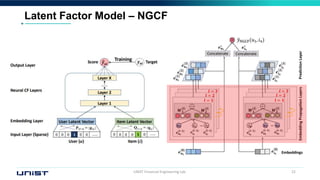
Latent Factor Model – NGCF
UNIST Financial Engineering Lab. 23
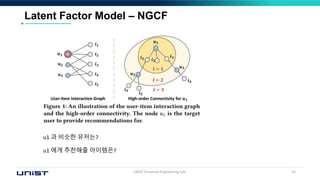
Latent Factor Model – NGCF
u1 과 비슷한 유저는?
u1 에게 추천해줄 아이템은?
UNIST Financial Engineering Lab. 24
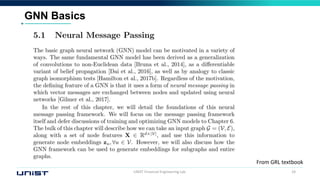
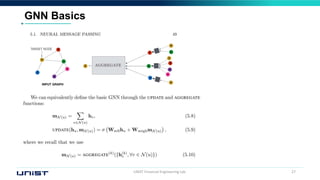
GNN Basics
From GRL textbook
UNIST Financial Engineering Lab. 25
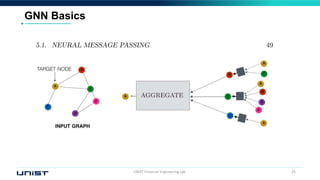
GNN Basics
UNIST Financial Engineering Lab. 26
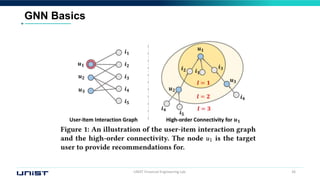
GNN Basics
UNIST Financial Engineering Lab. 27
GNN Basics
UNIST Financial Engineering Lab. 28
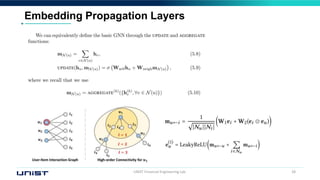
Embedding Propagation Layers
UNIST Financial Engineering Lab. 29
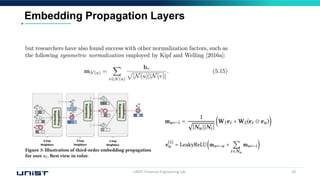
Embedding Propagation Layers
UNIST Financial Engineering Lab. 30
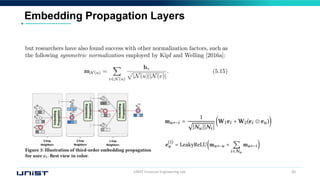
Embedding Propagation Layers
UNIST Financial Engineering Lab. 31
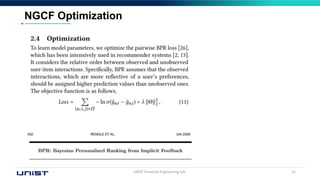
NGCF Optimization
UNIST Financial Engineering Lab. 32
Q&A
UNIST Financial Engineering Lab. 33
Q&A
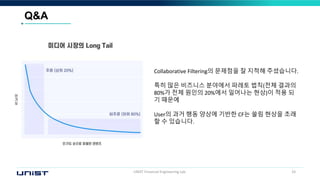
Collaborative Filtering의 문제점을 잘 지적해 주셨습니다.
특히 많은 비즈니스 분야에서 파레토 법칙(전체 결과의
80%가 전체 원인의 20%에서 일어나는 현상)이 적용 되
기 때문에
User의 과거 행동 양상에 기반한 CF는 쏠림 현상을 초래
할 수 있습니다.
UNIST Financial Engineering Lab. 34
Q&A
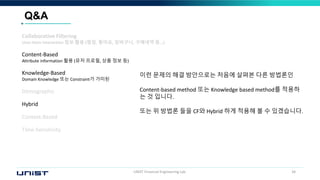
이런 문제의 해결 방안으로는 처음에 살펴본 다른 방법론인
Content-based method 또는 Knowledge based method를 적용하
는 것 입니다.
또는 위 방법론 들을 CF와 Hybrid 하게 적용해 볼 수 있겠습니다.
Collaborative Filtering
User-Item interaction 정보 활용 (평점, 좋아요, 장바구니, 구매내역 등…)
Content-Based
Attribute information 활용 (유저 프로필, 상품 정보 등)
Knowledge-Based
Domain Knowledge 또는 Constraint가 가미된
Demographic
Hybrid
Context-Based
Time-Sensitivity
UNIST Financial Engineering Lab. 35
Q&A
비즈니스 측면에서는 Serendipity(일부러 다른 취향의 아
이템을 노출)와 Diversity(추천 품목의 특성 다각화) 정도
를 조절하여 A/B 테스트 등을 통해 사용자의 만족도를 올
릴 수 있겠습니다.
Goal - Increasing Product Sales
Relevance
Novelty
Serendipity
Diversity
UNIST Financial Engineering Lab. 36
Q&A
UNIST Financial Engineering Lab. 37
Q&A
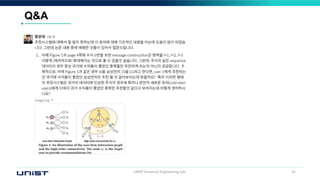
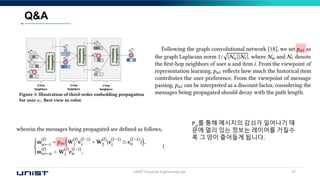
Pui를 통해 메시지의 감쇠가 일어나기 때
문에 멀리 있는 정보는 레이어를 거칠수
록 그 양이 줄어들게 됩니다.
UNIST Financial Engineering Lab. 38
Thank you for listening!

Collaborative Filtering - MF, NCF, NGCF

  • 1.
    Neural Graph CollaborativeFiltering (2020) Xiang Wang et al. The 42nd International ACM SIGIR Conference on Research and Development in Information Retrieval Department of Industrial Engineering Financial Engineering Lab JunPyo Park
  • 2.
    UNIST Financial EngineeringLab. 1 Contents Neural Graph Collaborative Filtering Recommender System Collaborative Filtering Latent Factor Model Matrix Factorization
  • 3.
    UNIST Financial EngineeringLab. 2 Contents Neural Graph Collaborative Filtering NCF
  • 4.
    UNIST Financial EngineeringLab. 3 Contents Neural Graph Collaborative Filtering NGCF
  • 5.
    UNIST Financial EngineeringLab. 4 Recommender Systems
  • 6.
    UNIST Financial EngineeringLab. 5 Recommender Systems Goal - Increasing Product Sales Relevance Novelty Serendipity Diversity Problem Formulation Matrix Completion Problem Top-k recommendation Problem
  • 7.
    UNIST Financial EngineeringLab. 6 Recommender Systems - Models Collaborative Filtering User-Item interaction 정보 활용 (평점, 좋아요, 장바구니, 구매내역 등…) Content-Based Attribute information 활용 (유저 프로필, 상품 정보 등) Knowledge-Based Domain Knowledge 또는 Constraint가 가미된 Demographic Hybrid Context-Based Time-Sensitivity
  • 8.
    UNIST Financial EngineeringLab. 7 Recommender Systems - Models Collaborative Filtering User-Item interaction 정보 활용 (평점, 좋아요, 장바구니, 구매내역 등…) Content-Based Attribute information 활용 (유저 프로필, 상품 정보 등) Knowledge-Based Domain Knowledge 또는 Constraint가 가미된 Demographic Hybrid Context-Based Time-Sensitivity
  • 9.
    UNIST Financial EngineeringLab. 8 Collaborative Filtering - Concepts Collaborative Filtering models use the collaborative power of the ratings provided by multiple users to make recommendations. The main challenge in designing collaborative filtering methods is that the underlying ratings matrices are sparse.
  • 10.
    UNIST Financial EngineeringLab. 9 Collaborative Filtering The basic idea of collaborative filtering methods is that these unspecified ratings can be imputed because the observed ratings are often highly correlated across various users and items.
  • 11.
    UNIST Financial EngineeringLab. 10 Collaborative Filtering - Methods Memory(neighborhood)-based User-based CF Item-based CF Model-based Decision and Regression Trees Naive bayes Latent Factor Model …
  • 12.
    UNIST Financial EngineeringLab. 11 Latent Factor Model Goal is to use dimensionality reduction methods to directly estimate the data matrix in one shot.
  • 13.
    UNIST Financial EngineeringLab. 12 Latent Factor Model – Matrix Factorization (MF)
  • 14.
    UNIST Financial EngineeringLab. 13 Latent Factor Model – Matrix Factorization (MF)
  • 15.
    UNIST Financial EngineeringLab. 14 Latent Factor Model – Matrix Factorization (MF)
  • 16.
    UNIST Financial EngineeringLab. 15 Latent Factor Model – Matrix Factorization (MF)
  • 17.
    UNIST Financial EngineeringLab. 16 Latent Factor Model
  • 18.
    UNIST Financial EngineeringLab. 17 Latent Factor Model – Matrix Factorization (MF)
  • 19.
    UNIST Financial EngineeringLab. 18 Latent Factor Model – NCF
  • 20.
    UNIST Financial EngineeringLab. 19 Latent Factor Model – NCF
  • 21.
    UNIST Financial EngineeringLab. 20 Latent Factor Model – NGCF
  • 22.
    UNIST Financial EngineeringLab. 21 Latent Factor Model – NGCF
  • 23.
    UNIST Financial EngineeringLab. 22 Latent Factor Model – NGCF
  • 24.
    UNIST Financial EngineeringLab. 23 Latent Factor Model – NGCF u1 과 비슷한 유저는? u1 에게 추천해줄 아이템은?
  • 25.
    UNIST Financial EngineeringLab. 24 GNN Basics From GRL textbook
  • 26.
    UNIST Financial EngineeringLab. 25 GNN Basics
  • 27.
    UNIST Financial EngineeringLab. 26 GNN Basics
  • 28.
    UNIST Financial EngineeringLab. 27 GNN Basics
  • 29.
    UNIST Financial EngineeringLab. 28 Embedding Propagation Layers
  • 30.
    UNIST Financial EngineeringLab. 29 Embedding Propagation Layers
  • 31.
    UNIST Financial EngineeringLab. 30 Embedding Propagation Layers
  • 32.
    UNIST Financial EngineeringLab. 31 NGCF Optimization
  • 33.
  • 34.
    UNIST Financial EngineeringLab. 33 Q&A Collaborative Filtering의 문제점을 잘 지적해 주셨습니다. 특히 많은 비즈니스 분야에서 파레토 법칙(전체 결과의 80%가 전체 원인의 20%에서 일어나는 현상)이 적용 되 기 때문에 User의 과거 행동 양상에 기반한 CF는 쏠림 현상을 초래 할 수 있습니다.
  • 35.
    UNIST Financial EngineeringLab. 34 Q&A 이런 문제의 해결 방안으로는 처음에 살펴본 다른 방법론인 Content-based method 또는 Knowledge based method를 적용하 는 것 입니다. 또는 위 방법론 들을 CF와 Hybrid 하게 적용해 볼 수 있겠습니다. Collaborative Filtering User-Item interaction 정보 활용 (평점, 좋아요, 장바구니, 구매내역 등…) Content-Based Attribute information 활용 (유저 프로필, 상품 정보 등) Knowledge-Based Domain Knowledge 또는 Constraint가 가미된 Demographic Hybrid Context-Based Time-Sensitivity
  • 36.
    UNIST Financial EngineeringLab. 35 Q&A 비즈니스 측면에서는 Serendipity(일부러 다른 취향의 아 이템을 노출)와 Diversity(추천 품목의 특성 다각화) 정도 를 조절하여 A/B 테스트 등을 통해 사용자의 만족도를 올 릴 수 있겠습니다. Goal - Increasing Product Sales Relevance Novelty Serendipity Diversity
  • 37.
  • 38.
    UNIST Financial EngineeringLab. 37 Q&A Pui를 통해 메시지의 감쇠가 일어나기 때 문에 멀리 있는 정보는 레이어를 거칠수 록 그 양이 줄어들게 됩니다.
  • 39.
    UNIST Financial EngineeringLab. 38 Thank you for listening!