Collaborative Filtering
Sue Yeon Syn
September 21, 2005
Additional papers
 Herlocker, J.L., et al. An algorithmic framework for performing
collaborative filtering. In Proceedings of the 22nd
International
Conference on Research and Development in Information
Retrieval (SIGIR ’99). 1999. Berkeley, California. ACM Press.
 Herlocker, J.L., J.A. konstan, and J. Riedl. Explaining
Collaborative Filtering Recommendations. In Proceedings of the
2000 ACM conference on Computer supported cooperative work
(CSCW ’00). 2000. Philadelphia, Pennsylvania. ACM Press.
 Balabanovic, M. and Shoham, Y. Fab: Content-based,
collaborative recommendation. Communications of the ACM,
40(3): 66-72, March 1997.
Agenda
 Concepts
 Uses
 CF vs. CB
 Algorithms
 Practical Issues
 Evaluation Metrics
 Future Issues
Concepts
 Collaborative Filtering
 The process of information filtering by collecting
human judgments (ratings)
 “word of mouth”
 User
 Any individual who provides ratings to a system
 Items
 Anything for which a human can provide a rating
Collaborative Filtering
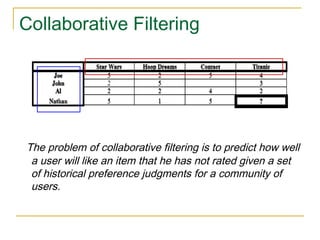
The problem of collaborative filtering is to predict how well
a user will like an item that he has not rated given a set
of historical preference judgments for a community of
users.
Uses for CF : User Tasks
 What tasks users may wish to accomplish
 Help me find new items I might like
 Advise me on a particular item
 Help me find a user (or some users) I might like
 Help our group find something new that we might
like
 Domain-specific tasks
 Help me find an item, new or not
Uses for CF : System Tasks
 What CF systems support
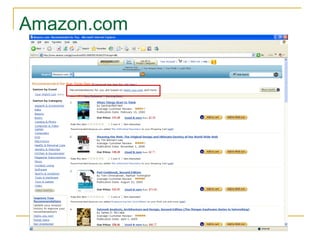
 Recommend items
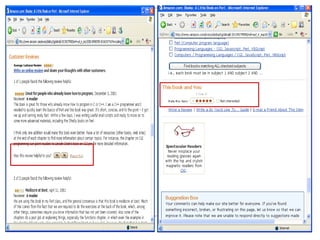
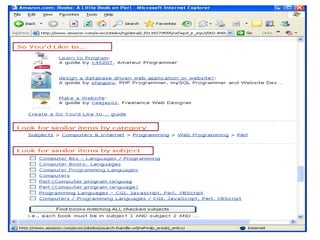
 Eg. Amazon.com
 Predict for a given item
 Constrained recommendations
 Recommend from a set of items
Amazon.com
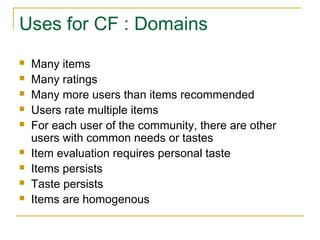
Uses for CF : Domains
 Many items
 Many ratings
 Many more users than items recommended
 Users rate multiple items
 For each user of the community, there are other
users with common needs or tastes
 Item evaluation requires personal taste
 Items persists
 Taste persists
 Items are homogenous
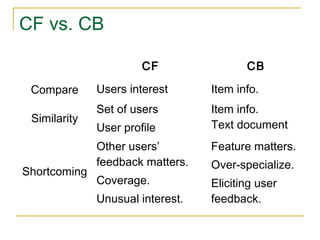
CF vs. CB
CF CB
Compare Users interest Item info.
Similarity
Set of users
User profile
Item info.
Text document
Shortcoming
Other users’
feedback matters.
Coverage.
Unusual interest.
Feature matters.
Over-specialize.
Eliciting user
feedback.
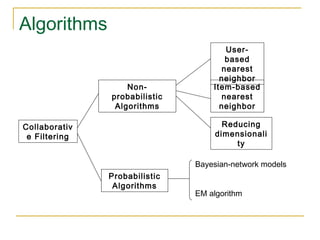
Algorithms
Collaborativ
e Filtering
Non-
probabilistic
Algorithms
Probabilistic
Algorithms
User-
based
nearest
neighbor
Item-based
nearest
neighbor
Reducing
dimensionali
ty
Bayesian-network models
EM algorithm
Algorithms : Non-probabilistic
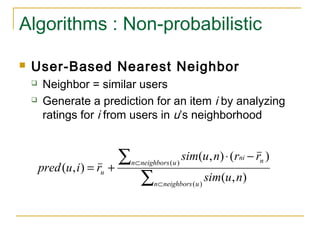
 User-Based Nearest Neighbor
 Neighbor = similar users
 Generate a prediction for an item i by analyzing
ratings for i from users in u’s neighborhood
∑
∑
⊂
⊂
−⋅
+=
)(
)(
),(
)(),(
),(
uneighborsn
uneighborsn nni
u
nusim
rrnusim
riupred
Algorithms : Non-probabilistic
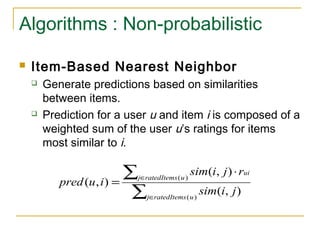
 Item-Based Nearest Neighbor
 Generate predictions based on similarities
between items.
 Prediction for a user u and item i is composed of a
weighted sum of the user u’s ratings for items
most similar to i.
∑
∑
∈
∈
⋅
=
)(
)(
),(
),(
),(
uratedItemsj
uratedItemsj
ui
jisim
rjisim
iupred
Algorithms : Non-probabilistic
 Dimensionality Reduction
 Reduce domain complexity by mapping the item
space to a smaller number of underlying
dimensions.
 Dimension may be latent topics or tastes.
 Vector-based techniques
 Vector decomposition
 Principal component analysis
 Factor analysis
Algorithms : Probabilistic
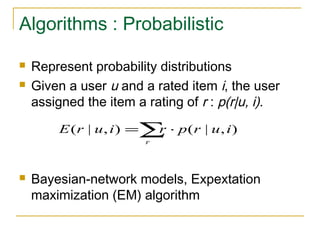
 Represent probability distributions
 Given a user u and a rated item i, the user
assigned the item a rating of r : p(r|u, i).
 Bayesian-network models, Expextation
maximization (EM) algorithm
∑ ⋅=
r
iurpriurE ),|(),|(
Practical Issues : Ratings
 Explicit vs. Implicit ratings
 Explicit ratings
 Users rate themselves for an item
 Most accurate descriptions of a user’s preference
 Challenging in collecting data
 Implicit ratings
 Observations of user behavior
 Can be collected with little or no cost to user
 Ratings inference may be imprecise.
Practical Issues : Ratings
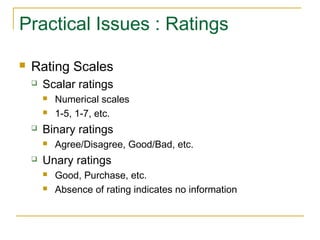
 Rating Scales
 Scalar ratings
 Numerical scales
 1-5, 1-7, etc.
 Binary ratings
 Agree/Disagree, Good/Bad, etc.
 Unary ratings
 Good, Purchase, etc.
 Absence of rating indicates no information
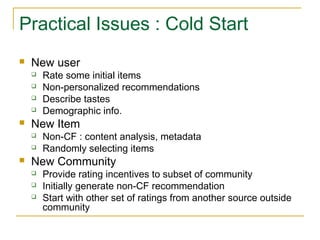
Practical Issues : Cold Start
 New user
 Rate some initial items
 Non-personalized recommendations
 Describe tastes
 Demographic info.
 New Item
 Non-CF : content analysis, metadata
 Randomly selecting items
 New Community
 Provide rating incentives to subset of community
 Initially generate non-CF recommendation
 Start with other set of ratings from another source outside
community
Evaluation Metrics
 Accuracy
 Predict accuracy
 The ability of a CF system to predict a user’s rating for
an item
 Mean absolute error (MAE)
 Rank accuracy
 Precision – percentage of items in a recommendation list
that the user would rate as useful
 Half-life utility – percentage of the maximum utility
achieved by the ranked list in question
Evaluation Metrics
 Novelty
 The ability of a CF system to recommend items that the
user was not already aware of.
 Serendipity
 Users are given recommendations for items that they would
not have seen given their existing channels of discovery.
 Coverage
 The percentage of the items known to the CF system for
which the CF system can generate predictions.
Evaluation Metrics
 Learning Rate
 How quickly the CF system becomes an effective
predictor of taste as data begins to arrive.
 Confidence
 Ability to evaluate the likely quality of its
predictions.
 User Satisfaction
 By surveying the users or measuring retention
and use statistics
Additional Issues : Privacy & Trust
 User profiles
 Personalized information
 Distributed architecture
 Recommender system may break trust when
malicious users give ratings that are not
representative of their true preferences.
Additional Issues : Interfaces
 Explanation
 Where, how, from whom the recommendations
are generated.
 Do not make it too much!
 Not showing reasoning process
 Graphs, key items
 Reviews
Additional Issues : Interfaces
 Social Navigation
 Make the behavior of community visible
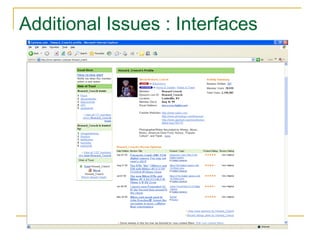
 Leaving “footprints” : read-wear / edit-wear
 Attempt to mimic more accurately the social
process of word-of-mouth recommendations
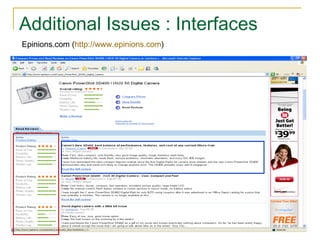
 Epinions.com
Additional Issues : Interfaces
Epinions.com (http://www.epinions.com)
Additional Issues : Interfaces
Additional Issues :
Hybrid Approach
 CF + CB
 Content based system
 Maintain user profile based on content analysis
 Collaborative system
 Directly compare profiles to determine similar
users for recommendation
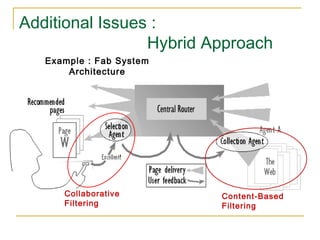
 Fab system
Additional Issues :
Hybrid Approach
Collaborative
Filtering
Content-Based
Filtering
Example : Fab System
Architecture
Questions and Comments?
Thank you!!

Collaborative filtering

  • 1.
    Collaborative Filtering Sue YeonSyn September 21, 2005
  • 2.
    Additional papers  Herlocker,J.L., et al. An algorithmic framework for performing collaborative filtering. In Proceedings of the 22nd International Conference on Research and Development in Information Retrieval (SIGIR ’99). 1999. Berkeley, California. ACM Press.  Herlocker, J.L., J.A. konstan, and J. Riedl. Explaining Collaborative Filtering Recommendations. In Proceedings of the 2000 ACM conference on Computer supported cooperative work (CSCW ’00). 2000. Philadelphia, Pennsylvania. ACM Press.  Balabanovic, M. and Shoham, Y. Fab: Content-based, collaborative recommendation. Communications of the ACM, 40(3): 66-72, March 1997.
  • 3.
    Agenda  Concepts  Uses CF vs. CB  Algorithms  Practical Issues  Evaluation Metrics  Future Issues
  • 4.
    Concepts  Collaborative Filtering The process of information filtering by collecting human judgments (ratings)  “word of mouth”  User  Any individual who provides ratings to a system  Items  Anything for which a human can provide a rating
  • 5.
    Collaborative Filtering The problemof collaborative filtering is to predict how well a user will like an item that he has not rated given a set of historical preference judgments for a community of users.
  • 6.
    Uses for CF: User Tasks  What tasks users may wish to accomplish  Help me find new items I might like  Advise me on a particular item  Help me find a user (or some users) I might like  Help our group find something new that we might like  Domain-specific tasks  Help me find an item, new or not
  • 7.
    Uses for CF: System Tasks  What CF systems support  Recommend items  Eg. Amazon.com  Predict for a given item  Constrained recommendations  Recommend from a set of items
  • 8.
  • 9.
    Uses for CF: Domains  Many items  Many ratings  Many more users than items recommended  Users rate multiple items  For each user of the community, there are other users with common needs or tastes  Item evaluation requires personal taste  Items persists  Taste persists  Items are homogenous
  • 10.
    CF vs. CB CFCB Compare Users interest Item info. Similarity Set of users User profile Item info. Text document Shortcoming Other users’ feedback matters. Coverage. Unusual interest. Feature matters. Over-specialize. Eliciting user feedback.
  • 11.
  • 12.
    Algorithms : Non-probabilistic User-Based Nearest Neighbor  Neighbor = similar users  Generate a prediction for an item i by analyzing ratings for i from users in u’s neighborhood ∑ ∑ ⊂ ⊂ −⋅ += )( )( ),( )(),( ),( uneighborsn uneighborsn nni u nusim rrnusim riupred
  • 13.
    Algorithms : Non-probabilistic Item-Based Nearest Neighbor  Generate predictions based on similarities between items.  Prediction for a user u and item i is composed of a weighted sum of the user u’s ratings for items most similar to i. ∑ ∑ ∈ ∈ ⋅ = )( )( ),( ),( ),( uratedItemsj uratedItemsj ui jisim rjisim iupred
  • 14.
    Algorithms : Non-probabilistic Dimensionality Reduction  Reduce domain complexity by mapping the item space to a smaller number of underlying dimensions.  Dimension may be latent topics or tastes.  Vector-based techniques  Vector decomposition  Principal component analysis  Factor analysis
  • 15.
    Algorithms : Probabilistic Represent probability distributions  Given a user u and a rated item i, the user assigned the item a rating of r : p(r|u, i).  Bayesian-network models, Expextation maximization (EM) algorithm ∑ ⋅= r iurpriurE ),|(),|(
  • 16.
    Practical Issues :Ratings  Explicit vs. Implicit ratings  Explicit ratings  Users rate themselves for an item  Most accurate descriptions of a user’s preference  Challenging in collecting data  Implicit ratings  Observations of user behavior  Can be collected with little or no cost to user  Ratings inference may be imprecise.
  • 19.
    Practical Issues :Ratings  Rating Scales  Scalar ratings  Numerical scales  1-5, 1-7, etc.  Binary ratings  Agree/Disagree, Good/Bad, etc.  Unary ratings  Good, Purchase, etc.  Absence of rating indicates no information
  • 20.
    Practical Issues :Cold Start  New user  Rate some initial items  Non-personalized recommendations  Describe tastes  Demographic info.  New Item  Non-CF : content analysis, metadata  Randomly selecting items  New Community  Provide rating incentives to subset of community  Initially generate non-CF recommendation  Start with other set of ratings from another source outside community
  • 21.
    Evaluation Metrics  Accuracy Predict accuracy  The ability of a CF system to predict a user’s rating for an item  Mean absolute error (MAE)  Rank accuracy  Precision – percentage of items in a recommendation list that the user would rate as useful  Half-life utility – percentage of the maximum utility achieved by the ranked list in question
  • 22.
    Evaluation Metrics  Novelty The ability of a CF system to recommend items that the user was not already aware of.  Serendipity  Users are given recommendations for items that they would not have seen given their existing channels of discovery.  Coverage  The percentage of the items known to the CF system for which the CF system can generate predictions.
  • 23.
    Evaluation Metrics  LearningRate  How quickly the CF system becomes an effective predictor of taste as data begins to arrive.  Confidence  Ability to evaluate the likely quality of its predictions.  User Satisfaction  By surveying the users or measuring retention and use statistics
  • 24.
    Additional Issues :Privacy & Trust  User profiles  Personalized information  Distributed architecture  Recommender system may break trust when malicious users give ratings that are not representative of their true preferences.
  • 25.
    Additional Issues :Interfaces  Explanation  Where, how, from whom the recommendations are generated.  Do not make it too much!  Not showing reasoning process  Graphs, key items  Reviews
  • 26.
    Additional Issues :Interfaces  Social Navigation  Make the behavior of community visible  Leaving “footprints” : read-wear / edit-wear  Attempt to mimic more accurately the social process of word-of-mouth recommendations  Epinions.com
  • 27.
    Additional Issues :Interfaces Epinions.com (http://www.epinions.com)
  • 28.
  • 29.
    Additional Issues : HybridApproach  CF + CB  Content based system  Maintain user profile based on content analysis  Collaborative system  Directly compare profiles to determine similar users for recommendation  Fab system
  • 30.
    Additional Issues : HybridApproach Collaborative Filtering Content-Based Filtering Example : Fab System Architecture
  • 31.