Recommender Systems &
Collaborative Filtering
Mark Levene
(Follow the links to learn more!)
What is a Recommender System
• E.g. music, books and movies
• In eCommerce recommend items
• In eLearning recommend content
• In search and navigation recommend links
• Use items as generic term for what is recommended
• Help people (customers, users) make decisions
• Recommendation is based on preferences
– Of an individual
– Of a group or community
Types of Recommender Systems
• Content-Based (CB) – use personal preferences to
match and filter items
– E.g. what sort of books do I like?
• Collaborative Filtering (CF) – match `like-minded’ people
– E.g. if two people have similar ‘taste’ they can
recommend items to each other
• Social Software – the recommendation process is
supported but not automated
– E.g. Weblogs provide a medium for recommendation
• Social Data Mining – Mine log data of social activity to
learn group preferences
– E.g. web usage mining
• We concentrate on CB and CF
Content-Based Recommenders
• Find me things that I liked in the past.
• Machine learns preferences through user
feedback and builds a user profile
• Explicit feedback – user rates items
• Implicit feedback – system records user activity
– Clicksteam data classified according to page category
and activity, e.g. browsing a product page
– Time spent on an activity such as browsing a page
• Recommendation is viewed as a search process,
with the user profile acting as the query and the
set of items acting as the documents to match.
Collaborative Filtering
• Match people with similar interests as a
basis for recommendation.
1) Many people must participate to make it
likely that a person with similar interests will
be found.
2) There must be a simple way for people to
express their interests.
3) There must be an efficient algorithm to
match people with similar interests.
How does CF Work?
• Users rate items – user interests recorded.
Ratings may be:
– Explicit, e.g. buying or rating an item
– Implicit, e.g. browsing time, no. of mouse clicks
• Nearest neighbour matching used to find people
with similar interests
• Items that neighbours rate highly but that you
have not rated are recommended to you
• User can then rate recommended items
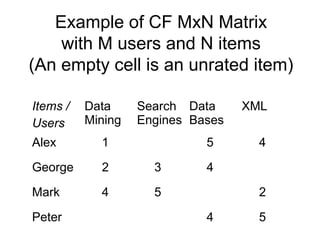
Example of CF MxN Matrix
with M users and N items
(An empty cell is an unrated item)
Items /
Users
Data
Mining
Search
Engines
Data
Bases
XML
Alex 1 5 4
George 2 3 4
Mark 4 5 2
Peter 4 5
Observations
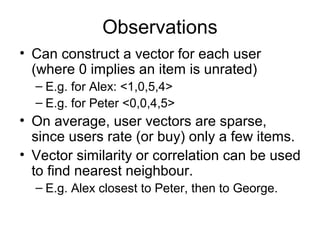
• Can construct a vector for each user
(where 0 implies an item is unrated)
– E.g. for Alex: <1,0,5,4>
– E.g. for Peter <0,0,4,5>
• On average, user vectors are sparse,
since users rate (or buy) only a few items.
• Vector similarity or correlation can be used
to find nearest neighbour.
– E.g. Alex closest to Peter, then to George.
Case Study – Amazon.com
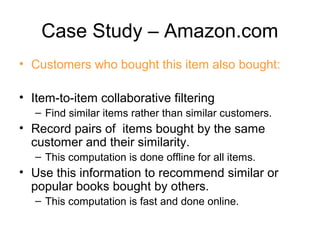
• Customers who bought this item also bought:
• Item-to-item collaborative filtering
– Find similar items rather than similar customers.
• Record pairs of items bought by the same
customer and their similarity.
– This computation is done offline for all items.
• Use this information to recommend similar or
popular books bought by others.
– This computation is fast and done online.
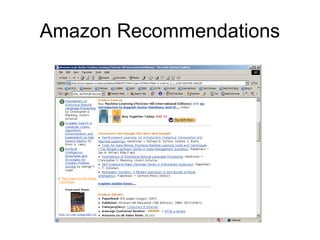
Amazon Recommendations
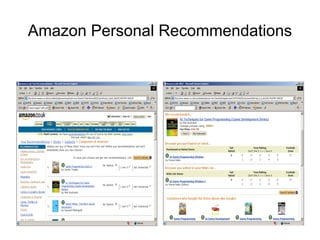
Amazon Personal Recommendations
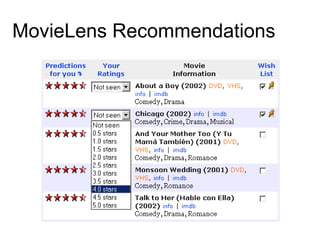
Case Study - GroupLens
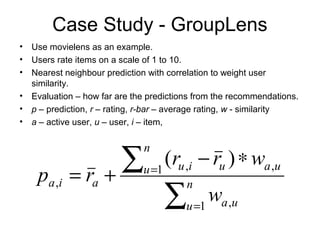
• Use movielens as an example.
• Users rate items on a scale of 1 to 10.
• Nearest neighbour prediction with correlation to weight user
similarity.
• Evaluation – how far are the predictions from the recommendations.
• p – prediction, r – rating, r-bar – average rating, w - similarity
• a – active user, u – user, i – item,
∑
∑
=
=
∗−
+= n
u ua
ua
n
u uiu
aia
w
wrr
rp
1 ,
,1 ,
,
)(
MovieLens Recommendations
Challenges for CF
• Sparsity problem – when many of the items have not
been rated by many people, it may be hard to find ‘like
minded’ people.
• First rater problem – what happens if an item has not
been rated by anyone.
• Privacy problems.
• Can combine CF with CB recommenders
– Use CB approach to score some unrated items.
– Then use CF for recommendations.
• Serendipity - recommend to me something I do not know
already
– Oxford dictionary: the occurrence and development of
events by chance in a happy or beneficial way.

Lec7 collaborative filtering

  • 1.
    Recommender Systems & CollaborativeFiltering Mark Levene (Follow the links to learn more!)
  • 2.
    What is aRecommender System • E.g. music, books and movies • In eCommerce recommend items • In eLearning recommend content • In search and navigation recommend links • Use items as generic term for what is recommended • Help people (customers, users) make decisions • Recommendation is based on preferences – Of an individual – Of a group or community
  • 3.
    Types of RecommenderSystems • Content-Based (CB) – use personal preferences to match and filter items – E.g. what sort of books do I like? • Collaborative Filtering (CF) – match `like-minded’ people – E.g. if two people have similar ‘taste’ they can recommend items to each other • Social Software – the recommendation process is supported but not automated – E.g. Weblogs provide a medium for recommendation • Social Data Mining – Mine log data of social activity to learn group preferences – E.g. web usage mining • We concentrate on CB and CF
  • 4.
    Content-Based Recommenders • Findme things that I liked in the past. • Machine learns preferences through user feedback and builds a user profile • Explicit feedback – user rates items • Implicit feedback – system records user activity – Clicksteam data classified according to page category and activity, e.g. browsing a product page – Time spent on an activity such as browsing a page • Recommendation is viewed as a search process, with the user profile acting as the query and the set of items acting as the documents to match.
  • 5.
    Collaborative Filtering • Matchpeople with similar interests as a basis for recommendation. 1) Many people must participate to make it likely that a person with similar interests will be found. 2) There must be a simple way for people to express their interests. 3) There must be an efficient algorithm to match people with similar interests.
  • 6.
    How does CFWork? • Users rate items – user interests recorded. Ratings may be: – Explicit, e.g. buying or rating an item – Implicit, e.g. browsing time, no. of mouse clicks • Nearest neighbour matching used to find people with similar interests • Items that neighbours rate highly but that you have not rated are recommended to you • User can then rate recommended items
  • 7.
    Example of CFMxN Matrix with M users and N items (An empty cell is an unrated item) Items / Users Data Mining Search Engines Data Bases XML Alex 1 5 4 George 2 3 4 Mark 4 5 2 Peter 4 5
  • 8.
    Observations • Can constructa vector for each user (where 0 implies an item is unrated) – E.g. for Alex: <1,0,5,4> – E.g. for Peter <0,0,4,5> • On average, user vectors are sparse, since users rate (or buy) only a few items. • Vector similarity or correlation can be used to find nearest neighbour. – E.g. Alex closest to Peter, then to George.
  • 9.
    Case Study –Amazon.com • Customers who bought this item also bought: • Item-to-item collaborative filtering – Find similar items rather than similar customers. • Record pairs of items bought by the same customer and their similarity. – This computation is done offline for all items. • Use this information to recommend similar or popular books bought by others. – This computation is fast and done online.
  • 10.
  • 11.
  • 12.
    Case Study -GroupLens • Use movielens as an example. • Users rate items on a scale of 1 to 10. • Nearest neighbour prediction with correlation to weight user similarity. • Evaluation – how far are the predictions from the recommendations. • p – prediction, r – rating, r-bar – average rating, w - similarity • a – active user, u – user, i – item, ∑ ∑ = = ∗− += n u ua ua n u uiu aia w wrr rp 1 , ,1 , , )(
  • 13.
  • 14.
    Challenges for CF •Sparsity problem – when many of the items have not been rated by many people, it may be hard to find ‘like minded’ people. • First rater problem – what happens if an item has not been rated by anyone. • Privacy problems. • Can combine CF with CB recommenders – Use CB approach to score some unrated items. – Then use CF for recommendations. • Serendipity - recommend to me something I do not know already – Oxford dictionary: the occurrence and development of events by chance in a happy or beneficial way.