Recommender Systems
Customization
• Customization is one of the more attractive
features of electronic commerce.
– Creating a different product for every user, suited to
his/her tastes.
• Once thought to be a novelty, now essential
– Provides a way for online providers to compete with
brick-and-mortar competitors.
– Possible to serve niche markets.
• Bezos: “If I have two million customers on the Web, then I
should have two million stores on the Web”
– (how dated is that? )
How can personalization help?
• Turn browsers into buyers
– People may go to Amazon without a specific purchase
in mind.
– Showing them something they want can spur a
purchase.
• Cross-sales
– Customers who have bought a product are suggested
related products.
• Encourages Loyalty
– Amazon is interested in becoming an e-commerce
portal. This means that they would like to respond to all
your online purchasing needs.
Examples
• Amazon
– Featured Recommendations: tailored to past
views/purchases.
– People who bought this: compares customers
– Alerts- sends you email when stuff you like is
on sale.
– Customer reviews
– ListMania
• Allows users to add their own reviews of products.
• Customers can find other reviews by a given user.
Examples
• Netflix
– You rate movies and others are suggested based
on these ratings.
– You are compared to other users.
• Reel.com
– Movie Matches – you enter a movie, and it
suggests similar movies.
– Compares movies to movies.
Examples
• Citeseer
– Recommends papers based on citations, similar
text, cited by.
• Launch
– Lets you customize your own “radio station”.
• You get a customized mp3 stream
Types of recommendations
• Population-based
– For example, the most popular news articles, or
searches, or downloads.
– Useful for sites that frequently add content.
– No user tracking needed.
• Netflix: Movers on the top 100
– Reflects movies that have been popular overall.
Types of recommendations
• Item-to-item
– Content-based
– One item is recommended based on the user’s
indication that they like another item.
• If you like Lord of the Rings, you’ll like Legend.
• Netflix: 1-5 star rating.
– Estimates how much you’ll like a movie based
on your past ratings.
Types of Recommendations
• Challenges with item-to-item:
– Getting users to tell you what they like
• Both financial and time reasons not to.
– Getting enough data to make “novel”
predictions.
• What users really want are recommendations for
things they’re not aware of.
Types of recommendations
• Item-to-item
– Most effective when you have metadata that
lets you automatically relate items.
– Genre, actors, director, etc.
• Also best when decoupled from payment
– Users should have an incentive to rate items
truthfully.
Types of recommendations
• User-based
– “Users who bought X like Y.”
– Each user is represented by a vector indicating
his ratings for each product.
– Users with a small distance between each other
are similar.
– Find a similar user and recommend things they
like that you haven’t rated.
• Netflix: “Users who liked …”
Types of recommendations
• User-based
– Advantages:
• Users don’t need to rate much.
• No info about products needed.
• Easy to implement
– Disadvantages
• Pushes users “toward the middle” – products with
more ratings carry more weight.
• How to deal with new products?
• Many products and few users -> lots of things don’t
get recommended.
Types of Recommendations
• Manual/free-form
– Users write reviews for a product, which are attached to
the product.
• Advantages:
– Natural language, explanations for pros/cons, users get
to participate.
• Disadvantages:
– Few ‘neutral’ recommendations, difficult to automate.
• Netflix: Member Reviews, Critic Reviews
Potential Applications
• Placing a product in space
– “The product you’re looking at is like …”
• Configuring display
– Choosing what to show or emphasize based on
preferences.
• Personalized discounts/coupons
– Grocery stores do this.
• Clustering users
– Determining the tastes of your consumers.
Details: How RS work
• Content-based (user-based) systems try to
learn a model of a user’s preferences.
• This is a function that, for each user, maps
an item, to an indication of how much the
user likes it.
– Might be yes/no or probabilistic.
How RS work
• A common model-learner is a naïve Bayes
classifier.
• An item is represented as a feature vector.
– Web pages: list/bag of possible words
– Movies: list of possible actors, directors, etc.
• This vector is large, so common features are
filtered out. (the, an, etc)
• Useful for unstructured data such as text
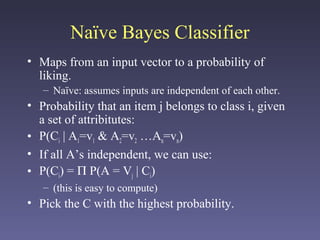
Naïve Bayes Classifier
• Maps from an input vector to a probability of
liking.
– Naïve: assumes inputs are independent of each other.
• Probability that an item j belongs to class i, given
a set of attribitutes:
• P(Ci | A1=v1 & A2=v2 …An=vn)
• If all A’s independent, we can use:
• P(Ci) = Π P(A = Vj | Ci)
– (this is easy to compute)
• Pick the C with the highest probability.
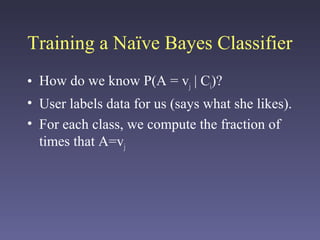
Training a Naïve Bayes Classifier
• How do we know P(A = vj | Ci)?
• User labels data for us (says what she likes).
• For each class, we compute the fraction of
times that A=vj
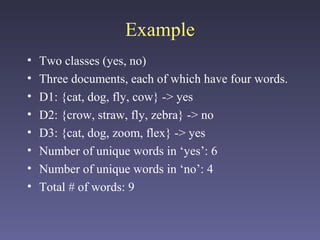
Example
• Two classes (yes, no)
• Three documents, each of which have four words.
• D1: {cat, dog, fly, cow} -> yes
• D2: {crow, straw, fly, zebra} -> no
• D3: {cat, dog, zoom, flex} -> yes
• Number of unique words in ‘yes’: 6
• Number of unique words in ‘no’: 4
• Total # of words: 9
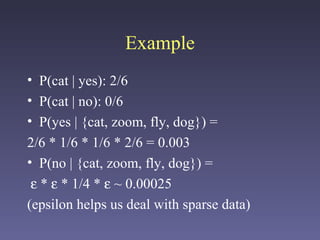
Example
• P(cat | yes): 2/6
• P(cat | no): 0/6
• P(yes | {cat, zoom, fly, dog}) =
2/6 * 1/6 * 1/6 * 2/6 = 0.003
• P(no | {cat, zoom, fly, dog}) =
ε * ε * 1/4 * ε ~ 0.00025
(epsilon helps us deal with sparse data)
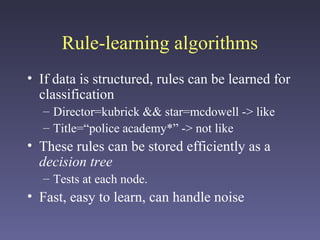
Rule-learning algorithms
• If data is structured, rules can be learned for
classification
– Director=kubrick && star=mcdowell -> like
– Title=“police academy*” -> not like
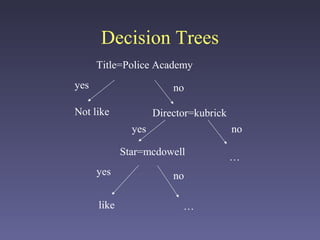
• These rules can be stored efficiently as a
decision tree
– Tests at each node.
• Fast, easy to learn, can handle noise
Decision Trees
Title=Police Academy
yes no
Not like Director=kubrick
Star=mcdowell
yes
yes no
no
…
…like
Other model-learning approaches
• TFIDF
– Produces similar results to Naïve Bayes
• Neural Net
– Learns a nonlinear function mapping features to
classes.
– More powerful, but results can be hard to
interpret.
Comparing users to users
• Often, it’s easier to compare users to other
users.
– Less data needed
– No knowledge of items required.
• Typical approach involves nearest-neighbor
classification.
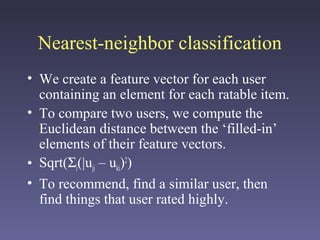
Nearest-neighbor classification
• We create a feature vector for each user
containing an element for each ratable item.
• To compare two users, we compute the
Euclidean distance between the ‘filled-in’
elements of their feature vectors.
• Sqrt(Σi(|uji – uki)2
)
• To recommend, find a similar user, then
find things that user rated highly.
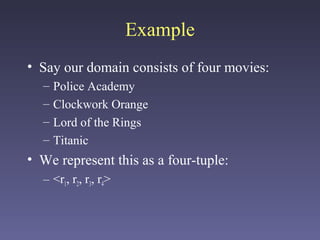
Example
• Say our domain consists of four movies:
– Police Academy
– Clockwork Orange
– Lord of the Rings
– Titanic
• We represent this as a four-tuple:
– <r1, r2, r3, r4>
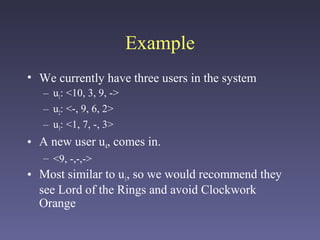
Example
• We currently have three users in the system
– u1: <10, 3, 9, ->
– u2: <-, 9, 6, 2>
– u3: <1, 7, -, 3>
• A new user u4, comes in.
– <9, -,-,->
• Most similar to u1, so we would recommend they
see Lord of the Rings and avoid Clockwork
Orange
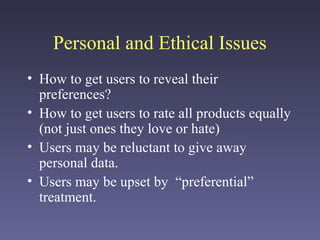
Personal and Ethical Issues
• How to get users to reveal their
preferences?
• How to get users to rate all products equally
(not just ones they love or hate)
• Users may be reluctant to give away
personal data.
• Users may be upset by “preferential”
treatment.
Summary
• Recommender systems allow online retailers to
customize their sites to meet consumer tastes.
– Aid browsing, suggest related items.
• Personaliztion is one of e-commerce’s advantages
compared to brick-and-mortar stores.
• Challenges: obtaining and mining data, making
intelligent and novel recommendations, ethics.
• Can perform comparisons across users or across
items.
– Trade off data needed versus detail of recommendation.

Recommender lecture

  • 1.
  • 2.
    Customization • Customization isone of the more attractive features of electronic commerce. – Creating a different product for every user, suited to his/her tastes. • Once thought to be a novelty, now essential – Provides a way for online providers to compete with brick-and-mortar competitors. – Possible to serve niche markets. • Bezos: “If I have two million customers on the Web, then I should have two million stores on the Web” – (how dated is that? )
  • 3.
    How can personalizationhelp? • Turn browsers into buyers – People may go to Amazon without a specific purchase in mind. – Showing them something they want can spur a purchase. • Cross-sales – Customers who have bought a product are suggested related products. • Encourages Loyalty – Amazon is interested in becoming an e-commerce portal. This means that they would like to respond to all your online purchasing needs.
  • 4.
    Examples • Amazon – FeaturedRecommendations: tailored to past views/purchases. – People who bought this: compares customers – Alerts- sends you email when stuff you like is on sale. – Customer reviews – ListMania • Allows users to add their own reviews of products. • Customers can find other reviews by a given user.
  • 5.
    Examples • Netflix – Yourate movies and others are suggested based on these ratings. – You are compared to other users. • Reel.com – Movie Matches – you enter a movie, and it suggests similar movies. – Compares movies to movies.
  • 6.
    Examples • Citeseer – Recommendspapers based on citations, similar text, cited by. • Launch – Lets you customize your own “radio station”. • You get a customized mp3 stream
  • 7.
    Types of recommendations •Population-based – For example, the most popular news articles, or searches, or downloads. – Useful for sites that frequently add content. – No user tracking needed. • Netflix: Movers on the top 100 – Reflects movies that have been popular overall.
  • 8.
    Types of recommendations •Item-to-item – Content-based – One item is recommended based on the user’s indication that they like another item. • If you like Lord of the Rings, you’ll like Legend. • Netflix: 1-5 star rating. – Estimates how much you’ll like a movie based on your past ratings.
  • 9.
    Types of Recommendations •Challenges with item-to-item: – Getting users to tell you what they like • Both financial and time reasons not to. – Getting enough data to make “novel” predictions. • What users really want are recommendations for things they’re not aware of.
  • 10.
    Types of recommendations •Item-to-item – Most effective when you have metadata that lets you automatically relate items. – Genre, actors, director, etc. • Also best when decoupled from payment – Users should have an incentive to rate items truthfully.
  • 11.
    Types of recommendations •User-based – “Users who bought X like Y.” – Each user is represented by a vector indicating his ratings for each product. – Users with a small distance between each other are similar. – Find a similar user and recommend things they like that you haven’t rated. • Netflix: “Users who liked …”
  • 12.
    Types of recommendations •User-based – Advantages: • Users don’t need to rate much. • No info about products needed. • Easy to implement – Disadvantages • Pushes users “toward the middle” – products with more ratings carry more weight. • How to deal with new products? • Many products and few users -> lots of things don’t get recommended.
  • 13.
    Types of Recommendations •Manual/free-form – Users write reviews for a product, which are attached to the product. • Advantages: – Natural language, explanations for pros/cons, users get to participate. • Disadvantages: – Few ‘neutral’ recommendations, difficult to automate. • Netflix: Member Reviews, Critic Reviews
  • 14.
    Potential Applications • Placinga product in space – “The product you’re looking at is like …” • Configuring display – Choosing what to show or emphasize based on preferences. • Personalized discounts/coupons – Grocery stores do this. • Clustering users – Determining the tastes of your consumers.
  • 15.
    Details: How RSwork • Content-based (user-based) systems try to learn a model of a user’s preferences. • This is a function that, for each user, maps an item, to an indication of how much the user likes it. – Might be yes/no or probabilistic.
  • 16.
    How RS work •A common model-learner is a naïve Bayes classifier. • An item is represented as a feature vector. – Web pages: list/bag of possible words – Movies: list of possible actors, directors, etc. • This vector is large, so common features are filtered out. (the, an, etc) • Useful for unstructured data such as text
  • 17.
    Naïve Bayes Classifier •Maps from an input vector to a probability of liking. – Naïve: assumes inputs are independent of each other. • Probability that an item j belongs to class i, given a set of attribitutes: • P(Ci | A1=v1 & A2=v2 …An=vn) • If all A’s independent, we can use: • P(Ci) = Π P(A = Vj | Ci) – (this is easy to compute) • Pick the C with the highest probability.
  • 18.
    Training a NaïveBayes Classifier • How do we know P(A = vj | Ci)? • User labels data for us (says what she likes). • For each class, we compute the fraction of times that A=vj
  • 19.
    Example • Two classes(yes, no) • Three documents, each of which have four words. • D1: {cat, dog, fly, cow} -> yes • D2: {crow, straw, fly, zebra} -> no • D3: {cat, dog, zoom, flex} -> yes • Number of unique words in ‘yes’: 6 • Number of unique words in ‘no’: 4 • Total # of words: 9
  • 20.
    Example • P(cat |yes): 2/6 • P(cat | no): 0/6 • P(yes | {cat, zoom, fly, dog}) = 2/6 * 1/6 * 1/6 * 2/6 = 0.003 • P(no | {cat, zoom, fly, dog}) = ε * ε * 1/4 * ε ~ 0.00025 (epsilon helps us deal with sparse data)
  • 21.
    Rule-learning algorithms • Ifdata is structured, rules can be learned for classification – Director=kubrick && star=mcdowell -> like – Title=“police academy*” -> not like • These rules can be stored efficiently as a decision tree – Tests at each node. • Fast, easy to learn, can handle noise
  • 22.
    Decision Trees Title=Police Academy yesno Not like Director=kubrick Star=mcdowell yes yes no no … …like
  • 23.
    Other model-learning approaches •TFIDF – Produces similar results to Naïve Bayes • Neural Net – Learns a nonlinear function mapping features to classes. – More powerful, but results can be hard to interpret.
  • 24.
    Comparing users tousers • Often, it’s easier to compare users to other users. – Less data needed – No knowledge of items required. • Typical approach involves nearest-neighbor classification.
  • 25.
    Nearest-neighbor classification • Wecreate a feature vector for each user containing an element for each ratable item. • To compare two users, we compute the Euclidean distance between the ‘filled-in’ elements of their feature vectors. • Sqrt(Σi(|uji – uki)2 ) • To recommend, find a similar user, then find things that user rated highly.
  • 26.
    Example • Say ourdomain consists of four movies: – Police Academy – Clockwork Orange – Lord of the Rings – Titanic • We represent this as a four-tuple: – <r1, r2, r3, r4>
  • 27.
    Example • We currentlyhave three users in the system – u1: <10, 3, 9, -> – u2: <-, 9, 6, 2> – u3: <1, 7, -, 3> • A new user u4, comes in. – <9, -,-,-> • Most similar to u1, so we would recommend they see Lord of the Rings and avoid Clockwork Orange
  • 28.
    Personal and EthicalIssues • How to get users to reveal their preferences? • How to get users to rate all products equally (not just ones they love or hate) • Users may be reluctant to give away personal data. • Users may be upset by “preferential” treatment.
  • 29.
    Summary • Recommender systemsallow online retailers to customize their sites to meet consumer tastes. – Aid browsing, suggest related items. • Personaliztion is one of e-commerce’s advantages compared to brick-and-mortar stores. • Challenges: obtaining and mining data, making intelligent and novel recommendations, ethics. • Can perform comparisons across users or across items. – Trade off data needed versus detail of recommendation.