Review of Probabilistic Matrix Factorization
Topic Modeling and Collaborative Topic Modeling
Collaborative Deep Learning
Review: Collaborative Deep Learning
Hai D. Nguyen
May 5, 2016
Hai D. Nguyen Review: Collaborative Deep Learning
Review of Probabilistic Matrix Factorization
Topic Modeling and Collaborative Topic Modeling
Collaborative Deep Learning
Table of contents
1 Review of Probabilistic Matrix Factorization
2 Topic Modeling and Collaborative Topic Modeling
3 Collaborative Deep Learning
Hai D. Nguyen Review: Collaborative Deep Learning
Review of Probabilistic Matrix Factorization
Topic Modeling and Collaborative Topic Modeling
Collaborative Deep Learning
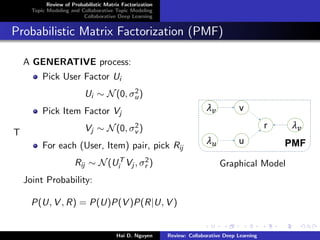
Probabilistic Matrix Factorization (PMF)
T
A GENERATIVE process:
Pick User Factor Ui
Ui ∼ N(0, σ2
u)
Pick Item Factor Vj
Vj ∼ N(0, σ2
v )
For each (User, Item) pair, pick Rij
Rij ∼ N(UT
i Vj , σ2
r )
Joint Probability:
P(U, V , R) = P(U)P(V )P(R|U, V )
Graphical Model
Hai D. Nguyen Review: Collaborative Deep Learning
Review of Probabilistic Matrix Factorization
Topic Modeling and Collaborative Topic Modeling
Collaborative Deep Learning
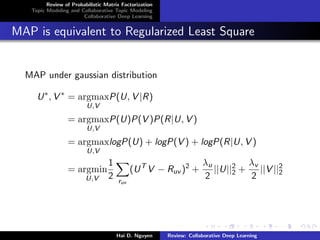
MAP is equivalent to Regularized Least Square
MAP under gaussian distribution
U∗
, V ∗
= argmax
U,V
P(U, V |R)
= argmax
U,V
P(U)P(V )P(R|U, V )
= argmax
U,V
logP(U) + logP(V ) + logP(R|U, V )
= argmin
U,V
1
2 ruv
(UT
V − Ruv )2
+
λu
2
||U||2
2 +
λv
2
||V ||2
2
Hai D. Nguyen Review: Collaborative Deep Learning
Review of Probabilistic Matrix Factorization
Topic Modeling and Collaborative Topic Modeling
Collaborative Deep Learning
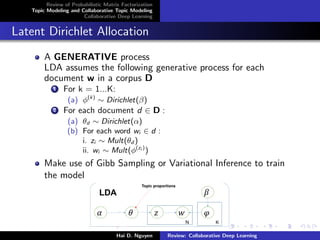
Latent Dirichlet Allocation
A GENERATIVE process
LDA assumes the following generative process for each
document w in a corpus D
1 For k = 1...K:
(a) φ(k)
∼ Dirichlet(β)
2 For each document d ∈ D :
(a) θd ∼ Dirichlet(α)
(b) For each word wi ∈ d :
i. zi ∼ Mult(θd )
ii. wi ∼ Mult(φ(zi )
)
Make use of Gibb Sampling or Variational Inference to train
the model
Hai D. Nguyen Review: Collaborative Deep Learning
Review of Probabilistic Matrix Factorization
Topic Modeling and Collaborative Topic Modeling
Collaborative Deep Learning
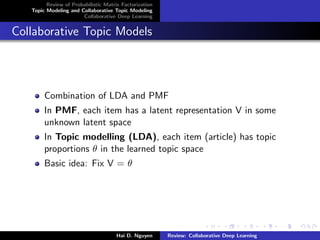
Collaborative Topic Models
Combination of LDA and PMF
In PMF, each item has a latent representation V in some
unknown latent space
In Topic modelling (LDA), each item (article) has topic
proportions θ in the learned topic space
Basic idea: Fix V = θ
Hai D. Nguyen Review: Collaborative Deep Learning
Review of Probabilistic Matrix Factorization
Topic Modeling and Collaborative Topic Modeling
Collaborative Deep Learning
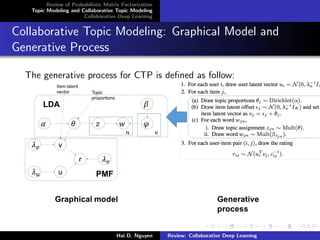
Collaborative Topic Modeling: Graphical Model and
Generative Process
The generative process for CTP is defined as follow:
Hai D. Nguyen Review: Collaborative Deep Learning
Review of Probabilistic Matrix Factorization
Topic Modeling and Collaborative Topic Modeling
Collaborative Deep Learning
Same idea as CTP model previously mentioned but different
methods (Deep Learning)
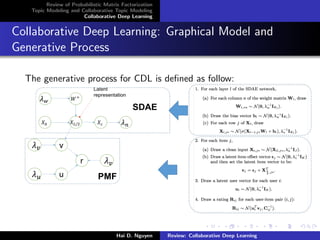
Replace Topic Model (LDA here) with a certain DEEP
LEARNING model which can be DBF, SDAE or CNN.
Hai D. Nguyen Review: Collaborative Deep Learning
Review of Probabilistic Matrix Factorization
Topic Modeling and Collaborative Topic Modeling
Collaborative Deep Learning
Collaborative Deep Learning: Graphical Model and
Generative Process
The generative process for CDL is defined as follow:
Hai D. Nguyen Review: Collaborative Deep Learning
Review of Probabilistic Matrix Factorization
Topic Modeling and Collaborative Topic Modeling
Collaborative Deep Learning
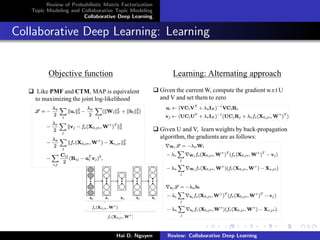
Collaborative Deep Learning: Learning
Hai D. Nguyen Review: Collaborative Deep Learning
Review of Probabilistic Matrix Factorization
Topic Modeling and Collaborative Topic Modeling
Collaborative Deep Learning
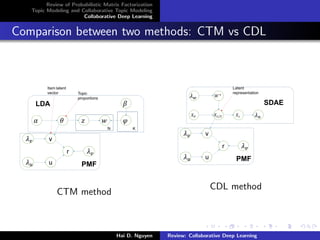
Comparison between two methods: CTM vs CDL
CTM method
CDL method
Hai D. Nguyen Review: Collaborative Deep Learning
Review of Probabilistic Matrix Factorization
Topic Modeling and Collaborative Topic Modeling
Collaborative Deep Learning
Some thoughs and extensions
it canbe extended to multi-dimensional recommendation
system (e.g., context-based RS) with Tensor approaches
In my opinion, LDA can be viewed as a shalow model. In this
paper, authors proposed using DL which can automatically
and deeply extract features for document (features maybe
more effective than that of LDA)
How can we extend LDA to deeper model?
Hai D. Nguyen Review: Collaborative Deep Learning

Collaborative DL

  • 1.
    Review of ProbabilisticMatrix Factorization Topic Modeling and Collaborative Topic Modeling Collaborative Deep Learning Review: Collaborative Deep Learning Hai D. Nguyen May 5, 2016 Hai D. Nguyen Review: Collaborative Deep Learning
  • 2.
    Review of ProbabilisticMatrix Factorization Topic Modeling and Collaborative Topic Modeling Collaborative Deep Learning Table of contents 1 Review of Probabilistic Matrix Factorization 2 Topic Modeling and Collaborative Topic Modeling 3 Collaborative Deep Learning Hai D. Nguyen Review: Collaborative Deep Learning
  • 3.
    Review of ProbabilisticMatrix Factorization Topic Modeling and Collaborative Topic Modeling Collaborative Deep Learning Probabilistic Matrix Factorization (PMF) T A GENERATIVE process: Pick User Factor Ui Ui ∼ N(0, σ2 u) Pick Item Factor Vj Vj ∼ N(0, σ2 v ) For each (User, Item) pair, pick Rij Rij ∼ N(UT i Vj , σ2 r ) Joint Probability: P(U, V , R) = P(U)P(V )P(R|U, V ) Graphical Model Hai D. Nguyen Review: Collaborative Deep Learning
  • 4.
    Review of ProbabilisticMatrix Factorization Topic Modeling and Collaborative Topic Modeling Collaborative Deep Learning MAP is equivalent to Regularized Least Square MAP under gaussian distribution U∗ , V ∗ = argmax U,V P(U, V |R) = argmax U,V P(U)P(V )P(R|U, V ) = argmax U,V logP(U) + logP(V ) + logP(R|U, V ) = argmin U,V 1 2 ruv (UT V − Ruv )2 + λu 2 ||U||2 2 + λv 2 ||V ||2 2 Hai D. Nguyen Review: Collaborative Deep Learning
  • 5.
    Review of ProbabilisticMatrix Factorization Topic Modeling and Collaborative Topic Modeling Collaborative Deep Learning Latent Dirichlet Allocation A GENERATIVE process LDA assumes the following generative process for each document w in a corpus D 1 For k = 1...K: (a) φ(k) ∼ Dirichlet(β) 2 For each document d ∈ D : (a) θd ∼ Dirichlet(α) (b) For each word wi ∈ d : i. zi ∼ Mult(θd ) ii. wi ∼ Mult(φ(zi ) ) Make use of Gibb Sampling or Variational Inference to train the model Hai D. Nguyen Review: Collaborative Deep Learning
  • 6.
    Review of ProbabilisticMatrix Factorization Topic Modeling and Collaborative Topic Modeling Collaborative Deep Learning Collaborative Topic Models Combination of LDA and PMF In PMF, each item has a latent representation V in some unknown latent space In Topic modelling (LDA), each item (article) has topic proportions θ in the learned topic space Basic idea: Fix V = θ Hai D. Nguyen Review: Collaborative Deep Learning
  • 7.
    Review of ProbabilisticMatrix Factorization Topic Modeling and Collaborative Topic Modeling Collaborative Deep Learning Collaborative Topic Modeling: Graphical Model and Generative Process The generative process for CTP is defined as follow: Hai D. Nguyen Review: Collaborative Deep Learning
  • 8.
    Review of ProbabilisticMatrix Factorization Topic Modeling and Collaborative Topic Modeling Collaborative Deep Learning Collaborative Deep Learning Same idea as CTP model previously mentioned but different methods (Deep Learning) Replace Topic Model (LDA here) with a certain DEEP LEARNING model which can be DBF, SDAE or CNN. Hai D. Nguyen Review: Collaborative Deep Learning
  • 9.
    Review of ProbabilisticMatrix Factorization Topic Modeling and Collaborative Topic Modeling Collaborative Deep Learning Collaborative Deep Learning: Graphical Model and Generative Process The generative process for CDL is defined as follow: Hai D. Nguyen Review: Collaborative Deep Learning
  • 10.
    Review of ProbabilisticMatrix Factorization Topic Modeling and Collaborative Topic Modeling Collaborative Deep Learning Collaborative Deep Learning: Learning Hai D. Nguyen Review: Collaborative Deep Learning
  • 11.
    Review of ProbabilisticMatrix Factorization Topic Modeling and Collaborative Topic Modeling Collaborative Deep Learning Comparison between two methods: CTM vs CDL CTM method CDL method Hai D. Nguyen Review: Collaborative Deep Learning
  • 12.
    Review of ProbabilisticMatrix Factorization Topic Modeling and Collaborative Topic Modeling Collaborative Deep Learning Some thoughs and extensions it canbe extended to multi-dimensional recommendation system (e.g., context-based RS) with Tensor approaches In my opinion, LDA can be viewed as a shalow model. In this paper, authors proposed using DL which can automatically and deeply extract features for document (features maybe more effective than that of LDA) How can we extend LDA to deeper model? Hai D. Nguyen Review: Collaborative Deep Learning