A guideline to a successful 
partnership 
21 November 2014
Preconditions 
The decisive issue is to create growth between two businesses of which the one is an established business (EB) and the 
other is an innovating business (IB). 
 The parties must be equal in the cooperation, and the EB as well as the IB must be profitable. 
 The EB will typically contribute to the cooperation with its experience, large network as well as knowledge of 
business operations. 
 The IB will contribute with new knowledge, new thinking, innovative methods, application of new technologies, etc. 
 The cooperation does not need to involve a common growth target since the crucial aspect is that the businesses 
are able to complement each other. 
***** 
 The cooperation is to create better opportunities for survival for the IB and provide the EB with new ideas and 
prospects.
Challenges of the IB 
 The IB does not have sufficient legal knowledge to understand the legal basis which the EB will set up for the 
cooperation. 
 The decision-making process is too time-consuming in large businesses and, therefore, IBs will often opt out of the 
cooperation since the IB takes a swift and very flexible approach to the process. 
 Matching of expectations is required in respect of practical issues, such as the use of premises, the EB’s internal 
rules, canteen scheme, payment, etc. 
 Matching of expectations is required as to the contribution of each business in the form of qualifications and 
knowledge, including preparation of action plans, follow-up action, series of meetings, etc.
How to meet such challenges in the cooperation agreement 
 The cooperation agreement must be brief and easily comprehensible 
 The decision-making process in the EB must not be time-consuming and, if possible, be manageable by one division 
only 
 Action plans must have been prepared 
 Practical issues must be described in appendices 
 Meetings must have been agreed upon in connection with the signing of the agreement 
***** 
Other issues which are important to clarify in the cooperation agreement ….
Fundamental issues 
 Purpose of the agreement is to realise the parties’ growth targets and potential 
 Two individual businesses cooperate, and no party may bind the other party 
 Contact persons and their powers 
 Meeting frequency 
 Premises, internal business rules, use of EB’s business facilities 
 Financial issues – payment of materials, use of machinery, etc. 
 Insurance 
 Term and termination 
 Liability for assistance, good advice, guidelines, etc.
Material issues 
 Intellectual property rights (IPR) 
 Confidentiality 
 It is important that good ideas are not disclosed. Therefore, the parties should accept a confidentiality clause 
including an agreed penalty 
[see the attached option] 
 Disputes 
 In the event of any dispute, the IB must also be able to afford litigation. Therefore, a swift and fairly balanced 
procedure is required 
[see the attached option]
Confidentiality 
”Ideas and information are exchanged with the clear expectation that the parties observe complete confidentiality in 
respect of the information received and solely use such information received for purposes within the scope of this 
agreement and, consequently, the parties are not entitled in any way to exploit or benefit from such business secrets. 
Any and all confidential material will remain the property of the relevant party, and the business secrets will still be 
deemed business secrets for an indefinite period of time after termination of the cooperation. 
In the event of any violation of the provisions, the party not in violation will be entitled to an agreed penalty of DKK [ ]”. 
The following may be added: 
”In the event that information, which has previously been deemed a business secret, becomes available to the public 
without this being due to the setting aside of a duty of confidentiality according to the agreement or law, such 
information will no longer be deemed a business secret.”
Disputes 
”In the event of any dispute between the parties, the parties must, within eight days, conduct negotiations attended by 
persons at management level with a view to settling such dispute. 
In the event of unsuccessful negotiations within the aforesaid time limit, the dispute must, immediately and within 
another two weeks, be sought settled by way of mediation by a mediator jointly appointed by the parties. 
In the event of unsuccessful mediation, the dispute must be settled by arbitration according to the ”Rules of Simplified 
Arbitration by the Danish Institute of Arbitration”, and the arbitrator must be appointed by the Institute and the costs 
incidental thereto must be paid by the EB.”
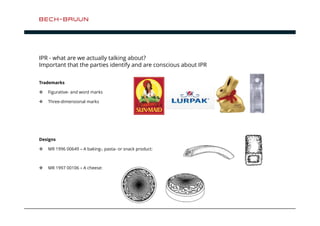
IPR - what are we actually talking about? 
Important that the parties identify and are conscious about IPR 
Trademarks 
 Figurative- and word marks 
 Three-dimensional marks 
Designs 
 MR 1996 00649 – A baking-, pasta- or snack product: 
 MR 1997 00106 – A cheese:
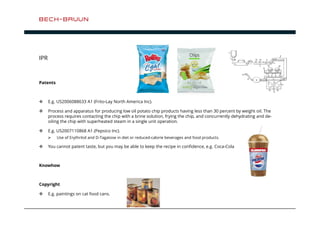
IPR 
Patents 
 E.g. US2006088633 A1 (Frito-Lay North America Inc). 
 Process and apparatus for producing low oil potato chip products having less than 30 percent by weight oil. The 
process requires contacting the chip with a brine solution, frying the chip, and concurrently dehydrating and de-oiling 
the chip with superheated steam in a single unit operation. 
 E.g. US2007110868 A1 (Pepsico Inc). 
 Use of Erythritol and D-Tagatose in diet or reduced-calorie beverages and food products. 
 You cannot patent taste, but you may be able to keep the recipe in confidence, e.g. Coca-Cola 
Knowhow 
Copyright 
 E.g. paintings on cat food cans.
What is key in relation to a succesful partnership from an IPR perspective? 
 WRITTEN AGREEMENT, WRITTEN AGREEMENT, WRITTEN AGREEMENT! 
 Before an issue as to IPR arises… when the parties are still optimistic and friends
Joint IPR 
 What is the challenges with joint IPR and when is IPR joint? 
 Co-creation (IPR created jointly between the parties) from a legal perspective when no agreement is entered into 
between the parties: 
 Uncertainty as to whether a party has been part of the creation (ownership) or just been ”a waiter” for the creating party 
(no ownership) 
 Unanimity (a party has a veto right) in relation to exploitation of co-created IPR 
 May cause substantial obstacles for the development of the partnership and the exploitation of the co-created IPR / the 
parties’ investment in the partnership!
Which IPR issues should be addressed / agreed upon in the agreement? Or to be realistic: 
should at least be considered… 
 Definition of each party’s ”background IPR” (created before the partnership) – shall not be joint, but parties shall 
have a license to exploit the other party’s background IPT to the extent necessary to… (purpose of the partnership) 
 Joint IPR should be defined AND the parties shall agree on “who is allowed to manage the joint IPR / make decisions 
involving joint IPR”, e.g.: 
 Assignment 
 License out 
 Enforcement (when? where? how?) 
 Apply for registered protection, e.g. trademark, design, patent, including which party shall bear the costs? 
 One party owner, the other party is granted a non-exclusive, perpetual, royalty-free license? 
 Exploitation of joint IPR (which markets? which segments? countries?) 
 Non-competition clause? If so, remember penalty clause (liquidated damages) 
 What happens to joint IPR if the partnership expires? 
 Ownership? 
 License? 
 None of the parties allowed to exploit joint IPR?
A successful partnership: advice on IPR 
 Written agreement before you actually start the cooperation! 
 Consider all of the above mentioned issues, but you do not need to write 1 page of each! 
 Be aware of “What is IPR?” (identification of IPR) and “Which IPR do each party bring into the partnership” 
 Is ”knowhow” possible to define? If so, it should be specified the agreement as ”knowhow” is of a indefinite nature 
from a legal point of view 
 To be honest – and not surprising: 
 Content of the agreement is a matter of bargaining position… but David may have unique skills, which Goliath cannot 
overcome by his size…
Copenhagen 
Langelinie Allé 35 
2100 Copenhagen 
Denmark 
Aarhus 
Værkmestergade 2 
8000 Aarhus C 
Denmark 
Shanghai 
Suite 1818, 18/F 
No. 699 Nanjing West Road 
Jing an District, 200041 Shanghai 
T +45 72 27 00 00 
F +45 72 27 00 27 
E info@bechbruun.com 
www.bechbruun.com 
15 
Jens Jerslev 
Partner · Aarhus 
M&A Corporate 
T +45 72 27 34 67 
M +45 25 26 34 67 
E jer@bechbruun.com 
Mikkel Friis Rossa 
Partner · Aarhus 
IP & Technology 
T +45 72 27 33 59 
M +45 25 26 33 59 
E mif@bechbruun.com 
Contact

Jens Jerslev, Bech Bruun

  • 1.
    A guideline toa successful partnership 21 November 2014
  • 2.
    Preconditions The decisiveissue is to create growth between two businesses of which the one is an established business (EB) and the other is an innovating business (IB).  The parties must be equal in the cooperation, and the EB as well as the IB must be profitable.  The EB will typically contribute to the cooperation with its experience, large network as well as knowledge of business operations.  The IB will contribute with new knowledge, new thinking, innovative methods, application of new technologies, etc.  The cooperation does not need to involve a common growth target since the crucial aspect is that the businesses are able to complement each other. *****  The cooperation is to create better opportunities for survival for the IB and provide the EB with new ideas and prospects.
  • 3.
    Challenges of theIB  The IB does not have sufficient legal knowledge to understand the legal basis which the EB will set up for the cooperation.  The decision-making process is too time-consuming in large businesses and, therefore, IBs will often opt out of the cooperation since the IB takes a swift and very flexible approach to the process.  Matching of expectations is required in respect of practical issues, such as the use of premises, the EB’s internal rules, canteen scheme, payment, etc.  Matching of expectations is required as to the contribution of each business in the form of qualifications and knowledge, including preparation of action plans, follow-up action, series of meetings, etc.
  • 4.
    How to meetsuch challenges in the cooperation agreement  The cooperation agreement must be brief and easily comprehensible  The decision-making process in the EB must not be time-consuming and, if possible, be manageable by one division only  Action plans must have been prepared  Practical issues must be described in appendices  Meetings must have been agreed upon in connection with the signing of the agreement ***** Other issues which are important to clarify in the cooperation agreement ….
  • 5.
    Fundamental issues Purpose of the agreement is to realise the parties’ growth targets and potential  Two individual businesses cooperate, and no party may bind the other party  Contact persons and their powers  Meeting frequency  Premises, internal business rules, use of EB’s business facilities  Financial issues – payment of materials, use of machinery, etc.  Insurance  Term and termination  Liability for assistance, good advice, guidelines, etc.
  • 6.
    Material issues Intellectual property rights (IPR)  Confidentiality  It is important that good ideas are not disclosed. Therefore, the parties should accept a confidentiality clause including an agreed penalty [see the attached option]  Disputes  In the event of any dispute, the IB must also be able to afford litigation. Therefore, a swift and fairly balanced procedure is required [see the attached option]
  • 7.
    Confidentiality ”Ideas andinformation are exchanged with the clear expectation that the parties observe complete confidentiality in respect of the information received and solely use such information received for purposes within the scope of this agreement and, consequently, the parties are not entitled in any way to exploit or benefit from such business secrets. Any and all confidential material will remain the property of the relevant party, and the business secrets will still be deemed business secrets for an indefinite period of time after termination of the cooperation. In the event of any violation of the provisions, the party not in violation will be entitled to an agreed penalty of DKK [ ]”. The following may be added: ”In the event that information, which has previously been deemed a business secret, becomes available to the public without this being due to the setting aside of a duty of confidentiality according to the agreement or law, such information will no longer be deemed a business secret.”
  • 8.
    Disputes ”In theevent of any dispute between the parties, the parties must, within eight days, conduct negotiations attended by persons at management level with a view to settling such dispute. In the event of unsuccessful negotiations within the aforesaid time limit, the dispute must, immediately and within another two weeks, be sought settled by way of mediation by a mediator jointly appointed by the parties. In the event of unsuccessful mediation, the dispute must be settled by arbitration according to the ”Rules of Simplified Arbitration by the Danish Institute of Arbitration”, and the arbitrator must be appointed by the Institute and the costs incidental thereto must be paid by the EB.”
  • 9.
    IPR - whatare we actually talking about? Important that the parties identify and are conscious about IPR Trademarks  Figurative- and word marks  Three-dimensional marks Designs  MR 1996 00649 – A baking-, pasta- or snack product:  MR 1997 00106 – A cheese:
  • 10.
    IPR Patents E.g. US2006088633 A1 (Frito-Lay North America Inc).  Process and apparatus for producing low oil potato chip products having less than 30 percent by weight oil. The process requires contacting the chip with a brine solution, frying the chip, and concurrently dehydrating and de-oiling the chip with superheated steam in a single unit operation.  E.g. US2007110868 A1 (Pepsico Inc).  Use of Erythritol and D-Tagatose in diet or reduced-calorie beverages and food products.  You cannot patent taste, but you may be able to keep the recipe in confidence, e.g. Coca-Cola Knowhow Copyright  E.g. paintings on cat food cans.
  • 11.
    What is keyin relation to a succesful partnership from an IPR perspective?  WRITTEN AGREEMENT, WRITTEN AGREEMENT, WRITTEN AGREEMENT!  Before an issue as to IPR arises… when the parties are still optimistic and friends
  • 12.
    Joint IPR What is the challenges with joint IPR and when is IPR joint?  Co-creation (IPR created jointly between the parties) from a legal perspective when no agreement is entered into between the parties:  Uncertainty as to whether a party has been part of the creation (ownership) or just been ”a waiter” for the creating party (no ownership)  Unanimity (a party has a veto right) in relation to exploitation of co-created IPR  May cause substantial obstacles for the development of the partnership and the exploitation of the co-created IPR / the parties’ investment in the partnership!
  • 13.
    Which IPR issuesshould be addressed / agreed upon in the agreement? Or to be realistic: should at least be considered…  Definition of each party’s ”background IPR” (created before the partnership) – shall not be joint, but parties shall have a license to exploit the other party’s background IPT to the extent necessary to… (purpose of the partnership)  Joint IPR should be defined AND the parties shall agree on “who is allowed to manage the joint IPR / make decisions involving joint IPR”, e.g.:  Assignment  License out  Enforcement (when? where? how?)  Apply for registered protection, e.g. trademark, design, patent, including which party shall bear the costs?  One party owner, the other party is granted a non-exclusive, perpetual, royalty-free license?  Exploitation of joint IPR (which markets? which segments? countries?)  Non-competition clause? If so, remember penalty clause (liquidated damages)  What happens to joint IPR if the partnership expires?  Ownership?  License?  None of the parties allowed to exploit joint IPR?
  • 14.
    A successful partnership:advice on IPR  Written agreement before you actually start the cooperation!  Consider all of the above mentioned issues, but you do not need to write 1 page of each!  Be aware of “What is IPR?” (identification of IPR) and “Which IPR do each party bring into the partnership”  Is ”knowhow” possible to define? If so, it should be specified the agreement as ”knowhow” is of a indefinite nature from a legal point of view  To be honest – and not surprising:  Content of the agreement is a matter of bargaining position… but David may have unique skills, which Goliath cannot overcome by his size…
  • 15.
    Copenhagen Langelinie Allé35 2100 Copenhagen Denmark Aarhus Værkmestergade 2 8000 Aarhus C Denmark Shanghai Suite 1818, 18/F No. 699 Nanjing West Road Jing an District, 200041 Shanghai T +45 72 27 00 00 F +45 72 27 00 27 E info@bechbruun.com www.bechbruun.com 15 Jens Jerslev Partner · Aarhus M&A Corporate T +45 72 27 34 67 M +45 25 26 34 67 E jer@bechbruun.com Mikkel Friis Rossa Partner · Aarhus IP & Technology T +45 72 27 33 59 M +45 25 26 33 59 E mif@bechbruun.com Contact