Marketing Strategy of Pass Pass Pulse
Submitted by: Deepayan Biswas
Roll no: 215117061
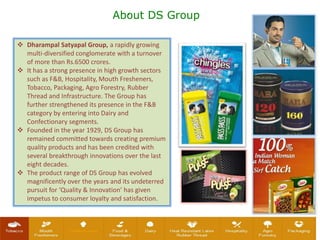
 Dharampal Satyapal Group, a rapidly growing
multi-diversified conglomerate with a turnover
of more than Rs.6500 crores.
 It has a strong presence in high growth sectors
such as F&B, Hospitality, Mouth Fresheners,
Tobacco, Packaging, Agro Forestry, Rubber
Thread and Infrastructure. The Group has
further strengthened its presence in the F&B
category by entering into Dairy and
Confectionary segments.
 Founded in the year 1929, DS Group has
remained committed towards creating premium
quality products and has been credited with
several breakthrough innovations over the last
eight decades.
 The product range of DS Group has evolved
magnificently over the years and its undeterred
pursuit for ‘Quality & Innovation’ has given
impetus to consumer loyalty and satisfaction.
• .
About DS Group
Confectionaries Market and the
Category Attractiveness
• Indian confectionery market is estimated at 8,500-
crore ($1.3-billion).
• Hard Boiled Candy (HBC) segment account for 48%
of the total confectionery market.
• Kaccha Aam (26%) and Mango flavour (24%)
together claim 50% share in the HBC market.
• According to Nielsen India, in this market, there
are:-
– low entry-exit barriers
– Since the unit price is low, one has to sell large
volumes
– Innovation and introduction of new flavours are
two major growth drivers
– Distribution plays a key role
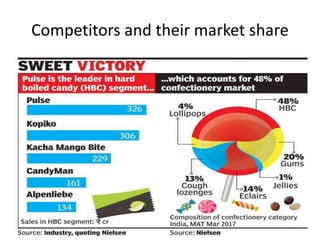
Competitors and their market share
Key to Success
1 rupees salty sweet game: A sensational flavour of kachha aam, then kala namak
type flavour and then sweetness of raw green mango.
Easy availability: it is available at each corner of the city.
Unique coloured wrapper: Attractive packaging with black and green colour on it, and
named pass pass on it.
Extensive research on the flavour: Research for more than 2 years on taste.
Target market strategy
Initially
• Geographic Segmentation: Since Rajasthani and
Gujarati cuisines share a similar tanginess as Pulse,
the company decided to test-market it in these
states first.
Eventually
• Mass Market Strategy: Raw mangoes are relished by
people of all age groups and geographies in India, so
there was no particular target group singled out for
Pulse.
• The candy, with its tangy taste cut across all age
groups and thus it became a full-fleged launch
eventually
Marketing Strategy
Market Pioneer Strategy
• The unorganised candy market in India is big, and no
brand has been able to break the tradition of flavour over
brand, wherein customers ask for "orange, mango or mint
wali" candy.
• Pulse has changed that. It has taken the category from
impulse-driven to Pulse-driven
• Indian customers usually buys candy in single pieces, but
in the case of pulse candy, consumers are buying in bulk—
five to 10 in one go.
Target audience:
• In terms of the audience, Pulse’s consumption cuts across
all age group and in terms of the communication, the
brand is targeting the youth, who can be anywhere
between 15-35 years
Promotion Strategy
• The makers of Pulse believe that it is one of the most
successful examples of brands built through word-of-
mouth, with social media facilitating the reach.
• While the company pushed the candy through in-store
promotions and an outdoor ad at select locations in NCR,
its fans were active in the online world.
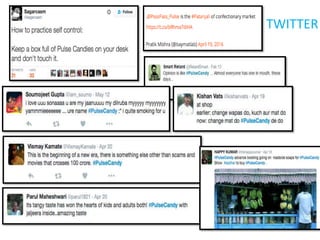
• The brand has, thanks to them, has a presence on all
social networking platforms including Facebook, Twitter
and Instagram. People even went to the extent of making
‘Pulse – Fan Communities’ on FB and making their own
Pulse advertisements
• In fact, the catchphrase on the outdoor ad - 'Pulse of
India' - was also suggested by them.
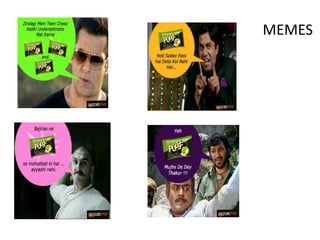
• The brand saw a lot of popularity on the digital medium.
Celebrities and even consumers came out and made
their videos about the product. Consumers owned the
product which gave the brand a big boost and the
product was promoted a lot through word-of-mouth.
MEMES
TWITTER
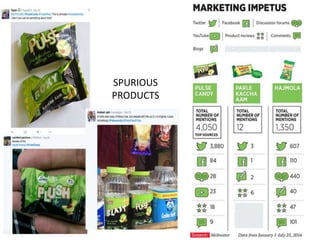
SPURIOUS
PRODUCTS
Pulse candy

Pulse candy

  • 1.
    Marketing Strategy ofPass Pass Pulse Submitted by: Deepayan Biswas Roll no: 215117061
  • 2.
     Dharampal SatyapalGroup, a rapidly growing multi-diversified conglomerate with a turnover of more than Rs.6500 crores.  It has a strong presence in high growth sectors such as F&B, Hospitality, Mouth Fresheners, Tobacco, Packaging, Agro Forestry, Rubber Thread and Infrastructure. The Group has further strengthened its presence in the F&B category by entering into Dairy and Confectionary segments.  Founded in the year 1929, DS Group has remained committed towards creating premium quality products and has been credited with several breakthrough innovations over the last eight decades.  The product range of DS Group has evolved magnificently over the years and its undeterred pursuit for ‘Quality & Innovation’ has given impetus to consumer loyalty and satisfaction. • . About DS Group
  • 3.
    Confectionaries Market andthe Category Attractiveness • Indian confectionery market is estimated at 8,500- crore ($1.3-billion). • Hard Boiled Candy (HBC) segment account for 48% of the total confectionery market. • Kaccha Aam (26%) and Mango flavour (24%) together claim 50% share in the HBC market. • According to Nielsen India, in this market, there are:- – low entry-exit barriers – Since the unit price is low, one has to sell large volumes – Innovation and introduction of new flavours are two major growth drivers – Distribution plays a key role
  • 4.
  • 5.
    Key to Success 1rupees salty sweet game: A sensational flavour of kachha aam, then kala namak type flavour and then sweetness of raw green mango. Easy availability: it is available at each corner of the city. Unique coloured wrapper: Attractive packaging with black and green colour on it, and named pass pass on it. Extensive research on the flavour: Research for more than 2 years on taste.
  • 6.
    Target market strategy Initially •Geographic Segmentation: Since Rajasthani and Gujarati cuisines share a similar tanginess as Pulse, the company decided to test-market it in these states first. Eventually • Mass Market Strategy: Raw mangoes are relished by people of all age groups and geographies in India, so there was no particular target group singled out for Pulse. • The candy, with its tangy taste cut across all age groups and thus it became a full-fleged launch eventually
  • 7.
    Marketing Strategy Market PioneerStrategy • The unorganised candy market in India is big, and no brand has been able to break the tradition of flavour over brand, wherein customers ask for "orange, mango or mint wali" candy. • Pulse has changed that. It has taken the category from impulse-driven to Pulse-driven • Indian customers usually buys candy in single pieces, but in the case of pulse candy, consumers are buying in bulk— five to 10 in one go. Target audience: • In terms of the audience, Pulse’s consumption cuts across all age group and in terms of the communication, the brand is targeting the youth, who can be anywhere between 15-35 years
  • 8.
    Promotion Strategy • Themakers of Pulse believe that it is one of the most successful examples of brands built through word-of- mouth, with social media facilitating the reach. • While the company pushed the candy through in-store promotions and an outdoor ad at select locations in NCR, its fans were active in the online world. • The brand has, thanks to them, has a presence on all social networking platforms including Facebook, Twitter and Instagram. People even went to the extent of making ‘Pulse – Fan Communities’ on FB and making their own Pulse advertisements • In fact, the catchphrase on the outdoor ad - 'Pulse of India' - was also suggested by them. • The brand saw a lot of popularity on the digital medium. Celebrities and even consumers came out and made their videos about the product. Consumers owned the product which gave the brand a big boost and the product was promoted a lot through word-of-mouth.
  • 9.
  • 10.
  • 11.