ANALISYS OF DABUR RURAL
    MARKET AND ITS
      STRATAGIES
By:

MBA- Marketing & Sales

VIVEK UPADHAY
Introduction
Dabur India Ltd. is the fourth largest FMCG Company in India.

• Largest Herbal & Natural Portfolio
• 4000 Distributors in India
• Retail Reach 2,500,000
• 5 Umbrella Brands
• 350+ products
• 4000 employees
• 15 Manufacturing Plants
Dabur’s Business Structure

• Consumer Care Division (CCD)
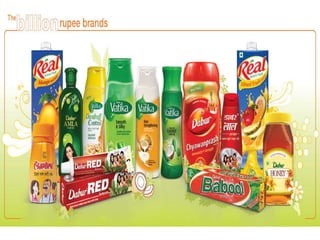
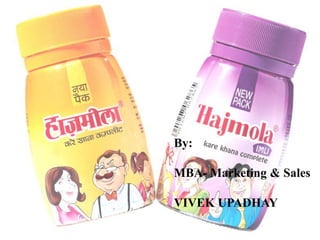
  Dabur (Ayurvedic), Vatika - Premium hair care, Hajmola -
  Tasty digestives, Real - Fruit juices & beverages, Fem –
  Fairness bleaches & skin care products
• Strategic positioning of Honey as food product, leading to
  market leadership (over 75%) in branded honey market.
• Dabur Chyawanprash the largest selling Ayurvedic medicine
  with over 65% market share.
• Hajmola tablets in command with 60% market share of
  digestive tablets category.
• Consumer Health Division (CHD)
• Major categories in traditional formulations
  include:
      - Asav Arishtas
      - Ras Rasayanas
      - Churnas
      - Medicated Oils
• International Business Division (IBD)
• spanning the Middle East, North & West Africa, EU and the
  US with its brands Dabur & Vatika.

• Leveraging the 'Natural' preference among
  local consumers to increase share in personal
  care categories.
Rural Marketing
• Rural marketing is promotion of a company's
  products in the rural market buy using
  strategies which differs from that of urban
  market, the rural market is more price
  sensitive but it has preference for quality.
Why Rural market?
• The rural population is 72% of total Indian
  population
• Literacy level (25% before independence –
  more than 65% in 2001)
• MART, the specialist rural marketing and rural
  development consultancy has found that 53
  per cent of FMCG sales lie in the rural areas.
• Of two million BSNL mobile connections, 50
  per cent went to small towns and villages.
• The rural market is zooming ahead at around
  25 per cent annually.
• "The rural market is growing faster than urban
  India now," says Venugopal Dhoot, chairman
  of the Rs 989 - crore (Rs billion) Videocon
  Appliances.
• "The urban market is a replacement and up
  gradation market today," adds Samsung's
  director, marketing, Ravinder Zutshi.
RURAL MARKETING STRATEGIES BY DABUR

• Promotion Strategy
• For attracting more customers Dabur using
  following Promotional tools in rural market:
     •   TV Commercial
     •   Radio
     •   News Paper
     •   POP display
     •   Wall panting
     •   Contest in Melas or Haats
     •   Video vans
     •   Sales Promotion
• Regional branding strategy
• Dabur is trying to capture market by launching
  products with a regional twist, e.g. Sivappu Pal
  Podi.
• Distribution Strategy
   –   Dealer
   –   Whole seller
   –   Agents
   –   Retailer
   –   Kirana store
• Dabur uses Astra to boost rural sales
• ASTRA- Advanced Sales Training for Retail
  Ascendance
• Shopkeepers selling Dabur India’s consumer
  product would now learn marketing through
  role plays
• Astra training consultancy module in five
  languages: Bengali, Tamil, Telegu, Malayam
  and Kannada.
Few more trends
• IOC, Dabur to tie up for rural marketing
  – IOC’s 1,000 retail outlets across the country will stock
    a range of Dabur’s Ayurvedic products.
• Dabur goes rural with campaign for immunity
  – 10 lakh-plus students were educated about the need
    for immunity in 1,000 schools across the country.
• ‘Dabur Gulabari Miss Fresh Face of UP 2009’
  – The hunt will cover nine major cities viz
    Kanpur, Lucknow, Meerut, Gorakhpur, Ghaziabad, Agr
    a, Noida, Allahabad and Varanasi.
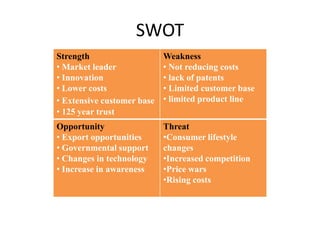
SWOT
Strength                    Weakness
• Market leader             • Not reducing costs
• Innovation                • lack of patents
• Lower costs               • Limited customer base
• Extensive customer base   • limited product line
• 125 year trust
Opportunity                 Threat
• Export opportunities      •Consumer lifestyle
• Governmental support      changes
• Changes in technology     •Increased competition
• Increase in awareness     •Price wars
                            •Rising costs
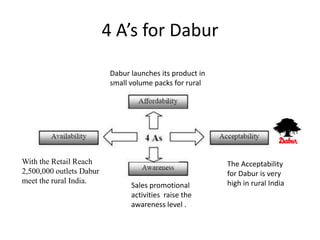
4 A’s for Dabur

                           Dabur launches its product in
                           small volume packs for rural


With the Retail Reach                                      The Acceptability
2,500,000 outlets Dabur                                    for Dabur is very
meet the rural India.                                      high in rural India
                                 Sales promotional
                                 activities raise the
                                 awareness level .
Rahul singh

Rahul singh

  • 1.
    ANALISYS OF DABURRURAL MARKET AND ITS STRATAGIES
  • 3.
    By: MBA- Marketing &Sales VIVEK UPADHAY
  • 4.
    Introduction Dabur India Ltd.is the fourth largest FMCG Company in India. • Largest Herbal & Natural Portfolio • 4000 Distributors in India • Retail Reach 2,500,000 • 5 Umbrella Brands • 350+ products • 4000 employees • 15 Manufacturing Plants
  • 5.
    Dabur’s Business Structure •Consumer Care Division (CCD) Dabur (Ayurvedic), Vatika - Premium hair care, Hajmola - Tasty digestives, Real - Fruit juices & beverages, Fem – Fairness bleaches & skin care products • Strategic positioning of Honey as food product, leading to market leadership (over 75%) in branded honey market. • Dabur Chyawanprash the largest selling Ayurvedic medicine with over 65% market share. • Hajmola tablets in command with 60% market share of digestive tablets category.
  • 6.
    • Consumer HealthDivision (CHD) • Major categories in traditional formulations include: - Asav Arishtas - Ras Rasayanas - Churnas - Medicated Oils
  • 7.
    • International BusinessDivision (IBD) • spanning the Middle East, North & West Africa, EU and the US with its brands Dabur & Vatika. • Leveraging the 'Natural' preference among local consumers to increase share in personal care categories.
  • 8.
    Rural Marketing • Ruralmarketing is promotion of a company's products in the rural market buy using strategies which differs from that of urban market, the rural market is more price sensitive but it has preference for quality.
  • 9.
    Why Rural market? •The rural population is 72% of total Indian population • Literacy level (25% before independence – more than 65% in 2001) • MART, the specialist rural marketing and rural development consultancy has found that 53 per cent of FMCG sales lie in the rural areas. • Of two million BSNL mobile connections, 50 per cent went to small towns and villages.
  • 10.
    • The ruralmarket is zooming ahead at around 25 per cent annually. • "The rural market is growing faster than urban India now," says Venugopal Dhoot, chairman of the Rs 989 - crore (Rs billion) Videocon Appliances. • "The urban market is a replacement and up gradation market today," adds Samsung's director, marketing, Ravinder Zutshi.
  • 11.
    RURAL MARKETING STRATEGIESBY DABUR • Promotion Strategy • For attracting more customers Dabur using following Promotional tools in rural market: • TV Commercial • Radio • News Paper • POP display • Wall panting • Contest in Melas or Haats • Video vans • Sales Promotion
  • 12.
    • Regional brandingstrategy • Dabur is trying to capture market by launching products with a regional twist, e.g. Sivappu Pal Podi. • Distribution Strategy – Dealer – Whole seller – Agents – Retailer – Kirana store
  • 13.
    • Dabur usesAstra to boost rural sales • ASTRA- Advanced Sales Training for Retail Ascendance • Shopkeepers selling Dabur India’s consumer product would now learn marketing through role plays • Astra training consultancy module in five languages: Bengali, Tamil, Telegu, Malayam and Kannada.
  • 14.
    Few more trends •IOC, Dabur to tie up for rural marketing – IOC’s 1,000 retail outlets across the country will stock a range of Dabur’s Ayurvedic products. • Dabur goes rural with campaign for immunity – 10 lakh-plus students were educated about the need for immunity in 1,000 schools across the country. • ‘Dabur Gulabari Miss Fresh Face of UP 2009’ – The hunt will cover nine major cities viz Kanpur, Lucknow, Meerut, Gorakhpur, Ghaziabad, Agr a, Noida, Allahabad and Varanasi.
  • 15.
    SWOT Strength Weakness • Market leader • Not reducing costs • Innovation • lack of patents • Lower costs • Limited customer base • Extensive customer base • limited product line • 125 year trust Opportunity Threat • Export opportunities •Consumer lifestyle • Governmental support changes • Changes in technology •Increased competition • Increase in awareness •Price wars •Rising costs
  • 16.
    4 A’s forDabur Dabur launches its product in small volume packs for rural With the Retail Reach The Acceptability 2,500,000 outlets Dabur for Dabur is very meet the rural India. high in rural India Sales promotional activities raise the awareness level .