PRINCIPLES OF FOOD ENGINEERING Prepared By-Mohit Jindal Page 1 of 72
PRINCIPLES OF FOOD ENGINEERING
DETAILED CONTENTS
1. Introduction (08 hrs)
 Units of measurement and their conversion
 Physical properties like colour, size, shape, density, specific gravity, thousand grain
weight/bulk density, porosity, Rheological properties of food materials and their
importance
 Thermal conductivity, specific heat, thermal diffusivity and other physical properties of
foods
2. Materials and energy Balance (08 hrs)
Basic principles, total mass & component mass balance, system boundaries, material balance
calculations, principle of energy balance, Heat, Enthalpy, calculations of specific heat.
3. Fluid Mechanics (10 hrs)
Manometers, Reynolds number, fluid flow characteristics, pumps – principles, types, and
working of most common pumps used in food industry
4. Heat and Mass Transfer during food processing – Modes of heat transfer i.e. conduction,
convection and radiation. Different heat exchangers. Principle of mass transfer, diffusion.
(10 hrs)
5. Thermal Processing of Foods (08 hrs)
Selection, operation and periodical maintenance of equipments used in food industry viz.
pasteurizer, autoclave, heat exchangers, evaporators, driers, boilers etc.
6. Psychrometry (04 hrs)
Principle of psychrometry and its application
LIST OF PRACTICALS
1. Determination of physical properties like size, shape, roundness, sphericity of the food products
2. Determination of angle of repose of grains
3. Study of thermal processing equipment
a) Pasteurizer
b) Heat Exchanger
c) Evaporator
PRINCIPLES OF FOOD ENGINEERING Prepared By-Mohit Jindal Page 2 of 72
d) Drier
4. Constructional and working details of different types of
a) Pumps for liquid transportation
b) Blower and fan for transportation for gases/air
5. Reading and interpretation of psychro-metric charts
6. Exercises related to material balance
7. Use of steam tables and their interpretation
8. Determination of thermal conductivity of a given food sample
PRINCIPLES OF FOOD ENGINEERING Prepared By-Mohit Jindal Page 3 of 72
A physical entity, which can be observed and/or measured, is defined qualitatively by a dimension. For
example, time, length, area, volume, mass, force, temperature, and energy are all considered
dimensions like unit of length may be measured as a meter, centimeter, or millimeter.
Primary dimensions, such as length, time, temperature, and mass, express a physical entity.
Secondary dimensions involve a combination of primary dimensions (e.g., volume is length cubed;
velocity is distance divided by time).
Physical quantities are measured by variety of unit systems. The most common systems include
the Imperial (English) system; the centimeter, gram, second (cgs) system; and the meter, kilogram,
second (mks) system. International organizations have attempted to standardize unit systems, symbols,
and their quantities. As a result of international agreements, the Systeme International d’Unites, or the
SI units have emerged. The SI units consist of seven base units, two supplementary units, and a series
of derived units.
Base Units
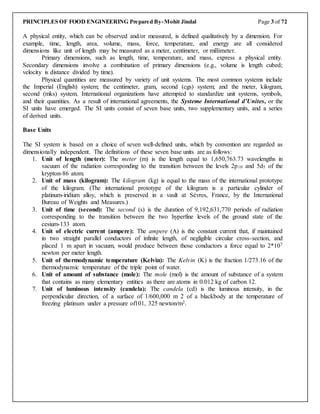
The SI system is based on a choice of seven well-defined units, which by convention are regarded as
dimensionally independent. The definitions of these seven base units are as follows:
1. Unit of length (meter): The meter (m) is the length equal to 1,650,763.73 wavelengths in
vacuum of the radiation corresponding to the transition between the levels 2p10 and 5d5 of the
krypton-86 atom.
2. Unit of mass (kilogram): The kilogram (kg) is equal to the mass of the international prototype
of the kilogram. (The international prototype of the kilogram is a particular cylinder of
platinum-iridium alloy, which is preserved in a vault at Sèvres, France, by the International
Bureau of Weights and Measures.)
3. Unit of time (second): The second (s) is the duration of 9,192,631,770 periods of radiation
corresponding to the transition between the two hyperfine levels of the ground state of the
cesium-133 atom.
4. Unit of electric current (ampere): The ampere (A) is the constant current that, if maintained
in two straight parallel conductors of infinite length, of negligible circular cross-section, and
placed 1 m apart in vacuum, would produce between those conductors a force equal to 2*107
newton per meter length.
5. Unit of thermodynamic temperature (Kelvin): The Kelvin (K) is the fraction 1/273.16 of the
thermodynamic temperature of the triple point of water.
6. Unit of amount of substance (mole): The mole (mol) is the amount of substance of a system
that contains as many elementary entities as there are atoms in 0.012 kg of carbon 12.
7. Unit of luminous intensity (candela): The candela (cd) is the luminous intensity, in the
perpendicular direction, of a surface of 1/600,000 m 2 of a blackbody at the temperature of
freezing platinum under a pressure of101, 325 newton/m2.
PRINCIPLES OF FOOD ENGINEERING Prepared By-Mohit Jindal Page 4 of 72
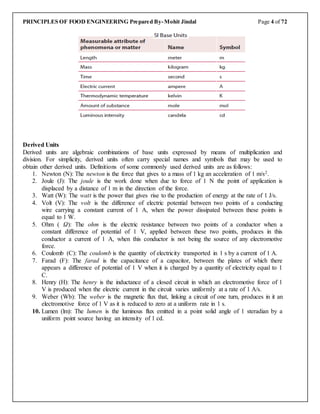
Derived Units
Derived units are algebraic combinations of base units expressed by means of multiplication and
division. For simplicity, derived units often carry special names and symbols that may be used to
obtain other derived units. Definitions of some commonly used derived units are as follows:
1. Newton (N): The newton is the force that gives to a mass of 1 kg an acceleration of 1 m/s2.
2. Joule (J): The joule is the work done when due to force of 1 N the point of application is
displaced by a distance of 1 m in the direction of the force.
3. Watt (W): The watt is the power that gives rise to the production of energy at the rate of 1 J/s.
4. Volt (V): The volt is the difference of electric potential between two points of a conducting
wire carrying a constant current of 1 A, when the power dissipated between these points is
equal to 1 W.
5. Ohm ( Ω): The ohm is the electric resistance between two points of a conductor when a
constant difference of potential of 1 V, applied between these two points, produces in this
conductor a current of 1 A, when this conductor is not being the source of any electromotive
force.
6. Coulomb (C): The coulomb is the quantity of electricity transported in 1 s by a current of 1 A.
7. Farad (F): The farad is the capacitance of a capacitor, between the plates of which there
appears a difference of potential of 1 V when it is charged by a quantity of electricity equal to 1
C.
8. Henry (H): The henry is the inductance of a closed circuit in which an electromotive force of 1
V is produced when the electric current in the circuit varies uniformly at a rate of 1 A/s.
9. Weber (Wb): The weber is the magnetic flux that, linking a circuit of one turn, produces in it an
electromotive force of 1 V as it is reduced to zero at a uniform rate in 1 s.
10. Lumen (lm): The lumen is the luminous flux emitted in a point solid angle of 1 steradian by a
uniform point source having an intensity of 1 cd.
PRINCIPLES OF FOOD ENGINEERING Prepared By-Mohit Jindal Page 5 of 72
Supplementary Units
This class of units contains two purely geometric units, which may be regarded either as base units or
as derived units.
1. Unit of plane angle (radian): The radian (rad) is the plane angle between two radii of a circle
that cut off on the circumference an arc equal in length to the radius.
2. Unit of solid angle (steradian): The steradian (sr) is the solid angle that, having its vertex in
the center of a sphere, cuts off an area of the surface of the sphere equal to that of a square with
sides of length equal to the radius of the sphere
 Physical properties
Food engineering is related to the analysis of equipment and systems used to process food on a
commercial production scale. Design of food equipment and processes to insure food quality and
safety we should know the response of the food materials to physical and chemical treatments. Raw
food materials are biological in nature and as such have certain unique characteristics which
distinguish them from other manufactured products. Because food materials are mainly of biological
origin they have
(a) Irregular shapes commonly found in naturally occurring raw materials;
(b) Properties with a non-normal frequency distribution;
(c) Heterogeneous composition;
(d) Composition that varies with variety, growing conditions, maturity and other factors; and they are
(e) Affected by chemical changes, moisture, respiration, and enzymatic activity.
 Rheological properties
The majority of industrial food processes involve fluid movement. Liquid foods such as milk and
juices have to be pumped through processing equipment or from one container to another. A number of
important unit operations such as filtration, pressing and mixing are, particular applications of fluid
flow. The mechanism and rate of energy and mass transfer are strongly dependent on flow
characteristics. The flow properties and deformation properties of fluids are the science called
‘rheology’ or the relationship between stress and strain is the subject matter of the science known as
rheology
PRINCIPLES OF FOOD ENGINEERING Prepared By-Mohit Jindal Page 6 of 72
 Mechanical Properties
Mechanical properties are those properties that determine the behavior of food materials when
subjected to external forces. Mechanical properties are important in processing (conveying, size
reduction) and consumption (texture, mouth feel).
The forces acting on the material are usually expressed as stress, i.e. intensity of the force per unit area
(N.m2 or Pa.). The dimensions and units of stress are like those of pressure.
The response of materials to stress is deformation, expressed as strain. Strain is usually expressed as a
dimensionless ratio, such as the elongation as a percentage of the original length.
We define three ideal types of deformation:
 Elastic deformation: deformation appears instantly with the application of stress and disappears
instantly with the removal of stress.
 Plastic deformation: deformation does not occur as long as the stress is below a limit value
known as yield stress. Deformation is permanent, i.e. the body does not return to its original
size and shape when the stress is removed.
 Viscous deformation: deformation (flow) occurs instantly with the application of stress and it is
permanent. The rate of strain is proportional to the stress
 Thermal Properties
In the food industry every process involves thermal effects such as heating, cooling or phase transition.
The thermal properties of foods are important in food process engineering. The following properties
are of particular importance: thermal conductivity, thermal diffusivity, specific heat, latent heat of
phase transition and emissivity.
 Electrical Properties
The electrical properties of foods are particularly relevant to microwave and ohmic heating of
foods and to the effect of electrostatic forces on the behavior of powders. The most important
properties are electrical conductivity and the dielectric properties. Ohmic heating is a technique
whereby a material is heated by passing an electric current through it.
Size and Shape
The size and shape of a raw food material can vary widely. The variation in shape of a product
may require additional parameters to define its size. The size of spherical particles like peas or
cantaloupes is easily defined by a single characteristic such as its diameter. The size of non-spherical
objects like wheat kernels, bananas, pears, or potatoes may be described by multiple length
measurements.
Particle size is used in sieve separation of foreign materials or grading (i.e., grouping into size
categories). Particle size is particularly important in grinding operations to determine the condition of
the final product and determines the required power to reduce the particle’s size.
Various types of cleaning, grading and equipments are designed on the basic physical
properties such as size, shape, specific gravity and colures. The shape of product is the important
parameter which effect covering characteristics of solid materials. The shape is also procedure in
calculation of various cooling and heating of food material.
Size is actually related or correlated to the property weight.
Shape affects the grade given to fresh fruit. To make the highest grade a fruit or vegetable must have
the commonly recognized expected shape of that particular fruit/vegetable.
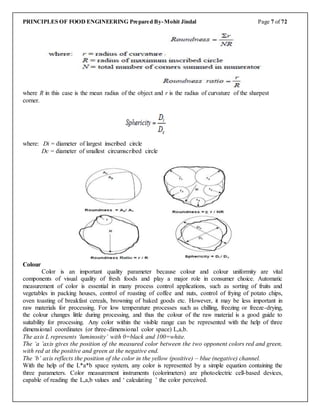
Roundness, as defined as, “is a measure of the sharpness of the corners of the solid.”
PRINCIPLES OF FOOD ENGINEERING Prepared By-Mohit Jindal Page 7 of 72
where R in this case is the mean radius of the object and r is the radius of curvature of the sharpest
corner.
where: Di = diameter of largest inscribed circle
Dc = diameter of smallest circumscribed circle
Colour
Color is an important quality parameter because colour and colour uniformity are vital
components of visual quality of fresh foods and play a major role in consumer choice. Automatic
measurement of color is essential in many process control applications, such as sorting of fruits and
vegetables in packing houses, control of roasting of coffee and nuts, control of frying of potato chips,
oven toasting of breakfast cereals, browning of baked goods etc. However, it may be less important in
raw materials for processing. For low temperature processes such as chilling, freezing or freeze-drying,
the colour changes little during processing, and thus the colour of the raw material is a good guide to
suitability for processing. Any color within the visible range can be represented with the help of three
dimensional coordinates (or three-dimensional color space) L,a,b.
The axis L represents ‘luminosity’ with 0=black and 100=white.
The ‘a ’axis gives the position of the measured color between the two opponent colors red and green,
with red at the positive and green at the negative end.
The ‘b’ axis reflects the position of the color in the yellow (positive) – blue (negative) channel.
With the help of the L*a*b space system, any color is represented by a simple equation containing the
three parameters. Color measurement instruments (colorimeters) are photoelectric cell-based devices,
capable of reading the L,a,b values and ‘ calculating ’ the color perceived.
PRINCIPLES OF FOOD ENGINEERING Prepared By-Mohit Jindal Page 8 of 72
Density:-
Density is defined as objects mass per unit volume. Mass is a property. The symbol most
often used for density is ρ (the lower case Greek letter rho). Mathematically, density is defined as mass
divided by volume. It is an indication of how matter is composed in the body material with more
compact density has higher density
The density can be expressed as
where
ρ = density (kg/m3)
m = mass (kg)
V = volume (m3)
The SI units for density are kg/m3. The imperial (U.S.) units are lb/ft3 (slugs/ft3). While people
often use pounds per cubic foot as a measure of density in the U.S.1 gram/cm3 = 1000 kg/m3 = 62.4
lb/ft3
The density of a material is equal to its mass divided by its volume and has SI units of kg m-3.
The density of materials is not constant and changes with temperature and pressure. Increasing the
pressure always increases the density of a material. Increasing the temperature generally decreases the
density. Knowledge of the density of foods is important in separation processes and differences in
density can have important effects on the operation of size reduction and mixing equipment. Product
density influences the amount and strength of packaging material. Breakfast cereal boxes contain a
required weight of cereal. More weight of material can be placed into a box if the cereal density is
greater. Also, food density influences its texture or mouth feel. Processing can affect product density
by introducing more air, such as is done in the manufacture of butter or ice cream.
Bulk Density:-
It is the weight of the food material in a unit volume. It is of importance in the packaging,
handling and other operations.
Bulk density is defined as the mass of many particles of the material divided by the
total volume they occupy.
Or
The weight of a material (including solid particles and any contained water) per unit volume including
voids.
Or
Bulk density is overall mass of the material divided by the volume occupied by the material
The total volume includes particle volume, inter-particle void volume, and internal pore
volume.
Bulk density is not an intrinsic property of a material; it can change depending on how the material is
handled. For example, a powder poured into a cylinder will have a particular bulk density; if the
cylinder is disturbed, the powder particles will move and usually settle closer together, resulting in a
higher bulk density. For this reason, the bulk density of powders is usually reported both as "freely
settled" (or "poured" density) and "tapped" density (where the tapped density refers to the bulk density
of the powder after a specified compaction process, usually involving vibration of the container.)
Oil, water and air occupy voids in the soil, called pore spaces.
Bulk density = Oven dry soil weight / volume of soil solids and pores
Particle density is the volumetric mass of the solid soil. It differs from bulk density because the
volume used does not include pore spaces.
Particle density = oven-dry soil weight / volume of soil solids
PRINCIPLES OF FOOD ENGINEERING Prepared By-Mohit Jindal Page 9 of 72
Porosity:-
The void space can be describing the porosity which is expressed as volume not occupied
as good material. Porosity is the percentage of air between the particles compared to a unit volume of
particles.
Porosity is that portion of the material volume occupied by pore spaces. This property does not have to
be measured directly since it can be calculated using values determined for bulk density and particle
density. Finding the ratio of bulk density to particle density and multiplying by 100 calculates the
percent solid space. If subtracting % solid space from 100 gives the % of soil volume that is pore
space.
% solid space = (bulk density / particle density) x 100
% porosity = 100 - (% solid space)
Sample Calculation of Porosity:
A 260 cm3 cylindrical container was used to collect an undisturbed soil sample. The container and soil
weighed 413 g when dried. When empty the container weighed 75 g. What is the bulk density and
porosity of the soil?
To determine bulk density:
Sample Volume = 260 cm3;
Sample Weight = 413 - 75 = 338 g;
Bulk density = 338 g/260 cm3= 1.3 g /cm3
To determine porosity:
Bulk density = 1.3 g /cm3;
Particle density = 2.65 g /cm3;
Porosity = 100 - (1.3/2.65 x 100) = 51%
Specific gravity.
The Specific Gravity - SG - is a dimensionless unit defined as the ratio of density of the
substance to the density of water at a specified temperature. Apparent specific gravity is the ratio of
the weight of a volume of the substance to the weight of an equal volume of the reference substance.
Specific Gravity can be expressed
SG = ρsubstance / ρH2O
where
SG = Specific Gravity of the substance
ρsubstance = density of the fluid or substance (kg/m3)
ρH2O = density of water - normally at temperature 4 oC (kg/m3)
It is common to use the density of water at 4 oC because at this point the density of water is at
the highest - 1000 kg/m3 or 62.4 lb/ft3. Specific gravity can also be calculated from the following
expression:
Specific gravity varies with temperature. The reference substance is nearly always water for
liquids or air for gases. Temperature and pressure must be specified for both the sample and the
reference. Pressure is nearly always 1 atm equal to 101.325 kPa. Temperatures for both sample and
reference vary from industry to industry. The density and specific gravity value as a stain and other
PRINCIPLES OF FOOD ENGINEERING Prepared By-Mohit Jindal Page 10 of 72
communities are used in design of solid storage separation of desired materials cleaning and grading,
texture and softness of food quality, the concentration of solutions of various materials such as brines,
hydrocarbons, sugar solutions (syrups, juices, honeys, brewers wort, must etc.) and acids.
Specific gravity can be measured in a number of ways.
1. Pycnometer
2. Digital density meters
Thermal Conductivity:-
Thermal conductivity is a measure of the ability of a material to transfer heat. It may be define
as the rate of heat flow through unit thickness of material per unit area normal to direction of heat flow
and per unit time per unit temperature difference is called thermal conductivity.
Or
The thermal conductivity is the heat energy transferred per unit time and per unit surface area, divided
by the temperature difference.
Thermal conductivity, k (also denoted as λ or κ), is the property of a material's ability
to conduct heat. It appears primarily in Fourier's Law for heat conduction. Heat flows at a higher rate
across materials of high thermal conductivity than across materials of low thermal conductivity.
Materials of high thermal conductivity are widely used in heat sink applications and materials of low
thermal conductivity are used as thermal insulation. Thermal conductivity of materials is temperature
dependent. Thermal energy always moves from that of higher concentration to lower concentration--
that is, from hot to cold.
In the following equation, thermal conductivity is the proportionality factor k. The distance of heat
transfer is defined as ∆x, which is perpendicular to area A. The rate of heat transferred through the
material is Q, from temperature T1 to temperature T2, when T1>T2. SI units for thermal conductivity
watt per meter kelvin W/ (m K), m kg s-3 K-1
Viscosity:-
Material
Thermal
conductivity
(W/m K)*
Diamond 1000
Silver 406.0
Copper 385.0
Gold 314
Brass 109.0
Aluminum 205.0
Iron 79.5
Steel 50.2
Fiberglass 0.04
Polystyrene
(styrofoam)
0.033
PRINCIPLES OF FOOD ENGINEERING Prepared By-Mohit Jindal Page 11 of 72
Viscosity is a resistance of a fluid which is being deformed by either shear stress or tensile
stress. In the other word we can say viscosity is the property of fluid by virtue of which is opposing its
flow.
Or
Viscosity is resistance to flow
Or
Viscosity describes a fluid's internal resistance to flow and may be thought of as a measure of
fluid friction.
Viscosity is an important characteristic of liquid foods in many areas of food processing. For
example the characteristic mouthfeel of food products such as tomato ketchup, cream, syrup and
yoghurt depends on their viscosity (or 'consistency'). The viscosity of many liquids changes during
heating/cooling or concentration and this has important effects on, for example, the power needed to
pump these products.
A liquid having a series of layers and when it flows over a surface, the uppermost layer flows
fastest and drags the next layer along at a slightly lower velocity, and so on through the layers. The
force that moves the liquid is known as the shearing force or 'shear stress' and the velocity gradient is
known as the 'shear rate'. If shear stress is plotted against shear rate, most simple liquids and gases
show a linear relationship and these are termed 'Newtonian' fluids. Examples include water, most oils,
gases, and simple solutions of sugars and salts. Where the relationship is non-linear the fluids are
termed 'non-Newtonian'. For all liquids, viscosity decreases with an increase in temperature but for
most gases it increases with temperature.(Lewis 1990).
In everyday terms (and for fluids only), viscosity is "thickness" or "internal friction".
Thus, water is "thin", having a lower viscosity, while honey is "thick", having a higher viscosity. All
real fluids have some resistance to stress and therefore are viscous. A fluid which has no resistance to
shear stress is known as an ideal fluid or in viscid fluid. Zero viscosity is observed only at very low
temperatures, in super fluids.
The word "viscosity" is derived from the Latin "viscum", meaning mistletoe and also a
viscous glue (birdlime) made from mistletoe berries. Viscosity represented by the symbol η "eta".
Viscosity is the ratio of the tangential frictional force per unit area. The SI unit of viscosity is
the pascal second [Pa s]. The pascal second is rarely used today the most common unit of viscosity is
the dyne second per square centimeter [dyne s/cm2], which is given the name poise [P] after the French
physiologist Jean Poiseuille (1799–1869). Ten poise equal one pascal second [Pa s] making
the centipoise [cP] and millipascal second [mPa s] identical.
1 pascal second = 10 poise
1 pascal second = 1,000 millipascal second
1 centipoise = 1 millipascal second
The other quantity called kinematic viscosity (represented by the symbol ν "nu") is the ratio of
the viscosity of a fluid to its density. The SI unit of kinematic viscosity is the square meter per
second [m2/s]. A more common unit of kinematic viscosity is the square centimeter per second [cm2/s],
which is given the name stokes [St] after the Irish mathematician and physicist George Stokes (1819–
1903).
1 m2/s = 10,000 cm2/s [stokes]
1 m2/s = 1,000,000 mm2/s [centistokes]
PRINCIPLES OF FOOD ENGINEERING Prepared By-Mohit Jindal Page 12 of 72
1 cm2/s 1 stokes
1 mm2/s = 1 centistokes
Thermal Diffusivity:-
It is defined as the ratio of thermal conductivity to the ‘volumetric heat capacity’ of the
material. Volumetric heat capacity is obtained by multiplying the mass specific heat c p by the density
ρ.
or
It may be calculated by dividing thermal conductivity with the specific heat and density. In heat
transfer analysis, thermal diffusivity usually denoted α but a, κ, k, and D are also used. It has the SI
unit of m²/s. The formula is:
where
is thermal conductivity (W/(m·K))
is density (kg/m³)
is specific heat capacity (J/(kg·K))
Thermal conductivity is a property that determines HOW MUCH heat will flow in a material, while
thermal diffusivity determines HOW RAPIDLY heat will flow within it. In a substance with high
thermal diffusivity, heat moves rapidly through because the substance conducts heat quickly relative to
its volumetric heat capacity or 'thermal bulk'. The substance generally does not require much energy
transfer to or from its surroundings to reach thermal equilibriumIt is important to determine heat
transfer rate in solid food material of any shape. It shows capacity of food material to store heat.
Heat
In physics, heat is energy in transfer other than as work or by transfer of matter. When there is
a suitable physical pathway, heat flows from a hotter body to a colder one.
Or
A form of energy associated with the motion of atoms or molecules and capable ofbeing transm
itted through solid and fluid media by conduction, through fluid media byconvection, and through emp
ty space by radiation.
Or
The transfer of energy from one body to another as a result of a difference intemperature or a c
hange in phase.
Specific Heat:-
The specific heat is the amount of heat per unit mass required to raise the temperature by one degree
Celsius without change in surface.
Or
It may be defined as amount of heat that must be added or removed from 1 kg of substance by 1º C
without change in surface. The relationship does not apply if a phase change is encountered, because
the heat added or removed during a phase change does not change the temperature
cp = Q / (mΔT)
where
PRINCIPLES OF FOOD ENGINEERING Prepared By-Mohit Jindal Page 13 of 72
cp is the specific heat (kJ/kgo, kJ/kgoC)
Q is the heat added(kJ)
m is the mass(kg)
T is the change in temperature (K, oC)
It is denoted by Cp. SI unit of heat capacity is kJ/(kg K)..Because of the high specific heat of
water relative to other materials, water will change its temperature less when it absorbs or loses a given
amount of heat. The reason you can burn your finger by touching the metal handle of a pot on the stove
when the water in the pot is still lukewarm is that the specific heat of water is ten times greater than
that of iron.
For example, the specific heat of water is around 4180 Joules per kilogram, so it takes 4180J of
energy to raise the temperature of 1kg of water by 1 degree Celsius.
Specific heat of weight agriculture materials is the sum of dry materials and moisture content. It
is an essential part of thermal analysis of food processing or equipment used for heating. Specific heat
can be thought of as a measure of how well a substance resists changing its temperature when it
absorbs or releases heat.
Latent heat:-
The quantity of heat absorbed or released by a substance undergoing a
change of state, such as
ice changing to water or water to steam, at constant temperature and pressure.
OR
Latent is the energy released or absorbed by a body or a thermodynamic system during a
constant-temperature process.
Or
Heat absorbed or released as the result of a phase change is called latent heat. There is no temperature
change during a phase change, thus there is no change in the kinetic energy of the particles in the
material.
The term was introduced around 1762 by Scottish chemist Joseph Black. It is derived from the
Latin latere (to lie hidden). The SI unit for specific latent heat is J/kg. Two of the more common forms
of latent heat (or enthalpies or energies) encountered are latent heat of fusion (melting) and latent
heat of vaporization (boiling). These names describe the direction of energy flow when changing
from one phase to the next: from solid to liquid, and liquid to gas.
A specific latent heat (L) expresses the amount of energy in the form of heat (Q) required to
completely effect a phase change of a unit of mass (m), usually 1kg, of a substance as an intensive
property:
where:
Q is the amount of energy released or absorbed during the change of phase of the
substance (in kJ),
m is the mass of the substance (in kg), and
L is the specific latent heat for a particular substance (kJ-kgm
−1
), either Lf for fusion, or Lv for
vaporization
The energy released comes from the potential energy stored in the bonds between the particles.
 exothermic (warming processes)
o condensation
o freezing
PRINCIPLES OF FOOD ENGINEERING Prepared By-Mohit Jindal Page 14 of 72
o deposition
 endothermic (cooling processes)
o evaporation/boiling
o melting
o sublimation
Endothermic meaning that the system absorbs energy on going from solid to liquid to gas. The change
is exothermic (the process releases energy) for the opposite direction.
Sensible heat
When an object is heated, its temperature rises as heat is added. The increase in heat is called
sensible heat. Similarly, when heat is removed from an object and its temperature falls, the heat
removed is also called sensible heat.
Sensible heat is heat exchanged by a body or thermodynamic system that changes the
temperature, and some macroscopic variables of the body, but leaves unchanged certain other
macroscopic variables, such as volume or pressure.
The terms sensible heat and latent heat are not special forms of energy; instead they
characterize the same form of energy, heat, in terms of their effect on a material or a thermodynamic
system. A good way to remember the distinction is that a change in sensible heat may be ″sensed″ with
a thermometer, and a change in latent heat is invisible to a thermometer – the temperature reading
doesn't change. For example, during a phase change such as the melting of ice, the temperature of the
system containing the ice and the liquid is constant until all ice has melted. The terms latent and
sensible are correlative. Heat that causes a change in temperature in an object is called sensible heat.
Enthalpy
Enthalpythermodynamic function of a system, equivalent to the sum of the internalenergy of th
e system plus the product of its volume multiplied by the pressure exerted on it by its surroundings.
Or
Enthalpy is a thermodynamic quantity equivalent to the total heat content of a system. It is
equal to the internal energy of the system plus the product of pressure and volume
+H indicates that heat is being absorbed in the reaction (it gets cold) and  H indicates that heat
is being given off in the reaction (it gets hot). Enthalpy is a defined thermodynamic potential,
designated by the letter "H", that consists of the internal energy of the system (U) plus the product of
pressure (p) and volume (V) of the system. The unit of measurement for enthalpy in the International
System of Units (SI) is the joule, but other historical, conventional units are still in use, such as the
British thermal unit and the calorie. The enthalpy is an extensive property. The enthalpy of a
homogeneous system is defined as:
H=U+pV
where
H is the enthalpy of the system
U is the internal energy of the system
p is the pressure of the system
V is the volume of the system.
Manometers
PRINCIPLES OF FOOD ENGINEERING Prepared By-Mohit Jindal Page 15 of 72
1. A manometer is a device for measuring fluid pressure consisting of a bent tube containing one
or more liquids of different densities.
2. A Manometer is a device to measure pressures. A common simple manometer consists of a U
shaped tube of glass filled with some liquid. Typically the liquid is mercury because of its high
density.
Amongst the oldest kind of stress measuring device is the manometer that comes with a vertical
glass tube that is filled with mercury. This device, which was invented in 1643 by an Italian physicist
at the exact same time a mathematician named Evangelista Torricelli, is also known as mercurial
manometer. A known pressure (which may be atmospheric) is applied to one end of the manometer
tube and the unknown pressure (to be determined) is applied to the other end. Differential pressure
manometer measures only the difference between the two Pressures.
The fundamental relationship for pressure expressed by a liquid column is:
Δp = P2-P1 = ρgh (1)
where:
Δp = differential pressure
P1 = pressure at the low-pressure connection
P2 = pressure at the high-pressure connection
ρ = density of the indicating fluid (at a specific temperature)
g = acceleration of gravity (at a specific latitude and elevation)
h = difference in column heights
Atmospheric Pressure - The pressure of the atmosphere on a unit surface. At sea level it is 29.92
in.Hg absolute.
Absolute Pressure. A measurement referenced to zero pressure; equals the sum of gauge pressure and
atmospheric pressure. Common units are pounds per square inch (psi), millimeters mercury (mmHga),
and inches mercury (in.Hga).
Ambient Pressure. The pressure of the medium surrounding a device. It varies from 29.92 in.Hg at
sea level to a few inches at high altitudes.
Vacuum. Any pressure below atmospheric pressure. When referenced to the atmosphere, it is called a
vacuum (or negative gauge) measurement. When referenced to zero pressure, it is an absolute pressure
measurement.
Zero Absolute Pressure. The complete absence of any gas; a perfect vacuum.
Gauge Pressure. A measurement referenced to atmospheric pressure. It varies with the barometric
reading. Also used to specify the maximum pressure rating of manometers. Common units include
pounds per square inch (psig).
Differential Pressure. The difference between two measurement points. Common units are inches of
water (in.H2O), pounds per square inch (psi), and millibars (mbar).
PRINCIPLES OF FOOD ENGINEERING Prepared By-Mohit Jindal Page 16 of 72
U-tube manometers, as their name suggests, are formed from a tube that is shaped like a U.
This type of manometer is very common. They are very simple to operate and require no gears or
levers or other items to adjust. The manometer consists of a U-
shaped tube that is closed at one end and a liquid. The closed end
of the tube has a vacuum, while the open end is attached to the
item whose pressure is to be measured. This type of manometer is
considered to be the primary standard by the National Institute of
Standards and Technology.
Advantages
1. Simple in construction
2. Low cost hence easy to buy.
3. Very accurate and sensitive
4. It can be used to measure other process variables.
Disadvantages
1. Fragile in construction.
2. Very sensitive to temperature changes.
3. Error can happen while measuring the height.
2. Well – type Manometer
A well-type manometer is similar to the U-tube manometer,
but has a few important differences. At the closed end of the
manometer is a large well that liquid rises and falls in according to
the pressure. This setup is advantageous in that it does not require the
observer to make a calculation by looking at both sides of the tube,
as is necessary in a U-tube manometer.
Advantages:
1. It does not require the observer to make a calculation by
looking at both sides of the tube.
2. It is manufactured with the
high degree of accuracy.
Disadvantages:
1. It places certain operational requirements not found with
the U-type.
3. Inclined Manometer
Many applications require accurate
measurement of low pressure such as
drafts and very low differentials, primarily
in air and gas installations. In these
applications the manometer is arranged
with the indicating tube inclined, therefore
providing an expanded scale. This
arrangement can allow 12” of scale length
to represent 1" of vertical liquid
PRINCIPLES OF FOOD ENGINEERING Prepared By-Mohit Jindal Page 17 of 72
height. With scale subdivisions to .01 inches of liquid height, the equivalent pressure of .000360
PSI per division can be read using water as the indicating fluid.
Advantages:
1. One need only compare the height of one liquid column, not the difference in height
between two liquid columns.
2. The cross-sectional area of the liquid column in the well is so much greater than that within
the transparent manometer tube that the change in height within the well is usually negligible.
Disadvantages:
1. A small change in a fluid height causes larger displacement in the transparent tube when it
is inclined to the angle and filled by oil.
2. High sensitivity
4. Dual – tube Manometer
A dual tube manometer is a manometer that is designed to read very high pressures. A high
pressure causes the need for a longer indicating tube, which is very inconvenient to the person
reading the manometer. A dual-tube manometer solves this
problem by having two tubes to read the pressure, a standard
well-type manometer and a well-type manometer with the
well at the 100-inch reading on the indicating tube.
Advantages:
1. High range pressure is more accurate with this
instrument.
Disadvantage:
1. Complicated operation
2. Inaccurate for the exact pressure value due to large
– scale calibration
Uses-
 Throughout history, mercury-filled manometer has been an very important device needed in the
construction of aqueducts, bridges, installing of swimming pools, and other engineering
applications. This has also been implemented for a number of industrial applications like for
visual monitoring of air and gas pressure in compressors as well as in vacuum equipment and
specialty tank applications. The manometer is also necessary in avionics and climate
forecasting. It principally studies the stress of fluid at the same time measure the speed at which
a stream of air is flowing.
 In healthcare field, the manometer is essential too. Healthcare professionals mainly use this
pressure measuring device in determining the blood stress of a particular person.
 Along with technological innovations, digital manometers are not just to the environment but
also to human safe for health. Mercury toxicity can have an effect on the central nervous
method and other vital organs of the physique such as kidneys and liver.
Reynolds number
PRINCIPLES OF FOOD ENGINEERING Prepared By-Mohit Jindal Page 18 of 72
In fluid mechanics, the Reynolds number (Re) is a dimensionless quantity that is used to help
predict similar flow patterns in different fluid flow situations. The concept was introduced by George
Gabriel Stokes in 1851, but the Reynolds number is named after Osborne Reynolds (1842–1912), who
popularized its use in 1883.The Reynolds number is defined as the ratio of inertial forces
to viscous forces and consequently quantifies the relative importance of these two types of forces for
given flow conditions.
Re=VLc/ν
Where
ν is the kinematic viscosity,
V is the mean velocity of the fluid,
Lc is the characteristic length of the geometry.
The higher the Reynolds number is, the more turbulent the flow will be. They are also used to
characterize different flow regimes within a similar fluid, such as laminar or turbulent flow: Fluid flow
is generally chaotic and very small changes to shape and surface roughness can result in very different
flows. Nevertheless, Reynolds numbers are a very important guide and are widely used.Reynolds
number has been so valuable for dealing with flow in pipes The Reynolds number can be defined for
several different situations where a fluid is in relative motion to a surface.. These definitions generally
include the fluid properties of density and viscosity, plus a velocity and a characteristic length or
characteristic dimension.
Flow in pipe
For flow in a pipe or tube, the Reynolds
number is generally defined as.
where:
 is the hydraulic diameter of the pipe; its characteristic travelled length, , (m).
 is the volumetric flow rate (m3
/s).
 is the pipe cross-sectional area (m²).
 is the mean velocity of the fluid (SI units: m/s).
 is the dynamic viscosity of the fluid (Pa·s or N·s/m² or kg/(m·s)).
 is the kinematic viscosity ( (m²/s).
 is the density of the fluid (kg/m³).
For a circular pipe, the hydraulic diameter is exactly equal to the inside pipe diameter, . That is,
PRINCIPLES OF FOOD ENGINEERING Prepared By-Mohit Jindal Page 19 of 72
The mixing Reynolds number is:
The Reynolds Number can be used to determine if flow is laminar, transient or turbulent. The flow is
 laminar when Re < 2300
 transient when 2300 < Re < 4000
 turbulent when Re > 4000
Fluid Flow
The flow of real fluids exhibits viscous effect that is they tend to "stick" to solid surfaces and
have stresses within their body. The flow of the fluids is very complex. The study of fluid motion have
in found useful engineering and scientifically application. There are two methods to describe the fluid
flow:-
1. Lagrangian
2. Eulerian
Lagrangian: - Each fluid particle carries its own properties such as density, momentum, etc.
The properties of fluid may change in time. The procedure of describing the entire flow by recording
the detail of each fluid particle is the Lagrangian description. The named after Italian mathematician
Joseph Louis Lagrange (1736-1813). Motion is described based upon Newton's laws. This is difficult
to use for practical flow analysis.
Eulerian: - Describes the flow field (velocity, acceleration, pressure, temperature, etc.) as
functions of position and timeline. In this method the motion of single particle is not considered but we
considered the motion of all fluid particles that pass through a fix point during a passage of its flow.
This is the Eulerian description. It is a field description. A probe fixed at a point is an example of an
Eulerian measuring device.
First type of fluid flow:-
1. Laminar Flow: - laminar flow (or streamline flow) occurs when a
fluid flows in parallel layers, with no disruption between the layers.
Laminar flow generally happen when dealing with small pipes and
low flow velocities .Laminar flow can be regarded as a series of
liquid cylinders in the pipe where the innermost parts flow the
fastest. Shear stress depends almost only on the viscosity-u-and in
the independent of density. Reynolds number for flow is 0 to 2300.
2. Turbulent Flow:-In this flow type of fluid (gas or
liquid) flow the fluid undergoes irregular
fluctuations, or mixing. In turbulent flow the speed
of the fluid at a point is continuously undergoing
changes in both magnitude and direction. The flow of
PRINCIPLES OF FOOD ENGINEERING Prepared By-Mohit Jindal Page 20 of 72
wind and rivers is generally turbulent. Most kinds of fluid flow are turbulent, except the fluids
flowing at the leading edge of solids, such as the inside wall of a pipe, The Reynolds number
for turbulent flow is 2300<Re<4000.
3. Transitional Flow: - On applying external disturbance we
find there are irregular fluctuations. It is a mixture of
laminar and turbulent flow with turbulence in the center
edges. It Reynolds number is Re>4000.
Second type of fluid flow (Change in space)
1. Uniform Flow (constant with space): - This flow is uniform in the nature if the flow of parameter
like pressure, velocity temperature and dentistry remain constant throughout the flow of fluid at
any given time.
2. Non – Uniform Flow (changes over space): - This flow is non –uniform if there is a change flow
in parameter from one selection to another.
Third type of flow:- (Change in time)
1. Steady State (constant with time): - Fluid motion is said to be steady when the fluid parameter at
any point in flow field remain constant with regard to time. Example of steady uniform flow is the
flow of water in a pipe of constant diameter at constant velocity.
2. Unsteady State (changes with time): - The flow is unsteady when parameter changes with regarded
to time. When the flow is unsteady, the fluid’s velocity can differ between any two points.
Fourth type of fluid flow:-
1. Compressible flow: - Flow is compressible if the density change due to temperature pressure
variation. The gases are compressible fluid. Gases are mainly having compressible flow.
2. Incompressible flow; - Flow is incompressible if the density change in very less with the change
of pressure and temperature. All the liquid are regarded as incompressible.
Fifth type of fluid flow:-
1. Ideal flow: - In ideal flow no friction exit between two fluid layers and the boundary wall. Such a
flow is imaginary but for all theoretical wall fluid may be assume to ideal.
2. Real flow: - In real flow the resistance due to viscosity exists.
Sixth type of fluid flow:-
1. Rotational flow: - A rotational flow exist when the fluid particle rotate about their center of
gravity while moving along the steam line. In a rotational flow if a match stick is thrown on the
surface of the moving fluid, it will rotate about its own axes
2. Irrotational flow: - The flow is irrotational when the fluid particles do not rotate about their
center of gravity while moving along its steam line.
Seventh type of fluid flow:-
Term one, two or three dimensional flow refers to the number of space coordinated required to
describe a flow. It appears that any physical flow is generally three-dimensional.
1. One dimensional: - In one dimensional flow the fluid parameter remain constant throughout any
cross sectional area perpendicular to the flow direction. In reality, flow is never one-dimensional
because viscosity causes the velocity to decrease to zero at the solid boundaries. Example – Flow
between parallel plates.
2. Two dimensional:-In two dimensional flows the flow velocity and other parameter varies along
two directions. Example- viscous flow between parallel plates.
3. Three dimensional:-In three dimensional flow the flow parameter is varies in all the three
direction. Example – flow in a river.
PRINCIPLES OF FOOD ENGINEERING Prepared By-Mohit Jindal Page 21 of 72
Pump:-
Pump is a mechanical energy to hydraulic energy in the form of pressure. So the pump is a
device which is used to pressure increase of a fluid.
Or
A pump is a device that moves fluids (liquids or gases), or sometimes slurries, by mechanical
action.
Pumps are basically used for situation where gravity cannot be used to move liquid products
and mechanical energy is required. This mechanical energy is provided by pumps. A wide range of
pump types is available to meet the many needs of individual water supply systems and special fluids
handling systems. Most common pump used in food industry are centrifugal, positive displacement,
peristaltic, turbine, gear, deep well, shallow well, jet, etc.
Applications of pumps -:
1. In agriculture workers.
2. Municipal water workers and drainage system.
3. Condensing water, boiler feed and such other application in stream power plant.
4. Oil pumping.
5. Transfer of raw materials.
Centrifugal Pump:-
These pumps are used to raise liquid from lower end/level to higher level. Most centrifugal
pumps used in food industry use two vane impellers. Impellers with three or four vanes are
available and may be used in some application.
Centrifugal pumps are most efficient with low viscosity liquid such as milk or fruit juice.
Where flow rate are high and pressure requirement are moderate. The discharge flow from
centrifugal pump is steady. Centrifugal pumps are well suited for water handling as well as many
other fluids-handling systems.
Parts of Centrifugal Pump
 Impeller: - A wheel provided with a series of backward curved blades or vanes is known as
impeller.
 Suction Pipe: - The pipe connected at its upper end for inlet of fluid in to the pump or to the eye
of pump.
 Delivery Pipe: - the pipe connected its lower end to the outlet of pump and delivers the liquid to
desire level is called delivery pipe.
 Casing: - An air tight chamber surround the impeller is called casing.
Principle:-
PRINCIPLES OF FOOD ENGINEERING Prepared By-Mohit Jindal Page 22 of 72
This pump is derived by power from an external source by which vanes are rotated. This created
centrifugal heat of water in the pressure. A particle vacuum created at the center due to which liquid is
drawn through suction pipe.
Working:-
In these pumps the amount of liquid delivered will vary with the height to which liquid to be lifted.
Like most pumps, a centrifugal pump converts mechanical energy from a motor to kinetic energy of
the fluid. Fluid enters through eye of the casing, is caught up in the impeller blades. Now fluid is
whirled tangentially and radially discharged from the casing to discharge pipe. The fluid gains both
velocity and pressure while passing through the impeller.
Positive DisplacementPumps
A positive displacement pump makes a fluid move by trapping a fixed amount and forcing
(displacing) that trapped volume into the discharge pipe.
Positive displacement types
A positive displacement pump can be classified according to the mechanism used to move the
fluid:
Rotary-type positive displacement: - Rotary pumps include sliding vane lobe type internal gear
and gear type pump. The rotary pump has the capability to rivers flow direction by reversing the
direction of rotor rotation.
Principle:-A centrifugal pump operates on the principle of centrifugal action of rotation but a
rotary pump is a positive displacement pump. The liquid is discharged by a positive pressure. These
pumps are priming use as power source in the hydraulic control system and to supply pressure oil for
lubricating of turbine and machine tools.
Rotary positive displacement pumps fall into three main types:
1. Gear pumps - a simple type of rotary pump where the liquid is pushed between two gears. Gear
pump uses rotating gears to force the pumped fluid through the pump. Several variations in
design are possible. Close tolerances and associated high wear rates are a characteristic of these
pumps. They are more appropriately used for special fluids handling applications than for water
systems.
PRINCIPLES OF FOOD ENGINEERING Prepared By-Mohit Jindal Page 23 of 72
2. Screw pumps - the shape of the internals of this pump is usually two screws turning against
each other to pump the liquid. Several different types of screw pumps exist. The differences
between the various types are the number of intermeshing screws and the pitch of the screws.
The pump is similar to a gear pump but uses helical gears or screws to move the fluid. As the
screw turns, vacuum forms at the inlet. Atmospheric pressure then pushes fluid into the cavities
and the fluid moves to the outlet. This pump has very smooth flow -- without the pulses
produced by the other positive-displacement pumps in this manual. Flow from the outlet is
smooth and continuous. However, screw pumps are not highly efficient. This design pump
often is used to supercharge other pumps, as a filter pump, or a transfer pump at low. High
pressures can be attained in this type of pump. The screw pump is commonly used in the food
industry. It can be used to “pump” dough-like materials that cannot be handled by many
pumps.
3. Rotary vane pumps - similar to scroll compressors, these have a cylindrical rotor encased in a
similarly shaped housing. As the rotor orbits, the vanes trap fluid between the rotor and the
casing, drawing the fluid through the pump.
Advantages: Rotary pumps are very efficient because they naturally remove air from the lines,
eliminating the need to bleed the air from the lines manually.
Drawbacks: The nature of the pump demands very close clearances between the rotating pump
and the outer edge, making it rotate at a slow, steady speed. If rotary pumps are operated at high
speeds, the fluids because erosion, which eventually causes enlarged clearances that liquid can pass
through, this reduces efficiency.
PRINCIPLES OF FOOD ENGINEERING Prepared By-Mohit Jindal Page 24 of 72
Reciprocating pump:-
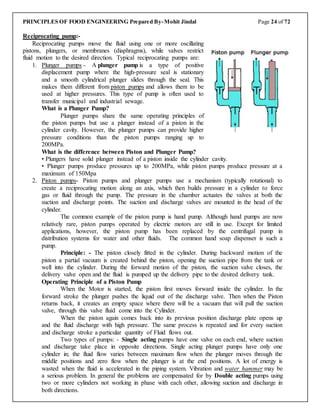
Reciprocating pumps move the fluid using one or more oscillating
pistons, plungers, or membranes (diaphragms), while valves restrict
fluid motion to the desired direction. Typical reciprocating pumps are:
1. Plunger pumps - A plunger pump is a type of positive
displacement pump where the high-pressure seal is stationary
and a smooth cylindrical plunger slides through the seal. This
makes them different from piston pumps and allows them to be
used at higher pressures. This type of pump is often used to
transfer municipal and industrial sewage.
What is a Plunger Pump?
Plunger pumps share the same operating principles of
the piston pumps but use a plunger instead of a piston in the
cylinder cavity. However, the plunger pumps can provide higher
pressure conditions than the piston pumps ranging up to
200MPa.
What is the difference between Piston and Plunger Pump?
• Plungers have solid plunger instead of a piston inside the cylinder cavity.
• Plunger pumps produce pressures up to 200MPa, while piston pumps produce pressure at a
maximum of 150Mpa
2. Piston pumps- Piston pumps and plunger pumps use a mechanism (typically rotational) to
create a reciprocating motion along an axis, which then builds pressure in a cylinder to force
gas or fluid through the pump. The pressure in the chamber actuates the valves at both the
suction and discharge points. The suction and discharge valves are mounted in the head of the
cylinder.
The common example of the piston pump is hand pump. Although hand pumps are now
relatively rare, piston pumps operated by electric motors are still in use. Except for limited
applications, however, the piston pump has been replaced by the centrifugal pump in
distribution systems for water and other fluids. The common hand soap dispenser is such a
pump.
Principle: - The piston closely fitted in the cylinder. During backward motion of the
piston a partial vacuum is created behind the piston, opening the suction pipe from the tank or
well into the cylinder. During the forward motion of the piston, the suction valve closes, the
delivery valve open and the fluid is pumped up the delivery pipe to the desired delivery tank.
Operating Principle of a Piston Pump
When the Motor is started, the piston first moves forward inside the cylinder. In the
forward stroke the plunger pushes the liquid out of the discharge valve. Then when the Piston
returns back, it creates an empty space where there will be a vacuum that will pull the suction
valve, through this valve fluid come into the Cylinder.
When the piston again comes back into its previous position discharge plate opens up
and the fluid discharge with high pressure. The same process is repeated and for every suction
and discharge stroke a particular quantity of Fluid flows out.
Two types of pumps: - Single acting pumps have one valve on each end, where suction
and discharge take place in opposite directions. Single acting plunger pumps have only one
cylinder in; the fluid flow varies between maximum flow when the plunger moves through the
middle positions and zero flow when the plunger is at the end positions. A lot of energy is
wasted when the fluid is accelerated in the piping system. Vibration and water hammer may be
a serious problem. In general the problems are compensated for by Double acting pumps using
two or more cylinders not working in phase with each other, allowing suction and discharge in
both directions.
PRINCIPLES OF FOOD ENGINEERING Prepared By-Mohit Jindal Page 25 of 72
Maintenance
 As wear and tear is more in a Piston Pump, maintenance cost will be a higher than the
Centrifugal pump.
 Piston rings are subjected to extreme friction and pressure and so damage to the piston rings is
inevitable. But by proper alignment and maintenance the failure rate can be reduced.
 Suction and discharge plates are also likely to get damaged often.
 If there is a reduction in pressure produced by the pump it is advisable to thoroughly check the
pump for damages in Piston rings and Valve Plates.
Features and Application of Piston Pumps
 Piston Pumps can create high pressures.
 Flow created will be less when compared to a Centrifugal Pump.
 Piston pumps can be used in places where high pressure is required and less flow is sufficient.
 Flow adjustment is possible only when a metering mechanism is attached to the Pump.
3. Diaphragm pumps – A diaphragm pump (also known as a Membrane pump, Air Operated
Double Diaphragm Pump (AODD) or Pneumatic Diaphragm Pump) is a positive displacement
pump that uses a combination of the reciprocating action of a rubber,
thermoplastic or Teflon diaphragm and suitable valves on either side of the diaphragm (check
valve, butterfly valves, flap valves, or any other form of shut-off valves) to pump a fluid.
Diaphragm valves are used to pump hazardous and toxic. Diaphragm pump characteristics:
 They can handle sludge and slurries with a relatively high amount of grit and solid content.
 suitable for discharge pressure up to 1,200 bar
 have good dry running characteristics.
 can be used to make artificial hearts.
 are used to make air pumps for the filters on small fish tanks.
 can be up to 97% efficient.
PRINCIPLES OF FOOD ENGINEERING Prepared By-Mohit Jindal Page 26 of 72
Selecting a Pump
Pump selection is based upon
 Capacity required
 pressure difference (sometimes called pump head) required
 Other special factors such as fluid to be pumped, sanitary requirements, space limitations,
noise restrictions, etc.
Modes of heat transfer i.e. conduction, convectionand radiation.
Heat is defined as thermal energy in transit.
Several modern definitions of heat are as follows:
 The energy transferred from a high-temperature object to a lower-temperature object is called
heat.
 Any spontaneous flow of energy from one object to another caused by a difference in
temperature between the objects is called heat.
The kinetic energy due to the random motion of the molecules of a substance is known as its heat
energy
What is Heat Transfer
Thermal energy is related to the temperature of matter. Heat transfer is a study of the exchange
of thermal energy through a body or between bodies which occurs when there is a temperature
difference. When two bodies are at different temperatures, thermal energy transfers from the one with
higher temperature to the one with lower temperature. Heat always transfers from hot to cold.
The common SI and English units and conversion factors used for heat and heat transfer rates.
Heat is typically given the symbol Q, and is expressed in joules (J) in SI units. The rate of heat transfer
is measured in watts (W), equal to joules per second, and is denoted by q. The heat flux, or the rate of
heat transfer per unit area, is measured in watts per area (W/m2), and uses q" for the symbol.
PRINCIPLES OF FOOD ENGINEERING Prepared By-Mohit Jindal Page 27 of 72
Table 1. Units and Conversion Factors for Heat Measurements
SI Units English Units
Thermal Energy (Q) 1 J 9.4787×10⁻⁴ Btu
Heat Transfer Rate (q) 1 J/s or 1 W 3.4123 Btu/h
Heat Flux (q") 1 W/m2 0.3171 Btu/h ft2
Three Modes of Heat Transfer
There are three modes of heat transfer: conduction, convection, and radiation. Any energy
exchange between bodies occurs through one of these modes or a combination of them. Conduction is
the transfer of heat through solids or stationery fluids. Convection uses the movement of fluids to
transfer heat. Radiation does not require a medium for transferring heat; this mode uses the
electromagnetic radiation emitted by an object for exchanging heat.
 Conduction
Conduction is at transfer through solids or stationery fluids. Vibrational energy is transferred
between atoms or molecules that do not themselves move. It is the basic transfer mechanism for heat
transfer in solids when you touch a hot object, the heat you feel is transferred through your skin by
conduction. Two mechanisms explain how heat is transferred by conduction:
 Lattice vibration
 Particle collision.
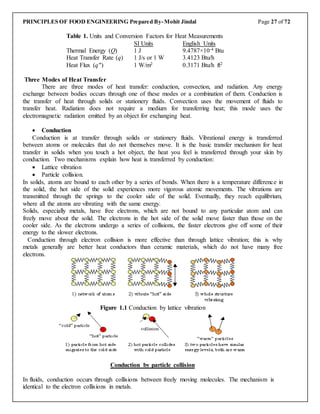
In solids, atoms are bound to each other by a series of bonds. When there is a temperature difference in
the solid, the hot side of the solid experiences more vigorous atomic movements. The vibrations are
transmitted through the springs to the cooler side of the solid. Eventually, they reach equilibrium,
where all the atoms are vibrating with the same energy.
Solids, especially metals, have free electrons, which are not bound to any particular atom and can
freely move about the solid. The electrons in the hot side of the solid move faster than those on the
cooler side. As the electrons undergo a series of collisions, the faster electrons give off some of their
energy to the slower electrons.
Conduction through electron collision is more effective than through lattice vibration; this is why
metals generally are better heat conductors than ceramic materials, which do not have many free
electrons.
Figure 1.1 Conduction by lattice vibration
Conduction by particle collision
In fluids, conduction occurs through collisions between freely moving molecules. The mechanism is
identical to the electron collisions in metals.
PRINCIPLES OF FOOD ENGINEERING Prepared By-Mohit Jindal Page 28 of 72
The effectiveness by which heat is transferred through a material is
measured by the thermal conductivity, k. A good conductor, such as copper,
has a high conductivity; a poor conductor, or an insulator, has a low
conductivity. Conductivity is measured in watts per meter per Kelvin
(W/mK). The rate of heat transfer by conduction is given by:
Where, A is the cross-sectional area, through which the heat is conducting,
T is the temperature difference between the two surfaces separated by a
distance Δx.
In heat transfer, a positive q means that heat is flowing into the body, and a
negative q represents heat leaving the body.
 Convection
Convection uses the motion of fluids to transfer heat. In a typical convective heat transfer, a hot
surface heats the surrounding fluid, which is then carried away by fluid movement such as wind. The
warm fluid is replaced by cooler fluid, which can draw more heat away from the surface. Since the
heated fluid is constantly replaced by cooler fluid, the rate of heat transfer is enhanced.
Natural convection (or free convection) refers to a case where the fluid movement is created
by the warm fluid itself. The density of fluid decrease as it is heated; thus, hot fluids are lighter than
cool fluids. Warm fluids surrounding a hot object rises, and are replaced by cooler fluid. The result is a
circulation of air above the warm surface,
Natural convection
Forced convection uses external means of producing fluid movement. Forced convection is
what makes a windy, winter day feel much colder than a calm day with same temperature. The heat
loss from your body is increased due to the constant replenishment of cold air by the wind. Natural
wind and fans are the two most common sources of forced convection.
Convection coefficient, h, is the measure of how effectively a fluid transfers heat by
convection. It is measured in W/m2K, and is determined by factors such as the fluid density, viscosity,
and velocity. Wind blowing at 5 mph has a lower h than wind at the same temperature blowing at 30
mph. The rate of heat transfer from a surface by convection is given by:
Where, A is the surface area of the object, Tsurface is the surface temperature, and T∞ is the ambient or
fluid temperature.
PRINCIPLES OF FOOD ENGINEERING Prepared By-Mohit Jindal Page 29 of 72
 Radiation
Radiative heat transfer does not require a medium to pass through; thus, it is the only form of heat
transfer present in vacuum. It uses electromagnetic radiation (photons), which travels at the speed of
light and is emitted by any matter with temperature above 0 degrees Kelvin (-273 °C). Radiative heat
transfer occurs when the emitted radiation strikes another body and is absorbed. We all experience
radiative heat transfer everyday; solar radiation, absorbed by our skin, is why we feel warmer in the
sun than in the shade.
The electromagnetic spectrum classifies radiation according to wavelengths of the radiation. Main
types of radiation are (from short to long wavelengths): gamma rays, x-rays, ultraviolet (UV), visible
light, infrared (IR), microwaves, and radio waves. A radiation with shorter wavelengths is more
energetic and contains more heat. X-rays, having wavelengths ~10-9 m, are very energetic and can be
harmful to humans, while visible light with wavelengths ~10-7 m contain less energy and therefore
have little effect on life.
A second characteristic which will become important later is that radiation with longer wavelengths
generally can penetrate through thicker solids. Most "hot" objects, from a cooking standpoint, emit
infrared radiation.
The amount of radiation emitted by an object is given by:
Where, A is the surface area, T is the temperature of the
body, σ is a constant called Stefan-Boltzmann constant, equal to
5.67×10⁻⁸ W/m2K4, and ε is a material property called emissivity.
Emissivity is a material property, ranging from 0 to 1, which
measures how much energy a surface can emit with respect to an
ideal emitter (ε = 1) at the same temperature.
Heat exchanger
A heat exchanger is a device that is used to transfer thermal energy (enthalpy) between two or more
fluids, between a solid surface and a fluid, or between solid particulates and a fluid, at different
temperatures and in thermal contact.
Or
A heat exchanger is a component that allows the transfer of heat from one fluid (liquid or gas) to
another fluid. Reasons for heat transfer include the following:
1. To heat a cooler fluid by means of a hotter fluid
2. To reduce the temperature of a hot fluid by means of a cooler fluid
3. To boil a liquid by means of a hotter fluid
4. To condense a gaseous fluid by means of a cooler fluid
5. To boil a liquid while condensing a hotter gaseous fluid
A variety of heat exchangers are used in industry and in their products. Heat exchangers are
classified according to transfer processes, number of fluids, degree of surface compactness,
construction features, flow arrangements, and heat transfer mechanisms.
PRINCIPLES OF FOOD ENGINEERING Prepared By-Mohit Jindal Page 30 of 72
Classification of heat exchanger:-
Heat exchanger can be classified an on their basis:-
1. Designed and construction
2. Operating principle
3. Arrangement of flow
Designand construction
 Triangular pitch These two arrangements give us compact arrangement, stronger tube sheet
and better heat transfer coefficient in shell side.
For given tube pitch to outer diameter ratio, we
can use 15% more tubes in given shell
diameter. These arrangements have one
disadvantage that it makes lanes between tubes
which becomes difficult for us to do
mechanical cleaning. Due to this
reason, we can do only chemical
cleaning or water jet cleaning.
 Square pitch-The each tube it makes a square of 90 degree angle. In this arrangement the gap
between the tubes is more, so less number
of tubes can be installed in given area.
 Shell and tube type heat exchanger The shell-and-tube heat exchanger is the type that is most
commonly used in process plants. In this type of heat exchanger one of the fluids flows through
the inside of the shell and the other fluid flows through tubes passing through the inside of the
shell, thereby enabling heat transfer between the two fluids. Baffles are added to enhance the
convection coefficient, which increases heat transfer between the two fluids.
One shell one tube
PRINCIPLES OF FOOD ENGINEERING Prepared By-Mohit Jindal Page 31 of 72
One shell and two tubes
The shell and tube exchanger consists of four major parts:
 Front Header—this is where the fluid enters the tube side of the exchanger. It is sometimes
referred to as the Stationary Header.
 Rear Header—this is where the tube side fluid leaves the exchanger or where it is returned to
the front header in exchangers with multiple tube side passes.
 Tube bundle—this comprises of the tubes, tube sheets, baffles and tie rods etc. to hold the
bundle together.
 Shell—this contains the tube bundle
Baffles-Baffle is the circular discs open from one end, and with holes to increase circular area. The
purpose of longitudinal baffles is to control the overall flow direction of the shell fluid such that a
desired overall flow arrangement of the two fluid streams is achieved. Baffles serve three functions: 1)
support the tube; 2) maintain the tube spacing; and 3) direct the flow of fluid in the desired pattern
through the shell side.
 Plate heat exchangers
A plate heat exchanger consists of a series of thin corrugated metal plates between
which a number of channels are formed, with the primary and secondary fluids flowing through
alternate channels. Heat transfer takes place from the primary fluid steam to the secondary
process fluid in adjacent channels across the plate. A corrugated pattern of ridges increases the
rigidity of the plates and provides greater support against differential pressures. This pattern
also creates turbulent flow in the channels, improving heat transfer efficiency, which tends to
PRINCIPLES OF FOOD ENGINEERING Prepared By-Mohit Jindal Page 32 of 72
make the plate heat exchanger more compact than a traditional shell and tube heat exchanger.
This type of heat exchanger provide not only large heat transfer but also easy to clean, easy to
repair, easy to increase and decrease the number of plates as per requirements
 Spiral type heat exchanger
It consists of two tubes bounded spirally in
one inside the other which results in two
rectangular narrow passages to which heat
exchange fluid flow in counter current or in the
same direction. It requires lower surface area than
shell and tube exchangers. These exchangers can
be used for highly viscous fluids at low, medium
pressures. The hot fluid enter the unit at center and
leaves at periphery cold fluid enter the unit at
periphery and leave at center while flowing to the
outer passage
 Extended surface and fin type heat
exchanger- These types of heat exchanger
are used when one of the fluids has a much
lower heat coefficient than other. In this
type of heat exchanger the outside area of
the tube is increased or extended by fins.
PRINCIPLES OF FOOD ENGINEERING Prepared By-Mohit Jindal Page 33 of 72
So heat transfer rate increases. Example auto mobile radiators
Shell and Coil type heat exchanger-The shell and coil tube series are
manufactured as a singe unit with no removable parts. The coiled tube
bundles are welded to a compact tube sheet located within the entry and
exit connections. The cylindrical shell is terminated by hemi-spherical
heads.They are simple in construction and less expensive in fabrication.
 Scraped surface heat exchanger Scraped surface heat exchanger
is basically is used for viscous food and organic solution. Scraped
surface heat exchanger contains large center tube of two of 100 to
300 mm in diameter jacketed with steam or cooling liquid. The
inside of central tube is scraped continuously with two or more
blades mounting on rotating shaft. The rotating blade continuously
scrap the inner surface of inner tube which prevent localized
clogging or over heating and give rapid heat transfer rate
On the basis of operating principle
 Indirect-Contact Heat Exchangers- In an indirect-contact heat exchanger, the fluid streams
remain separate and the heat transfers continuously through an impervious dividing wall or into
and out of a wall in a transient manner. Thus, ideally, there is no direct contact between
thermally interacting fluids. This type of heat exchanger also referred to as a surface heat
exchanger, can be further classified into direct-transfer type, storage type, and fluidized-bed
exchangers.
 Direct-Contact Heat Exchangers- In a direct-contact exchanger, two fluid streams come into
direct contact, exchange heat, and are then separated. Where mixing between the fluids is
either harmless Common applications of a direct-contact exchanger involve mass transfer in
addition to heat transfer, such as in evaporative cooling and rectification. Compared to indirect
contact recuperates and regenerators, in direct-contact heat exchangers are:
PRINCIPLES OF FOOD ENGINEERING Prepared By-Mohit Jindal Page 34 of 72
1. Very high heat transfer rates are achievable
2. The exchanger construction is relatively
inexpensive
3. The fouling problem is generally
nonexistent, due to the absence of a heat
transfer surface (wall) between the two
fluids.
However, the applications are limited because where a
direct contact of two fluid streams is permissible.
 Regenerative heat exchanger- a regenerator is a
type of heat exchanger where heat from the hot fluid is intermittently stored in a thermal
storage medium before it is transferred to the cold fluid. To accomplish this hot fluid is brought
into contact with the heat storage medium, and then the fluid is displaced with the cold fluid,
which absorbs the heat. It was later
used in glass and steel making, in high
pressure boilers and chemical and other
applications, where it continues to be
important today.
Rotary regenerators the matrix rotates
continuously through two counter-flowing
streams of fluid. In this way, the two streams
are mostly separated but the seals are generally
not perfect. Only one stream flows through
each section of the matrix at a time; however,
over the course of a rotation, both streams
eventually flow through all sections of the
matrix in succession. Each portion of the
matrix will be nearly isothermal, since the
rotation is perpendicular to both the
temperature gradient and flow direction, and
not through them. The two fluid streams flow counter-current. The fluid temperatures vary
across the flow area; however the local stream temperatures are not a function of time.
In a fixed matrix regenerator, a single fluid stream has cyclical, reversible flow; it is said
to flow "counter-current". This regenerator may be part of a valve less system, such as
a Stirling engine. In another configuration, the fluid is ducted through valves to different
matrices in alternate operating periods
PRINCIPLES OF FOOD ENGINEERING Prepared By-Mohit Jindal Page 35 of 72
Arrangement of flow
 Parallel flow- when both the tube side fluid and the shell side fluid flow in the same direction.
In this case, the two fluids enter the heat exchanger from the same end with a large temperature
difference. As the fluids transfer heat, hotter to cooler, the temperatures of the two fluids
approach each other. Note that the hottest cold-fluid temperature is always less than the coldest
hot-fluid temperature.
Parallel Flow Heat Exchanger
 Counter flow- when the two fluids flow in opposite directions. Each of the fluids enters the heat
exchanger at opposite ends. Because the cooler fluid exits the counter flow heat exchanger at
the end where the hot fluid enters the heat exchanger, the cooler fluid will approach the inlet
temperature of the hot fluid. Counter flow heat exchangers are the most efficient of the three
types. In contrast to the parallel flow heat exchanger, the counter flow heat exchanger can have
the hottest cold-fluid temperature greater than the coldest hot-fluid temperature.
Counter Flow Heat Exchanger
 Cross flow- when one fluid flows perpendicular to the second fluid; that is, one fluid flows
through tubes and the second fluid passes around the tubes at 90anangle. Cross flow heat
exchangers are usually found in applications where one of the fluids changes state (2-phase
flow). An example is a steam system's condenser, in which the steam exiting the turbine enters
the condenser shell side, and the cool water flowing in the tubes absorbs the heat from the
steam, condensing it into water. Large volumes of vapor may be condensed using this type of
heat exchanger flow.
PRINCIPLES OF FOOD ENGINEERING Prepared By-Mohit Jindal Page 36 of 72
Cross Flow Heat Exchanger
Selection and operation of equipments used in food industries
Several types of heat exchanger are used in food industries. It should be evident that a basic
understanding of the mechanism of heat transfer both food and the materials used in construction of
food processing equipment is necessary before we can design or evaluate any heat exchanger
equipment. A wide variety of food products is processed using heat exchanger.
The following points are considered for the selection of heat exchanger
1. Thermal properties :- properties such as specific heat thermal conductivity and thermal
diffusivity of food and equipment material plat an important role in determining the rate of heat
transfer
2. Mode of heat transfer:- A mathematical description of the actual mode of heat transfer, such as
conduction, convection, and radiation is necessary to determine quantity such as total amount
of heat transfer from heating or cooling medium to the product
Specifications of various types heat exchanger are:-
1. The maintaince of these heat exchanger should be simple so that, they can be easily and quickly
removed for product surface inspection
2. The plate heat exchanger have a hygienic design for food application
3. Their capacity can be easily increased by adding more relaters to the frame
4. The heat exchanger should be such that the energy conservation by regeneration possible.
Principle of mass transfer, diffusion
Mass transfer plays a very important role in basic unit operations of food processing, such as
drying, extraction, distillation, and absorption. Mass transfer is the net movement of mass from one
location, usually meaning a stream, phase, fraction or component, to another.
To study mass transfer in food systems, it is important that we understand the term mass
transfer. We have a bulk flow of a fluid from one location to another, there is a movement of the fluid
(of a certain mass), but the process is not mass transfer, according to the context being used. Our use of
the term mass transfer is restricted to the migration of a constituent of a fluid or a component of a
mixture. The migration occurs because of changes in the physical equilibrium of the system caused by
the concentration differences.
PRINCIPLES OF FOOD ENGINEERING Prepared By-Mohit Jindal Page 37 of 72
Consider this example:
For example, if you open a bottle of highly volatile material such as nail polish remover in a room, the
component (acetone) will migrate to various parts of the room because of the concentration gradients
of acetone. If the air is stationary, the transfer occurs as a result of random motion of the acetone
molecules. If a fan or any other external means are used to cause air turbulence, the eddy currents will
enhance the transfer of acetone molecules to distant regions in the room.
All three of the molecular transport processes - momentum, heat, and mass-are characterized by the
general type of equation,
In mass transfer, mass is transferred under the driving force provided by a partial pressure or
concentration difference. The rate of mass transfer is proportional to the potential (pressure or
concentration) difference and to the properties of the transfer system characterized by a mass-transfer
coefficient.
Mass transfer coefficient: - In engineering, the mass transfer coefficient is a diffusion rate constant that
relates the mass transfer rate, mass transfer area, and concentration change as driving force:
Where:
 kc is the mass transfer coefficient [mol/(s·m2)/(mol/m3)], or m/s
 is the mass transfer rate [mol/s]
 A is the effective mass transfer area [m2]
 ΔCA is the driving force concentration difference [mol/m3].
Types of mass transfer :-
Mass transfer involves both mass diffusion occurring at a molecular scale and bulk transport of mass
due to convection flow.
1. Diffusion mass transfer
2. Convection mass transfer
1. Diffusion mass transfer
1) Molecular diffusion
2) Eddy diffusion
 Molecular diffusion: - Diffusion from the random molecular motion is termed molecular
diffusion. It is the transfer of matter on a microscopic level from a region of higher conc. to
lower conc. i.e. mixing of gas and liquid. Molecular diffusion is four types:-
1. Ordinary diffusion: - Result from the conc. gradient (higher to lower). The diffusion sub-stance
to moves from a position of lower conc.
2. Thermal diffusion: - Due to different in temperature from one part to another in the system .A
temperature gradient will develop which cause diffusion.
3. Pressure diffusion: - Resulting from the atmospheric pressure differences that provide the
driving potential to the mass transfer.
4. Forced diffusion: - This is result due to external force.
PRINCIPLES OF FOOD ENGINEERING Prepared By-Mohit Jindal Page 38 of 72
.
 Eddy diffusion: - When one of diffusion fluid is in turbulence motion (zig-zag) the diffusion
called eddy diffusion .The zig –zag motion of one fluid greatly the speed of mass transfer.
Convection mass transfer: -
Mass transfer involves bulk transport of mass due to convection flow. When the transport of a
component due to a concentration gradient is enhanced by convection, the mass flux of the component
will be higher than would occur by molecular diffusion.
Convective mass transfer will occur in liquids and gases, and within the structure of a porous
solid. The relative contributions of molecular diffusion and convective mass transfer will depend on
the magnitude of convective currents within the liquid or gas. The convective mass transfer coefficient
k m is defined as the rate of mass transfer per unit area per unit concentration difference. Thus,
where
mg is the mass flux (kg/s);
c is concentration of component B, mass per unit volume (kg/m3);
A is area (m2).
The units of k m are m3/m2 s or m/s. The coefficient represents the volume (m3) of component B
transported across a boundary of one square meter per second.
Fick's Law for Molecular Diffusion
Fick's laws of diffusion describe diffusion and were derived by Adolf Fick in 1855.Molecular
diffusion or molecular transport can be defined as the transfer or movement of individual molecules
through a fluid by means of the random, individual movements of the molecules. The diffusion process
can be described mathematically using Fick’s law diffusion, which states that the mass flux per unit
area of a component is proportional to its concentration gradient. Consider a box which is initially
divided into two parts, as shown in Figure. Each side of the box has a height and depth of 1 unit, and a
width of length . At some instant in time, the partition is removed, and B and E diffuse in opposite
directions as a result of the concentration gradients.
We will check the box and count the molecules on each side. When we remove the dividing
line the first time we check the box, after a period delta t, 20% of the molecules that were originally on
PRINCIPLES OF FOOD ENGINEERING Prepared By-Mohit Jindal Page 39 of 72
the left will have moved to the right, and 20% of the molecules moved from right to left. Now we
count the molecules on each side, then, we will find 8 ``x'' molecules remaining on the left and 2 on the
right, and 16 ``y'' molecules remaining on the right, 4 having moved to the left. If we assume that the
mass of each molecule is 1 unit, we can calculate concentrations in units of mass/volume. Thus, we
obtain Fick's Law:
Or
Where
J is the "diffusion flux" (amount of substance) per unit area per unit time]. J measures the
amount of substance that will flow through a small area during a small time interval.
mg is mass flux of component B (kg/s)
c is the concentration of component B, mass per unit volume (kg/m 3)
D is the mass diffusivity (m 2/s);
A is area (m 2).
x is the position [length], for example m.
We note that Fick’s law is similar to Fourier’s law of heat conduction,
Where
q is the rate of heat flow in the direction of heat transfer by conduction (W)
k is thermal conductivity (W/[m °C])
A is area (normal to the direction of heat transfer) through which heat flows (m 2);
T is temperature (°C); and x is length (m), a variable.
and Newton’s equation for shear-stress–strain relationship,
These similarities between the three transport equations suggest additional analogies among mass
transfer, heat transfer, and momentum transfer.
PRINCIPLES OF FOOD ENGINEERING Prepared By-Mohit Jindal Page 40 of 72
Selection, operation and periodical maintenance of equipments used in food
industry viz. pasteurizer, autoclave, heat exchangers, evaporators, driers, boilers
etc.
Pasteurizer
In the food industry, we refer to the processing steps required to eliminate the potential for food
borne illness or preservation process.
Pasteurization is a process of heat treatment used to inactivate enzymes and to kill relatively
heat-sensitive microorganisms that cause spoilage with minimal changes in food properties (e.g.,
sensory and nutritional)
Pasteurizer is a device which is used for the preservation of food product by heating (at defined
temperature. for a defined time period).It is also defined as mild heat treatment for avoiding microbial
and enzymatic spoilage. It is used to extend the shelf life of food at low temperatures (usually 4°C) for
several days (e.g., milk) or for several months (e.g., bottled fruit). Heating liquid foods to 100°C is
employed to destroy heat-labile spoilage organisms, such as non-spore-forming bacteria, yeast, and
molds
Purpose of Pasteurization
1. The primary objective of pasteurization is to free the food of any microorganisms that might
cause deterioration the consumer's health.
2. In low-acid foods (pH > 4.5), the main purpose is the destruction of pathogenic bacteria
3. Below pH 4.5, destruction of spoilage microorganisms or enzyme inactivation is usually more
important.
4. Pasteurization does not aim at killing spore-bearing organisms, such as the thermophilic
Bacillus subtilis, but these organisms and most other spore-bearing bacteria cannot grow in
acidic fruit juices.
5. Pasteurization of carbonated juices done for destroying yeasts and molds.
Types of Pasteurization
there are several types of pasteurization:
1. In-package pasteurization: Inside packages, heating to the level of sterility is not required. A
gradual change in temperature is preferred in some containers
2. Pasteurization prior to packaging: Preheating is good for foods that are sensitive to high
temperature gradients.
3. Batch pasteurization or LTLT (Low temperature long time) is suitable for small quantities
ranging from 200-1000 litre requiring low initial cost of production. Here fluid foods like milk
are held in a tank where they are heated to 62.8°C for 30 minutes. A batch pasteurizer consists
of a steam-jacketed kettle or a tank equipped with steam coils in which the juice or milk is
heated to the desired temperature.
4. Continuous pasteurization or HTST (High temperature short time): treatment is ideal for
large scale handling of 5000 litres per hour (LPH) or higher. The complete process of
preheating, heating, holding, pre-cooling and chilling is completed in a plate type heat
exchanger: Foods like milk are subjected to 71.7°C for about 15 seconds or more by flowing
through different heat exchangers. In continuous pasteurization generally plate heat exchanger,
tubular heat exchanger, scraped surface heat exchanger are used depending on the viscosity of
the fluid food material. The heating medium is usually steam or water.
PRINCIPLES OF FOOD ENGINEERING Prepared By-Mohit Jindal Page 41 of 72
5. Ultra high temperature (UHT): In ultra high temperature pasteurizer food product are heated
at very high temperature (Above boiling temperature) for a fraction of second or for a few
second. Ultra-heat treatment sterilizes food by heating it above 135°C (275°F) - the temperature
required to kill spores in milk - for 1 to 2 seconds. UHT is most commonly used
in milk production, but the process is also used for fruit juices, cream, soy
milk, yogurt, wine, soups, honey, and stews. UHT milk was invented in the 1960s, and became
generally available for consumption in the 1970s. High heat during the UHT process can
cause Maillard browning and change the taste and smell of dairy products. UHT milk has a
typical shelf life of six to nine months, until opened.
Most pasteurization systems are designed for liquid foods, and with specific attention to achieving
a specific time–temperature process. The continuous high temperature short-time (HTST)
pasteurization system has several basic components, including the following:
 Heat exchangers for product heating/cooling. Mostly plate heat exchangers are used to heat the
product to the desired temperature. The heating medium may be hot water or steam, and a
regeneration section is used to increase efficiency of the process. In this section, hot product
becomes the heating medium. Cold water is the cooling medium in a separate section of the
heat exchanger.
 Holding tube. The holding tube is an important component of the pasteurization system.
Although lethality accumulates in the heating, holding, and cooling sections, the Food and
Drug Administration (FDA) will consider only the lethality accumulating in the holding
section. It follows that the design of the holding tube is crucial to achieve a uniform and
sufficient thermal process.
 Pumps and flow control. A metering pump, located upstream from the holding tube, is used to
maintain the required product flow rate. Usually a positive displacement pump is used for this
application. Centrifugal pumps are more sensitive to pressure drop and should be used only for
clean-in-place (CIP) applications.
PRINCIPLES OF FOOD ENGINEERING Prepared By-Mohit Jindal Page 42 of 72
 Flow diversion valve. An important control point in any pasteurization system is the flow
diversion valve (FDV). This remotely activated valve is located downstream from the holding
tube. A temperature sensor located at the exit to the holding tube activates the FDV; when the
temperature is above the established pasteurization temperature, the valve is maintained in a
f
o
r
w
a
r
d
f
l
o
w
position. If the product temperature drops below the desired pasteurization temperature, the
FDV diverts the product flow to the unheated product inlet to the system. The valve and sensor
prevent product that has not received the established time–temperature treatment from reaching
the product packing system.
PRINCIPLES OF FOOD ENGINEERING Prepared By-Mohit Jindal Page 43 of 72
Autoclave
An autoclave is a pressure chamber used to sterilize equipment and supplies by subjecting them to
high pressure saturated steam at 121 °C (249°F) for around 15–20 minutes depending on the size of the
load and the contents.
Or
An autoclave (Fig. 1) is a container that exposes the material to be sterilized to temperatures above the
boiling point of water, which is achieved by increasing pressure.
PRINCIPLES OF FOOD ENGINEERING Prepared By-Mohit Jindal Page 44 of 72
Autoclave word comes from the Greek "auto" for automatic and the Latin "clvis," for key (as in lock
and key).
Who invented autoclaves?
 Ancient Greeks use boiling water to sterilize medical tools.
 1679: French engineer Denis Papin (1647–1712) invents the steam pressure cooker—an
important step in the development of steam engines.
 1860s: French biologist Louis Pasteur (1822–1895) helps to confirm the germ theory of
disease. He realizes that heating things to kill germs can prevent diseases and extend the life of
foodstuffs (which leads him to the invention of pasteurization).
 1880s: Pasteur's collaborator Charles Chamberland (1851–1908) invents the modern autoclave.
Theory of operation
An autoclave is a large pressure cooker; it operates by using steam under pressure as the
sterilizing agent. High pressures help steam to reach high temperatures, thus increasing its heat content
and killing power. Achieving high and even moisture content in the steam-air environment is important
for effective autoclaving. The ability of air to carry heat is directly related to the amount of moisture
present in the air. The more moisture present, the more heat can be carried, so steam is one of the most
effective carriers of heat. Moist heat is kill microorganisms by causing coagulation of essential
proteins.
Due to heat the vibratory motion of every molecule of a microorganism is increased and
intermolecular hydrogen bond between proteins breaks. Death rate is directly proportional to the
concentration of microorganisms at any given time. All autoclaves operate on a time/temperature
relationship; increasing the temperature decreases TDT, and lowering the temperature increases TDT.
Some standard temperatures/pressures employed are 1150C/10 p.s.i., 1210C/ 15 p.s.i., and
1320C/27 p.s.i. (psi=pounds per square inch).
How an autoclave works
The complete sterilization process of an autoclave has different phases:
1. Purge Phase: Once the chamber is sealed, all the air is removed from it either by a simple
vacuum pump (in a design called pre-vacuum which is more effective ) or by pumping in steam
to force the air out of the way (an alternative design called gravity displacement). The heating
resistor heats water from the bottom of the boiler, producing steam that will forces air up
through the purge valve. This phase ends when the sterilization temperature is reached.
 Sterilization Phase: Once the purge valve is closed and the previously selected sterilization
temperature about 121–140°C (250–284°F) is reached, the sterilization process begins. A
pressure regulator maintains jacket and chamber pressure. Overpressure protection is provided
by a safety valve.
 Discharge Phase: After the sterilization process ends, the heating resistor turns off in order to stop
producingsteam.Boilerpressureandthe temperature begin to drop gradually.
PREVENTATIVE MAINTENANCE
Preventative maintenance will greatly increase the efficiency of your autoclave, reduce
downtime and save costly repairs. It may be considered as a scheduled inspection, which could result
PRINCIPLES OF FOOD ENGINEERING Prepared By-Mohit Jindal Page 45 of 72
in minor adjustments or repairs, major repairs, or premature replacement of parts. It is designed to
maintain safety, and delay or avoid an emergency.
.
Daily / Weekly Maintenance Activity:
Although the manual will provide specific instructions some general guidelines can be provided. Steps
that should be taken daily or weekly, depending upon use pattern and control during packaging and
loading, are:
1. Disinfect exterior surfaces of the autoclave
2. Check door gaskets for wear
3. Clean interior walls with tri-sodium-phosphate, other mild detergent or as recommended by the
manufacturer. Never use a strong abrasive or steel wool. Rinse with tap water after cleaning.
4. Clean screen leading to discharge line
5. Check primary and secondary containers for integrity (stress fractures, cracks, chips etc.)
6. Consult manual to determine other recommended activities
Yearly Maintenance Activity: An annual inspection and maintenance program should be undertaken
by qualified individuals.
Safety is all-important. Since you're using high-pressure, high-temperature steam, you have to be
especially careful when you open an autoclave that there is no sudden release of pressure that could
cause a dangerous steam explosion.
Uses
 Sterilization autoclaves are widely used in microbiology, medicine, podiatry, tattooing, body
piercing, veterinary science, mycology, dentistry, and prosthetics fabrication. They vary in size
and function depending on the media to be sterilized.
 Laboratory glassware, other equipment and waste, surgical instruments and medical waste.
 A growing application of autoclaves is the pre-disposal treatment and sterilization of waste
material, such as pathogenic hospital waste.
 Autoclaves are also widely used to cure composites and in the vulcanization of rubber.
 Nylon is made by "cooking" a concentrated salt solution in an autoclave to encourage the
formation of long-chain polymer molecules.
Evaporators
Evaporation is an important unit operation commonly used to remove water from dilute
liquid foods to obtain concentrated liquid products. Removal of water from foods provides
microbiological stability and assists in reducing transportation and storage costs.
A typical example of the evaporation process is in the manufacture of tomato paste,
usually around 35% to 37% total solids, obtained by evaporating water from tomato juice,
which has an initial concentration of 5% to 6% total solids.
Evaporation differs from dehydration, since the final product of the evaporation
process remains in liquid state. It also differs from distillation, since the vapors produced in
the evaporator are not further divided into fractions.
PRINCIPLES OF FOOD ENGINEERING Prepared By-Mohit Jindal Page 46 of 72
An evaporator consists of a heat exchanger enclosed in a large chamber. The product
inside the evaporation chamber is kept under vacuum. The presence of vacuum causes the
temperature difference between steam and the product and the product boils at relatively low
temperatures, thus minimizing heat damage. The vapors produced are conveyed through a
condenser to a vacuum system. The steam condenses inside the heat exchanger and the
condensate is discarded. The vapors produced are discarded without further utilizing their
inherent heat is called a single-effect evaporator. If the vapors are reused as the heating
medium in another evaporator chamber called a multiple-effect evaporator.
In a multi-effect evaporator, steam is used only in the first effect. After of vapors from first effect
reused as heating medium in second and third effects results give higher energy efficiency. And
partially concentrated product leaving the first effect is introduced as feed into the second and third
effect.
In addition, fouling of the heat-exchange surface can seriously reduce the rate of heat transfer.
Frequent cleaning of heat-exchange surfaces requires shutdown of the equipment, thus
PRINCIPLES OF FOOD ENGINEERING Prepared By-Mohit Jindal Page 47 of 72
decreasing the processing capacity. Liquid foods that foam during vaporization cause product
losses as a result of escape through vapor outlets. In designing evaporation systems, it is
important to keep in perspective the preceding characteristics of liquid food.
BOILING-POINT ELEVATION
Boiling-point elevation of a solution (liquid food) is defined as the increase in boiling point over that of
pure water, at a given pressure.
A simple method to estimate boiling-point elevation is the use of Dühring’s rule. The Dühring rule
states that a linear relationship exists between the boiling-point temperature of the solution and the
boiling- point temperature of water at the same pressure. The linear relationship does not hold over a
wide range of temperatures, but over moderate temperature ranges, it is quite acceptable. Dühring
lines for a sodium chloride–water system are shown in Figure 8.3. Example 8.1 illustrates the use of
the figure to estimate boiling-point elevation.
The boiling-point elevation merits consideration since the temperature difference between
steam and product decreases as the boiling point of the liquid increases due to
concentration. The reduced temperature differential causes a reduction in rate of heat
transfer between steam and product.
TYPES OF EVAPORATORS
Several types of evaporators are used in the food industry.
1. Batch-Type Pan Evaporator
One of the simplest and perhaps oldest
types of evaporators used in the food
industry is the batch-type pan evaporator.
In this product is heated in a steam jacketed
spherical vessel. The heating vessel may be
open to the atmosphere or connected to a
condenser and vacuum. Vacuum permits
boiling the product at temperatures lower
than the boiling point at atmospheric
pressure, thus reducing the thermal
damage to heat-sensitive products.
The heat-transfer area per unit volume in
a pan evaporator is small. Thus, the
residence time of the product is usually very long, up to several hours. Heating of the
product occurs mainly due to natural convection, resulting in smaller convective heat-
transfer coefficients. The poor heat-transfer characteristics substantially reduce the
processing capacities of the batch-type pan evaporators.
PRINCIPLES OF FOOD ENGINEERING Prepared By-Mohit Jindal Page 48 of 72
2. Natural Circulation Evaporators
In natural circulation evaporators,
short vertical tubes, typically 1–2 m
long and 50–100 mm in diameter,
are arranged inside the steam chest.
The whole calandria (tubes and
steam chest) is located in the bottom
of the vessel. The product, when
heated, rises through these tubes by
natural circulation while steam
condenses outside the tubes.
Evaporation takes place inside the
tubes, and the product is
concentrated. The concentrated
liquid falls back to the base of the
vessel through a central annular
section. In natural-circulation
evaporator a shell-and-tube heat exchanger can be provided outside the main evaporation
vessel to preheat the liquid feed.
3. Rising-Film Evaporator
In a rising film evaporator a low-viscosity liquid food is allow ed to boil inside 10–15 m-
long vertical tubes. The tubes are heated from the outside with steam.
The liquid rises inside these tubes by vapors formed near the bottom of the heating tubes.
The upward movement of vapors causes a thin liquid film to move rapidly upward. A
temperature differential of at least 14°C between the product and the heating medium is
necessary to obtain a well-developed film. High convective heat-transfer coefficients are
PRINCIPLES OF FOOD ENGINEERING Prepared By-Mohit Jindal Page 49 of 72
achieved in these evaporators. Although the operation is mostly once-through, liquid can
be recirculated if necessary to obtain the required solid concentration.
4. Falling-Film Evaporator
In falling-film evaporator thin liquid film moving downward under gravity on the inside of
the vertical tubes. The design of such evaporators is complicated by the fact that
distribution of liquid in a uniform film
flowing downward in a tube is more
difficult to obtain than an upward-flow
system such as in a rising-film
evaporator. This is accomplished by the
use of specially designed distributors or
spray nozzles.
The falling-film evaporator allows
a greater number of effects than the
rising-film evaporator. In rising-film only
four effects are feasible but in falling-film
evaporator 10 or more effects may be
possible. The falling-film evaporator can
handle more viscous liquids than the
rising-film type. This type of evaporator
is best suited for highly heat-sensitive
products such as orange juice. Typical residence time in a falling-film evaporator is 20 to
30 seconds, compared with a residence time of 3 to 4 minutes in a rising-film evaporator.
5. Rising/Falling-Film Evaporator
In the rising/falling-film evaporator,
the product is concentrated by
circulation through a rising-film
section followed by a falling-film
section of the evaporator. In this type
of evaporator the product is first
concentrated as it ascends through a
rising tube section, followed by the
pre-concentrated product descending
through a falling-film section; there it
attains its final concentration.
6. Forced-Circulation Evaporator
PRINCIPLES OF FOOD ENGINEERING Prepared By-Mohit Jindal Page 50 of 72
The forced-circulation evaporator involves a non-contact heat exchanger where liquid
food is circulated at high rates. A hydrostatic head, above the top of the tubes, eliminates
any boiling of the liquid. Inside the separator, absolute pressure is kept slightly lower than
that in the tube bundle. Thus, the liquid entering the separator flashes to form a vapor.
The temperature difference across the heating surface in the heat exchanger is usually 3–
5°C. Axial flow pumps are generally used to maintain high circulation rates with linear
velocities of 2–6 m/s, compared with a linear velocity of 0.3–1 m/s in natural circulation
evaporators. Both capital and operating costs of these evaporators are very low in
comparison with other types of evaporators.
7. Agitated Thin-Film Evaporator
For very viscous fluid foods, feed is spread on the
inside of the cylindrical heating surface by wiper
blades. Due to high agitation, considerably higher rates
of heat transfer are obtained. The cylindrical
configuration results in low heat-transfer area per unit
volume of the product. High-pressure steam is used as
the heating medium to obtain high wall temperatures
for reasonable evaporation rates. The major
disadvantages are the high capital and maintenance
costs and low processing capacity.
PRINCIPLES OF FOOD ENGINEERING Prepared By-Mohit Jindal Page 51 of 72
Cleaning and sanitization
Periodically the evaporator must be shut down for cleaning and sanitizing. The cleaning cycle period
depends in the rate of fouling occurring in the evaporator. This cleaning cycle can vary from daily in
the dairy industry to weekly or longer for sugar refining. For the food industry the selection of
evaporator some factors should keep in mind
 Type of construction material-stainless steel is the preferred material for the food industry
 Hygienic design of connection and fittings
 Overall Design criteria like the vessels must be free draining and all the food contact
surface must be easily accessible for cleaning.
The removal of moisture from a food product is one of the oldest preservation methods. By
reducing the water content of a food product to very low levels, the opportunity for microbial
deterioration is eliminated and the rates of other deteriorative reactions are reduced significantly.
A dryer (or drier) is a machine or apparatus used to remove moisture. It may be a small
laboratory oven taking a few grams of moist material or a large industrial unit handling tones of wet
feed per hour. However, there are three principal factors that define the nature of a dryer:
1. The method of material conveyance through the drying section;
2. The method of heating the material;
3. The pressure and temperature of operation.
The systems we will describe are representative of the systems used for dehydration of foods.
Classification of Dryers:
There is much type of dryers which can be classified into different manners like
Mode of operation  Batch
 Continuous
Heat input-type  Convection*, conduction, radiation,
electromagnetic fields, combination of heat
transfer modes
State of material in dryer  Stationary
 Moving, agitated, dispersed
Operating pressure  Vacuum*
 Atmospheric
Drying medium (convection) · Air*
· Superheated steam
· Flue gases
Drying temperature  Below boiling temperature*
 Above boiling temperature
 Below freezing point
Relative motion between
drying medium and drying
solids
 Co-current
 Counter-current
 Mixed flow
Number of stages  Single
 Multi-stage
Residence time  Short (< 1 minute)
 Medium (1 – 60 minutes)
 Long (> 60 minutes)
PRINCIPLES OF FOOD ENGINEERING Prepared By-Mohit Jindal Page 52 of 72
Each type of dryer has specific characteristics, which make it suited or unsuitable for specific
applications.
Classification of dryers on the basis of the mode of thermal energy input is the most useful to identify
some key features of each class of dryers.
 Direct dryers
This type of dryers also known as convective dryers. In direct dryers, the drying medium contacts the
material to be dried directly and supplies the heat required for drying by convection; the evaporated
moisture is carried away by the same drying medium. Drying gas temperatures may range from 50º C
to 400º C depending on the material.
 Indirect dryers
This involve supplying of heat to the drying material without direct contact with the heat transfer
medium, i.e., heat is transferred from the heat transfer medium (steam, hot gas, thermal fluids, etc.) to
the wet solid by conduction. Vacuum operation also eases recovery of solvents by direct condensation
thus alleviating serious environmental problem.
SELECTION OF DRYERS
Selection of the best type is a challenging task. A wrong dryer for a given application can give a loss
not only to cost but also quality and quantity of product. Note that minor changes in composition or
physical properties of a given product can influence its drying characteristics, handling properties.
Following information is necessary to select a suitable dryer:
 Dryer throughput; mode of feedstock production (batch/continuous)
 Physical, chemical and biochemical properties of the wet feed as well as desired product
specifications; expected variability in feed characteristics
 Upstream and downstream processing operations
 Moisture content of the feed and product
 Quality parameters (physical, chemical, biochemical)
 Safety aspects, e.g., fire hazard and explosion hazards, toxicity
 Value of the product
 Need for automatic control
 Toxicological properties of the product
 Turndown ratio, flexibility in capacity requirements
 Type and cost of fuel, cost of electricity
 Environmental regulations
 Space in plant
For high value products like pharmaceuticals, certain foods and advanced materials, the cost of
dryer is not an important factor.
Drying of food and biotechnological products require GMP (Good Manufacturing Practice) and
hygienic equipment design and operation. Such materials are subject to thermal as well as
microbiological degradation during drying as well as in storage.
If the feed rate is low (< 100 kg/h), a batch-type dryer may be suited. Note that there is a
limited choice of dryers that can operate in the batch mode.
1. Tray or Cabinet Dryers
PRINCIPLES OF FOOD ENGINEERING Prepared By-Mohit Jindal Page 53 of 72
These types of drying systems use trays or similar product holders to expose the product to
heated air in an enclosed space. The trays holding the product inside a cabinet or similar enclosure are
exposed to heated air so that dehydration will proceed. Air movement over the product surface is at
relatively high velocities to ensure that heat and mass transfer will proceed in an efficient manner.
A cabinet dryer can be operated under vacuum for heat-sensitive materials or when solvents
must be recovered from the vapor. The reduction in pressure reduces the temperature at which product
moisture evaporates, resulting in improvements in product quality. A cabinet dryer of about 1000 sq ft
of tray will handle from 1000 to 1500 pounds of fresh prepared vegetables every 6 or 7 hours.
In most cases, cabinet dryers are operated as batch systems and have the disadvantage of non-
uniform drying of a product at different locations within the system. Improper loading of trays can also
cause poor distribution of drying air and hence poor dryer performance. These dryers require large
amount of labor to load and unload the product. Normally, the product trays must be rotated to
improve uniformity of drying.
Applications
 Tray dryers are used for diverse drying applications like food, electrodes, bakery, plastic &
powders and drying of pigments.
 Tray dryer is used in the industries where drying and heating are the essential parts of the
manufacturing process.
 Thermostatic inner chamber of the dryer is fabricated using mild steel and stainless steel and its
temperature ranges from 50C to 150C.
2. Pneumatic/Flash Dryer
The pneumatic or ‘flash’ dryer is used with products that dry rapidly or where any required
diffusion to the surface occurs readily. Drying takes place in a matter of seconds. Wet material is
mixed with a stream of heated air (or other gas), which conveys it through a drying duct where high
heat and mass transfer rates rapidly dry the product. Applications include the drying of filter cakes,
crystals, granules, pastes, sludge and slurries; in fact almost any material where a powdered product is
required. Salient features are as follows.
 Particulate matter can be dispersed, entrained and pneumatically conveyed in air. If this air is
hot, material is dried.
 Pre-forming or mixing with dried material may be needed feed the moist material.
 The dried product is separated in a cyclone. This is followed by separation in further cyclones,
fabric sleeve filters or wet scrubbers.
PRINCIPLES OF FOOD ENGINEERING Prepared By-Mohit Jindal Page 54 of 72
 This is suitable for rapidly drying heat sensitive materials. Sticky, greasy material or that which
may cause attrition (dust generation) is not suitable.
Applications
The main application are found in rubber additives, biological feed, PVC, fish meal, salt, feed, mineral
powder, coal powder, polypropylene, sodium sulfate, benzoic acid, gluten, plastic resins, potato
powder, corn gluten powder, medicines, alcohol dregs.
 the mineral industry, potassium, lead or magnesium derivates,
 the food industry: starch, casein,
 the organic products: filter, cakes.
3. Rotary Dryers
The rotary dryer is a continuously operated direct contact dryer consisting of a slowly revolving
cylindrical shell that is typically inclined to the horizontal a few degrees to aid the transportation of the
wet feedstock which is introduced into the drum at the upper end and the dried product withdrawn at
the lower end . To increase the retention time of very fine and light materials in the dryer (e.g., cheese
granules), in rare cases, it may be advantageous to incline the cylinder with the product end at a higher
elevation.
The drying medium (hot air, combustion gases, flue gases, etc.) flows axially through the drum
either concurrently with the feedstock or counter current. The concurrent mode is preferred for heat-
sensitive materials and for higher drying rates in general.
Applications
PRINCIPLES OF FOOD ENGINEERING Prepared By-Mohit Jindal Page 55 of 72
 Rotary dryer is suitable to dry metallic and nonmetallic mineral, clay in cement industrial and
coal slime in coal mine, etc. Rotary dryer can be widely used to dry various materials, and it is
simple to be operated.
 Dryer is widely used in the field of building materials, metallurgist, chemical industry, cement
and so on. It can dry slag, coal powder, mining powder, clay, sand, limestone and so on.
 The dryer has advantages of reasonable structure, high efficiency, low energy consumption and
convenient for transportation.

4. Tunnel Dryers
In tunnel dryers the heated drying air is introduced at one end of the tunnel and moves at an
established velocity through trays of products being carried on trucks. The product trucks are moved
through the tunnel at a rate required to maintain the residence time needed for dehydration. The
product can be moved in the same direction as the air flow to provide concurrent dehydration, or the
tunnel can be operated in countercurrent manner, with the product moving in the direction opposite to
air flow.
The arrangement used will depend on the product and the sensitivity of quality characteristics
to temperature. The overall efficiency of the countercurrent system may be higher than the concurrent;
product quality considerations may not allow its use.
5. Fluidized-Bed Dryers
PRINCIPLES OF FOOD ENGINEERING Prepared By-Mohit Jindal Page 56 of 72
A second relatively new design for drying solid-particle foods incorporates the concept of the
fluidized bed. In this system, the product pieces are suspended in the heated air throughout the time
required for drying. The movement of product through the system is enhanced by the change in mass
of individual particles as moisture is evaporated. The movement of the product created by fluidized
particles results in equal drying from all product surfaces. The primary limitation to the fl uidized-bed
process is the size of particles that will allow efficient drying. As would be expected, smaller particles
can be maintained in suspension with lower air velocities and will dry more rapidly. Although these
are desirable characteristics, not all products can be adapted to the process.
Applications
 Food industry: Cereals, Coffee, Grains, Animal food, Rice, Tea....
 Minerals & Mining: Coal, Coke, Copper Sulphate, Limestone.......
 Pharmaciuticals: Lithium carbonate, Salicylic Acid, Pancreatic Bile acid and salts.......
 Chemical & Biochemical: General chemicals, Drying Agents, Ion exchange Resins.....
6. Spray Dryer
Spray drying has been one of the most energy-consuming drying processes, yet it remains one that is
essential to the production of dairy and food product powders. Basically, spray drying is accomplished
by atomizing feed liquid into a drying chamber, where the small droplets are subjected to a stream of
hot air and converted to powder particles. As the powder is discharged from the drying chamber, it is
passed through a powder/air separator and collected for packaging. The dried product is then placed in
a sealed container at moisture contents that are usually below 5%.
PRINCIPLES OF FOOD ENGINEERING Prepared By-Mohit Jindal Page 57 of 72
Product quality is considered excellent due to the protection of product solids by evaporative
cooling in the spray dryer. The small particle size of dried solids promotes easy reconstitution when
mixed with water. Most spray dryers are equipped for primary powder collection at efficiency of about
99.5%, and most can be supplied with secondary collection equipment if necessary
Applications
 Food: milk powder, coffee, tea, eggs, cereal, spices, flavorings, starch and starch derivatives,
vitamins, enzymes, colorings...
PRINCIPLES OF FOOD ENGINEERING Prepared By-Mohit Jindal Page 58 of 72
 Pharmaceutical: antibiotics, medical ingredients, additives
 Industrial: paint pigments, ceramic materials....
7. Freeze-Dryer
Freeze-drying, also known as lyophilization, or cryodesiccation, is a dehydration process
typically used to preserve a perishable material or make the material more convenient for transport.
Freeze-drying works by freezing the material and then reducing the surrounding pressure to allow the
frozen water in the material to sublimate directly from the solid phase to the gas phase. Because of the
low temperature, low pressure, and low drying rate, freeze drying is quite expensive compared to many
other drying methods. However, freeze drying can produce high quality dried products. Thus, it is the
preferred drying method for some high value materials.
If a freeze-dried substance is sealed to prevent the reabsorption of moisture, the substance may
be stored at room temperature without refrigeration, and be protected against spoilage for many years.
Freeze-drying also causes less damage to the substance than other dehydration methods using
higher temperatures. Freeze-drying does not usually cause shrinkage or toughening of the material
being dried. In addition, flavours, smells and nutritional content generally remain unchanged, making
the process popular for preserving food.
Freeze-dried products can be rehydrated (reconstituted) much more quickly and easily because
the process leaves microscopic pores. Freeze-drying can also be used to increase the shelf life of
some pharmaceuticals for many years.
Applications
 Pharmaceutical companies often use freeze-drying to increase the shelf life of the products,
such as vaccines.
 In pharmaceutical industry freeze drying to produce tablets or wafers,
 Instant coffee is sometimes freeze-dried, despite the high costs of the freeze-driers used.
 Freeze-dried fruits are used in some breakfast cereal or sold as a snack,
 From early 1970s freeze-drying is used in agriculturally based industries was in processing of
crops such as peanuts/groundnuts and tobacco.
8. Drum-Dryers
PRINCIPLES OF FOOD ENGINEERING Prepared By-Mohit Jindal Page 59 of 72
These may be atmospheric or vacuum, consisting of stem heated drums 2 to 6 feet in diameter to which
to be dried is applied by feeding device. The drums may be single or double. The drums revolve and
before they have to make one complete their revolution, the material is sufficiently dry to be removed
by “Doctor Blade” or scraper. The wet material is fed onto the drums by any one of several
arrangements: by spray feeding system or by perforated pipe. The feed method is depends upon the
type of material being dried.
Applications
 Drum dryers are mainly used to convert molten chemicals in to solid flakes. Solidified material
is thus flaked by adjustable scraper.
 The dryer drum is accurately fabricated to ensure proper heating of aggregates with minimum
heat loss.
 Rotary dryers are used for drying high viscosity liquids or pasty materials such as potato
starches, gelatins, adhesives and synthetic resins.
9. Kiln Dryers
These type dryers sometimes called “evaporators” and are used chiefly for drying apples and hops. A
kiln consists of a two story arrangement, the lower floor or cellar being provided with a stove or
furnace and fume pipe. The heating pipes of the furnaces are arranged so that the warm air is equally
distributed underneath the ceiling of the cellar. The ceiling consists of narrow slots and the air passes
between the slats into the first floor. The material to be dried is spread evenly to a depth of 4 to 8
inches on the slatted floor. To facilitate air movement, intake ducts are cut into the lower parts of the
cellar walls, and on the first floor. The air is passed outside. Air movement, with this arrangement,
depends upon the convection and of course passage of the hot air through the material cannot be
controlled.
PRINCIPLES OF FOOD ENGINEERING Prepared By-Mohit Jindal Page 60 of 72
Some kilns are therefore provided with fans. Potato requires 12 to 14 hours to dry in kiln and it is
necessary to turn the material several times during operation.
10. Vacuum Dryer
In vacuum drying, the product is placed inside a chamber where the pressure is reduced to
produce a vacuum. Since the total pressure of chamber and the partial pressure of the water vapor in
the chamber is also very low. This low partial pressure causes a large partial pressure difference
between the water in the product and the surroundings. Thus water moves more readily from the
product to the surrounding environment in the chamber. Drying under vacuum conditions permits
drying at a lower temperature.
This characteristic of vacuum drying is very important for products that may suffer significant
flavor changes at higher temperatures. One advantage to vacuum drying is that it conserves energy.
Less energy is needed for drying, cutting down economic and environmental costs. This process work
faster than other drying methods and cutting down processing time.
PRINCIPLES OF FOOD ENGINEERING Prepared By-Mohit Jindal Page 61 of 72
Boiler
Boilers are closed vessels that use a fuel source or electricity to heat water or generate steam for
industrial heating and humidification applications. The basic concept of a boiler involves a heat source
(furnace) and a heat exchanger (pipes or tubes) or heat transfer medium which allows water to be
heated above its boiling point. They are used to heat premises but they may also be used for heating
water, oil or steam, for use in industrial process .There is no such thing as a 100 % efficient boiler
around 20 % of all heat generated is lost up the chimney, but this heat loss can increase to 30 % or
more if the boiler poorly maintained or operated. . The size of the boiler is matched to the size of the
facility.
 If the boiler is oversized, the fuel bills will be excessive.
 If the boiler is undersized, it may not generate enough heat in winter.
Classification of boilers
Classification of boilers can happen according to several methods.
According to fuel type: -
 solid fuel fired - coal, wood, waste material
 oil fired - light or heavy fuel-oil
 Gas fired - natural gas, LPG, biogas, etc.
 Coal is the standard fuel source for industrial boilers. Most coal-boiler applications used
pulverized coal (coal ground to a fine powder), which burns more completely than larger clumps
of coal.
 Waste Material fuel includes all types of burnable organic material, including rice husk, wood
chips, and other agricultural waste products.
 Wood is a fuel source used for some traditional boiler designs.
 Oil-fired boilers used gasoline or other petroleum-based fluids as the fuel source.
 Electric is used in the form of either resistance heating coils or electrode-type units to provide
heat for boilers, typically those of very low capacities or those for commercial/domestic use.
Electric boilers operate quietly, are easy to service and maintain, and are often cheaper than
combustion boilers for low-capacity operations.
 Gas-fired boilers are designed to operate on either propane or natural gas. Some gas-fired boilers
can be switched over to one or the other with some modifications to account for the different
characteristics of the fuels.
 Hydronic boilers use steam as the heat source in the system's heat exchanger. Heat is transferred
from the steam as it cycles through the system to heat the target water for hot water generation or
for creating steam to run turbines in power plant operations.
According to firing equipment type:
 solid fuel fired - grate type fix or moving, fuel-dust streamlines firing, fluidization
 oil fired - evaporative, atomization(pressure atomization, rotary cap)
PRINCIPLES OF FOOD ENGINEERING Prepared By-Mohit Jindal Page 62 of 72
 gas fired - atmospherically-with partial or total premix
Over-pressurized - turbulent diffusion type
Fluidized bed systems: - The fuels burnt in these boilers include coal, washery rejects, rice husk,
bagasse & other agricultural wastes. The fluidized bed boilers have a wide capacity range- 0.5 T/hr to
over 100 T/hr.
In this type of boiler evenly distributed air or gas is passed upward through solid particles
(sand, limestone etc) spread on bed of fine mesh. At low velocity mesh; the particles are undisturbed at
low velocity. As air velocity is gradually increased, the individual particles are suspended in the air
stream – the bed is called “fluidized”. Further increase in air velocity, there is bubble formation,
vigorous turbulence, rapid mixing and formation of dense defined bed surface. The bed of solid
particles behaves like a boiling liquid and assumes the appearance of a fluid – “bubbling fluidized
bed”.
Coal is injected continuously into the bed, the coal will burn rapidly and bed attains a uniform
temperature. The fluidized bed combustion (FBC) takes place at about 840 OC to 950 OC
Commercial FBC units operate at competitive efficiencies, cost less than today's conventional
boiler units, and have NO2 and SO2 emissions below levels mandated by Federal standards.
Although, it has some disadvantages such as erosion on the tubes inside the boiler, uneven
temperature distribution caused by clogs on the air inlet of the bed, long starting times reaching up
to 48 hours in some cases.
According to heat utilization design:- firetube, watertube, others e.g. made of cast iron
Advantages of Fluidized bed systems boilers
1. Production of NOx is temperature depended as in FBC temperature is less than other
combustion processes hence it results in low production of NOx.
2. Lower production of SOx because SO2, SO3 etc. are captured by lime stone.
3. FBC has 10 times more heat transfer then other combustion processes because of burning
particle, hence it has high combustion efficiency.
4. FBC has a lower combustion temperature of 750C were as an ordinary boiler operates at
850C.
5. FBC has low centering process (melting of Ash).
PRINCIPLES OF FOOD ENGINEERING Prepared By-Mohit Jindal Page 63 of 72
6. Less area is required for FBC due to high co-efficient of convective heat transfer.
7. Iso-thermal bed combustion as temperature in free belt and active belt remain constant.
8. Low air pollution.
Fire Tube Boiler
In fire tube boiler, hot gases pass through the tubes and boiler feed water in the shell side is
converted into steam. Fire tube boilers are generally used for relatively small steam capacities and low
to medium steam pressures. Fire tube boilers are competitive for steam rates up to 12,000 kg/hour and
pressures up to 18 kg/cm2. Fire tube boilers are available for operation with oil, gas or solid fuels.
Fire-tube boilers are more fuel efficient and easier to operate than water-tube boilers, and because of
their simple construction also tend to have a lower initial cost. For economic reasons, most fire tube
boilers are nowadays of “packaged” construction for all fuels. Fire-tube boilers are subdivided into
three groups:
 Horizontal return tubular (HRT) boilers typically have horizontal, self-contained fire tubes
with a separate combustion chamber.
 Scotch, Scotch marine, or shell boilers have the firetube and combustion chamber housed
within the same shell.
 Firebox boilers have a water-jacketed firebox and employ at most three passes of combustion
gases
Advantages of fire-tube boilers
 Relatively inexpensive
 Easy to clean
 Compact in size
 Available in sizes from 600,000 btu/hr to 50,000,000 btu/hr
 Easy to replace tubes
 Well suited for space heating and industrial process applications
Disadvantages of fire-tube boilers include:
 Not suitable for high pressure applications 250 psig and above
 Limitation for high capacity steam generation
Watertube Boilers
Watertube boilers are designed to circulate hot combustion gases around the
outside of a large number of water-filled tubes. In water tube boiler, boiler feed water flows
through the tubes and enters the boiler drum. The circulated water is heated by the combustion
gases and converted into steam at the vapor space in the drum. These boilers are selected when the
PRINCIPLES OF FOOD ENGINEERING Prepared By-Mohit Jindal Page 64 of 72
steam demand as well as steam pressure requirements are high as in the case of process cum power
boiler / power boilers.
Most modern water boiler tube designs are within the capacity range 4,500 – 120,000 kg/hour of
steam, at very high pressures. Many water tube boilers nowadays are of “packaged” construction if
oil and /or gas are to be used as fuel. Solid fuel fired water tube designs are available but packaged
designs are less common.
Advantages of Water Tube Boiler
1. High evaporative steam output for a comparative small space
2. High steam pressure
3. High steam surface area for a small space
4. Short time taken to vary the steam loads
5. High efficiency
Disadvantages of Water Tube Boiler
1. Very expensive
2. Once installed it cannot be transferred to a new area as it is too expensive to do so. You have
to cut off all the tubes to affect the move.
3. High maintenance cost - parts replacements are expensive.
4. The roof generating tubes are frequently burst or choked with scale
5. Require very high quality of water. Using softened water still poses problems to chemical
treatment of the tubes.
According to fluid flow type:- natural circulation, forced circulation
According to heat transfer medium:
 flue gas
 air
 hot- / warm water
 steam saturated / superheated
 termo-oil
According to flue-gas side pressure: - depression type, overpressure type
PRINCIPLES OF FOOD ENGINEERING Prepared By-Mohit Jindal Page 65 of 72
Boiler maintenance: -
Boiler maintenance is key to ensuring that your boiler is safe. A badly maintained boiler plant
will waste significant amount of money. Check your plant regularly and check for signs of
inefficiency-look for any warning lights, sign of leakage from pipe work ,valves and gas smells
,damage and burn marks to boiler and flues. Good efficiency depends on good combustion and low
chimney loses
The boiler operator is responsible for operating and maintaining the boiler in a safe and
efficient manner. Most boiler accidents are caused by operator error and poor maintenance.
The Chief Engineer of a boiler plant holds the responsibility for directing boiler operations,
procedures and maintenance. The information used by the Chief Engineer comes from manufacturer’s
recommendations, the ASME and NBIC codes, and generally accepted maintenance practices. A boiler
efficiency improvement program must include two aspects:
1. action to bring the boiler to peak efficiency
2. action to maintain the efficiency at the maximum level.
SCHEDULED MAINTENANCE
Before performing any maintenance procedure, make certain boiler water supply and electrical power
supply is OFF and cannot accidentally be turned on.
Key words
 '''AFUE'''- Annual Fuel Utilization Efficiency, a standard government rating for energy efficiency.
 '''Air Conditioner'''- A device used to decrease the temperature and humidity of air that moves
through it.
 '''Blower'''- A unit used with a furnace to circulate air through a network of ducts.
 '''BTU/h'''- (British Thermal Units per hour) a standard rating for heat transfer capacity.
 '''Cast Iron'''- A durable metal with an exceptional capability to hold and transfer heat.
 '''Chimney Venting'''- A vertical vent used to transfer exhaust products from a boiler or furnace to the
outdoors.
 '''Combustion'''- The process of converting fuel into heat; requires oxygen.
 '''Flue'''- The passageway that takes combustion exhaust from the combustion chamber to the flue
collector and venting system.
 '''Forced Hot Air'''- A furnace system using a blower to circulate air from within the home through
the furnace and back into the home (as opposed to gravity circulation).
 '''Furnace'''- An enclosure in which energy in a non-thermal form is converted to heat, especially
such an enclosure in which heat is generated by the combustion of a suitable fuel.
 '''Heater'''- An apparatus that heats or provides heat.
 '''Heat Exchanger'''- The part of the boiler or furnace used for transmitting heat from the flame to air
or water for heating.
 '''Heat Transfer'''- The transmission of heat from the source (flame) to air or water.
PRINCIPLES OF FOOD ENGINEERING Prepared By-Mohit Jindal Page 66 of 72
 '''Heating Capacity'''- The amount of usable heat produced by a heating unit.
 '''Radiant Heating'''- The method of heating the walls, floors, or ceilings in order to transfer heat to
the occupants of a room.
 '''Radiator'''- A heating element, typically metal, used in conjunction with water or steam to give off
heat.
 '''Safety Shut-off Device'''- Any device used to shut down a heating appliance in the event an unsafe
condition exists.
PRINCIPLES OF FOOD ENGINEERING Prepared By-Mohit Jindal Page 67 of 72
Principle of psychrometry and its application
The psychrometric chart shows graphically the parameters relating to water
moisture in air. Psychrometrics or psychrometry or hygrometry are terms used to describe the field
of engineering concerned with the determination of physical and thermodynamic properties of gas-
vapor mixtures. The term derives from the Greek psuchron meaning "cold" and metron meaning
"means of measurement". Psychrometric charts are graphic representations of the psychrometric
properties of air. The psychrometric chart looks complicated with vast numbers of lines and curves in
it, but is very easy to understand if you know the basic properties of air.
Advantages of the Chart
1) If all the values are calculated manually using the formulae, it takes lots of time, but with a
psychrometric chart these values can be found within seconds or minutes.
2) With a psychrometric chart we can easily find out the present and the final condition of the air. Say
if the air is cooled from 100oF to 75oF, all we have to do is draw the horizontal line to locate the initial
and final condition of the air.
3) A psychrometric chart is very useful in carrying out heat load or cooling load calculations.
Psychrometric properties
 Dry-bulb temperature (DBT):- The name implies that the sensing bulb or element is in fact
dry. We measure the temperature of the air with a thermometer. Traditional thermometers have
a bulb that contains a liquid that expands, and a tube indicating the temperature on a scale. As
the liquid expands, it rises up the scale. Dry-bulb temperature is the commonly measured
temperature from a thermometer. It is called "dry-bulb" since the sensing tip of the
thermometer is dry. The temperature of the air is measured in °F in the USA and in °C
everywhere else. This temperature is shown as the horizontal axis of the chart.
PRINCIPLES OF FOOD ENGINEERING Prepared By-Mohit Jindal Page 68 of 72
 Wet-bulb temperature (WBT):- Wet-bulb temperature is determined when air is circulated
past a wetted sensor tip. The moisture evaporates, lowering the temperature recorded by the
thermometer. Less moisture in the air will result in a faster rate of evaporation and therefore a
colder reading.
The accuracy of a simple wet-bulb thermometer depends on how fast air passes over the
bulb and how well the thermometer is shielded from the radiant temperature of its
surroundings. In practice wrap a paper tissue over the thermocouple properly for accurate
reading. Move air over the tissue (or move the thermocouple through the air) so the water
evaporates. When the air sample is saturated with water (that is, it has 100% relative humidity),
no water can evaporate from the moist tissue so the WB temperature will read the same as the
DB temperature. This temperature is therefore also referred to as the saturation temperature.
This temperature is indicated by diagonal lines on the chart.
 Relative humidity: - This is the ratio of the fraction of water vapor in the air to the fraction of
saturated moist air at the same temperature and pressure. RH is dimensionless, and is usually
expressed as a percentage. 100% RH indicates the air is saturated and cannot hold any more
moisture. Preferred values of comfort for people are between 35% and 60%. Air temperature
(dry-bulb) is important because warmer air can hold more moisture than cold air.
Lines of constant relative humidity are shown as exponential lines on the psychrometric
chart. The line at 100% is referred to as the saturation line. Dew point temperature: - The
saturation temperature of the moisture present in the sample of air, it can also be defined as the
temperature at which the vapors changes into liquid (condensation). Dew point
temperature indicates the temperature at which water will begin to condense out of moist air.
 Moisture content: -This is also known as the humidity ratio and is usually designated as W. It
is the proportion of the mass of water vapor per unit mass of dry air. Humidity ratio is
dimensionless, but in the US it is usually expressed as pounds of moisture per pound of dry air.
The moisture content is the vertical axis of the chart.
 Enthalpy (total heat): - is the heat energy content of moist air. Enthalpy (usually designated as
h) is the total amount of heat energy of the moist air and therefore includes the amount of heat
PRINCIPLES OF FOOD ENGINEERING Prepared By-Mohit Jindal Page 69 of 72
of the dry air and the water vapor in the air. Thus the enthalpy is indicated by diagonal lines on
the chart.2. In the US, enthalpy is measured in BTU per pound of dry air; elsewhere it is
measured in Joules per kilogram of air.
 Specific volume:- This is the inverse of density. Specific volume is therefore the volume per
unit mass of the air sample. This is shown as diagonal lines on the chart.
How to use a psychrometric chart:
To use the chart, we must be given two values to determine our point of measure. For example,
if given wet bulb and dry bulb temperatures, we can find the point of measure by observing where they
line up. From here, we can read directly to the left to determine the dew point temperature, and read
the curved lines to determine relative humidity. We may also look up values such as humidity ratio,
specific volume of air, and enthalpy.
An example simplified psychrometric chart for temperatures and relative humidities, used by
engineers to regulate heating, ventilation and air conditioning systems to provide comfortable indoor
air conditions for people.
PRINCIPLES OF FOOD ENGINEERING Prepared By-Mohit Jindal Page 70 of 72
Example:
 Determining relative humidity: The percent relative humidity can be located at the intersection
of the horizontal dry bulb and diagonally down sloping wet bulb temperature lines. Metric (SI):
Using a dry bulb of 25 °C and a wet bulb of 20 °C, read the relative humidity at approximately
63.5%.
Finding relative humidity
Question: Dry Bulb temperature is 21°C and 15.5°C is wet bulb temperature, what is the
relative humidity?
Answer: Look at horizontal axis to find 21°C. Move a pencil up this line to meet the
intersection with the diagonal line for 15.5°C. Identify that this point falls just over half way
between the lines of relative humidly for 50% and 60%. The answer is 56% relative humidity.
Dew point
Question: An air conditioning system is not working well. The temperature of the evaporator
coil is 11.7°C. The air in the room is at 24.4°C and 40% relative humidity. Will the air
conditioner remove moisture from this air?
Answer: Look at the horizontal axis to find 24.4°C. Move a pencil up this line to meet the
intersection with the exponential line for 40% relative humidity. Move the pencil to the right to
read the dew point. This is 10°C. The evaporator coil is warmer than the dew point so it will
not condense water from the air.
Common applications
 Although the principles of psychrometry apply to any physical system consisting of gas-vapor
mixtures, the most common system of interest is the mixture of water vapor and air, because of
its application in heating, ventilating, and air-conditioning and meteorology. In human terms,
our thermal comfort is in large part a consequence of not just the temperature of the
surrounding air, but (because we cool ourselves via perspiration) the extent to which that air is
saturated with water vapor.
 Many substances are hygroscopic, meaning they attract water, usually in proportion to the
relative humidity or above a critical relative humidity. Such substances include cotton, paper,
cellulose, other wood products, sugar, calcium oxide (burned lime) and many chemicals and
fertilizers. Industries that use these materials are concerned with relative humidity control in
production and storage of such materials.
 In industrial drying applications, such as drying paper, manufacturers usually try to achieve an
optimum between low relative humidity, which increases the drying rate, and energy usage,
which decreases as exhaust relative humidity increases. In many industrial applications it is
important to avoid condensation that would ruin product or cause corrosion.
 Molds and fungi can be controlled by keeping relative humidity low. Wood destroying fungi
generally do not grow at relative humidities below 75%.
PRINCIPLES OF FOOD ENGINEERING Prepared By-Mohit Jindal Page 71 of 72
PRINCIPLES OF FOOD ENGINEERING Prepared By-Mohit Jindal Page 72 of 72

PRINCIPLES OF FOOD ENGINEERING

  • 1.
    PRINCIPLES OF FOODENGINEERING Prepared By-Mohit Jindal Page 1 of 72 PRINCIPLES OF FOOD ENGINEERING DETAILED CONTENTS 1. Introduction (08 hrs)  Units of measurement and their conversion  Physical properties like colour, size, shape, density, specific gravity, thousand grain weight/bulk density, porosity, Rheological properties of food materials and their importance  Thermal conductivity, specific heat, thermal diffusivity and other physical properties of foods 2. Materials and energy Balance (08 hrs) Basic principles, total mass & component mass balance, system boundaries, material balance calculations, principle of energy balance, Heat, Enthalpy, calculations of specific heat. 3. Fluid Mechanics (10 hrs) Manometers, Reynolds number, fluid flow characteristics, pumps – principles, types, and working of most common pumps used in food industry 4. Heat and Mass Transfer during food processing – Modes of heat transfer i.e. conduction, convection and radiation. Different heat exchangers. Principle of mass transfer, diffusion. (10 hrs) 5. Thermal Processing of Foods (08 hrs) Selection, operation and periodical maintenance of equipments used in food industry viz. pasteurizer, autoclave, heat exchangers, evaporators, driers, boilers etc. 6. Psychrometry (04 hrs) Principle of psychrometry and its application LIST OF PRACTICALS 1. Determination of physical properties like size, shape, roundness, sphericity of the food products 2. Determination of angle of repose of grains 3. Study of thermal processing equipment a) Pasteurizer b) Heat Exchanger c) Evaporator
  • 2.
    PRINCIPLES OF FOODENGINEERING Prepared By-Mohit Jindal Page 2 of 72 d) Drier 4. Constructional and working details of different types of a) Pumps for liquid transportation b) Blower and fan for transportation for gases/air 5. Reading and interpretation of psychro-metric charts 6. Exercises related to material balance 7. Use of steam tables and their interpretation 8. Determination of thermal conductivity of a given food sample
  • 3.
    PRINCIPLES OF FOODENGINEERING Prepared By-Mohit Jindal Page 3 of 72 A physical entity, which can be observed and/or measured, is defined qualitatively by a dimension. For example, time, length, area, volume, mass, force, temperature, and energy are all considered dimensions like unit of length may be measured as a meter, centimeter, or millimeter. Primary dimensions, such as length, time, temperature, and mass, express a physical entity. Secondary dimensions involve a combination of primary dimensions (e.g., volume is length cubed; velocity is distance divided by time). Physical quantities are measured by variety of unit systems. The most common systems include the Imperial (English) system; the centimeter, gram, second (cgs) system; and the meter, kilogram, second (mks) system. International organizations have attempted to standardize unit systems, symbols, and their quantities. As a result of international agreements, the Systeme International d’Unites, or the SI units have emerged. The SI units consist of seven base units, two supplementary units, and a series of derived units. Base Units The SI system is based on a choice of seven well-defined units, which by convention are regarded as dimensionally independent. The definitions of these seven base units are as follows: 1. Unit of length (meter): The meter (m) is the length equal to 1,650,763.73 wavelengths in vacuum of the radiation corresponding to the transition between the levels 2p10 and 5d5 of the krypton-86 atom. 2. Unit of mass (kilogram): The kilogram (kg) is equal to the mass of the international prototype of the kilogram. (The international prototype of the kilogram is a particular cylinder of platinum-iridium alloy, which is preserved in a vault at Sèvres, France, by the International Bureau of Weights and Measures.) 3. Unit of time (second): The second (s) is the duration of 9,192,631,770 periods of radiation corresponding to the transition between the two hyperfine levels of the ground state of the cesium-133 atom. 4. Unit of electric current (ampere): The ampere (A) is the constant current that, if maintained in two straight parallel conductors of infinite length, of negligible circular cross-section, and placed 1 m apart in vacuum, would produce between those conductors a force equal to 2*107 newton per meter length. 5. Unit of thermodynamic temperature (Kelvin): The Kelvin (K) is the fraction 1/273.16 of the thermodynamic temperature of the triple point of water. 6. Unit of amount of substance (mole): The mole (mol) is the amount of substance of a system that contains as many elementary entities as there are atoms in 0.012 kg of carbon 12. 7. Unit of luminous intensity (candela): The candela (cd) is the luminous intensity, in the perpendicular direction, of a surface of 1/600,000 m 2 of a blackbody at the temperature of freezing platinum under a pressure of101, 325 newton/m2.
  • 4.
    PRINCIPLES OF FOODENGINEERING Prepared By-Mohit Jindal Page 4 of 72 Derived Units Derived units are algebraic combinations of base units expressed by means of multiplication and division. For simplicity, derived units often carry special names and symbols that may be used to obtain other derived units. Definitions of some commonly used derived units are as follows: 1. Newton (N): The newton is the force that gives to a mass of 1 kg an acceleration of 1 m/s2. 2. Joule (J): The joule is the work done when due to force of 1 N the point of application is displaced by a distance of 1 m in the direction of the force. 3. Watt (W): The watt is the power that gives rise to the production of energy at the rate of 1 J/s. 4. Volt (V): The volt is the difference of electric potential between two points of a conducting wire carrying a constant current of 1 A, when the power dissipated between these points is equal to 1 W. 5. Ohm ( Ω): The ohm is the electric resistance between two points of a conductor when a constant difference of potential of 1 V, applied between these two points, produces in this conductor a current of 1 A, when this conductor is not being the source of any electromotive force. 6. Coulomb (C): The coulomb is the quantity of electricity transported in 1 s by a current of 1 A. 7. Farad (F): The farad is the capacitance of a capacitor, between the plates of which there appears a difference of potential of 1 V when it is charged by a quantity of electricity equal to 1 C. 8. Henry (H): The henry is the inductance of a closed circuit in which an electromotive force of 1 V is produced when the electric current in the circuit varies uniformly at a rate of 1 A/s. 9. Weber (Wb): The weber is the magnetic flux that, linking a circuit of one turn, produces in it an electromotive force of 1 V as it is reduced to zero at a uniform rate in 1 s. 10. Lumen (lm): The lumen is the luminous flux emitted in a point solid angle of 1 steradian by a uniform point source having an intensity of 1 cd.
  • 5.
    PRINCIPLES OF FOODENGINEERING Prepared By-Mohit Jindal Page 5 of 72 Supplementary Units This class of units contains two purely geometric units, which may be regarded either as base units or as derived units. 1. Unit of plane angle (radian): The radian (rad) is the plane angle between two radii of a circle that cut off on the circumference an arc equal in length to the radius. 2. Unit of solid angle (steradian): The steradian (sr) is the solid angle that, having its vertex in the center of a sphere, cuts off an area of the surface of the sphere equal to that of a square with sides of length equal to the radius of the sphere  Physical properties Food engineering is related to the analysis of equipment and systems used to process food on a commercial production scale. Design of food equipment and processes to insure food quality and safety we should know the response of the food materials to physical and chemical treatments. Raw food materials are biological in nature and as such have certain unique characteristics which distinguish them from other manufactured products. Because food materials are mainly of biological origin they have (a) Irregular shapes commonly found in naturally occurring raw materials; (b) Properties with a non-normal frequency distribution; (c) Heterogeneous composition; (d) Composition that varies with variety, growing conditions, maturity and other factors; and they are (e) Affected by chemical changes, moisture, respiration, and enzymatic activity.  Rheological properties The majority of industrial food processes involve fluid movement. Liquid foods such as milk and juices have to be pumped through processing equipment or from one container to another. A number of important unit operations such as filtration, pressing and mixing are, particular applications of fluid flow. The mechanism and rate of energy and mass transfer are strongly dependent on flow characteristics. The flow properties and deformation properties of fluids are the science called ‘rheology’ or the relationship between stress and strain is the subject matter of the science known as rheology
  • 6.
    PRINCIPLES OF FOODENGINEERING Prepared By-Mohit Jindal Page 6 of 72  Mechanical Properties Mechanical properties are those properties that determine the behavior of food materials when subjected to external forces. Mechanical properties are important in processing (conveying, size reduction) and consumption (texture, mouth feel). The forces acting on the material are usually expressed as stress, i.e. intensity of the force per unit area (N.m2 or Pa.). The dimensions and units of stress are like those of pressure. The response of materials to stress is deformation, expressed as strain. Strain is usually expressed as a dimensionless ratio, such as the elongation as a percentage of the original length. We define three ideal types of deformation:  Elastic deformation: deformation appears instantly with the application of stress and disappears instantly with the removal of stress.  Plastic deformation: deformation does not occur as long as the stress is below a limit value known as yield stress. Deformation is permanent, i.e. the body does not return to its original size and shape when the stress is removed.  Viscous deformation: deformation (flow) occurs instantly with the application of stress and it is permanent. The rate of strain is proportional to the stress  Thermal Properties In the food industry every process involves thermal effects such as heating, cooling or phase transition. The thermal properties of foods are important in food process engineering. The following properties are of particular importance: thermal conductivity, thermal diffusivity, specific heat, latent heat of phase transition and emissivity.  Electrical Properties The electrical properties of foods are particularly relevant to microwave and ohmic heating of foods and to the effect of electrostatic forces on the behavior of powders. The most important properties are electrical conductivity and the dielectric properties. Ohmic heating is a technique whereby a material is heated by passing an electric current through it. Size and Shape The size and shape of a raw food material can vary widely. The variation in shape of a product may require additional parameters to define its size. The size of spherical particles like peas or cantaloupes is easily defined by a single characteristic such as its diameter. The size of non-spherical objects like wheat kernels, bananas, pears, or potatoes may be described by multiple length measurements. Particle size is used in sieve separation of foreign materials or grading (i.e., grouping into size categories). Particle size is particularly important in grinding operations to determine the condition of the final product and determines the required power to reduce the particle’s size. Various types of cleaning, grading and equipments are designed on the basic physical properties such as size, shape, specific gravity and colures. The shape of product is the important parameter which effect covering characteristics of solid materials. The shape is also procedure in calculation of various cooling and heating of food material. Size is actually related or correlated to the property weight. Shape affects the grade given to fresh fruit. To make the highest grade a fruit or vegetable must have the commonly recognized expected shape of that particular fruit/vegetable. Roundness, as defined as, “is a measure of the sharpness of the corners of the solid.”
  • 7.
    PRINCIPLES OF FOODENGINEERING Prepared By-Mohit Jindal Page 7 of 72 where R in this case is the mean radius of the object and r is the radius of curvature of the sharpest corner. where: Di = diameter of largest inscribed circle Dc = diameter of smallest circumscribed circle Colour Color is an important quality parameter because colour and colour uniformity are vital components of visual quality of fresh foods and play a major role in consumer choice. Automatic measurement of color is essential in many process control applications, such as sorting of fruits and vegetables in packing houses, control of roasting of coffee and nuts, control of frying of potato chips, oven toasting of breakfast cereals, browning of baked goods etc. However, it may be less important in raw materials for processing. For low temperature processes such as chilling, freezing or freeze-drying, the colour changes little during processing, and thus the colour of the raw material is a good guide to suitability for processing. Any color within the visible range can be represented with the help of three dimensional coordinates (or three-dimensional color space) L,a,b. The axis L represents ‘luminosity’ with 0=black and 100=white. The ‘a ’axis gives the position of the measured color between the two opponent colors red and green, with red at the positive and green at the negative end. The ‘b’ axis reflects the position of the color in the yellow (positive) – blue (negative) channel. With the help of the L*a*b space system, any color is represented by a simple equation containing the three parameters. Color measurement instruments (colorimeters) are photoelectric cell-based devices, capable of reading the L,a,b values and ‘ calculating ’ the color perceived.
  • 8.
    PRINCIPLES OF FOODENGINEERING Prepared By-Mohit Jindal Page 8 of 72 Density:- Density is defined as objects mass per unit volume. Mass is a property. The symbol most often used for density is ρ (the lower case Greek letter rho). Mathematically, density is defined as mass divided by volume. It is an indication of how matter is composed in the body material with more compact density has higher density The density can be expressed as where ρ = density (kg/m3) m = mass (kg) V = volume (m3) The SI units for density are kg/m3. The imperial (U.S.) units are lb/ft3 (slugs/ft3). While people often use pounds per cubic foot as a measure of density in the U.S.1 gram/cm3 = 1000 kg/m3 = 62.4 lb/ft3 The density of a material is equal to its mass divided by its volume and has SI units of kg m-3. The density of materials is not constant and changes with temperature and pressure. Increasing the pressure always increases the density of a material. Increasing the temperature generally decreases the density. Knowledge of the density of foods is important in separation processes and differences in density can have important effects on the operation of size reduction and mixing equipment. Product density influences the amount and strength of packaging material. Breakfast cereal boxes contain a required weight of cereal. More weight of material can be placed into a box if the cereal density is greater. Also, food density influences its texture or mouth feel. Processing can affect product density by introducing more air, such as is done in the manufacture of butter or ice cream. Bulk Density:- It is the weight of the food material in a unit volume. It is of importance in the packaging, handling and other operations. Bulk density is defined as the mass of many particles of the material divided by the total volume they occupy. Or The weight of a material (including solid particles and any contained water) per unit volume including voids. Or Bulk density is overall mass of the material divided by the volume occupied by the material The total volume includes particle volume, inter-particle void volume, and internal pore volume. Bulk density is not an intrinsic property of a material; it can change depending on how the material is handled. For example, a powder poured into a cylinder will have a particular bulk density; if the cylinder is disturbed, the powder particles will move and usually settle closer together, resulting in a higher bulk density. For this reason, the bulk density of powders is usually reported both as "freely settled" (or "poured" density) and "tapped" density (where the tapped density refers to the bulk density of the powder after a specified compaction process, usually involving vibration of the container.) Oil, water and air occupy voids in the soil, called pore spaces. Bulk density = Oven dry soil weight / volume of soil solids and pores Particle density is the volumetric mass of the solid soil. It differs from bulk density because the volume used does not include pore spaces. Particle density = oven-dry soil weight / volume of soil solids
  • 9.
    PRINCIPLES OF FOODENGINEERING Prepared By-Mohit Jindal Page 9 of 72 Porosity:- The void space can be describing the porosity which is expressed as volume not occupied as good material. Porosity is the percentage of air between the particles compared to a unit volume of particles. Porosity is that portion of the material volume occupied by pore spaces. This property does not have to be measured directly since it can be calculated using values determined for bulk density and particle density. Finding the ratio of bulk density to particle density and multiplying by 100 calculates the percent solid space. If subtracting % solid space from 100 gives the % of soil volume that is pore space. % solid space = (bulk density / particle density) x 100 % porosity = 100 - (% solid space) Sample Calculation of Porosity: A 260 cm3 cylindrical container was used to collect an undisturbed soil sample. The container and soil weighed 413 g when dried. When empty the container weighed 75 g. What is the bulk density and porosity of the soil? To determine bulk density: Sample Volume = 260 cm3; Sample Weight = 413 - 75 = 338 g; Bulk density = 338 g/260 cm3= 1.3 g /cm3 To determine porosity: Bulk density = 1.3 g /cm3; Particle density = 2.65 g /cm3; Porosity = 100 - (1.3/2.65 x 100) = 51% Specific gravity. The Specific Gravity - SG - is a dimensionless unit defined as the ratio of density of the substance to the density of water at a specified temperature. Apparent specific gravity is the ratio of the weight of a volume of the substance to the weight of an equal volume of the reference substance. Specific Gravity can be expressed SG = ρsubstance / ρH2O where SG = Specific Gravity of the substance ρsubstance = density of the fluid or substance (kg/m3) ρH2O = density of water - normally at temperature 4 oC (kg/m3) It is common to use the density of water at 4 oC because at this point the density of water is at the highest - 1000 kg/m3 or 62.4 lb/ft3. Specific gravity can also be calculated from the following expression: Specific gravity varies with temperature. The reference substance is nearly always water for liquids or air for gases. Temperature and pressure must be specified for both the sample and the reference. Pressure is nearly always 1 atm equal to 101.325 kPa. Temperatures for both sample and reference vary from industry to industry. The density and specific gravity value as a stain and other
  • 10.
    PRINCIPLES OF FOODENGINEERING Prepared By-Mohit Jindal Page 10 of 72 communities are used in design of solid storage separation of desired materials cleaning and grading, texture and softness of food quality, the concentration of solutions of various materials such as brines, hydrocarbons, sugar solutions (syrups, juices, honeys, brewers wort, must etc.) and acids. Specific gravity can be measured in a number of ways. 1. Pycnometer 2. Digital density meters Thermal Conductivity:- Thermal conductivity is a measure of the ability of a material to transfer heat. It may be define as the rate of heat flow through unit thickness of material per unit area normal to direction of heat flow and per unit time per unit temperature difference is called thermal conductivity. Or The thermal conductivity is the heat energy transferred per unit time and per unit surface area, divided by the temperature difference. Thermal conductivity, k (also denoted as λ or κ), is the property of a material's ability to conduct heat. It appears primarily in Fourier's Law for heat conduction. Heat flows at a higher rate across materials of high thermal conductivity than across materials of low thermal conductivity. Materials of high thermal conductivity are widely used in heat sink applications and materials of low thermal conductivity are used as thermal insulation. Thermal conductivity of materials is temperature dependent. Thermal energy always moves from that of higher concentration to lower concentration-- that is, from hot to cold. In the following equation, thermal conductivity is the proportionality factor k. The distance of heat transfer is defined as ∆x, which is perpendicular to area A. The rate of heat transferred through the material is Q, from temperature T1 to temperature T2, when T1>T2. SI units for thermal conductivity watt per meter kelvin W/ (m K), m kg s-3 K-1 Viscosity:- Material Thermal conductivity (W/m K)* Diamond 1000 Silver 406.0 Copper 385.0 Gold 314 Brass 109.0 Aluminum 205.0 Iron 79.5 Steel 50.2 Fiberglass 0.04 Polystyrene (styrofoam) 0.033
  • 11.
    PRINCIPLES OF FOODENGINEERING Prepared By-Mohit Jindal Page 11 of 72 Viscosity is a resistance of a fluid which is being deformed by either shear stress or tensile stress. In the other word we can say viscosity is the property of fluid by virtue of which is opposing its flow. Or Viscosity is resistance to flow Or Viscosity describes a fluid's internal resistance to flow and may be thought of as a measure of fluid friction. Viscosity is an important characteristic of liquid foods in many areas of food processing. For example the characteristic mouthfeel of food products such as tomato ketchup, cream, syrup and yoghurt depends on their viscosity (or 'consistency'). The viscosity of many liquids changes during heating/cooling or concentration and this has important effects on, for example, the power needed to pump these products. A liquid having a series of layers and when it flows over a surface, the uppermost layer flows fastest and drags the next layer along at a slightly lower velocity, and so on through the layers. The force that moves the liquid is known as the shearing force or 'shear stress' and the velocity gradient is known as the 'shear rate'. If shear stress is plotted against shear rate, most simple liquids and gases show a linear relationship and these are termed 'Newtonian' fluids. Examples include water, most oils, gases, and simple solutions of sugars and salts. Where the relationship is non-linear the fluids are termed 'non-Newtonian'. For all liquids, viscosity decreases with an increase in temperature but for most gases it increases with temperature.(Lewis 1990). In everyday terms (and for fluids only), viscosity is "thickness" or "internal friction". Thus, water is "thin", having a lower viscosity, while honey is "thick", having a higher viscosity. All real fluids have some resistance to stress and therefore are viscous. A fluid which has no resistance to shear stress is known as an ideal fluid or in viscid fluid. Zero viscosity is observed only at very low temperatures, in super fluids. The word "viscosity" is derived from the Latin "viscum", meaning mistletoe and also a viscous glue (birdlime) made from mistletoe berries. Viscosity represented by the symbol η "eta". Viscosity is the ratio of the tangential frictional force per unit area. The SI unit of viscosity is the pascal second [Pa s]. The pascal second is rarely used today the most common unit of viscosity is the dyne second per square centimeter [dyne s/cm2], which is given the name poise [P] after the French physiologist Jean Poiseuille (1799–1869). Ten poise equal one pascal second [Pa s] making the centipoise [cP] and millipascal second [mPa s] identical. 1 pascal second = 10 poise 1 pascal second = 1,000 millipascal second 1 centipoise = 1 millipascal second The other quantity called kinematic viscosity (represented by the symbol ν "nu") is the ratio of the viscosity of a fluid to its density. The SI unit of kinematic viscosity is the square meter per second [m2/s]. A more common unit of kinematic viscosity is the square centimeter per second [cm2/s], which is given the name stokes [St] after the Irish mathematician and physicist George Stokes (1819– 1903). 1 m2/s = 10,000 cm2/s [stokes] 1 m2/s = 1,000,000 mm2/s [centistokes]
  • 12.
    PRINCIPLES OF FOODENGINEERING Prepared By-Mohit Jindal Page 12 of 72 1 cm2/s 1 stokes 1 mm2/s = 1 centistokes Thermal Diffusivity:- It is defined as the ratio of thermal conductivity to the ‘volumetric heat capacity’ of the material. Volumetric heat capacity is obtained by multiplying the mass specific heat c p by the density ρ. or It may be calculated by dividing thermal conductivity with the specific heat and density. In heat transfer analysis, thermal diffusivity usually denoted α but a, κ, k, and D are also used. It has the SI unit of m²/s. The formula is: where is thermal conductivity (W/(m·K)) is density (kg/m³) is specific heat capacity (J/(kg·K)) Thermal conductivity is a property that determines HOW MUCH heat will flow in a material, while thermal diffusivity determines HOW RAPIDLY heat will flow within it. In a substance with high thermal diffusivity, heat moves rapidly through because the substance conducts heat quickly relative to its volumetric heat capacity or 'thermal bulk'. The substance generally does not require much energy transfer to or from its surroundings to reach thermal equilibriumIt is important to determine heat transfer rate in solid food material of any shape. It shows capacity of food material to store heat. Heat In physics, heat is energy in transfer other than as work or by transfer of matter. When there is a suitable physical pathway, heat flows from a hotter body to a colder one. Or A form of energy associated with the motion of atoms or molecules and capable ofbeing transm itted through solid and fluid media by conduction, through fluid media byconvection, and through emp ty space by radiation. Or The transfer of energy from one body to another as a result of a difference intemperature or a c hange in phase. Specific Heat:- The specific heat is the amount of heat per unit mass required to raise the temperature by one degree Celsius without change in surface. Or It may be defined as amount of heat that must be added or removed from 1 kg of substance by 1º C without change in surface. The relationship does not apply if a phase change is encountered, because the heat added or removed during a phase change does not change the temperature cp = Q / (mΔT) where
  • 13.
    PRINCIPLES OF FOODENGINEERING Prepared By-Mohit Jindal Page 13 of 72 cp is the specific heat (kJ/kgo, kJ/kgoC) Q is the heat added(kJ) m is the mass(kg) T is the change in temperature (K, oC) It is denoted by Cp. SI unit of heat capacity is kJ/(kg K)..Because of the high specific heat of water relative to other materials, water will change its temperature less when it absorbs or loses a given amount of heat. The reason you can burn your finger by touching the metal handle of a pot on the stove when the water in the pot is still lukewarm is that the specific heat of water is ten times greater than that of iron. For example, the specific heat of water is around 4180 Joules per kilogram, so it takes 4180J of energy to raise the temperature of 1kg of water by 1 degree Celsius. Specific heat of weight agriculture materials is the sum of dry materials and moisture content. It is an essential part of thermal analysis of food processing or equipment used for heating. Specific heat can be thought of as a measure of how well a substance resists changing its temperature when it absorbs or releases heat. Latent heat:- The quantity of heat absorbed or released by a substance undergoing a change of state, such as ice changing to water or water to steam, at constant temperature and pressure. OR Latent is the energy released or absorbed by a body or a thermodynamic system during a constant-temperature process. Or Heat absorbed or released as the result of a phase change is called latent heat. There is no temperature change during a phase change, thus there is no change in the kinetic energy of the particles in the material. The term was introduced around 1762 by Scottish chemist Joseph Black. It is derived from the Latin latere (to lie hidden). The SI unit for specific latent heat is J/kg. Two of the more common forms of latent heat (or enthalpies or energies) encountered are latent heat of fusion (melting) and latent heat of vaporization (boiling). These names describe the direction of energy flow when changing from one phase to the next: from solid to liquid, and liquid to gas. A specific latent heat (L) expresses the amount of energy in the form of heat (Q) required to completely effect a phase change of a unit of mass (m), usually 1kg, of a substance as an intensive property: where: Q is the amount of energy released or absorbed during the change of phase of the substance (in kJ), m is the mass of the substance (in kg), and L is the specific latent heat for a particular substance (kJ-kgm −1 ), either Lf for fusion, or Lv for vaporization The energy released comes from the potential energy stored in the bonds between the particles.  exothermic (warming processes) o condensation o freezing
  • 14.
    PRINCIPLES OF FOODENGINEERING Prepared By-Mohit Jindal Page 14 of 72 o deposition  endothermic (cooling processes) o evaporation/boiling o melting o sublimation Endothermic meaning that the system absorbs energy on going from solid to liquid to gas. The change is exothermic (the process releases energy) for the opposite direction. Sensible heat When an object is heated, its temperature rises as heat is added. The increase in heat is called sensible heat. Similarly, when heat is removed from an object and its temperature falls, the heat removed is also called sensible heat. Sensible heat is heat exchanged by a body or thermodynamic system that changes the temperature, and some macroscopic variables of the body, but leaves unchanged certain other macroscopic variables, such as volume or pressure. The terms sensible heat and latent heat are not special forms of energy; instead they characterize the same form of energy, heat, in terms of their effect on a material or a thermodynamic system. A good way to remember the distinction is that a change in sensible heat may be ″sensed″ with a thermometer, and a change in latent heat is invisible to a thermometer – the temperature reading doesn't change. For example, during a phase change such as the melting of ice, the temperature of the system containing the ice and the liquid is constant until all ice has melted. The terms latent and sensible are correlative. Heat that causes a change in temperature in an object is called sensible heat. Enthalpy Enthalpythermodynamic function of a system, equivalent to the sum of the internalenergy of th e system plus the product of its volume multiplied by the pressure exerted on it by its surroundings. Or Enthalpy is a thermodynamic quantity equivalent to the total heat content of a system. It is equal to the internal energy of the system plus the product of pressure and volume +H indicates that heat is being absorbed in the reaction (it gets cold) and  H indicates that heat is being given off in the reaction (it gets hot). Enthalpy is a defined thermodynamic potential, designated by the letter "H", that consists of the internal energy of the system (U) plus the product of pressure (p) and volume (V) of the system. The unit of measurement for enthalpy in the International System of Units (SI) is the joule, but other historical, conventional units are still in use, such as the British thermal unit and the calorie. The enthalpy is an extensive property. The enthalpy of a homogeneous system is defined as: H=U+pV where H is the enthalpy of the system U is the internal energy of the system p is the pressure of the system V is the volume of the system. Manometers
  • 15.
    PRINCIPLES OF FOODENGINEERING Prepared By-Mohit Jindal Page 15 of 72 1. A manometer is a device for measuring fluid pressure consisting of a bent tube containing one or more liquids of different densities. 2. A Manometer is a device to measure pressures. A common simple manometer consists of a U shaped tube of glass filled with some liquid. Typically the liquid is mercury because of its high density. Amongst the oldest kind of stress measuring device is the manometer that comes with a vertical glass tube that is filled with mercury. This device, which was invented in 1643 by an Italian physicist at the exact same time a mathematician named Evangelista Torricelli, is also known as mercurial manometer. A known pressure (which may be atmospheric) is applied to one end of the manometer tube and the unknown pressure (to be determined) is applied to the other end. Differential pressure manometer measures only the difference between the two Pressures. The fundamental relationship for pressure expressed by a liquid column is: Δp = P2-P1 = ρgh (1) where: Δp = differential pressure P1 = pressure at the low-pressure connection P2 = pressure at the high-pressure connection ρ = density of the indicating fluid (at a specific temperature) g = acceleration of gravity (at a specific latitude and elevation) h = difference in column heights Atmospheric Pressure - The pressure of the atmosphere on a unit surface. At sea level it is 29.92 in.Hg absolute. Absolute Pressure. A measurement referenced to zero pressure; equals the sum of gauge pressure and atmospheric pressure. Common units are pounds per square inch (psi), millimeters mercury (mmHga), and inches mercury (in.Hga). Ambient Pressure. The pressure of the medium surrounding a device. It varies from 29.92 in.Hg at sea level to a few inches at high altitudes. Vacuum. Any pressure below atmospheric pressure. When referenced to the atmosphere, it is called a vacuum (or negative gauge) measurement. When referenced to zero pressure, it is an absolute pressure measurement. Zero Absolute Pressure. The complete absence of any gas; a perfect vacuum. Gauge Pressure. A measurement referenced to atmospheric pressure. It varies with the barometric reading. Also used to specify the maximum pressure rating of manometers. Common units include pounds per square inch (psig). Differential Pressure. The difference between two measurement points. Common units are inches of water (in.H2O), pounds per square inch (psi), and millibars (mbar).
  • 16.
    PRINCIPLES OF FOODENGINEERING Prepared By-Mohit Jindal Page 16 of 72 U-tube manometers, as their name suggests, are formed from a tube that is shaped like a U. This type of manometer is very common. They are very simple to operate and require no gears or levers or other items to adjust. The manometer consists of a U- shaped tube that is closed at one end and a liquid. The closed end of the tube has a vacuum, while the open end is attached to the item whose pressure is to be measured. This type of manometer is considered to be the primary standard by the National Institute of Standards and Technology. Advantages 1. Simple in construction 2. Low cost hence easy to buy. 3. Very accurate and sensitive 4. It can be used to measure other process variables. Disadvantages 1. Fragile in construction. 2. Very sensitive to temperature changes. 3. Error can happen while measuring the height. 2. Well – type Manometer A well-type manometer is similar to the U-tube manometer, but has a few important differences. At the closed end of the manometer is a large well that liquid rises and falls in according to the pressure. This setup is advantageous in that it does not require the observer to make a calculation by looking at both sides of the tube, as is necessary in a U-tube manometer. Advantages: 1. It does not require the observer to make a calculation by looking at both sides of the tube. 2. It is manufactured with the high degree of accuracy. Disadvantages: 1. It places certain operational requirements not found with the U-type. 3. Inclined Manometer Many applications require accurate measurement of low pressure such as drafts and very low differentials, primarily in air and gas installations. In these applications the manometer is arranged with the indicating tube inclined, therefore providing an expanded scale. This arrangement can allow 12” of scale length to represent 1" of vertical liquid
  • 17.
    PRINCIPLES OF FOODENGINEERING Prepared By-Mohit Jindal Page 17 of 72 height. With scale subdivisions to .01 inches of liquid height, the equivalent pressure of .000360 PSI per division can be read using water as the indicating fluid. Advantages: 1. One need only compare the height of one liquid column, not the difference in height between two liquid columns. 2. The cross-sectional area of the liquid column in the well is so much greater than that within the transparent manometer tube that the change in height within the well is usually negligible. Disadvantages: 1. A small change in a fluid height causes larger displacement in the transparent tube when it is inclined to the angle and filled by oil. 2. High sensitivity 4. Dual – tube Manometer A dual tube manometer is a manometer that is designed to read very high pressures. A high pressure causes the need for a longer indicating tube, which is very inconvenient to the person reading the manometer. A dual-tube manometer solves this problem by having two tubes to read the pressure, a standard well-type manometer and a well-type manometer with the well at the 100-inch reading on the indicating tube. Advantages: 1. High range pressure is more accurate with this instrument. Disadvantage: 1. Complicated operation 2. Inaccurate for the exact pressure value due to large – scale calibration Uses-  Throughout history, mercury-filled manometer has been an very important device needed in the construction of aqueducts, bridges, installing of swimming pools, and other engineering applications. This has also been implemented for a number of industrial applications like for visual monitoring of air and gas pressure in compressors as well as in vacuum equipment and specialty tank applications. The manometer is also necessary in avionics and climate forecasting. It principally studies the stress of fluid at the same time measure the speed at which a stream of air is flowing.  In healthcare field, the manometer is essential too. Healthcare professionals mainly use this pressure measuring device in determining the blood stress of a particular person.  Along with technological innovations, digital manometers are not just to the environment but also to human safe for health. Mercury toxicity can have an effect on the central nervous method and other vital organs of the physique such as kidneys and liver. Reynolds number
  • 18.
    PRINCIPLES OF FOODENGINEERING Prepared By-Mohit Jindal Page 18 of 72 In fluid mechanics, the Reynolds number (Re) is a dimensionless quantity that is used to help predict similar flow patterns in different fluid flow situations. The concept was introduced by George Gabriel Stokes in 1851, but the Reynolds number is named after Osborne Reynolds (1842–1912), who popularized its use in 1883.The Reynolds number is defined as the ratio of inertial forces to viscous forces and consequently quantifies the relative importance of these two types of forces for given flow conditions. Re=VLc/ν Where ν is the kinematic viscosity, V is the mean velocity of the fluid, Lc is the characteristic length of the geometry. The higher the Reynolds number is, the more turbulent the flow will be. They are also used to characterize different flow regimes within a similar fluid, such as laminar or turbulent flow: Fluid flow is generally chaotic and very small changes to shape and surface roughness can result in very different flows. Nevertheless, Reynolds numbers are a very important guide and are widely used.Reynolds number has been so valuable for dealing with flow in pipes The Reynolds number can be defined for several different situations where a fluid is in relative motion to a surface.. These definitions generally include the fluid properties of density and viscosity, plus a velocity and a characteristic length or characteristic dimension. Flow in pipe For flow in a pipe or tube, the Reynolds number is generally defined as. where:  is the hydraulic diameter of the pipe; its characteristic travelled length, , (m).  is the volumetric flow rate (m3 /s).  is the pipe cross-sectional area (m²).  is the mean velocity of the fluid (SI units: m/s).  is the dynamic viscosity of the fluid (Pa·s or N·s/m² or kg/(m·s)).  is the kinematic viscosity ( (m²/s).  is the density of the fluid (kg/m³). For a circular pipe, the hydraulic diameter is exactly equal to the inside pipe diameter, . That is,
  • 19.
    PRINCIPLES OF FOODENGINEERING Prepared By-Mohit Jindal Page 19 of 72 The mixing Reynolds number is: The Reynolds Number can be used to determine if flow is laminar, transient or turbulent. The flow is  laminar when Re < 2300  transient when 2300 < Re < 4000  turbulent when Re > 4000 Fluid Flow The flow of real fluids exhibits viscous effect that is they tend to "stick" to solid surfaces and have stresses within their body. The flow of the fluids is very complex. The study of fluid motion have in found useful engineering and scientifically application. There are two methods to describe the fluid flow:- 1. Lagrangian 2. Eulerian Lagrangian: - Each fluid particle carries its own properties such as density, momentum, etc. The properties of fluid may change in time. The procedure of describing the entire flow by recording the detail of each fluid particle is the Lagrangian description. The named after Italian mathematician Joseph Louis Lagrange (1736-1813). Motion is described based upon Newton's laws. This is difficult to use for practical flow analysis. Eulerian: - Describes the flow field (velocity, acceleration, pressure, temperature, etc.) as functions of position and timeline. In this method the motion of single particle is not considered but we considered the motion of all fluid particles that pass through a fix point during a passage of its flow. This is the Eulerian description. It is a field description. A probe fixed at a point is an example of an Eulerian measuring device. First type of fluid flow:- 1. Laminar Flow: - laminar flow (or streamline flow) occurs when a fluid flows in parallel layers, with no disruption between the layers. Laminar flow generally happen when dealing with small pipes and low flow velocities .Laminar flow can be regarded as a series of liquid cylinders in the pipe where the innermost parts flow the fastest. Shear stress depends almost only on the viscosity-u-and in the independent of density. Reynolds number for flow is 0 to 2300. 2. Turbulent Flow:-In this flow type of fluid (gas or liquid) flow the fluid undergoes irregular fluctuations, or mixing. In turbulent flow the speed of the fluid at a point is continuously undergoing changes in both magnitude and direction. The flow of
  • 20.
    PRINCIPLES OF FOODENGINEERING Prepared By-Mohit Jindal Page 20 of 72 wind and rivers is generally turbulent. Most kinds of fluid flow are turbulent, except the fluids flowing at the leading edge of solids, such as the inside wall of a pipe, The Reynolds number for turbulent flow is 2300<Re<4000. 3. Transitional Flow: - On applying external disturbance we find there are irregular fluctuations. It is a mixture of laminar and turbulent flow with turbulence in the center edges. It Reynolds number is Re>4000. Second type of fluid flow (Change in space) 1. Uniform Flow (constant with space): - This flow is uniform in the nature if the flow of parameter like pressure, velocity temperature and dentistry remain constant throughout the flow of fluid at any given time. 2. Non – Uniform Flow (changes over space): - This flow is non –uniform if there is a change flow in parameter from one selection to another. Third type of flow:- (Change in time) 1. Steady State (constant with time): - Fluid motion is said to be steady when the fluid parameter at any point in flow field remain constant with regard to time. Example of steady uniform flow is the flow of water in a pipe of constant diameter at constant velocity. 2. Unsteady State (changes with time): - The flow is unsteady when parameter changes with regarded to time. When the flow is unsteady, the fluid’s velocity can differ between any two points. Fourth type of fluid flow:- 1. Compressible flow: - Flow is compressible if the density change due to temperature pressure variation. The gases are compressible fluid. Gases are mainly having compressible flow. 2. Incompressible flow; - Flow is incompressible if the density change in very less with the change of pressure and temperature. All the liquid are regarded as incompressible. Fifth type of fluid flow:- 1. Ideal flow: - In ideal flow no friction exit between two fluid layers and the boundary wall. Such a flow is imaginary but for all theoretical wall fluid may be assume to ideal. 2. Real flow: - In real flow the resistance due to viscosity exists. Sixth type of fluid flow:- 1. Rotational flow: - A rotational flow exist when the fluid particle rotate about their center of gravity while moving along the steam line. In a rotational flow if a match stick is thrown on the surface of the moving fluid, it will rotate about its own axes 2. Irrotational flow: - The flow is irrotational when the fluid particles do not rotate about their center of gravity while moving along its steam line. Seventh type of fluid flow:- Term one, two or three dimensional flow refers to the number of space coordinated required to describe a flow. It appears that any physical flow is generally three-dimensional. 1. One dimensional: - In one dimensional flow the fluid parameter remain constant throughout any cross sectional area perpendicular to the flow direction. In reality, flow is never one-dimensional because viscosity causes the velocity to decrease to zero at the solid boundaries. Example – Flow between parallel plates. 2. Two dimensional:-In two dimensional flows the flow velocity and other parameter varies along two directions. Example- viscous flow between parallel plates. 3. Three dimensional:-In three dimensional flow the flow parameter is varies in all the three direction. Example – flow in a river.
  • 21.
    PRINCIPLES OF FOODENGINEERING Prepared By-Mohit Jindal Page 21 of 72 Pump:- Pump is a mechanical energy to hydraulic energy in the form of pressure. So the pump is a device which is used to pressure increase of a fluid. Or A pump is a device that moves fluids (liquids or gases), or sometimes slurries, by mechanical action. Pumps are basically used for situation where gravity cannot be used to move liquid products and mechanical energy is required. This mechanical energy is provided by pumps. A wide range of pump types is available to meet the many needs of individual water supply systems and special fluids handling systems. Most common pump used in food industry are centrifugal, positive displacement, peristaltic, turbine, gear, deep well, shallow well, jet, etc. Applications of pumps -: 1. In agriculture workers. 2. Municipal water workers and drainage system. 3. Condensing water, boiler feed and such other application in stream power plant. 4. Oil pumping. 5. Transfer of raw materials. Centrifugal Pump:- These pumps are used to raise liquid from lower end/level to higher level. Most centrifugal pumps used in food industry use two vane impellers. Impellers with three or four vanes are available and may be used in some application. Centrifugal pumps are most efficient with low viscosity liquid such as milk or fruit juice. Where flow rate are high and pressure requirement are moderate. The discharge flow from centrifugal pump is steady. Centrifugal pumps are well suited for water handling as well as many other fluids-handling systems. Parts of Centrifugal Pump  Impeller: - A wheel provided with a series of backward curved blades or vanes is known as impeller.  Suction Pipe: - The pipe connected at its upper end for inlet of fluid in to the pump or to the eye of pump.  Delivery Pipe: - the pipe connected its lower end to the outlet of pump and delivers the liquid to desire level is called delivery pipe.  Casing: - An air tight chamber surround the impeller is called casing. Principle:-
  • 22.
    PRINCIPLES OF FOODENGINEERING Prepared By-Mohit Jindal Page 22 of 72 This pump is derived by power from an external source by which vanes are rotated. This created centrifugal heat of water in the pressure. A particle vacuum created at the center due to which liquid is drawn through suction pipe. Working:- In these pumps the amount of liquid delivered will vary with the height to which liquid to be lifted. Like most pumps, a centrifugal pump converts mechanical energy from a motor to kinetic energy of the fluid. Fluid enters through eye of the casing, is caught up in the impeller blades. Now fluid is whirled tangentially and radially discharged from the casing to discharge pipe. The fluid gains both velocity and pressure while passing through the impeller. Positive DisplacementPumps A positive displacement pump makes a fluid move by trapping a fixed amount and forcing (displacing) that trapped volume into the discharge pipe. Positive displacement types A positive displacement pump can be classified according to the mechanism used to move the fluid: Rotary-type positive displacement: - Rotary pumps include sliding vane lobe type internal gear and gear type pump. The rotary pump has the capability to rivers flow direction by reversing the direction of rotor rotation. Principle:-A centrifugal pump operates on the principle of centrifugal action of rotation but a rotary pump is a positive displacement pump. The liquid is discharged by a positive pressure. These pumps are priming use as power source in the hydraulic control system and to supply pressure oil for lubricating of turbine and machine tools. Rotary positive displacement pumps fall into three main types: 1. Gear pumps - a simple type of rotary pump where the liquid is pushed between two gears. Gear pump uses rotating gears to force the pumped fluid through the pump. Several variations in design are possible. Close tolerances and associated high wear rates are a characteristic of these pumps. They are more appropriately used for special fluids handling applications than for water systems.
  • 23.
    PRINCIPLES OF FOODENGINEERING Prepared By-Mohit Jindal Page 23 of 72 2. Screw pumps - the shape of the internals of this pump is usually two screws turning against each other to pump the liquid. Several different types of screw pumps exist. The differences between the various types are the number of intermeshing screws and the pitch of the screws. The pump is similar to a gear pump but uses helical gears or screws to move the fluid. As the screw turns, vacuum forms at the inlet. Atmospheric pressure then pushes fluid into the cavities and the fluid moves to the outlet. This pump has very smooth flow -- without the pulses produced by the other positive-displacement pumps in this manual. Flow from the outlet is smooth and continuous. However, screw pumps are not highly efficient. This design pump often is used to supercharge other pumps, as a filter pump, or a transfer pump at low. High pressures can be attained in this type of pump. The screw pump is commonly used in the food industry. It can be used to “pump” dough-like materials that cannot be handled by many pumps. 3. Rotary vane pumps - similar to scroll compressors, these have a cylindrical rotor encased in a similarly shaped housing. As the rotor orbits, the vanes trap fluid between the rotor and the casing, drawing the fluid through the pump. Advantages: Rotary pumps are very efficient because they naturally remove air from the lines, eliminating the need to bleed the air from the lines manually. Drawbacks: The nature of the pump demands very close clearances between the rotating pump and the outer edge, making it rotate at a slow, steady speed. If rotary pumps are operated at high speeds, the fluids because erosion, which eventually causes enlarged clearances that liquid can pass through, this reduces efficiency.
  • 24.
    PRINCIPLES OF FOODENGINEERING Prepared By-Mohit Jindal Page 24 of 72 Reciprocating pump:- Reciprocating pumps move the fluid using one or more oscillating pistons, plungers, or membranes (diaphragms), while valves restrict fluid motion to the desired direction. Typical reciprocating pumps are: 1. Plunger pumps - A plunger pump is a type of positive displacement pump where the high-pressure seal is stationary and a smooth cylindrical plunger slides through the seal. This makes them different from piston pumps and allows them to be used at higher pressures. This type of pump is often used to transfer municipal and industrial sewage. What is a Plunger Pump? Plunger pumps share the same operating principles of the piston pumps but use a plunger instead of a piston in the cylinder cavity. However, the plunger pumps can provide higher pressure conditions than the piston pumps ranging up to 200MPa. What is the difference between Piston and Plunger Pump? • Plungers have solid plunger instead of a piston inside the cylinder cavity. • Plunger pumps produce pressures up to 200MPa, while piston pumps produce pressure at a maximum of 150Mpa 2. Piston pumps- Piston pumps and plunger pumps use a mechanism (typically rotational) to create a reciprocating motion along an axis, which then builds pressure in a cylinder to force gas or fluid through the pump. The pressure in the chamber actuates the valves at both the suction and discharge points. The suction and discharge valves are mounted in the head of the cylinder. The common example of the piston pump is hand pump. Although hand pumps are now relatively rare, piston pumps operated by electric motors are still in use. Except for limited applications, however, the piston pump has been replaced by the centrifugal pump in distribution systems for water and other fluids. The common hand soap dispenser is such a pump. Principle: - The piston closely fitted in the cylinder. During backward motion of the piston a partial vacuum is created behind the piston, opening the suction pipe from the tank or well into the cylinder. During the forward motion of the piston, the suction valve closes, the delivery valve open and the fluid is pumped up the delivery pipe to the desired delivery tank. Operating Principle of a Piston Pump When the Motor is started, the piston first moves forward inside the cylinder. In the forward stroke the plunger pushes the liquid out of the discharge valve. Then when the Piston returns back, it creates an empty space where there will be a vacuum that will pull the suction valve, through this valve fluid come into the Cylinder. When the piston again comes back into its previous position discharge plate opens up and the fluid discharge with high pressure. The same process is repeated and for every suction and discharge stroke a particular quantity of Fluid flows out. Two types of pumps: - Single acting pumps have one valve on each end, where suction and discharge take place in opposite directions. Single acting plunger pumps have only one cylinder in; the fluid flow varies between maximum flow when the plunger moves through the middle positions and zero flow when the plunger is at the end positions. A lot of energy is wasted when the fluid is accelerated in the piping system. Vibration and water hammer may be a serious problem. In general the problems are compensated for by Double acting pumps using two or more cylinders not working in phase with each other, allowing suction and discharge in both directions.
  • 25.
    PRINCIPLES OF FOODENGINEERING Prepared By-Mohit Jindal Page 25 of 72 Maintenance  As wear and tear is more in a Piston Pump, maintenance cost will be a higher than the Centrifugal pump.  Piston rings are subjected to extreme friction and pressure and so damage to the piston rings is inevitable. But by proper alignment and maintenance the failure rate can be reduced.  Suction and discharge plates are also likely to get damaged often.  If there is a reduction in pressure produced by the pump it is advisable to thoroughly check the pump for damages in Piston rings and Valve Plates. Features and Application of Piston Pumps  Piston Pumps can create high pressures.  Flow created will be less when compared to a Centrifugal Pump.  Piston pumps can be used in places where high pressure is required and less flow is sufficient.  Flow adjustment is possible only when a metering mechanism is attached to the Pump. 3. Diaphragm pumps – A diaphragm pump (also known as a Membrane pump, Air Operated Double Diaphragm Pump (AODD) or Pneumatic Diaphragm Pump) is a positive displacement pump that uses a combination of the reciprocating action of a rubber, thermoplastic or Teflon diaphragm and suitable valves on either side of the diaphragm (check valve, butterfly valves, flap valves, or any other form of shut-off valves) to pump a fluid. Diaphragm valves are used to pump hazardous and toxic. Diaphragm pump characteristics:  They can handle sludge and slurries with a relatively high amount of grit and solid content.  suitable for discharge pressure up to 1,200 bar  have good dry running characteristics.  can be used to make artificial hearts.  are used to make air pumps for the filters on small fish tanks.  can be up to 97% efficient.
  • 26.
    PRINCIPLES OF FOODENGINEERING Prepared By-Mohit Jindal Page 26 of 72 Selecting a Pump Pump selection is based upon  Capacity required  pressure difference (sometimes called pump head) required  Other special factors such as fluid to be pumped, sanitary requirements, space limitations, noise restrictions, etc. Modes of heat transfer i.e. conduction, convectionand radiation. Heat is defined as thermal energy in transit. Several modern definitions of heat are as follows:  The energy transferred from a high-temperature object to a lower-temperature object is called heat.  Any spontaneous flow of energy from one object to another caused by a difference in temperature between the objects is called heat. The kinetic energy due to the random motion of the molecules of a substance is known as its heat energy What is Heat Transfer Thermal energy is related to the temperature of matter. Heat transfer is a study of the exchange of thermal energy through a body or between bodies which occurs when there is a temperature difference. When two bodies are at different temperatures, thermal energy transfers from the one with higher temperature to the one with lower temperature. Heat always transfers from hot to cold. The common SI and English units and conversion factors used for heat and heat transfer rates. Heat is typically given the symbol Q, and is expressed in joules (J) in SI units. The rate of heat transfer is measured in watts (W), equal to joules per second, and is denoted by q. The heat flux, or the rate of heat transfer per unit area, is measured in watts per area (W/m2), and uses q" for the symbol.
  • 27.
    PRINCIPLES OF FOODENGINEERING Prepared By-Mohit Jindal Page 27 of 72 Table 1. Units and Conversion Factors for Heat Measurements SI Units English Units Thermal Energy (Q) 1 J 9.4787×10⁻⁴ Btu Heat Transfer Rate (q) 1 J/s or 1 W 3.4123 Btu/h Heat Flux (q") 1 W/m2 0.3171 Btu/h ft2 Three Modes of Heat Transfer There are three modes of heat transfer: conduction, convection, and radiation. Any energy exchange between bodies occurs through one of these modes or a combination of them. Conduction is the transfer of heat through solids or stationery fluids. Convection uses the movement of fluids to transfer heat. Radiation does not require a medium for transferring heat; this mode uses the electromagnetic radiation emitted by an object for exchanging heat.  Conduction Conduction is at transfer through solids or stationery fluids. Vibrational energy is transferred between atoms or molecules that do not themselves move. It is the basic transfer mechanism for heat transfer in solids when you touch a hot object, the heat you feel is transferred through your skin by conduction. Two mechanisms explain how heat is transferred by conduction:  Lattice vibration  Particle collision. In solids, atoms are bound to each other by a series of bonds. When there is a temperature difference in the solid, the hot side of the solid experiences more vigorous atomic movements. The vibrations are transmitted through the springs to the cooler side of the solid. Eventually, they reach equilibrium, where all the atoms are vibrating with the same energy. Solids, especially metals, have free electrons, which are not bound to any particular atom and can freely move about the solid. The electrons in the hot side of the solid move faster than those on the cooler side. As the electrons undergo a series of collisions, the faster electrons give off some of their energy to the slower electrons. Conduction through electron collision is more effective than through lattice vibration; this is why metals generally are better heat conductors than ceramic materials, which do not have many free electrons. Figure 1.1 Conduction by lattice vibration Conduction by particle collision In fluids, conduction occurs through collisions between freely moving molecules. The mechanism is identical to the electron collisions in metals.
  • 28.
    PRINCIPLES OF FOODENGINEERING Prepared By-Mohit Jindal Page 28 of 72 The effectiveness by which heat is transferred through a material is measured by the thermal conductivity, k. A good conductor, such as copper, has a high conductivity; a poor conductor, or an insulator, has a low conductivity. Conductivity is measured in watts per meter per Kelvin (W/mK). The rate of heat transfer by conduction is given by: Where, A is the cross-sectional area, through which the heat is conducting, T is the temperature difference between the two surfaces separated by a distance Δx. In heat transfer, a positive q means that heat is flowing into the body, and a negative q represents heat leaving the body.  Convection Convection uses the motion of fluids to transfer heat. In a typical convective heat transfer, a hot surface heats the surrounding fluid, which is then carried away by fluid movement such as wind. The warm fluid is replaced by cooler fluid, which can draw more heat away from the surface. Since the heated fluid is constantly replaced by cooler fluid, the rate of heat transfer is enhanced. Natural convection (or free convection) refers to a case where the fluid movement is created by the warm fluid itself. The density of fluid decrease as it is heated; thus, hot fluids are lighter than cool fluids. Warm fluids surrounding a hot object rises, and are replaced by cooler fluid. The result is a circulation of air above the warm surface, Natural convection Forced convection uses external means of producing fluid movement. Forced convection is what makes a windy, winter day feel much colder than a calm day with same temperature. The heat loss from your body is increased due to the constant replenishment of cold air by the wind. Natural wind and fans are the two most common sources of forced convection. Convection coefficient, h, is the measure of how effectively a fluid transfers heat by convection. It is measured in W/m2K, and is determined by factors such as the fluid density, viscosity, and velocity. Wind blowing at 5 mph has a lower h than wind at the same temperature blowing at 30 mph. The rate of heat transfer from a surface by convection is given by: Where, A is the surface area of the object, Tsurface is the surface temperature, and T∞ is the ambient or fluid temperature.
  • 29.
    PRINCIPLES OF FOODENGINEERING Prepared By-Mohit Jindal Page 29 of 72  Radiation Radiative heat transfer does not require a medium to pass through; thus, it is the only form of heat transfer present in vacuum. It uses electromagnetic radiation (photons), which travels at the speed of light and is emitted by any matter with temperature above 0 degrees Kelvin (-273 °C). Radiative heat transfer occurs when the emitted radiation strikes another body and is absorbed. We all experience radiative heat transfer everyday; solar radiation, absorbed by our skin, is why we feel warmer in the sun than in the shade. The electromagnetic spectrum classifies radiation according to wavelengths of the radiation. Main types of radiation are (from short to long wavelengths): gamma rays, x-rays, ultraviolet (UV), visible light, infrared (IR), microwaves, and radio waves. A radiation with shorter wavelengths is more energetic and contains more heat. X-rays, having wavelengths ~10-9 m, are very energetic and can be harmful to humans, while visible light with wavelengths ~10-7 m contain less energy and therefore have little effect on life. A second characteristic which will become important later is that radiation with longer wavelengths generally can penetrate through thicker solids. Most "hot" objects, from a cooking standpoint, emit infrared radiation. The amount of radiation emitted by an object is given by: Where, A is the surface area, T is the temperature of the body, σ is a constant called Stefan-Boltzmann constant, equal to 5.67×10⁻⁸ W/m2K4, and ε is a material property called emissivity. Emissivity is a material property, ranging from 0 to 1, which measures how much energy a surface can emit with respect to an ideal emitter (ε = 1) at the same temperature. Heat exchanger A heat exchanger is a device that is used to transfer thermal energy (enthalpy) between two or more fluids, between a solid surface and a fluid, or between solid particulates and a fluid, at different temperatures and in thermal contact. Or A heat exchanger is a component that allows the transfer of heat from one fluid (liquid or gas) to another fluid. Reasons for heat transfer include the following: 1. To heat a cooler fluid by means of a hotter fluid 2. To reduce the temperature of a hot fluid by means of a cooler fluid 3. To boil a liquid by means of a hotter fluid 4. To condense a gaseous fluid by means of a cooler fluid 5. To boil a liquid while condensing a hotter gaseous fluid A variety of heat exchangers are used in industry and in their products. Heat exchangers are classified according to transfer processes, number of fluids, degree of surface compactness, construction features, flow arrangements, and heat transfer mechanisms.
  • 30.
    PRINCIPLES OF FOODENGINEERING Prepared By-Mohit Jindal Page 30 of 72 Classification of heat exchanger:- Heat exchanger can be classified an on their basis:- 1. Designed and construction 2. Operating principle 3. Arrangement of flow Designand construction  Triangular pitch These two arrangements give us compact arrangement, stronger tube sheet and better heat transfer coefficient in shell side. For given tube pitch to outer diameter ratio, we can use 15% more tubes in given shell diameter. These arrangements have one disadvantage that it makes lanes between tubes which becomes difficult for us to do mechanical cleaning. Due to this reason, we can do only chemical cleaning or water jet cleaning.  Square pitch-The each tube it makes a square of 90 degree angle. In this arrangement the gap between the tubes is more, so less number of tubes can be installed in given area.  Shell and tube type heat exchanger The shell-and-tube heat exchanger is the type that is most commonly used in process plants. In this type of heat exchanger one of the fluids flows through the inside of the shell and the other fluid flows through tubes passing through the inside of the shell, thereby enabling heat transfer between the two fluids. Baffles are added to enhance the convection coefficient, which increases heat transfer between the two fluids. One shell one tube
  • 31.
    PRINCIPLES OF FOODENGINEERING Prepared By-Mohit Jindal Page 31 of 72 One shell and two tubes The shell and tube exchanger consists of four major parts:  Front Header—this is where the fluid enters the tube side of the exchanger. It is sometimes referred to as the Stationary Header.  Rear Header—this is where the tube side fluid leaves the exchanger or where it is returned to the front header in exchangers with multiple tube side passes.  Tube bundle—this comprises of the tubes, tube sheets, baffles and tie rods etc. to hold the bundle together.  Shell—this contains the tube bundle Baffles-Baffle is the circular discs open from one end, and with holes to increase circular area. The purpose of longitudinal baffles is to control the overall flow direction of the shell fluid such that a desired overall flow arrangement of the two fluid streams is achieved. Baffles serve three functions: 1) support the tube; 2) maintain the tube spacing; and 3) direct the flow of fluid in the desired pattern through the shell side.  Plate heat exchangers A plate heat exchanger consists of a series of thin corrugated metal plates between which a number of channels are formed, with the primary and secondary fluids flowing through alternate channels. Heat transfer takes place from the primary fluid steam to the secondary process fluid in adjacent channels across the plate. A corrugated pattern of ridges increases the rigidity of the plates and provides greater support against differential pressures. This pattern also creates turbulent flow in the channels, improving heat transfer efficiency, which tends to
  • 32.
    PRINCIPLES OF FOODENGINEERING Prepared By-Mohit Jindal Page 32 of 72 make the plate heat exchanger more compact than a traditional shell and tube heat exchanger. This type of heat exchanger provide not only large heat transfer but also easy to clean, easy to repair, easy to increase and decrease the number of plates as per requirements  Spiral type heat exchanger It consists of two tubes bounded spirally in one inside the other which results in two rectangular narrow passages to which heat exchange fluid flow in counter current or in the same direction. It requires lower surface area than shell and tube exchangers. These exchangers can be used for highly viscous fluids at low, medium pressures. The hot fluid enter the unit at center and leaves at periphery cold fluid enter the unit at periphery and leave at center while flowing to the outer passage  Extended surface and fin type heat exchanger- These types of heat exchanger are used when one of the fluids has a much lower heat coefficient than other. In this type of heat exchanger the outside area of the tube is increased or extended by fins.
  • 33.
    PRINCIPLES OF FOODENGINEERING Prepared By-Mohit Jindal Page 33 of 72 So heat transfer rate increases. Example auto mobile radiators Shell and Coil type heat exchanger-The shell and coil tube series are manufactured as a singe unit with no removable parts. The coiled tube bundles are welded to a compact tube sheet located within the entry and exit connections. The cylindrical shell is terminated by hemi-spherical heads.They are simple in construction and less expensive in fabrication.  Scraped surface heat exchanger Scraped surface heat exchanger is basically is used for viscous food and organic solution. Scraped surface heat exchanger contains large center tube of two of 100 to 300 mm in diameter jacketed with steam or cooling liquid. The inside of central tube is scraped continuously with two or more blades mounting on rotating shaft. The rotating blade continuously scrap the inner surface of inner tube which prevent localized clogging or over heating and give rapid heat transfer rate On the basis of operating principle  Indirect-Contact Heat Exchangers- In an indirect-contact heat exchanger, the fluid streams remain separate and the heat transfers continuously through an impervious dividing wall or into and out of a wall in a transient manner. Thus, ideally, there is no direct contact between thermally interacting fluids. This type of heat exchanger also referred to as a surface heat exchanger, can be further classified into direct-transfer type, storage type, and fluidized-bed exchangers.  Direct-Contact Heat Exchangers- In a direct-contact exchanger, two fluid streams come into direct contact, exchange heat, and are then separated. Where mixing between the fluids is either harmless Common applications of a direct-contact exchanger involve mass transfer in addition to heat transfer, such as in evaporative cooling and rectification. Compared to indirect contact recuperates and regenerators, in direct-contact heat exchangers are:
  • 34.
    PRINCIPLES OF FOODENGINEERING Prepared By-Mohit Jindal Page 34 of 72 1. Very high heat transfer rates are achievable 2. The exchanger construction is relatively inexpensive 3. The fouling problem is generally nonexistent, due to the absence of a heat transfer surface (wall) between the two fluids. However, the applications are limited because where a direct contact of two fluid streams is permissible.  Regenerative heat exchanger- a regenerator is a type of heat exchanger where heat from the hot fluid is intermittently stored in a thermal storage medium before it is transferred to the cold fluid. To accomplish this hot fluid is brought into contact with the heat storage medium, and then the fluid is displaced with the cold fluid, which absorbs the heat. It was later used in glass and steel making, in high pressure boilers and chemical and other applications, where it continues to be important today. Rotary regenerators the matrix rotates continuously through two counter-flowing streams of fluid. In this way, the two streams are mostly separated but the seals are generally not perfect. Only one stream flows through each section of the matrix at a time; however, over the course of a rotation, both streams eventually flow through all sections of the matrix in succession. Each portion of the matrix will be nearly isothermal, since the rotation is perpendicular to both the temperature gradient and flow direction, and not through them. The two fluid streams flow counter-current. The fluid temperatures vary across the flow area; however the local stream temperatures are not a function of time. In a fixed matrix regenerator, a single fluid stream has cyclical, reversible flow; it is said to flow "counter-current". This regenerator may be part of a valve less system, such as a Stirling engine. In another configuration, the fluid is ducted through valves to different matrices in alternate operating periods
  • 35.
    PRINCIPLES OF FOODENGINEERING Prepared By-Mohit Jindal Page 35 of 72 Arrangement of flow  Parallel flow- when both the tube side fluid and the shell side fluid flow in the same direction. In this case, the two fluids enter the heat exchanger from the same end with a large temperature difference. As the fluids transfer heat, hotter to cooler, the temperatures of the two fluids approach each other. Note that the hottest cold-fluid temperature is always less than the coldest hot-fluid temperature. Parallel Flow Heat Exchanger  Counter flow- when the two fluids flow in opposite directions. Each of the fluids enters the heat exchanger at opposite ends. Because the cooler fluid exits the counter flow heat exchanger at the end where the hot fluid enters the heat exchanger, the cooler fluid will approach the inlet temperature of the hot fluid. Counter flow heat exchangers are the most efficient of the three types. In contrast to the parallel flow heat exchanger, the counter flow heat exchanger can have the hottest cold-fluid temperature greater than the coldest hot-fluid temperature. Counter Flow Heat Exchanger  Cross flow- when one fluid flows perpendicular to the second fluid; that is, one fluid flows through tubes and the second fluid passes around the tubes at 90anangle. Cross flow heat exchangers are usually found in applications where one of the fluids changes state (2-phase flow). An example is a steam system's condenser, in which the steam exiting the turbine enters the condenser shell side, and the cool water flowing in the tubes absorbs the heat from the steam, condensing it into water. Large volumes of vapor may be condensed using this type of heat exchanger flow.
  • 36.
    PRINCIPLES OF FOODENGINEERING Prepared By-Mohit Jindal Page 36 of 72 Cross Flow Heat Exchanger Selection and operation of equipments used in food industries Several types of heat exchanger are used in food industries. It should be evident that a basic understanding of the mechanism of heat transfer both food and the materials used in construction of food processing equipment is necessary before we can design or evaluate any heat exchanger equipment. A wide variety of food products is processed using heat exchanger. The following points are considered for the selection of heat exchanger 1. Thermal properties :- properties such as specific heat thermal conductivity and thermal diffusivity of food and equipment material plat an important role in determining the rate of heat transfer 2. Mode of heat transfer:- A mathematical description of the actual mode of heat transfer, such as conduction, convection, and radiation is necessary to determine quantity such as total amount of heat transfer from heating or cooling medium to the product Specifications of various types heat exchanger are:- 1. The maintaince of these heat exchanger should be simple so that, they can be easily and quickly removed for product surface inspection 2. The plate heat exchanger have a hygienic design for food application 3. Their capacity can be easily increased by adding more relaters to the frame 4. The heat exchanger should be such that the energy conservation by regeneration possible. Principle of mass transfer, diffusion Mass transfer plays a very important role in basic unit operations of food processing, such as drying, extraction, distillation, and absorption. Mass transfer is the net movement of mass from one location, usually meaning a stream, phase, fraction or component, to another. To study mass transfer in food systems, it is important that we understand the term mass transfer. We have a bulk flow of a fluid from one location to another, there is a movement of the fluid (of a certain mass), but the process is not mass transfer, according to the context being used. Our use of the term mass transfer is restricted to the migration of a constituent of a fluid or a component of a mixture. The migration occurs because of changes in the physical equilibrium of the system caused by the concentration differences.
  • 37.
    PRINCIPLES OF FOODENGINEERING Prepared By-Mohit Jindal Page 37 of 72 Consider this example: For example, if you open a bottle of highly volatile material such as nail polish remover in a room, the component (acetone) will migrate to various parts of the room because of the concentration gradients of acetone. If the air is stationary, the transfer occurs as a result of random motion of the acetone molecules. If a fan or any other external means are used to cause air turbulence, the eddy currents will enhance the transfer of acetone molecules to distant regions in the room. All three of the molecular transport processes - momentum, heat, and mass-are characterized by the general type of equation, In mass transfer, mass is transferred under the driving force provided by a partial pressure or concentration difference. The rate of mass transfer is proportional to the potential (pressure or concentration) difference and to the properties of the transfer system characterized by a mass-transfer coefficient. Mass transfer coefficient: - In engineering, the mass transfer coefficient is a diffusion rate constant that relates the mass transfer rate, mass transfer area, and concentration change as driving force: Where:  kc is the mass transfer coefficient [mol/(s·m2)/(mol/m3)], or m/s  is the mass transfer rate [mol/s]  A is the effective mass transfer area [m2]  ΔCA is the driving force concentration difference [mol/m3]. Types of mass transfer :- Mass transfer involves both mass diffusion occurring at a molecular scale and bulk transport of mass due to convection flow. 1. Diffusion mass transfer 2. Convection mass transfer 1. Diffusion mass transfer 1) Molecular diffusion 2) Eddy diffusion  Molecular diffusion: - Diffusion from the random molecular motion is termed molecular diffusion. It is the transfer of matter on a microscopic level from a region of higher conc. to lower conc. i.e. mixing of gas and liquid. Molecular diffusion is four types:- 1. Ordinary diffusion: - Result from the conc. gradient (higher to lower). The diffusion sub-stance to moves from a position of lower conc. 2. Thermal diffusion: - Due to different in temperature from one part to another in the system .A temperature gradient will develop which cause diffusion. 3. Pressure diffusion: - Resulting from the atmospheric pressure differences that provide the driving potential to the mass transfer. 4. Forced diffusion: - This is result due to external force.
  • 38.
    PRINCIPLES OF FOODENGINEERING Prepared By-Mohit Jindal Page 38 of 72 .  Eddy diffusion: - When one of diffusion fluid is in turbulence motion (zig-zag) the diffusion called eddy diffusion .The zig –zag motion of one fluid greatly the speed of mass transfer. Convection mass transfer: - Mass transfer involves bulk transport of mass due to convection flow. When the transport of a component due to a concentration gradient is enhanced by convection, the mass flux of the component will be higher than would occur by molecular diffusion. Convective mass transfer will occur in liquids and gases, and within the structure of a porous solid. The relative contributions of molecular diffusion and convective mass transfer will depend on the magnitude of convective currents within the liquid or gas. The convective mass transfer coefficient k m is defined as the rate of mass transfer per unit area per unit concentration difference. Thus, where mg is the mass flux (kg/s); c is concentration of component B, mass per unit volume (kg/m3); A is area (m2). The units of k m are m3/m2 s or m/s. The coefficient represents the volume (m3) of component B transported across a boundary of one square meter per second. Fick's Law for Molecular Diffusion Fick's laws of diffusion describe diffusion and were derived by Adolf Fick in 1855.Molecular diffusion or molecular transport can be defined as the transfer or movement of individual molecules through a fluid by means of the random, individual movements of the molecules. The diffusion process can be described mathematically using Fick’s law diffusion, which states that the mass flux per unit area of a component is proportional to its concentration gradient. Consider a box which is initially divided into two parts, as shown in Figure. Each side of the box has a height and depth of 1 unit, and a width of length . At some instant in time, the partition is removed, and B and E diffuse in opposite directions as a result of the concentration gradients. We will check the box and count the molecules on each side. When we remove the dividing line the first time we check the box, after a period delta t, 20% of the molecules that were originally on
  • 39.
    PRINCIPLES OF FOODENGINEERING Prepared By-Mohit Jindal Page 39 of 72 the left will have moved to the right, and 20% of the molecules moved from right to left. Now we count the molecules on each side, then, we will find 8 ``x'' molecules remaining on the left and 2 on the right, and 16 ``y'' molecules remaining on the right, 4 having moved to the left. If we assume that the mass of each molecule is 1 unit, we can calculate concentrations in units of mass/volume. Thus, we obtain Fick's Law: Or Where J is the "diffusion flux" (amount of substance) per unit area per unit time]. J measures the amount of substance that will flow through a small area during a small time interval. mg is mass flux of component B (kg/s) c is the concentration of component B, mass per unit volume (kg/m 3) D is the mass diffusivity (m 2/s); A is area (m 2). x is the position [length], for example m. We note that Fick’s law is similar to Fourier’s law of heat conduction, Where q is the rate of heat flow in the direction of heat transfer by conduction (W) k is thermal conductivity (W/[m °C]) A is area (normal to the direction of heat transfer) through which heat flows (m 2); T is temperature (°C); and x is length (m), a variable. and Newton’s equation for shear-stress–strain relationship, These similarities between the three transport equations suggest additional analogies among mass transfer, heat transfer, and momentum transfer.
  • 40.
    PRINCIPLES OF FOODENGINEERING Prepared By-Mohit Jindal Page 40 of 72 Selection, operation and periodical maintenance of equipments used in food industry viz. pasteurizer, autoclave, heat exchangers, evaporators, driers, boilers etc. Pasteurizer In the food industry, we refer to the processing steps required to eliminate the potential for food borne illness or preservation process. Pasteurization is a process of heat treatment used to inactivate enzymes and to kill relatively heat-sensitive microorganisms that cause spoilage with minimal changes in food properties (e.g., sensory and nutritional) Pasteurizer is a device which is used for the preservation of food product by heating (at defined temperature. for a defined time period).It is also defined as mild heat treatment for avoiding microbial and enzymatic spoilage. It is used to extend the shelf life of food at low temperatures (usually 4°C) for several days (e.g., milk) or for several months (e.g., bottled fruit). Heating liquid foods to 100°C is employed to destroy heat-labile spoilage organisms, such as non-spore-forming bacteria, yeast, and molds Purpose of Pasteurization 1. The primary objective of pasteurization is to free the food of any microorganisms that might cause deterioration the consumer's health. 2. In low-acid foods (pH > 4.5), the main purpose is the destruction of pathogenic bacteria 3. Below pH 4.5, destruction of spoilage microorganisms or enzyme inactivation is usually more important. 4. Pasteurization does not aim at killing spore-bearing organisms, such as the thermophilic Bacillus subtilis, but these organisms and most other spore-bearing bacteria cannot grow in acidic fruit juices. 5. Pasteurization of carbonated juices done for destroying yeasts and molds. Types of Pasteurization there are several types of pasteurization: 1. In-package pasteurization: Inside packages, heating to the level of sterility is not required. A gradual change in temperature is preferred in some containers 2. Pasteurization prior to packaging: Preheating is good for foods that are sensitive to high temperature gradients. 3. Batch pasteurization or LTLT (Low temperature long time) is suitable for small quantities ranging from 200-1000 litre requiring low initial cost of production. Here fluid foods like milk are held in a tank where they are heated to 62.8°C for 30 minutes. A batch pasteurizer consists of a steam-jacketed kettle or a tank equipped with steam coils in which the juice or milk is heated to the desired temperature. 4. Continuous pasteurization or HTST (High temperature short time): treatment is ideal for large scale handling of 5000 litres per hour (LPH) or higher. The complete process of preheating, heating, holding, pre-cooling and chilling is completed in a plate type heat exchanger: Foods like milk are subjected to 71.7°C for about 15 seconds or more by flowing through different heat exchangers. In continuous pasteurization generally plate heat exchanger, tubular heat exchanger, scraped surface heat exchanger are used depending on the viscosity of the fluid food material. The heating medium is usually steam or water.
  • 41.
    PRINCIPLES OF FOODENGINEERING Prepared By-Mohit Jindal Page 41 of 72 5. Ultra high temperature (UHT): In ultra high temperature pasteurizer food product are heated at very high temperature (Above boiling temperature) for a fraction of second or for a few second. Ultra-heat treatment sterilizes food by heating it above 135°C (275°F) - the temperature required to kill spores in milk - for 1 to 2 seconds. UHT is most commonly used in milk production, but the process is also used for fruit juices, cream, soy milk, yogurt, wine, soups, honey, and stews. UHT milk was invented in the 1960s, and became generally available for consumption in the 1970s. High heat during the UHT process can cause Maillard browning and change the taste and smell of dairy products. UHT milk has a typical shelf life of six to nine months, until opened. Most pasteurization systems are designed for liquid foods, and with specific attention to achieving a specific time–temperature process. The continuous high temperature short-time (HTST) pasteurization system has several basic components, including the following:  Heat exchangers for product heating/cooling. Mostly plate heat exchangers are used to heat the product to the desired temperature. The heating medium may be hot water or steam, and a regeneration section is used to increase efficiency of the process. In this section, hot product becomes the heating medium. Cold water is the cooling medium in a separate section of the heat exchanger.  Holding tube. The holding tube is an important component of the pasteurization system. Although lethality accumulates in the heating, holding, and cooling sections, the Food and Drug Administration (FDA) will consider only the lethality accumulating in the holding section. It follows that the design of the holding tube is crucial to achieve a uniform and sufficient thermal process.  Pumps and flow control. A metering pump, located upstream from the holding tube, is used to maintain the required product flow rate. Usually a positive displacement pump is used for this application. Centrifugal pumps are more sensitive to pressure drop and should be used only for clean-in-place (CIP) applications.
  • 42.
    PRINCIPLES OF FOODENGINEERING Prepared By-Mohit Jindal Page 42 of 72  Flow diversion valve. An important control point in any pasteurization system is the flow diversion valve (FDV). This remotely activated valve is located downstream from the holding tube. A temperature sensor located at the exit to the holding tube activates the FDV; when the temperature is above the established pasteurization temperature, the valve is maintained in a f o r w a r d f l o w position. If the product temperature drops below the desired pasteurization temperature, the FDV diverts the product flow to the unheated product inlet to the system. The valve and sensor prevent product that has not received the established time–temperature treatment from reaching the product packing system.
  • 43.
    PRINCIPLES OF FOODENGINEERING Prepared By-Mohit Jindal Page 43 of 72 Autoclave An autoclave is a pressure chamber used to sterilize equipment and supplies by subjecting them to high pressure saturated steam at 121 °C (249°F) for around 15–20 minutes depending on the size of the load and the contents. Or An autoclave (Fig. 1) is a container that exposes the material to be sterilized to temperatures above the boiling point of water, which is achieved by increasing pressure.
  • 44.
    PRINCIPLES OF FOODENGINEERING Prepared By-Mohit Jindal Page 44 of 72 Autoclave word comes from the Greek "auto" for automatic and the Latin "clvis," for key (as in lock and key). Who invented autoclaves?  Ancient Greeks use boiling water to sterilize medical tools.  1679: French engineer Denis Papin (1647–1712) invents the steam pressure cooker—an important step in the development of steam engines.  1860s: French biologist Louis Pasteur (1822–1895) helps to confirm the germ theory of disease. He realizes that heating things to kill germs can prevent diseases and extend the life of foodstuffs (which leads him to the invention of pasteurization).  1880s: Pasteur's collaborator Charles Chamberland (1851–1908) invents the modern autoclave. Theory of operation An autoclave is a large pressure cooker; it operates by using steam under pressure as the sterilizing agent. High pressures help steam to reach high temperatures, thus increasing its heat content and killing power. Achieving high and even moisture content in the steam-air environment is important for effective autoclaving. The ability of air to carry heat is directly related to the amount of moisture present in the air. The more moisture present, the more heat can be carried, so steam is one of the most effective carriers of heat. Moist heat is kill microorganisms by causing coagulation of essential proteins. Due to heat the vibratory motion of every molecule of a microorganism is increased and intermolecular hydrogen bond between proteins breaks. Death rate is directly proportional to the concentration of microorganisms at any given time. All autoclaves operate on a time/temperature relationship; increasing the temperature decreases TDT, and lowering the temperature increases TDT. Some standard temperatures/pressures employed are 1150C/10 p.s.i., 1210C/ 15 p.s.i., and 1320C/27 p.s.i. (psi=pounds per square inch). How an autoclave works The complete sterilization process of an autoclave has different phases: 1. Purge Phase: Once the chamber is sealed, all the air is removed from it either by a simple vacuum pump (in a design called pre-vacuum which is more effective ) or by pumping in steam to force the air out of the way (an alternative design called gravity displacement). The heating resistor heats water from the bottom of the boiler, producing steam that will forces air up through the purge valve. This phase ends when the sterilization temperature is reached.  Sterilization Phase: Once the purge valve is closed and the previously selected sterilization temperature about 121–140°C (250–284°F) is reached, the sterilization process begins. A pressure regulator maintains jacket and chamber pressure. Overpressure protection is provided by a safety valve.  Discharge Phase: After the sterilization process ends, the heating resistor turns off in order to stop producingsteam.Boilerpressureandthe temperature begin to drop gradually. PREVENTATIVE MAINTENANCE Preventative maintenance will greatly increase the efficiency of your autoclave, reduce downtime and save costly repairs. It may be considered as a scheduled inspection, which could result
  • 45.
    PRINCIPLES OF FOODENGINEERING Prepared By-Mohit Jindal Page 45 of 72 in minor adjustments or repairs, major repairs, or premature replacement of parts. It is designed to maintain safety, and delay or avoid an emergency. . Daily / Weekly Maintenance Activity: Although the manual will provide specific instructions some general guidelines can be provided. Steps that should be taken daily or weekly, depending upon use pattern and control during packaging and loading, are: 1. Disinfect exterior surfaces of the autoclave 2. Check door gaskets for wear 3. Clean interior walls with tri-sodium-phosphate, other mild detergent or as recommended by the manufacturer. Never use a strong abrasive or steel wool. Rinse with tap water after cleaning. 4. Clean screen leading to discharge line 5. Check primary and secondary containers for integrity (stress fractures, cracks, chips etc.) 6. Consult manual to determine other recommended activities Yearly Maintenance Activity: An annual inspection and maintenance program should be undertaken by qualified individuals. Safety is all-important. Since you're using high-pressure, high-temperature steam, you have to be especially careful when you open an autoclave that there is no sudden release of pressure that could cause a dangerous steam explosion. Uses  Sterilization autoclaves are widely used in microbiology, medicine, podiatry, tattooing, body piercing, veterinary science, mycology, dentistry, and prosthetics fabrication. They vary in size and function depending on the media to be sterilized.  Laboratory glassware, other equipment and waste, surgical instruments and medical waste.  A growing application of autoclaves is the pre-disposal treatment and sterilization of waste material, such as pathogenic hospital waste.  Autoclaves are also widely used to cure composites and in the vulcanization of rubber.  Nylon is made by "cooking" a concentrated salt solution in an autoclave to encourage the formation of long-chain polymer molecules. Evaporators Evaporation is an important unit operation commonly used to remove water from dilute liquid foods to obtain concentrated liquid products. Removal of water from foods provides microbiological stability and assists in reducing transportation and storage costs. A typical example of the evaporation process is in the manufacture of tomato paste, usually around 35% to 37% total solids, obtained by evaporating water from tomato juice, which has an initial concentration of 5% to 6% total solids. Evaporation differs from dehydration, since the final product of the evaporation process remains in liquid state. It also differs from distillation, since the vapors produced in the evaporator are not further divided into fractions.
  • 46.
    PRINCIPLES OF FOODENGINEERING Prepared By-Mohit Jindal Page 46 of 72 An evaporator consists of a heat exchanger enclosed in a large chamber. The product inside the evaporation chamber is kept under vacuum. The presence of vacuum causes the temperature difference between steam and the product and the product boils at relatively low temperatures, thus minimizing heat damage. The vapors produced are conveyed through a condenser to a vacuum system. The steam condenses inside the heat exchanger and the condensate is discarded. The vapors produced are discarded without further utilizing their inherent heat is called a single-effect evaporator. If the vapors are reused as the heating medium in another evaporator chamber called a multiple-effect evaporator. In a multi-effect evaporator, steam is used only in the first effect. After of vapors from first effect reused as heating medium in second and third effects results give higher energy efficiency. And partially concentrated product leaving the first effect is introduced as feed into the second and third effect. In addition, fouling of the heat-exchange surface can seriously reduce the rate of heat transfer. Frequent cleaning of heat-exchange surfaces requires shutdown of the equipment, thus
  • 47.
    PRINCIPLES OF FOODENGINEERING Prepared By-Mohit Jindal Page 47 of 72 decreasing the processing capacity. Liquid foods that foam during vaporization cause product losses as a result of escape through vapor outlets. In designing evaporation systems, it is important to keep in perspective the preceding characteristics of liquid food. BOILING-POINT ELEVATION Boiling-point elevation of a solution (liquid food) is defined as the increase in boiling point over that of pure water, at a given pressure. A simple method to estimate boiling-point elevation is the use of Dühring’s rule. The Dühring rule states that a linear relationship exists between the boiling-point temperature of the solution and the boiling- point temperature of water at the same pressure. The linear relationship does not hold over a wide range of temperatures, but over moderate temperature ranges, it is quite acceptable. Dühring lines for a sodium chloride–water system are shown in Figure 8.3. Example 8.1 illustrates the use of the figure to estimate boiling-point elevation. The boiling-point elevation merits consideration since the temperature difference between steam and product decreases as the boiling point of the liquid increases due to concentration. The reduced temperature differential causes a reduction in rate of heat transfer between steam and product. TYPES OF EVAPORATORS Several types of evaporators are used in the food industry. 1. Batch-Type Pan Evaporator One of the simplest and perhaps oldest types of evaporators used in the food industry is the batch-type pan evaporator. In this product is heated in a steam jacketed spherical vessel. The heating vessel may be open to the atmosphere or connected to a condenser and vacuum. Vacuum permits boiling the product at temperatures lower than the boiling point at atmospheric pressure, thus reducing the thermal damage to heat-sensitive products. The heat-transfer area per unit volume in a pan evaporator is small. Thus, the residence time of the product is usually very long, up to several hours. Heating of the product occurs mainly due to natural convection, resulting in smaller convective heat- transfer coefficients. The poor heat-transfer characteristics substantially reduce the processing capacities of the batch-type pan evaporators.
  • 48.
    PRINCIPLES OF FOODENGINEERING Prepared By-Mohit Jindal Page 48 of 72 2. Natural Circulation Evaporators In natural circulation evaporators, short vertical tubes, typically 1–2 m long and 50–100 mm in diameter, are arranged inside the steam chest. The whole calandria (tubes and steam chest) is located in the bottom of the vessel. The product, when heated, rises through these tubes by natural circulation while steam condenses outside the tubes. Evaporation takes place inside the tubes, and the product is concentrated. The concentrated liquid falls back to the base of the vessel through a central annular section. In natural-circulation evaporator a shell-and-tube heat exchanger can be provided outside the main evaporation vessel to preheat the liquid feed. 3. Rising-Film Evaporator In a rising film evaporator a low-viscosity liquid food is allow ed to boil inside 10–15 m- long vertical tubes. The tubes are heated from the outside with steam. The liquid rises inside these tubes by vapors formed near the bottom of the heating tubes. The upward movement of vapors causes a thin liquid film to move rapidly upward. A temperature differential of at least 14°C between the product and the heating medium is necessary to obtain a well-developed film. High convective heat-transfer coefficients are
  • 49.
    PRINCIPLES OF FOODENGINEERING Prepared By-Mohit Jindal Page 49 of 72 achieved in these evaporators. Although the operation is mostly once-through, liquid can be recirculated if necessary to obtain the required solid concentration. 4. Falling-Film Evaporator In falling-film evaporator thin liquid film moving downward under gravity on the inside of the vertical tubes. The design of such evaporators is complicated by the fact that distribution of liquid in a uniform film flowing downward in a tube is more difficult to obtain than an upward-flow system such as in a rising-film evaporator. This is accomplished by the use of specially designed distributors or spray nozzles. The falling-film evaporator allows a greater number of effects than the rising-film evaporator. In rising-film only four effects are feasible but in falling-film evaporator 10 or more effects may be possible. The falling-film evaporator can handle more viscous liquids than the rising-film type. This type of evaporator is best suited for highly heat-sensitive products such as orange juice. Typical residence time in a falling-film evaporator is 20 to 30 seconds, compared with a residence time of 3 to 4 minutes in a rising-film evaporator. 5. Rising/Falling-Film Evaporator In the rising/falling-film evaporator, the product is concentrated by circulation through a rising-film section followed by a falling-film section of the evaporator. In this type of evaporator the product is first concentrated as it ascends through a rising tube section, followed by the pre-concentrated product descending through a falling-film section; there it attains its final concentration. 6. Forced-Circulation Evaporator
  • 50.
    PRINCIPLES OF FOODENGINEERING Prepared By-Mohit Jindal Page 50 of 72 The forced-circulation evaporator involves a non-contact heat exchanger where liquid food is circulated at high rates. A hydrostatic head, above the top of the tubes, eliminates any boiling of the liquid. Inside the separator, absolute pressure is kept slightly lower than that in the tube bundle. Thus, the liquid entering the separator flashes to form a vapor. The temperature difference across the heating surface in the heat exchanger is usually 3– 5°C. Axial flow pumps are generally used to maintain high circulation rates with linear velocities of 2–6 m/s, compared with a linear velocity of 0.3–1 m/s in natural circulation evaporators. Both capital and operating costs of these evaporators are very low in comparison with other types of evaporators. 7. Agitated Thin-Film Evaporator For very viscous fluid foods, feed is spread on the inside of the cylindrical heating surface by wiper blades. Due to high agitation, considerably higher rates of heat transfer are obtained. The cylindrical configuration results in low heat-transfer area per unit volume of the product. High-pressure steam is used as the heating medium to obtain high wall temperatures for reasonable evaporation rates. The major disadvantages are the high capital and maintenance costs and low processing capacity.
  • 51.
    PRINCIPLES OF FOODENGINEERING Prepared By-Mohit Jindal Page 51 of 72 Cleaning and sanitization Periodically the evaporator must be shut down for cleaning and sanitizing. The cleaning cycle period depends in the rate of fouling occurring in the evaporator. This cleaning cycle can vary from daily in the dairy industry to weekly or longer for sugar refining. For the food industry the selection of evaporator some factors should keep in mind  Type of construction material-stainless steel is the preferred material for the food industry  Hygienic design of connection and fittings  Overall Design criteria like the vessels must be free draining and all the food contact surface must be easily accessible for cleaning. The removal of moisture from a food product is one of the oldest preservation methods. By reducing the water content of a food product to very low levels, the opportunity for microbial deterioration is eliminated and the rates of other deteriorative reactions are reduced significantly. A dryer (or drier) is a machine or apparatus used to remove moisture. It may be a small laboratory oven taking a few grams of moist material or a large industrial unit handling tones of wet feed per hour. However, there are three principal factors that define the nature of a dryer: 1. The method of material conveyance through the drying section; 2. The method of heating the material; 3. The pressure and temperature of operation. The systems we will describe are representative of the systems used for dehydration of foods. Classification of Dryers: There is much type of dryers which can be classified into different manners like Mode of operation  Batch  Continuous Heat input-type  Convection*, conduction, radiation, electromagnetic fields, combination of heat transfer modes State of material in dryer  Stationary  Moving, agitated, dispersed Operating pressure  Vacuum*  Atmospheric Drying medium (convection) · Air* · Superheated steam · Flue gases Drying temperature  Below boiling temperature*  Above boiling temperature  Below freezing point Relative motion between drying medium and drying solids  Co-current  Counter-current  Mixed flow Number of stages  Single  Multi-stage Residence time  Short (< 1 minute)  Medium (1 – 60 minutes)  Long (> 60 minutes)
  • 52.
    PRINCIPLES OF FOODENGINEERING Prepared By-Mohit Jindal Page 52 of 72 Each type of dryer has specific characteristics, which make it suited or unsuitable for specific applications. Classification of dryers on the basis of the mode of thermal energy input is the most useful to identify some key features of each class of dryers.  Direct dryers This type of dryers also known as convective dryers. In direct dryers, the drying medium contacts the material to be dried directly and supplies the heat required for drying by convection; the evaporated moisture is carried away by the same drying medium. Drying gas temperatures may range from 50º C to 400º C depending on the material.  Indirect dryers This involve supplying of heat to the drying material without direct contact with the heat transfer medium, i.e., heat is transferred from the heat transfer medium (steam, hot gas, thermal fluids, etc.) to the wet solid by conduction. Vacuum operation also eases recovery of solvents by direct condensation thus alleviating serious environmental problem. SELECTION OF DRYERS Selection of the best type is a challenging task. A wrong dryer for a given application can give a loss not only to cost but also quality and quantity of product. Note that minor changes in composition or physical properties of a given product can influence its drying characteristics, handling properties. Following information is necessary to select a suitable dryer:  Dryer throughput; mode of feedstock production (batch/continuous)  Physical, chemical and biochemical properties of the wet feed as well as desired product specifications; expected variability in feed characteristics  Upstream and downstream processing operations  Moisture content of the feed and product  Quality parameters (physical, chemical, biochemical)  Safety aspects, e.g., fire hazard and explosion hazards, toxicity  Value of the product  Need for automatic control  Toxicological properties of the product  Turndown ratio, flexibility in capacity requirements  Type and cost of fuel, cost of electricity  Environmental regulations  Space in plant For high value products like pharmaceuticals, certain foods and advanced materials, the cost of dryer is not an important factor. Drying of food and biotechnological products require GMP (Good Manufacturing Practice) and hygienic equipment design and operation. Such materials are subject to thermal as well as microbiological degradation during drying as well as in storage. If the feed rate is low (< 100 kg/h), a batch-type dryer may be suited. Note that there is a limited choice of dryers that can operate in the batch mode. 1. Tray or Cabinet Dryers
  • 53.
    PRINCIPLES OF FOODENGINEERING Prepared By-Mohit Jindal Page 53 of 72 These types of drying systems use trays or similar product holders to expose the product to heated air in an enclosed space. The trays holding the product inside a cabinet or similar enclosure are exposed to heated air so that dehydration will proceed. Air movement over the product surface is at relatively high velocities to ensure that heat and mass transfer will proceed in an efficient manner. A cabinet dryer can be operated under vacuum for heat-sensitive materials or when solvents must be recovered from the vapor. The reduction in pressure reduces the temperature at which product moisture evaporates, resulting in improvements in product quality. A cabinet dryer of about 1000 sq ft of tray will handle from 1000 to 1500 pounds of fresh prepared vegetables every 6 or 7 hours. In most cases, cabinet dryers are operated as batch systems and have the disadvantage of non- uniform drying of a product at different locations within the system. Improper loading of trays can also cause poor distribution of drying air and hence poor dryer performance. These dryers require large amount of labor to load and unload the product. Normally, the product trays must be rotated to improve uniformity of drying. Applications  Tray dryers are used for diverse drying applications like food, electrodes, bakery, plastic & powders and drying of pigments.  Tray dryer is used in the industries where drying and heating are the essential parts of the manufacturing process.  Thermostatic inner chamber of the dryer is fabricated using mild steel and stainless steel and its temperature ranges from 50C to 150C. 2. Pneumatic/Flash Dryer The pneumatic or ‘flash’ dryer is used with products that dry rapidly or where any required diffusion to the surface occurs readily. Drying takes place in a matter of seconds. Wet material is mixed with a stream of heated air (or other gas), which conveys it through a drying duct where high heat and mass transfer rates rapidly dry the product. Applications include the drying of filter cakes, crystals, granules, pastes, sludge and slurries; in fact almost any material where a powdered product is required. Salient features are as follows.  Particulate matter can be dispersed, entrained and pneumatically conveyed in air. If this air is hot, material is dried.  Pre-forming or mixing with dried material may be needed feed the moist material.  The dried product is separated in a cyclone. This is followed by separation in further cyclones, fabric sleeve filters or wet scrubbers.
  • 54.
    PRINCIPLES OF FOODENGINEERING Prepared By-Mohit Jindal Page 54 of 72  This is suitable for rapidly drying heat sensitive materials. Sticky, greasy material or that which may cause attrition (dust generation) is not suitable. Applications The main application are found in rubber additives, biological feed, PVC, fish meal, salt, feed, mineral powder, coal powder, polypropylene, sodium sulfate, benzoic acid, gluten, plastic resins, potato powder, corn gluten powder, medicines, alcohol dregs.  the mineral industry, potassium, lead or magnesium derivates,  the food industry: starch, casein,  the organic products: filter, cakes. 3. Rotary Dryers The rotary dryer is a continuously operated direct contact dryer consisting of a slowly revolving cylindrical shell that is typically inclined to the horizontal a few degrees to aid the transportation of the wet feedstock which is introduced into the drum at the upper end and the dried product withdrawn at the lower end . To increase the retention time of very fine and light materials in the dryer (e.g., cheese granules), in rare cases, it may be advantageous to incline the cylinder with the product end at a higher elevation. The drying medium (hot air, combustion gases, flue gases, etc.) flows axially through the drum either concurrently with the feedstock or counter current. The concurrent mode is preferred for heat- sensitive materials and for higher drying rates in general. Applications
  • 55.
    PRINCIPLES OF FOODENGINEERING Prepared By-Mohit Jindal Page 55 of 72  Rotary dryer is suitable to dry metallic and nonmetallic mineral, clay in cement industrial and coal slime in coal mine, etc. Rotary dryer can be widely used to dry various materials, and it is simple to be operated.  Dryer is widely used in the field of building materials, metallurgist, chemical industry, cement and so on. It can dry slag, coal powder, mining powder, clay, sand, limestone and so on.  The dryer has advantages of reasonable structure, high efficiency, low energy consumption and convenient for transportation.  4. Tunnel Dryers In tunnel dryers the heated drying air is introduced at one end of the tunnel and moves at an established velocity through trays of products being carried on trucks. The product trucks are moved through the tunnel at a rate required to maintain the residence time needed for dehydration. The product can be moved in the same direction as the air flow to provide concurrent dehydration, or the tunnel can be operated in countercurrent manner, with the product moving in the direction opposite to air flow. The arrangement used will depend on the product and the sensitivity of quality characteristics to temperature. The overall efficiency of the countercurrent system may be higher than the concurrent; product quality considerations may not allow its use. 5. Fluidized-Bed Dryers
  • 56.
    PRINCIPLES OF FOODENGINEERING Prepared By-Mohit Jindal Page 56 of 72 A second relatively new design for drying solid-particle foods incorporates the concept of the fluidized bed. In this system, the product pieces are suspended in the heated air throughout the time required for drying. The movement of product through the system is enhanced by the change in mass of individual particles as moisture is evaporated. The movement of the product created by fluidized particles results in equal drying from all product surfaces. The primary limitation to the fl uidized-bed process is the size of particles that will allow efficient drying. As would be expected, smaller particles can be maintained in suspension with lower air velocities and will dry more rapidly. Although these are desirable characteristics, not all products can be adapted to the process. Applications  Food industry: Cereals, Coffee, Grains, Animal food, Rice, Tea....  Minerals & Mining: Coal, Coke, Copper Sulphate, Limestone.......  Pharmaciuticals: Lithium carbonate, Salicylic Acid, Pancreatic Bile acid and salts.......  Chemical & Biochemical: General chemicals, Drying Agents, Ion exchange Resins..... 6. Spray Dryer Spray drying has been one of the most energy-consuming drying processes, yet it remains one that is essential to the production of dairy and food product powders. Basically, spray drying is accomplished by atomizing feed liquid into a drying chamber, where the small droplets are subjected to a stream of hot air and converted to powder particles. As the powder is discharged from the drying chamber, it is passed through a powder/air separator and collected for packaging. The dried product is then placed in a sealed container at moisture contents that are usually below 5%.
  • 57.
    PRINCIPLES OF FOODENGINEERING Prepared By-Mohit Jindal Page 57 of 72 Product quality is considered excellent due to the protection of product solids by evaporative cooling in the spray dryer. The small particle size of dried solids promotes easy reconstitution when mixed with water. Most spray dryers are equipped for primary powder collection at efficiency of about 99.5%, and most can be supplied with secondary collection equipment if necessary Applications  Food: milk powder, coffee, tea, eggs, cereal, spices, flavorings, starch and starch derivatives, vitamins, enzymes, colorings...
  • 58.
    PRINCIPLES OF FOODENGINEERING Prepared By-Mohit Jindal Page 58 of 72  Pharmaceutical: antibiotics, medical ingredients, additives  Industrial: paint pigments, ceramic materials.... 7. Freeze-Dryer Freeze-drying, also known as lyophilization, or cryodesiccation, is a dehydration process typically used to preserve a perishable material or make the material more convenient for transport. Freeze-drying works by freezing the material and then reducing the surrounding pressure to allow the frozen water in the material to sublimate directly from the solid phase to the gas phase. Because of the low temperature, low pressure, and low drying rate, freeze drying is quite expensive compared to many other drying methods. However, freeze drying can produce high quality dried products. Thus, it is the preferred drying method for some high value materials. If a freeze-dried substance is sealed to prevent the reabsorption of moisture, the substance may be stored at room temperature without refrigeration, and be protected against spoilage for many years. Freeze-drying also causes less damage to the substance than other dehydration methods using higher temperatures. Freeze-drying does not usually cause shrinkage or toughening of the material being dried. In addition, flavours, smells and nutritional content generally remain unchanged, making the process popular for preserving food. Freeze-dried products can be rehydrated (reconstituted) much more quickly and easily because the process leaves microscopic pores. Freeze-drying can also be used to increase the shelf life of some pharmaceuticals for many years. Applications  Pharmaceutical companies often use freeze-drying to increase the shelf life of the products, such as vaccines.  In pharmaceutical industry freeze drying to produce tablets or wafers,  Instant coffee is sometimes freeze-dried, despite the high costs of the freeze-driers used.  Freeze-dried fruits are used in some breakfast cereal or sold as a snack,  From early 1970s freeze-drying is used in agriculturally based industries was in processing of crops such as peanuts/groundnuts and tobacco. 8. Drum-Dryers
  • 59.
    PRINCIPLES OF FOODENGINEERING Prepared By-Mohit Jindal Page 59 of 72 These may be atmospheric or vacuum, consisting of stem heated drums 2 to 6 feet in diameter to which to be dried is applied by feeding device. The drums may be single or double. The drums revolve and before they have to make one complete their revolution, the material is sufficiently dry to be removed by “Doctor Blade” or scraper. The wet material is fed onto the drums by any one of several arrangements: by spray feeding system or by perforated pipe. The feed method is depends upon the type of material being dried. Applications  Drum dryers are mainly used to convert molten chemicals in to solid flakes. Solidified material is thus flaked by adjustable scraper.  The dryer drum is accurately fabricated to ensure proper heating of aggregates with minimum heat loss.  Rotary dryers are used for drying high viscosity liquids or pasty materials such as potato starches, gelatins, adhesives and synthetic resins. 9. Kiln Dryers These type dryers sometimes called “evaporators” and are used chiefly for drying apples and hops. A kiln consists of a two story arrangement, the lower floor or cellar being provided with a stove or furnace and fume pipe. The heating pipes of the furnaces are arranged so that the warm air is equally distributed underneath the ceiling of the cellar. The ceiling consists of narrow slots and the air passes between the slats into the first floor. The material to be dried is spread evenly to a depth of 4 to 8 inches on the slatted floor. To facilitate air movement, intake ducts are cut into the lower parts of the cellar walls, and on the first floor. The air is passed outside. Air movement, with this arrangement, depends upon the convection and of course passage of the hot air through the material cannot be controlled.
  • 60.
    PRINCIPLES OF FOODENGINEERING Prepared By-Mohit Jindal Page 60 of 72 Some kilns are therefore provided with fans. Potato requires 12 to 14 hours to dry in kiln and it is necessary to turn the material several times during operation. 10. Vacuum Dryer In vacuum drying, the product is placed inside a chamber where the pressure is reduced to produce a vacuum. Since the total pressure of chamber and the partial pressure of the water vapor in the chamber is also very low. This low partial pressure causes a large partial pressure difference between the water in the product and the surroundings. Thus water moves more readily from the product to the surrounding environment in the chamber. Drying under vacuum conditions permits drying at a lower temperature. This characteristic of vacuum drying is very important for products that may suffer significant flavor changes at higher temperatures. One advantage to vacuum drying is that it conserves energy. Less energy is needed for drying, cutting down economic and environmental costs. This process work faster than other drying methods and cutting down processing time.
  • 61.
    PRINCIPLES OF FOODENGINEERING Prepared By-Mohit Jindal Page 61 of 72 Boiler Boilers are closed vessels that use a fuel source or electricity to heat water or generate steam for industrial heating and humidification applications. The basic concept of a boiler involves a heat source (furnace) and a heat exchanger (pipes or tubes) or heat transfer medium which allows water to be heated above its boiling point. They are used to heat premises but they may also be used for heating water, oil or steam, for use in industrial process .There is no such thing as a 100 % efficient boiler around 20 % of all heat generated is lost up the chimney, but this heat loss can increase to 30 % or more if the boiler poorly maintained or operated. . The size of the boiler is matched to the size of the facility.  If the boiler is oversized, the fuel bills will be excessive.  If the boiler is undersized, it may not generate enough heat in winter. Classification of boilers Classification of boilers can happen according to several methods. According to fuel type: -  solid fuel fired - coal, wood, waste material  oil fired - light or heavy fuel-oil  Gas fired - natural gas, LPG, biogas, etc.  Coal is the standard fuel source for industrial boilers. Most coal-boiler applications used pulverized coal (coal ground to a fine powder), which burns more completely than larger clumps of coal.  Waste Material fuel includes all types of burnable organic material, including rice husk, wood chips, and other agricultural waste products.  Wood is a fuel source used for some traditional boiler designs.  Oil-fired boilers used gasoline or other petroleum-based fluids as the fuel source.  Electric is used in the form of either resistance heating coils or electrode-type units to provide heat for boilers, typically those of very low capacities or those for commercial/domestic use. Electric boilers operate quietly, are easy to service and maintain, and are often cheaper than combustion boilers for low-capacity operations.  Gas-fired boilers are designed to operate on either propane or natural gas. Some gas-fired boilers can be switched over to one or the other with some modifications to account for the different characteristics of the fuels.  Hydronic boilers use steam as the heat source in the system's heat exchanger. Heat is transferred from the steam as it cycles through the system to heat the target water for hot water generation or for creating steam to run turbines in power plant operations. According to firing equipment type:  solid fuel fired - grate type fix or moving, fuel-dust streamlines firing, fluidization  oil fired - evaporative, atomization(pressure atomization, rotary cap)
  • 62.
    PRINCIPLES OF FOODENGINEERING Prepared By-Mohit Jindal Page 62 of 72  gas fired - atmospherically-with partial or total premix Over-pressurized - turbulent diffusion type Fluidized bed systems: - The fuels burnt in these boilers include coal, washery rejects, rice husk, bagasse & other agricultural wastes. The fluidized bed boilers have a wide capacity range- 0.5 T/hr to over 100 T/hr. In this type of boiler evenly distributed air or gas is passed upward through solid particles (sand, limestone etc) spread on bed of fine mesh. At low velocity mesh; the particles are undisturbed at low velocity. As air velocity is gradually increased, the individual particles are suspended in the air stream – the bed is called “fluidized”. Further increase in air velocity, there is bubble formation, vigorous turbulence, rapid mixing and formation of dense defined bed surface. The bed of solid particles behaves like a boiling liquid and assumes the appearance of a fluid – “bubbling fluidized bed”. Coal is injected continuously into the bed, the coal will burn rapidly and bed attains a uniform temperature. The fluidized bed combustion (FBC) takes place at about 840 OC to 950 OC Commercial FBC units operate at competitive efficiencies, cost less than today's conventional boiler units, and have NO2 and SO2 emissions below levels mandated by Federal standards. Although, it has some disadvantages such as erosion on the tubes inside the boiler, uneven temperature distribution caused by clogs on the air inlet of the bed, long starting times reaching up to 48 hours in some cases. According to heat utilization design:- firetube, watertube, others e.g. made of cast iron Advantages of Fluidized bed systems boilers 1. Production of NOx is temperature depended as in FBC temperature is less than other combustion processes hence it results in low production of NOx. 2. Lower production of SOx because SO2, SO3 etc. are captured by lime stone. 3. FBC has 10 times more heat transfer then other combustion processes because of burning particle, hence it has high combustion efficiency. 4. FBC has a lower combustion temperature of 750C were as an ordinary boiler operates at 850C. 5. FBC has low centering process (melting of Ash).
  • 63.
    PRINCIPLES OF FOODENGINEERING Prepared By-Mohit Jindal Page 63 of 72 6. Less area is required for FBC due to high co-efficient of convective heat transfer. 7. Iso-thermal bed combustion as temperature in free belt and active belt remain constant. 8. Low air pollution. Fire Tube Boiler In fire tube boiler, hot gases pass through the tubes and boiler feed water in the shell side is converted into steam. Fire tube boilers are generally used for relatively small steam capacities and low to medium steam pressures. Fire tube boilers are competitive for steam rates up to 12,000 kg/hour and pressures up to 18 kg/cm2. Fire tube boilers are available for operation with oil, gas or solid fuels. Fire-tube boilers are more fuel efficient and easier to operate than water-tube boilers, and because of their simple construction also tend to have a lower initial cost. For economic reasons, most fire tube boilers are nowadays of “packaged” construction for all fuels. Fire-tube boilers are subdivided into three groups:  Horizontal return tubular (HRT) boilers typically have horizontal, self-contained fire tubes with a separate combustion chamber.  Scotch, Scotch marine, or shell boilers have the firetube and combustion chamber housed within the same shell.  Firebox boilers have a water-jacketed firebox and employ at most three passes of combustion gases Advantages of fire-tube boilers  Relatively inexpensive  Easy to clean  Compact in size  Available in sizes from 600,000 btu/hr to 50,000,000 btu/hr  Easy to replace tubes  Well suited for space heating and industrial process applications Disadvantages of fire-tube boilers include:  Not suitable for high pressure applications 250 psig and above  Limitation for high capacity steam generation Watertube Boilers Watertube boilers are designed to circulate hot combustion gases around the outside of a large number of water-filled tubes. In water tube boiler, boiler feed water flows through the tubes and enters the boiler drum. The circulated water is heated by the combustion gases and converted into steam at the vapor space in the drum. These boilers are selected when the
  • 64.
    PRINCIPLES OF FOODENGINEERING Prepared By-Mohit Jindal Page 64 of 72 steam demand as well as steam pressure requirements are high as in the case of process cum power boiler / power boilers. Most modern water boiler tube designs are within the capacity range 4,500 – 120,000 kg/hour of steam, at very high pressures. Many water tube boilers nowadays are of “packaged” construction if oil and /or gas are to be used as fuel. Solid fuel fired water tube designs are available but packaged designs are less common. Advantages of Water Tube Boiler 1. High evaporative steam output for a comparative small space 2. High steam pressure 3. High steam surface area for a small space 4. Short time taken to vary the steam loads 5. High efficiency Disadvantages of Water Tube Boiler 1. Very expensive 2. Once installed it cannot be transferred to a new area as it is too expensive to do so. You have to cut off all the tubes to affect the move. 3. High maintenance cost - parts replacements are expensive. 4. The roof generating tubes are frequently burst or choked with scale 5. Require very high quality of water. Using softened water still poses problems to chemical treatment of the tubes. According to fluid flow type:- natural circulation, forced circulation According to heat transfer medium:  flue gas  air  hot- / warm water  steam saturated / superheated  termo-oil According to flue-gas side pressure: - depression type, overpressure type
  • 65.
    PRINCIPLES OF FOODENGINEERING Prepared By-Mohit Jindal Page 65 of 72 Boiler maintenance: - Boiler maintenance is key to ensuring that your boiler is safe. A badly maintained boiler plant will waste significant amount of money. Check your plant regularly and check for signs of inefficiency-look for any warning lights, sign of leakage from pipe work ,valves and gas smells ,damage and burn marks to boiler and flues. Good efficiency depends on good combustion and low chimney loses The boiler operator is responsible for operating and maintaining the boiler in a safe and efficient manner. Most boiler accidents are caused by operator error and poor maintenance. The Chief Engineer of a boiler plant holds the responsibility for directing boiler operations, procedures and maintenance. The information used by the Chief Engineer comes from manufacturer’s recommendations, the ASME and NBIC codes, and generally accepted maintenance practices. A boiler efficiency improvement program must include two aspects: 1. action to bring the boiler to peak efficiency 2. action to maintain the efficiency at the maximum level. SCHEDULED MAINTENANCE Before performing any maintenance procedure, make certain boiler water supply and electrical power supply is OFF and cannot accidentally be turned on. Key words  '''AFUE'''- Annual Fuel Utilization Efficiency, a standard government rating for energy efficiency.  '''Air Conditioner'''- A device used to decrease the temperature and humidity of air that moves through it.  '''Blower'''- A unit used with a furnace to circulate air through a network of ducts.  '''BTU/h'''- (British Thermal Units per hour) a standard rating for heat transfer capacity.  '''Cast Iron'''- A durable metal with an exceptional capability to hold and transfer heat.  '''Chimney Venting'''- A vertical vent used to transfer exhaust products from a boiler or furnace to the outdoors.  '''Combustion'''- The process of converting fuel into heat; requires oxygen.  '''Flue'''- The passageway that takes combustion exhaust from the combustion chamber to the flue collector and venting system.  '''Forced Hot Air'''- A furnace system using a blower to circulate air from within the home through the furnace and back into the home (as opposed to gravity circulation).  '''Furnace'''- An enclosure in which energy in a non-thermal form is converted to heat, especially such an enclosure in which heat is generated by the combustion of a suitable fuel.  '''Heater'''- An apparatus that heats or provides heat.  '''Heat Exchanger'''- The part of the boiler or furnace used for transmitting heat from the flame to air or water for heating.  '''Heat Transfer'''- The transmission of heat from the source (flame) to air or water.
  • 66.
    PRINCIPLES OF FOODENGINEERING Prepared By-Mohit Jindal Page 66 of 72  '''Heating Capacity'''- The amount of usable heat produced by a heating unit.  '''Radiant Heating'''- The method of heating the walls, floors, or ceilings in order to transfer heat to the occupants of a room.  '''Radiator'''- A heating element, typically metal, used in conjunction with water or steam to give off heat.  '''Safety Shut-off Device'''- Any device used to shut down a heating appliance in the event an unsafe condition exists.
  • 67.
    PRINCIPLES OF FOODENGINEERING Prepared By-Mohit Jindal Page 67 of 72 Principle of psychrometry and its application The psychrometric chart shows graphically the parameters relating to water moisture in air. Psychrometrics or psychrometry or hygrometry are terms used to describe the field of engineering concerned with the determination of physical and thermodynamic properties of gas- vapor mixtures. The term derives from the Greek psuchron meaning "cold" and metron meaning "means of measurement". Psychrometric charts are graphic representations of the psychrometric properties of air. The psychrometric chart looks complicated with vast numbers of lines and curves in it, but is very easy to understand if you know the basic properties of air. Advantages of the Chart 1) If all the values are calculated manually using the formulae, it takes lots of time, but with a psychrometric chart these values can be found within seconds or minutes. 2) With a psychrometric chart we can easily find out the present and the final condition of the air. Say if the air is cooled from 100oF to 75oF, all we have to do is draw the horizontal line to locate the initial and final condition of the air. 3) A psychrometric chart is very useful in carrying out heat load or cooling load calculations. Psychrometric properties  Dry-bulb temperature (DBT):- The name implies that the sensing bulb or element is in fact dry. We measure the temperature of the air with a thermometer. Traditional thermometers have a bulb that contains a liquid that expands, and a tube indicating the temperature on a scale. As the liquid expands, it rises up the scale. Dry-bulb temperature is the commonly measured temperature from a thermometer. It is called "dry-bulb" since the sensing tip of the thermometer is dry. The temperature of the air is measured in °F in the USA and in °C everywhere else. This temperature is shown as the horizontal axis of the chart.
  • 68.
    PRINCIPLES OF FOODENGINEERING Prepared By-Mohit Jindal Page 68 of 72  Wet-bulb temperature (WBT):- Wet-bulb temperature is determined when air is circulated past a wetted sensor tip. The moisture evaporates, lowering the temperature recorded by the thermometer. Less moisture in the air will result in a faster rate of evaporation and therefore a colder reading. The accuracy of a simple wet-bulb thermometer depends on how fast air passes over the bulb and how well the thermometer is shielded from the radiant temperature of its surroundings. In practice wrap a paper tissue over the thermocouple properly for accurate reading. Move air over the tissue (or move the thermocouple through the air) so the water evaporates. When the air sample is saturated with water (that is, it has 100% relative humidity), no water can evaporate from the moist tissue so the WB temperature will read the same as the DB temperature. This temperature is therefore also referred to as the saturation temperature. This temperature is indicated by diagonal lines on the chart.  Relative humidity: - This is the ratio of the fraction of water vapor in the air to the fraction of saturated moist air at the same temperature and pressure. RH is dimensionless, and is usually expressed as a percentage. 100% RH indicates the air is saturated and cannot hold any more moisture. Preferred values of comfort for people are between 35% and 60%. Air temperature (dry-bulb) is important because warmer air can hold more moisture than cold air. Lines of constant relative humidity are shown as exponential lines on the psychrometric chart. The line at 100% is referred to as the saturation line. Dew point temperature: - The saturation temperature of the moisture present in the sample of air, it can also be defined as the temperature at which the vapors changes into liquid (condensation). Dew point temperature indicates the temperature at which water will begin to condense out of moist air.  Moisture content: -This is also known as the humidity ratio and is usually designated as W. It is the proportion of the mass of water vapor per unit mass of dry air. Humidity ratio is dimensionless, but in the US it is usually expressed as pounds of moisture per pound of dry air. The moisture content is the vertical axis of the chart.  Enthalpy (total heat): - is the heat energy content of moist air. Enthalpy (usually designated as h) is the total amount of heat energy of the moist air and therefore includes the amount of heat
  • 69.
    PRINCIPLES OF FOODENGINEERING Prepared By-Mohit Jindal Page 69 of 72 of the dry air and the water vapor in the air. Thus the enthalpy is indicated by diagonal lines on the chart.2. In the US, enthalpy is measured in BTU per pound of dry air; elsewhere it is measured in Joules per kilogram of air.  Specific volume:- This is the inverse of density. Specific volume is therefore the volume per unit mass of the air sample. This is shown as diagonal lines on the chart. How to use a psychrometric chart: To use the chart, we must be given two values to determine our point of measure. For example, if given wet bulb and dry bulb temperatures, we can find the point of measure by observing where they line up. From here, we can read directly to the left to determine the dew point temperature, and read the curved lines to determine relative humidity. We may also look up values such as humidity ratio, specific volume of air, and enthalpy. An example simplified psychrometric chart for temperatures and relative humidities, used by engineers to regulate heating, ventilation and air conditioning systems to provide comfortable indoor air conditions for people.
  • 70.
    PRINCIPLES OF FOODENGINEERING Prepared By-Mohit Jindal Page 70 of 72 Example:  Determining relative humidity: The percent relative humidity can be located at the intersection of the horizontal dry bulb and diagonally down sloping wet bulb temperature lines. Metric (SI): Using a dry bulb of 25 °C and a wet bulb of 20 °C, read the relative humidity at approximately 63.5%. Finding relative humidity Question: Dry Bulb temperature is 21°C and 15.5°C is wet bulb temperature, what is the relative humidity? Answer: Look at horizontal axis to find 21°C. Move a pencil up this line to meet the intersection with the diagonal line for 15.5°C. Identify that this point falls just over half way between the lines of relative humidly for 50% and 60%. The answer is 56% relative humidity. Dew point Question: An air conditioning system is not working well. The temperature of the evaporator coil is 11.7°C. The air in the room is at 24.4°C and 40% relative humidity. Will the air conditioner remove moisture from this air? Answer: Look at the horizontal axis to find 24.4°C. Move a pencil up this line to meet the intersection with the exponential line for 40% relative humidity. Move the pencil to the right to read the dew point. This is 10°C. The evaporator coil is warmer than the dew point so it will not condense water from the air. Common applications  Although the principles of psychrometry apply to any physical system consisting of gas-vapor mixtures, the most common system of interest is the mixture of water vapor and air, because of its application in heating, ventilating, and air-conditioning and meteorology. In human terms, our thermal comfort is in large part a consequence of not just the temperature of the surrounding air, but (because we cool ourselves via perspiration) the extent to which that air is saturated with water vapor.  Many substances are hygroscopic, meaning they attract water, usually in proportion to the relative humidity or above a critical relative humidity. Such substances include cotton, paper, cellulose, other wood products, sugar, calcium oxide (burned lime) and many chemicals and fertilizers. Industries that use these materials are concerned with relative humidity control in production and storage of such materials.  In industrial drying applications, such as drying paper, manufacturers usually try to achieve an optimum between low relative humidity, which increases the drying rate, and energy usage, which decreases as exhaust relative humidity increases. In many industrial applications it is important to avoid condensation that would ruin product or cause corrosion.  Molds and fungi can be controlled by keeping relative humidity low. Wood destroying fungi generally do not grow at relative humidities below 75%.
  • 71.
    PRINCIPLES OF FOODENGINEERING Prepared By-Mohit Jindal Page 71 of 72
  • 72.
    PRINCIPLES OF FOODENGINEERING Prepared By-Mohit Jindal Page 72 of 72