COGNITIVE RADIO IN 5G 
NILOOFAR HASHEMZADFOROUZAN 
MOBILE COMMUNICATION 
UNIVERSITY OF TEHRAN
COGNITIVE RADIO IN 5G 
• Introduction 
• Describes the mobile telephony standards 
evolution over the time 
• 5g concept 
• Cognitive Radio’ concept 
• Proposed Solution for 5G: CR Based 5G 
• Conclusion
Introduction 
Both the cognitive radio (CR) and the fifth generation 
of cellular wireless standards (5G) are considered to be 
the future technologies: on one hand, CR offers the 
possibility to significantly increase the spectrum 
efficiency, by smart secondary users (CR users) using 
the free licensed users spectrum holes; on the other 
hand, the 5G implies the whole wireless world 
interconnection (WISDOM—Wireless Innovative 
System for Dynamic Operating Mega communications 
concept), together with very high data rates Quality of 
Service (QoS) service applications. In this project they 
are combined together into a “CR based 5G”.
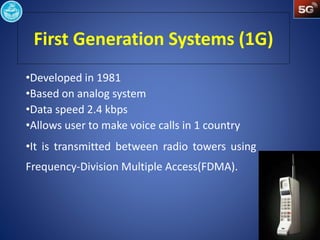
First Generation Systems (1G) 
•Developed in 1981 
•Based on analog system 
•Data speed 2.4 kbps 
•Allows user to make voice calls in 1 country 
•It is transmitted between radio towers using 
Frequency-Division Multiple Access(FDMA).
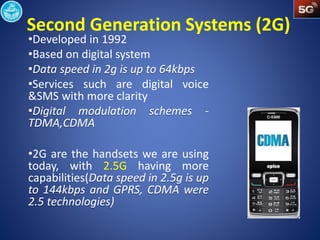
Second Generation Systems (2G) 
•Developed in 1992 
•Based on digital system 
•Services such are digital voice 
&SMS with more clarity 
•2G are the handsets we are using 
today, with 2.5G having more 
capabilities(
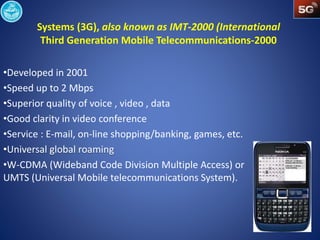
Systems (3G), also known as IMT-2000 (International 
Third Generation Mobile Telecommunications-2000 
•Developed in 2001 
•Speed up to 2 Mbps 
•Superior quality of voice , video , data 
•Good clarity in video conference 
•Service : E-mail, on-line shopping/banking, games, etc. 
•W-CDMA (Wideband Code Division Multiple Access) or 
UMTS (Universal Mobile telecommunications System).
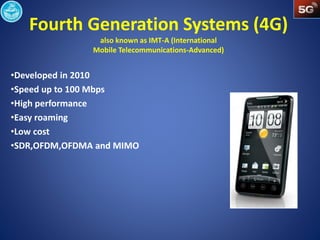
Fourth Generation Systems (4G) 
also known as IMT-A (International 
Mobile Telecommunications-Advanced) 
•Developed in 2010 
•Speed up to 100 Mbps 
•High performance 
•Easy roaming 
•Low cost
5G Concept 
The twenty-first century is surely the “century of speed”, and 
achieves a high evolution in all the possible domains, 
especially in communication . Therefore, a new technology 
started to be delineated, that will provide all the possible 
applications, by using only one universal device, and 
interconnecting the already existing communication 
infrastructures—that is the fifth generation of the mobile 
communications standards—5G. 
In 2009 proposed for the first time in the literature the 
WISDOM concept, and gave an in point 5G definition: 
4G & WISDOM ⇒ 5G
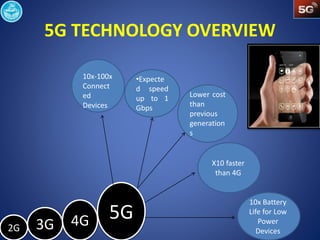
5G TECHNOLOGY OVERVIEW 
10x-100x 
Connect 
ed 
Devices 
2G 3G 4G 5G 
•Expecte 
d speed 
up to 1 
Gbps 
Lower cost 
than 
previous 
generation 
s 
10x Battery 
Life for Low 
Power 
Devices 
X10 faster 
than 4G
Hardware & Software of 5G 
 5G Software: 
• 5G will be single unified 
standard of different 
wireless networks, including 
LAN technologies, 
LAN/WAN, WWWW- World 
Wide Wireless Web, unified 
IP 
• Internet protocol version 
6(IPv6)*. 
• One unified global standard. 
 5G Hardware: 
• Uses UWB (Ultra Wide 
Band) networks with higher 
BW at low energy levels 
• Uses smart antenna 
• Uses CDMA (Code Division 
Multiple Access)
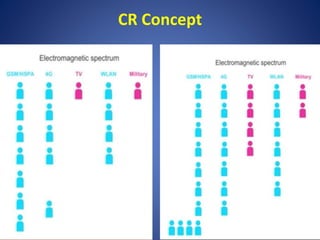
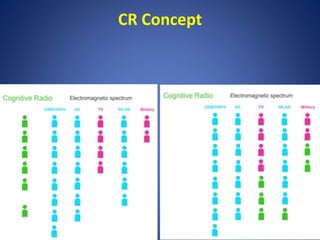
CR Concept
CR Concept
CR Technology: Definition 
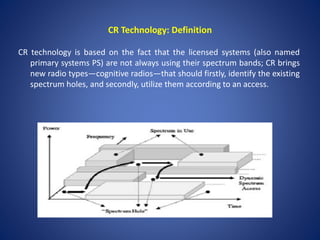
CR technology is based on the fact that the licensed systems (also named 
primary systems PS) are not always using their spectrum bands; CR brings 
new radio types—cognitive radios—that should firstly, identify the existing 
spectrum holes, and secondly, utilize them according to an access.
Spectrum Management Implications 
By spectrum sensing: it is mainly understood the CRs 
capability to detect the available channels, within the pre-existing 
systems licensed bands. 
• signal detection: does a signal exist on the sensed channel? 
(In this step is no need to 
know the type of the existing signal); 
• signal classification: in the case when a signal exist, is the 
signal a PUs signal? (the 
signal type is usually determined by extracting the sensed 
signal features); 
• channel availability decision, based on some criterion or 
rule: the channel is or not 
available?
Increasing the Performance in 5G: CR 
based 5G 
It can be summarized that the 5G goal is to 
integrate/inter-connect various types of 
communication technologies, and the CR ability is 
to self integrate into the wireless world 
diversity.(Basically 5G integrates and 
interconnects all the wireless technologies, and 
CR adapts and works with all the wireless 
technologies.) these features are 5G essential in 
order to manage the complexity induced by a 
variety of possible usage scenarios, on the one 
hand, and to minimize the spectrum, on the 
other hand
Conclusions 
• I presented and discussed the 5G and CR 
technologies, and finally 5G network based on 
the CR functionality has been proposed. 
• The proposed CR-5G network is strongly 
sustained by the main 5G requirements 
achievement through the CR use, in a high-performance 
manner.
Reference 
-ENERGY-EFFICIENT COGNITIVE RADIO ,Xuemin Hong, Jing Wang, Cheng-Xiang Wang, and Jianghong Shi ,Cognitive Radio in 5G: A 
Perspective on Energy-Spectral Efficiency Trade-off, IEEE Communications Magazine • July 2014 
-COGNITIVE RADIO RESOURCE MANAGEMENT FOR FUTURE CELLULAR NETWORKS, SHAO-YU LIEN, NATIONAL FORMOSA 
UNIVERSITY KWANG-CHENG CHEN, NATIONAL TAIWAN UNIVERSITY 
YING-CHANG LIANG, INSTITUTE FOR INFOCOMM RESEARCH (I2R) AND UNIVERSITY OF ELECTRONIC SCIENCE AND TECHNOLOGY 
OF CHINA YONGHUA LIN, IBM RESEARCH DIVISION, IEEE Wireless Communications • February 2014 
EMERGING TECHNOLOGIES AND RESEARCH 
CHALLENGES FOR 5G WIRELESS NETWORKS, WOON HAU CHIN, ZHONG FAN, AND RUSSELL HAINES, IEEE Wireless 
Communications • April 2014 
-Selfish Attacks and Detection in 
Cognitive Radio Ad-Hoc Networks 
Minho Jo, Longzhe Han, Dohoon Kim, and Hoh Peter In, Korea University, IEEE Network • May/June 2013 
- Cognitive Radio Networks, Adrian Popescu ,Dept. of Communications and Computer Systems,School of Computing,Blekinge 
Institute of Technology,371 79 Karlskrona, Sweden 
-Cognitive Radio in 5G: A Perspective on Energy-Spectral Efficiency Trade-off, Xuemin Hong, Jing Wang, Cheng-Xiang Wang, and 
Jianghong Shi, IEEE Communications Magazine • July 2014 
-Cellular Architecture and Key 
Technologies for 5G Wireless 
Communication Networks, Cheng-Xiang Wang, Heriot-Watt University and University of Tabuk Fourat Haider, Heriot-Watt 
University Xiqi Gao and Xiao-Hu You, Southeast University,Yang Yang, ShanghaiTech University Dongfeng Yuan, Shandong 
University 
Hadi M. Aggoune, University of Tabuk ,Harald Haas, University of Edinburgh ,Simon Fletcher, NEC Telecom MODUS Ltd. 
Erol Hepsaydir, Hutchison 3G UK, IEEE Communications Magazine • February 2014 
•
THANK YOU

Cognitive Radio in 5G

  • 1.
    COGNITIVE RADIO IN5G NILOOFAR HASHEMZADFOROUZAN MOBILE COMMUNICATION UNIVERSITY OF TEHRAN
  • 2.
    COGNITIVE RADIO IN5G • Introduction • Describes the mobile telephony standards evolution over the time • 5g concept • Cognitive Radio’ concept • Proposed Solution for 5G: CR Based 5G • Conclusion
  • 3.
    Introduction Both thecognitive radio (CR) and the fifth generation of cellular wireless standards (5G) are considered to be the future technologies: on one hand, CR offers the possibility to significantly increase the spectrum efficiency, by smart secondary users (CR users) using the free licensed users spectrum holes; on the other hand, the 5G implies the whole wireless world interconnection (WISDOM—Wireless Innovative System for Dynamic Operating Mega communications concept), together with very high data rates Quality of Service (QoS) service applications. In this project they are combined together into a “CR based 5G”.
  • 4.
    First Generation Systems(1G) •Developed in 1981 •Based on analog system •Data speed 2.4 kbps •Allows user to make voice calls in 1 country •It is transmitted between radio towers using Frequency-Division Multiple Access(FDMA).
  • 5.
    Second Generation Systems(2G) •Developed in 1992 •Based on digital system •Services such are digital voice &SMS with more clarity •2G are the handsets we are using today, with 2.5G having more capabilities(
  • 6.
    Systems (3G), alsoknown as IMT-2000 (International Third Generation Mobile Telecommunications-2000 •Developed in 2001 •Speed up to 2 Mbps •Superior quality of voice , video , data •Good clarity in video conference •Service : E-mail, on-line shopping/banking, games, etc. •W-CDMA (Wideband Code Division Multiple Access) or UMTS (Universal Mobile telecommunications System).
  • 7.
    Fourth Generation Systems(4G) also known as IMT-A (International Mobile Telecommunications-Advanced) •Developed in 2010 •Speed up to 100 Mbps •High performance •Easy roaming •Low cost
  • 8.
    5G Concept Thetwenty-first century is surely the “century of speed”, and achieves a high evolution in all the possible domains, especially in communication . Therefore, a new technology started to be delineated, that will provide all the possible applications, by using only one universal device, and interconnecting the already existing communication infrastructures—that is the fifth generation of the mobile communications standards—5G. In 2009 proposed for the first time in the literature the WISDOM concept, and gave an in point 5G definition: 4G & WISDOM ⇒ 5G
  • 9.
    5G TECHNOLOGY OVERVIEW 10x-100x Connect ed Devices 2G 3G 4G 5G •Expecte d speed up to 1 Gbps Lower cost than previous generation s 10x Battery Life for Low Power Devices X10 faster than 4G
  • 10.
    Hardware & Softwareof 5G  5G Software: • 5G will be single unified standard of different wireless networks, including LAN technologies, LAN/WAN, WWWW- World Wide Wireless Web, unified IP • Internet protocol version 6(IPv6)*. • One unified global standard.  5G Hardware: • Uses UWB (Ultra Wide Band) networks with higher BW at low energy levels • Uses smart antenna • Uses CDMA (Code Division Multiple Access)
  • 11.
  • 12.
  • 13.
    CR Technology: Definition CR technology is based on the fact that the licensed systems (also named primary systems PS) are not always using their spectrum bands; CR brings new radio types—cognitive radios—that should firstly, identify the existing spectrum holes, and secondly, utilize them according to an access.
  • 14.
    Spectrum Management Implications By spectrum sensing: it is mainly understood the CRs capability to detect the available channels, within the pre-existing systems licensed bands. • signal detection: does a signal exist on the sensed channel? (In this step is no need to know the type of the existing signal); • signal classification: in the case when a signal exist, is the signal a PUs signal? (the signal type is usually determined by extracting the sensed signal features); • channel availability decision, based on some criterion or rule: the channel is or not available?
  • 15.
    Increasing the Performancein 5G: CR based 5G It can be summarized that the 5G goal is to integrate/inter-connect various types of communication technologies, and the CR ability is to self integrate into the wireless world diversity.(Basically 5G integrates and interconnects all the wireless technologies, and CR adapts and works with all the wireless technologies.) these features are 5G essential in order to manage the complexity induced by a variety of possible usage scenarios, on the one hand, and to minimize the spectrum, on the other hand
  • 16.
    Conclusions • Ipresented and discussed the 5G and CR technologies, and finally 5G network based on the CR functionality has been proposed. • The proposed CR-5G network is strongly sustained by the main 5G requirements achievement through the CR use, in a high-performance manner.
  • 17.
    Reference -ENERGY-EFFICIENT COGNITIVERADIO ,Xuemin Hong, Jing Wang, Cheng-Xiang Wang, and Jianghong Shi ,Cognitive Radio in 5G: A Perspective on Energy-Spectral Efficiency Trade-off, IEEE Communications Magazine • July 2014 -COGNITIVE RADIO RESOURCE MANAGEMENT FOR FUTURE CELLULAR NETWORKS, SHAO-YU LIEN, NATIONAL FORMOSA UNIVERSITY KWANG-CHENG CHEN, NATIONAL TAIWAN UNIVERSITY YING-CHANG LIANG, INSTITUTE FOR INFOCOMM RESEARCH (I2R) AND UNIVERSITY OF ELECTRONIC SCIENCE AND TECHNOLOGY OF CHINA YONGHUA LIN, IBM RESEARCH DIVISION, IEEE Wireless Communications • February 2014 EMERGING TECHNOLOGIES AND RESEARCH CHALLENGES FOR 5G WIRELESS NETWORKS, WOON HAU CHIN, ZHONG FAN, AND RUSSELL HAINES, IEEE Wireless Communications • April 2014 -Selfish Attacks and Detection in Cognitive Radio Ad-Hoc Networks Minho Jo, Longzhe Han, Dohoon Kim, and Hoh Peter In, Korea University, IEEE Network • May/June 2013 - Cognitive Radio Networks, Adrian Popescu ,Dept. of Communications and Computer Systems,School of Computing,Blekinge Institute of Technology,371 79 Karlskrona, Sweden -Cognitive Radio in 5G: A Perspective on Energy-Spectral Efficiency Trade-off, Xuemin Hong, Jing Wang, Cheng-Xiang Wang, and Jianghong Shi, IEEE Communications Magazine • July 2014 -Cellular Architecture and Key Technologies for 5G Wireless Communication Networks, Cheng-Xiang Wang, Heriot-Watt University and University of Tabuk Fourat Haider, Heriot-Watt University Xiqi Gao and Xiao-Hu You, Southeast University,Yang Yang, ShanghaiTech University Dongfeng Yuan, Shandong University Hadi M. Aggoune, University of Tabuk ,Harald Haas, University of Edinburgh ,Simon Fletcher, NEC Telecom MODUS Ltd. Erol Hepsaydir, Hutchison 3G UK, IEEE Communications Magazine • February 2014 •
  • 18.