Cognitive Psychology
Lesson 4 - Spring 2019
The spatial brain
Professor Valentina Bazzarin
USAC Reggio Emilia
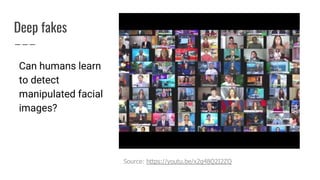
Deep fakes
Source: https://youtu.be/x2g48Q2I2ZQ
Can humans learn
to detect
manipulated facial
images?
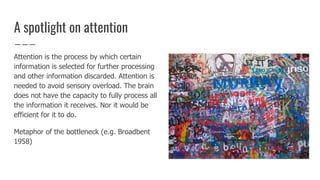
A spotlight on attention
Attention is the process by which certain
information is selected for further processing
and other information discarded. Attention is
needed to avoid sensory overload. The brain
does not have the capacity to fully process all
the information it receives. Nor it would be
efficient for it to do.
Metaphor of the bottleneck (e.g. Broadbent
1958)
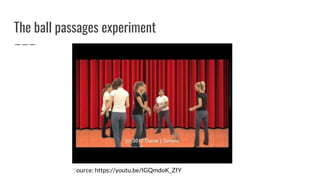
The ball passages experiment
Source: https://youtu.be/IGQmdoK_ZfY
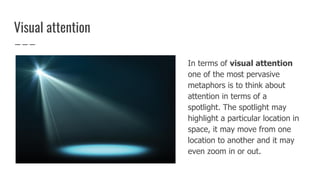
Visual attention
In terms of visual attention
one of the most pervasive
metaphors is to think about
attention in terms of a
spotlight. The spotlight may
highlight a particular location in
space, it may move from one
location to another and it may
even zoom in or out.
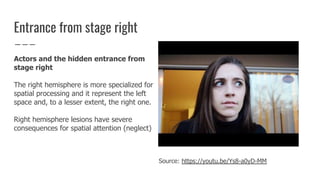
Entrance from stage right
Actors and the hidden entrance from
stage right
The right hemisphere is more specialized for
spatial processing and it represent the left
space and, to a lesser extent, the right one.
Right hemisphere lesions have severe
consequences for spatial attention (neglect)
Source: https://youtu.be/Ys8-a0yD-MM
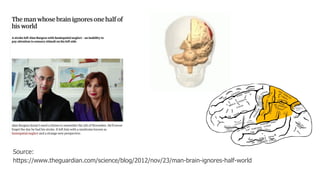
Source:
https://www.theguardian.com/science/blog/2012/nov/23/man-brain-ignores-half-world
But Did You See the Gorilla? The Problem With Inattentional
Blindness
“How could they miss something right before their eyes? This form of invisibility
depends not on the limits of the eye, but on the limits of the mind. We
consciously see only a small subset of our visual world, and when our attention is
focused on one thing, we fail to notice other, unexpected things around us,
including those we might want to see.”
https://www.smithsonianmag.com/science-nature/but-did-you-see-the-gorilla-the-problem-with-inattentional-blindness-173
39778/#PBmjB0cD5yuFzX3v.99
Orienting the spotlight
We can assume that the spotlight initially shifts to the cued location, but if the
target does not appear attention shifts to another location (disengagement).
There is a processing cost in terms of reaction time associated with going back to
the previously attended location, called inhibition of return.
Exogenous orienting: attention that is externally guided by a stimulus
Endogenous orienting: attention is guided by the goals of the perceiver.
Visual search: a task of detecting the presence or absence of a specified target
object in an array of other distracting objects.
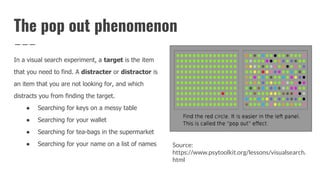
The pop out phenomenon
In a visual search experiment, a target is the item
that you need to find. A distracter or distractor is
an item that you are not looking for, and which
distracts you from finding the target.
● Searching for keys on a messy table
● Searching for your wallet
● Searching for tea-bags in the supermarket
● Searching for your name on a list of names Source:
https://www.psytoolkit.org/lessons/visualsearch.
html
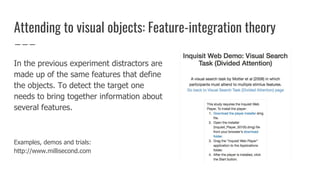
Attending to visual objects: Feature-integration theory
In the previous experiment distractors are
made up of the same features that define
the objects. To detect the target one
needs to bring together information about
several features.
Examples, demos and trials:
http://www.millisecond.com
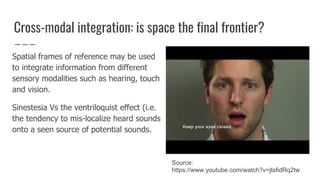
Cross-modal integration: is space the final frontier?
Spatial frames of reference may be used
to integrate information from different
sensory modalities such as hearing, touch
and vision.
Sinestesia Vs the ventriloquist effect (i.e.
the tendency to mis-localize heard sounds
onto a seen source of potential sounds.
Source:
https://www.youtube.com/watch?v=jtsfidRq2tw
Losing space: Seeing one object at a time
Balint’s syndrome is a severe difficulty
in spatial processing normally following
bilateral lesions of the parietal lobe;
symptoms include simultagnosia, optic
ataxia and optic apraxia.
Simultagnosia is the inability to perceive
more than one object at a time.
3 clinical characteristics of
Balint’s syndrome:
1) Inability to perceive more
than one object at a time
(simultagnosia)
2) Inability to reach in the
proper direction for an
object under visual
guidance (optic ataxia)
3) Fixation of gaze without a
primary deficit of eye
movement (optic apraxia)
Losing half of space: Spatial frames and neglect
Is neglect a problem in low level perception or attention?
Functional imaging reveals that the objects in the neglected visual feed still
activate visual regions in the occipital cortex. So neglect is not a disorder of low
level visual perception.
One additional symptom of neglect that illustrate this point is called “extinction”:
when presented with two stimuli at the same time (one in each hemispace), then
the stimulus on the opposite side of the lesion is not consciously perceived.
Remembering space: Does the hippocampus store a
long-term map of the environment?
https://www.ted.com/talks/neil_burgess_how_your_brain_tells_you_where_you_are
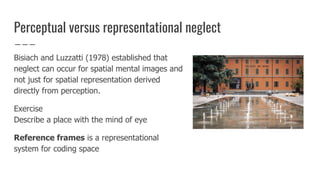
Perceptual versus representational neglect
Bisiach and Luzzatti (1978) established that
neglect can occur for spatial mental images and
not just for spatial representation derived
directly from perception.
Exercise
Describe a place with the mind of eye
Reference frames is a representational
system for coding space
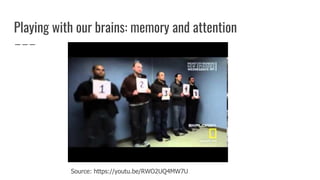
Playing with our brains: memory and attention
Source: https://youtu.be/RWO2UQ4MW7U
Hallucinations
Source: https://youtu.be/SgOTaXhbqPQ
Maps of fantasy worlds: realism

Cognitive psychology L4 spring 2019

  • 1.
    Cognitive Psychology Lesson 4- Spring 2019 The spatial brain Professor Valentina Bazzarin USAC Reggio Emilia
  • 2.
    Deep fakes Source: https://youtu.be/x2g48Q2I2ZQ Canhumans learn to detect manipulated facial images?
  • 3.
    A spotlight onattention Attention is the process by which certain information is selected for further processing and other information discarded. Attention is needed to avoid sensory overload. The brain does not have the capacity to fully process all the information it receives. Nor it would be efficient for it to do. Metaphor of the bottleneck (e.g. Broadbent 1958)
  • 4.
    The ball passagesexperiment Source: https://youtu.be/IGQmdoK_ZfY
  • 5.
    Visual attention In termsof visual attention one of the most pervasive metaphors is to think about attention in terms of a spotlight. The spotlight may highlight a particular location in space, it may move from one location to another and it may even zoom in or out.
  • 6.
    Entrance from stageright Actors and the hidden entrance from stage right The right hemisphere is more specialized for spatial processing and it represent the left space and, to a lesser extent, the right one. Right hemisphere lesions have severe consequences for spatial attention (neglect) Source: https://youtu.be/Ys8-a0yD-MM
  • 7.
  • 8.
    But Did YouSee the Gorilla? The Problem With Inattentional Blindness “How could they miss something right before their eyes? This form of invisibility depends not on the limits of the eye, but on the limits of the mind. We consciously see only a small subset of our visual world, and when our attention is focused on one thing, we fail to notice other, unexpected things around us, including those we might want to see.” https://www.smithsonianmag.com/science-nature/but-did-you-see-the-gorilla-the-problem-with-inattentional-blindness-173 39778/#PBmjB0cD5yuFzX3v.99
  • 9.
    Orienting the spotlight Wecan assume that the spotlight initially shifts to the cued location, but if the target does not appear attention shifts to another location (disengagement). There is a processing cost in terms of reaction time associated with going back to the previously attended location, called inhibition of return. Exogenous orienting: attention that is externally guided by a stimulus Endogenous orienting: attention is guided by the goals of the perceiver. Visual search: a task of detecting the presence or absence of a specified target object in an array of other distracting objects.
  • 10.
    The pop outphenomenon In a visual search experiment, a target is the item that you need to find. A distracter or distractor is an item that you are not looking for, and which distracts you from finding the target. ● Searching for keys on a messy table ● Searching for your wallet ● Searching for tea-bags in the supermarket ● Searching for your name on a list of names Source: https://www.psytoolkit.org/lessons/visualsearch. html
  • 11.
    Attending to visualobjects: Feature-integration theory In the previous experiment distractors are made up of the same features that define the objects. To detect the target one needs to bring together information about several features. Examples, demos and trials: http://www.millisecond.com
  • 12.
    Cross-modal integration: isspace the final frontier? Spatial frames of reference may be used to integrate information from different sensory modalities such as hearing, touch and vision. Sinestesia Vs the ventriloquist effect (i.e. the tendency to mis-localize heard sounds onto a seen source of potential sounds. Source: https://www.youtube.com/watch?v=jtsfidRq2tw
  • 13.
    Losing space: Seeingone object at a time Balint’s syndrome is a severe difficulty in spatial processing normally following bilateral lesions of the parietal lobe; symptoms include simultagnosia, optic ataxia and optic apraxia. Simultagnosia is the inability to perceive more than one object at a time. 3 clinical characteristics of Balint’s syndrome: 1) Inability to perceive more than one object at a time (simultagnosia) 2) Inability to reach in the proper direction for an object under visual guidance (optic ataxia) 3) Fixation of gaze without a primary deficit of eye movement (optic apraxia)
  • 14.
    Losing half ofspace: Spatial frames and neglect Is neglect a problem in low level perception or attention? Functional imaging reveals that the objects in the neglected visual feed still activate visual regions in the occipital cortex. So neglect is not a disorder of low level visual perception. One additional symptom of neglect that illustrate this point is called “extinction”: when presented with two stimuli at the same time (one in each hemispace), then the stimulus on the opposite side of the lesion is not consciously perceived.
  • 15.
    Remembering space: Doesthe hippocampus store a long-term map of the environment? https://www.ted.com/talks/neil_burgess_how_your_brain_tells_you_where_you_are
  • 16.
    Perceptual versus representationalneglect Bisiach and Luzzatti (1978) established that neglect can occur for spatial mental images and not just for spatial representation derived directly from perception. Exercise Describe a place with the mind of eye Reference frames is a representational system for coding space
  • 17.
    Playing with ourbrains: memory and attention Source: https://youtu.be/RWO2UQ4MW7U
  • 18.