Cognitive Psychology
Lesson 09 - Spring 2019
The numerate brain
The executive brain
Professor Valentina Bazzarin
USAC Reggio Emilia
The numerate brain
This part is not concerned with
algebra but with a core set of
numerical abilities that seem to be
common to almost all humans from
infants to elderly, from the
unschooled to the mathematical
prodigy. Also many other animals have
a basic understanding of numbers.
Dyscalculia (acalculia): difficulties
in understanding numbers; calculation
difficulties.
https://youtu.be/u-Ak83B_G6E
The percentage of the population
with developmental dyscalculia is
estimated to be between 3­6
percent, or one in twenty
individuals,” says Line Rothmann,
and she is one of them. As a
dyscalculic, she has difficulty
understanding anything and
everything math related.
https://www.youtube.com/watch?v=rlPFv_E
DnvY
Knowledge of numbers has a dedicated neural substrate
Knowledge of numbers is a basic and near universal aspect of
cognition. It is aided by language and cultural knowledge but it is
not dependent on these.
Number meanings can be selectively impaired by damage (dyscalculia)
and may have a dedicated neural substrate (including the
intraparietal sulcus).
Whereas the right hemisphere enables the approximate representation
of number (e.g. about 10), the left hemisphere may enable exact, or
countable, quantification (e.g. exactly 10). This is likely because
the left hemisphere number meaning system can interface with
symbolic/linguistic representations.
Teaching math
without words
https://youtu.be/7odhYT8yzUM
The meaning of numbers and counting
The meaning of numbers has been variously referred to as magnitude,
quantity (Dehaene 1997) or numerosity (Butterworth 1999). Number
meaning is abstract and independent from of the format used to
denote (e.g. 3, III, three, tre). Integer numbers or whole numbers
are properties of a collection.
Counting is the process of putting each item in a collection in a
one-to-one correspondence with a number or some other
internal/external tally.
Different types of calculation procedure (addition, division, etc.)
may be selectively impaired by brain damage.
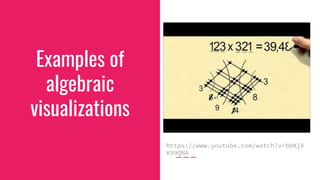
Examples of
algebraic
visualizations
https://www.youtube.com/watch?v=bbKjX
KV9QNA
Counting with fingers, bodies and bases
We need a method to keep track of how many
items have been counted so far.
- External items (marks on bones)
- Internal aids (linguistic symbols).
There is a restricted number of ways of
counting
- Use body parts
- Use base systems.
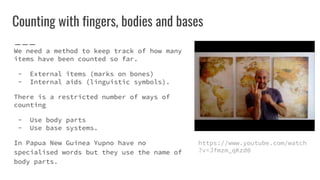
In Papua New Guinea Yupno have no
specialised words but they use the name of
body parts.
https://www.youtube.com/watch
?v=Jfmzm_qKzd0
Finger agnosia - Gerstmann's syndrome
Finger agnosia, first defined in 1924 by
Josef Gerstmann, is the loss in the ability
"to distinguish, name, or recognize the
fingers",[1]
not only the patient's own
fingers, but also the fingers of others, and
drawings and other representations of
fingers. It is one of a tetrad of symptoms
in Gerstmann syndrome, although it is also
possible for finger agnosia to exist on its
own without any other disorders. Usually,
lesions to the left angular gyrus and
posterior parietal areas can lead to finger
agnosia.
Source: wikipedia “finger agnosia”
https://www.youtube.com/watch
?v=vGr8Nbh0Qyw
Key-words
Finger agnosia is an inability to identify
individual fingers by touch.
Gerstmann's syndrome is a set of four deficits
(acalculia, finger agnosia, agraphia and
left-right disorientation) believed to be
associated with a damage to the left parietal
lobe.
Transcoding
Transcoding means that one symbol is translated into another
of a different type (it encompasses processes such as
reading, i.e passing from written symbols to verbal ones,
writing, i.e verbal labels to written symbols and others).
A number of studies have provided empirical evidence for a
direct route between arabic numeral recognition and verbal
output that bypasses number semantics (Cipollotti 1995).
Are numbers represented in a visuospatial code?
Numbers have a visuospatial component
that may relate to the fact that they
form an ordered set.
SNARC effect: if people are asked to
make judgements about numbers (e.g.
odd/even judgments) they are faster
with their left hand for small
numbers but faster with the right
hand for large numbers
https://technabob.com/blog/2011/1
1/11/virtual-icub-robot-counts-li
ke-a-human/
The executive brain
The executive functions of the brain can be defined as the
complex processes by which an individual optimizes his or
her performance in a situation that requires the operation
of a number of cognitive processes (Baddeley 1986).
Metaphor → brain’s conductor which instructs other regions
to perform or to be silenced, and generally coordinates
their synchronized activity (Goldberg 2001)
Metacognitive role: supervisory or controlling
Anatomical and functional divisions of the prefrontal cortex
Wikipedia : executive functions
Optimize executive functions
Executive functions are needed to performance when:
- Several cognitive processes need to be coordinated;
- A situation is novel or difficult;
- A situation does not require an automatic response;
Functional imaging studies and studies on brain-damaged patients
point to a key role of the prefrontal cortex in executive functions.
Patients with lesions here may have difficulties in problem solving,
overcoming habitual responses, multi-tasking and so on.
Working memory is involved too and may consist of several
subsystems, including maintenance and manipulation.
Executive functions in practice
https://www.youtube.com/watch?v=Vo-iygv
8s7M
https://www.youtube.com/watch?v=tXZa
u5VIIvU
Key words
Ecological validity: the extent to which a task
relates to everyday situations outside the laboratory
Wisconsin Card Sorting Test: A test of executive
functions involving rule induction and rule use
Stroop test: Response interference from naming the ink
color of a written color name (e.g. the word RED is
printed in blue and participants are asked to say the
ink color, that is blue)
Neuroeconomics
The use of brain
based
methods/theories in
order to account for
economic decision
making.
https://www.youtube.com/watch?v=2uca-L
oSqwE

Cog psy L9 spring2019

  • 1.
    Cognitive Psychology Lesson 09- Spring 2019 The numerate brain The executive brain Professor Valentina Bazzarin USAC Reggio Emilia
  • 2.
    The numerate brain Thispart is not concerned with algebra but with a core set of numerical abilities that seem to be common to almost all humans from infants to elderly, from the unschooled to the mathematical prodigy. Also many other animals have a basic understanding of numbers. Dyscalculia (acalculia): difficulties in understanding numbers; calculation difficulties. https://youtu.be/u-Ak83B_G6E
  • 3.
    The percentage ofthe population with developmental dyscalculia is estimated to be between 3­6 percent, or one in twenty individuals,” says Line Rothmann, and she is one of them. As a dyscalculic, she has difficulty understanding anything and everything math related. https://www.youtube.com/watch?v=rlPFv_E DnvY
  • 4.
    Knowledge of numbershas a dedicated neural substrate Knowledge of numbers is a basic and near universal aspect of cognition. It is aided by language and cultural knowledge but it is not dependent on these. Number meanings can be selectively impaired by damage (dyscalculia) and may have a dedicated neural substrate (including the intraparietal sulcus). Whereas the right hemisphere enables the approximate representation of number (e.g. about 10), the left hemisphere may enable exact, or countable, quantification (e.g. exactly 10). This is likely because the left hemisphere number meaning system can interface with symbolic/linguistic representations.
  • 5.
  • 6.
    The meaning ofnumbers and counting The meaning of numbers has been variously referred to as magnitude, quantity (Dehaene 1997) or numerosity (Butterworth 1999). Number meaning is abstract and independent from of the format used to denote (e.g. 3, III, three, tre). Integer numbers or whole numbers are properties of a collection. Counting is the process of putting each item in a collection in a one-to-one correspondence with a number or some other internal/external tally. Different types of calculation procedure (addition, division, etc.) may be selectively impaired by brain damage.
  • 7.
  • 8.
    Counting with fingers,bodies and bases We need a method to keep track of how many items have been counted so far. - External items (marks on bones) - Internal aids (linguistic symbols). There is a restricted number of ways of counting - Use body parts - Use base systems. In Papua New Guinea Yupno have no specialised words but they use the name of body parts. https://www.youtube.com/watch ?v=Jfmzm_qKzd0
  • 9.
    Finger agnosia -Gerstmann's syndrome Finger agnosia, first defined in 1924 by Josef Gerstmann, is the loss in the ability "to distinguish, name, or recognize the fingers",[1] not only the patient's own fingers, but also the fingers of others, and drawings and other representations of fingers. It is one of a tetrad of symptoms in Gerstmann syndrome, although it is also possible for finger agnosia to exist on its own without any other disorders. Usually, lesions to the left angular gyrus and posterior parietal areas can lead to finger agnosia. Source: wikipedia “finger agnosia” https://www.youtube.com/watch ?v=vGr8Nbh0Qyw
  • 10.
    Key-words Finger agnosia isan inability to identify individual fingers by touch. Gerstmann's syndrome is a set of four deficits (acalculia, finger agnosia, agraphia and left-right disorientation) believed to be associated with a damage to the left parietal lobe.
  • 11.
    Transcoding Transcoding means thatone symbol is translated into another of a different type (it encompasses processes such as reading, i.e passing from written symbols to verbal ones, writing, i.e verbal labels to written symbols and others). A number of studies have provided empirical evidence for a direct route between arabic numeral recognition and verbal output that bypasses number semantics (Cipollotti 1995).
  • 12.
    Are numbers representedin a visuospatial code? Numbers have a visuospatial component that may relate to the fact that they form an ordered set. SNARC effect: if people are asked to make judgements about numbers (e.g. odd/even judgments) they are faster with their left hand for small numbers but faster with the right hand for large numbers https://technabob.com/blog/2011/1 1/11/virtual-icub-robot-counts-li ke-a-human/
  • 13.
    The executive brain Theexecutive functions of the brain can be defined as the complex processes by which an individual optimizes his or her performance in a situation that requires the operation of a number of cognitive processes (Baddeley 1986). Metaphor → brain’s conductor which instructs other regions to perform or to be silenced, and generally coordinates their synchronized activity (Goldberg 2001) Metacognitive role: supervisory or controlling
  • 14.
    Anatomical and functionaldivisions of the prefrontal cortex Wikipedia : executive functions
  • 15.
    Optimize executive functions Executivefunctions are needed to performance when: - Several cognitive processes need to be coordinated; - A situation is novel or difficult; - A situation does not require an automatic response; Functional imaging studies and studies on brain-damaged patients point to a key role of the prefrontal cortex in executive functions. Patients with lesions here may have difficulties in problem solving, overcoming habitual responses, multi-tasking and so on. Working memory is involved too and may consist of several subsystems, including maintenance and manipulation.
  • 16.
    Executive functions inpractice https://www.youtube.com/watch?v=Vo-iygv 8s7M https://www.youtube.com/watch?v=tXZa u5VIIvU
  • 17.
    Key words Ecological validity:the extent to which a task relates to everyday situations outside the laboratory Wisconsin Card Sorting Test: A test of executive functions involving rule induction and rule use Stroop test: Response interference from naming the ink color of a written color name (e.g. the word RED is printed in blue and participants are asked to say the ink color, that is blue)
  • 18.
    Neuroeconomics The use ofbrain based methods/theories in order to account for economic decision making. https://www.youtube.com/watch?v=2uca-L oSqwE