CORE group
October 14, 2016
Social Analysis and Action
Social analysis and action
10/21/2016
2
Norms
Explore & Reflect
Catalyze change
process
Individual and
collective Actions
Social Analysis & Action is an approach,
designed to catalyze a process of
exploration and reflection to facilitate
individual and community actions that
support more equitable gender/social
norms and healthy behaviors.
What is a norm?
Equitable gender and social Norms
• What is a gender norm? social
norm?
• How do norms affect health,
nutrition and wellbeing?
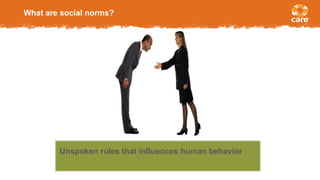
What are social norms?
Unspoken rules that influences human behavior
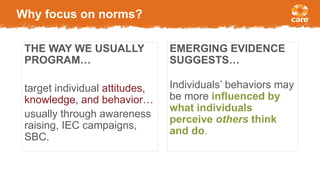
Why focus on norms?
THE WAY WE USUALLY
PROGRAM…
target individual attitudes,
knowledge, and behavior…
usually through awareness
raising, IEC campaigns,
SBC.
EMERGING EVIDENCE
SUGGESTS…
Individuals’ behaviors may
be more influenced by
what individuals
perceive others think
and do.
Social Analysis and Action
• A facilitated process through which individuals and
communities explore and challenge the social norms and
practices that shape their lives and health.
• Goal = Catalyze a community-owned change process
Individuals and communities challenge restrictive norms
Act together to create more equitable social norms
Build community support for the change process
10/21/2016
6
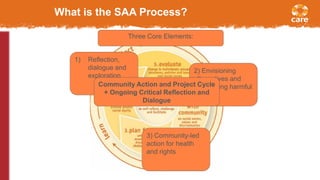
What is the SAA Process?
1) Reflection,
dialogue and
exploration
2) Envisioning
alternatives and
challenging harmful
norms
3) Community-led
action for health
and rights
Three Core Elements:
Community Action and Project Cycle
+ Ongoing Critical Reflection and
Dialogue
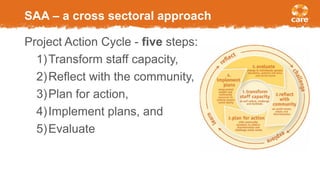
SAA – a cross sectoral approach
Project Action Cycle - five steps:
1)Transform staff capacity,
2)Reflect with the community,
3)Plan for action,
4)Implement plans, and
5)Evaluate
The repeated CRD process leads to:
• Increased understanding of how beliefs, attitudes and
norms may have negative effect on behaviors,
development outcomes
• Opportunity to imagine and discuss alternative ways of
thinking and behaving
• Changes in attitudes and perceptions to support more
equitable social and gender norms and healthier behaviors
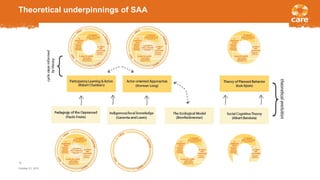
Theoretical underpinnings of SAA
October 21, 2016
10
Minimum set of processes for SAA:
1. Staff capacity transformation
2. Gender and situational analysis
3. Context tailored discussion guide for facilitators
4. Capacity building - skilled Facilitation using Critical
Reflective Dialogue
5. Process of Reflection and Dialogue
6. Monitoring and Evaluation
Processes for SAA …
• Staff transformation: A prerequisite to using SAA is building
staff and partners’ own ability to explore and reflect upon their own
social values and assumptions regarding gender and power.
• Gender and situational analysis: Conducting a situational
analysis at the start of a project is highly recommended and basis
for using SAA
• Context tailored discussion guide for facilitators
Processes for SAA …
• Skilled Facilitation for CRD:
• surface attitudes, values, perceptions and assumptions
• explore how these attitudes, values and perceptions shape behavior
• reflect on the consequences of those norms and behaviors.
• Continuous Process of Reflection and Dialogue:
• Regular reflection and dialogue (both with staffs and communities) that
focuses on addressing social and gender norms, attitudes and behaviors
• Monitoring and evaluation:
• qualitative, participatory documentation of processes and assessment of
changes.
Desired Outcomes of SAA include:
• Improved awareness and facility:- Program staff, collaborating
partners and communities – gender, power, norms
• Equitable social and gender norms - resulting in sector-specific
and cross-cutting behavior change at the household, community
and institutional levels
• More effective programs - resulting in concrete improvements in
the lives of individuals and communities
Key elements for a well documented SAA process
• Reflective process in which gender and power are
explicitly discussed
• Values, perceptions, practices and larger changes
occurring in social norms are qualitatively assessed.
• Objectively verifiable measures of status (health,
livelihoods, nutrition…) for individuals and
communities evaluated.
Thank you
Please contact Feven Mekuria @ feven.mekuria@care.org or
Mariela Rodriguez @ mrodriguez@care.org for SAA related materials
October 21, 2016
16

Social Analysis and Action - CARE

  • 1.
    CORE group October 14,2016 Social Analysis and Action
  • 2.
    Social analysis andaction 10/21/2016 2 Norms Explore & Reflect Catalyze change process Individual and collective Actions Social Analysis & Action is an approach, designed to catalyze a process of exploration and reflection to facilitate individual and community actions that support more equitable gender/social norms and healthy behaviors.
  • 3.
    What is anorm? Equitable gender and social Norms • What is a gender norm? social norm? • How do norms affect health, nutrition and wellbeing?
  • 4.
    What are socialnorms? Unspoken rules that influences human behavior
  • 5.
    Why focus onnorms? THE WAY WE USUALLY PROGRAM… target individual attitudes, knowledge, and behavior… usually through awareness raising, IEC campaigns, SBC. EMERGING EVIDENCE SUGGESTS… Individuals’ behaviors may be more influenced by what individuals perceive others think and do.
  • 6.
    Social Analysis andAction • A facilitated process through which individuals and communities explore and challenge the social norms and practices that shape their lives and health. • Goal = Catalyze a community-owned change process Individuals and communities challenge restrictive norms Act together to create more equitable social norms Build community support for the change process 10/21/2016 6
  • 7.
    What is theSAA Process? 1) Reflection, dialogue and exploration 2) Envisioning alternatives and challenging harmful norms 3) Community-led action for health and rights Three Core Elements: Community Action and Project Cycle + Ongoing Critical Reflection and Dialogue
  • 8.
    SAA – across sectoral approach Project Action Cycle - five steps: 1)Transform staff capacity, 2)Reflect with the community, 3)Plan for action, 4)Implement plans, and 5)Evaluate
  • 9.
    The repeated CRDprocess leads to: • Increased understanding of how beliefs, attitudes and norms may have negative effect on behaviors, development outcomes • Opportunity to imagine and discuss alternative ways of thinking and behaving • Changes in attitudes and perceptions to support more equitable social and gender norms and healthier behaviors
  • 10.
    Theoretical underpinnings ofSAA October 21, 2016 10
  • 11.
    Minimum set ofprocesses for SAA: 1. Staff capacity transformation 2. Gender and situational analysis 3. Context tailored discussion guide for facilitators 4. Capacity building - skilled Facilitation using Critical Reflective Dialogue 5. Process of Reflection and Dialogue 6. Monitoring and Evaluation
  • 12.
    Processes for SAA… • Staff transformation: A prerequisite to using SAA is building staff and partners’ own ability to explore and reflect upon their own social values and assumptions regarding gender and power. • Gender and situational analysis: Conducting a situational analysis at the start of a project is highly recommended and basis for using SAA • Context tailored discussion guide for facilitators
  • 13.
    Processes for SAA… • Skilled Facilitation for CRD: • surface attitudes, values, perceptions and assumptions • explore how these attitudes, values and perceptions shape behavior • reflect on the consequences of those norms and behaviors. • Continuous Process of Reflection and Dialogue: • Regular reflection and dialogue (both with staffs and communities) that focuses on addressing social and gender norms, attitudes and behaviors • Monitoring and evaluation: • qualitative, participatory documentation of processes and assessment of changes.
  • 14.
    Desired Outcomes ofSAA include: • Improved awareness and facility:- Program staff, collaborating partners and communities – gender, power, norms • Equitable social and gender norms - resulting in sector-specific and cross-cutting behavior change at the household, community and institutional levels • More effective programs - resulting in concrete improvements in the lives of individuals and communities
  • 15.
    Key elements fora well documented SAA process • Reflective process in which gender and power are explicitly discussed • Values, perceptions, practices and larger changes occurring in social norms are qualitatively assessed. • Objectively verifiable measures of status (health, livelihoods, nutrition…) for individuals and communities evaluated.
  • 16.
    Thank you Please contactFeven Mekuria @ feven.mekuria@care.org or Mariela Rodriguez @ mrodriguez@care.org for SAA related materials October 21, 2016 16