Problems faced by students while
speaking English at intermediate
level in Pakistan
Prepared by
Ms. Rukhsana
TEFL Assignment
Code 5659
The Factors Causing these
Problems:
Bad Schooling
Unskilled Teachers
Grammar Translation method of Teaching
Impact of Mother Tongue
Role of Electronic Media (no educational programs)
Unmotivated Behavior of Teachers
No activities to promote speaking in the class.
Three kinds of speaking
situations
Interactive,
Partially interactive, and
Non-interactive
Difficulties
No correspondence
between sound and
symbols
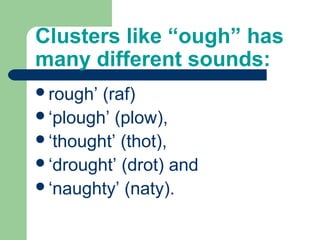
Clusters like “ough” has
many different sounds:
rough’ (raf)
‘plough’ (plow),
‘thought’ (thot),
‘drought’ (drot) and
‘naughty’ (naty).
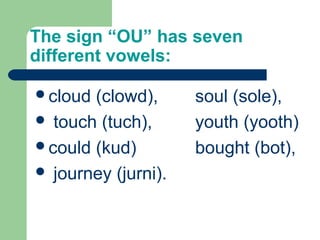
The sign “OU” has seven
different vowels:
cloud (clowd), soul (sole),
 touch (tuch), youth (yooth)
could (kud) bought (bot),
 journey (jurni).
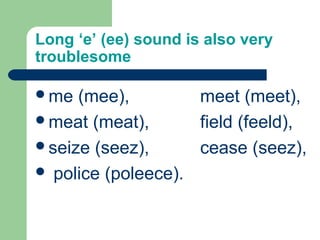
Long ‘e’ (ee) sound is also very
troublesome
me (mee), meet (meet),
meat (meat), field (feeld),
seize (seez), cease (seez),
 police (poleece).
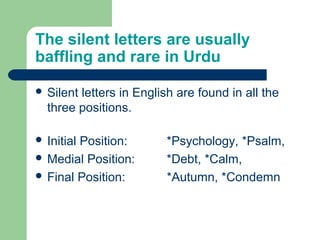
The silent letters are usually
baffling and rare in Urdu
 Silent letters in English are found in all the
three positions.
 Initial Position: *Psychology, *Psalm,
 Medial Position: *Debt, *Calm,
 Final Position: *Autumn, *Condemn
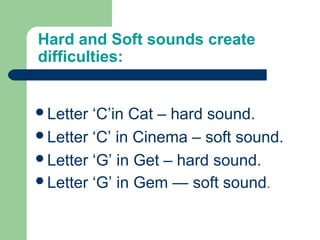
Hard and Soft sounds create
difficulties:
Letter ‘C’in Cat – hard sound.
Letter ‘C’ in Cinema – soft sound.
Letter ‘G’ in Get – hard sound.
Letter ‘G’ in Gem — soft sound.
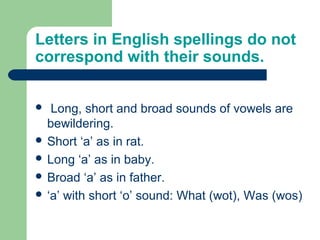
Letters in English spellings do not
correspond with their sounds.
 Long, short and broad sounds of vowels are
bewildering.
 Short ‘a’ as in rat.
 Long ‘a’ as in baby.
 Broad ‘a’ as in father.
 ‘a’ with short ‘o’ sound: What (wot), Was (wos)
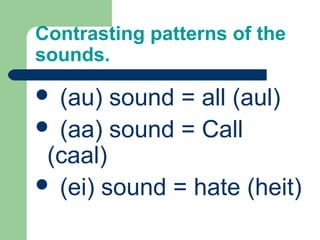
Contrasting patterns of the
sounds.
 (au) sound = all (aul)
 (aa) sound = Call
(caal)
 (ei) sound = hate (heit)
Transliteration:
The danger of it is that the
students pronounce the
English word as it is
expressed in Urdu.
Lack of Confidence
While speaking English most of
students feel shy owing to the lack
of confidence or have improper
knowledge of English Grammar or
Tenses etc.
Remedial Measures
 Qualified teachers to recruited and further
provide them training sessions to enhance their
spoken English.
 Students should practice speaking English and
correct pronunciation by watching movie etc.
 Audio-lingual method of teaching must be
adopted in schools for better practice.
Cont.…..
 Meaning of words must be explored by the
students so that they are learnt and
remembered better.
 Providing the students such an atmosphere so
that they can practice speaking English.
 English speaking clubs can be introduced so
that the students may communicate with each
other.
Thank you for
being with me!

Code 5659 ppt

  • 1.
    Problems faced bystudents while speaking English at intermediate level in Pakistan Prepared by Ms. Rukhsana TEFL Assignment Code 5659
  • 2.
    The Factors Causingthese Problems: Bad Schooling Unskilled Teachers Grammar Translation method of Teaching Impact of Mother Tongue Role of Electronic Media (no educational programs) Unmotivated Behavior of Teachers No activities to promote speaking in the class.
  • 3.
    Three kinds ofspeaking situations Interactive, Partially interactive, and Non-interactive
  • 4.
  • 5.
    Clusters like “ough”has many different sounds: rough’ (raf) ‘plough’ (plow), ‘thought’ (thot), ‘drought’ (drot) and ‘naughty’ (naty).
  • 6.
    The sign “OU”has seven different vowels: cloud (clowd), soul (sole),  touch (tuch), youth (yooth) could (kud) bought (bot),  journey (jurni).
  • 7.
    Long ‘e’ (ee)sound is also very troublesome me (mee), meet (meet), meat (meat), field (feeld), seize (seez), cease (seez),  police (poleece).
  • 8.
    The silent lettersare usually baffling and rare in Urdu  Silent letters in English are found in all the three positions.  Initial Position: *Psychology, *Psalm,  Medial Position: *Debt, *Calm,  Final Position: *Autumn, *Condemn
  • 9.
    Hard and Softsounds create difficulties: Letter ‘C’in Cat – hard sound. Letter ‘C’ in Cinema – soft sound. Letter ‘G’ in Get – hard sound. Letter ‘G’ in Gem — soft sound.
  • 10.
    Letters in Englishspellings do not correspond with their sounds.  Long, short and broad sounds of vowels are bewildering.  Short ‘a’ as in rat.  Long ‘a’ as in baby.  Broad ‘a’ as in father.  ‘a’ with short ‘o’ sound: What (wot), Was (wos)
  • 11.
    Contrasting patterns ofthe sounds.  (au) sound = all (aul)  (aa) sound = Call (caal)  (ei) sound = hate (heit)
  • 12.
    Transliteration: The danger ofit is that the students pronounce the English word as it is expressed in Urdu.
  • 13.
    Lack of Confidence Whilespeaking English most of students feel shy owing to the lack of confidence or have improper knowledge of English Grammar or Tenses etc.
  • 14.
    Remedial Measures  Qualifiedteachers to recruited and further provide them training sessions to enhance their spoken English.  Students should practice speaking English and correct pronunciation by watching movie etc.  Audio-lingual method of teaching must be adopted in schools for better practice.
  • 15.
    Cont.…..  Meaning ofwords must be explored by the students so that they are learnt and remembered better.  Providing the students such an atmosphere so that they can practice speaking English.  English speaking clubs can be introduced so that the students may communicate with each other.
  • 16.