HOW CAN EFL
PRONUNCIATION BE
TAUGHT?
SHAGUFTA MOGHAL
An Introduction to EFL:
• EFL stands for English as a foreign language. English as a foreign
language is the use of English by speakers with different native languages.
EFL is used for non-native English speakers learning English in country
where English is not commonly spoken.
Goals:
 we must take into consideration three
things:
 learner age
 amount of exposure
 differences of individual ability.
Learner Age:
The hypothesis claims that if humans do not learn a
foreign language before a certain age (perhaps around
puberty), then it becomes impossible to learn the foreign
language like a native speaker because of changes such as
maturation of the brain.
Differences Of Individual Ability:
Students have different phonetic abilities due to biological
and physiological differences. Some are more sensitive to
sounds and are better at imitating sounds than others.
Pronunciation:
The Production of Significant Sound. Significant because it
is used as part of a code of a particular language it is used
to achieve meaning in contexts of use.
Auditory Phonetics = The perception of the sound.
Articulatory Phonetics = The production of the sound.
Parts Of Pronunciation:
Sounds
Stress and rhythm
Intonation
Phonemes
• Smallest unit of sound that has meaning
• Represent various sounds that consonant and vowels, or
combinations, can create
• Written with phonetic symbols
• Here we will use IPA, the international phonetics Alphabet
Pronunciation Teaching:
• Pronunciation teaching not only makes students aware of
different sounds and sound features can also improve their
speaking immeasurably Showing where they are made in the
mouth, making students aware of where words should be
stressed.
Reasons To Teach Pronunciation:
functional intelligibility
 functional communicability
 increased self-confidence
speech monitoring abilities Why teach?
Functional Intelligibility:
Spoken English in which an accent is not distracting to the
listener.
Functional Communicability:
learner’ s ability to function successfully within the specific
communicative situations.
Speech Monitoring Abilities:
Good learners listen to the input and try to imitate it.
Steps For Teaching Pronunciation
Planning Stage:
• Three questions that you should
ask; Is it important? If yes; Collect
the information about the feature
you want to teach Spot the
potential problems of Turkish
learners
Teaching Stage:
• Description and analysis
• Listening discrimination
• Controlled practice (Teacher
centered, accuracy)
• Semi-controlled(Guided practice)
• Free practice (Communicative
practice)
Description And Analysis
The teacher presents a feature showing when and how it occurs. The teacher
can present examples and rules.
Listening Discrimination
 The teacher presents listening contextualized for activities for
discrimination exercises.
 Example
 You work/worked at the school.
 I live/lived in the city.
Controlled Practice
• In controlled activities the learner’s attention should be focused
almost completely on the form.
• Example
• Live Lived
• Work worked
• Study studied
Guided Practice
• In guided practice the learner’s attention is no longer entirely on form. The
learner now begins to focus on meaning, grammar and communicative intent
as well as pronunciation.
• Example
• A : did you work last night?
• B: yes, I did. I worked until 11:00 pm
• A: what did you do?
• B: I fixed my computer and prepared my report
Communicative Practice
• In this stage, activities balance between form and meaning.
• Example:
• Make a list of the activities you did on your last vocation. Talk to
a partner and find out about similarities and differences
Teaching EFL Pronunciation
Why is pronunciation necessary in EFL?
1. Pronunciation is an integral part of foreign language learning.
2. It directly effects learner’s communicative competence as well as
performance.
3. Teaching English pronunciation is still surprisingly neglected or ignored
in many EFL settings, most teachers do not have useful strategies or
techniques for teaching EFL pronunciation and as the do not know
what strategies are appropriate when they meet a specific problem, they
simply avoid pronunciation instruction in the classroom.
Continue….
Why should EFL pronunciation be taught?
The usefulness of teaching foreign language pronunciation is a widely
debated issue in the language teaching world.
Nonetheless pronunciation is definitely the biggest thing that people
notice when a person is speaking. Let us look at an example:
“whenever I spoke to a person in America, they kept asking me
“what? What?”.
I would repeat my sentence again and again. Finally they would say
“Ah-Ha” and then saw my sentence, using exactly my words. It was
very embarrassing. I knew my sentence and grammar were good, but
nobody would understand me, just because of my pronunciation.
Continue…….
What should be taught in pronunciation?
The question “what should be taught?” encompasses two
different points:
(a) the level, variety or accent of EFL
(b) the aspects, components or features of EFL pronunciation
 EFL learners have to try to get as close as possible in their
pronunciation to one of the dominant native-speaker accents
such as received pronunciation.
 EFL pronunciation should cover both the segmental and
suprasegmental as well as the training of speech organs, such
as lips, teeth, palate, tongue, vocal folds, ears etc.
Continue…
Segmental embody vowel and consonant sounds, preferably phonemes as
well as syllables. English language consist of 20 vowels (12 monophthong's
and 8 diphthong's) and 24 consonant phonemes.
The suprasegmental are comprised of stress in words and connected speech,
rhythm, pitch, loudness, length, quality and tone that play an essential and
natural role in English speech production and perception
Factors
Environmental, physical, psychological, instructional, and other
factors affect the process of learning and teaching English--
particularly its sound systems.
Continue….
• Factors are divided into two groups:
• Direct
• Indirect
the former denoting factors directly related to both the teacher
and the student, and the latter referring to factors with somehow
indirect impact on the teaching and learning task.
Continue…
Direct factor
 A very important factor influencing the value of correct pronunciation arises from the
society's needs and attitudes.
 The inadequate knowledge of some teachers of English about linguistics and
methodology has also caused many problems for both teachers and their students. For
instance, an English teacher pronounces a word in his/her class but the year after, the
same students may hear the same word with a completely different pronunciation.
Confused with the two diverse pronunciations, the students suggest that they have
been taught to pronounce that word in a different way by their previous teacher.
 It is obvious that one of the teachers is making a mistake because the difference
between the two pronunciations suggested for the same word is so big that it is rarely
justifiable by dialectal variations, i.e. British, American, Australian, etc.
Indirect Factor
 Concerning the indirect factors, firstly, the assigned time for
English classes through an academic year is so short that
the teachers may not even be able to cover the whole
textbook.
 Secondly, the presence of a large number of students in
class does not allow the teacher to control the class
effectively
Continue…..
• The third indirect factor related to the school environment is the lack of
facilities which could help the teacher a lot. Laboratories (at least tape-
recorders with a few preliminary instructional tapes), simple English books
in libraries, and some other teaching devices, such as video-players,
computers, DVD players, and the like seem to be of great use and help in
teaching English, especially in early intermediate classes.
Common Techniques When Teaching
Pronunciation
Drilling/ choral repetition
Minimal pairs
Kinesthetic activities
Technology enhanced
Peer monitoring
Phonetic chart
Graphic representation
Role plays
Drilling/ Choral Repetition
• Choral repetition is when the teacher or a learner models
language and the group of learners repeat it together.
• Example.
• The class are practicing the pronunciation of the schwa sound.
The teacher models words from a list and the learners repeat
them together.
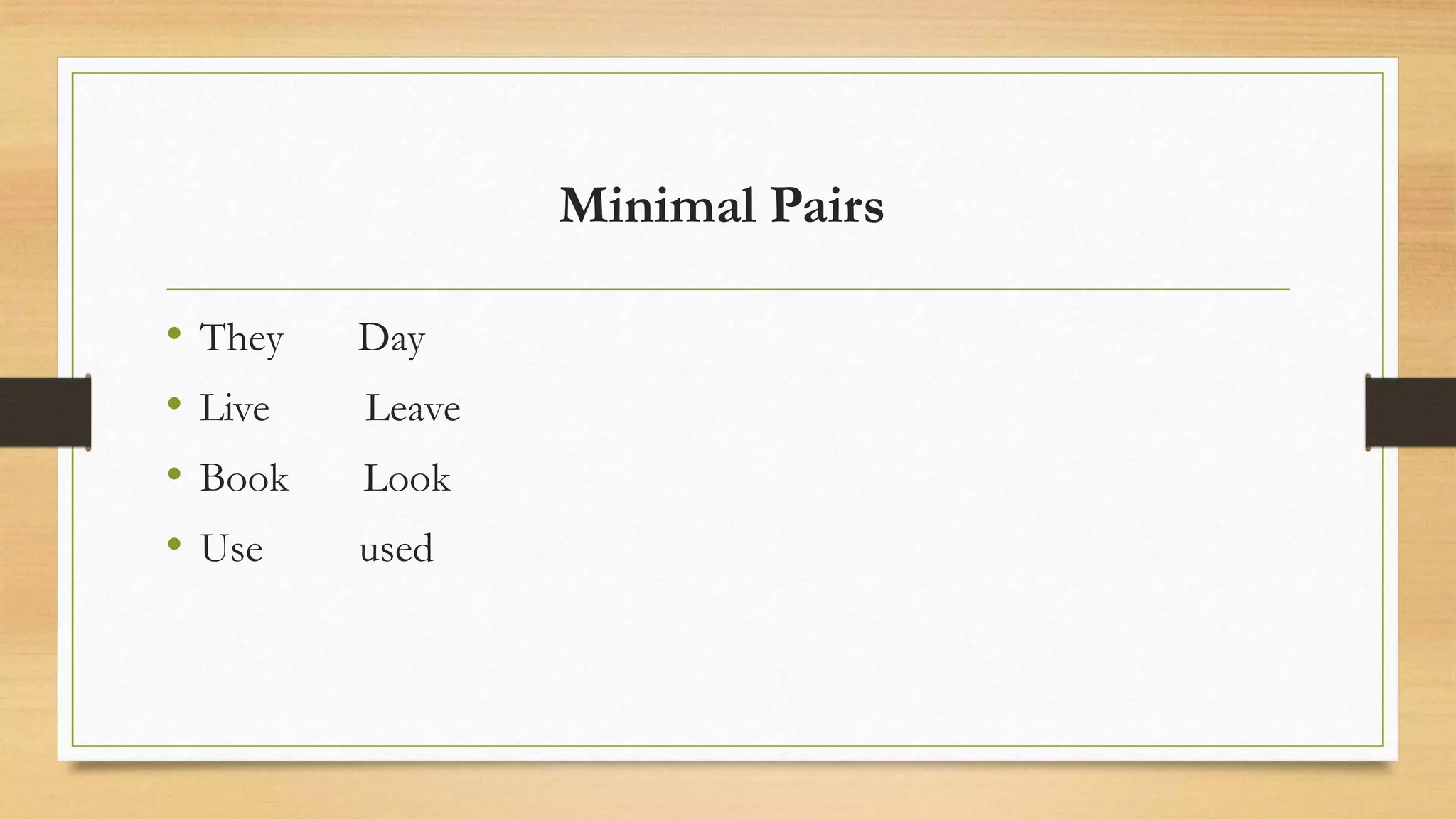
Minimal Pairs
• They Day
• Live Leave
• Book Look
• Use used
Kinesthetic Activities
• Which is your favorite dish…………..,……………. Or ………………?
Role Plays
• A: do you want some tea?
• B: no, thanks
• A: what about some milk?
• B: that sounds great.
Peer Monitoring
• Peer mentoring is a form of mentorship that usually takes place
between a person who has lived through a specific experience
(peer mentor) and a person who is new to that experience
(the peer mentee).
Phonemic Chart
Activities
Minimal Pairs Bingo
Odd One Out
Run and Grab
 Sound TPR (Total Physical Response)
Dictation
Card Games
Minimal Pair Math
Odd One Out
• Put similar words into groups of three—two with one sound, and one with a
different (although similar) sound. Or you could have groups of four or five which
contain the same sound, but only one that’s different. For example:
• meet, seat, sit (for vowels)
• plays, pace, space (for consonants)
• The selection of the odd word can be a reading exercise—where students read the
words to themselves out loud and identify the sounds in the written words—or
a listening exercise—where the teacher reads the words and the students respond to
the “odd” word.
Run and Grab
• You could have your minimal pairs on flashcards or you could simply write two (or
more) words at a time on the board.
• Create two teams and then pair students up with a member of the opposite team. In
turn, each pair goes to stand at the back of the room, looking down an aisle at the
board.
• When you call one of the minimal pairs out, the pair races to the front to touch the
correct word (the odd word out) on the board or grab the appropriate flashcard.
• Students from the winning team could have a turn at calling the words for others to
run to.
Minimal Pairs Bingo
• A Bingo card commonly has 5 x 5 squares, so you can use 25 words (12
minimal pairs, or more than two words for some sounds). One or more
spaces on each card could be a “free” spot, or you could change the size,
maybe to 4 x 4. (I have found that 25 words works well for a full lesson, and
everyone will be able to learn them all by the end.)
Sound TPR (Total Physical Response)
• Designate particular movements to particular sounds, as lively or as gentle as
you like. For instance, they could be sitting at their desks and raise a hand,
clap or stand up when they hear a particular sound, or they could be standing
in a space and jump or run in response to sounds.
Dictation
• Dictation is when someone speaks out loud and someone else writes it
down. Getting your students to write down what you say is good listening
practice for them, and when you’re dictating minimal pairs they need
to listen especially carefully.
Card Games
• Flashcards are a wonderful resource that every ESL teacher should have
bundles of. They can be used for whole class activities and games, or you can
create multiple smaller sets to be used by individuals at their desks or in
pair/group work activities.
Minimal Pair Math
• Assign a number to each of the minimal pair words you wish to focus on.
Then call out the words in your chosen sequence, possibly joined with
mathematical symbols (e.g., plus, minus). Students can write down the words
and their associated numbers while you speak. Ask the students to give you
the final number that all these words add up to.
How to Solve ESL Student Pronunciation
Problems
• There are some sounds in English that can be difficult for any learner, and there are
also distinctions between sounds that some students find confusing because there is
no such distinction in their mother tongue. When all, or at least several, of your
students are struggling with the same problem, it is definitely worthwhile doing
some activities to target specific areas.
• First, they need to be able to hear the difference between the incorrect and the
correct sound.
• Then they need to learn how to make the correct sound.
• Finally, they also need to be able to recognize (when reading, for example) when and
how to make the correct sound.

How can EFL Pronunciation be Taught

  • 1.
    HOW CAN EFL PRONUNCIATIONBE TAUGHT? SHAGUFTA MOGHAL
  • 2.
    An Introduction toEFL: • EFL stands for English as a foreign language. English as a foreign language is the use of English by speakers with different native languages. EFL is used for non-native English speakers learning English in country where English is not commonly spoken.
  • 3.
    Goals:  we musttake into consideration three things:  learner age  amount of exposure  differences of individual ability.
  • 4.
    Learner Age: The hypothesisclaims that if humans do not learn a foreign language before a certain age (perhaps around puberty), then it becomes impossible to learn the foreign language like a native speaker because of changes such as maturation of the brain.
  • 5.
    Differences Of IndividualAbility: Students have different phonetic abilities due to biological and physiological differences. Some are more sensitive to sounds and are better at imitating sounds than others.
  • 6.
    Pronunciation: The Production ofSignificant Sound. Significant because it is used as part of a code of a particular language it is used to achieve meaning in contexts of use. Auditory Phonetics = The perception of the sound. Articulatory Phonetics = The production of the sound.
  • 7.
  • 8.
    Phonemes • Smallest unitof sound that has meaning • Represent various sounds that consonant and vowels, or combinations, can create • Written with phonetic symbols • Here we will use IPA, the international phonetics Alphabet
  • 9.
    Pronunciation Teaching: • Pronunciationteaching not only makes students aware of different sounds and sound features can also improve their speaking immeasurably Showing where they are made in the mouth, making students aware of where words should be stressed.
  • 10.
    Reasons To TeachPronunciation: functional intelligibility  functional communicability  increased self-confidence speech monitoring abilities Why teach?
  • 11.
    Functional Intelligibility: Spoken Englishin which an accent is not distracting to the listener. Functional Communicability: learner’ s ability to function successfully within the specific communicative situations. Speech Monitoring Abilities: Good learners listen to the input and try to imitate it.
  • 12.
    Steps For TeachingPronunciation Planning Stage: • Three questions that you should ask; Is it important? If yes; Collect the information about the feature you want to teach Spot the potential problems of Turkish learners Teaching Stage: • Description and analysis • Listening discrimination • Controlled practice (Teacher centered, accuracy) • Semi-controlled(Guided practice) • Free practice (Communicative practice)
  • 13.
    Description And Analysis Theteacher presents a feature showing when and how it occurs. The teacher can present examples and rules. Listening Discrimination  The teacher presents listening contextualized for activities for discrimination exercises.  Example  You work/worked at the school.  I live/lived in the city.
  • 14.
    Controlled Practice • Incontrolled activities the learner’s attention should be focused almost completely on the form. • Example • Live Lived • Work worked • Study studied
  • 15.
    Guided Practice • Inguided practice the learner’s attention is no longer entirely on form. The learner now begins to focus on meaning, grammar and communicative intent as well as pronunciation. • Example • A : did you work last night? • B: yes, I did. I worked until 11:00 pm • A: what did you do? • B: I fixed my computer and prepared my report
  • 16.
    Communicative Practice • Inthis stage, activities balance between form and meaning. • Example: • Make a list of the activities you did on your last vocation. Talk to a partner and find out about similarities and differences
  • 17.
    Teaching EFL Pronunciation Whyis pronunciation necessary in EFL? 1. Pronunciation is an integral part of foreign language learning. 2. It directly effects learner’s communicative competence as well as performance. 3. Teaching English pronunciation is still surprisingly neglected or ignored in many EFL settings, most teachers do not have useful strategies or techniques for teaching EFL pronunciation and as the do not know what strategies are appropriate when they meet a specific problem, they simply avoid pronunciation instruction in the classroom.
  • 18.
    Continue…. Why should EFLpronunciation be taught? The usefulness of teaching foreign language pronunciation is a widely debated issue in the language teaching world. Nonetheless pronunciation is definitely the biggest thing that people notice when a person is speaking. Let us look at an example: “whenever I spoke to a person in America, they kept asking me “what? What?”. I would repeat my sentence again and again. Finally they would say “Ah-Ha” and then saw my sentence, using exactly my words. It was very embarrassing. I knew my sentence and grammar were good, but nobody would understand me, just because of my pronunciation.
  • 19.
    Continue……. What should betaught in pronunciation? The question “what should be taught?” encompasses two different points: (a) the level, variety or accent of EFL (b) the aspects, components or features of EFL pronunciation  EFL learners have to try to get as close as possible in their pronunciation to one of the dominant native-speaker accents such as received pronunciation.  EFL pronunciation should cover both the segmental and suprasegmental as well as the training of speech organs, such as lips, teeth, palate, tongue, vocal folds, ears etc.
  • 20.
    Continue… Segmental embody voweland consonant sounds, preferably phonemes as well as syllables. English language consist of 20 vowels (12 monophthong's and 8 diphthong's) and 24 consonant phonemes. The suprasegmental are comprised of stress in words and connected speech, rhythm, pitch, loudness, length, quality and tone that play an essential and natural role in English speech production and perception
  • 21.
    Factors Environmental, physical, psychological,instructional, and other factors affect the process of learning and teaching English-- particularly its sound systems.
  • 22.
    Continue…. • Factors aredivided into two groups: • Direct • Indirect the former denoting factors directly related to both the teacher and the student, and the latter referring to factors with somehow indirect impact on the teaching and learning task.
  • 23.
    Continue… Direct factor  Avery important factor influencing the value of correct pronunciation arises from the society's needs and attitudes.  The inadequate knowledge of some teachers of English about linguistics and methodology has also caused many problems for both teachers and their students. For instance, an English teacher pronounces a word in his/her class but the year after, the same students may hear the same word with a completely different pronunciation. Confused with the two diverse pronunciations, the students suggest that they have been taught to pronounce that word in a different way by their previous teacher.  It is obvious that one of the teachers is making a mistake because the difference between the two pronunciations suggested for the same word is so big that it is rarely justifiable by dialectal variations, i.e. British, American, Australian, etc.
  • 24.
    Indirect Factor  Concerningthe indirect factors, firstly, the assigned time for English classes through an academic year is so short that the teachers may not even be able to cover the whole textbook.  Secondly, the presence of a large number of students in class does not allow the teacher to control the class effectively
  • 25.
    Continue….. • The thirdindirect factor related to the school environment is the lack of facilities which could help the teacher a lot. Laboratories (at least tape- recorders with a few preliminary instructional tapes), simple English books in libraries, and some other teaching devices, such as video-players, computers, DVD players, and the like seem to be of great use and help in teaching English, especially in early intermediate classes.
  • 26.
    Common Techniques WhenTeaching Pronunciation Drilling/ choral repetition Minimal pairs Kinesthetic activities Technology enhanced Peer monitoring Phonetic chart Graphic representation Role plays
  • 27.
    Drilling/ Choral Repetition •Choral repetition is when the teacher or a learner models language and the group of learners repeat it together. • Example. • The class are practicing the pronunciation of the schwa sound. The teacher models words from a list and the learners repeat them together.
  • 28.
    Minimal Pairs • TheyDay • Live Leave • Book Look • Use used
  • 29.
    Kinesthetic Activities • Whichis your favorite dish…………..,……………. Or ………………?
  • 30.
    Role Plays • A:do you want some tea? • B: no, thanks • A: what about some milk? • B: that sounds great.
  • 31.
    Peer Monitoring • Peermentoring is a form of mentorship that usually takes place between a person who has lived through a specific experience (peer mentor) and a person who is new to that experience (the peer mentee).
  • 32.
  • 33.
    Activities Minimal Pairs Bingo OddOne Out Run and Grab  Sound TPR (Total Physical Response) Dictation Card Games Minimal Pair Math
  • 34.
    Odd One Out •Put similar words into groups of three—two with one sound, and one with a different (although similar) sound. Or you could have groups of four or five which contain the same sound, but only one that’s different. For example: • meet, seat, sit (for vowels) • plays, pace, space (for consonants) • The selection of the odd word can be a reading exercise—where students read the words to themselves out loud and identify the sounds in the written words—or a listening exercise—where the teacher reads the words and the students respond to the “odd” word.
  • 35.
    Run and Grab •You could have your minimal pairs on flashcards or you could simply write two (or more) words at a time on the board. • Create two teams and then pair students up with a member of the opposite team. In turn, each pair goes to stand at the back of the room, looking down an aisle at the board. • When you call one of the minimal pairs out, the pair races to the front to touch the correct word (the odd word out) on the board or grab the appropriate flashcard. • Students from the winning team could have a turn at calling the words for others to run to.
  • 36.
    Minimal Pairs Bingo •A Bingo card commonly has 5 x 5 squares, so you can use 25 words (12 minimal pairs, or more than two words for some sounds). One or more spaces on each card could be a “free” spot, or you could change the size, maybe to 4 x 4. (I have found that 25 words works well for a full lesson, and everyone will be able to learn them all by the end.)
  • 37.
    Sound TPR (TotalPhysical Response) • Designate particular movements to particular sounds, as lively or as gentle as you like. For instance, they could be sitting at their desks and raise a hand, clap or stand up when they hear a particular sound, or they could be standing in a space and jump or run in response to sounds.
  • 38.
    Dictation • Dictation iswhen someone speaks out loud and someone else writes it down. Getting your students to write down what you say is good listening practice for them, and when you’re dictating minimal pairs they need to listen especially carefully.
  • 39.
    Card Games • Flashcardsare a wonderful resource that every ESL teacher should have bundles of. They can be used for whole class activities and games, or you can create multiple smaller sets to be used by individuals at their desks or in pair/group work activities.
  • 40.
    Minimal Pair Math •Assign a number to each of the minimal pair words you wish to focus on. Then call out the words in your chosen sequence, possibly joined with mathematical symbols (e.g., plus, minus). Students can write down the words and their associated numbers while you speak. Ask the students to give you the final number that all these words add up to.
  • 41.
    How to SolveESL Student Pronunciation Problems • There are some sounds in English that can be difficult for any learner, and there are also distinctions between sounds that some students find confusing because there is no such distinction in their mother tongue. When all, or at least several, of your students are struggling with the same problem, it is definitely worthwhile doing some activities to target specific areas. • First, they need to be able to hear the difference between the incorrect and the correct sound. • Then they need to learn how to make the correct sound. • Finally, they also need to be able to recognize (when reading, for example) when and how to make the correct sound.