PROMOTION&
TRANSFER
PROMOTION
&TRANSFER
Promotion
Means
Advancement
withinan
organization
PURPOSES? • To furnish an effective incentive for initiative,
enterprise and ambition.
• To conserve proved skill, training & ability.
• To reduce discontent and unrest.
• To attract suitable and competent workers.
• To suggest logical training for advancement.
Watkins & Dodd.
PRINCIPLES
 Written promotion polices.
 job analysis.
 Seniority or merit Based
promotion.
 Scientific procedure for
evaluating employee
performance
 Immediate senior should
recommend promotion
 Vacancies should be notify to
employee in advance.
 Promotion should not be forced
on reluctant employee
promotion should be made on
probation.
SENIORITY as a Basis
of PROMOTION.
The senior most person in the
lower grade shall be promoted as
and when there is an opening in
the higher position.
MERIT as a Basis of PROMOTION
The most capable person in the lower
grade, no matter if he is junior most in the
company shall be promoted.
SENIORITY-CUM-MERIT Basis
A combination of both seniority and merit
may be considered as a sound basis for
promotion.
In demotion the employee is shifted to a job lower in status, grade
and responsibilities.
Demotion is a shift to a position in which responsibilities are
decreased. promotion is , in a sense, an increase in rank and
demotion is decrease in rank.
-Dale Yoder
DEMOTION
CAUSES
• Combination of
departments and
elimination of jobs.
• Inadequacy and bad
performance.
• Change in technology.
TRANSFER
PROMOTION
A transfer does not imply any ascending
or descending change in status or
responsibility.
“Transfer is a change in job where the new job
is substantially equal to the old in terms of pay,
status and responsibilities.”
By - Edwin B. Flippo
PURPOSES
• To Meet the Organizational Requirements.
• To Meet Employees’ Requests.
• To Ensures Better Utilization of the Employees.
• To Make the Employees More Versatile.
• To Adjust the Workforce.
• To Provide Relief to the Employees.
• To Reduce Conflicts and Incompatibilities.
• To Penalize the Employees.
• To Maintain a Tenure System.
• To Accommodate Family Related Issues.
TYPES
OF
TRANSFERS
On the Basis of PURPOSE
• Production Transfers
• Replacement Transfers
• Versatility Transfers
• Shift Transfers
• Remedial Transfers
• Precautionary Transfers
On the Basis of
UNIT
• Sectional Transfers
• Departmental Transfers
• Inter-Plant Transfers
The management
must frame a
policy on transfers
instead of treating
each case on its
merits.
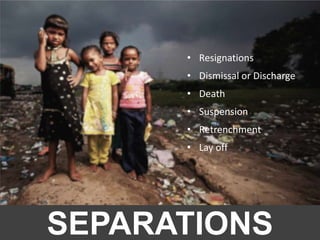
SEPARATIONS
• Resignations
• Dismissal or Discharge
• Death
• Suspension
• Retrenchment
• Lay off
This
presentation is
the result of
concentration
build during the
best working
Hours of a
teenager’s life
1:30 AM– 5:30AM
HANDCRAFTEDBY
RAMITAGGARWAL
THANK YOU
ramitaggarwal12@gmail.com

Promotion & Transfer PPT

  • 1.
  • 2.
  • 3.
  • 4.
    PURPOSES? • Tofurnish an effective incentive for initiative, enterprise and ambition. • To conserve proved skill, training & ability. • To reduce discontent and unrest. • To attract suitable and competent workers. • To suggest logical training for advancement. Watkins & Dodd.
  • 5.
    PRINCIPLES  Written promotionpolices.  job analysis.  Seniority or merit Based promotion.  Scientific procedure for evaluating employee performance  Immediate senior should recommend promotion  Vacancies should be notify to employee in advance.  Promotion should not be forced on reluctant employee promotion should be made on probation.
  • 7.
    SENIORITY as aBasis of PROMOTION. The senior most person in the lower grade shall be promoted as and when there is an opening in the higher position.
  • 8.
    MERIT as aBasis of PROMOTION The most capable person in the lower grade, no matter if he is junior most in the company shall be promoted.
  • 9.
    SENIORITY-CUM-MERIT Basis A combinationof both seniority and merit may be considered as a sound basis for promotion.
  • 10.
    In demotion theemployee is shifted to a job lower in status, grade and responsibilities. Demotion is a shift to a position in which responsibilities are decreased. promotion is , in a sense, an increase in rank and demotion is decrease in rank. -Dale Yoder DEMOTION
  • 11.
    CAUSES • Combination of departmentsand elimination of jobs. • Inadequacy and bad performance. • Change in technology.
  • 12.
  • 13.
    A transfer doesnot imply any ascending or descending change in status or responsibility. “Transfer is a change in job where the new job is substantially equal to the old in terms of pay, status and responsibilities.” By - Edwin B. Flippo
  • 14.
    PURPOSES • To Meetthe Organizational Requirements. • To Meet Employees’ Requests. • To Ensures Better Utilization of the Employees. • To Make the Employees More Versatile. • To Adjust the Workforce. • To Provide Relief to the Employees. • To Reduce Conflicts and Incompatibilities. • To Penalize the Employees. • To Maintain a Tenure System. • To Accommodate Family Related Issues.
  • 15.
  • 16.
    On the Basisof PURPOSE • Production Transfers • Replacement Transfers • Versatility Transfers • Shift Transfers • Remedial Transfers • Precautionary Transfers
  • 17.
    On the Basisof UNIT • Sectional Transfers • Departmental Transfers • Inter-Plant Transfers
  • 18.
    The management must framea policy on transfers instead of treating each case on its merits.
  • 19.
    SEPARATIONS • Resignations • Dismissalor Discharge • Death • Suspension • Retrenchment • Lay off
  • 20.
    This presentation is the resultof concentration build during the best working Hours of a teenager’s life 1:30 AM– 5:30AM HANDCRAFTEDBY RAMITAGGARWAL
  • 21.