Presented by –
Amrit Kumar Deepak
MD. Tuffail
Saurabh Meena
• Coca-Cola company is a beverage company, manufacturer, distributor, and
marketer of non-alcoholic beverages.
• Invented by pharmacist Dr. John S. Pemberton in 1885.The Coca-Cola formula and
brand was bought in 1889 by Asa Candler who incorporated The Coca-Cola
Company in 1892.
• Coca-Cola currently serve in over 206 countries and serves 1.9 billion servings
each day.
• The Coca-Cola Company is headquarter in Atlanta, Georgia.
• Its current Chairman and CEO is Muhtar Kent.
• Coca-Cola is the best-selling soft drink in most countries and sells more
than 500 products. While the Middle East is one of the only regions in the
world where Coca-Cola is not the number one soda drink.
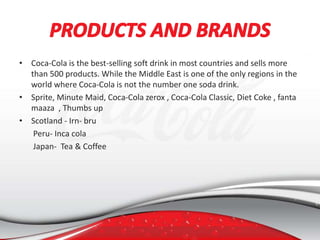
• Sprite, Minute Maid, Coca-Cola zerox , Coca-Cola Classic, Diet Coke , fanta
maaza , Thumbs up
• Scotland - Irn- bru
Peru- Inca cola
Japan- Tea & Coffee
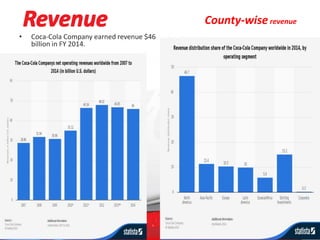
• Coca-Cola Company earned revenue $46
billion in FY 2014.
County-wiserevenue
• To refresh the world.
• To inspire moments of
optimism and happiness.
• To create value and make a
difference.
Vision
People: Be a great place to work where
people are inspired to be the best they
can be.
Portfolio: Bring to the world a portfolio
of quality beverage brands that
anticipate and satisfy people's desires
and needs.
Partners: Nurture a winning network of
customers and suppliers, together we
create mutual, enduring value.
Profit: Maximize long-term return to
shareowners while being mindful of
our overall responsibilities.
Productivity: Be a highly effective, lean
and fast-moving organization.
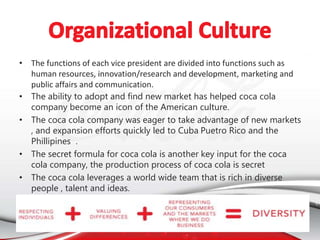
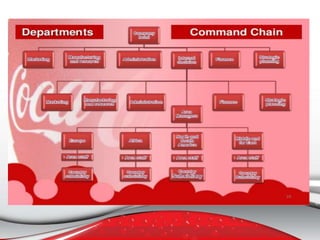
• The functions of each vice president are divided into functions such as
human resources, innovation/research and development, marketing and
public affairs and communication.
• The ability to adopt and find new market has helped coca cola
company become an icon of the American culture.
• The coca cola company was eager to take advantage of new markets
, and expansion efforts quickly led to Cuba Puetro Rico and the
Phillipines .
• The secret formula for coca cola is another key input for the coca
cola company, the production process of coca cola is secret
• The coca cola leverages a world wide team that is rich in diverse
people , talent and ideas.
• The organization can quickly respond to changing market demands
because it divides into further small unit.
• Decisions to be made on a more local level.
• The Code of Conduct for the organization is a guidebook for how every
employee should act.
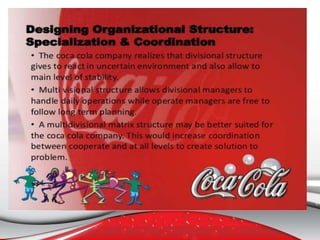
• The Coca-Cola Company’s structure is a hybrid of both
mechanistic and organic models.
• The CEO is also a member of the Senior Leadership Team. This team
consists of each head of the eight operating groups aforementioned, and
also has other top executives in areas like innovation and technology and
marketing. Although there are only six people that answer directly to the
CEO.
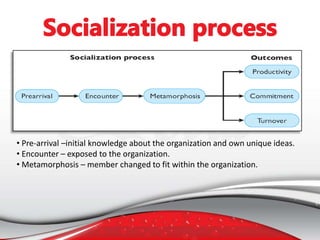
• Pre-arrival –initial knowledge about the organization and own unique ideas.
• Encounter – exposed to the organization.
• Metamorphosis – member changed to fit within the organization.
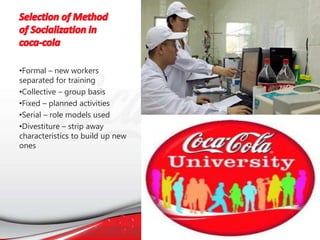
•Formal – new workers
separated for training
•Collective – group basis
•Fixed – planned activities
•Serial – role models used
•Divestiture – strip away
characteristics to build up new
ones
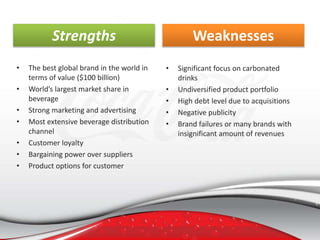
Strengths Weaknesses
• Significant focus on carbonated
drinks
• Undiversified product portfolio
• High debt level due to acquisitions
• Negative publicity
• Brand failures or many brands with
insignificant amount of revenues
• The best global brand in the world in
terms of value ($100 billion)
• World’s largest market share in
beverage
• Strong marketing and advertising
• Most extensive beverage distribution
channel
• Customer loyalty
• Bargaining power over suppliers
• Product options for customer
For your attention

Coca cola

  • 2.
    Presented by – AmritKumar Deepak MD. Tuffail Saurabh Meena
  • 3.
    • Coca-Cola companyis a beverage company, manufacturer, distributor, and marketer of non-alcoholic beverages. • Invented by pharmacist Dr. John S. Pemberton in 1885.The Coca-Cola formula and brand was bought in 1889 by Asa Candler who incorporated The Coca-Cola Company in 1892. • Coca-Cola currently serve in over 206 countries and serves 1.9 billion servings each day. • The Coca-Cola Company is headquarter in Atlanta, Georgia. • Its current Chairman and CEO is Muhtar Kent.
  • 4.
    • Coca-Cola isthe best-selling soft drink in most countries and sells more than 500 products. While the Middle East is one of the only regions in the world where Coca-Cola is not the number one soda drink. • Sprite, Minute Maid, Coca-Cola zerox , Coca-Cola Classic, Diet Coke , fanta maaza , Thumbs up • Scotland - Irn- bru Peru- Inca cola Japan- Tea & Coffee
  • 5.
    • Coca-Cola Companyearned revenue $46 billion in FY 2014. County-wiserevenue
  • 6.
    • To refreshthe world. • To inspire moments of optimism and happiness. • To create value and make a difference. Vision People: Be a great place to work where people are inspired to be the best they can be. Portfolio: Bring to the world a portfolio of quality beverage brands that anticipate and satisfy people's desires and needs. Partners: Nurture a winning network of customers and suppliers, together we create mutual, enduring value. Profit: Maximize long-term return to shareowners while being mindful of our overall responsibilities. Productivity: Be a highly effective, lean and fast-moving organization.
  • 8.
    • The functionsof each vice president are divided into functions such as human resources, innovation/research and development, marketing and public affairs and communication. • The ability to adopt and find new market has helped coca cola company become an icon of the American culture. • The coca cola company was eager to take advantage of new markets , and expansion efforts quickly led to Cuba Puetro Rico and the Phillipines . • The secret formula for coca cola is another key input for the coca cola company, the production process of coca cola is secret • The coca cola leverages a world wide team that is rich in diverse people , talent and ideas.
  • 9.
    • The organizationcan quickly respond to changing market demands because it divides into further small unit. • Decisions to be made on a more local level. • The Code of Conduct for the organization is a guidebook for how every employee should act. • The Coca-Cola Company’s structure is a hybrid of both mechanistic and organic models. • The CEO is also a member of the Senior Leadership Team. This team consists of each head of the eight operating groups aforementioned, and also has other top executives in areas like innovation and technology and marketing. Although there are only six people that answer directly to the CEO.
  • 11.
    • Pre-arrival –initialknowledge about the organization and own unique ideas. • Encounter – exposed to the organization. • Metamorphosis – member changed to fit within the organization.
  • 12.
    •Formal – newworkers separated for training •Collective – group basis •Fixed – planned activities •Serial – role models used •Divestiture – strip away characteristics to build up new ones
  • 14.
    Strengths Weaknesses • Significantfocus on carbonated drinks • Undiversified product portfolio • High debt level due to acquisitions • Negative publicity • Brand failures or many brands with insignificant amount of revenues • The best global brand in the world in terms of value ($100 billion) • World’s largest market share in beverage • Strong marketing and advertising • Most extensive beverage distribution channel • Customer loyalty • Bargaining power over suppliers • Product options for customer
  • 15.

Editor's Notes

  • #13 Coca-Cola University (CCU) is our Company's education curriculum, which provides a wide range of courses through classroom learning, e-learning and field training to help associates develop personally and professionally. CCU's learning portfolio focuses on leadership; marketing; human rights; ethics and compliance; diversity; sustainability; finance; and other competencies. We offer thousands of courses to associates through CCU. In 2009, more than 27,000 associates participated in 1,720 CCU classroom sessions worldwide, and 39,100 associates participated in e-learning courses.
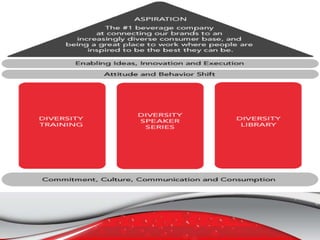
  • #14 Our various diversity education programs efforts have moved from minimizing conflict to strengthen our ability to amplify, respect, value and leverage our differences to drive sustainable business results. Our three pillars of diversity education are Diversity Training, a Diversity Speaker Series and our Diversity Library. Ongoing diversity training helps drive employee engagement, create a work environment that visibly values and leverages diversity and accelerates productivity