Constraining the metabolic genotype-
phenotype relationship using a phylogeny
of in silico methods
Dr. Nathan Lewis
Beng 212
Feb 17, 2015
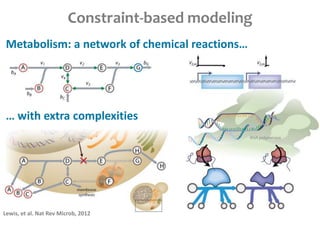
Constraint-based modeling
Metabolism: a network of chemical reactions…
… with extra complexities
Lewis, et al. Nat Rev Microb, 2012
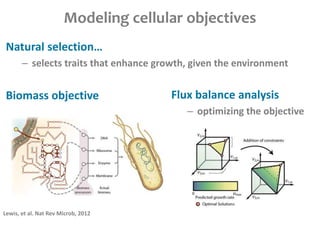
Modeling cellular objectives
Natural selection…
– selects traits that enhance growth, given the environment
Biomass objective Flux balance analysis
– optimizing the objective
Lewis, et al. Nat Rev Microb, 2012
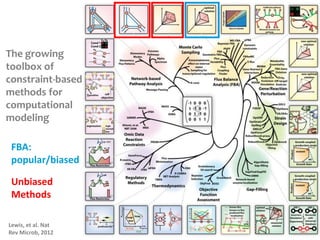
The growing
toolbox of
constraint-based
methods for
computational
modeling
FBA:
popular/biased
Unbiased
Methods
Lewis, et al. Nat
Rev Microb, 2012
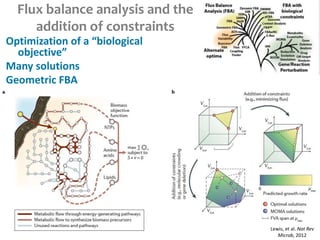
Flux balance analysis and the
addition of constraints
Optimization of a “biological
objective”
Many solutions
Geometric FBA
Lewis, et al. Nat Rev
Microb, 2012
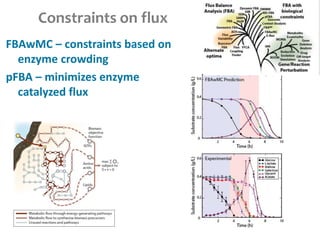
Constraints on flux
FBAwMC – constraints based on
enzyme crowding
pFBA – minimizes enzyme
catalyzed flux
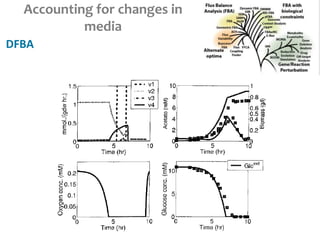
Accounting for changes in
media
DFBA
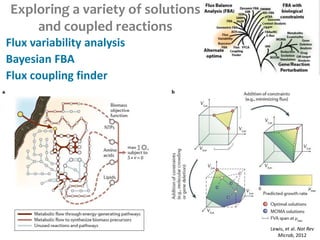
Exploring a variety of solutions
and coupled reactions
Flux variability analysis
Bayesian FBA
Flux coupling finder
Lewis, et al. Nat Rev
Microb, 2012
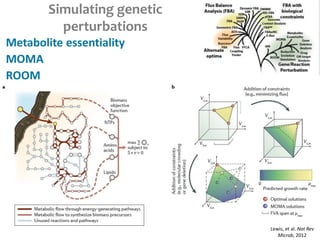
Simulating genetic
perturbations
Metabolite essentiality
MOMA
ROOM
Lewis, et al. Nat Rev
Microb, 2012
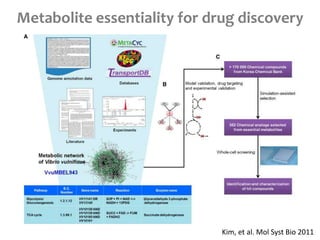
Metabolite essentiality for drug discovery
Kim, et al. Mol Syst Bio 2011
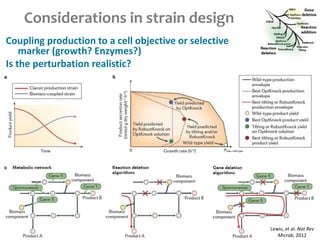
Considerations in strain design
Coupling production to a cell objective or selective
marker (growth? Enzymes?)
Is the perturbation realistic?
Lewis, et al. Nat Rev
Microb, 2012
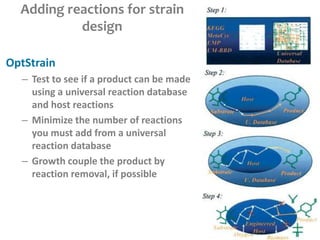
Adding reactions for strain
design
OptStrain
– Test to see if a product can be made
using a universal reaction database
and host reactions
– Minimize the number of reactions
you must add from a universal
reaction database
– Growth couple the product by
reaction removal, if possible
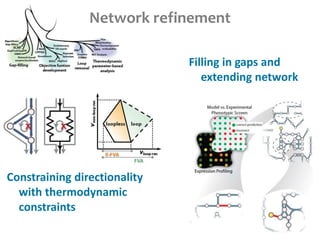
Constraining directionality
with thermodynamic
constraints
Network refinement
Filling in gaps and
extending network
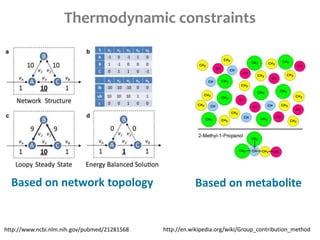
Thermodynamic constraints
Based on metabolite
http://www.ncbi.nlm.nih.gov/pubmed/21281568
Based on network topology
http://en.wikipedia.org/wiki/Group_contribution_method
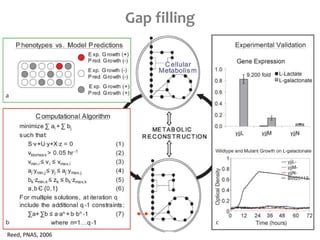
Gap filling
Reed, PNAS, 2006
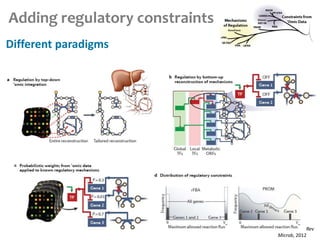
Adding regulatory constraints
Different paradigms
Lewis, et al. Nat Rev
Microb, 2012
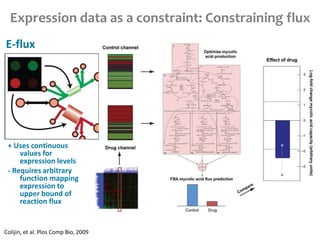
Expression data as a constraint: Constraining flux
E-flux
Colijin, et al. Plos Comp Bio, 2009
+ Uses continuous
values for
expression levels
- Requires arbitrary
function mapping
expression to
upper bound of
reaction flux
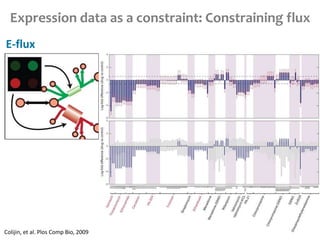
Expression data as a constraint: Constraining flux
E-flux
Colijin, et al. Plos Comp Bio, 2009
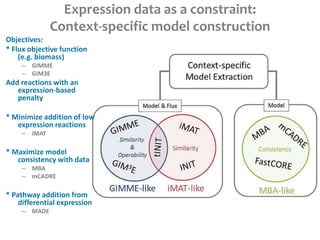
Expression data as a constraint:
Context-specific model construction
Objectives:
* Flux objective function
(e.g. biomass)
– GIMME
– GIM3E
Add reactions with an
expression-based
penalty
* Minimize addition of low
expression reactions
– iMAT
* Maximize model
consistency with data
– MBA
– mCADRE
* Pathway addition from
differential expression
– MADE
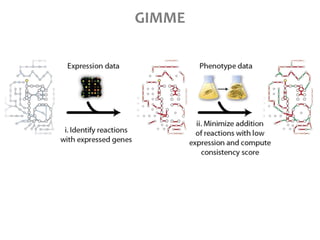
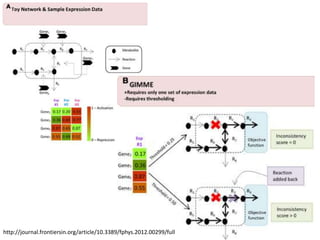
GIMME
http://journal.frontiersin.org/article/10.3389/fphys.2012.00299/full
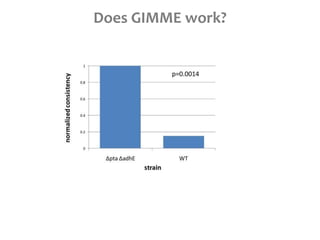
Does GIMME work?
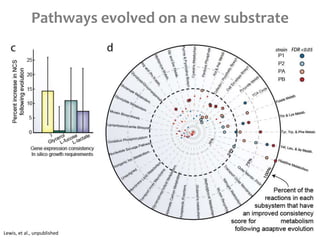
Pathways evolved on a new substrate
Lewis, et al., unpublished
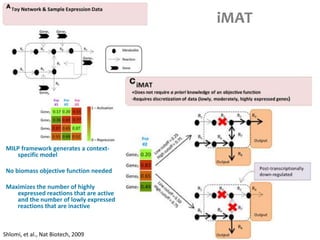
iMAT
MILP framework generates a context-
specific model
No biomass objective function needed
Maximizes the number of highly
expressed reactions that are active
and the number of lowly expressed
reactions that are inactive
Shlomi, et al., Nat Biotech, 2009
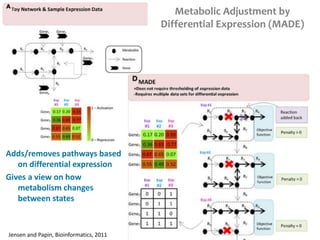
Metabolic Adjustment by
Differential Expression (MADE)
Adds/removes pathways based
on differential expression
Gives a view on how
metabolism changes
between states
Jensen and Papin, Bioinformatics, 2011
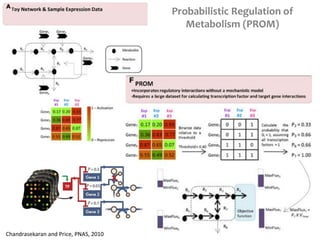
Probabilistic Regulation of
Metabolism (PROM)
Chandrasekaran and Price, PNAS, 2010
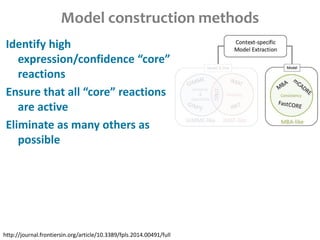
Model construction methods
Identify high
expression/confidence “core”
reactions
Ensure that all “core” reactions
are active
Eliminate as many others as
possible
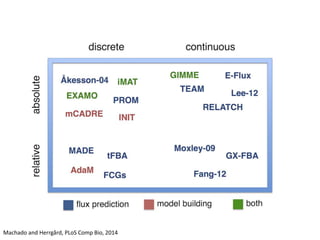
http://journal.frontiersin.org/article/10.3389/fpls.2014.00491/full
Machado and Herrgård, PLoS Comp Bio, 2014
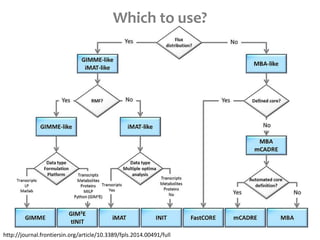
Which to use?
http://journal.frontiersin.org/article/10.3389/fpls.2014.00491/full
APPLYING THE
METHODS TO
STUDYING
CANCER
METABOLISM
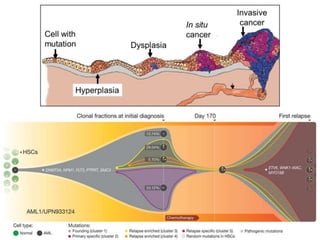
Deregulated growth in cancer results from a
myriad of molecular changes
SNPs, indels, translocations, chromosomal aberrations
Aberrant post-translational modifications
Changes in DNA and histone modification
Altered xenobiotic metabolism
Variations in glycans
Metabolic rewiring
Oncometabolites
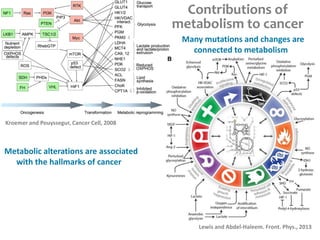
Contributions of
metabolism to cancer
Kroemer and Pouyssegur, Cancer Cell, 2008
Many mutations and changes are
connected to metabolism
Metabolic alterations are associated
with the hallmarks of cancer
Lewis and Abdel-Haleem. Front. Phys., 2013
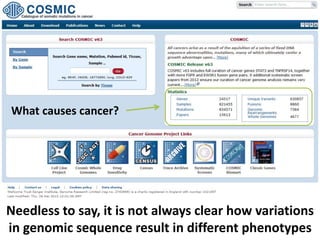
Needless to say, it is not always clear how variations
in genomic sequence result in different phenotypes
What causes cancer?
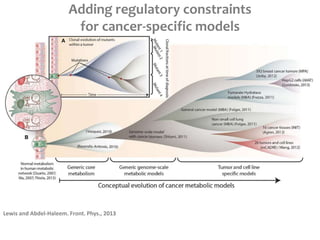
Adding regulatory constraints
for cancer-specific models
Lewis and Abdel-Haleem. Front. Phys., 2013
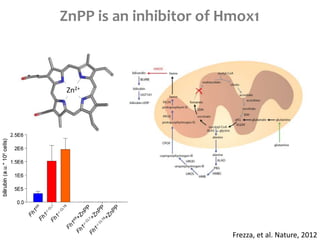
ZnPP is an inhibitor of Hmox1
Zn2+
Frezza, et al. Nature, 2012
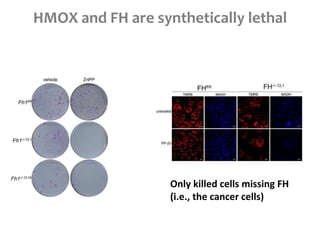
HMOX and FH are synthetically lethal
Only killed cells missing FH
(i.e., the cancer cells)
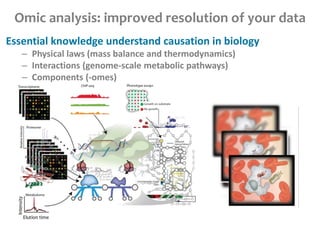
Omic analysis: improved resolution of your data
Essential knowledge understand causation in biology
– Physical laws (mass balance and thermodynamics)
– Interactions (genome-scale metabolic pathways)
– Components (-omes)
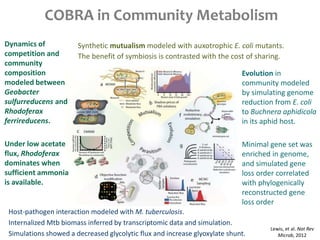
COBRA in Community Metabolism
Dynamics of
competition and
community
composition
modeled between
Geobacter
sulfurreducens and
Rhodoferax
ferrireducens.
Under low acetate
flux, Rhodoferax
dominates when
sufficient ammonia
is available.
Synthetic mutualism modeled with auxotrophic E. coli mutants.
The benefit of symbiosis is contrasted with the cost of sharing.
Evolution in
community modeled
by simulating genome
reduction from E. coli
to Buchnera aphidicola
in its aphid host.
Minimal gene set was
enriched in genome,
and simulated gene
loss order correlated
with phylogenically
reconstructed gene
loss order
Host-pathogen interaction modeled with M. tuberculosis.
Internalized Mtb biomass inferred by transcriptomic data and simulation.
Simulations showed a decreased glycolytic flux and increase glyoxylate shunt.
Lewis, et al. Nat Rev
Microb, 2012
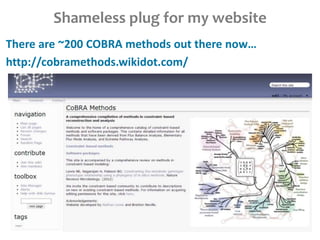
Shameless plug for my website
There are ~200 COBRA methods out there now…
http://cobramethods.wikidot.com/

Cobra phylogeny paper slides

  • 1.
    Constraining the metabolicgenotype- phenotype relationship using a phylogeny of in silico methods Dr. Nathan Lewis Beng 212 Feb 17, 2015
  • 2.
    Constraint-based modeling Metabolism: anetwork of chemical reactions… … with extra complexities Lewis, et al. Nat Rev Microb, 2012
  • 3.
    Modeling cellular objectives Naturalselection… – selects traits that enhance growth, given the environment Biomass objective Flux balance analysis – optimizing the objective Lewis, et al. Nat Rev Microb, 2012
  • 4.
    The growing toolbox of constraint-based methodsfor computational modeling FBA: popular/biased Unbiased Methods Lewis, et al. Nat Rev Microb, 2012
  • 5.
    Flux balance analysisand the addition of constraints Optimization of a “biological objective” Many solutions Geometric FBA Lewis, et al. Nat Rev Microb, 2012
  • 6.
    Constraints on flux FBAwMC– constraints based on enzyme crowding pFBA – minimizes enzyme catalyzed flux
  • 7.
  • 8.
    Exploring a varietyof solutions and coupled reactions Flux variability analysis Bayesian FBA Flux coupling finder Lewis, et al. Nat Rev Microb, 2012
  • 9.
  • 10.
    Metabolite essentiality fordrug discovery Kim, et al. Mol Syst Bio 2011
  • 11.
    Considerations in straindesign Coupling production to a cell objective or selective marker (growth? Enzymes?) Is the perturbation realistic? Lewis, et al. Nat Rev Microb, 2012
  • 12.
    Adding reactions forstrain design OptStrain – Test to see if a product can be made using a universal reaction database and host reactions – Minimize the number of reactions you must add from a universal reaction database – Growth couple the product by reaction removal, if possible
  • 13.
    Constraining directionality with thermodynamic constraints Networkrefinement Filling in gaps and extending network
  • 14.
    Thermodynamic constraints Based onmetabolite http://www.ncbi.nlm.nih.gov/pubmed/21281568 Based on network topology http://en.wikipedia.org/wiki/Group_contribution_method
  • 15.
  • 16.
    Adding regulatory constraints Differentparadigms Lewis, et al. Nat Rev Microb, 2012
  • 17.
    Expression data asa constraint: Constraining flux E-flux Colijin, et al. Plos Comp Bio, 2009 + Uses continuous values for expression levels - Requires arbitrary function mapping expression to upper bound of reaction flux
  • 18.
    Expression data asa constraint: Constraining flux E-flux Colijin, et al. Plos Comp Bio, 2009
  • 19.
    Expression data asa constraint: Context-specific model construction Objectives: * Flux objective function (e.g. biomass) – GIMME – GIM3E Add reactions with an expression-based penalty * Minimize addition of low expression reactions – iMAT * Maximize model consistency with data – MBA – mCADRE * Pathway addition from differential expression – MADE
  • 20.
  • 21.
  • 22.
  • 23.
    Pathways evolved ona new substrate Lewis, et al., unpublished
  • 24.
    iMAT MILP framework generatesa context- specific model No biomass objective function needed Maximizes the number of highly expressed reactions that are active and the number of lowly expressed reactions that are inactive Shlomi, et al., Nat Biotech, 2009
  • 25.
    Metabolic Adjustment by DifferentialExpression (MADE) Adds/removes pathways based on differential expression Gives a view on how metabolism changes between states Jensen and Papin, Bioinformatics, 2011
  • 26.
    Probabilistic Regulation of Metabolism(PROM) Chandrasekaran and Price, PNAS, 2010
  • 27.
    Model construction methods Identifyhigh expression/confidence “core” reactions Ensure that all “core” reactions are active Eliminate as many others as possible http://journal.frontiersin.org/article/10.3389/fpls.2014.00491/full
  • 28.
    Machado and Herrgård,PLoS Comp Bio, 2014
  • 29.
  • 30.
  • 31.
    Deregulated growth incancer results from a myriad of molecular changes SNPs, indels, translocations, chromosomal aberrations Aberrant post-translational modifications Changes in DNA and histone modification Altered xenobiotic metabolism Variations in glycans Metabolic rewiring Oncometabolites
  • 32.
    Contributions of metabolism tocancer Kroemer and Pouyssegur, Cancer Cell, 2008 Many mutations and changes are connected to metabolism Metabolic alterations are associated with the hallmarks of cancer Lewis and Abdel-Haleem. Front. Phys., 2013
  • 34.
    Needless to say,it is not always clear how variations in genomic sequence result in different phenotypes What causes cancer?
  • 35.
    Adding regulatory constraints forcancer-specific models Lewis and Abdel-Haleem. Front. Phys., 2013
  • 36.
    ZnPP is aninhibitor of Hmox1 Zn2+ Frezza, et al. Nature, 2012
  • 37.
    HMOX and FHare synthetically lethal Only killed cells missing FH (i.e., the cancer cells)
  • 38.
    Omic analysis: improvedresolution of your data Essential knowledge understand causation in biology – Physical laws (mass balance and thermodynamics) – Interactions (genome-scale metabolic pathways) – Components (-omes)
  • 39.
    COBRA in CommunityMetabolism Dynamics of competition and community composition modeled between Geobacter sulfurreducens and Rhodoferax ferrireducens. Under low acetate flux, Rhodoferax dominates when sufficient ammonia is available. Synthetic mutualism modeled with auxotrophic E. coli mutants. The benefit of symbiosis is contrasted with the cost of sharing. Evolution in community modeled by simulating genome reduction from E. coli to Buchnera aphidicola in its aphid host. Minimal gene set was enriched in genome, and simulated gene loss order correlated with phylogenically reconstructed gene loss order Host-pathogen interaction modeled with M. tuberculosis. Internalized Mtb biomass inferred by transcriptomic data and simulation. Simulations showed a decreased glycolytic flux and increase glyoxylate shunt. Lewis, et al. Nat Rev Microb, 2012
  • 40.
    Shameless plug formy website There are ~200 COBRA methods out there now… http://cobramethods.wikidot.com/