THE EFFECTS OF VISCOELASTIC
BEHAVIOR ON COATING
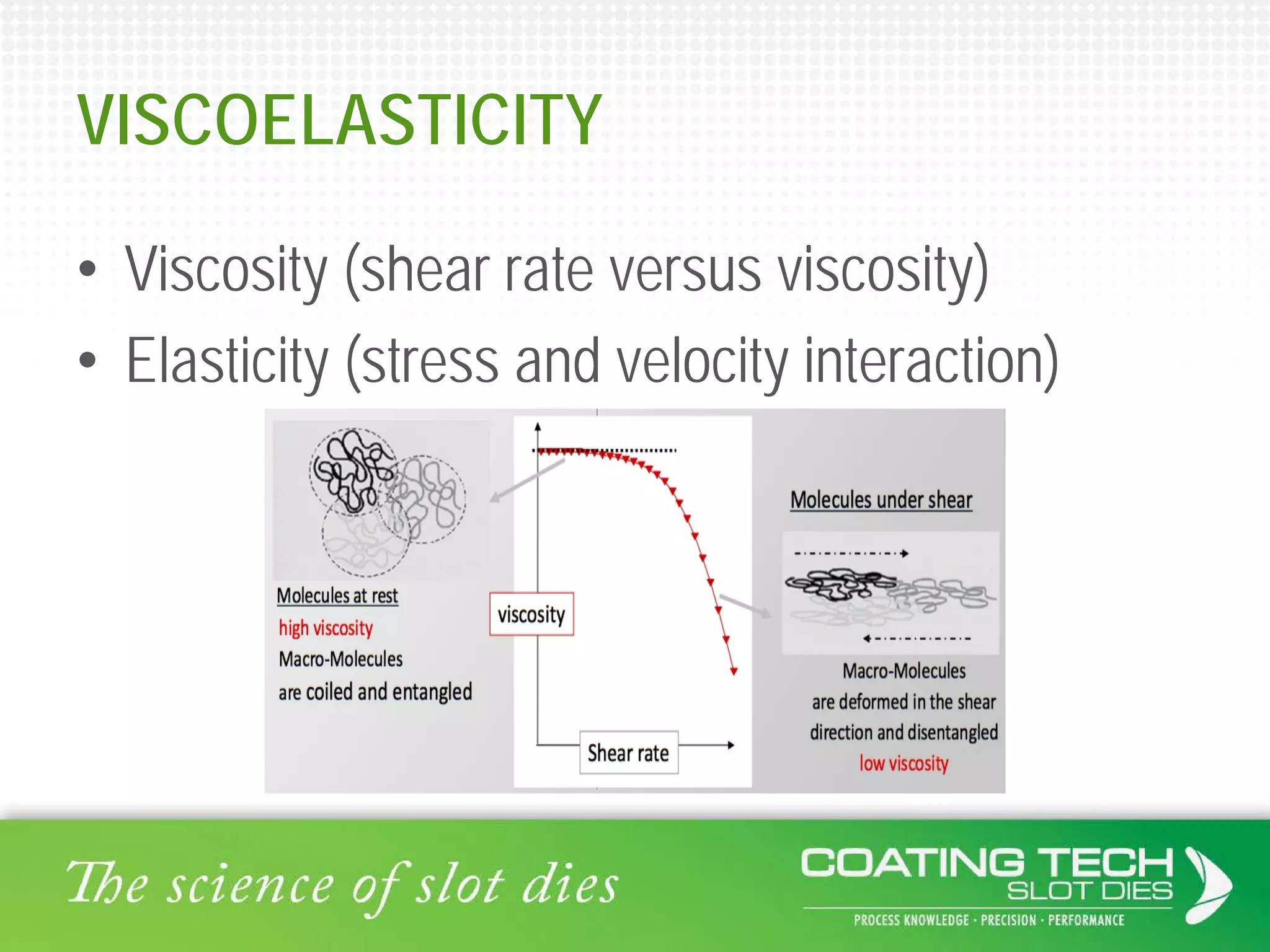
VISCOELASTICITY
• Viscosity (shear rate versus viscosity)
• Elasticity (stress and velocity interaction)
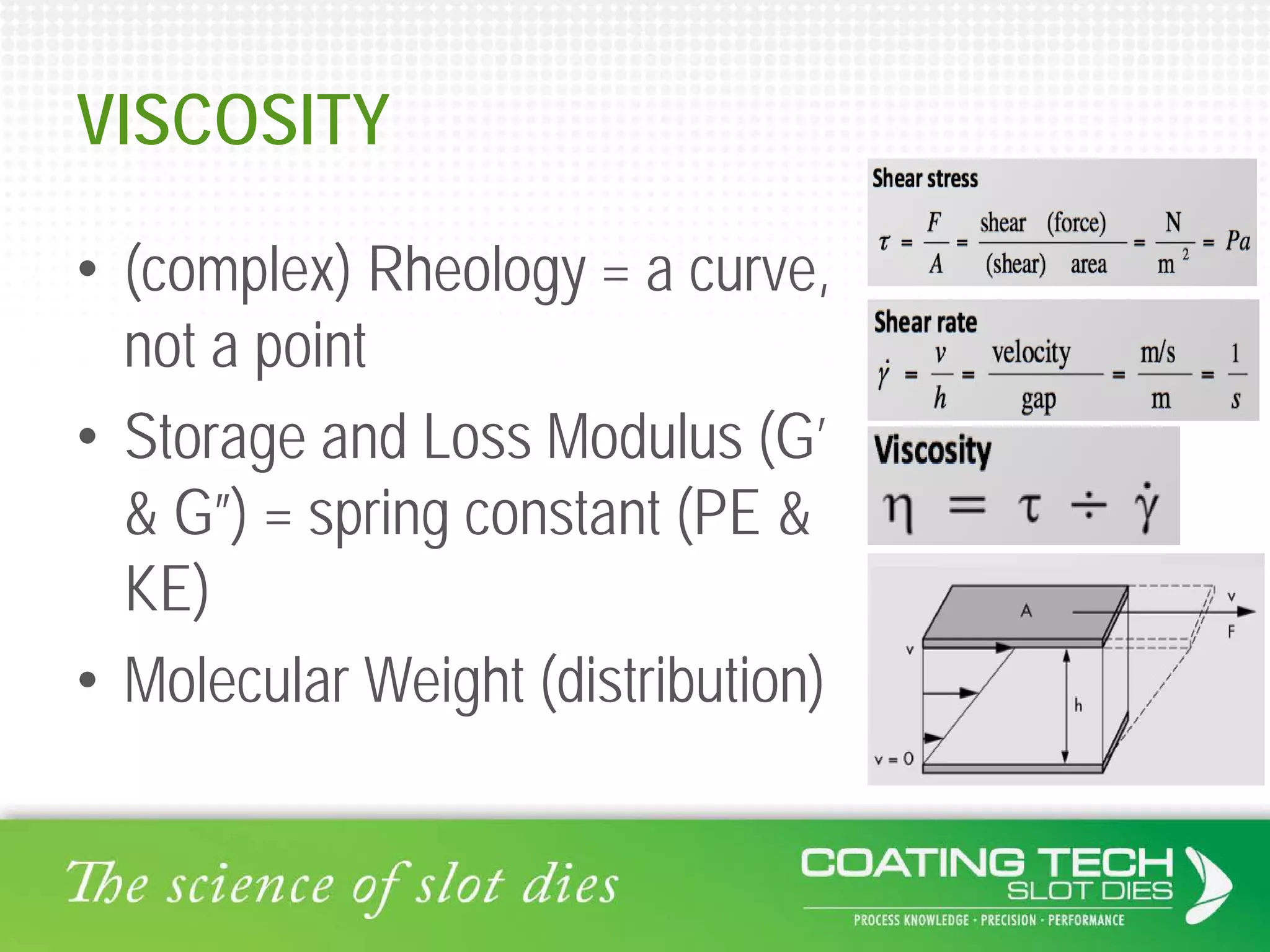
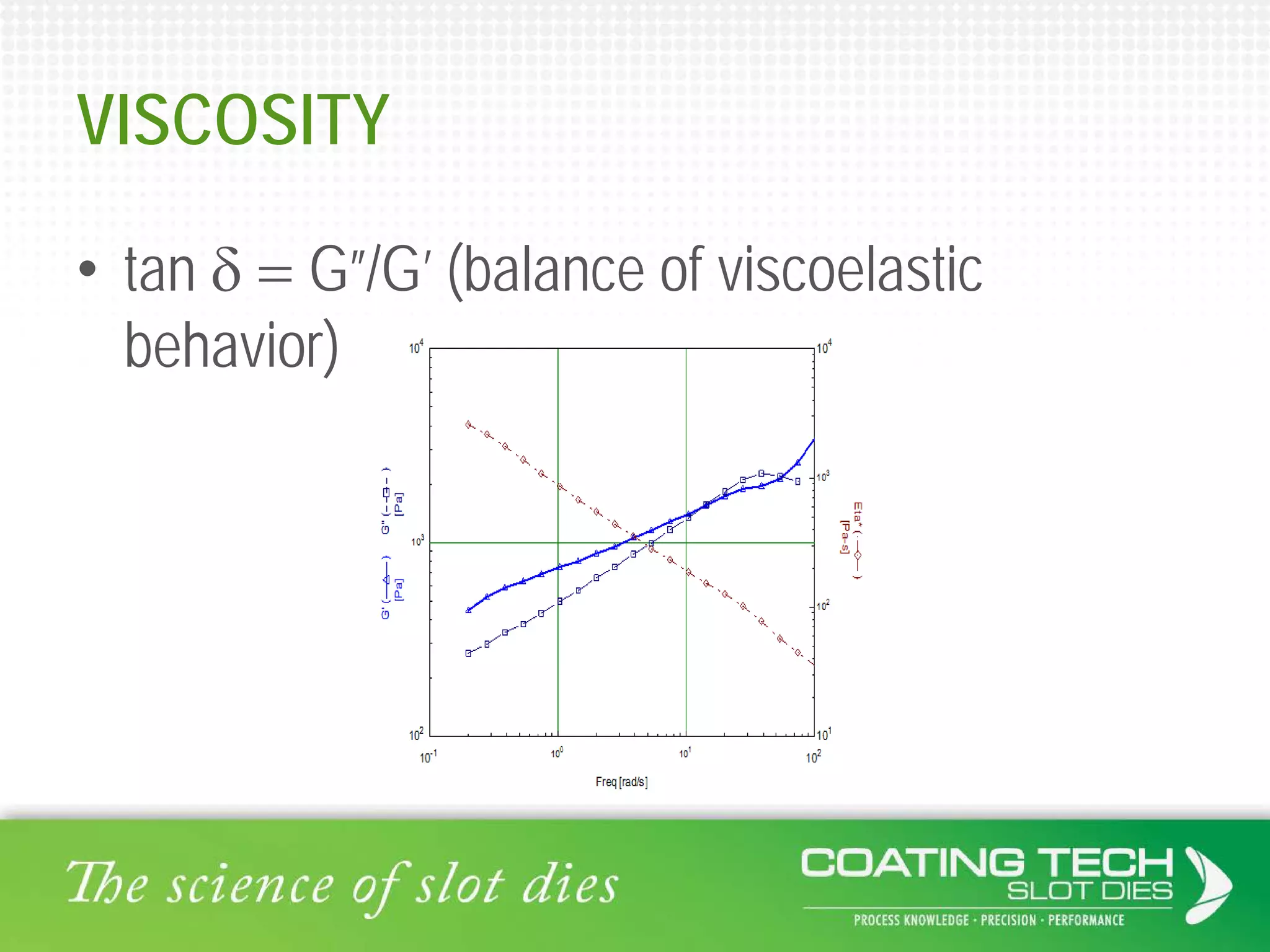
VISCOSITY
• (complex) Rheology = a curve,
not a point
• Storage and Loss Modulus (G’
& G”) = spring constant (PE &
KE)
• Molecular Weight (distribution)
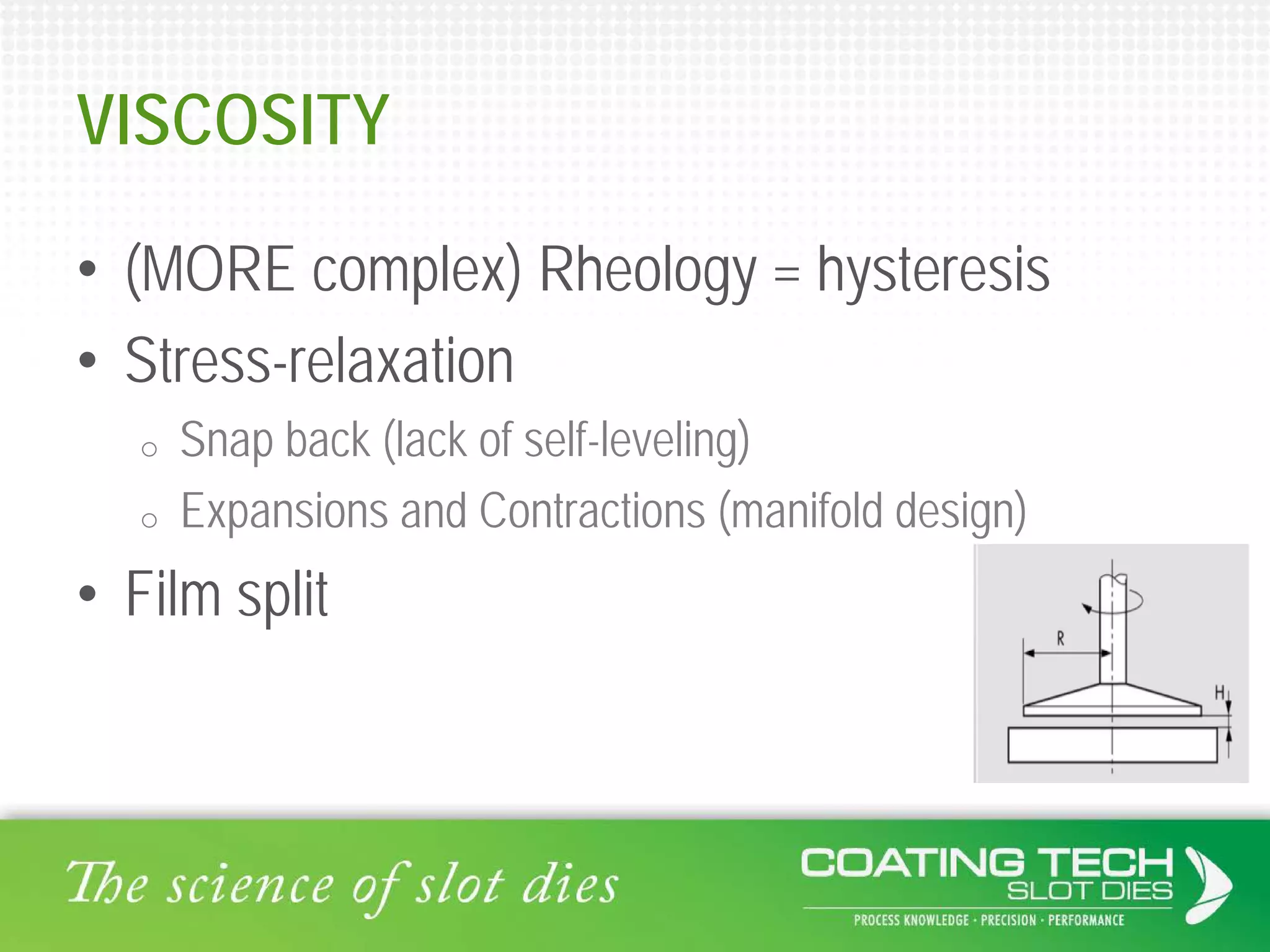
VISCOSITY
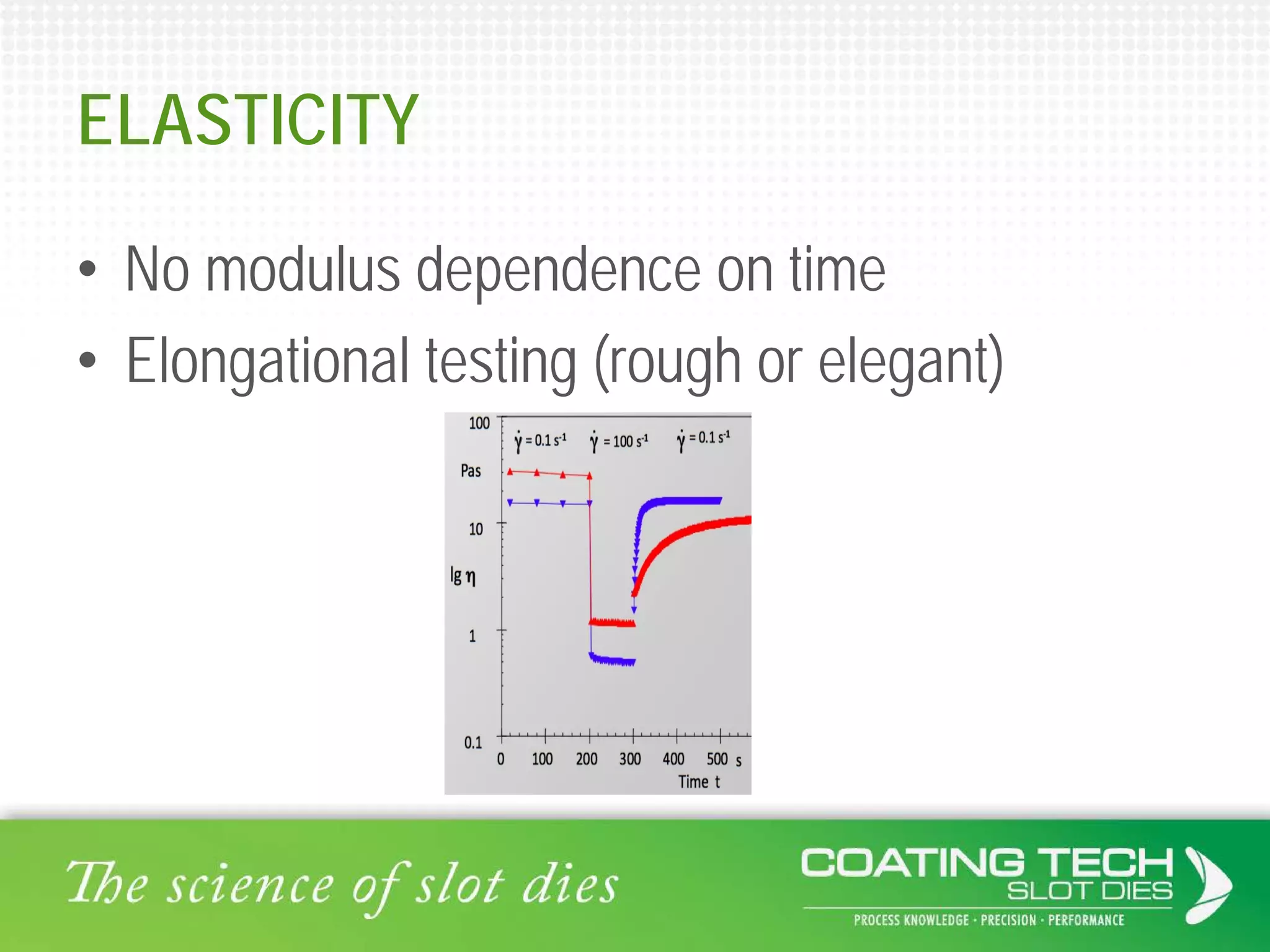
• (MORE complex) Rheology = hysteresis
• Stress-relaxation
o Snap back (lack of self-leveling)
o Expansions and Contractions (manifold design)
• Film split
VISCOSITY
• tan δ = G”/G’ (balance of viscoelastic
behavior)
ELASTICITY
• No modulus dependence on time
• Elongational testing (rough or elegant)
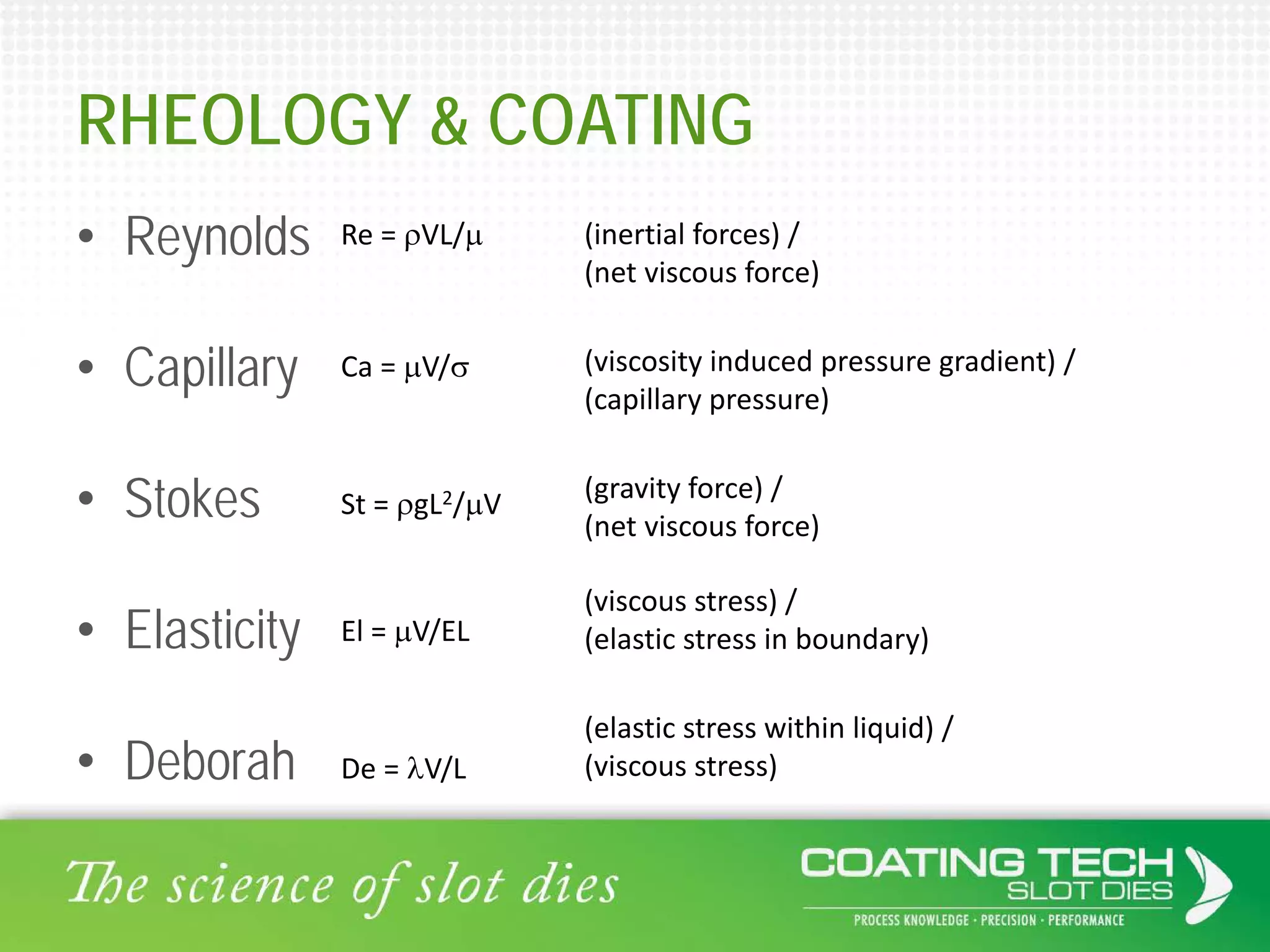
RHEOLOGY & COATING
• Reynolds
• Capillary
• Stokes
• Elasticity
• Deborah
Re = ρVL/µ
Ca = µV/σ
St = ρgL2/µV
El = µV/EL
De = λV/L
(inertial forces) /
(net viscous force)
(viscosity induced pressure gradient) /
(capillary pressure)
(gravity force) /
(net viscous force)
(viscous stress) /
(elastic stress in boundary)
(elastic stress within liquid) /
(viscous stress)
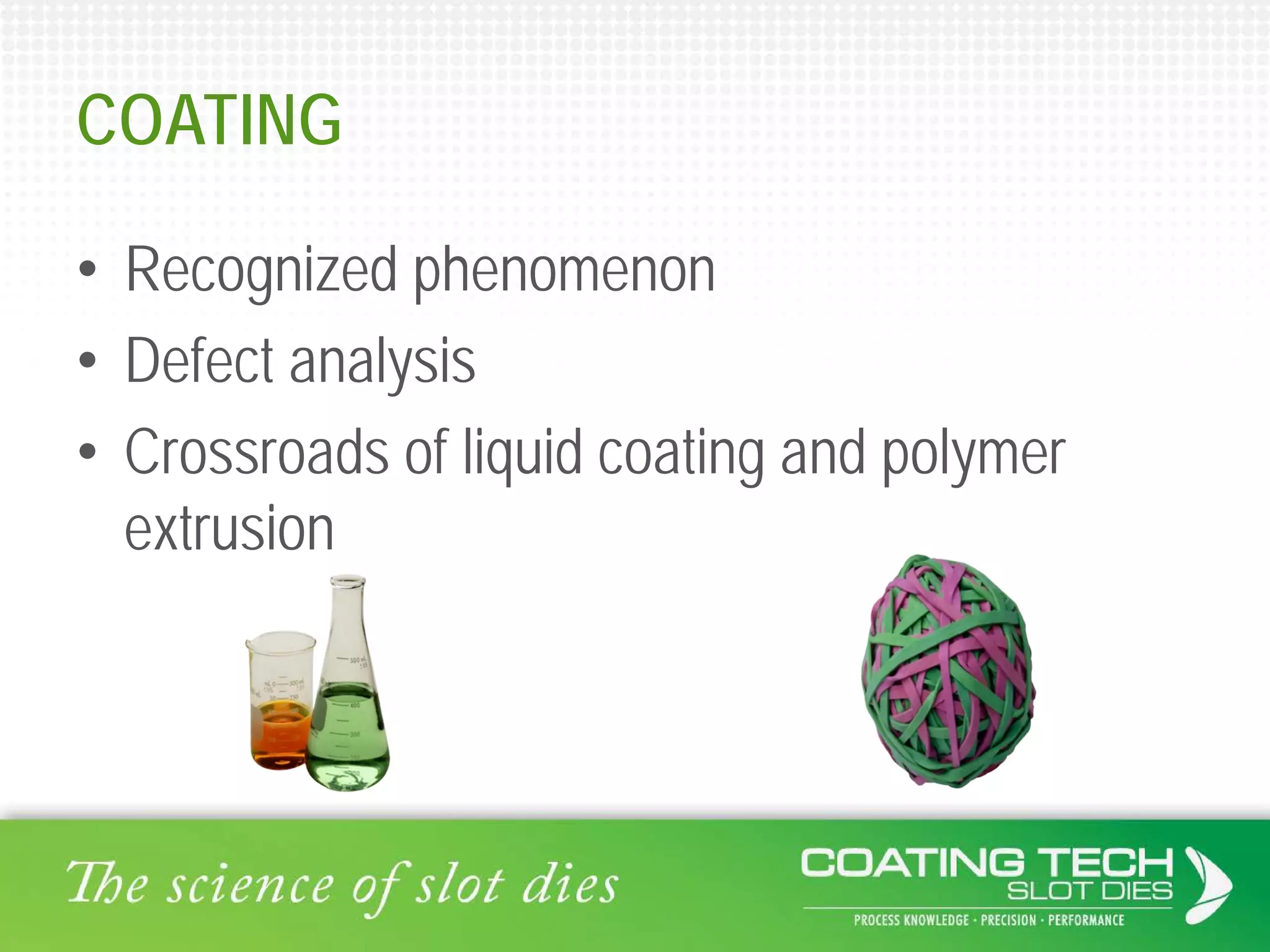
COATING
• Recognized phenomenon
• Defect analysis
• Crossroads of liquid coating and polymer
extrusion
COATING
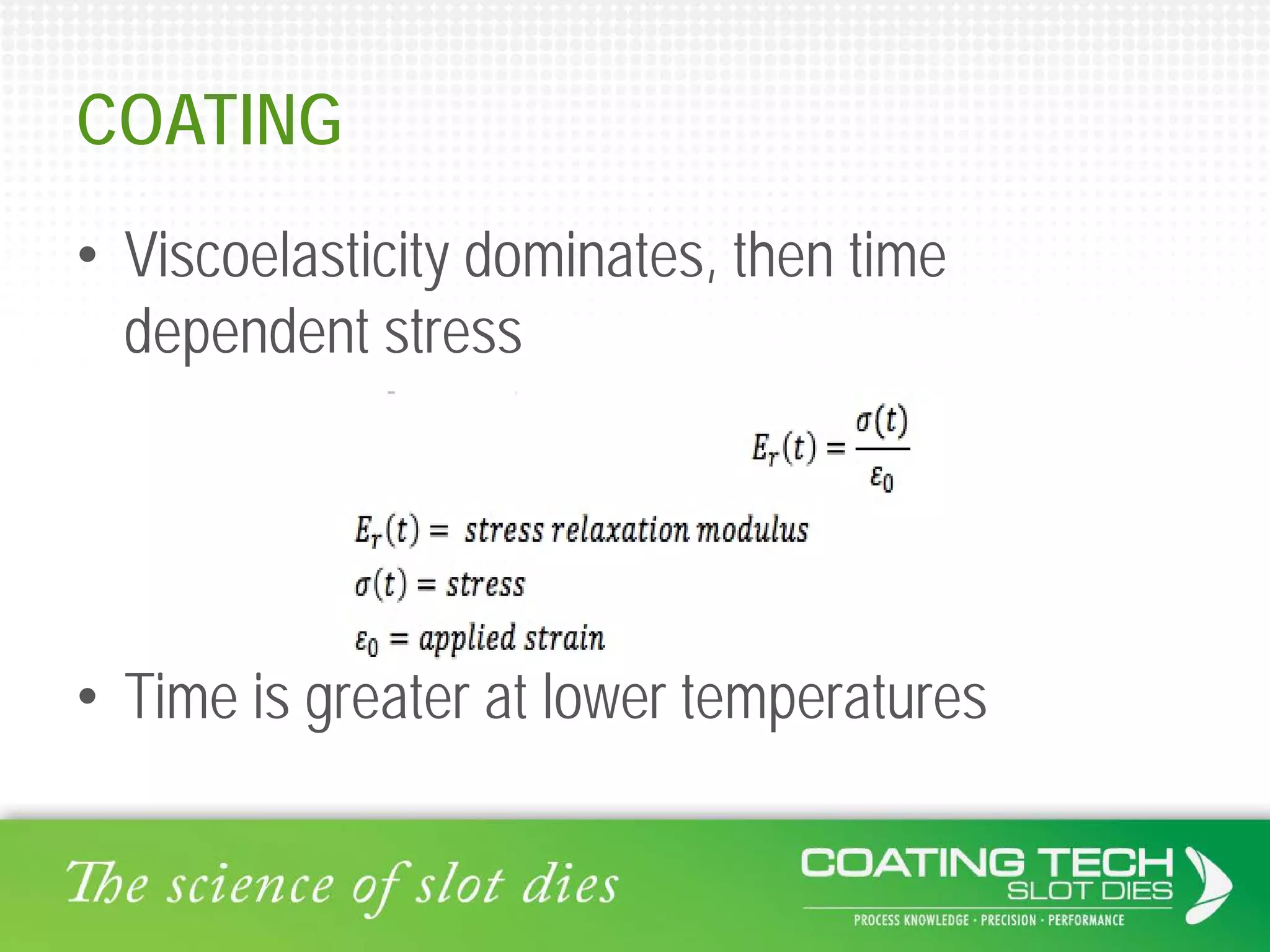
• Viscoelasticity dominates, then time
dependent stress
• Time is greater at lower temperatures
COATING
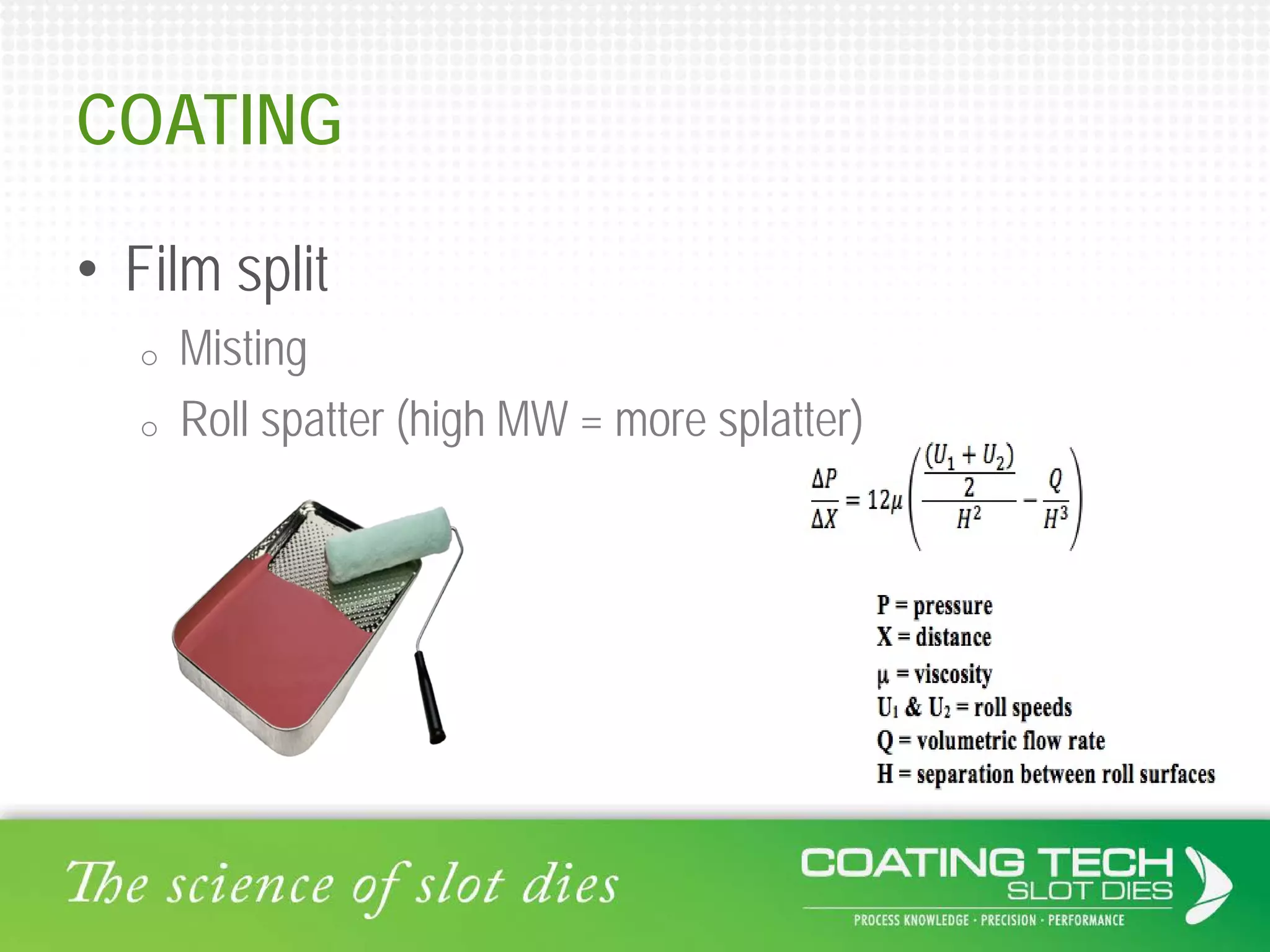
• Film split
o Misting
o Roll spatter (high MW = more splatter)
COATING
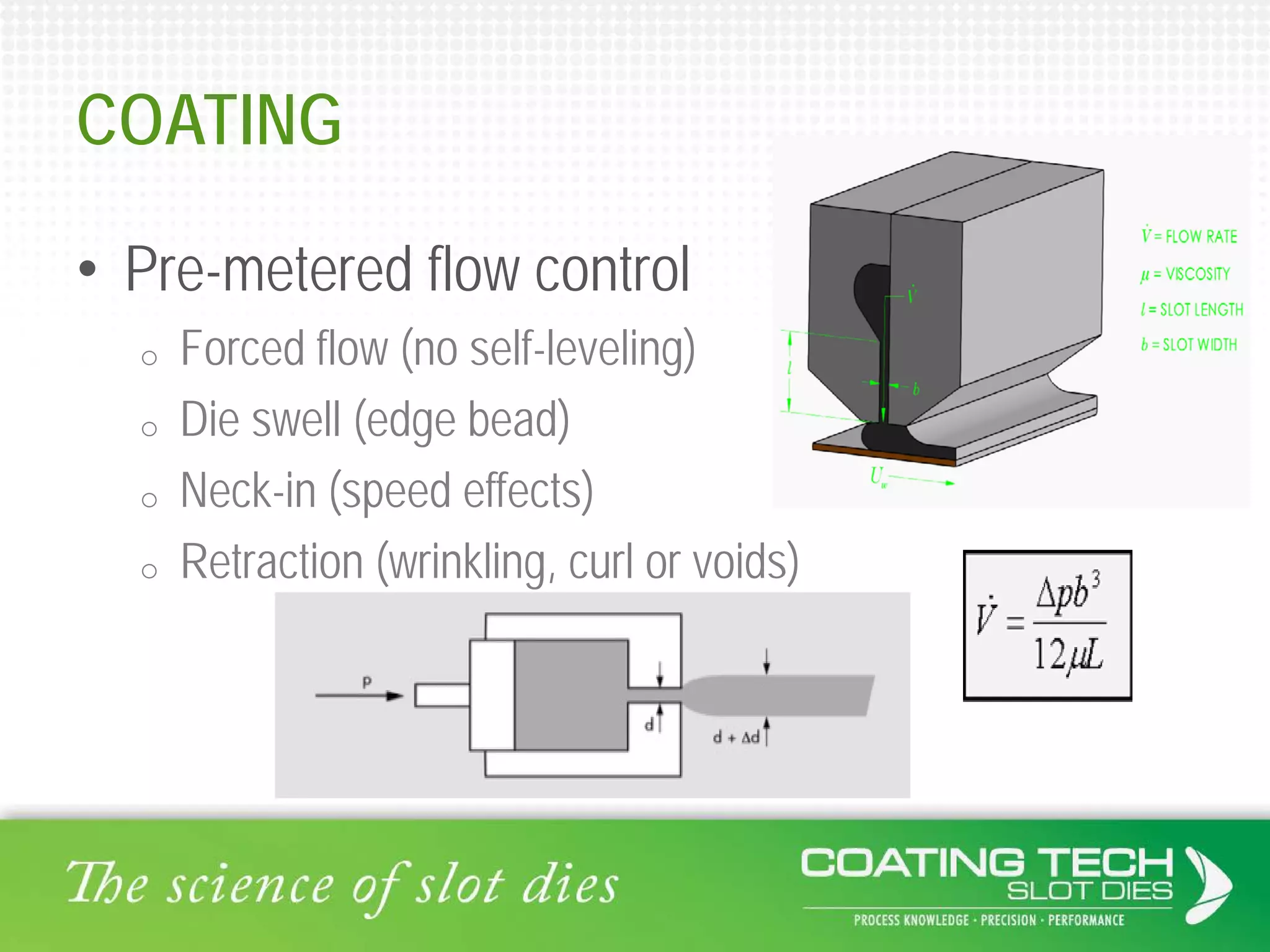
• Pre-metered flow control
o Forced flow (no self-leveling)
o Die swell (edge bead)
o Neck-in (speed effects)
o Retraction (wrinkling, curl or voids)
COATING
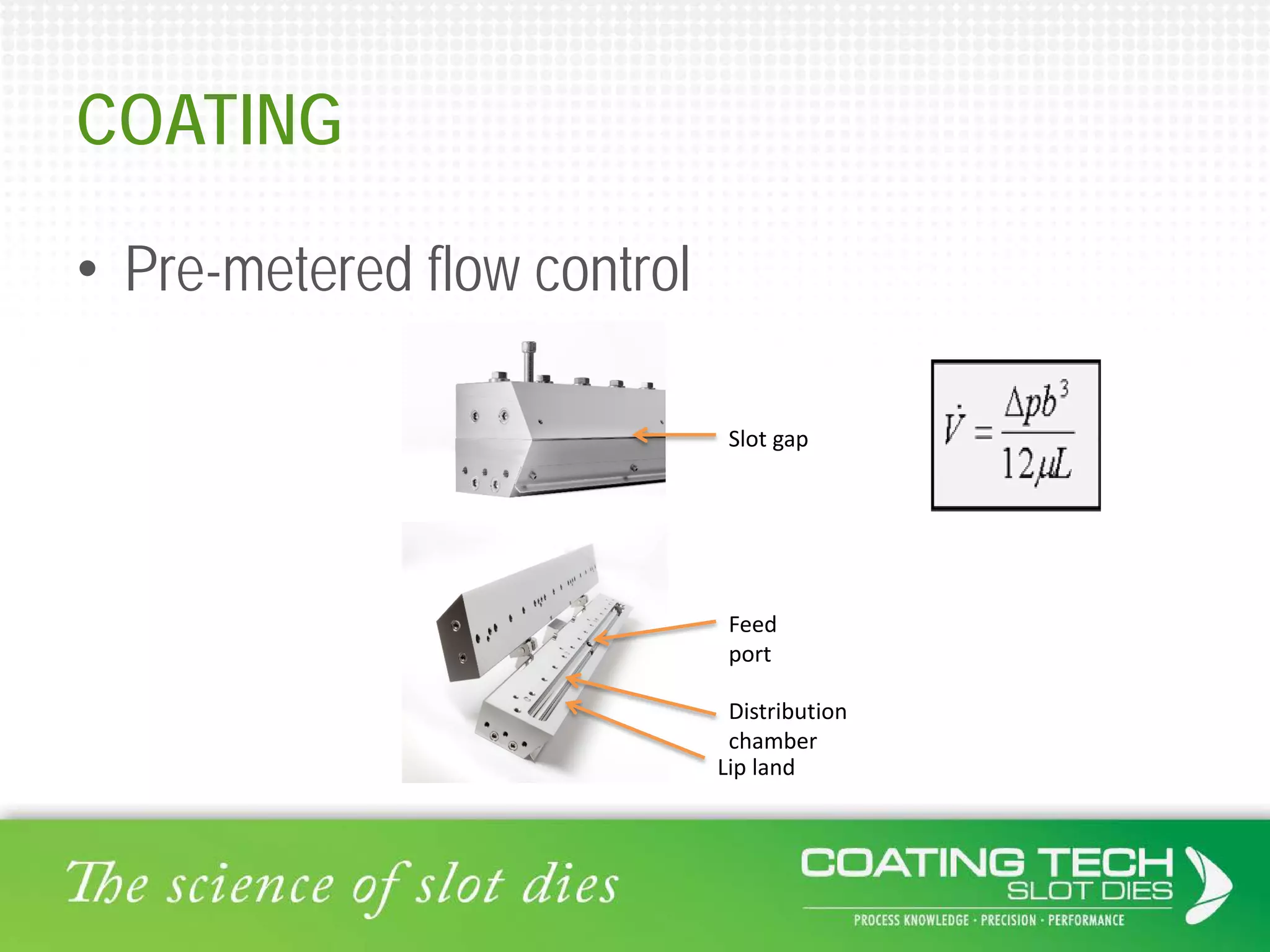
• Pre-metered flow control
Distribution
chamber
Feed
port
Slot gap
Lip land
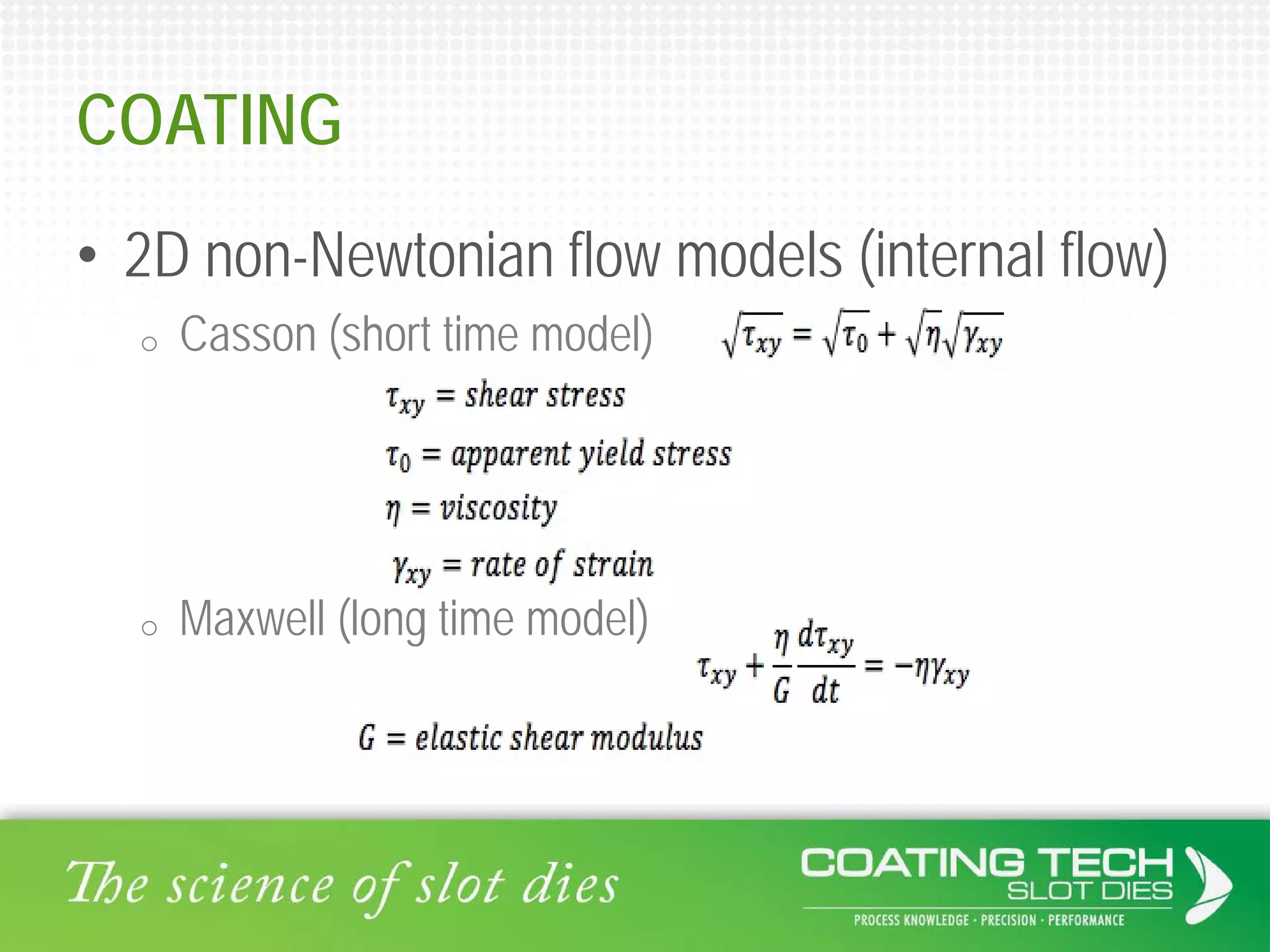
• 2D non-Newtonian flow models (internal flow)
o Casson (short time model)
o Maxwell (long time model)
COATING
COATING
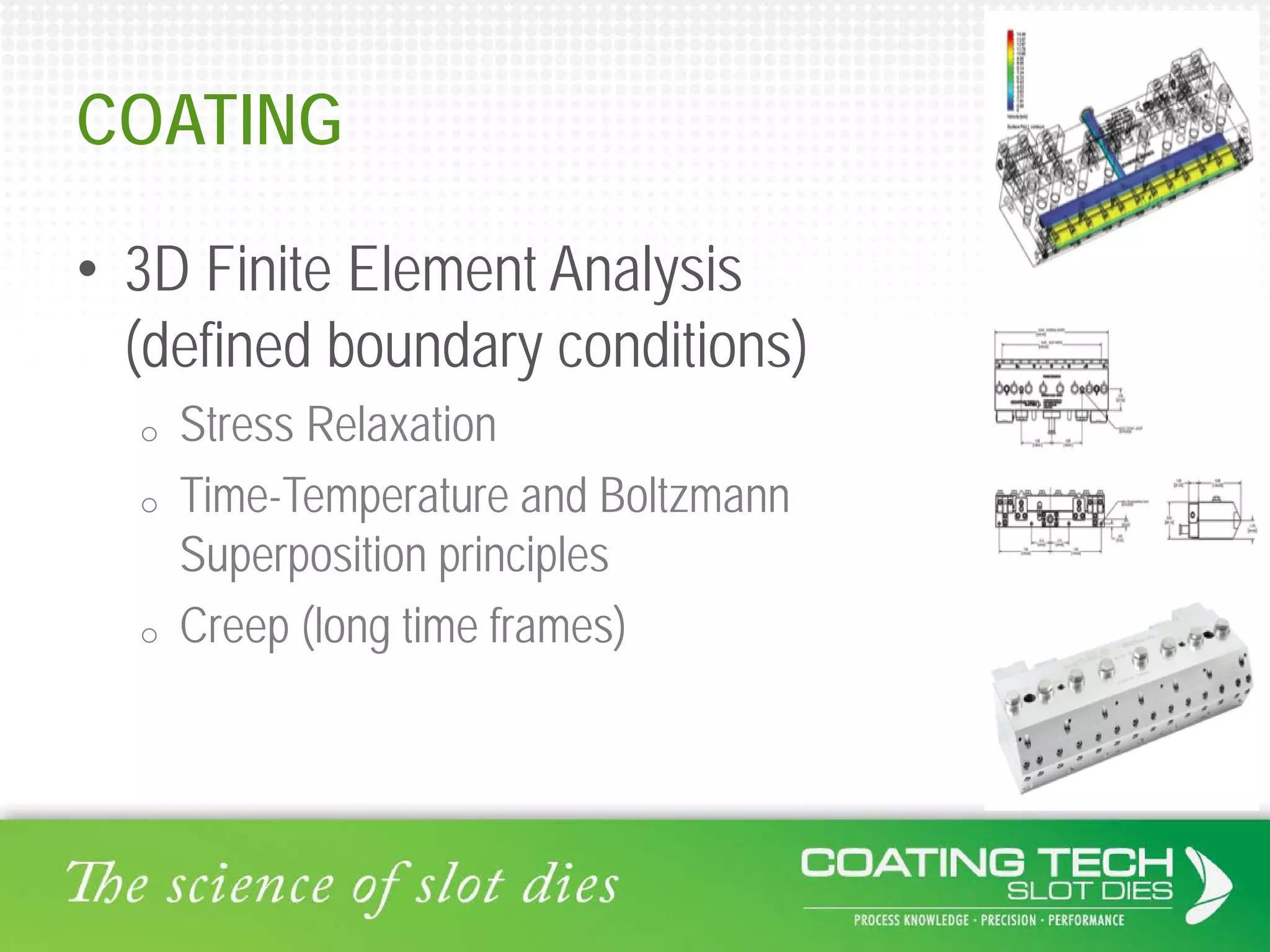
• 3D Finite Element Analysis
(defined boundary conditions)
o Stress Relaxation
o Time-Temperature and Boltzmann
Superposition principles
o Creep (long time frames)
COATING
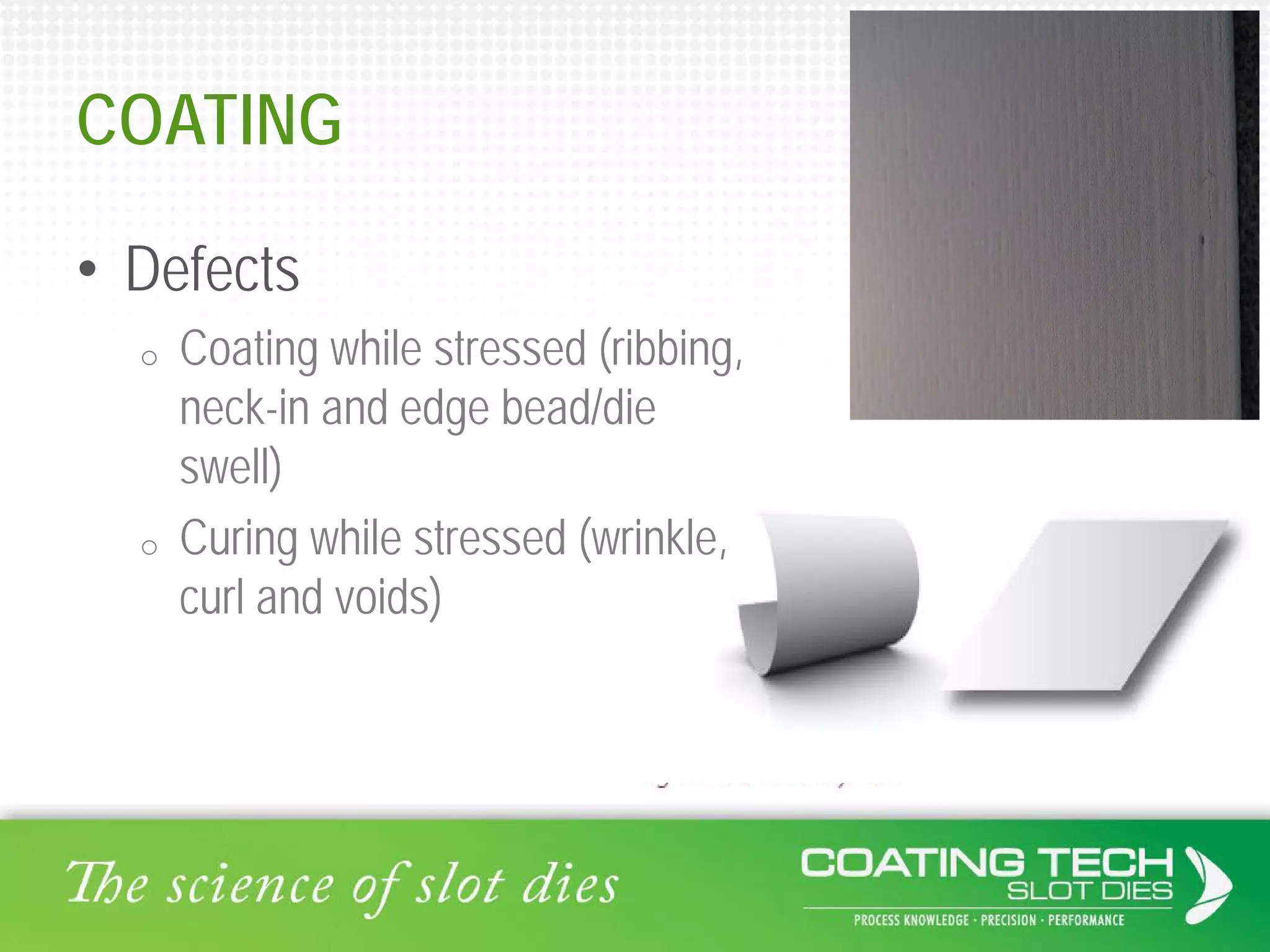
• Defects
o Coating while stressed (ribbing,
neck-in and edge bead/die
swell)
o Curing while stressed (wrinkle,
curl and voids)
COATING
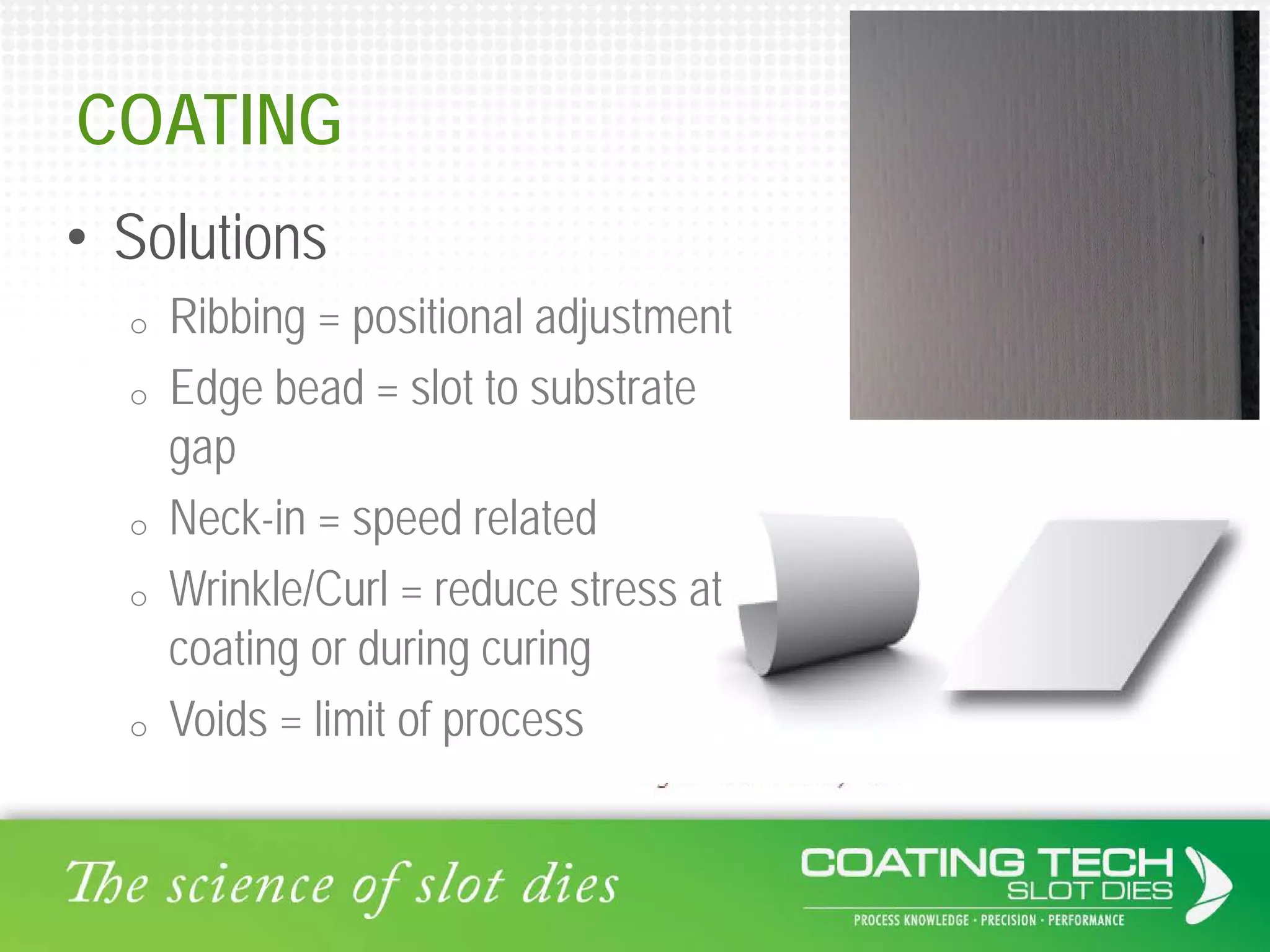
• Solutions
o Ribbing = positional adjustment
o Edge bead = slot to substrate
gap
o Neck-in = speed related
o Wrinkle/Curl = reduce stress at
coating or during curing
o Voids = limit of process
SUMMARY
• Viscoelasticy is complex – test appropriately
• Reduce stress to improve coating
• Implement mathematical understanding to
coating process development
• Coating window is fundamentally reduced
because of viscoelastic behavior
The Effects of Viscoelastic Behavior on Coating

The Effects of Viscoelastic Behavior on Coating

  • 1.
    THE EFFECTS OFVISCOELASTIC BEHAVIOR ON COATING
  • 2.
    VISCOELASTICITY • Viscosity (shearrate versus viscosity) • Elasticity (stress and velocity interaction)
  • 3.
    VISCOSITY • (complex) Rheology= a curve, not a point • Storage and Loss Modulus (G’ & G”) = spring constant (PE & KE) • Molecular Weight (distribution)
  • 4.
    VISCOSITY • (MORE complex)Rheology = hysteresis • Stress-relaxation o Snap back (lack of self-leveling) o Expansions and Contractions (manifold design) • Film split
  • 5.
    VISCOSITY • tan δ= G”/G’ (balance of viscoelastic behavior)
  • 6.
    ELASTICITY • No modulusdependence on time • Elongational testing (rough or elegant)
  • 7.
    RHEOLOGY & COATING •Reynolds • Capillary • Stokes • Elasticity • Deborah Re = ρVL/µ Ca = µV/σ St = ρgL2/µV El = µV/EL De = λV/L (inertial forces) / (net viscous force) (viscosity induced pressure gradient) / (capillary pressure) (gravity force) / (net viscous force) (viscous stress) / (elastic stress in boundary) (elastic stress within liquid) / (viscous stress)
  • 8.
    COATING • Recognized phenomenon •Defect analysis • Crossroads of liquid coating and polymer extrusion
  • 9.
    COATING • Viscoelasticity dominates,then time dependent stress • Time is greater at lower temperatures
  • 10.
    COATING • Film split oMisting o Roll spatter (high MW = more splatter)
  • 11.
    COATING • Pre-metered flowcontrol o Forced flow (no self-leveling) o Die swell (edge bead) o Neck-in (speed effects) o Retraction (wrinkling, curl or voids)
  • 12.
    COATING • Pre-metered flowcontrol Distribution chamber Feed port Slot gap Lip land
  • 13.
    • 2D non-Newtonianflow models (internal flow) o Casson (short time model) o Maxwell (long time model) COATING
  • 14.
    COATING • 3D FiniteElement Analysis (defined boundary conditions) o Stress Relaxation o Time-Temperature and Boltzmann Superposition principles o Creep (long time frames)
  • 15.
    COATING • Defects o Coatingwhile stressed (ribbing, neck-in and edge bead/die swell) o Curing while stressed (wrinkle, curl and voids)
  • 16.
    COATING • Solutions o Ribbing= positional adjustment o Edge bead = slot to substrate gap o Neck-in = speed related o Wrinkle/Curl = reduce stress at coating or during curing o Voids = limit of process
  • 17.
    SUMMARY • Viscoelasticy iscomplex – test appropriately • Reduce stress to improve coating • Implement mathematical understanding to coating process development • Coating window is fundamentally reduced because of viscoelastic behavior