Presentedby : Kaushik Saha, Certified AgileCoach
Coaching Model – Coach for
Performance
Presented byKaushik Saha(CertifiedAgileCoach)
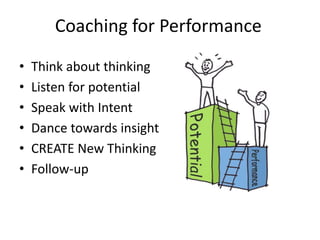
Coaching for Performance
• Think about thinking
• Listen for potential
• Speak with Intent
• Dance towards insight
• CREATE New Thinking
• Follow-up
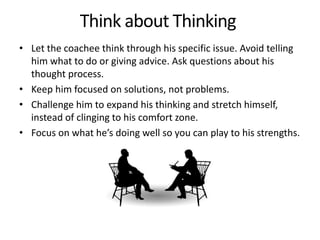
Think about Thinking
• Let the coachee think through his specific issue. Avoid telling
him what to do or giving advice. Ask questions about his
thought process.
• Keep him focused on solutions, not problems.
• Challenge him to expand his thinking and stretch himself,
instead of clinging to his comfort zone.
• Focus on what he’s doing well so you can play to his strengths.
Think about Thinking
Problem
Ask
Solution
Tell
Help Improve Thinking
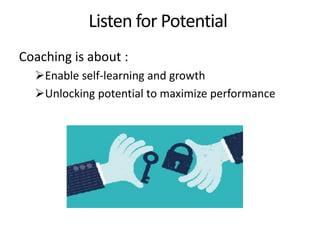
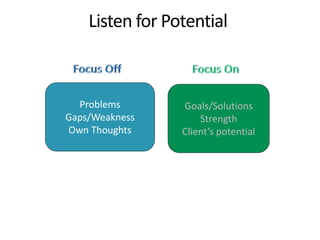
Listen for Potential
Coaching is about :
Enable self-learning and growth
Unlocking potential to maximize performance
Listen for Potential
Problems
Gaps/Weakness
Own Thoughts
Goals/Solutions
Strength
Client’s potential
Speak with Intent
Speak with focus for maximizing improvement in thinking :
Succinct
Saves significant time and mental energy
Helps stay on client’s agenda
Use active visual words where necessary
Specific
Focus on meaningful and relevant information, beyond the obvious
One to three most important items
Generous
Help them relate to what you are doing
Use words to include other person’s perspective
The Dance towards Insight
Four faces of Insight
1. Awareness of Dilemma
2. Reflection
3. Illumination – the ‘Aha!’ moment
4. Motivation
The Dance towards Insight
A coaching model that helps :
 Helping people develop a deeper awareness of their dilemma
 Keeping people fully engaged towards making new
connections
 Making the ‘Aha!’ moments happen
Optimal Solution
3. Help
Improve
Thinking
2.Powerful
Questions
1.Dilemma
The Dance towards Insight
1. Permission
2. Placement
3. Questioning
4. Clarifying
The Dance towards Insight
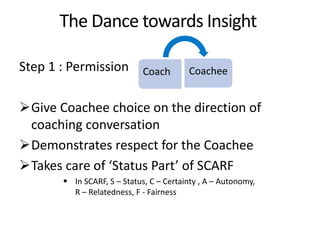
Step 1 : Permission
Give Coachee choice on the direction of
coaching conversation
Demonstrates respect for the Coachee
Takes care of ‘Status Part’ of SCARF
 In SCARF, S – Status, C – Certainty , A – Autonomy,
R – Relatedness, F - Fairness
Coach Coachee
The Dance towards Insight
Step 2 : Placement
Bring people to the same point in the
conversation
Help Coachee create clear mental map by
sharing key information:
– Setting the scene
– How long would you like to speak for ?
– What your goal for the conversation is ?
– What are you looking to achieve from the dialogue ?
Coach Coachee
The Dance towards Insight
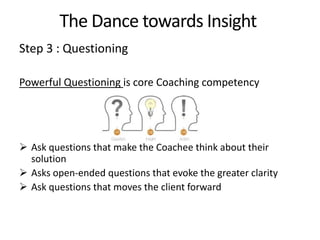
Step 3 : Questioning
Powerful Questioning is core Coaching competency
 Ask questions that make the Coachee think about their
solution
 Asks open-ended questions that evoke the greater clarity
 Ask questions that moves the client forward
The Dance towards Insight
Step 4 : Clarifying
Clarifying is the voicing the essence of what is being said
Simplifying complex ideas allows us to make connection to other ideas
easily
When clarifying, pay attention to:
What is trying to say
What are not saying
What is emotional context
 What is real feelings
What is the essence of what they are saying
Create New Thinking
CREATE Model
The idea of CREATE Model is to ‘Coach for Action’
Current
Reality
Explore
Alternatives
Tap their
Energy
Create New Thinking
Alternatives of CREATE Model – GROW Model
The idea of GROW Model is also to ‘Coach for Action’
Goal
Setting
Reality
Check
Options
Developed
Wrap It Up
Follow-up
FEELING
Facts
Emotions
Encouragement
Learning
Implications
New Goal
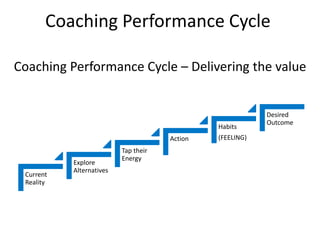
Coaching Performance Cycle
Coaching Performance Cycle – Delivering the value
Current
Reality
Explore
Alternatives
Tap their
Energy
Action
Habits
(FEELING)
Desired
Outcome
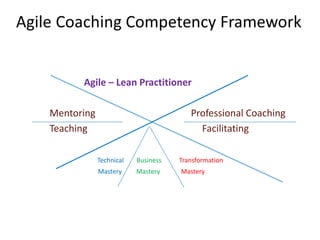
Agile – Lean Practitioner
Mentoring Professional Coaching
Teaching Facilitating
Technical Business Transformation
Mastery Mastery Mastery

Coaching Model - Coach for Performance

  • 1.
    Presentedby : KaushikSaha, Certified AgileCoach Coaching Model – Coach for Performance Presented byKaushik Saha(CertifiedAgileCoach)
  • 2.
    Coaching for Performance •Think about thinking • Listen for potential • Speak with Intent • Dance towards insight • CREATE New Thinking • Follow-up
  • 3.
    Think about Thinking •Let the coachee think through his specific issue. Avoid telling him what to do or giving advice. Ask questions about his thought process. • Keep him focused on solutions, not problems. • Challenge him to expand his thinking and stretch himself, instead of clinging to his comfort zone. • Focus on what he’s doing well so you can play to his strengths.
  • 4.
  • 5.
    Listen for Potential Coachingis about : Enable self-learning and growth Unlocking potential to maximize performance
  • 6.
    Listen for Potential Problems Gaps/Weakness OwnThoughts Goals/Solutions Strength Client’s potential
  • 7.
    Speak with Intent Speakwith focus for maximizing improvement in thinking : Succinct Saves significant time and mental energy Helps stay on client’s agenda Use active visual words where necessary Specific Focus on meaningful and relevant information, beyond the obvious One to three most important items Generous Help them relate to what you are doing Use words to include other person’s perspective
  • 8.
    The Dance towardsInsight Four faces of Insight 1. Awareness of Dilemma 2. Reflection 3. Illumination – the ‘Aha!’ moment 4. Motivation
  • 9.
    The Dance towardsInsight A coaching model that helps :  Helping people develop a deeper awareness of their dilemma  Keeping people fully engaged towards making new connections  Making the ‘Aha!’ moments happen Optimal Solution 3. Help Improve Thinking 2.Powerful Questions 1.Dilemma
  • 10.
    The Dance towardsInsight 1. Permission 2. Placement 3. Questioning 4. Clarifying
  • 11.
    The Dance towardsInsight Step 1 : Permission Give Coachee choice on the direction of coaching conversation Demonstrates respect for the Coachee Takes care of ‘Status Part’ of SCARF  In SCARF, S – Status, C – Certainty , A – Autonomy, R – Relatedness, F - Fairness Coach Coachee
  • 12.
    The Dance towardsInsight Step 2 : Placement Bring people to the same point in the conversation Help Coachee create clear mental map by sharing key information: – Setting the scene – How long would you like to speak for ? – What your goal for the conversation is ? – What are you looking to achieve from the dialogue ? Coach Coachee
  • 13.
    The Dance towardsInsight Step 3 : Questioning Powerful Questioning is core Coaching competency  Ask questions that make the Coachee think about their solution  Asks open-ended questions that evoke the greater clarity  Ask questions that moves the client forward
  • 14.
    The Dance towardsInsight Step 4 : Clarifying Clarifying is the voicing the essence of what is being said Simplifying complex ideas allows us to make connection to other ideas easily When clarifying, pay attention to: What is trying to say What are not saying What is emotional context  What is real feelings What is the essence of what they are saying
  • 15.
    Create New Thinking CREATEModel The idea of CREATE Model is to ‘Coach for Action’ Current Reality Explore Alternatives Tap their Energy
  • 16.
    Create New Thinking Alternativesof CREATE Model – GROW Model The idea of GROW Model is also to ‘Coach for Action’ Goal Setting Reality Check Options Developed Wrap It Up
  • 17.
  • 18.
    Coaching Performance Cycle CoachingPerformance Cycle – Delivering the value Current Reality Explore Alternatives Tap their Energy Action Habits (FEELING) Desired Outcome
  • 19.
    Agile – LeanPractitioner Mentoring Professional Coaching Teaching Facilitating Technical Business Transformation Mastery Mastery Mastery

Editor's Notes

  • #3 These include actions to process information from the customer and actions to transform the product on its way to the customer.
  • #9 These include actions to process information from the customer and actions to transform the product on its way to the customer.
  • #13 These include actions to process information from the customer and actions to transform the product on its way to the customer.
  • #16 Create Model gives three sequential steps for achieving the ‘ACTION’
  • #17 Create Model gives three sequential steps for achieving the ‘ACTION’
  • #18 Follow-up techniques to set the new goal
  • #19 These include actions to process information from the customer and actions to transform the product on its way to the customer.
  • #20 Agile Coaching – Roles and Resposibilities