FOSTERING A GROWTH
MINDSET IN DIFFICULT TIMES
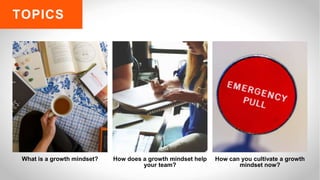
TOPICS
What is a growth mindset? How does a growth mindset help
your team?
How can you cultivate a growth
mindset now?
ABOUT US
FUNDRAISING PRACTITIONERS
NOT PH.D., PSYCHOLOGIST OR
SOCIOLOGIST
DEFINING A
GROWTH MINDSET
MINDSET BY CAROL DWECK, PH.D.
Stanford psychologist
Latest edition 2016
Short summary:
https://youtu.be/EyIF5VUOJc0
WHAT MINDSET ARE YOU?
http://blog.mindsetworks.com/what-s-my-
mindset
FIXED MINDSET
Talents are innate gifts
Failure defines you and is to be avoided
More black and white approach to learning:
you know it or you don’t
May have a sense of entitlement or denial
FIXED MINDSET
In a fixed mindset students believe
their basic abilities, their
intelligence, their talents, are just
fixed traits. They have a certain
amount and that's that, and then
their goal becomes to look smart all
the time and never look dumb.
—Carol Dweck
GROWTH MINDSET
Talents can be developed through
hard work: skill comes from
practice
Failure is a temporary setback:
mistakes are part of learning
Learning is a process that is
ultimately rewarding
GROWTH MINDSET
In a growth mindset students
understand that their talents and
abilities can be developed through
effort, good teaching and
persistence. They don't necessarily
think everyone's the same or anyone
can be Einstein, but they believe
everyone can get smarter if they
work at it. —Carol Dweck
KEY COMPARISONS
Growth
• No matter your intelligence, you can
always change it
• I like my work best when I have to
think hard
• I can learn from my mistakes
• When something is hard, I work
harder
Fixed
• You can learn new things, but can't
change your intelligence
• I like my work best when I can do it
well without much trouble
• Mistakes are to be avoided
• When something is hard, I feel like
I'm not smart
IS A GROWTH
MINDSET BETTER?
IS A GROWTH MINDSET BETTER?
We all have aspects of both
You don't want or need constant
innovation: some things should be done
a certain way for good reasons
Constant change in a time of change
can lead to panic, dissatisfaction and
disengagement
YOUR TEAM AND
GROWTH MINDSETS
“WHEN ENTIRE COMPANIES EMBRACE A GROWTH MINDSET,
THEIR EMPLOYEES REPORT FEELING FAR MORE EMPOWERED
AND COMMITTED.
A [FIXED MINDSET] COMPANY…MAKES IT HARDER FOR PEOPLE
TO PRACTICE GROWTH-MINDSET THINKING AND BEHAVIOR,
SUCH AS SHARING INFORMATION, COLLABORATING,
INNOVATING, SEEKING FEEDBACK, OR ADMITTING ERRORS.”
-ANDREW NGUYEN, HARVARD BUSINESS REVIEW
BENEFITS OF A GROWTH MINDSET
Fosters collaboration
Encourages innovation
Promotes higher achievement
Supports a more inclusive culture for
different backgrounds, skills and
abilities
Avoids the “expertise trap”
May make your team more responsive
GROWTH MINDSET COMPANIES IN CRISIS
Immediately challenge core services
How can we serve mission differently?
How can we reassign our talent?
How can we distribute the problem
solving?
EMPLOYEES IN A GROWTH
MINDSET COMPANY ARE:
47% likelier to say that their
colleagues are trustworthy
34% likelier to feel a strong
sense of ownership and
commitment to the company
65% likelier to say that the
company supports risk taking
49% likelier to say that the
company fosters innovation
“How Companies Can Profit from a Growth Mindset,” Harvard Business Review, November 2014
DISADVANTAGES OF A GROWTH MINDSET
Growth mindset people can
sometimes believe “anyone can do
anything” even when they really can't
Risk of distraction and frustration
Try to do everything
New ideas too often
High performers who are motivated by
star status may leave
WHERE
DO FIXED
MINDSETS
THRIVE?
ORGANIZATIONAL
GROWTH CURVE
PHASE ONE
Formative stage
Trial and error
Informal
Leader dominated
High risk
Hard to attract established talent
Reactive
PHASE TWO
Normative stage
Repeat and refine; set systems
Formal
Manager dominated
Low risk
Easy to attract established talent
Responsive and planned
PHASE THREE
Storming stage
Revise systems
Chaos and confusion
Leader-Manager dominated
Risk increases
May lose talent
Responsive and reactive
FIXED MINDSETS TEND TO THRIVE IN
PHASE 2 ORGANIZATIONS OR
DEPARTMENTS
CULTIVATING
GROWTH
MINDSETS
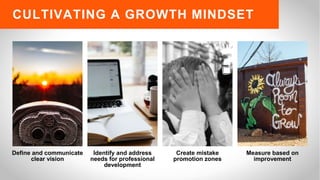
CULTIVATING A GROWTH MINDSET
Define and communicate
clear vision
Identify and address
needs for professional
development
Create mistake
promotion zones
Measure based on
improvement
CLEAR VISION
Define what is not negotiable
What is the bigger picture goal?
Especially in times of crisis, focus is key
“YOU DON'T WORK FOR LOWELL
OBSERVATORY. YOU ARE LOWELL
OBSERVATORY.”
BOB MILLIS
PROMOTE PROFESSIONAL DEVELOPMENT
Set professional development
expectations
Encourage sharing
Periodic skills gap analysis
Investing in your team
BOOK STUDY:
MARKETING
REBELLION
MARK W. SCHAEFER
CREATE MISTAKE PROMOTION ZONES
Strategic risk tolerance
Designated “loss”
Conservative wins
Innovation lab
EAA DAY OF FLIGHT
MEASURE BASED ON IMPROVEMENT
Be less defensive about mistakes
Post-mortem analysis
Reinforce improvements
CLICKER
TRAINING
HIDDEN BRAIN: WHEN EVERYTHING CLICKS
HTTPS://WWW.NPR.ORG/2018/06/04/616127481/WHEN-EVERYTHING-CLICKS-THE-POWER-OF-JUDGMENT-FREE-LEARNING
HELPING GROWTH AND FIXED MINDSETS INTERACT
Talent management systems are biased toward
fixed mindset
Understand what fixed mindset people see as
their best assets
For fixed mindsets, place them where they excel
Use growth mindset strategies to build a culture
of strengths
WHY NOW?
We've hit the reset button
Planning in times of uncertainty
focuses on assessing your assets
WHY NOW?
Stages of quarantine
• Entertainment
• Personal development
• Combat sense of helplessness
• To help
How can you help your team navigate
this time?
SUMMARY
Growth mindset people prioritize learning
Fixed mindset people prioritize innate talents
A growth mindset focus can help a team be more
collaborative and innovative, but if unchecked
can lead to distraction
Talent management models tend to reward fixed
mindsets
Create growth mindset innovation zones where
mistakes are encouraged
ALICE FERRIS, CFRE, ACFRE
JIM ANDERSON, CFRE
info@goalbusters.net
888-883-2690
goalbusters.net
goalbusters
goalbusters_

Fostering a Growth Mindset

  • 1.
    FOSTERING A GROWTH MINDSETIN DIFFICULT TIMES
  • 5.
    TOPICS What is agrowth mindset? How does a growth mindset help your team? How can you cultivate a growth mindset now?
  • 6.
    ABOUT US FUNDRAISING PRACTITIONERS NOTPH.D., PSYCHOLOGIST OR SOCIOLOGIST
  • 7.
  • 8.
    MINDSET BY CAROLDWECK, PH.D. Stanford psychologist Latest edition 2016 Short summary: https://youtu.be/EyIF5VUOJc0
  • 9.
    WHAT MINDSET AREYOU? http://blog.mindsetworks.com/what-s-my- mindset
  • 11.
    FIXED MINDSET Talents areinnate gifts Failure defines you and is to be avoided More black and white approach to learning: you know it or you don’t May have a sense of entitlement or denial
  • 12.
    FIXED MINDSET In afixed mindset students believe their basic abilities, their intelligence, their talents, are just fixed traits. They have a certain amount and that's that, and then their goal becomes to look smart all the time and never look dumb. —Carol Dweck
  • 13.
    GROWTH MINDSET Talents canbe developed through hard work: skill comes from practice Failure is a temporary setback: mistakes are part of learning Learning is a process that is ultimately rewarding
  • 14.
    GROWTH MINDSET In agrowth mindset students understand that their talents and abilities can be developed through effort, good teaching and persistence. They don't necessarily think everyone's the same or anyone can be Einstein, but they believe everyone can get smarter if they work at it. —Carol Dweck
  • 15.
    KEY COMPARISONS Growth • Nomatter your intelligence, you can always change it • I like my work best when I have to think hard • I can learn from my mistakes • When something is hard, I work harder Fixed • You can learn new things, but can't change your intelligence • I like my work best when I can do it well without much trouble • Mistakes are to be avoided • When something is hard, I feel like I'm not smart
  • 16.
  • 17.
    IS A GROWTHMINDSET BETTER? We all have aspects of both You don't want or need constant innovation: some things should be done a certain way for good reasons Constant change in a time of change can lead to panic, dissatisfaction and disengagement
  • 18.
  • 19.
    “WHEN ENTIRE COMPANIESEMBRACE A GROWTH MINDSET, THEIR EMPLOYEES REPORT FEELING FAR MORE EMPOWERED AND COMMITTED. A [FIXED MINDSET] COMPANY…MAKES IT HARDER FOR PEOPLE TO PRACTICE GROWTH-MINDSET THINKING AND BEHAVIOR, SUCH AS SHARING INFORMATION, COLLABORATING, INNOVATING, SEEKING FEEDBACK, OR ADMITTING ERRORS.” -ANDREW NGUYEN, HARVARD BUSINESS REVIEW
  • 20.
    BENEFITS OF AGROWTH MINDSET Fosters collaboration Encourages innovation Promotes higher achievement Supports a more inclusive culture for different backgrounds, skills and abilities Avoids the “expertise trap” May make your team more responsive
  • 21.
    GROWTH MINDSET COMPANIESIN CRISIS Immediately challenge core services How can we serve mission differently? How can we reassign our talent? How can we distribute the problem solving?
  • 22.
    EMPLOYEES IN AGROWTH MINDSET COMPANY ARE: 47% likelier to say that their colleagues are trustworthy 34% likelier to feel a strong sense of ownership and commitment to the company 65% likelier to say that the company supports risk taking 49% likelier to say that the company fosters innovation “How Companies Can Profit from a Growth Mindset,” Harvard Business Review, November 2014
  • 23.
    DISADVANTAGES OF AGROWTH MINDSET Growth mindset people can sometimes believe “anyone can do anything” even when they really can't Risk of distraction and frustration Try to do everything New ideas too often High performers who are motivated by star status may leave
  • 24.
  • 25.
  • 27.
    PHASE ONE Formative stage Trialand error Informal Leader dominated High risk Hard to attract established talent Reactive
  • 28.
    PHASE TWO Normative stage Repeatand refine; set systems Formal Manager dominated Low risk Easy to attract established talent Responsive and planned
  • 29.
    PHASE THREE Storming stage Revisesystems Chaos and confusion Leader-Manager dominated Risk increases May lose talent Responsive and reactive
  • 31.
    FIXED MINDSETS TENDTO THRIVE IN PHASE 2 ORGANIZATIONS OR DEPARTMENTS
  • 32.
  • 33.
    CULTIVATING A GROWTHMINDSET Define and communicate clear vision Identify and address needs for professional development Create mistake promotion zones Measure based on improvement
  • 34.
    CLEAR VISION Define whatis not negotiable What is the bigger picture goal? Especially in times of crisis, focus is key
  • 35.
    “YOU DON'T WORKFOR LOWELL OBSERVATORY. YOU ARE LOWELL OBSERVATORY.” BOB MILLIS
  • 36.
    PROMOTE PROFESSIONAL DEVELOPMENT Setprofessional development expectations Encourage sharing Periodic skills gap analysis Investing in your team
  • 37.
  • 38.
    CREATE MISTAKE PROMOTIONZONES Strategic risk tolerance Designated “loss” Conservative wins Innovation lab
  • 39.
    EAA DAY OFFLIGHT
  • 40.
    MEASURE BASED ONIMPROVEMENT Be less defensive about mistakes Post-mortem analysis Reinforce improvements
  • 41.
  • 42.
    HIDDEN BRAIN: WHENEVERYTHING CLICKS HTTPS://WWW.NPR.ORG/2018/06/04/616127481/WHEN-EVERYTHING-CLICKS-THE-POWER-OF-JUDGMENT-FREE-LEARNING
  • 43.
    HELPING GROWTH ANDFIXED MINDSETS INTERACT Talent management systems are biased toward fixed mindset Understand what fixed mindset people see as their best assets For fixed mindsets, place them where they excel Use growth mindset strategies to build a culture of strengths
  • 44.
    WHY NOW? We've hitthe reset button Planning in times of uncertainty focuses on assessing your assets
  • 45.
    WHY NOW? Stages ofquarantine • Entertainment • Personal development • Combat sense of helplessness • To help How can you help your team navigate this time?
  • 46.
    SUMMARY Growth mindset peopleprioritize learning Fixed mindset people prioritize innate talents A growth mindset focus can help a team be more collaborative and innovative, but if unchecked can lead to distraction Talent management models tend to reward fixed mindsets Create growth mindset innovation zones where mistakes are encouraged
  • 47.
    ALICE FERRIS, CFRE,ACFRE JIM ANDERSON, CFRE info@goalbusters.net 888-883-2690 goalbusters.net goalbusters goalbusters_

Editor's Notes

  • #2 Alice intro
  • #3 Alice
  • #4 Jim Newton didn't have to deal with all this...Zoom meetings, kids and family at home, stress to still do work, more Zoom meetings, home schooling, etc....
  • #5 Alice
  • #6 Jim Topics Teams that promote and foster a growth mindset tend to be more collaborative, empowered, and committed--all factors we need in an effective organization. In this session, we'll review Dr. Carol Dweck's research on mindset, translate how a growth mindset can help build a more effective team, and provide real-world examples of how mindset can help you not only survive, but thrive in spite of our current environment.
  • #7 Jim What gives us any expertise in this? Well, nothing. We're approaching this from a lay person’s perspective and focusing on using this understanding to better fulfill your and your team’s potential
  • #8 Jim
  • #9 Jim
  • #10 Alice
  • #11 Alice
  • #12 Alice Entitlement: The World Owes You--the world needs to change, not you. Denial: My Life is Perfect--If my life is flawed, then I'm flawed, so everything is fine.
  • #13 Alice
  • #14 Jim
  • #15 Jim
  • #16 Jim
  • #17 Alice
  • #18 Alice Implication that growth is better This is not always the case
  • #19 Alice
  • #20 Alice
  • #21 Alice “Your Expertise May Be Holding You Back” Jason Schneider, Harvard Business Review, May-June 2019 Less about ego (Dweck)
  • #22 Alice
  • #23 Jim
  • #24 Alice Growth is unbounded — or, anyone can become an opera singer. We often hear that growth mindset registers as “Anyone can do anything, so long as they put their mind to it.” In fact, this feeling of limitlessness may distract employees from pursuing what they were hired for, or from what they excel at most. The result is often demotivation and confusion. Growth mindset means having a positive, can-do attitude no matter what. We hear a lot that leaders are using growth mindset to chastise employees who say they have too much on their plate. This is counter-productive. Growth mindset must always take people’s cognitive capacity in mind. No one has infinite resources.
  • #25 Jim
  • #26 Jim
  • #27 Jim
  • #28 Jim
  • #29 Jim
  • #30 Jim
  • #31 Jim
  • #32 Jim
  • #33 Jim
  • #34 Jim
  • #35 Alice
  • #36 Alice
  • #37 Alice
  • #38 Alice
  • #39 Alice
  • #40 Alice
  • #41 Alice
  • #42 Alice
  • #43 Alice
  • #44 Alice
  • #45 Jim
  • #46 Alice Mark Phillips Blue Frog Consulting
  • #47 Jim
  • #48 Jim