The Fundamentals of Coaching
Glenmore Global Resources
People | Performance | Values | Culture
Prabhash Hettiarachchi, ACC
Learning Objectives
• Apply a structured approach of Coaching using powerful but simple & practical
models to improve employee performance and morale resulting enhanced
business results
• Practice difficult but essential conversations need to happen in day-to-day life to
achieve success at work & in life by using techniques that make those more
meaningful
• Develop effective communication skills
• Learn to give feedback in a more professional & an impactful manner
.
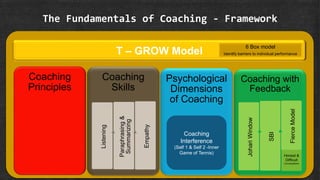
Coaching with
Feedback
Psychological
Dimensions
of Coaching
Coaching
Skills
Coaching
Principles
Listening
.
Paraphrasing&
Summarizing
Empathy
T – GROW Model
6 Box model
Identify barriers to individual performance
Coaching
Interference
(Self 1 & Self 2 -Inner
Game of Tennis)
Honest &
Difficult
Conversations
The Fundamentals of Coaching - Framework
JohariWindow
SBI
.
FierceModel
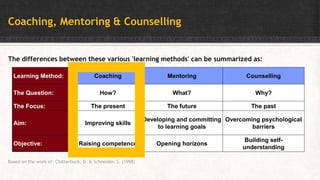
Coaching, Mentoring & Counselling
Learning Method: Coaching Mentoring Counselling
The Question: How? What? Why?
The Focus: The present The future The past
Aim: Improving skills
Developing and committing
to learning goals
Overcoming psychological
barriers
Objective: Raising competence Opening horizons
Building self-
understanding
The differences between these various 'learning methods' can be summarized as:
Based on the work of: Clutterbuck, D. & Schneider, S. (1998)
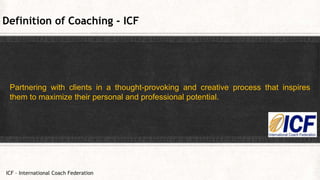
Definition of Coaching - ICF
Partnering with clients in a thought-provoking and creative process that inspires
them to maximize their personal and professional potential.
ICF – International Coach Federation
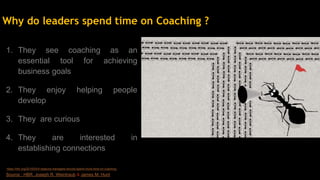
Why do leaders spend time on Coaching ?
Source : HBR, Joseph R. Weintraub & James M. Hunt
1. They see coaching as an
essential tool for achieving
business goals
2. They enjoy helping people
develop
3. They are curious
4. They are interested in
establishing connections
https://hbr.org/2015/05/4-reasons-managers-should-spend-more-time-on-coaching
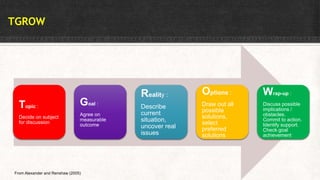
TGROW
Topic :
Decide on subject
for discussion
Goal :
Agree on
measurable
outcome
Reality :
Describe
current
situation,
uncover real
issues
Options :
Draw out all
possible
solutions,
select
preferred
solutions
Wrap-up :
Discuss possible
implications /
obstacles.
Commit to action.
Identify support.
Check goal
achievement
From Alexander and Renshaw (2005)
Coaching Principles
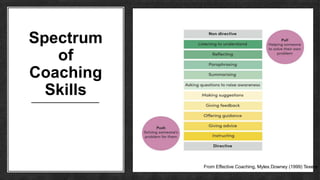
Spectrum
of
Coaching
Skills
From Effective Coaching, Myles Downey (1999) Texere
Deep listening at 3 levels
1. Head Level
Listen to key facts and story;
- Key ideas
- Thoughts
- Perspectives
2. Heart level
Listen to the Heart;
- Feelings
- Emotions
- Energy levels
3. Will & Determination
Listen to the “feet”;
- Direction
- Motivation
- Feedback
Blocks to Listening
Paraphrasing & Summarising
Empathy
Psychological
Dimensions of
Coaching
Outer and Inner dimensions
Job description
Deadlines
Places Role
Money
People Events
Relationships
Colleagues
External Landscape
Images
Dreams
Thoughts
Voices
Memories
Beliefs
Emotions / feelings
Hopes
Desires
Conflicts
Physical sensations
Psychological defenses / self protection
Internal Landscape
Self 1 and Self 2
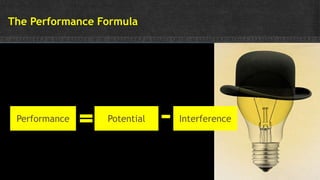
The Performance Formula
Performance InterferencePotential
Coaching the Interference
Instructions
20
The Elements of NLP
Coaching with feedback
Why is feedback important?
All leaders need feedback to be able to grow and develop
The higher you are in the organization, the less likely you will receive honest and
open feedback. That is very DANGEROUS!
The Johari Window
Managing information about YOU and perceptions of you as a Leader
This model was created by psychologists Joseph Luft (1916–2014) and Harrington Ingham (1916–1995) in 1955
The Power of Awareness
The Competence Cycle Model of Learning
Coaches need to identify the stage at
which an individual is at to use the right
sort of language to help them move to the
next stage. After all, it’s difficult to try to
improve a skill if you don’t know that you
lack it
With difficult conversations we mean the following :
A conversation that has the
following elements;
- High risk
- Different points of view
- Uncertainty
- History of baggage
- Strong emotions
It is not about just giving some feedback or giving a difficult message !
The Fierce Model
• What type of issues or situations have you found lead to difficult
situations in the work place ?
• What are some factors that can make conversation difficult ?
Giving Feedback using SBI
Main Source
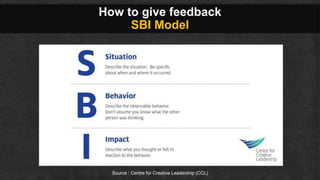
How to give feedback
SBI Model
Source : Centre for Creative Leadership (CCL)
.
Coaching with
Feedback
Psychological
Dimensions
of Coaching
Coaching
Skills
Coaching
Principles
Listening
.
Paraphrasing&
Summarizing
Empathy
T – GROW Model
6 Box model
Identify barriers to individual performance
Coaching
Interference
(Self 1 & Self 2 -Inner
Game of Tennis)
Honest &
Difficult
Conversations
Reflection : Our Framework
JohariWindow
SBI
.
FierceModel
References
The Inner Game of Tennis by Timothy Gallwey
Fierce Conversations by Susan Scott
Dominic Miles
Glenmore Global Resources
People | Performance | Values | Culture

Unlock Your Potential | Coaching

  • 1.
    The Fundamentals ofCoaching Glenmore Global Resources People | Performance | Values | Culture Prabhash Hettiarachchi, ACC
  • 2.
    Learning Objectives • Applya structured approach of Coaching using powerful but simple & practical models to improve employee performance and morale resulting enhanced business results • Practice difficult but essential conversations need to happen in day-to-day life to achieve success at work & in life by using techniques that make those more meaningful • Develop effective communication skills • Learn to give feedback in a more professional & an impactful manner
  • 3.
    . Coaching with Feedback Psychological Dimensions of Coaching Coaching Skills Coaching Principles Listening . Paraphrasing& Summarizing Empathy T– GROW Model 6 Box model Identify barriers to individual performance Coaching Interference (Self 1 & Self 2 -Inner Game of Tennis) Honest & Difficult Conversations The Fundamentals of Coaching - Framework JohariWindow SBI . FierceModel
  • 4.
    Coaching, Mentoring &Counselling Learning Method: Coaching Mentoring Counselling The Question: How? What? Why? The Focus: The present The future The past Aim: Improving skills Developing and committing to learning goals Overcoming psychological barriers Objective: Raising competence Opening horizons Building self- understanding The differences between these various 'learning methods' can be summarized as: Based on the work of: Clutterbuck, D. & Schneider, S. (1998)
  • 5.
    Definition of Coaching- ICF Partnering with clients in a thought-provoking and creative process that inspires them to maximize their personal and professional potential. ICF – International Coach Federation
  • 6.
    Why do leadersspend time on Coaching ? Source : HBR, Joseph R. Weintraub & James M. Hunt 1. They see coaching as an essential tool for achieving business goals 2. They enjoy helping people develop 3. They are curious 4. They are interested in establishing connections https://hbr.org/2015/05/4-reasons-managers-should-spend-more-time-on-coaching
  • 7.
    TGROW Topic : Decide onsubject for discussion Goal : Agree on measurable outcome Reality : Describe current situation, uncover real issues Options : Draw out all possible solutions, select preferred solutions Wrap-up : Discuss possible implications / obstacles. Commit to action. Identify support. Check goal achievement From Alexander and Renshaw (2005)
  • 9.
  • 10.
  • 11.
    Deep listening at3 levels 1. Head Level Listen to key facts and story; - Key ideas - Thoughts - Perspectives 2. Heart level Listen to the Heart; - Feelings - Emotions - Energy levels 3. Will & Determination Listen to the “feet”; - Direction - Motivation - Feedback
  • 12.
  • 13.
  • 14.
  • 15.
  • 16.
    Outer and Innerdimensions Job description Deadlines Places Role Money People Events Relationships Colleagues External Landscape Images Dreams Thoughts Voices Memories Beliefs Emotions / feelings Hopes Desires Conflicts Physical sensations Psychological defenses / self protection Internal Landscape
  • 17.
    Self 1 andSelf 2
  • 18.
  • 19.
  • 20.
  • 21.
  • 22.
    Why is feedbackimportant? All leaders need feedback to be able to grow and develop The higher you are in the organization, the less likely you will receive honest and open feedback. That is very DANGEROUS!
  • 23.
    The Johari Window Managinginformation about YOU and perceptions of you as a Leader This model was created by psychologists Joseph Luft (1916–2014) and Harrington Ingham (1916–1995) in 1955 The Power of Awareness
  • 24.
    The Competence CycleModel of Learning Coaches need to identify the stage at which an individual is at to use the right sort of language to help them move to the next stage. After all, it’s difficult to try to improve a skill if you don’t know that you lack it
  • 25.
    With difficult conversationswe mean the following : A conversation that has the following elements; - High risk - Different points of view - Uncertainty - History of baggage - Strong emotions It is not about just giving some feedback or giving a difficult message !
  • 26.
    The Fierce Model •What type of issues or situations have you found lead to difficult situations in the work place ? • What are some factors that can make conversation difficult ?
  • 27.
    Giving Feedback usingSBI Main Source
  • 28.
    How to givefeedback SBI Model Source : Centre for Creative Leadership (CCL)
  • 29.
    . Coaching with Feedback Psychological Dimensions of Coaching Coaching Skills Coaching Principles Listening . Paraphrasing& Summarizing Empathy T– GROW Model 6 Box model Identify barriers to individual performance Coaching Interference (Self 1 & Self 2 -Inner Game of Tennis) Honest & Difficult Conversations Reflection : Our Framework JohariWindow SBI . FierceModel
  • 31.
    References The Inner Gameof Tennis by Timothy Gallwey Fierce Conversations by Susan Scott Dominic Miles
  • 32.
    Glenmore Global Resources People| Performance | Values | Culture