HFMA
Webinar series 2017
Session 5
Coaching and mentoring
for challenging
conversations
Wednesday 31 May 2017
HFMAHFMA
Breaking bad news
Holding someone to account
Challenging poor performance or behaviour
Confronting something embarrassing
A disagreement
It requires courage
It requires clarity
It requires planning and preparation
What makes it challenging?
HFMAHFMA
The coachee is capable of developing perfect solutions
Julie Starr
Some key principles
Non judgmental
Unconditional positive
regard
Congruence
Genuineness
Acceptance
Empowerment
SIMPLE
Solutions not problems
In-between the noses
Make use of what is there
Possibilities
Language
Every case is different
Jackson and McKergow
HFMAHFMA
I would have thought with your experience you would know that by
now
I know I should do it but I think you would do this much better than I
would
I’m here to treat patients but all I hear is people like you talking
about money and demanding that I fill in paperwork that takes me
away from looking after them
What do you think is the best thing to do about this situation?
Isn’t it time you pulled yourself together and got on with it?
I think when you have been here as long as I have, you’ll see the
truth of what I’m saying
I’m not prepared to put up with this nonsense.
Things people say
4
HFMAHFMA
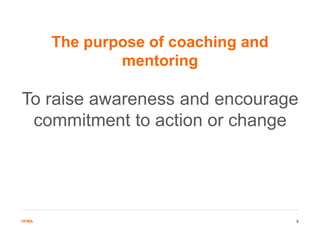
To raise awareness and encourage
commitment to action or change
The purpose of coaching and
mentoring
5
HFMAHFMA
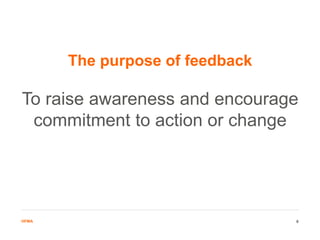
To raise awareness and encourage
commitment to action or change
The purpose of feedback
6
HFMAHFMA
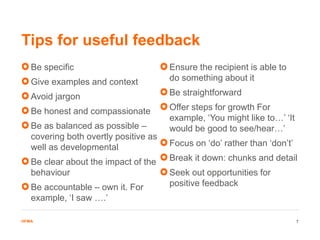
Be specific
Give examples and context
Avoid jargon
Be honest and compassionate
Be as balanced as possible –
covering both overtly positive as
well as developmental
Be clear about the impact of the
behaviour
Be accountable – own it. For
example, ‘I saw ….’
Ensure the recipient is able to
do something about it
Be straightforward
Offer steps for growth For
example, ‘You might like to…’ ‘It
would be good to see/hear…’
Focus on ‘do’ rather than ‘don’t’
Break it down: chunks and detail
Seek out opportunities for
positive feedback
Tips for useful feedback
7
HFMAHFMA
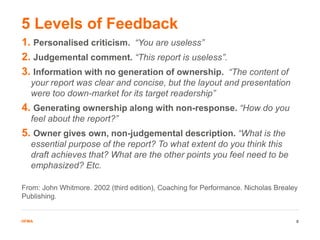
1. Personalised criticism. “You are useless”
2. Judgemental comment. “This report is useless”.
3. Information with no generation of ownership. “The content of
your report was clear and concise, but the layout and presentation
were too down-market for its target readership”
4. Generating ownership along with non-response. “How do you
feel about the report?”
5. Owner gives own, non-judgemental description. “What is the
essential purpose of the report? To what extent do you think this
draft achieves that? What are the other points you feel need to be
emphasized? Etc.
From: John Whitmore. 2002 (third edition), Coaching for Performance. Nicholas Brealey
Publishing.
5 Levels of Feedback
8
HFMAHFMA
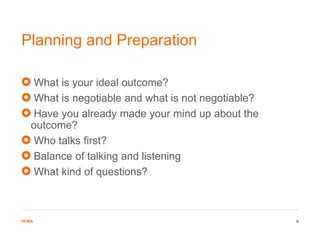
What is your ideal outcome?
What is negotiable and what is not negotiable?
Have you already made your mind up about the
outcome?
Who talks first?
Balance of talking and listening
What kind of questions?
Planning and Preparation
9
HFMAHFMA
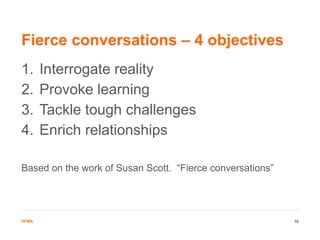
1. Interrogate reality
2. Provoke learning
3. Tackle tough challenges
4. Enrich relationships
Based on the work of Susan Scott. “Fierce conversations”
Fierce conversations – 4 objectives
10
About the HFMA
The Healthcare Financial Management Association (HFMA) is the UK representative body for finance professionals working in the NHS
and the wider healthcare sector. Our aim is to support the NHS finance function, to promote good practice in financial management and
to improve the general understanding of NHS finance issues.
Our work is informed by a number of committees and special interest groups made up of healthcare finance practitioners. We publish
numerous guides and briefings aimed at finance professionals, non-executive directors and non-finance staff. We also provide training
and development opportunities – including a suite of web based learning modules – across all of these groups.
www.hfma.org.uk
Thank you – any questions?

Coaching and mentoring for challenging conversations

  • 1.
    HFMA Webinar series 2017 Session5 Coaching and mentoring for challenging conversations Wednesday 31 May 2017
  • 2.
    HFMAHFMA Breaking bad news Holdingsomeone to account Challenging poor performance or behaviour Confronting something embarrassing A disagreement It requires courage It requires clarity It requires planning and preparation What makes it challenging?
  • 3.
    HFMAHFMA The coachee iscapable of developing perfect solutions Julie Starr Some key principles Non judgmental Unconditional positive regard Congruence Genuineness Acceptance Empowerment SIMPLE Solutions not problems In-between the noses Make use of what is there Possibilities Language Every case is different Jackson and McKergow
  • 4.
    HFMAHFMA I would havethought with your experience you would know that by now I know I should do it but I think you would do this much better than I would I’m here to treat patients but all I hear is people like you talking about money and demanding that I fill in paperwork that takes me away from looking after them What do you think is the best thing to do about this situation? Isn’t it time you pulled yourself together and got on with it? I think when you have been here as long as I have, you’ll see the truth of what I’m saying I’m not prepared to put up with this nonsense. Things people say 4
  • 5.
    HFMAHFMA To raise awarenessand encourage commitment to action or change The purpose of coaching and mentoring 5
  • 6.
    HFMAHFMA To raise awarenessand encourage commitment to action or change The purpose of feedback 6
  • 7.
    HFMAHFMA Be specific Give examplesand context Avoid jargon Be honest and compassionate Be as balanced as possible – covering both overtly positive as well as developmental Be clear about the impact of the behaviour Be accountable – own it. For example, ‘I saw ….’ Ensure the recipient is able to do something about it Be straightforward Offer steps for growth For example, ‘You might like to…’ ‘It would be good to see/hear…’ Focus on ‘do’ rather than ‘don’t’ Break it down: chunks and detail Seek out opportunities for positive feedback Tips for useful feedback 7
  • 8.
    HFMAHFMA 1. Personalised criticism.“You are useless” 2. Judgemental comment. “This report is useless”. 3. Information with no generation of ownership. “The content of your report was clear and concise, but the layout and presentation were too down-market for its target readership” 4. Generating ownership along with non-response. “How do you feel about the report?” 5. Owner gives own, non-judgemental description. “What is the essential purpose of the report? To what extent do you think this draft achieves that? What are the other points you feel need to be emphasized? Etc. From: John Whitmore. 2002 (third edition), Coaching for Performance. Nicholas Brealey Publishing. 5 Levels of Feedback 8
  • 9.
    HFMAHFMA What is yourideal outcome? What is negotiable and what is not negotiable? Have you already made your mind up about the outcome? Who talks first? Balance of talking and listening What kind of questions? Planning and Preparation 9
  • 10.
    HFMAHFMA 1. Interrogate reality 2.Provoke learning 3. Tackle tough challenges 4. Enrich relationships Based on the work of Susan Scott. “Fierce conversations” Fierce conversations – 4 objectives 10
  • 11.
    About the HFMA TheHealthcare Financial Management Association (HFMA) is the UK representative body for finance professionals working in the NHS and the wider healthcare sector. Our aim is to support the NHS finance function, to promote good practice in financial management and to improve the general understanding of NHS finance issues. Our work is informed by a number of committees and special interest groups made up of healthcare finance practitioners. We publish numerous guides and briefings aimed at finance professionals, non-executive directors and non-finance staff. We also provide training and development opportunities – including a suite of web based learning modules – across all of these groups. www.hfma.org.uk Thank you – any questions?