CO2 REDUCTION
Submitted by:
Prashant (2K21CHPN01007)
Mitali Gupta (2K21CHPN01006)
Submitted to:
Dr. Roopa Rani
INTRODUCTION
 CO2 is a greenhouse gas.
 It is mainly responsible for the global warming and ocean
acidification.
 The methods for reduction is classified as:
a. Artificial
b. Natural
 Various chemicals and fuels are produced by co2 reduction.
CARBON DIOXIDE PROFILE
CHEMICAL
FORMULA
CO2
LOW
REACTIVITY
COLORLESS
GAS
FUTURE CHALLENGES
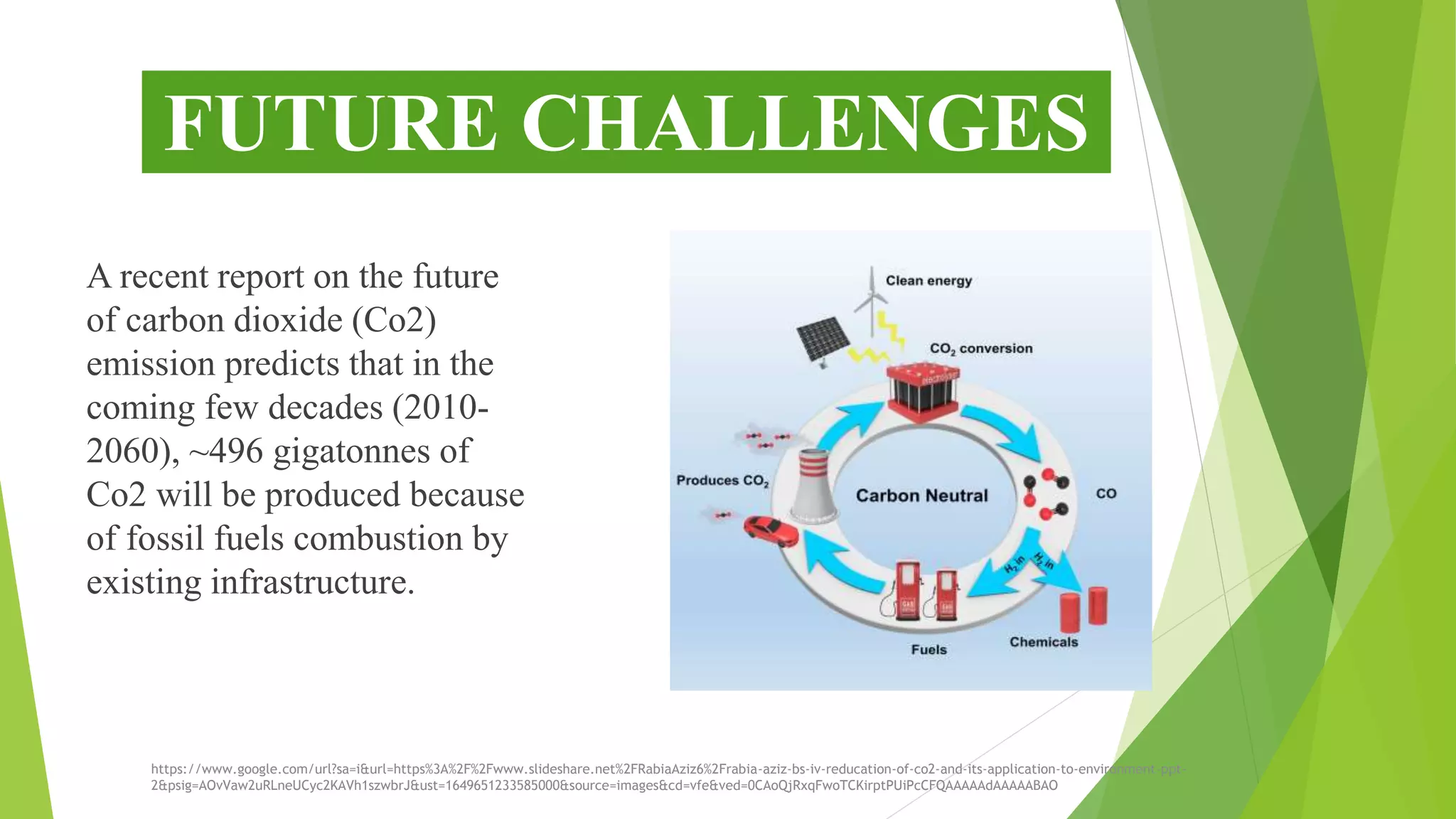
A recent report on the future
of carbon dioxide (Co2)
emission predicts that in the
coming few decades (2010-
2060), ~496 gigatonnes of
Co2 will be produced because
of fossil fuels combustion by
existing infrastructure.
https://www.google.com/url?sa=i&url=https%3A%2F%2Fwww.slideshare.net%2FRabiaAziz6%2Frabia-aziz-bs-iv-reducation-of-co2-and-its-application-to-environment-ppt-
2&psig=AOvVaw2uRLneUCyc2KAVh1szwbrJ&ust=1649651233585000&source=images&cd=vfe&ved=0CAoQjRxqFwoTCKirptPUiPcCFQAAAAAdAAAAABAO
SOLUTION TO THE PROBLEM
 Co2 can be artificially converted into fuel or
commodity chemicals.
 The Co2 conversion methodology not only
addresses the potential solution for
controlling the Co2 concentration level in the
environment but also offers an alternative
approach for conversion of renewable energy
to a chemical fuel or product.
 So far, various noble metals (Ag, Au, Cu, Pt
and so on) and metal complexes are used as
heterogeneous catalysts (as electrodes ) for
Co2 reduction. However, the rising cost of
noble metals is the main hindrance towards
their large scale practical applications.
https://www.google.com/url?sa=i&url=https%3A%2F%2Fwww.slideshare.net%2Fsaurav9119%2Felectrochemical-reduction-of-carbon-dioxide&psig=AOvVaw1kVDVdBrhgM3nNR-
16f7hA&ust=1649655978304000&source=images&cd=vfe&ved=0CAoQjRxqFwoTCPi6xenliPcCFQAAAAAdAAAAABAD
Attempts at Co2 Reduction
 Radiochemical
 Chemical reduction
 Thermochemical
 Photo chemical
 Electrochemical
 Biochemical
 Bio photochemical
 Photo electrochemical
 Bio electrochemical
 Bio photoelectrochemical
ELECTROCHEMICAL REDUCTION
 The electrochemical reduction of
carbon dioxide is the conversion
of carbon dioxide(Co2) to more reduced
chemical species using electrical
energy.
 Electrochemical reduction of carbon
dioxide represents a possible means of
producing chemicals or fuels,
converting carbon dioxide (CO2) to
organic feedstocks such as formic acid
(HCOOH),carbon monoxide
(CO), methane (CH4), ethylene (C2H4)
and ethanol (C2H5OH).
 Among the more selective metallic
catalysts in this field are tin for formic
acid, silver for carbon monoxide
and copper for methane, ethylene or
ethanol.
https://en.wikipedia.org/wiki/Electrochemical_reduction_of_carbon_dioxide#:~:text=The%20electrochemical%20reduction%20of%20carbon,of%20the%20most%20promising%20approaches.
WORKING
Products obtained using different metallic electrocatalyst
APPLICATIONS
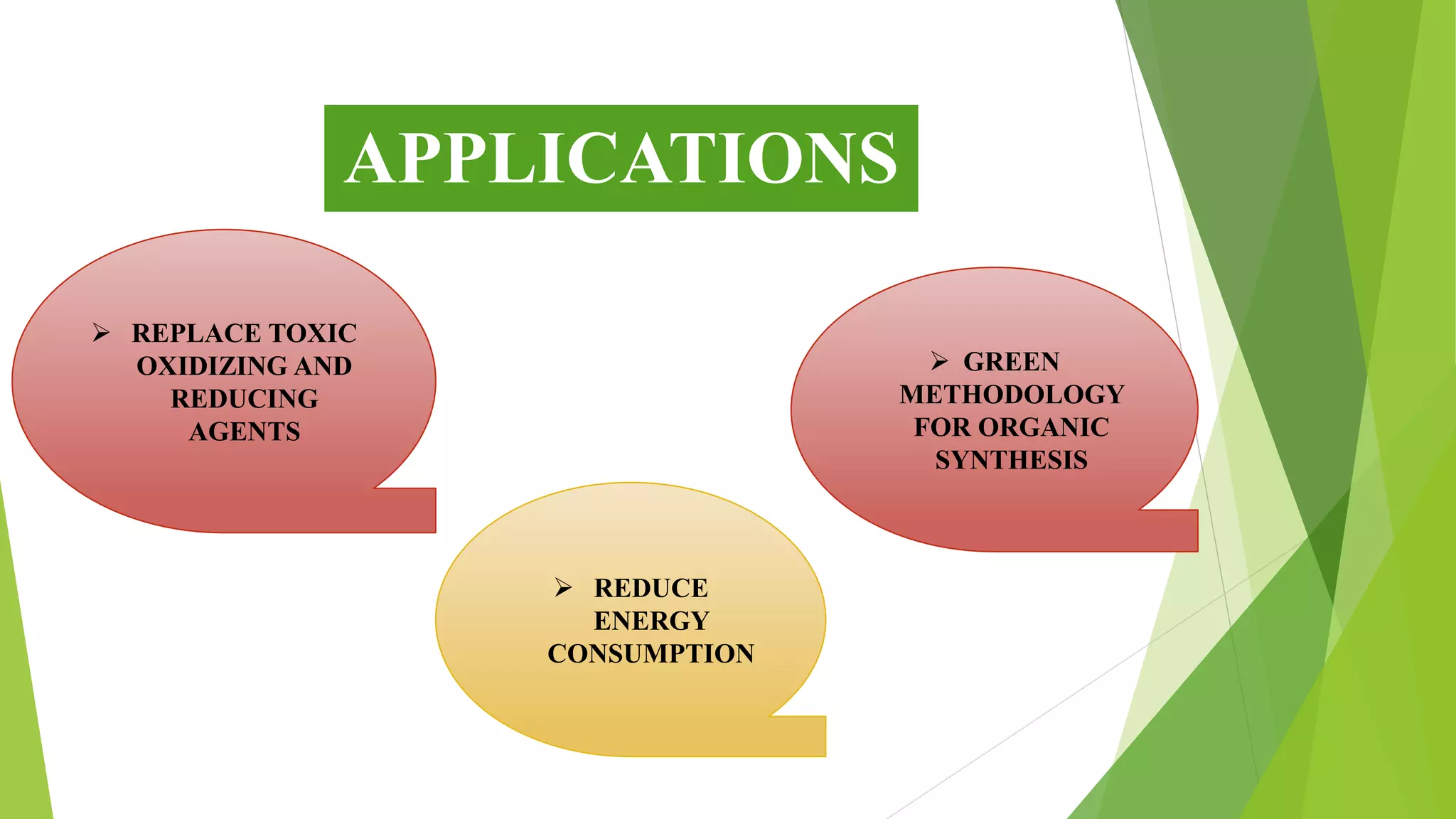
 REPLACE TOXIC
OXIDIZING AND
REDUCING
AGENTS
 REDUCE
ENERGY
CONSUMPTION
 GREEN
METHODOLOGY
FOR ORGANIC
SYNTHESIS
PHOTOCHEMICAL REDUCTION
Photochemical reduction involves chemical reduction generated from the photoexcitation of another molecule, called a
photosensitizer.
CATALYTIC CO2 REDUCTION
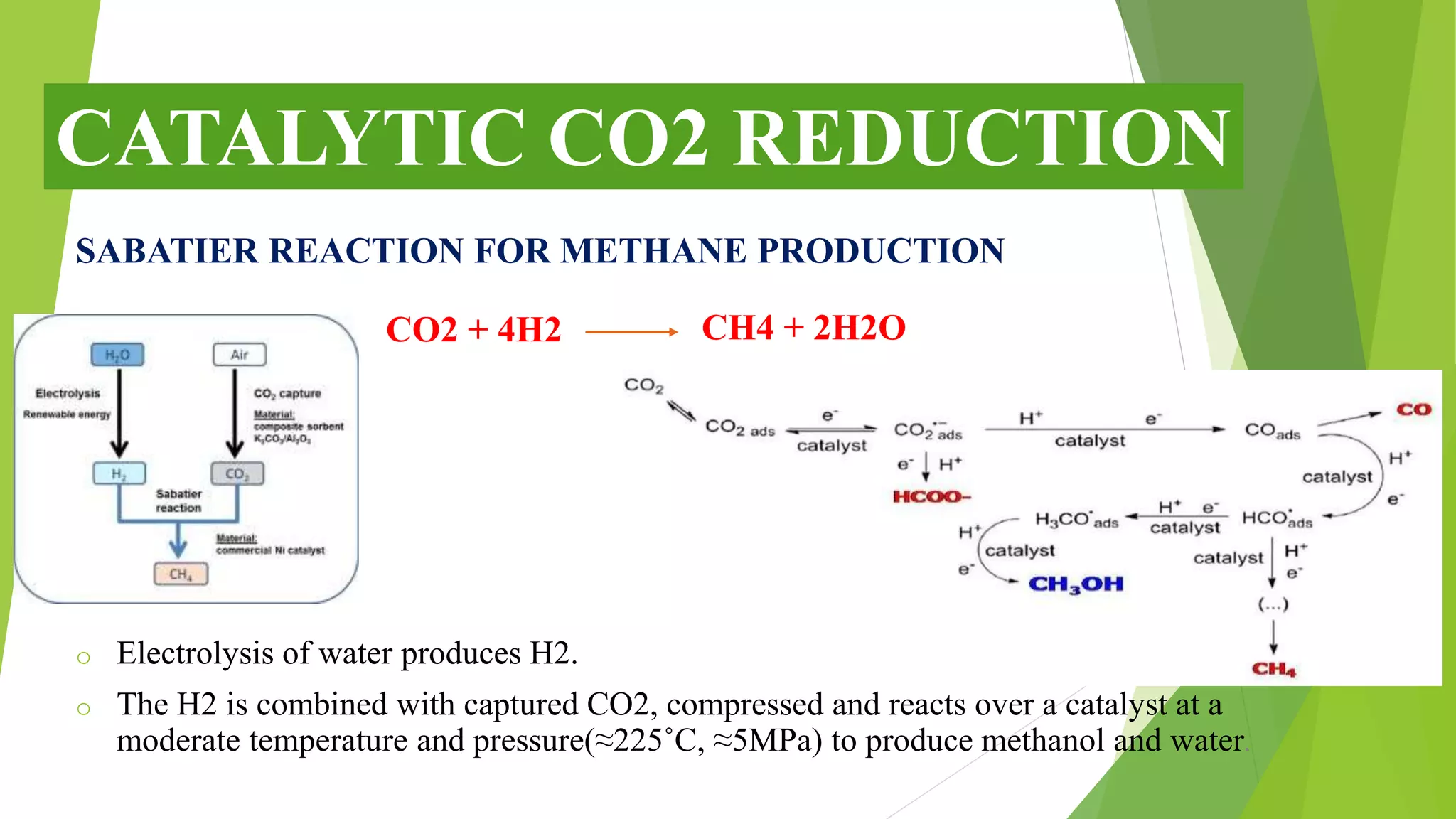
SABATIER REACTION FOR METHANE PRODUCTION
o Electrolysis of water produces H2.
o The H2 is combined with captured CO2, compressed and reacts over a catalyst at a
moderate temperature and pressure(≈225˚C, ≈5MPa) to produce methanol and water.
CO2 + 4H2 CH4 + 2H2O
CALVIN CYCLE
 The Calvin cycle is a process that plants and algae use to turn carbon dioxide from the air
into sugar, the food autotrophs need to grow.
 Every living thing on Earth depends on the Calvin cycle.
 Plants depend on the Calvin cycle for energy and food.
 The primary function of the Calvin cycle is to make organic products that plants need using
the products from the light reactions of photosynthesis (ATP and NADPH).
 The products formed after a single turn of the Calvin cycle are 3 ADP, 2 glyceraldehyde-3-
phosphate (G3P) molecules, and 2 NADP+.
STAGES OF CALVIN CYCLE
FIXATION
REGENERATION
REDUCTION
Merits and De-Merits
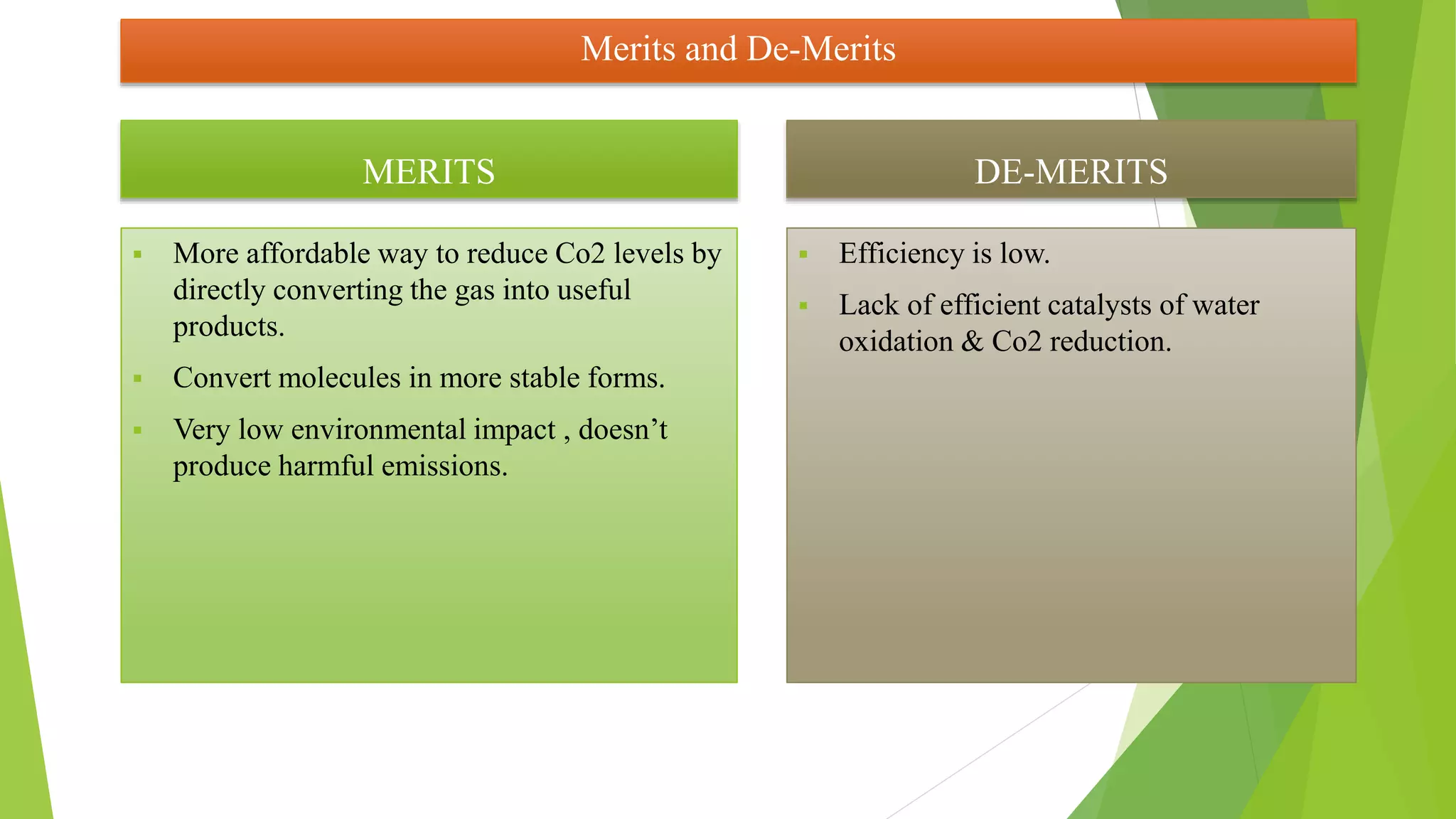
MERITS
 More affordable way to reduce Co2 levels by
directly converting the gas into useful
products.
 Convert molecules in more stable forms.
 Very low environmental impact , doesn’t
produce harmful emissions.
DE-MERITS
 Efficiency is low.
 Lack of efficient catalysts of water
oxidation & Co2 reduction.
THANK YOU!!
THE END

Carbon dioxide reduction

  • 1.
    CO2 REDUCTION Submitted by: Prashant(2K21CHPN01007) Mitali Gupta (2K21CHPN01006) Submitted to: Dr. Roopa Rani
  • 2.
    INTRODUCTION  CO2 isa greenhouse gas.  It is mainly responsible for the global warming and ocean acidification.  The methods for reduction is classified as: a. Artificial b. Natural  Various chemicals and fuels are produced by co2 reduction.
  • 3.
  • 4.
    FUTURE CHALLENGES A recentreport on the future of carbon dioxide (Co2) emission predicts that in the coming few decades (2010- 2060), ~496 gigatonnes of Co2 will be produced because of fossil fuels combustion by existing infrastructure. https://www.google.com/url?sa=i&url=https%3A%2F%2Fwww.slideshare.net%2FRabiaAziz6%2Frabia-aziz-bs-iv-reducation-of-co2-and-its-application-to-environment-ppt- 2&psig=AOvVaw2uRLneUCyc2KAVh1szwbrJ&ust=1649651233585000&source=images&cd=vfe&ved=0CAoQjRxqFwoTCKirptPUiPcCFQAAAAAdAAAAABAO
  • 5.
    SOLUTION TO THEPROBLEM  Co2 can be artificially converted into fuel or commodity chemicals.  The Co2 conversion methodology not only addresses the potential solution for controlling the Co2 concentration level in the environment but also offers an alternative approach for conversion of renewable energy to a chemical fuel or product.  So far, various noble metals (Ag, Au, Cu, Pt and so on) and metal complexes are used as heterogeneous catalysts (as electrodes ) for Co2 reduction. However, the rising cost of noble metals is the main hindrance towards their large scale practical applications. https://www.google.com/url?sa=i&url=https%3A%2F%2Fwww.slideshare.net%2Fsaurav9119%2Felectrochemical-reduction-of-carbon-dioxide&psig=AOvVaw1kVDVdBrhgM3nNR- 16f7hA&ust=1649655978304000&source=images&cd=vfe&ved=0CAoQjRxqFwoTCPi6xenliPcCFQAAAAAdAAAAABAD
  • 6.
    Attempts at Co2Reduction  Radiochemical  Chemical reduction  Thermochemical  Photo chemical  Electrochemical  Biochemical  Bio photochemical  Photo electrochemical  Bio electrochemical  Bio photoelectrochemical
  • 7.
    ELECTROCHEMICAL REDUCTION  Theelectrochemical reduction of carbon dioxide is the conversion of carbon dioxide(Co2) to more reduced chemical species using electrical energy.  Electrochemical reduction of carbon dioxide represents a possible means of producing chemicals or fuels, converting carbon dioxide (CO2) to organic feedstocks such as formic acid (HCOOH),carbon monoxide (CO), methane (CH4), ethylene (C2H4) and ethanol (C2H5OH).  Among the more selective metallic catalysts in this field are tin for formic acid, silver for carbon monoxide and copper for methane, ethylene or ethanol. https://en.wikipedia.org/wiki/Electrochemical_reduction_of_carbon_dioxide#:~:text=The%20electrochemical%20reduction%20of%20carbon,of%20the%20most%20promising%20approaches.
  • 8.
  • 9.
    Products obtained usingdifferent metallic electrocatalyst
  • 10.
    APPLICATIONS  REPLACE TOXIC OXIDIZINGAND REDUCING AGENTS  REDUCE ENERGY CONSUMPTION  GREEN METHODOLOGY FOR ORGANIC SYNTHESIS
  • 11.
    PHOTOCHEMICAL REDUCTION Photochemical reductioninvolves chemical reduction generated from the photoexcitation of another molecule, called a photosensitizer.
  • 12.
    CATALYTIC CO2 REDUCTION SABATIERREACTION FOR METHANE PRODUCTION o Electrolysis of water produces H2. o The H2 is combined with captured CO2, compressed and reacts over a catalyst at a moderate temperature and pressure(≈225˚C, ≈5MPa) to produce methanol and water. CO2 + 4H2 CH4 + 2H2O
  • 13.
    CALVIN CYCLE  TheCalvin cycle is a process that plants and algae use to turn carbon dioxide from the air into sugar, the food autotrophs need to grow.  Every living thing on Earth depends on the Calvin cycle.  Plants depend on the Calvin cycle for energy and food.  The primary function of the Calvin cycle is to make organic products that plants need using the products from the light reactions of photosynthesis (ATP and NADPH).  The products formed after a single turn of the Calvin cycle are 3 ADP, 2 glyceraldehyde-3- phosphate (G3P) molecules, and 2 NADP+.
  • 14.
    STAGES OF CALVINCYCLE FIXATION REGENERATION REDUCTION
  • 16.
    Merits and De-Merits MERITS More affordable way to reduce Co2 levels by directly converting the gas into useful products.  Convert molecules in more stable forms.  Very low environmental impact , doesn’t produce harmful emissions. DE-MERITS  Efficiency is low.  Lack of efficient catalysts of water oxidation & Co2 reduction.
  • 17.