PATHWAYS TO
EXCELLENCE:
USING BACKWARD DESIGN
PRINCIPLES FOR
INSTRUCTION AND
ASSESSMENT
A CALPER WEBINAR
Donna L. Clementi
World Languages Methods Instructor, Lawrence University
Donna.clementi@gmail.com
Backward Design: Major Steps
5/7/2014CALPER Webinar Donna Clementi
2
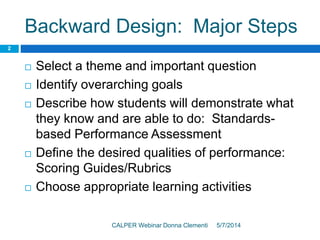
 Select a theme and important question
 Identify overarching goals
 Describe how students will demonstrate what
they know and are able to do: Standards-
based Performance Assessment
 Define the desired qualities of performance:
Scoring Guides/Rubrics
 Choose appropriate learning activities
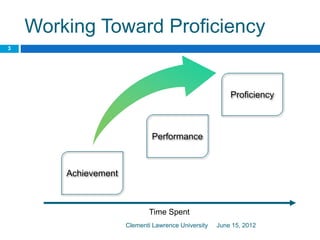
Time Spent
Achievement
Proficiency
Working Toward Proficiency
June 15, 2012Clementi Lawrence University
3
Performance
Achievement
5/7/2014CALPER Webinar Donna Clementi
4
 Measures student’s knowledge of specified
elements in the curriculum taught during a
specific time period
 Includes short quizzes, chapter tests, final
examinations covering the content of a whole
course.
 MEMORIZED
Performance
5/7/2014CALPER Webinar Donna Clementi
5
 Measures student’s ability to complete tasks
that require the application of learning in an
actual or simulated setting
 Tasks may include listening, reading, viewing,
speaking, writing, and two-way interactions
 PRACTICED
 Resource:
http://www.actfl.org/sites/default/files/pdfs/PerformanceDescriptorsLanguageLearner
s.pdf
Proficiency
5/7/2014CALPER Webinar Donna Clementi
6
 Measures student’s ability to use language for
real world purposes to accomplish real world
linguistic tasks
 Includes a wide range of topics and settings
 SPONTANEOUS
 Resource:
http://actflproficiencyguidelines2012.org/
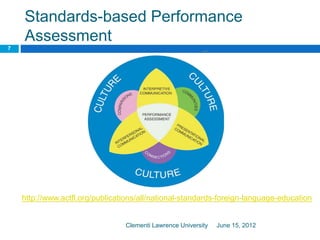
Standards-based Performance
Assessment
June 15, 2012Clementi Lawrence University
7
http://www.actfl.org/publications/all/national-standards-foreign-language-education
Lead with Culture: Overarching
Themes
June 15, 2012Clementi Lawrence University
8
 Personal and Public Identities
 Families and Communities
 Contemporary Life
 Beauty and Aesthetics
 Science and Technology
 Global Challenges
*Six Overarching Themes of the AP Curriculum Framework 2009
Lead with Culture: Important
Questions
5/7/2014CALPER Webinar Donna Clementi
9
 How does what I do define who I am?
 How are families defined in today’s world?
 How balanced is your lifestyle?
 How do music and art reflect time and place?
 How does technology make life simpler/more
complex?
 What can’t all children go to school?
Example
5/7/2014CALPER Webinar Donna Clementi
10
 Language and Level: French
Novice High Intermediate Low
 Theme: Global Issues: Education
 Important Question: Why can’t all young
people go to school?
Overarching Goals
5/7/2014CALPER Webinar Donna Clementi
11
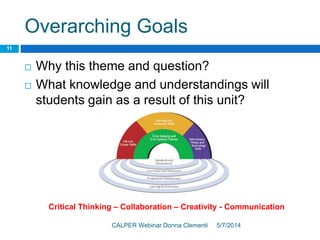
 Why this theme and question?
 What knowledge and understandings will
students gain as a result of this unit?
Critical Thinking – Collaboration – Creativity - Communication
Example
5/7/2014CALPER Webinar Donna Clementi
12
 Goals:
 Describe the current status of education of young
people locally, nationally, and globally
 Identify and categorize economic, political, and social
reasons why young people around the world cannot
go to/stay in school
 Give reasons why going to school is important to
oneself, and important locally, nationally, globally
 Give examples of initiatives to support schooling for
all young people around the world
 Connect with a school in (x) to learn more about the
school; collaborate to develop a plan for continued
communication
Standards-based Performance
Assessments
5/7/2014CALPER Webinar Donna Clementi
13
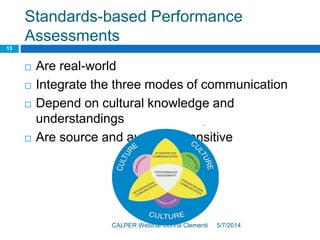
 Are real-world
 Integrate the three modes of communication
 Depend on cultural knowledge and
understandings
 Are source and audience sensitive
Interpretive Task(s)
5/7/2014CALPER Webinar Donna Clementi
14
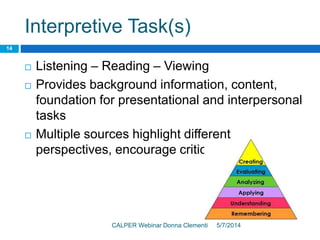
 Listening – Reading – Viewing
 Provides background information, content,
foundation for presentational and interpersonal
tasks
 Multiple sources highlight different
perspectives, encourage critical thinking
Interpretive Formative
Assessment
 Determine if each statement is true or false. If the statement is true, circle
the place in the article that shows that the statement is true.
1. Children must attend school until they are 16 years old.
2. Children work in factories during the school year.
3. In many countries, children work instead of going to school.
 Pourquoi l’école pour tous ? Pour que tous les enfants, même les plus
pauvres, aient le droit d’apprendre à lire, à écrire, à compter, puis plus tard
de faire des études.
 A quoi ça sert ? Les enfants, obligés d’aller à l’école, au début jusqu’à
douze ans, puis quatorze, maintenant seize, ne peuvent plus aller travailler
dans les usines ou dans les champs durant l’année scolaire. Grâce à la
lecture et à l’écriture les gens du peuple sont devenus des citoyens
capables de comprendre leurs droits. L’école aide à sortir de l’ignorance,
donc à échapper à la misère. Il ne faut pas oublier qu’il y a encore
beaucoup de pays dans le monde où tous les enfants ne vont pas à l’école
: ils travaillent.
 Victor Hugo, au 19ème siècle, a sans cesse combattu pour l’école libre*. Il
disait que la connaissance éclaire l’esprit comme la lumière éclaire le jour.June 15, 2012Clementi Lawrence University
15
Presentational Task
5/7/2014CALPER Webinar Donna Clementi
16
 Speaking – Writing
 Requires an audience who will benefit from
reading or listening to or viewing the polished
presentation
 Timely, helpful feedback is essential
Presentational Formative
Assessment
5/7/2014CALPER Webinar Donna Clementi
17
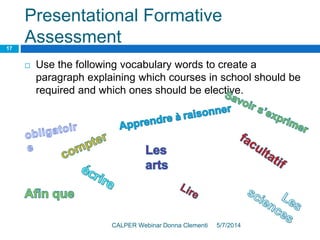
 Use the following vocabulary words to create a
paragraph explaining which courses in school should be
required and which ones should be elective.
Interpersonal Task
5/7/2014CALPER Webinar Donna Clementi
18
 Two-way spontaneous, negotiated interactions
 Often includes discussion of possible
responses to the important question
 Focus on successful communication
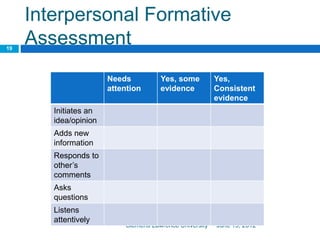
Interpersonal Formative
Assessment
June 15, 2012
19
Clementi Lawrence University
Needs
attention
Yes, some
evidence
Yes,
Consistent
evidence
Initiates an
idea/opinion
Adds new
information
Responds to
other’s
comments
Asks
questions
Listens
attentively
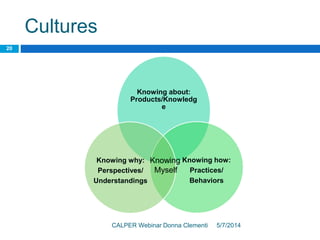
Cultures
5/7/2014CALPER Webinar Donna Clementi
20
Knowing about:
Products/Knowledg
e
Knowing how:
Practices/
Behaviors
Knowing why:
Perspectives/
Understandings
Knowing
Myself
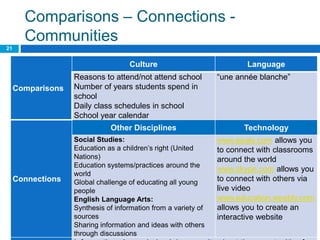
Comparisons – Connections -
Communities
5/7/2014CALPER Webinar Donna Clementi
21
Comparisons
Culture Language
Reasons to attend/not attend school
Number of years students spend in
school
Daily class schedules in school
School year calendar
“une année blanche”
Connections
Other Disciplines Technology
Social Studies:
Education as a children’s right (United
Nations)
Education systems/practices around the
world
Global challenge of educating all young
people
English Language Arts:
Synthesis of information from a variety of
sources
Sharing information and ideas with others
through discussions
www.epals.com allows you
to connect with classrooms
around the world
www.skype.com allows you
to connect with others via
live video
www.education.weebly.com
allows you to create an
interactive website
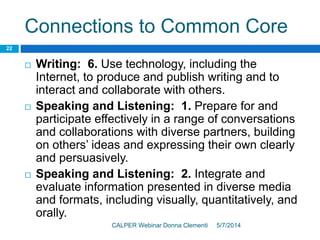
Connections to Common Core
5/7/2014CALPER Webinar Donna Clementi
22
 Writing: 6. Use technology, including the
Internet, to produce and publish writing and to
interact and collaborate with others.
 Speaking and Listening: 1. Prepare for and
participate effectively in a range of conversations
and collaborations with diverse partners, building
on others’ ideas and expressing their own clearly
and persuasively.
 Speaking and Listening: 2. Integrate and
evaluate information presented in diverse media
and formats, including visually, quantitatively, and
orally.
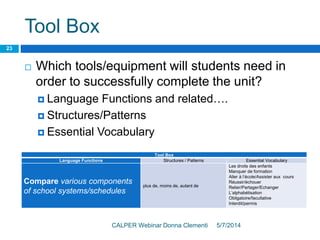
Tool Box
5/7/2014CALPER Webinar Donna Clementi
23
 Which tools/equipment will students need in
order to successfully complete the unit?
 Language Functions and related….
 Structures/Patterns
 Essential Vocabulary
Tool Box
Language Functions Structures / Patterns Essential Vocabulary
Compare various components
of school systems/schedules
plus de, moins de, autant de
Les droits des enfants
Manquer de formation
Aller à l’école/Assister aux cours
Réussir/échouer
Relier/Partager/Echanger
L’alphabétisation
Obligatoire/facultative
Interdit/permis
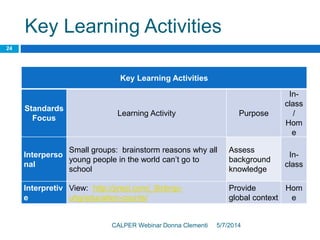
Key Learning Activities
5/7/2014CALPER Webinar Donna Clementi
24
Key Learning Activities
Standards
Focus
Learning Activity Purpose
In-
class
/
Hom
e
Interperso
nal
Small groups: brainstorm reasons why all
young people in the world can’t go to
school
Assess
background
knowledge
In-
class
Interpretiv
e
View: http://prezi.com/_9icbrqc-
uhg/education-counts/
Provide
global context
Hom
e
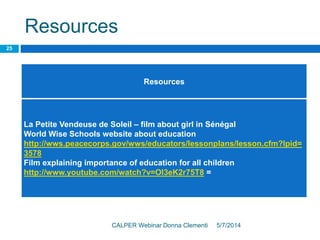
Resources
5/7/2014CALPER Webinar Donna Clementi
25
Resources
La Petite Vendeuse de Soleil – film about girl in Sénégal
World Wise Schools website about education
http://wws.peacecorps.gov/wws/educators/lessonplans/lesson.cfm?lpid=
3578
Film explaining importance of education for all children
http://www.youtube.com/watch?v=OI3eK2r75T8 =
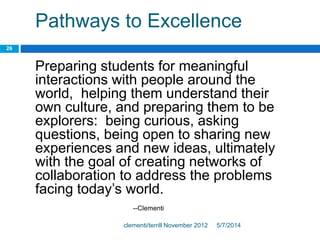
Pathways to Excellence
Preparing students for meaningful
interactions with people around the
world, helping them understand their
own culture, and preparing them to be
explorers: being curious, asking
questions, being open to sharing new
experiences and new ideas, ultimately
with the goal of creating networks of
collaboration to address the problems
facing today’s world.
--Clementi
5/7/2014clementi/terrill November 2012
26

Pathways to Excellence: Using Backward Design Principles for Instruction and Assessment with Dr. Clementi

  • 1.
    PATHWAYS TO EXCELLENCE: USING BACKWARDDESIGN PRINCIPLES FOR INSTRUCTION AND ASSESSMENT A CALPER WEBINAR Donna L. Clementi World Languages Methods Instructor, Lawrence University Donna.clementi@gmail.com
  • 2.
    Backward Design: MajorSteps 5/7/2014CALPER Webinar Donna Clementi 2  Select a theme and important question  Identify overarching goals  Describe how students will demonstrate what they know and are able to do: Standards- based Performance Assessment  Define the desired qualities of performance: Scoring Guides/Rubrics  Choose appropriate learning activities
  • 3.
    Time Spent Achievement Proficiency Working TowardProficiency June 15, 2012Clementi Lawrence University 3 Performance
  • 4.
    Achievement 5/7/2014CALPER Webinar DonnaClementi 4  Measures student’s knowledge of specified elements in the curriculum taught during a specific time period  Includes short quizzes, chapter tests, final examinations covering the content of a whole course.  MEMORIZED
  • 5.
    Performance 5/7/2014CALPER Webinar DonnaClementi 5  Measures student’s ability to complete tasks that require the application of learning in an actual or simulated setting  Tasks may include listening, reading, viewing, speaking, writing, and two-way interactions  PRACTICED  Resource: http://www.actfl.org/sites/default/files/pdfs/PerformanceDescriptorsLanguageLearner s.pdf
  • 6.
    Proficiency 5/7/2014CALPER Webinar DonnaClementi 6  Measures student’s ability to use language for real world purposes to accomplish real world linguistic tasks  Includes a wide range of topics and settings  SPONTANEOUS  Resource: http://actflproficiencyguidelines2012.org/
  • 7.
    Standards-based Performance Assessment June 15,2012Clementi Lawrence University 7 http://www.actfl.org/publications/all/national-standards-foreign-language-education
  • 8.
    Lead with Culture:Overarching Themes June 15, 2012Clementi Lawrence University 8  Personal and Public Identities  Families and Communities  Contemporary Life  Beauty and Aesthetics  Science and Technology  Global Challenges *Six Overarching Themes of the AP Curriculum Framework 2009
  • 9.
    Lead with Culture:Important Questions 5/7/2014CALPER Webinar Donna Clementi 9  How does what I do define who I am?  How are families defined in today’s world?  How balanced is your lifestyle?  How do music and art reflect time and place?  How does technology make life simpler/more complex?  What can’t all children go to school?
  • 10.
    Example 5/7/2014CALPER Webinar DonnaClementi 10  Language and Level: French Novice High Intermediate Low  Theme: Global Issues: Education  Important Question: Why can’t all young people go to school?
  • 11.
    Overarching Goals 5/7/2014CALPER WebinarDonna Clementi 11  Why this theme and question?  What knowledge and understandings will students gain as a result of this unit? Critical Thinking – Collaboration – Creativity - Communication
  • 12.
    Example 5/7/2014CALPER Webinar DonnaClementi 12  Goals:  Describe the current status of education of young people locally, nationally, and globally  Identify and categorize economic, political, and social reasons why young people around the world cannot go to/stay in school  Give reasons why going to school is important to oneself, and important locally, nationally, globally  Give examples of initiatives to support schooling for all young people around the world  Connect with a school in (x) to learn more about the school; collaborate to develop a plan for continued communication
  • 13.
    Standards-based Performance Assessments 5/7/2014CALPER WebinarDonna Clementi 13  Are real-world  Integrate the three modes of communication  Depend on cultural knowledge and understandings  Are source and audience sensitive
  • 14.
    Interpretive Task(s) 5/7/2014CALPER WebinarDonna Clementi 14  Listening – Reading – Viewing  Provides background information, content, foundation for presentational and interpersonal tasks  Multiple sources highlight different perspectives, encourage critical thinking
  • 15.
    Interpretive Formative Assessment  Determineif each statement is true or false. If the statement is true, circle the place in the article that shows that the statement is true. 1. Children must attend school until they are 16 years old. 2. Children work in factories during the school year. 3. In many countries, children work instead of going to school.  Pourquoi l’école pour tous ? Pour que tous les enfants, même les plus pauvres, aient le droit d’apprendre à lire, à écrire, à compter, puis plus tard de faire des études.  A quoi ça sert ? Les enfants, obligés d’aller à l’école, au début jusqu’à douze ans, puis quatorze, maintenant seize, ne peuvent plus aller travailler dans les usines ou dans les champs durant l’année scolaire. Grâce à la lecture et à l’écriture les gens du peuple sont devenus des citoyens capables de comprendre leurs droits. L’école aide à sortir de l’ignorance, donc à échapper à la misère. Il ne faut pas oublier qu’il y a encore beaucoup de pays dans le monde où tous les enfants ne vont pas à l’école : ils travaillent.  Victor Hugo, au 19ème siècle, a sans cesse combattu pour l’école libre*. Il disait que la connaissance éclaire l’esprit comme la lumière éclaire le jour.June 15, 2012Clementi Lawrence University 15
  • 16.
    Presentational Task 5/7/2014CALPER WebinarDonna Clementi 16  Speaking – Writing  Requires an audience who will benefit from reading or listening to or viewing the polished presentation  Timely, helpful feedback is essential
  • 17.
    Presentational Formative Assessment 5/7/2014CALPER WebinarDonna Clementi 17  Use the following vocabulary words to create a paragraph explaining which courses in school should be required and which ones should be elective.
  • 18.
    Interpersonal Task 5/7/2014CALPER WebinarDonna Clementi 18  Two-way spontaneous, negotiated interactions  Often includes discussion of possible responses to the important question  Focus on successful communication
  • 19.
    Interpersonal Formative Assessment June 15,2012 19 Clementi Lawrence University Needs attention Yes, some evidence Yes, Consistent evidence Initiates an idea/opinion Adds new information Responds to other’s comments Asks questions Listens attentively
  • 20.
    Cultures 5/7/2014CALPER Webinar DonnaClementi 20 Knowing about: Products/Knowledg e Knowing how: Practices/ Behaviors Knowing why: Perspectives/ Understandings Knowing Myself
  • 21.
    Comparisons – Connections- Communities 5/7/2014CALPER Webinar Donna Clementi 21 Comparisons Culture Language Reasons to attend/not attend school Number of years students spend in school Daily class schedules in school School year calendar “une année blanche” Connections Other Disciplines Technology Social Studies: Education as a children’s right (United Nations) Education systems/practices around the world Global challenge of educating all young people English Language Arts: Synthesis of information from a variety of sources Sharing information and ideas with others through discussions www.epals.com allows you to connect with classrooms around the world www.skype.com allows you to connect with others via live video www.education.weebly.com allows you to create an interactive website
  • 22.
    Connections to CommonCore 5/7/2014CALPER Webinar Donna Clementi 22  Writing: 6. Use technology, including the Internet, to produce and publish writing and to interact and collaborate with others.  Speaking and Listening: 1. Prepare for and participate effectively in a range of conversations and collaborations with diverse partners, building on others’ ideas and expressing their own clearly and persuasively.  Speaking and Listening: 2. Integrate and evaluate information presented in diverse media and formats, including visually, quantitatively, and orally.
  • 23.
    Tool Box 5/7/2014CALPER WebinarDonna Clementi 23  Which tools/equipment will students need in order to successfully complete the unit?  Language Functions and related….  Structures/Patterns  Essential Vocabulary Tool Box Language Functions Structures / Patterns Essential Vocabulary Compare various components of school systems/schedules plus de, moins de, autant de Les droits des enfants Manquer de formation Aller à l’école/Assister aux cours Réussir/échouer Relier/Partager/Echanger L’alphabétisation Obligatoire/facultative Interdit/permis
  • 24.
    Key Learning Activities 5/7/2014CALPERWebinar Donna Clementi 24 Key Learning Activities Standards Focus Learning Activity Purpose In- class / Hom e Interperso nal Small groups: brainstorm reasons why all young people in the world can’t go to school Assess background knowledge In- class Interpretiv e View: http://prezi.com/_9icbrqc- uhg/education-counts/ Provide global context Hom e
  • 25.
    Resources 5/7/2014CALPER Webinar DonnaClementi 25 Resources La Petite Vendeuse de Soleil – film about girl in Sénégal World Wise Schools website about education http://wws.peacecorps.gov/wws/educators/lessonplans/lesson.cfm?lpid= 3578 Film explaining importance of education for all children http://www.youtube.com/watch?v=OI3eK2r75T8 =
  • 26.
    Pathways to Excellence Preparingstudents for meaningful interactions with people around the world, helping them understand their own culture, and preparing them to be explorers: being curious, asking questions, being open to sharing new experiences and new ideas, ultimately with the goal of creating networks of collaboration to address the problems facing today’s world. --Clementi 5/7/2014clementi/terrill November 2012 26