STUDENTS AND TEACHER’S ATTITUDES AND PERCEPTIONS TOWARD WIKI-BASED COLLABORATIVE PROCESS WRITING PEDAGOGY IN A PRIMARY FIVE CHINESE CLASSROOM XUANXI LI  SAMUEL KAI WAH CHU  MATSUKO WOO
Introduction  Traditional Teacher-centered teaching approach in writing Wikis are widely applied to encourage authors to participate in collaborative writing PBworks.com Wikispaces.com Wetpaint.com Wikia.com National Writing Project(Mak & Coniam, 2008) Few existing wiki projects related to the teaching and learning of writing in Chinese in primary school
Theoretical Framework of the Study Constructivist learning theory  This study is based on two constructivist learning models:  individual cognitive constructivism (Piaget, 1967) and  social constructivism (Vygotsky, 1978).  Hewett (2009): social constructivism related to collaborative learning Social view of writing process theory According to Tobin (2001), the process pedagogy of writing focuses on writing as a process rather than a product.  According to Tompkins (2008), the writing process describes what students think and do as they write, supporting the collaborative writing activity. It consists of nonlinear and recurrent cyclic series of five stages: prewriting, drafting, revising, editing, and publishing. The labeling of the stages is simply an aid to identifying writing activities.
Conceptual Model for WCPWP Based on constructivist learning theory and the social theory of the writing process, one may expect students to learn to write better if they can write compositions collaboratively in groups in a wiki-based writing environment.  However, in order to carry out the design, implementation and evaluation of the learning activities and supporting environment, this study needed to have a clear integrated conceptual model of the pedagogy.
Research Questions What are the attitudes and perceptions of teacher and students toward  Wiki-based Collaborative Process Writing Pedagogy  ?
Methodology Participants The Joyous Writing Club Research Design  Instruments
The participants were 59 primary five students (average age of ten years) and their Chinese language teacher from a primary school in the city of Shenzhen, Mainland China.  The school was rated medium to high in terms of the quality of campus facilities. Teaching and learning activities were conducted in the students ’ classroom and in one of their computer labs.  The computer lab has 56 Shenzhou-brand computers and is equipped with Asymmetric Digital Subscriber Line (ADSL). The 56 computers share the ADSL data rates, which can be as high as 4mbps downstream and up to 512kbps upstream. The students ’  classroom is equipped with a multi-media presentation facility from the teacher ’ s computer.  All students in the class returned signed informed consent forms from their parents. The teacher and school principal also returned signed informed consent forms. The study has been reviewed and approved by the Human Research Ethics Committee of the University of Hong Kong.   Participants
The Joyous Writing Club www.joyouswriting.com
Research Design  Case study: Three  months   Mixed methods including quantitative data and qualitative data
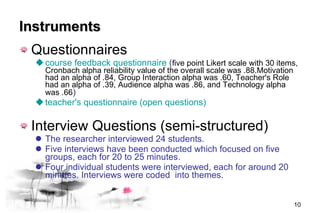
Instruments  Questionnaires  course feedback questionnaire  ( five point Likert scale with 30 items, Cronbach alpha reliability value of the overall scale was .88.Motivation had an alpha of .84, Group Interaction alpha was .60, Teacher's Role had an alpha of .39, Audience alpha was .86, and Technology alpha was .66 ) teacher's questionnaire (open questions) Interview Questions (semi-structured) The researcher interviewed 24 students.  Five interviews have been conducted which focused on five groups, each for 20 to 25 minutes.  Four individual students were interviewed, each for around 20 minutes. Interviews were coded  into themes.
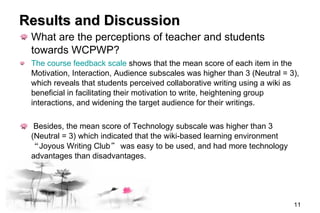
Results and Discussion What are the perceptions of teacher and students towards  WCPWP ? The course feedback scale  shows that the mean score of each item in the Motivation, Interaction, Audience subscales was higher than 3 (Neutral = 3), which reveals that students perceived collaborative writing using a wiki as beneficial in facilitating their motivation to write, heightening group interactions, and widening the target audience for their writings. Besides, the mean score of Technology subscale was higher than 3 (Neutral = 3) which indicated that the wiki-based learning environment  “ Joyous Writing Club ”  was easy to be used, and had more technology advantages than disadvantages.
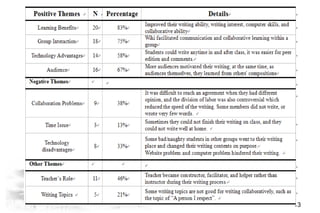
What are the perceptions of teacher and students towards  WCPWP ? Students' statements were initially examined to group similar comments into themes. The fit between each statement and the theme were evaluated. Finally, each theme was given a label, the percentage of students who contributed comments to the theme was calculated, and representative statements were selected.
What are the perceptions of teacher and students towards  WCPWP ? Analysis of the responses to teacher ’ s questionnaire after the experimental teaching indicates that the participating Chinese language teacher became more interest in using the collaborative writing method with wiki, as compared to the traditional individual writing method. She also expressed that, during the collaborative writing class with wiki, her role was more that of a facilitator than an instructor.
Conclusion The result found that most students became more interested in writing after using collaborative writing approach with wiki. Both students ’  responses to the course feedback questionnaire and the interviews reveal ed  that they perceived the collaborative writing using a wiki as beneficial in facilitating motivation to write, heightened group interactions , and the potential audiences activated their writing interest. Besides, the results also indicated that technology brought them more advantages than disadvantages for their learning. Furthermore, the interviews to students shown that they perceived writing on JWC brought them other learning benefits such as improving their writing ability, computer skills, and collaborative ability.
Implications This study provides information that may help teachers and researchers to understand students ’  and teacher ’ s responses towards WCPWP a Chinese writing class.  It also provides practical recommendations for primary school Chinese language teachers in teaching Chinese writing using Wiki-based Collaborative Process Writing Pedagogy (WCPWP).
9_Cite 2011

9_Cite 2011

  • 1.
    STUDENTS AND TEACHER’SATTITUDES AND PERCEPTIONS TOWARD WIKI-BASED COLLABORATIVE PROCESS WRITING PEDAGOGY IN A PRIMARY FIVE CHINESE CLASSROOM XUANXI LI SAMUEL KAI WAH CHU MATSUKO WOO
  • 2.
    Introduction TraditionalTeacher-centered teaching approach in writing Wikis are widely applied to encourage authors to participate in collaborative writing PBworks.com Wikispaces.com Wetpaint.com Wikia.com National Writing Project(Mak & Coniam, 2008) Few existing wiki projects related to the teaching and learning of writing in Chinese in primary school
  • 3.
    Theoretical Framework ofthe Study Constructivist learning theory This study is based on two constructivist learning models: individual cognitive constructivism (Piaget, 1967) and social constructivism (Vygotsky, 1978). Hewett (2009): social constructivism related to collaborative learning Social view of writing process theory According to Tobin (2001), the process pedagogy of writing focuses on writing as a process rather than a product. According to Tompkins (2008), the writing process describes what students think and do as they write, supporting the collaborative writing activity. It consists of nonlinear and recurrent cyclic series of five stages: prewriting, drafting, revising, editing, and publishing. The labeling of the stages is simply an aid to identifying writing activities.
  • 4.
    Conceptual Model forWCPWP Based on constructivist learning theory and the social theory of the writing process, one may expect students to learn to write better if they can write compositions collaboratively in groups in a wiki-based writing environment. However, in order to carry out the design, implementation and evaluation of the learning activities and supporting environment, this study needed to have a clear integrated conceptual model of the pedagogy.
  • 5.
    Research Questions Whatare the attitudes and perceptions of teacher and students toward Wiki-based Collaborative Process Writing Pedagogy ?
  • 6.
    Methodology Participants TheJoyous Writing Club Research Design Instruments
  • 7.
    The participants were59 primary five students (average age of ten years) and their Chinese language teacher from a primary school in the city of Shenzhen, Mainland China. The school was rated medium to high in terms of the quality of campus facilities. Teaching and learning activities were conducted in the students ’ classroom and in one of their computer labs. The computer lab has 56 Shenzhou-brand computers and is equipped with Asymmetric Digital Subscriber Line (ADSL). The 56 computers share the ADSL data rates, which can be as high as 4mbps downstream and up to 512kbps upstream. The students ’ classroom is equipped with a multi-media presentation facility from the teacher ’ s computer. All students in the class returned signed informed consent forms from their parents. The teacher and school principal also returned signed informed consent forms. The study has been reviewed and approved by the Human Research Ethics Committee of the University of Hong Kong. Participants
  • 8.
    The Joyous WritingClub www.joyouswriting.com
  • 9.
    Research Design Case study: Three months Mixed methods including quantitative data and qualitative data
  • 10.
    Instruments Questionnaires course feedback questionnaire ( five point Likert scale with 30 items, Cronbach alpha reliability value of the overall scale was .88.Motivation had an alpha of .84, Group Interaction alpha was .60, Teacher's Role had an alpha of .39, Audience alpha was .86, and Technology alpha was .66 ) teacher's questionnaire (open questions) Interview Questions (semi-structured) The researcher interviewed 24 students. Five interviews have been conducted which focused on five groups, each for 20 to 25 minutes. Four individual students were interviewed, each for around 20 minutes. Interviews were coded into themes.
  • 11.
    Results and DiscussionWhat are the perceptions of teacher and students towards WCPWP ? The course feedback scale shows that the mean score of each item in the Motivation, Interaction, Audience subscales was higher than 3 (Neutral = 3), which reveals that students perceived collaborative writing using a wiki as beneficial in facilitating their motivation to write, heightening group interactions, and widening the target audience for their writings. Besides, the mean score of Technology subscale was higher than 3 (Neutral = 3) which indicated that the wiki-based learning environment “ Joyous Writing Club ” was easy to be used, and had more technology advantages than disadvantages.
  • 12.
    What are theperceptions of teacher and students towards WCPWP ? Students' statements were initially examined to group similar comments into themes. The fit between each statement and the theme were evaluated. Finally, each theme was given a label, the percentage of students who contributed comments to the theme was calculated, and representative statements were selected.
  • 14.
    What are theperceptions of teacher and students towards WCPWP ? Analysis of the responses to teacher ’ s questionnaire after the experimental teaching indicates that the participating Chinese language teacher became more interest in using the collaborative writing method with wiki, as compared to the traditional individual writing method. She also expressed that, during the collaborative writing class with wiki, her role was more that of a facilitator than an instructor.
  • 15.
    Conclusion The resultfound that most students became more interested in writing after using collaborative writing approach with wiki. Both students ’ responses to the course feedback questionnaire and the interviews reveal ed that they perceived the collaborative writing using a wiki as beneficial in facilitating motivation to write, heightened group interactions , and the potential audiences activated their writing interest. Besides, the results also indicated that technology brought them more advantages than disadvantages for their learning. Furthermore, the interviews to students shown that they perceived writing on JWC brought them other learning benefits such as improving their writing ability, computer skills, and collaborative ability.
  • 16.
    Implications This studyprovides information that may help teachers and researchers to understand students ’ and teacher ’ s responses towards WCPWP a Chinese writing class. It also provides practical recommendations for primary school Chinese language teachers in teaching Chinese writing using Wiki-based Collaborative Process Writing Pedagogy (WCPWP).