Language Learning and Technology
Module 6
Miranda Miller
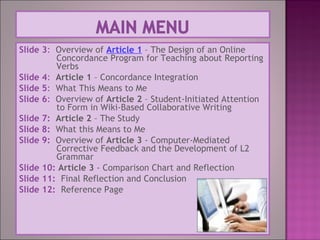
Slide 3: Overview of Article 1 – The Design of an Online
Concordance Program for Teaching about Reporting
Verbs
Slide 4: Article 1 – Concordance Integration
Slide 5: What This Means to Me
Slide 6: Overview of Article 2 – Student-Initiated Attention
to Form in Wiki-Based Collaborative Writing
Slide 7: Article 2 – The Study
Slide 8: What this Means to Me
Slide 9: Overview of Article 3 - Computer-Mediated
Corrective Feedback and the Development of L2
Grammar
Slide 10: Article 3 - Comparison Chart and Reflection
Slide 11: Final Reflection and Conclusion
Slide 12: Reference Page
 This article discusses the use of a web-based concordancing
program using an interface design to help students
appropriately choose reporting verbs. Appropriate reporting
verbs are important for asserting credible claims in academic
papers.
 Concordancing can facilitate the union of grammar and
rhetoric, which emphasizes how grammatical choice is
influenced by rhetorical context. This emphasizes the ability
of learners to construct meaning for themselves.
 Concordancing programs do not provide “correct” answers to
questions about grammar, but instead, they help create a
learning environment where the user has to choose one
appropriate answer from possibly many appropriate answers.
 Learners must construct the best answers from the sample
sentences without obtaining immediate feedback on whether
their answers are correct. In this way, the learner is engaged
in the thinking processes underlying the creation of their
knowledge on the grammar.
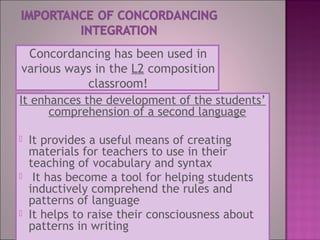
Concordancing has been used in
various ways in the L2 composition
classroom!
It enhances the development of the students’
comprehension of a second language
 It provides a useful means of creating
materials for teachers to use in their
teaching of vocabulary and syntax
 It has become a tool for helping students
inductively comprehend the rules and
patterns of language
 It helps to raise their consciousness about
patterns in writing
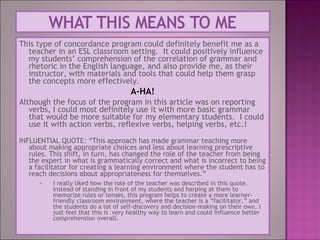
This type of concordance program could definitely benefit me as a
teacher in an ESL classroom setting. It could positively influence
my students’ comprehension of the correlation of grammar and
rhetoric in the English language, and also provide me, as their
instructor, with materials and tools that could help them grasp
the concepts more effectively.
A-HA!
Although the focus of the program in this article was on reporting
verbs, I could most definitely use it with more basic grammar
that would be more suitable for my elementary students. I could
use it with action verbs, reflexive verbs, helping verbs, etc.!
INFLUENTIAL QUOTE: “This approach has made grammar teaching more
about making appropriate choices and less about learning prescriptive
rules. This shift, in turn, has changed the role of the teacher from being
the expert in what is grammatically correct and what is incorrect to being
a facilitator for creating a learning environment where the student has to
reach decisions about appropriateness for themselves.”
- I really liked how the role of the teacher was described in this quote.
Instead of standing in front of my students and harping at them to
memorize rules or tenses, this program helps to create a more learner-
friendly classroom environment, where the teacher is a “facilitator,” and
the students do a lot of self-discovery and decision-making on their own. I
just feel that this is very healthy way to learn and could influence better
comprehension overall.
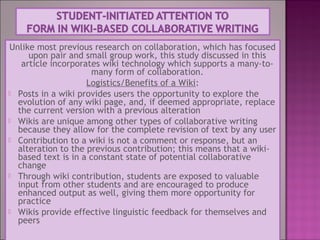
Unlike most previous research on collaboration, which has focused
upon pair and small group work, this study discussed in this
article incorporates wiki technology which supports a many-to-
many form of collaboration.
Logistics/Benefits of a Wiki:
 Posts in a wiki provides users the opportunity to explore the
evolution of any wiki page, and, if deemed appropriate, replace
the current version with a previous alteration
 Wikis are unique among other types of collaborative writing
because they allow for the complete revision of text by any user
 Contribution to a wiki is not a comment or response, but an
alteration to the previous contribution; this means that a wiki-
based text is in a constant state of potential collaborative
change
 Through wiki contribution, students are exposed to valuable
input from other students and are encouraged to produce
enhanced output as well, giving them more opportunity for
practice
 Wikis provide effective linguistic feedback for themselves and
peers
The current study was conducted for Non-Native Speaker pre-service English
teachers. Students were required to participate 3 times a week to stay on top of
an ongoing collaboration on a wiki.
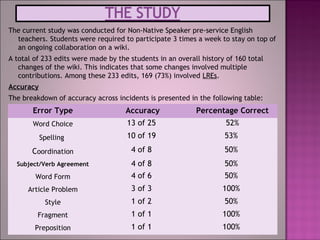
A total of 233 edits were made by the students in an overall history of 160 total
changes of the wiki. This indicates that some changes involved multiple
contributions. Among these 233 edits, 169 (73%) involved LREs.
Accuracy
The breakdown of accuracy across incidents is presented in the following table:
Error Type Accuracy Percentage Correct
Word Choice 13 of 25 52%
Spelling 10 of 19 53%
Coordination 4 of 8 50%
Subject/Verb Agreement 4 of 8 50%
Word Form 4 of 6 50%
Article Problem 3 of 3 100%
Style 1 of 2 50%
Fragment 1 of 1 100%
Preposition 1 of 1 100%
Although wiki use may be too advanced for my elementary
students, I definitely see how it could benefit more
advanced L2 students. It leads learners to reflect on their
own language production as they attempt to a create
meaning to their writing, which is so important when
learning a new language. It then allows students to utilize
peer feedback, as well as increased grammatical accuracy,
influencing the overall quality of their writing.
A-Ha!
Now I see why we experimented with a wiki in W200! I really
didn’t understand its benefits at the time, as it was all
very new to me, but I now see the advantages of this type
of collaborative writing.
Interesting Quote: “Learner autonomy is obviously important
in SLA. Successful autonomous use of the target language
should be the ultimate goal of language instruction.”
- I agree and think that an autonomous use of a new
language is absolutely crucial in developing the best
and most educated knowledge about that language.
It provides a consistency that better allows for
students to capture and understanding its meaning.
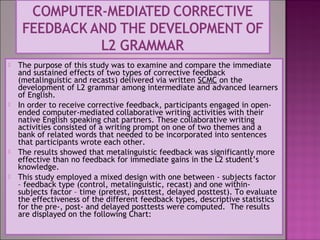
 The purpose of this study was to examine and compare the immediate
and sustained effects of two types of corrective feedback
(metalinguistic and recasts) delivered via written SCMC on the
development of L2 grammar among intermediate and advanced learners
of English.
 In order to receive corrective feedback, participants engaged in open-
ended computer-mediated collaborative writing activities with their
native English speaking chat partners. These collaborative writing
activities consisted of a writing prompt on one of two themes and a
bank of related words that needed to be incorporated into sentences
that participants wrote each other.
 The results showed that metalinguistic feedback was significantly more
effective than no feedback for immediate gains in the L2 student’s
knowledge.
 This study employed a mixed design with one between - subjects factor
– feedback type (control, metalinguistic, recast) and one within-
subjects factor – time (pretest, posttest, delayed posttest). To evaluate
the effectiveness of the different feedback types, descriptive statistics
for the pre-, post- and delayed posttests were computed. The results
are displayed on the following Chart:
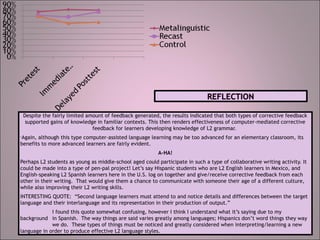
Despite the fairly limited amount of feedback generated, the results indicated that both types of corrective feedback
supported gains of knowledge in familiar contexts. This then renders effectiveness of computer-mediated corrective
feedback for learners developing knowledge of L2 grammar.
•Again, although this type computer-assisted language learning may be too advanced for an elementary classroom, its
benefits to more advanced learners are fairly evident.
A-HA!
Perhaps L2 students as young as middle-school aged could participate in such a type of collaborative writing activity. It
could be made into a type of pen-pal project! Let’s say Hispanic students who are L2 English learners in Mexico, and
English-speaking L2 Spanish learners here in the U.S. log on together and give/receive corrective feedback from each
other in their writing. That would give them a chance to communicate with someone their age of a different culture,
while also improving their L2 writing skills.
INTERESTING QUOTE: “Second language learners must attend to and notice details and differences between the target
language and their interlanguage and its representation in their production of output.”
I found this quote somewhat confusing, however I think I understand what it’s saying due to my
background in Spanish. The way things are said varies greatly among languages; Hispanics don’t word things they way
we do. These types of things must be noticed and greatly considered when interpreting/learning a new
language in order to produce effective L2 language styles.
Having a passion for the Spanish language, 3 years ago I decided to
incorporate it into my degree somehow, and started taking college
Spanish classes along with my Elementary Education requirements.
Just recently, I made the decision to use my Spanish knowledge in
pursuing a dual ESL license, which I will began classes for next
semester while taking the teaching blocks. This has everything to do
with the reason for choosing the preceding 3 articles that I’ve
presented for our final PowerPoint presentation for Module 6. Through
this assignment I’ve learned so much about computer assisted language
learning. With technological advancements such as concordance
programs, wikis, and online corrective feedback, L2 learners could
have a tremendous advantage to the comprehension of another
language than those had in the past. These advancements produce
interactive learning environments that stimulate students’ thinking
processes in order to benefit them in their comprehension of the
language like nothing before. They introduce teachers as “facilitators”
who can provide the means to enhance a student’s learning of another
language through a more collaborative way of interpreting that could
help them effectively induce their foundation of comprehension for
years to come. These advancements are definitely noteworthy
accomplishments in education that ESL teachers should consider
incorporating in their teaching as best as soon as they can; I know I will
certainly keep them in mind when I’m a teacher someday
 Bloch, Joel (2009).The design of an online
concordancing program for teaching about
reporting verbs. Language Learning and
Technology. 13, 59-78.
 Kessler, Greg (2009).Student-initiated
attention to form in wiki-based collaborative
writing. Language Learning and Technology.
13, 79-95.
 Sauro, Shannon (2009).Computer-mediated
corrective feedback and the development of
L2 grammar. Learning Language and
Technology. 13, 96-120.

Computer Assisted Language Learning97 2003

  • 1.
    Language Learning andTechnology Module 6 Miranda Miller
  • 2.
    Slide 3: Overviewof Article 1 – The Design of an Online Concordance Program for Teaching about Reporting Verbs Slide 4: Article 1 – Concordance Integration Slide 5: What This Means to Me Slide 6: Overview of Article 2 – Student-Initiated Attention to Form in Wiki-Based Collaborative Writing Slide 7: Article 2 – The Study Slide 8: What this Means to Me Slide 9: Overview of Article 3 - Computer-Mediated Corrective Feedback and the Development of L2 Grammar Slide 10: Article 3 - Comparison Chart and Reflection Slide 11: Final Reflection and Conclusion Slide 12: Reference Page
  • 3.
     This articlediscusses the use of a web-based concordancing program using an interface design to help students appropriately choose reporting verbs. Appropriate reporting verbs are important for asserting credible claims in academic papers.  Concordancing can facilitate the union of grammar and rhetoric, which emphasizes how grammatical choice is influenced by rhetorical context. This emphasizes the ability of learners to construct meaning for themselves.  Concordancing programs do not provide “correct” answers to questions about grammar, but instead, they help create a learning environment where the user has to choose one appropriate answer from possibly many appropriate answers.  Learners must construct the best answers from the sample sentences without obtaining immediate feedback on whether their answers are correct. In this way, the learner is engaged in the thinking processes underlying the creation of their knowledge on the grammar.
  • 4.
    Concordancing has beenused in various ways in the L2 composition classroom! It enhances the development of the students’ comprehension of a second language  It provides a useful means of creating materials for teachers to use in their teaching of vocabulary and syntax  It has become a tool for helping students inductively comprehend the rules and patterns of language  It helps to raise their consciousness about patterns in writing
  • 5.
    This type ofconcordance program could definitely benefit me as a teacher in an ESL classroom setting. It could positively influence my students’ comprehension of the correlation of grammar and rhetoric in the English language, and also provide me, as their instructor, with materials and tools that could help them grasp the concepts more effectively. A-HA! Although the focus of the program in this article was on reporting verbs, I could most definitely use it with more basic grammar that would be more suitable for my elementary students. I could use it with action verbs, reflexive verbs, helping verbs, etc.! INFLUENTIAL QUOTE: “This approach has made grammar teaching more about making appropriate choices and less about learning prescriptive rules. This shift, in turn, has changed the role of the teacher from being the expert in what is grammatically correct and what is incorrect to being a facilitator for creating a learning environment where the student has to reach decisions about appropriateness for themselves.” - I really liked how the role of the teacher was described in this quote. Instead of standing in front of my students and harping at them to memorize rules or tenses, this program helps to create a more learner- friendly classroom environment, where the teacher is a “facilitator,” and the students do a lot of self-discovery and decision-making on their own. I just feel that this is very healthy way to learn and could influence better comprehension overall.
  • 6.
    Unlike most previousresearch on collaboration, which has focused upon pair and small group work, this study discussed in this article incorporates wiki technology which supports a many-to- many form of collaboration. Logistics/Benefits of a Wiki:  Posts in a wiki provides users the opportunity to explore the evolution of any wiki page, and, if deemed appropriate, replace the current version with a previous alteration  Wikis are unique among other types of collaborative writing because they allow for the complete revision of text by any user  Contribution to a wiki is not a comment or response, but an alteration to the previous contribution; this means that a wiki- based text is in a constant state of potential collaborative change  Through wiki contribution, students are exposed to valuable input from other students and are encouraged to produce enhanced output as well, giving them more opportunity for practice  Wikis provide effective linguistic feedback for themselves and peers
  • 7.
    The current studywas conducted for Non-Native Speaker pre-service English teachers. Students were required to participate 3 times a week to stay on top of an ongoing collaboration on a wiki. A total of 233 edits were made by the students in an overall history of 160 total changes of the wiki. This indicates that some changes involved multiple contributions. Among these 233 edits, 169 (73%) involved LREs. Accuracy The breakdown of accuracy across incidents is presented in the following table: Error Type Accuracy Percentage Correct Word Choice 13 of 25 52% Spelling 10 of 19 53% Coordination 4 of 8 50% Subject/Verb Agreement 4 of 8 50% Word Form 4 of 6 50% Article Problem 3 of 3 100% Style 1 of 2 50% Fragment 1 of 1 100% Preposition 1 of 1 100%
  • 8.
    Although wiki usemay be too advanced for my elementary students, I definitely see how it could benefit more advanced L2 students. It leads learners to reflect on their own language production as they attempt to a create meaning to their writing, which is so important when learning a new language. It then allows students to utilize peer feedback, as well as increased grammatical accuracy, influencing the overall quality of their writing. A-Ha! Now I see why we experimented with a wiki in W200! I really didn’t understand its benefits at the time, as it was all very new to me, but I now see the advantages of this type of collaborative writing. Interesting Quote: “Learner autonomy is obviously important in SLA. Successful autonomous use of the target language should be the ultimate goal of language instruction.” - I agree and think that an autonomous use of a new language is absolutely crucial in developing the best and most educated knowledge about that language. It provides a consistency that better allows for students to capture and understanding its meaning.
  • 9.
     The purposeof this study was to examine and compare the immediate and sustained effects of two types of corrective feedback (metalinguistic and recasts) delivered via written SCMC on the development of L2 grammar among intermediate and advanced learners of English.  In order to receive corrective feedback, participants engaged in open- ended computer-mediated collaborative writing activities with their native English speaking chat partners. These collaborative writing activities consisted of a writing prompt on one of two themes and a bank of related words that needed to be incorporated into sentences that participants wrote each other.  The results showed that metalinguistic feedback was significantly more effective than no feedback for immediate gains in the L2 student’s knowledge.  This study employed a mixed design with one between - subjects factor – feedback type (control, metalinguistic, recast) and one within- subjects factor – time (pretest, posttest, delayed posttest). To evaluate the effectiveness of the different feedback types, descriptive statistics for the pre-, post- and delayed posttests were computed. The results are displayed on the following Chart:
  • 10.
    Despite the fairlylimited amount of feedback generated, the results indicated that both types of corrective feedback supported gains of knowledge in familiar contexts. This then renders effectiveness of computer-mediated corrective feedback for learners developing knowledge of L2 grammar. •Again, although this type computer-assisted language learning may be too advanced for an elementary classroom, its benefits to more advanced learners are fairly evident. A-HA! Perhaps L2 students as young as middle-school aged could participate in such a type of collaborative writing activity. It could be made into a type of pen-pal project! Let’s say Hispanic students who are L2 English learners in Mexico, and English-speaking L2 Spanish learners here in the U.S. log on together and give/receive corrective feedback from each other in their writing. That would give them a chance to communicate with someone their age of a different culture, while also improving their L2 writing skills. INTERESTING QUOTE: “Second language learners must attend to and notice details and differences between the target language and their interlanguage and its representation in their production of output.” I found this quote somewhat confusing, however I think I understand what it’s saying due to my background in Spanish. The way things are said varies greatly among languages; Hispanics don’t word things they way we do. These types of things must be noticed and greatly considered when interpreting/learning a new language in order to produce effective L2 language styles.
  • 11.
    Having a passionfor the Spanish language, 3 years ago I decided to incorporate it into my degree somehow, and started taking college Spanish classes along with my Elementary Education requirements. Just recently, I made the decision to use my Spanish knowledge in pursuing a dual ESL license, which I will began classes for next semester while taking the teaching blocks. This has everything to do with the reason for choosing the preceding 3 articles that I’ve presented for our final PowerPoint presentation for Module 6. Through this assignment I’ve learned so much about computer assisted language learning. With technological advancements such as concordance programs, wikis, and online corrective feedback, L2 learners could have a tremendous advantage to the comprehension of another language than those had in the past. These advancements produce interactive learning environments that stimulate students’ thinking processes in order to benefit them in their comprehension of the language like nothing before. They introduce teachers as “facilitators” who can provide the means to enhance a student’s learning of another language through a more collaborative way of interpreting that could help them effectively induce their foundation of comprehension for years to come. These advancements are definitely noteworthy accomplishments in education that ESL teachers should consider incorporating in their teaching as best as soon as they can; I know I will certainly keep them in mind when I’m a teacher someday
  • 12.
     Bloch, Joel(2009).The design of an online concordancing program for teaching about reporting verbs. Language Learning and Technology. 13, 59-78.  Kessler, Greg (2009).Student-initiated attention to form in wiki-based collaborative writing. Language Learning and Technology. 13, 79-95.  Sauro, Shannon (2009).Computer-mediated corrective feedback and the development of L2 grammar. Learning Language and Technology. 13, 96-120.

Editor's Notes

  • #5 L2 is the language a person knows, is learning or is acquiring in addition to their native language (L1). In this context it means "second language and/or foreign language classrooms”; also in association with SLA and ESL.
  • #8 LREs refers to language-related episodes; any language oriented contribution to the wiki.
  • #9 SLA : Second Language Acquisition
  • #10 SCMC: synchronous computer-mediated communication
  • #12 ESL: English as a Second Language