COMPETENCY MAPPINGCOMPETENCY MAPPING
PINTU SINGH
PRATIK DADHE
PRIYANKA KURKUTE
PURVASHI PAHUJA
CONTENTSCONTENTS
• COMPETENCY?
• COMPONENTS OF COMPETENCY
• CLASSIFICATION OF COMPETENCY
• COMPETENCY MAPPING
• PROCESS OF COMPETENCY MAPPING
• NEED FOR COMPETENCY MAPPING
• AREAS OF IMPLEMENTATION
• ADVANTAGES
• DISADVANTAGES
• CONCLUSION
WHAT IS COMPETENCY?WHAT IS COMPETENCY?
• It’s an underlying characteristic of a person which
enables him /her to deliver superior performance in a
given job, role or a situation.
• Competencies are personal characteristics that
contribute to effective managerial performance.
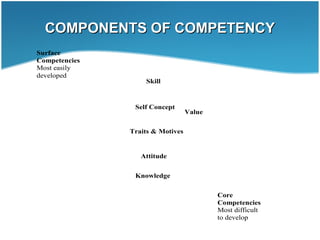
COMPONENTS OF COMPETENCYCOMPONENTS OF COMPETENCY
Self Concept
Traits & Motives
Value
Attitude
Knowledge
Skill
Surface
Competencies
Most easily
developed
Core
Competencies
Most difficult
to develop
COMPONENTS OF COMPETENCYCOMPONENTS OF COMPETENCY
• KNOWLEDGE- refers to the information a person
possesses about specific areas. It comprises of many
factors like memory, numerical ability, linguistic ability.
• SKILL- represents intelligent application of knowledge,
experience, and tools.
COMPONENTS OF COMPETENCYCOMPONENTS OF COMPETENCY
• ATTITUDE- Attitudes are predispositions to other
individuals, groups, objects, situations, events, issues,
etc.
• Attitudes decide our approach or avoidance behaviour.
• They are normally conceptualized as positive or
negative.
COMPONENTS OF COMPETENCYCOMPONENTS OF COMPETENCY
• Knowledge and skills tend to be visible and relatively
surface, characteristics of people.
• But attitude, trait and motive competencies are more
hidden “deeper” and central to personality.
WHO IDENTIFIES COMPETENCIES?WHO IDENTIFIES COMPETENCIES?
Competencies can be identified by one of more of the
following category of people:
• Experts
• HR Specialists
• Job analysts
• Psychologists
BEHAVIOUR INDICATORSBEHAVIOUR INDICATORS
• A Competency is described in terms of key behaviours
that enables recognition of that competency at the work
place.
• These behaviours are demonstrated by excellent
performers on-the-job much more consistently than
average or poor performers.
Some key behaviour indicators in an employeeSome key behaviour indicators in an employee
• Independently researches for information and solutions
to issues.
• Ability to know what needs to be done or find out and
take steps to get it done.
• Ask questions when not sure of what the problem is or to
gain more information.
• Shows willingness to experiment with new things.
• Develops a list of decision making guidelines to help
arrive at logical solutions.
CLASSIFICATION OF COMPETENCYCLASSIFICATION OF COMPETENCY
• BASIC COMPETENCIES - Basic competencies are
inherent in all individuals, only their degree of existence
differs. For example, problem solving is a competency
that exists in every individual but in varying degrees.
• ORGANISATIONAL COMPETENCIES – competencies
in an organisation.
TYPES OF BASIC COMPETENCIESTYPES OF BASIC COMPETENCIES
1.Intellectual Competencies: determine the intellectual
ability of a person.
2. Motivational Competencies: determine the level of
motivation in an individual.
3. Emotional Competencies: determine an individual's
emotional quotient.
4. Social Competencies: determine the level of social
ability in a person.
TYPES OF ORGANISATIONALTYPES OF ORGANISATIONAL
COMPETENCIESCOMPETENCIES
1. GENERIC COMPETENCIES
2. MANAGERIAL COMPETENCIES
3. FUNCTIONAL COMPETENCIES
GENERIC COMPETENCIESGENERIC COMPETENCIES
• Competencies which are considered essential for all
staff, regardless of their function or level.
• Communication, program execution, processing tools,
linguistic, etc.
MANAGERIAL COMPETENCIESMANAGERIAL COMPETENCIES
• Competencies which are considered essential for staff
with managerial or supervisory responsibility in any
service or program.
• Customer Orientation, Organizing Skills, Planning Skills,
Execution Skills, Analytical Skills, Decision Making,
Delegation, Leadership, Developing and supporting
subordinates for effectiveness.
TECHNICAL COMPETENCIESTECHNICAL COMPETENCIES
• Specific competencies which are considered essential to
perform any job in the organization within a defined
technical or functional area of work.
• Example is business awareness, business skills,
technical skills.
WHAT IS COMPETENCY MAPPING?WHAT IS COMPETENCY MAPPING?
• A process through which one assesses and determines
one's strengths as an individual worker and in some
cases, as part of an organization.
• It examines two areas - emotional intelligence or
emotional quotient (EQ), and strengths of the individual
in areas like team structure, leadership, and decision-
making.
WHAT IS COMPETENCY MAPPING?WHAT IS COMPETENCY MAPPING?
• Competency mapping not only acts as a useful tool for
the organisation but also aids an individual's
competency.
• Large organizations use competency mapping to
analyze the combination of strengths in different workers
to produce the most effective teams and the highest
quality work.
WHAT IS COMPETENCY MAPPING?WHAT IS COMPETENCY MAPPING?
• It has been a general observation that hard work, sincerity,
knowledge, intelligence alone does not make a person a star
performer in his/her profession.
• Good managers are generally aware about different qualities
a person must possess to do a job effectively, and they make
use of their knowledge to select and train their subordinates.
WHAT IS COMPETENCY MAPPING?WHAT IS COMPETENCY MAPPING?
• Organisational psychologists have refined this
understanding and converted it into a structural and formal
process called Competency Mapping.
• It is one of the most powerful tools:-
 aiding the improvement for the HR professionals in finding
the right employee for a job.
 development of the employed person in doing the assigned
job effectively.
PROCESS OF COMPETENCY MAPPINGPROCESS OF COMPETENCY MAPPING
• Competency Mapping process is designed to
consistently measure and assess individual and group
performance as it relates to the expectations of the
organization and its customers.
• It is used to identify key attributes (knowledge, skills, and
behavior attributes) that are required to perform
effectively in a job or an identified process.
PROCESS OF COMPETENCY MAPPINGPROCESS OF COMPETENCY MAPPING
• Competency Mapping juxtaposes two sets of data:
1. Based on organizational workflow and processes.
2. Based on individual and group performance capabilities.
METHODOLOGY OF COMPETENCYMETHODOLOGY OF COMPETENCY
MAPPINGMAPPING
1. LAYING DOWN OF OBJECTIVES:
 To establish a Competency Model to create a benchmark for all
the employees in the organization and will help in performing all
HR functions more efficiently.
 To map the competencies of the existing employees and
understand where they fall low or average in comparison to the
competencies essential for their job.
METHODOLOGY OF COMPETENCYMETHODOLOGY OF COMPETENCY
MAPPINGMAPPING
2.PREPARATION OF ROLE PROFILE QUESTIONNAIRE: 2 tools are
used.
Rank order rating- finds out which competencies are required for
each job/role and their order of importance to each profile.
Behavioural Event Interview- a set of open ended questions to find
out the STAR’s (Situation, Task, Action and Results).
METHODOLOGY OF COMPETENCYMETHODOLOGY OF COMPETENCY
MAPPINGMAPPING
3. COLLECTION OF RESPONSES:-
 Employees are asked to fill up the questionnaire.
 Responses are collected from the employees by one on one
interaction.
4. ANALYSIS:-
 Based on the ratings provided by each employee to the different
competencies.
 Highest rated competencies form the critical competencies in the
Competency model and the others follow in the other categories.
 Opportunity Algorithm is used to map the current competencies
of the employees in relation to the competencies rated by the
employees in question.
METHODOLOGY OF COMPETENCYMETHODOLOGY OF COMPETENCY
MAPPINGMAPPING
5. FINDINGS:-
 With the help of the Opportunity Algorithm and the ratings provided
by the employees, the Competency Model and the Competency
Scorecard for each employee can be established.
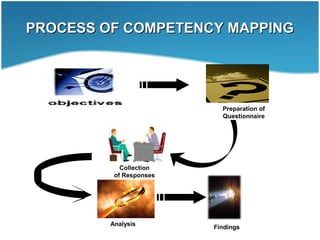
PROCESS OF COMPETENCY MAPPINGPROCESS OF COMPETENCY MAPPING
Preparation of
Questionnaire
Collection
of Responses
Analysis
Findings
NEED FOR COMPETENCY MAPPINGNEED FOR COMPETENCY MAPPING
• Increased cost of manpower.
• Need for ensuring that competent people are available
for performing various critical roles.
• Downsizing adds to the consequent need to get a lot of
things done with fewer people and thus reduce
manpower costs and pass on the advantage to the
customer.
NEED FOR COMPETENCY MAPPINGNEED FOR COMPETENCY MAPPING
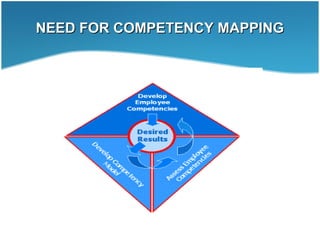
• Recognition that technology, finances, customers and
markets, systems and processes can all be set right or
managed effectively if we have the right kind of human
resources.
• Recognition of the strategic advantage given by employee
competencies in building the core competencies of the
organization.
NEED FOR COMPETENCY MAPPINGNEED FOR COMPETENCY MAPPING
AREAS OF IMPLEMENTATIONAREAS OF IMPLEMENTATION
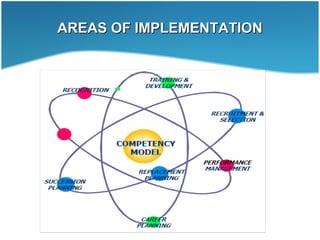
• Recruitment and selection
• Training and Development
– determine competencies for a particular position, identify gaps in
terms of the competencies for that role and the competencies of
the person doing that role to diagnose the training and
development needs.
• Career and succession planning
– assessing employees potential to take on new challenges,
matching the competency profile of an individual to the set of
competencies required for excellence within a profession.
AREAS OF IMPLEMENTATIONAREAS OF IMPLEMENTATION
• Rewards and Recognition: One way of improving employee
performance is by recognizing and rewarding effort. Competency
pay is the best way to do so.
– To attract more competent than average employees.
– To motivate employees to maintain and enhance their skills and
competencies regularly.
• Performance Management System: Focus on “HOW” of
performance and not on “WHAT” of performance i.e. not on results
but how the results are achieved, Link to development of the
individual and not just rewards.
ADVANTAGES OF COMPETENCYADVANTAGES OF COMPETENCY
MAPPINGMAPPING
• For the company
– Improved job satisfaction, better employee retention.
– Increase in effectiveness of training and professional
development programs.
– Provides a common understanding of scope and
requirements of a specific role.
ADVANTAGES OF COMPETENCYADVANTAGES OF COMPETENCY
MAPPINGMAPPING
• For the company
– Help companies “raise the bar” of performance
expectations.
– Help teams and individuals align their behaviors with
key organizational strategies.
ADVANTAGES OF COMPETENCYADVANTAGES OF COMPETENCY
MAPPINGMAPPING
• For Managers
– Identify performance criteria to improve the accuracy
and ease of the selection process.
– Easier communication of performance expectations.
ADVANTAGES OF COMPETENCYADVANTAGES OF COMPETENCY
MAPPINGMAPPING
• For employees
– Provide a more specific and objective assessment of
their strengths and the tools required to enhance their
skills.
– Enhances clarity on career related issues.
– Helps each understand how to achieve expectations.
DISADVANTAGES OF COMPETENCYDISADVANTAGES OF COMPETENCY
MAPPINGMAPPING
1. Especially when conducted by an organization, there
may be no room for an individual to work in a field that
would best make use of his or her competencies.
2. If the company does not respond to competency
mapping by reorganizing its employees, then it can be of
little short-term benefit and may actually result in greater
unhappiness on the part of individual employees.
DISADVANTAGES OF COMPETENCYDISADVANTAGES OF COMPETENCY
MAPPINGMAPPING
3. If too much emphasis is placed on 'inputs' at the
expense of 'outputs', there is a risk that it will favor
employees who are good in theory but not in practice
and will fail to achieve the results that make a business
successful.
4. They can become out of date very quickly due to the fast
pace of change in organizations and it can therefore be
expensive and time consuming to keep them up-to-date.
CONCLUSIONCONCLUSION
• It’s a process of identifying key competencies for an
organization and a job and incorporating those
competencies throughout the various processes (i.e. job
evaluation, training, recruitment) of the organization.
• Competent employees have become need of the hour in
every organization and it is now essential that they
undertake competency mapping.
Cm1
Cm1

Cm1

  • 1.
    COMPETENCY MAPPINGCOMPETENCY MAPPING PINTUSINGH PRATIK DADHE PRIYANKA KURKUTE PURVASHI PAHUJA
  • 2.
    CONTENTSCONTENTS • COMPETENCY? • COMPONENTSOF COMPETENCY • CLASSIFICATION OF COMPETENCY • COMPETENCY MAPPING • PROCESS OF COMPETENCY MAPPING • NEED FOR COMPETENCY MAPPING • AREAS OF IMPLEMENTATION • ADVANTAGES • DISADVANTAGES • CONCLUSION
  • 3.
    WHAT IS COMPETENCY?WHATIS COMPETENCY? • It’s an underlying characteristic of a person which enables him /her to deliver superior performance in a given job, role or a situation. • Competencies are personal characteristics that contribute to effective managerial performance.
  • 4.
    COMPONENTS OF COMPETENCYCOMPONENTSOF COMPETENCY Self Concept Traits & Motives Value Attitude Knowledge Skill Surface Competencies Most easily developed Core Competencies Most difficult to develop
  • 5.
    COMPONENTS OF COMPETENCYCOMPONENTSOF COMPETENCY • KNOWLEDGE- refers to the information a person possesses about specific areas. It comprises of many factors like memory, numerical ability, linguistic ability. • SKILL- represents intelligent application of knowledge, experience, and tools.
  • 6.
    COMPONENTS OF COMPETENCYCOMPONENTSOF COMPETENCY • ATTITUDE- Attitudes are predispositions to other individuals, groups, objects, situations, events, issues, etc. • Attitudes decide our approach or avoidance behaviour. • They are normally conceptualized as positive or negative.
  • 7.
    COMPONENTS OF COMPETENCYCOMPONENTSOF COMPETENCY • Knowledge and skills tend to be visible and relatively surface, characteristics of people. • But attitude, trait and motive competencies are more hidden “deeper” and central to personality.
  • 8.
    WHO IDENTIFIES COMPETENCIES?WHOIDENTIFIES COMPETENCIES? Competencies can be identified by one of more of the following category of people: • Experts • HR Specialists • Job analysts • Psychologists
  • 9.
    BEHAVIOUR INDICATORSBEHAVIOUR INDICATORS •A Competency is described in terms of key behaviours that enables recognition of that competency at the work place. • These behaviours are demonstrated by excellent performers on-the-job much more consistently than average or poor performers.
  • 10.
    Some key behaviourindicators in an employeeSome key behaviour indicators in an employee • Independently researches for information and solutions to issues. • Ability to know what needs to be done or find out and take steps to get it done. • Ask questions when not sure of what the problem is or to gain more information. • Shows willingness to experiment with new things. • Develops a list of decision making guidelines to help arrive at logical solutions.
  • 11.
    CLASSIFICATION OF COMPETENCYCLASSIFICATIONOF COMPETENCY • BASIC COMPETENCIES - Basic competencies are inherent in all individuals, only their degree of existence differs. For example, problem solving is a competency that exists in every individual but in varying degrees. • ORGANISATIONAL COMPETENCIES – competencies in an organisation.
  • 12.
    TYPES OF BASICCOMPETENCIESTYPES OF BASIC COMPETENCIES 1.Intellectual Competencies: determine the intellectual ability of a person. 2. Motivational Competencies: determine the level of motivation in an individual. 3. Emotional Competencies: determine an individual's emotional quotient. 4. Social Competencies: determine the level of social ability in a person.
  • 13.
    TYPES OF ORGANISATIONALTYPESOF ORGANISATIONAL COMPETENCIESCOMPETENCIES 1. GENERIC COMPETENCIES 2. MANAGERIAL COMPETENCIES 3. FUNCTIONAL COMPETENCIES
  • 14.
    GENERIC COMPETENCIESGENERIC COMPETENCIES •Competencies which are considered essential for all staff, regardless of their function or level. • Communication, program execution, processing tools, linguistic, etc.
  • 15.
    MANAGERIAL COMPETENCIESMANAGERIAL COMPETENCIES •Competencies which are considered essential for staff with managerial or supervisory responsibility in any service or program. • Customer Orientation, Organizing Skills, Planning Skills, Execution Skills, Analytical Skills, Decision Making, Delegation, Leadership, Developing and supporting subordinates for effectiveness.
  • 16.
    TECHNICAL COMPETENCIESTECHNICAL COMPETENCIES •Specific competencies which are considered essential to perform any job in the organization within a defined technical or functional area of work. • Example is business awareness, business skills, technical skills.
  • 17.
    WHAT IS COMPETENCYMAPPING?WHAT IS COMPETENCY MAPPING? • A process through which one assesses and determines one's strengths as an individual worker and in some cases, as part of an organization. • It examines two areas - emotional intelligence or emotional quotient (EQ), and strengths of the individual in areas like team structure, leadership, and decision- making.
  • 18.
    WHAT IS COMPETENCYMAPPING?WHAT IS COMPETENCY MAPPING? • Competency mapping not only acts as a useful tool for the organisation but also aids an individual's competency. • Large organizations use competency mapping to analyze the combination of strengths in different workers to produce the most effective teams and the highest quality work.
  • 19.
    WHAT IS COMPETENCYMAPPING?WHAT IS COMPETENCY MAPPING? • It has been a general observation that hard work, sincerity, knowledge, intelligence alone does not make a person a star performer in his/her profession. • Good managers are generally aware about different qualities a person must possess to do a job effectively, and they make use of their knowledge to select and train their subordinates.
  • 20.
    WHAT IS COMPETENCYMAPPING?WHAT IS COMPETENCY MAPPING? • Organisational psychologists have refined this understanding and converted it into a structural and formal process called Competency Mapping. • It is one of the most powerful tools:-  aiding the improvement for the HR professionals in finding the right employee for a job.  development of the employed person in doing the assigned job effectively.
  • 21.
    PROCESS OF COMPETENCYMAPPINGPROCESS OF COMPETENCY MAPPING • Competency Mapping process is designed to consistently measure and assess individual and group performance as it relates to the expectations of the organization and its customers. • It is used to identify key attributes (knowledge, skills, and behavior attributes) that are required to perform effectively in a job or an identified process.
  • 22.
    PROCESS OF COMPETENCYMAPPINGPROCESS OF COMPETENCY MAPPING • Competency Mapping juxtaposes two sets of data: 1. Based on organizational workflow and processes. 2. Based on individual and group performance capabilities.
  • 23.
    METHODOLOGY OF COMPETENCYMETHODOLOGYOF COMPETENCY MAPPINGMAPPING 1. LAYING DOWN OF OBJECTIVES:  To establish a Competency Model to create a benchmark for all the employees in the organization and will help in performing all HR functions more efficiently.  To map the competencies of the existing employees and understand where they fall low or average in comparison to the competencies essential for their job.
  • 24.
    METHODOLOGY OF COMPETENCYMETHODOLOGYOF COMPETENCY MAPPINGMAPPING 2.PREPARATION OF ROLE PROFILE QUESTIONNAIRE: 2 tools are used. Rank order rating- finds out which competencies are required for each job/role and their order of importance to each profile. Behavioural Event Interview- a set of open ended questions to find out the STAR’s (Situation, Task, Action and Results).
  • 25.
    METHODOLOGY OF COMPETENCYMETHODOLOGYOF COMPETENCY MAPPINGMAPPING 3. COLLECTION OF RESPONSES:-  Employees are asked to fill up the questionnaire.  Responses are collected from the employees by one on one interaction. 4. ANALYSIS:-  Based on the ratings provided by each employee to the different competencies.  Highest rated competencies form the critical competencies in the Competency model and the others follow in the other categories.  Opportunity Algorithm is used to map the current competencies of the employees in relation to the competencies rated by the employees in question.
  • 26.
    METHODOLOGY OF COMPETENCYMETHODOLOGYOF COMPETENCY MAPPINGMAPPING 5. FINDINGS:-  With the help of the Opportunity Algorithm and the ratings provided by the employees, the Competency Model and the Competency Scorecard for each employee can be established.
  • 27.
    PROCESS OF COMPETENCYMAPPINGPROCESS OF COMPETENCY MAPPING Preparation of Questionnaire Collection of Responses Analysis Findings
  • 28.
    NEED FOR COMPETENCYMAPPINGNEED FOR COMPETENCY MAPPING • Increased cost of manpower. • Need for ensuring that competent people are available for performing various critical roles. • Downsizing adds to the consequent need to get a lot of things done with fewer people and thus reduce manpower costs and pass on the advantage to the customer.
  • 29.
    NEED FOR COMPETENCYMAPPINGNEED FOR COMPETENCY MAPPING • Recognition that technology, finances, customers and markets, systems and processes can all be set right or managed effectively if we have the right kind of human resources. • Recognition of the strategic advantage given by employee competencies in building the core competencies of the organization.
  • 30.
    NEED FOR COMPETENCYMAPPINGNEED FOR COMPETENCY MAPPING
  • 31.
  • 32.
    AREAS OF IMPLEMENTATIONAREASOF IMPLEMENTATION • Recruitment and selection • Training and Development – determine competencies for a particular position, identify gaps in terms of the competencies for that role and the competencies of the person doing that role to diagnose the training and development needs. • Career and succession planning – assessing employees potential to take on new challenges, matching the competency profile of an individual to the set of competencies required for excellence within a profession.
  • 33.
    AREAS OF IMPLEMENTATIONAREASOF IMPLEMENTATION • Rewards and Recognition: One way of improving employee performance is by recognizing and rewarding effort. Competency pay is the best way to do so. – To attract more competent than average employees. – To motivate employees to maintain and enhance their skills and competencies regularly. • Performance Management System: Focus on “HOW” of performance and not on “WHAT” of performance i.e. not on results but how the results are achieved, Link to development of the individual and not just rewards.
  • 34.
    ADVANTAGES OF COMPETENCYADVANTAGESOF COMPETENCY MAPPINGMAPPING • For the company – Improved job satisfaction, better employee retention. – Increase in effectiveness of training and professional development programs. – Provides a common understanding of scope and requirements of a specific role.
  • 35.
    ADVANTAGES OF COMPETENCYADVANTAGESOF COMPETENCY MAPPINGMAPPING • For the company – Help companies “raise the bar” of performance expectations. – Help teams and individuals align their behaviors with key organizational strategies.
  • 36.
    ADVANTAGES OF COMPETENCYADVANTAGESOF COMPETENCY MAPPINGMAPPING • For Managers – Identify performance criteria to improve the accuracy and ease of the selection process. – Easier communication of performance expectations.
  • 37.
    ADVANTAGES OF COMPETENCYADVANTAGESOF COMPETENCY MAPPINGMAPPING • For employees – Provide a more specific and objective assessment of their strengths and the tools required to enhance their skills. – Enhances clarity on career related issues. – Helps each understand how to achieve expectations.
  • 38.
    DISADVANTAGES OF COMPETENCYDISADVANTAGESOF COMPETENCY MAPPINGMAPPING 1. Especially when conducted by an organization, there may be no room for an individual to work in a field that would best make use of his or her competencies. 2. If the company does not respond to competency mapping by reorganizing its employees, then it can be of little short-term benefit and may actually result in greater unhappiness on the part of individual employees.
  • 39.
    DISADVANTAGES OF COMPETENCYDISADVANTAGESOF COMPETENCY MAPPINGMAPPING 3. If too much emphasis is placed on 'inputs' at the expense of 'outputs', there is a risk that it will favor employees who are good in theory but not in practice and will fail to achieve the results that make a business successful. 4. They can become out of date very quickly due to the fast pace of change in organizations and it can therefore be expensive and time consuming to keep them up-to-date.
  • 40.
    CONCLUSIONCONCLUSION • It’s aprocess of identifying key competencies for an organization and a job and incorporating those competencies throughout the various processes (i.e. job evaluation, training, recruitment) of the organization. • Competent employees have become need of the hour in every organization and it is now essential that they undertake competency mapping.