Competencies
Competencies include collection of success factors necessary for
achieving important results in a specific job or work role in an
Organization.
Success factors are the combinations of Knowledge, skills and
attributes that are described in terms of specific behaviors and are
demonstrated by superior performers in those jobs.
Attributes include-Personal characteristics, traits, motives, values,
or way of thinking that affect an individual’s behavior.
Competency and Competence
Competency is a cluster of knowledge, skills, attitudes that affect a
major part of one’s job that correlates with performance on the job,
can be measured against well accepted standards and that can be
improved.
Competency refers to the ability to perform effectively the function
associated with management at work situation and brings out the
dimensions of behavior lying behind competent performers.
Competence refers to areas of work at which the employee is
competent.
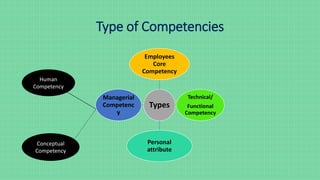
Type of Competencies
Types
Employees
Core
Competency
Technical/
Functional
Competency
Personal
attribute
Managerial
Competenc
y
Human
Competency
Conceptual
Competency
Competency mapping
• Competency mapping is a process of identifying key
competencies for a particular position in an organization, then
using it for a host of HR applications, Most importantly
performance management besides recruitment, selection,
Training & Development, Career development, HRP etc.
• It is a systematic process of identifying and differentiating
Knowledge, skills, Attitude and Behavior necessary for
attaining and sustaining required result for ensuring success at
a given job.
Need of Competency mapping
• The need arose due to following reasons:
• Increased cost of manpower
• Need for ensuring that competent people are available for performing
various critical roles
• Technology, Finances, Customers, Markets, systems, process etc can
be managed effectively if organization has right kind of human
resources.
• Required to create a performance based culture, increased accuracy
in selection, Placements, Training and development, talent retention
etc.
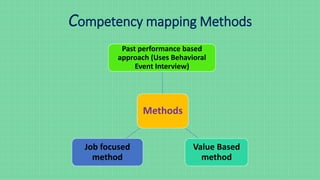
Competency mapping Methods
Methods
Past performance based
approach (Uses Behavioral
Event Interview)
Value Based
method
Job focused
method
Past performance based approach (Uses
Behavioral Event Interview)
• Identifying the position to be mapped
• Identifying Outstanding performers, below average, or average
performers
• Interviewing them by using BEI
• Generating list of competencies needed and not needed.
Job Focused method
• Understanding the Purpose of Job
• Asking incumbents to list down the job’s major activities and
accountabilities
• Mapping each task
Value based method
This method uses:
• Normative
• Cultural
• Traditional values
of the organization to construct competencies.
Benefits of Competency based approach
• Competencies provide direction. Competencies provide organizations
with a way to define—in behavioral terms—what it is that people
need to do to produce the results the organization desires, in a way
that is in keeping with its culture.
• Competencies are measurable. Competencies enable organizations to
evaluate the extent to which employees demonstrate the behaviors
that are critical for success and are critical for strengthening an
organization’s capacity to meet strategic objectives.
• Competencies can be learned. Unlike personality traits, competencies
are characteristics of individuals that can be developed and improved.
• Competencies can distinguish and differentiate the organization.
Competencies represent a behavioral dimension on which
organizations can distinguish and differentiate themselves.
• Competencies can integrate management practices. Competencies
can provide a structured model that can be used to integrate and
align management practices (e.g., recruiting, performance
management, training and development, reward and recognition)
throughout the organization.
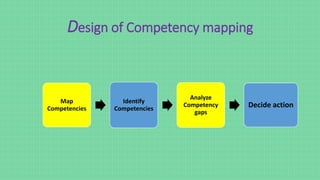
Design of Competency mapping
Map
Competencies
Identify
Competencies
Analyze
Competency
gaps
Decide action

Competency mapping

  • 1.
    Competencies Competencies include collectionof success factors necessary for achieving important results in a specific job or work role in an Organization. Success factors are the combinations of Knowledge, skills and attributes that are described in terms of specific behaviors and are demonstrated by superior performers in those jobs. Attributes include-Personal characteristics, traits, motives, values, or way of thinking that affect an individual’s behavior.
  • 2.
    Competency and Competence Competencyis a cluster of knowledge, skills, attitudes that affect a major part of one’s job that correlates with performance on the job, can be measured against well accepted standards and that can be improved. Competency refers to the ability to perform effectively the function associated with management at work situation and brings out the dimensions of behavior lying behind competent performers. Competence refers to areas of work at which the employee is competent.
  • 3.
  • 4.
    Competency mapping • Competencymapping is a process of identifying key competencies for a particular position in an organization, then using it for a host of HR applications, Most importantly performance management besides recruitment, selection, Training & Development, Career development, HRP etc. • It is a systematic process of identifying and differentiating Knowledge, skills, Attitude and Behavior necessary for attaining and sustaining required result for ensuring success at a given job.
  • 5.
    Need of Competencymapping • The need arose due to following reasons: • Increased cost of manpower • Need for ensuring that competent people are available for performing various critical roles • Technology, Finances, Customers, Markets, systems, process etc can be managed effectively if organization has right kind of human resources. • Required to create a performance based culture, increased accuracy in selection, Placements, Training and development, talent retention etc.
  • 6.
    Competency mapping Methods Methods Pastperformance based approach (Uses Behavioral Event Interview) Value Based method Job focused method
  • 7.
    Past performance basedapproach (Uses Behavioral Event Interview) • Identifying the position to be mapped • Identifying Outstanding performers, below average, or average performers • Interviewing them by using BEI • Generating list of competencies needed and not needed.
  • 8.
    Job Focused method •Understanding the Purpose of Job • Asking incumbents to list down the job’s major activities and accountabilities • Mapping each task
  • 9.
    Value based method Thismethod uses: • Normative • Cultural • Traditional values of the organization to construct competencies.
  • 10.
    Benefits of Competencybased approach • Competencies provide direction. Competencies provide organizations with a way to define—in behavioral terms—what it is that people need to do to produce the results the organization desires, in a way that is in keeping with its culture. • Competencies are measurable. Competencies enable organizations to evaluate the extent to which employees demonstrate the behaviors that are critical for success and are critical for strengthening an organization’s capacity to meet strategic objectives.
  • 11.
    • Competencies canbe learned. Unlike personality traits, competencies are characteristics of individuals that can be developed and improved. • Competencies can distinguish and differentiate the organization. Competencies represent a behavioral dimension on which organizations can distinguish and differentiate themselves. • Competencies can integrate management practices. Competencies can provide a structured model that can be used to integrate and align management practices (e.g., recruiting, performance management, training and development, reward and recognition) throughout the organization.
  • 12.
    Design of Competencymapping Map Competencies Identify Competencies Analyze Competency gaps Decide action