Technician Level 2 (LOB Bus) – Module 2
Transmission & Clutch Systems
Introduction
Please introduce yourself loud and clear including your details for:
 Participant Name
 Dealership Name
 Location
 Experience in Tata Motors (In years & months)
 Hobbies &
 What Bonds you with TATA MOTORS
7/26/2022 TML 2
Program Objective
At the end of this module the participants will be able to:
 Perform basic checks on the Transmission systems
 Perform preventive maintenance on transmission systems
 Dismantle & Assemble Transmissions
 Perform inspection of components
 Perform basic checks on Clutch system
 Dismantle & Assemble the clutch system
7/26/2022 TML 3
Program Agenda
 Allison Automatic Transmission
– Introduction
– Preventive Maintenance
– Removal from vehicle and re-fitment
 ZF-6S100BO – Manual Gear Box
– Introduction
– Inspection & Adjustment
– Dismantling and Assembly
 Clutch System Overhauling (430mm Diaphragm type)
– Removal from vehicle
– Inspection & Maintenance
– Re-fitment on vehicle
– Clutch Booster System
7/26/2022 TML 4
Allison Automatic Transmission
7/26/2022 TML 5
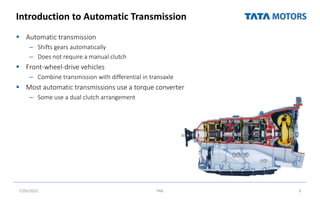
Introduction to Automatic Transmission
 Automatic transmission
– Shifts gears automatically
– Does not require a manual clutch
 Front-wheel-drive vehicles
– Combine transmission with differential in transaxle
 Most automatic transmissions use a torque converter
– Some use a dual clutch arrangement
6
7/26/2022 TML
Auto Transmission Vs Manual Transmission
Automatic Transmission
 Automatically change gear ratios as the
vehicle moves, freeing the driver from
having to shift gears manually
 Automatic Transmission Parts:
– Torque converter
– Pump
– Clutch bands
 A relatively small amount of energy is
required to pressurize the hydraulic control
system, which uses fluid pressure to
determine the correct shifting patterns and
operate the various automatic clutch
mechanisms
7
7/26/2022 TML
Manual Transmission
 Driver has to shift gears manually using a
gear shifter
 Manual Transmission Parts:
– Drive Shaft
– Counter Shaft
– Counter Shaft
 Manual transmissions avoids the power
requirement of the hydraulic control
system, by relying on the human muscle
power to disengage the clutch and actuate
the gear levers, and the mental power of
the operator to make appropriate gear
ratio selections
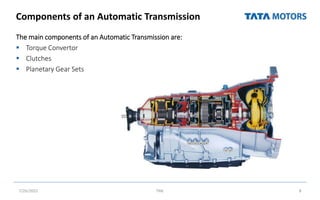
Components of an Automatic Transmission
The main components of an Automatic Transmission are:
 Torque Convertor
 Clutches
 Planetary Gear Sets
8
7/26/2022 TML
T270R & T280R Deep Sump Gear Box
Introduction to Allison Transmission
7/26/2022 TML 9
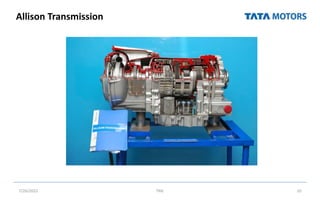
Allison Transmission
7/26/2022 TML 10
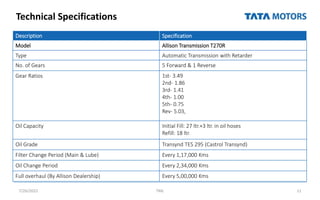
Technical Specifications
7/26/2022 TML 11
Description Specification
Model Allison Transmission T270R
Type Automatic Transmission with Retarder
No. of Gears 5 Forward & 1 Reverse
Gear Ratios 1st- 3.49
2nd- 1.86
3rd- 1.41
4th- 1.00
5th- 0.75
Rev- 5.03,
Oil Capacity Initial Fill: 27 ltr.+3 ltr. in oil hoses
Refill: 18 ltr.
Oil Grade Transynd TES 295 (Castrol Transynd)
Filter Change Period (Main & Lube) Every 1,17,000 Kms
Oil Change Period Every 2,34,000 Kms
Full overhaul (By Allison Dealership) Every 5,00,000 Kms
Components of Allison Automatic Transmission
7/26/2022 TML 12
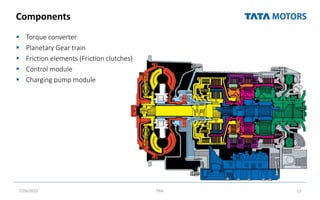
Components
 Torque converter
 Planetary Gear train
 Friction elements (Friction clutches)
 Control module
 Charging pump module
7/26/2022 TML 13
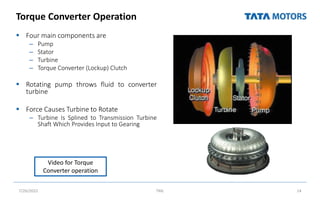
Torque Converter Operation
 Four main components are
– Pump
– Stator
– Turbine
– Torque Converter (Lockup) Clutch
 Rotating pump throws fluid to converter
turbine
 Force Causes Turbine to Rotate
– Turbine Is Splined to Transmission Turbine
Shaft Which Provides Input to Gearing
7/26/2022 TML 14
Video for Torque
Converter operation
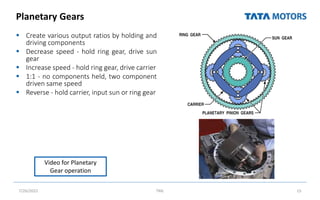
Planetary Gears
 Create various output ratios by holding and
driving components
 Decrease speed - hold ring gear, drive sun
gear
 Increase speed - hold ring gear, drive carrier
 1:1 - no components held, two component
driven same speed
 Reverse - hold carrier, input sun or ring gear
7/26/2022 TML 15
Video for Planetary
Gear operation
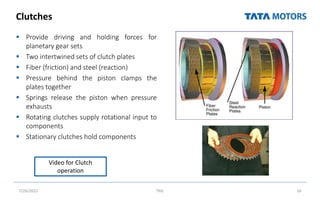
Clutches
 Provide driving and holding forces for
planetary gear sets
 Two intertwined sets of clutch plates
 Fiber (friction) and steel (reaction)
 Pressure behind the piston clamps the
plates together
 Springs release the piston when pressure
exhausts
 Rotating clutches supply rotational input to
components
 Stationary clutches hold components
7/26/2022 TML 16
Video for Clutch
operation
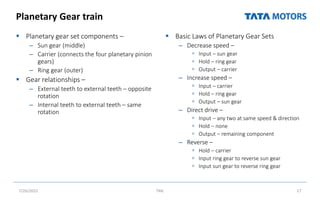
Planetary Gear train
 Planetary gear set components –
– Sun gear (middle)
– Carrier (connects the four planetary pinion
gears)
– Ring gear (outer)
 Gear relationships –
– External teeth to external teeth – opposite
rotation
– Internal teeth to external teeth – same
rotation
 Basic Laws of Planetary Gear Sets
– Decrease speed –
 Input – sun gear
 Hold – ring gear
 Output – carrier
– Increase speed –
 Input – carrier
 Hold – ring gear
 Output – sun gear
– Direct drive –
 Input – any two at same speed & direction
 Hold – none
 Output – remaining component
– Reverse –
 Hold – carrier
 Input ring gear to reverse sun gear
 Input sun gear to reverse ring gear
7/26/2022 TML 17
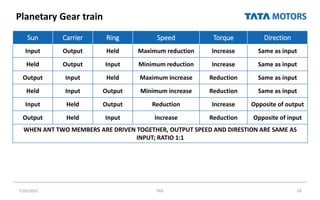
Planetary Gear train
7/26/2022 TML 18
Sun Carrier Ring Speed Torque Direction
Input Output Held Maximum reduction Increase Same as input
Held Output Input Minimum reduction Increase Same as input
Output Input Held Maximum increase Reduction Same as input
Held Input Output Minimum increase Reduction Same as input
Input Held Output Reduction Increase Opposite of output
Output Held Input Increase Reduction Opposite of input
WHEN ANT TWO MEMBERS ARE DRIVEN TOGETHER, OUTPUT SPEED AND DIRESTION ARE SAME AS
INPUT; RATIO 1:1
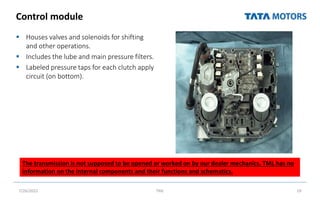
Control module
 Houses valves and solenoids for shifting
and other operations.
 Includes the lube and main pressure filters.
 Labeled pressure taps for each clutch apply
circuit (on bottom).
7/26/2022 TML 19
The transmission is not supposed to be opened or worked on by our dealer mechanics. TML has no
information on the internal components and their functions and schematics.
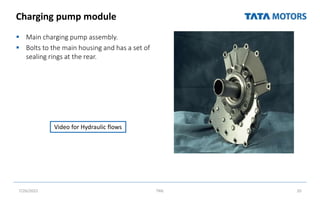
Charging pump module
 Main charging pump assembly.
 Bolts to the main housing and has a set of
sealing rings at the rear.
7/26/2022 TML 20
Video for Hydraulic flows
Preventive Maintenance
7/26/2022 TML 21
Transmission
 Clean and inspect the exterior of the transmission at regular intervals
 Frequency of inspection depends upon the severity of the transmission
 Inspect the transmission for:
– Loose Bolt – Transmission and mounting components
– Fluid Leaks – repair immediately
– Loose, dirty or improperly adjusted throttle sensor
– Damaged or loose hose
– Worn, frayed or improperly routed electrical harnesses
– Dented worn or out-of-phase driveline U joint and slip fittings
– Clogged or dirty breather
– Check transmission fluid for evidence of engine coolant
7/26/2022 TML 22
Vehicle
 Check the vehicle cooling system occasionally for evidence of transmission fluid
 Transmission fluid in the vehicle cooling system indicates a faulty oil-cooler
 Check battery cut-off switch for proper mounting of ground-power connection for
Transmission Control Module
 Check for driveline/propeller shaft :
– Vibrations
– Balancing
– Slip-joints alignment and
– U-joints phasing
7/26/2022 TML 23
Fluid Level – Periodic Check
 Always maintain proper transmission fluid level
 Ways to check transmission fluid level:
– Electronically :
 Through shift selector.
 Through Allison DOC.
– Manual fluid check :
 Cold Check.
 Hot Check.
 Always maintain transmission fluid clean
 Always use TransSynd during refill / change of transmission fluid
7/26/2022 TML 24
Fluid & Filter Change
 Follow recommended fluid and filter change interval
 Filter and fluid change interval depends also upon the severity of application
 Establish the change interval for a particular vocation by conducting oil-sample analysis
 Always follow guidelines for draining fluid, replacing filter and oil
 Transmission Oil shall be changed
– If there is an evidence of dirt in the fluid or
– If the fluid is discolored
– If there is any evidence of water, coolant or metal particles
7/26/2022 TML 25
Fluid Leakage Diagnosis
 Identify the leakage and oil whether it’s
– Engine Oil
– Transmission Oil
– Any other fluid viz. steering oil, coolant etc
 In case of Transmission Oil leakage identify causes
– Transmission mating surfaces
– Housing leak
– Leak at converter end
– Fill tube
 Inspect gasket mating surfaces
 Alternate methods to identify leakage
– Powder method
– Black Light and Dye method
7/26/2022 TML 26
Breather Maintenance
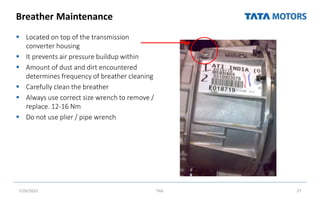
 Located on top of the transmission
converter housing
 It prevents air pressure buildup within
 Amount of dust and dirt encountered
determines frequency of breather cleaning
 Carefully clean the breather
 Always use correct size wrench to remove /
replace. 12-16 Nm
 Do not use plier / pipe wrench
7/26/2022 TML 27
Gear Shift Selector
7/26/2022 TML 28
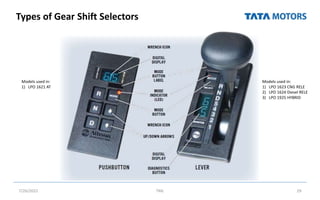
Types of Gear Shift Selectors
7/26/2022 TML 29
Models used in:
1) LPO 1623 CNG RELE
2) LPO 1624 Diesel RELE
3) LPO 1925 HYBRID
Models used in:
1) LPO 1621 AT
Prognostic Features
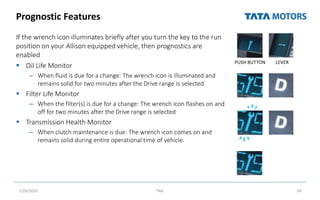
If the wrench icon illuminates briefly after you turn the key to the run
position on your Allison equipped vehicle, then prognostics are
enabled
 Oil Life Monitor
– When fluid is due for a change: The wrench icon is illuminated and
remains solid for two minutes after the Drive range is selected
 Filter Life Monitor
– When the filter(s) is due for a change: The wrench icon flashes on and
off for two minutes after the Drive range is selected
 Transmission Health Monitor
– When clutch maintenance is due: The wrench icon comes on and
remains solid during entire operational time of vehicle.
7/26/2022 TML 30
PUSH BUTTON LEVER
Accessing Prognostics
When you are alerted via the wrench icon on the shift selector that service is due, you can check
the status by toggling through the shift selector display as follows. Be sure to park the vehicle on
a level surface, shift to N (Neutral) and apply the parking brake before accessing prognostics
through the shift selector.
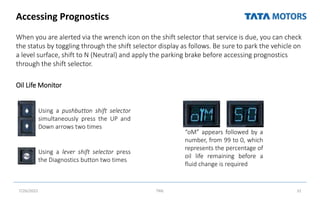
Oil Life Monitor
7/26/2022 TML 31
Using a pushbutton shift selector
simultaneously press the UP and
Down arrows two times
Using a lever shift selector press
the Diagnostics button two times
“oM” appears followed by a
number, from 99 to 0, which
represents the percentage of
oil life remaining before a
fluid change is required
Accessing Prognostics
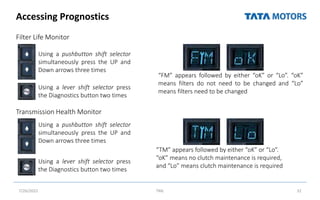
Filter Life Monitor
Transmission Health Monitor
7/26/2022 TML 32
Using a pushbutton shift selector
simultaneously press the UP and
Down arrows three times
Using a lever shift selector press
the Diagnostics button two times
“FM” appears followed by either “oK” or “Lo”. “oK”
means filters do not need to be changed and “Lo”
means filters need to be changed
Using a pushbutton shift selector
simultaneously press the UP and
Down arrows three times
Using a lever shift selector press
the Diagnostics button two times
“TM” appears followed by either “oK” or “Lo”.
“oK” means no clutch maintenance is required,
and “Lo” means clutch maintenance is required
Resetting Prognostics
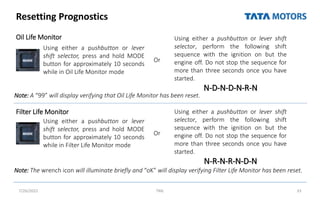
Oil Life Monitor
Filter Life Monitor
7/26/2022 TML 33
Using either a pushbutton or lever
shift selector, press and hold MODE
button for approximately 10 seconds
while in Oil Life Monitor mode
Or
Using either a pushbutton or lever shift
selector, perform the following shift
sequence with the ignition on but the
engine off. Do not stop the sequence for
more than three seconds once you have
started.
N-D-N-D-N-R-N
Using either a pushbutton or lever
shift selector, press and hold MODE
button for approximately 10 seconds
while in Filter Life Monitor mode
Or
Using either a pushbutton or lever shift
selector, perform the following shift
sequence with the ignition on but the
engine off. Do not stop the sequence for
more than three seconds once you have
started.
N-R-N-R-N-D-N
Note: A “99” will display verifying that Oil Life Monitor has been reset.
Note: The wrench icon will illuminate briefly and “oK” will display verifying Filter Life Monitor has been reset.
Resetting Prognostics
Transmission Health Monitor
The wrench icon clears automatically when appropriate conditions are detected. Transmission
Health Monitor must be reset manually using Allison DOC™ after correcting a clutch system
issue.
7/26/2022 TML 34
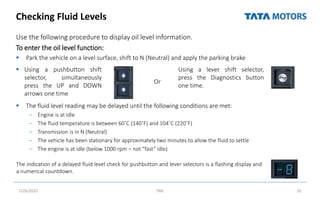
Checking Fluid Levels
Use the following procedure to display oil level information.
To enter the oil level function:
 Park the vehicle on a level surface, shift to N (Neutral) and apply the parking brake
 The fluid level reading may be delayed until the following conditions are met:
– Engine is at idle
– The fluid temperature is between 60˚C (140˚F) and 104˚C (220˚F)
– Transmission is in N (Neutral)
– The vehicle has been stationary for approximately two minutes to allow the fluid to settle
– The engine is at idle (below 1000 rpm – not “fast” idle)
7/26/2022 TML 35
Using a lever shift selector,
press the Diagnostics button
one time.
 Using a pushbutton shift
selector, simultaneously
press the UP and DOWN
arrows one time
Or
The indication of a delayed fluid level check for pushbutton and lever selectors is a flashing display and
a numerical countdown.
Checking Fluid Levels
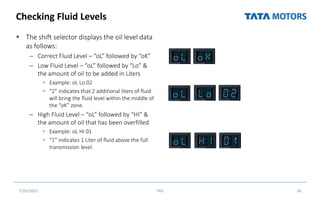
 The shift selector displays the oil level data
as follows:
– Correct Fluid Level – “oL” followed by “oK”
– Low Fluid Level – “oL” followed by “Lo” &
the amount of oil to be added in Liters
 Example: oL Lo 02
 “2” indicates that 2 additional liters of fluid
will bring the fluid level within the middle of
the “oK” zone.
– High Fluid Level – “oL” followed by “HI” &
the amount of oil that has been overfilled
 Example: oL HI 01
 “1” indicates 1 Liter of fluid above the full
transmission level.
7/26/2022 TML 36
Identify the different components of the gearbox
Practical Exercise
7/26/2022 TML 37
Exercise Name- Walk
around of gear box
Duration – 30 Mins
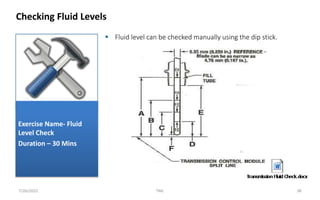
 Fluid level can be checked manually using the dip stick.
Checking Fluid Levels
7/26/2022 TML 38
Exercise Name- Fluid
Level Check
Duration – 30 Mins
Removal & Re-fitment of Gear Box on Vehicle
7/26/2022 TML 39
Instructions for practical exercise
 Trainer:
– Guide the trainee through the procedure of removal and re-
fitment of gear box on vehicle
 Trainees:
– Follow the instructions of the trainer
 Objective:
– To perform Removal & Re-fitment of Gear Box on Vehicle
Practical Exercise
7/26/2022 TML 40
Exercise Name- Removal
& Re-fitment of Gear
Box on Vehicle
Duration – 120 Mins
Gear Box Removal and Re-fitment.docx
Manual Gear Box with Cable Shift
ZF 6S1000BO
7/26/2022 TML 41
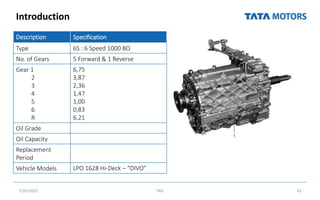
Introduction
7/26/2022 TML 42
Description Specification
Type 6S : 6 Speed 1000 BO
No. of Gears 5 Forward & 1 Reverse
Gear 1
2
3
4
5
6
R
6,75
3,87
2,36
1,47
1,00
0,83
6,21
Oil Grade
Oil Capacity
Replacement
Period
Vehicle Models LPO 1628 Hi-Deck – “DIVO”
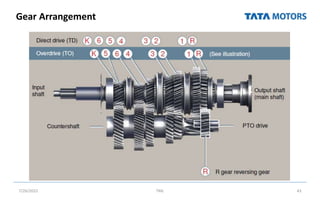
Gear Arrangement
7/26/2022 TML 43
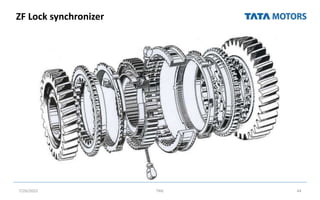
ZF Lock synchronizer
7/26/2022 TML 44
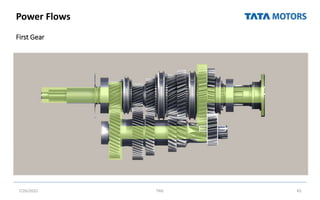
Power Flows
First Gear
7/26/2022 TML 45
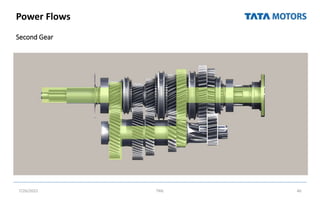
Power Flows
Second Gear
7/26/2022 TML 46
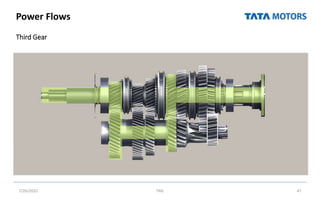
Power Flows
Third Gear
7/26/2022 TML 47
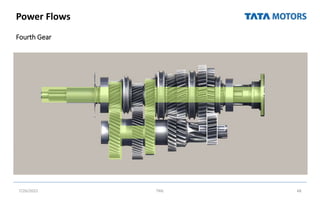
Power Flows
Fourth Gear
7/26/2022 TML 48
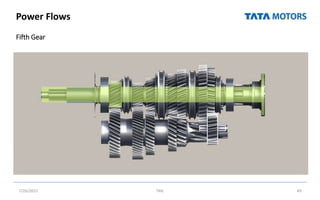
Power Flows
Fifth Gear
7/26/2022 TML 49
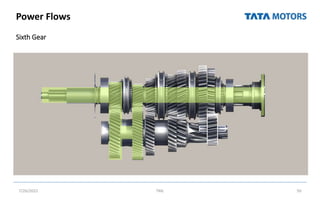
Power Flows
Sixth Gear
7/26/2022 TML 50
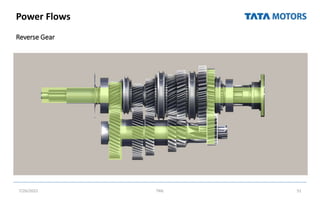
Power Flows
Reverse Gear
7/26/2022 TML 51
Instructions for practical exercise
 Trainer:
– Guide the trainee through the procedure of Adjustment of the
PGS Cable
 Trainees:
– Follow the instructions of the trainer
 Objective:
– To perform inspection of the gearbox and adjust the PGS cable
Practical Exercise
7/26/2022 TML 52
Exercise Name-
Inspection of gearbox &
PGS cable adjustment
Duration – 120 Mins
Instructions for practical exercise
 Trainer:
– Guide the trainee through the procedure of Dismantling and
assembling the gear box
 Trainees:
– Follow the instructions of the trainer
 Objective:
– To Dismantle, Inspect and Assemble the gear box.
Practical Exercise
7/26/2022 TML 53
Exercise Name-
Dismantle and assemble
gear box
Duration – 180 Mins
Video for Dismantling
and assembly of gear box
SETCO 430 DIA Diaphragm Type Clutch
Clutch System Overhauling
7/26/2022 TML 54
Introduction
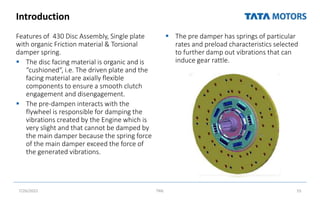
Features of 430 Disc Assembly, Single plate
with organic Friction material & Torsional
damper spring.
 The disc facing material is organic and is
“cushioned“, i.e. The driven plate and the
facing material are axially flexible
components to ensure a smooth clutch
engagement and disengagement.
 The pre‐dampen interacts with the
flywheel is responsible for damping the
vibrations created by the Engine which is
very slight and that cannot be damped by
the main damper because the spring force
of the main damper exceed the force of
the generated vibrations.
 The pre damper has springs of particular
rates and preload characteristics selected
to further damp out vibrations that can
induce gear rattle.
7/26/2022 TML 55
Introduction
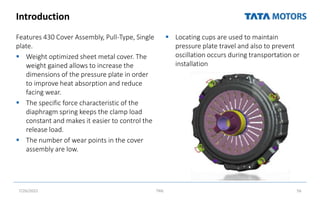
Features 430 Cover Assembly, Pull‐Type, Single
plate.
 Weight optimized sheet metal cover. The
weight gained allows to increase the
dimensions of the pressure plate in order
to improve heat absorption and reduce
facing wear.
 The specific force characteristic of the
diaphragm spring keeps the clamp load
constant and makes it easier to control the
release load.
 The number of wear points in the cover
assembly are low.
 Locating cups are used to maintain
pressure plate travel and also to prevent
oscillation occurs during transportation or
installation
7/26/2022 TML 56
Components of Clutch
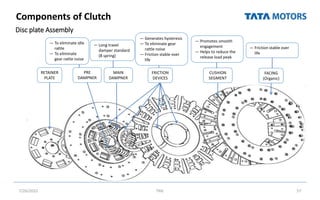
Disc plate Assembly
7/26/2022 TML 57
RETAINER
PLATE
PRE
DAMPNER
FRICTION
DEVICES
CUSHION
SEGMENT
FACING
(Organic)
MAIN
DAMPNER
— To eliminate idle
rattle
— To eliminate
gear rattle noise
— Long travel
damper standard
(8 spring)
— Generates hysteresis
— To eliminate gear
rattle noise
— Friction stable over
life
— Promotes smooth
engagement
— Helps to reduce the
release load peak
— Friction stable over
life
Components of Clutch
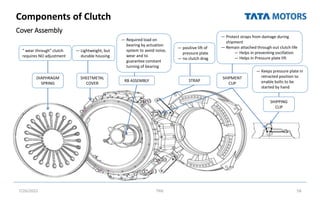
Cover Assembly
7/26/2022 TML 58
DIAPHRAGM
SPRING
SHEETMETAL
COVER
RB ASSEMBLY STRAP
SHIPMENT
CUP
SHIPPING
CLIP
“ wear through” clutch
requires NO adjustment
— Lightweight, but
durable housing
— Required load on
bearing by actuation
system to avoid noise,
wear and to
guarantee constant
turning of bearing
— positive lift of
pressure plate
— no clutch drag
— Protect straps from damage during
shipment
— Remain attached through out clutch life
— Helps in preventing oscillation
— Helps in Pressure plate lift
— Keeps pressure plate in
retracted position to
enable bolts to be
started by hand
Instructions for practical exercise
 Trainer:
– Guide the trainees through the procedure of inspection of the
Clutch System
– Follow the guidelines in the next slides
 Trainees:
– Follow the instructions of the trainer
 Objective:
– To perform inspection of the clutch system
Practical Exercise
7/26/2022 TML 59
Exercise Name-
Inspection of Clutch
system
Duration – 120 Mins
Inspection
Checks for Clutch Assembly before attempting Installation
 Inspect disc and cover for damage due to dropping, e.g. facing damaged at O.D. or shipping cups
of cover and/or straps damaged, O.D. of cover housing damaged etc.
 Put release bearing onto guiding sleeve of the transmission ‐make sure it can move freely on
sleeve
 keep dirt, oil, grease away from clutch
Checks for Clutch Disc Assembly
 Always grease the Hub splines of the clutch disc to ensure easy movement on the Gear box input
shaft
 When the Hub splines have been greased , fit the clutch disc on the gear box shaft, slightly move
the components to and fro and wipe off excess grease
 Before bolting down the cover assembly ensure use of Tool to center the clutch disc correctly in
the flywheel
 Centre Disc with a splined shaft, proceed carefully when inserting the gearbox shaft in to the hub
of the clutch disc to avoid damage of the splines and the torsional vibration damper ,as it is
sensitive to shock
7/26/2022 TML 60
Inspection
Checks for Clutch Cover Assembly
 Remove Dirt and contamination from the cover assembly with non‐petroleum base cleaning
solvent.
 Inspect the cover, Pressure plate ,straps ,Diaphragm spring etc. for damage during
transportation.
Checks for Fly wheel & Transmission components
 Inspect Flywheel for flatness, damaged threads and damaged centering shoulder, inspect
pilot bearing for free, easy rotation.
 Inspect interface of flywheel‐housing to bell‐housing for any damage or dirt that would lead
to misalignment; the bearing is self‐centering, but can compensate only a limited amount of
misalignment.
 Check transmission input shaft spline for any damage and make sure that the disc can move
easily forward and backwards on the spline.
7/26/2022 TML 61
 Please follow the procedure as described in the slides to follow.
Practical Exercise
7/26/2022 TML 62
Exercise Name – Clutch
Bleeding & Pedal Free
Play adjustment
Duration – 120 mins
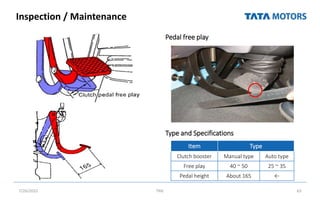
Inspection / Maintenance
Pedal free play
Type and Specifications
7/26/2022 TML 63
Item Type
Clutch booster Manual type Auto type
Free play 40 ~ 50 25 ~ 35
Pedal height About 165 ←
Inspection / Maintenance
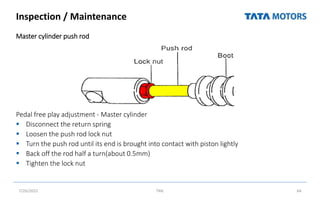
Master cylinder push rod
Pedal free play adjustment - Master cylinder
 Disconnect the return spring
 Loosen the push rod lock nut
 Turn the push rod until its end is brought into contact with piston lightly
 Back off the rod half a turn(about 0.5mm)
 Tighten the lock nut
7/26/2022 TML 64
Inspection / Maintenance
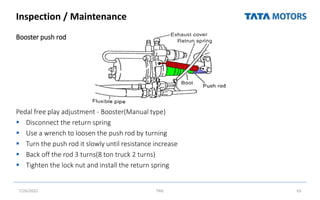
Booster push rod
Pedal free play adjustment - Booster(Manual type)
 Disconnect the return spring
 Use a wrench to loosen the push rod by turning
 Turn the push rod it slowly until resistance increase
 Back off the rod 3 turns(8 ton truck 2 turns)
 Tighten the lock nut and install the return spring
7/26/2022 TML 65
Inspection / Maintenance
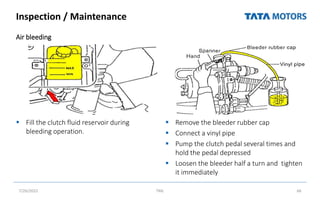
Air bleeding
 Fill the clutch fluid reservoir during
bleeding operation.
 Remove the bleeder rubber cap
 Connect a vinyl pipe
 Pump the clutch pedal several times and
hold the pedal depressed
 Loosen the bleeder half a turn and tighten
it immediately
7/26/2022 TML 66
 Please follow the procedure as described in the slides to follow.
Practical Exercise
7/26/2022 TML 67
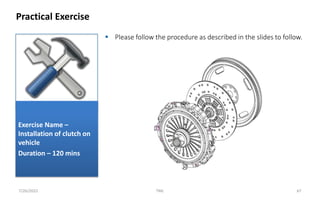
Exercise Name –
Installation of clutch on
vehicle
Duration – 120 mins
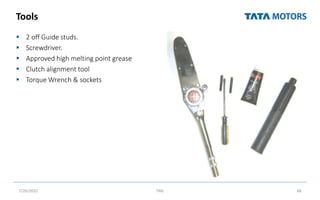
Tools
 2 off Guide studs.
 Screwdriver.
 Approved high melting point grease
 Clutch alignment tool
 Torque Wrench & sockets
7/26/2022 TML 68
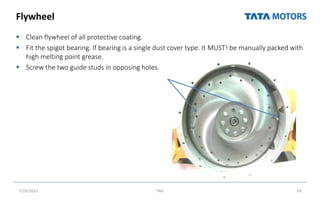
Flywheel
 Clean flywheel of all protective coating.
 Fit the spigot bearing. If bearing is a single dust cover type. It MUST! be manually packed with
high melting point grease.
 Screw the two guide studs in opposing holes.
7/26/2022 TML 69
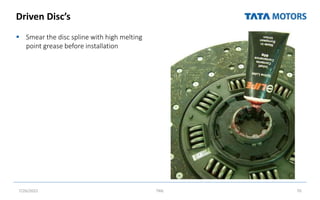
Driven Disc’s
 Smear the disc spline with high melting
point grease before installation
7/26/2022 TML 70
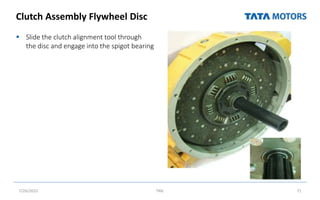
Clutch Assembly Flywheel Disc
 Slide the clutch alignment tool through
the disc and engage into the spigot bearing
7/26/2022 TML 71
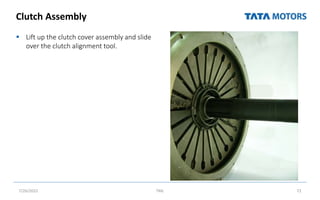
Clutch Assembly
 Lift up the clutch cover assembly and slide
over the clutch alignment tool.
7/26/2022 TML 72
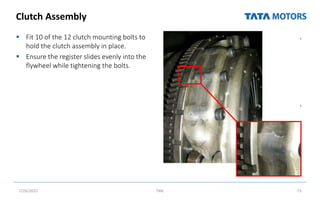
Clutch Assembly
 Fit 10 of the 12 clutch mounting bolts to
hold the clutch assembly in place.
 Ensure the register slides evenly into the
flywheel while tightening the bolts.
7/26/2022 TML 73
Clutch Assembly
 Remove the two guide studs and crew in
the remaining 2 mounting bolts
 Tighten the 12 clutch mounting bolts in
two stages to the correct torque setting
– 22lb/ft [30nm] : Fist Stage
– 43lb/ft [58nm] : Second Stage
 The sequence is shown in the image
7/26/2022 TML 74
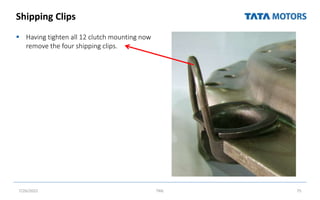
Shipping Clips
 Having tighten all 12 clutch mounting now
remove the four shipping clips.
7/26/2022 TML 75
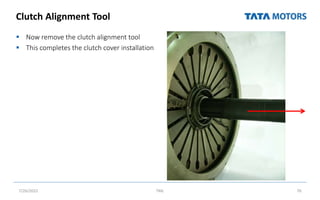
Clutch Alignment Tool
 Now remove the clutch alignment tool
 This completes the clutch cover installation
7/26/2022 TML 76
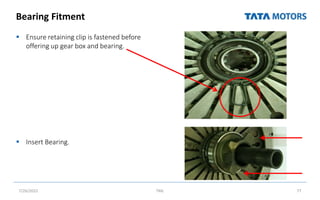
Bearing Fitment
 Ensure retaining clip is fastened before
offering up gear box and bearing.
 Insert Bearing.
7/26/2022 TML 77
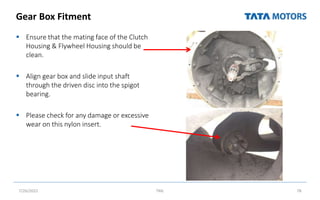
Gear Box Fitment
 Ensure that the mating face of the Clutch
Housing & Flywheel Housing should be
clean.
 Align gear box and slide input shaft
through the driven disc into the spigot
bearing.
 Please check for any damage or excessive
wear on this nylon insert.
7/26/2022 TML 78
Clutch Booster
7/26/2022 TML 79
Introduction
 Clutch Servos are used to reduce the force required to operate the clutch pedal and to permit
sensitive and accurate actuation of the clutch in the vehicle.
 The Clutch servo consists of three parts:
– Hydraulic slave cylinder
– Control Valve
– Pneumatic Servo cylinder
 Some of the other optional accessories available with clutch servo are
– Electrical trigger through a electrical sensor to activate transmission control
– Mechanical wear indicator
7/26/2022 TML 80
Port Details
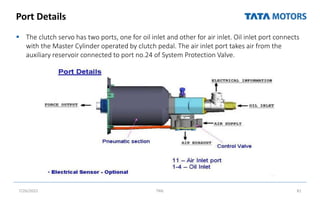
 The clutch servo has two ports, one for oil inlet and other for air inlet. Oil inlet port connects
with the Master Cylinder operated by clutch pedal. The air inlet port takes air from the
auxiliary reservoir connected to port no.24 of System Protection Valve.
7/26/2022 TML 81
Manual Bleeding of Clutch Servo
Manual bleeding of Clutch Servo:
 Top off clutch master cylinder reservoir and fill adequate amount of fluid
 Put a transparent Plastic tube or hose on the clutch servo bleeding nipple and submerge the
other end of tube in a jar with some hydraulic fluid
 Slowly depress the clutch pedal
 Slightly loosen the nipple
 While fluid is traveling through the plastic tube, tighten the bleeder before the pedal is fully
released
 Release the pedal
Repeat the procedure until:
 No bubbles appear in the fluid section
 The bleeder nipple was opened after the clutch pedal started depressing and was closed
before the pedal reached the bottom
Recommended Hydraulic fluid: Brake Fluid to SAE J1703
7/26/2022 TML 82
Mechanical Linkage Checks
 Check and ensure the mechanical linkages used for pedal assembly is free from friction to
avoid hard pedal and loss of stroke
 Where ever required the linkages are to be lubricated
 Ensure pedal free play is maintained as per recommendation
 If the pedal free play is low it may lead to constant engagement of clutch leading to wear
/overheating
7/26/2022 TML 83
Periodic Maintenance
No special maintenance is required for Clutch Servo in the field except for the following points:
 Check during routine vehicle maintenance for any leak in the joints – both air and hydraulic
 Check for tightness of mounting bolts, Fork and bleeding screw
 Clean the wear indicator and exhaust valve in case if it is soiled
 Overhaul the unit using appropriate repair kit once in 3 years through SCL’s Authorized
Service Centre
Caution: Do not operate the clutch servo without mounting on the bracket.
7/26/2022 TML 84
Wear Indicator
Purpose of Wear Indicator:
 To provide visual indication of the wear from the clutch.
Operation:
 The wear indicator is integral part of the clutch-servo body.
 The wear indicator rod is held by an internal friction system and it rests against the moving
piston of the clutch-servo.
 The wear indicator rod will project out more when the clutch is worn.
 The clutch wear can be assessed by measuring the gap between the self locking washer and
the plastic body of the indicator.
When we should adjust the Wear Indicator:
 When assembling the clutch-servo in the vehicle.
 At the time of replacing the Clutch in the vehicle during service.
7/26/2022 TML 85
Adjusting Wear Indicator
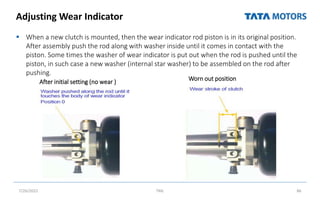
 When a new clutch is mounted, then the wear indicator rod piston is in its original position.
After assembly push the rod along with washer inside until it comes in contact with the
piston. Some times the washer of wear indicator is put out when the rod is pushed until the
piston, in such case a new washer (internal star washer) to be assembled on the rod after
pushing.
7/26/2022 TML 86
After initial setting (no wear ) Worn out position
All The Best!
7/26/2022 TML 87

Clutch & Transmission System.pptx

  • 1.
    Technician Level 2(LOB Bus) – Module 2 Transmission & Clutch Systems
  • 2.
    Introduction Please introduce yourselfloud and clear including your details for:  Participant Name  Dealership Name  Location  Experience in Tata Motors (In years & months)  Hobbies &  What Bonds you with TATA MOTORS 7/26/2022 TML 2
  • 3.
    Program Objective At theend of this module the participants will be able to:  Perform basic checks on the Transmission systems  Perform preventive maintenance on transmission systems  Dismantle & Assemble Transmissions  Perform inspection of components  Perform basic checks on Clutch system  Dismantle & Assemble the clutch system 7/26/2022 TML 3
  • 4.
    Program Agenda  AllisonAutomatic Transmission – Introduction – Preventive Maintenance – Removal from vehicle and re-fitment  ZF-6S100BO – Manual Gear Box – Introduction – Inspection & Adjustment – Dismantling and Assembly  Clutch System Overhauling (430mm Diaphragm type) – Removal from vehicle – Inspection & Maintenance – Re-fitment on vehicle – Clutch Booster System 7/26/2022 TML 4
  • 5.
  • 6.
    Introduction to AutomaticTransmission  Automatic transmission – Shifts gears automatically – Does not require a manual clutch  Front-wheel-drive vehicles – Combine transmission with differential in transaxle  Most automatic transmissions use a torque converter – Some use a dual clutch arrangement 6 7/26/2022 TML
  • 7.
    Auto Transmission VsManual Transmission Automatic Transmission  Automatically change gear ratios as the vehicle moves, freeing the driver from having to shift gears manually  Automatic Transmission Parts: – Torque converter – Pump – Clutch bands  A relatively small amount of energy is required to pressurize the hydraulic control system, which uses fluid pressure to determine the correct shifting patterns and operate the various automatic clutch mechanisms 7 7/26/2022 TML Manual Transmission  Driver has to shift gears manually using a gear shifter  Manual Transmission Parts: – Drive Shaft – Counter Shaft – Counter Shaft  Manual transmissions avoids the power requirement of the hydraulic control system, by relying on the human muscle power to disengage the clutch and actuate the gear levers, and the mental power of the operator to make appropriate gear ratio selections
  • 8.
    Components of anAutomatic Transmission The main components of an Automatic Transmission are:  Torque Convertor  Clutches  Planetary Gear Sets 8 7/26/2022 TML
  • 9.
    T270R & T280RDeep Sump Gear Box Introduction to Allison Transmission 7/26/2022 TML 9
  • 10.
  • 11.
    Technical Specifications 7/26/2022 TML11 Description Specification Model Allison Transmission T270R Type Automatic Transmission with Retarder No. of Gears 5 Forward & 1 Reverse Gear Ratios 1st- 3.49 2nd- 1.86 3rd- 1.41 4th- 1.00 5th- 0.75 Rev- 5.03, Oil Capacity Initial Fill: 27 ltr.+3 ltr. in oil hoses Refill: 18 ltr. Oil Grade Transynd TES 295 (Castrol Transynd) Filter Change Period (Main & Lube) Every 1,17,000 Kms Oil Change Period Every 2,34,000 Kms Full overhaul (By Allison Dealership) Every 5,00,000 Kms
  • 12.
    Components of AllisonAutomatic Transmission 7/26/2022 TML 12
  • 13.
    Components  Torque converter Planetary Gear train  Friction elements (Friction clutches)  Control module  Charging pump module 7/26/2022 TML 13
  • 14.
    Torque Converter Operation Four main components are – Pump – Stator – Turbine – Torque Converter (Lockup) Clutch  Rotating pump throws fluid to converter turbine  Force Causes Turbine to Rotate – Turbine Is Splined to Transmission Turbine Shaft Which Provides Input to Gearing 7/26/2022 TML 14 Video for Torque Converter operation
  • 15.
    Planetary Gears  Createvarious output ratios by holding and driving components  Decrease speed - hold ring gear, drive sun gear  Increase speed - hold ring gear, drive carrier  1:1 - no components held, two component driven same speed  Reverse - hold carrier, input sun or ring gear 7/26/2022 TML 15 Video for Planetary Gear operation
  • 16.
    Clutches  Provide drivingand holding forces for planetary gear sets  Two intertwined sets of clutch plates  Fiber (friction) and steel (reaction)  Pressure behind the piston clamps the plates together  Springs release the piston when pressure exhausts  Rotating clutches supply rotational input to components  Stationary clutches hold components 7/26/2022 TML 16 Video for Clutch operation
  • 17.
    Planetary Gear train Planetary gear set components – – Sun gear (middle) – Carrier (connects the four planetary pinion gears) – Ring gear (outer)  Gear relationships – – External teeth to external teeth – opposite rotation – Internal teeth to external teeth – same rotation  Basic Laws of Planetary Gear Sets – Decrease speed –  Input – sun gear  Hold – ring gear  Output – carrier – Increase speed –  Input – carrier  Hold – ring gear  Output – sun gear – Direct drive –  Input – any two at same speed & direction  Hold – none  Output – remaining component – Reverse –  Hold – carrier  Input ring gear to reverse sun gear  Input sun gear to reverse ring gear 7/26/2022 TML 17
  • 18.
    Planetary Gear train 7/26/2022TML 18 Sun Carrier Ring Speed Torque Direction Input Output Held Maximum reduction Increase Same as input Held Output Input Minimum reduction Increase Same as input Output Input Held Maximum increase Reduction Same as input Held Input Output Minimum increase Reduction Same as input Input Held Output Reduction Increase Opposite of output Output Held Input Increase Reduction Opposite of input WHEN ANT TWO MEMBERS ARE DRIVEN TOGETHER, OUTPUT SPEED AND DIRESTION ARE SAME AS INPUT; RATIO 1:1
  • 19.
    Control module  Housesvalves and solenoids for shifting and other operations.  Includes the lube and main pressure filters.  Labeled pressure taps for each clutch apply circuit (on bottom). 7/26/2022 TML 19 The transmission is not supposed to be opened or worked on by our dealer mechanics. TML has no information on the internal components and their functions and schematics.
  • 20.
    Charging pump module Main charging pump assembly.  Bolts to the main housing and has a set of sealing rings at the rear. 7/26/2022 TML 20 Video for Hydraulic flows
  • 21.
  • 22.
    Transmission  Clean andinspect the exterior of the transmission at regular intervals  Frequency of inspection depends upon the severity of the transmission  Inspect the transmission for: – Loose Bolt – Transmission and mounting components – Fluid Leaks – repair immediately – Loose, dirty or improperly adjusted throttle sensor – Damaged or loose hose – Worn, frayed or improperly routed electrical harnesses – Dented worn or out-of-phase driveline U joint and slip fittings – Clogged or dirty breather – Check transmission fluid for evidence of engine coolant 7/26/2022 TML 22
  • 23.
    Vehicle  Check thevehicle cooling system occasionally for evidence of transmission fluid  Transmission fluid in the vehicle cooling system indicates a faulty oil-cooler  Check battery cut-off switch for proper mounting of ground-power connection for Transmission Control Module  Check for driveline/propeller shaft : – Vibrations – Balancing – Slip-joints alignment and – U-joints phasing 7/26/2022 TML 23
  • 24.
    Fluid Level –Periodic Check  Always maintain proper transmission fluid level  Ways to check transmission fluid level: – Electronically :  Through shift selector.  Through Allison DOC. – Manual fluid check :  Cold Check.  Hot Check.  Always maintain transmission fluid clean  Always use TransSynd during refill / change of transmission fluid 7/26/2022 TML 24
  • 25.
    Fluid & FilterChange  Follow recommended fluid and filter change interval  Filter and fluid change interval depends also upon the severity of application  Establish the change interval for a particular vocation by conducting oil-sample analysis  Always follow guidelines for draining fluid, replacing filter and oil  Transmission Oil shall be changed – If there is an evidence of dirt in the fluid or – If the fluid is discolored – If there is any evidence of water, coolant or metal particles 7/26/2022 TML 25
  • 26.
    Fluid Leakage Diagnosis Identify the leakage and oil whether it’s – Engine Oil – Transmission Oil – Any other fluid viz. steering oil, coolant etc  In case of Transmission Oil leakage identify causes – Transmission mating surfaces – Housing leak – Leak at converter end – Fill tube  Inspect gasket mating surfaces  Alternate methods to identify leakage – Powder method – Black Light and Dye method 7/26/2022 TML 26
  • 27.
    Breather Maintenance  Locatedon top of the transmission converter housing  It prevents air pressure buildup within  Amount of dust and dirt encountered determines frequency of breather cleaning  Carefully clean the breather  Always use correct size wrench to remove / replace. 12-16 Nm  Do not use plier / pipe wrench 7/26/2022 TML 27
  • 28.
  • 29.
    Types of GearShift Selectors 7/26/2022 TML 29 Models used in: 1) LPO 1623 CNG RELE 2) LPO 1624 Diesel RELE 3) LPO 1925 HYBRID Models used in: 1) LPO 1621 AT
  • 30.
    Prognostic Features If thewrench icon illuminates briefly after you turn the key to the run position on your Allison equipped vehicle, then prognostics are enabled  Oil Life Monitor – When fluid is due for a change: The wrench icon is illuminated and remains solid for two minutes after the Drive range is selected  Filter Life Monitor – When the filter(s) is due for a change: The wrench icon flashes on and off for two minutes after the Drive range is selected  Transmission Health Monitor – When clutch maintenance is due: The wrench icon comes on and remains solid during entire operational time of vehicle. 7/26/2022 TML 30 PUSH BUTTON LEVER
  • 31.
    Accessing Prognostics When youare alerted via the wrench icon on the shift selector that service is due, you can check the status by toggling through the shift selector display as follows. Be sure to park the vehicle on a level surface, shift to N (Neutral) and apply the parking brake before accessing prognostics through the shift selector. Oil Life Monitor 7/26/2022 TML 31 Using a pushbutton shift selector simultaneously press the UP and Down arrows two times Using a lever shift selector press the Diagnostics button two times “oM” appears followed by a number, from 99 to 0, which represents the percentage of oil life remaining before a fluid change is required
  • 32.
    Accessing Prognostics Filter LifeMonitor Transmission Health Monitor 7/26/2022 TML 32 Using a pushbutton shift selector simultaneously press the UP and Down arrows three times Using a lever shift selector press the Diagnostics button two times “FM” appears followed by either “oK” or “Lo”. “oK” means filters do not need to be changed and “Lo” means filters need to be changed Using a pushbutton shift selector simultaneously press the UP and Down arrows three times Using a lever shift selector press the Diagnostics button two times “TM” appears followed by either “oK” or “Lo”. “oK” means no clutch maintenance is required, and “Lo” means clutch maintenance is required
  • 33.
    Resetting Prognostics Oil LifeMonitor Filter Life Monitor 7/26/2022 TML 33 Using either a pushbutton or lever shift selector, press and hold MODE button for approximately 10 seconds while in Oil Life Monitor mode Or Using either a pushbutton or lever shift selector, perform the following shift sequence with the ignition on but the engine off. Do not stop the sequence for more than three seconds once you have started. N-D-N-D-N-R-N Using either a pushbutton or lever shift selector, press and hold MODE button for approximately 10 seconds while in Filter Life Monitor mode Or Using either a pushbutton or lever shift selector, perform the following shift sequence with the ignition on but the engine off. Do not stop the sequence for more than three seconds once you have started. N-R-N-R-N-D-N Note: A “99” will display verifying that Oil Life Monitor has been reset. Note: The wrench icon will illuminate briefly and “oK” will display verifying Filter Life Monitor has been reset.
  • 34.
    Resetting Prognostics Transmission HealthMonitor The wrench icon clears automatically when appropriate conditions are detected. Transmission Health Monitor must be reset manually using Allison DOC™ after correcting a clutch system issue. 7/26/2022 TML 34
  • 35.
    Checking Fluid Levels Usethe following procedure to display oil level information. To enter the oil level function:  Park the vehicle on a level surface, shift to N (Neutral) and apply the parking brake  The fluid level reading may be delayed until the following conditions are met: – Engine is at idle – The fluid temperature is between 60˚C (140˚F) and 104˚C (220˚F) – Transmission is in N (Neutral) – The vehicle has been stationary for approximately two minutes to allow the fluid to settle – The engine is at idle (below 1000 rpm – not “fast” idle) 7/26/2022 TML 35 Using a lever shift selector, press the Diagnostics button one time.  Using a pushbutton shift selector, simultaneously press the UP and DOWN arrows one time Or The indication of a delayed fluid level check for pushbutton and lever selectors is a flashing display and a numerical countdown.
  • 36.
    Checking Fluid Levels The shift selector displays the oil level data as follows: – Correct Fluid Level – “oL” followed by “oK” – Low Fluid Level – “oL” followed by “Lo” & the amount of oil to be added in Liters  Example: oL Lo 02  “2” indicates that 2 additional liters of fluid will bring the fluid level within the middle of the “oK” zone. – High Fluid Level – “oL” followed by “HI” & the amount of oil that has been overfilled  Example: oL HI 01  “1” indicates 1 Liter of fluid above the full transmission level. 7/26/2022 TML 36
  • 37.
    Identify the differentcomponents of the gearbox Practical Exercise 7/26/2022 TML 37 Exercise Name- Walk around of gear box Duration – 30 Mins
  • 38.
     Fluid levelcan be checked manually using the dip stick. Checking Fluid Levels 7/26/2022 TML 38 Exercise Name- Fluid Level Check Duration – 30 Mins
  • 39.
    Removal & Re-fitmentof Gear Box on Vehicle 7/26/2022 TML 39
  • 40.
    Instructions for practicalexercise  Trainer: – Guide the trainee through the procedure of removal and re- fitment of gear box on vehicle  Trainees: – Follow the instructions of the trainer  Objective: – To perform Removal & Re-fitment of Gear Box on Vehicle Practical Exercise 7/26/2022 TML 40 Exercise Name- Removal & Re-fitment of Gear Box on Vehicle Duration – 120 Mins Gear Box Removal and Re-fitment.docx
  • 41.
    Manual Gear Boxwith Cable Shift ZF 6S1000BO 7/26/2022 TML 41
  • 42.
    Introduction 7/26/2022 TML 42 DescriptionSpecification Type 6S : 6 Speed 1000 BO No. of Gears 5 Forward & 1 Reverse Gear 1 2 3 4 5 6 R 6,75 3,87 2,36 1,47 1,00 0,83 6,21 Oil Grade Oil Capacity Replacement Period Vehicle Models LPO 1628 Hi-Deck – “DIVO”
  • 43.
  • 44.
  • 45.
  • 46.
  • 47.
  • 48.
  • 49.
  • 50.
  • 51.
  • 52.
    Instructions for practicalexercise  Trainer: – Guide the trainee through the procedure of Adjustment of the PGS Cable  Trainees: – Follow the instructions of the trainer  Objective: – To perform inspection of the gearbox and adjust the PGS cable Practical Exercise 7/26/2022 TML 52 Exercise Name- Inspection of gearbox & PGS cable adjustment Duration – 120 Mins
  • 53.
    Instructions for practicalexercise  Trainer: – Guide the trainee through the procedure of Dismantling and assembling the gear box  Trainees: – Follow the instructions of the trainer  Objective: – To Dismantle, Inspect and Assemble the gear box. Practical Exercise 7/26/2022 TML 53 Exercise Name- Dismantle and assemble gear box Duration – 180 Mins Video for Dismantling and assembly of gear box
  • 54.
    SETCO 430 DIADiaphragm Type Clutch Clutch System Overhauling 7/26/2022 TML 54
  • 55.
    Introduction Features of 430Disc Assembly, Single plate with organic Friction material & Torsional damper spring.  The disc facing material is organic and is “cushioned“, i.e. The driven plate and the facing material are axially flexible components to ensure a smooth clutch engagement and disengagement.  The pre‐dampen interacts with the flywheel is responsible for damping the vibrations created by the Engine which is very slight and that cannot be damped by the main damper because the spring force of the main damper exceed the force of the generated vibrations.  The pre damper has springs of particular rates and preload characteristics selected to further damp out vibrations that can induce gear rattle. 7/26/2022 TML 55
  • 56.
    Introduction Features 430 CoverAssembly, Pull‐Type, Single plate.  Weight optimized sheet metal cover. The weight gained allows to increase the dimensions of the pressure plate in order to improve heat absorption and reduce facing wear.  The specific force characteristic of the diaphragm spring keeps the clamp load constant and makes it easier to control the release load.  The number of wear points in the cover assembly are low.  Locating cups are used to maintain pressure plate travel and also to prevent oscillation occurs during transportation or installation 7/26/2022 TML 56
  • 57.
    Components of Clutch Discplate Assembly 7/26/2022 TML 57 RETAINER PLATE PRE DAMPNER FRICTION DEVICES CUSHION SEGMENT FACING (Organic) MAIN DAMPNER — To eliminate idle rattle — To eliminate gear rattle noise — Long travel damper standard (8 spring) — Generates hysteresis — To eliminate gear rattle noise — Friction stable over life — Promotes smooth engagement — Helps to reduce the release load peak — Friction stable over life
  • 58.
    Components of Clutch CoverAssembly 7/26/2022 TML 58 DIAPHRAGM SPRING SHEETMETAL COVER RB ASSEMBLY STRAP SHIPMENT CUP SHIPPING CLIP “ wear through” clutch requires NO adjustment — Lightweight, but durable housing — Required load on bearing by actuation system to avoid noise, wear and to guarantee constant turning of bearing — positive lift of pressure plate — no clutch drag — Protect straps from damage during shipment — Remain attached through out clutch life — Helps in preventing oscillation — Helps in Pressure plate lift — Keeps pressure plate in retracted position to enable bolts to be started by hand
  • 59.
    Instructions for practicalexercise  Trainer: – Guide the trainees through the procedure of inspection of the Clutch System – Follow the guidelines in the next slides  Trainees: – Follow the instructions of the trainer  Objective: – To perform inspection of the clutch system Practical Exercise 7/26/2022 TML 59 Exercise Name- Inspection of Clutch system Duration – 120 Mins
  • 60.
    Inspection Checks for ClutchAssembly before attempting Installation  Inspect disc and cover for damage due to dropping, e.g. facing damaged at O.D. or shipping cups of cover and/or straps damaged, O.D. of cover housing damaged etc.  Put release bearing onto guiding sleeve of the transmission ‐make sure it can move freely on sleeve  keep dirt, oil, grease away from clutch Checks for Clutch Disc Assembly  Always grease the Hub splines of the clutch disc to ensure easy movement on the Gear box input shaft  When the Hub splines have been greased , fit the clutch disc on the gear box shaft, slightly move the components to and fro and wipe off excess grease  Before bolting down the cover assembly ensure use of Tool to center the clutch disc correctly in the flywheel  Centre Disc with a splined shaft, proceed carefully when inserting the gearbox shaft in to the hub of the clutch disc to avoid damage of the splines and the torsional vibration damper ,as it is sensitive to shock 7/26/2022 TML 60
  • 61.
    Inspection Checks for ClutchCover Assembly  Remove Dirt and contamination from the cover assembly with non‐petroleum base cleaning solvent.  Inspect the cover, Pressure plate ,straps ,Diaphragm spring etc. for damage during transportation. Checks for Fly wheel & Transmission components  Inspect Flywheel for flatness, damaged threads and damaged centering shoulder, inspect pilot bearing for free, easy rotation.  Inspect interface of flywheel‐housing to bell‐housing for any damage or dirt that would lead to misalignment; the bearing is self‐centering, but can compensate only a limited amount of misalignment.  Check transmission input shaft spline for any damage and make sure that the disc can move easily forward and backwards on the spline. 7/26/2022 TML 61
  • 62.
     Please followthe procedure as described in the slides to follow. Practical Exercise 7/26/2022 TML 62 Exercise Name – Clutch Bleeding & Pedal Free Play adjustment Duration – 120 mins
  • 63.
    Inspection / Maintenance Pedalfree play Type and Specifications 7/26/2022 TML 63 Item Type Clutch booster Manual type Auto type Free play 40 ~ 50 25 ~ 35 Pedal height About 165 ←
  • 64.
    Inspection / Maintenance Mastercylinder push rod Pedal free play adjustment - Master cylinder  Disconnect the return spring  Loosen the push rod lock nut  Turn the push rod until its end is brought into contact with piston lightly  Back off the rod half a turn(about 0.5mm)  Tighten the lock nut 7/26/2022 TML 64
  • 65.
    Inspection / Maintenance Boosterpush rod Pedal free play adjustment - Booster(Manual type)  Disconnect the return spring  Use a wrench to loosen the push rod by turning  Turn the push rod it slowly until resistance increase  Back off the rod 3 turns(8 ton truck 2 turns)  Tighten the lock nut and install the return spring 7/26/2022 TML 65
  • 66.
    Inspection / Maintenance Airbleeding  Fill the clutch fluid reservoir during bleeding operation.  Remove the bleeder rubber cap  Connect a vinyl pipe  Pump the clutch pedal several times and hold the pedal depressed  Loosen the bleeder half a turn and tighten it immediately 7/26/2022 TML 66
  • 67.
     Please followthe procedure as described in the slides to follow. Practical Exercise 7/26/2022 TML 67 Exercise Name – Installation of clutch on vehicle Duration – 120 mins
  • 68.
    Tools  2 offGuide studs.  Screwdriver.  Approved high melting point grease  Clutch alignment tool  Torque Wrench & sockets 7/26/2022 TML 68
  • 69.
    Flywheel  Clean flywheelof all protective coating.  Fit the spigot bearing. If bearing is a single dust cover type. It MUST! be manually packed with high melting point grease.  Screw the two guide studs in opposing holes. 7/26/2022 TML 69
  • 70.
    Driven Disc’s  Smearthe disc spline with high melting point grease before installation 7/26/2022 TML 70
  • 71.
    Clutch Assembly FlywheelDisc  Slide the clutch alignment tool through the disc and engage into the spigot bearing 7/26/2022 TML 71
  • 72.
    Clutch Assembly  Liftup the clutch cover assembly and slide over the clutch alignment tool. 7/26/2022 TML 72
  • 73.
    Clutch Assembly  Fit10 of the 12 clutch mounting bolts to hold the clutch assembly in place.  Ensure the register slides evenly into the flywheel while tightening the bolts. 7/26/2022 TML 73
  • 74.
    Clutch Assembly  Removethe two guide studs and crew in the remaining 2 mounting bolts  Tighten the 12 clutch mounting bolts in two stages to the correct torque setting – 22lb/ft [30nm] : Fist Stage – 43lb/ft [58nm] : Second Stage  The sequence is shown in the image 7/26/2022 TML 74
  • 75.
    Shipping Clips  Havingtighten all 12 clutch mounting now remove the four shipping clips. 7/26/2022 TML 75
  • 76.
    Clutch Alignment Tool Now remove the clutch alignment tool  This completes the clutch cover installation 7/26/2022 TML 76
  • 77.
    Bearing Fitment  Ensureretaining clip is fastened before offering up gear box and bearing.  Insert Bearing. 7/26/2022 TML 77
  • 78.
    Gear Box Fitment Ensure that the mating face of the Clutch Housing & Flywheel Housing should be clean.  Align gear box and slide input shaft through the driven disc into the spigot bearing.  Please check for any damage or excessive wear on this nylon insert. 7/26/2022 TML 78
  • 79.
  • 80.
    Introduction  Clutch Servosare used to reduce the force required to operate the clutch pedal and to permit sensitive and accurate actuation of the clutch in the vehicle.  The Clutch servo consists of three parts: – Hydraulic slave cylinder – Control Valve – Pneumatic Servo cylinder  Some of the other optional accessories available with clutch servo are – Electrical trigger through a electrical sensor to activate transmission control – Mechanical wear indicator 7/26/2022 TML 80
  • 81.
    Port Details  Theclutch servo has two ports, one for oil inlet and other for air inlet. Oil inlet port connects with the Master Cylinder operated by clutch pedal. The air inlet port takes air from the auxiliary reservoir connected to port no.24 of System Protection Valve. 7/26/2022 TML 81
  • 82.
    Manual Bleeding ofClutch Servo Manual bleeding of Clutch Servo:  Top off clutch master cylinder reservoir and fill adequate amount of fluid  Put a transparent Plastic tube or hose on the clutch servo bleeding nipple and submerge the other end of tube in a jar with some hydraulic fluid  Slowly depress the clutch pedal  Slightly loosen the nipple  While fluid is traveling through the plastic tube, tighten the bleeder before the pedal is fully released  Release the pedal Repeat the procedure until:  No bubbles appear in the fluid section  The bleeder nipple was opened after the clutch pedal started depressing and was closed before the pedal reached the bottom Recommended Hydraulic fluid: Brake Fluid to SAE J1703 7/26/2022 TML 82
  • 83.
    Mechanical Linkage Checks Check and ensure the mechanical linkages used for pedal assembly is free from friction to avoid hard pedal and loss of stroke  Where ever required the linkages are to be lubricated  Ensure pedal free play is maintained as per recommendation  If the pedal free play is low it may lead to constant engagement of clutch leading to wear /overheating 7/26/2022 TML 83
  • 84.
    Periodic Maintenance No specialmaintenance is required for Clutch Servo in the field except for the following points:  Check during routine vehicle maintenance for any leak in the joints – both air and hydraulic  Check for tightness of mounting bolts, Fork and bleeding screw  Clean the wear indicator and exhaust valve in case if it is soiled  Overhaul the unit using appropriate repair kit once in 3 years through SCL’s Authorized Service Centre Caution: Do not operate the clutch servo without mounting on the bracket. 7/26/2022 TML 84
  • 85.
    Wear Indicator Purpose ofWear Indicator:  To provide visual indication of the wear from the clutch. Operation:  The wear indicator is integral part of the clutch-servo body.  The wear indicator rod is held by an internal friction system and it rests against the moving piston of the clutch-servo.  The wear indicator rod will project out more when the clutch is worn.  The clutch wear can be assessed by measuring the gap between the self locking washer and the plastic body of the indicator. When we should adjust the Wear Indicator:  When assembling the clutch-servo in the vehicle.  At the time of replacing the Clutch in the vehicle during service. 7/26/2022 TML 85
  • 86.
    Adjusting Wear Indicator When a new clutch is mounted, then the wear indicator rod piston is in its original position. After assembly push the rod along with washer inside until it comes in contact with the piston. Some times the washer of wear indicator is put out when the rod is pushed until the piston, in such case a new washer (internal star washer) to be assembled on the rod after pushing. 7/26/2022 TML 86 After initial setting (no wear ) Worn out position
  • 87.