
1341 758 101
ZF Synchromesh
Transmission
16 S 1620 TD, 16 S 1820 TO
16 S 1920 TD, 16 S 2220 TO
16 S 2220 TD, 16 S 2520 TO
16 S 2320 TD, 16 S 2723 TO
Betriebsanleitung
Operating Instructions
Manuel d’Utilisation
Manual de Servicio
Istruzioni per l’Uso
Subject to alterations in design
Copyright by ZF
This documentation is protected by copyright. Any
reproduction or dissemination in whatever form which
does not comply fully with the intended purpose of this
documentation is prohibited without the consent of ZF
Friedrichshafen AG.
Printed in Germany
ZF Friedrichshafen AG, MC-C / 2006
Edition: 2006-02
Preface
Your vehicle is fitted with a mechanical synchromesh
transmission from the ZF-ECOSPLIT range.
The more familiar you are with your ZF transmission, the
more cost-effectively you will be able to drive with it.
These operating instructions tell you how to make the best
use of the technological advantages of the ZF transmission.
Therefore please carefully read these operating instruc-
tions, and any special instructions given by the vehicle
manufacturer, before driving the vehicle for the first time.
In order to ensure reliability in service, please note the
specifications governing maintenance. The ZF Customer
Service specialists are available to assist you in carrying
out maintenance work or to help if any other problems
arise.
Motoring pleasure with ZF transmissions is brought to you
by
ZF Friedrichshafen AG
Nutzfahrzeug- und Sonder-Antriebstechnik
Commercial Vehicle and Special Driveline Technology
D-88038 Friedrichshafen
Phone +49 (0) 7541 77-0
Fax +49 (0) 7541 77-90 80 00
Internet: www.zf.com
1341 758 101 - 2006-02 3
The following safety instructions appear in this manual:
NOTE
Refers to special processes, techniques, information, etc.
CAUTION
This is used when incorrect, unprofessional working
practices could damage the product.
DANGER!
This is used when lack of care could lead to personal
injury or material damage.
THREATS TO THE ENVIRONMENT!
Lubricants, consumables, and cleaning agents must
not be allowed to enter the soil, ground water, or
sewage system.
• Ask your local environment agency
for safety information on the relevant
products and adhere to their requirements.
• Collect used oil in a suitably large container.
• Dispose of used oil, dirty filters, lubricants, and
cleaning agents in accordance with
environmental protection guidelines.
• When working with lubricants and cleaning agents
always refer to the manufacturer’s instructions.
!
!
Safety Instructions
4
Page
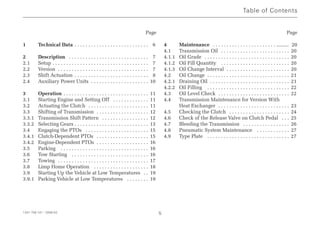
1 Technical Data . . . . . . . . . . . . . . . . . . . . . . . . . . . 6
2 Description . . . . . . . . . . . . . . . . . . . . . . . . . . . . . 7
2.1 Setup . . . . . . . . . . . . . . . . . . . . . . . . . . . . . . . . . . . 7
2.2 Version . . . . . . . . . . . . . . . . . . . . . . . . . . . . . . . . . 7
2.3 Shift Actuation . . . . . . . . . . . . . . . . . . . . . . . . . . . 8
2.4 Auxiliary Power Units . . . . . . . . . . . . . . . . . . . . . 10
3 Operation . . . . . . . . . . . . . . . . . . . . . . . . . . . . . . . 11
3.1 Starting Engine and Setting Off . . . . . . . . . . . . . 11
3.2 Actuating the Clutch . . . . . . . . . . . . . . . . . . . . . . 11
3.3 Shifting of Transmission . . . . . . . . . . . . . . . . . . . 12
3.3.1 Transmission Shift Pattern . . . . . . . . . . . . . . . . . 12
3.3.2 Selecting Gears . . . . . . . . . . . . . . . . . . . . . . . . . . . 13
3.4 Engaging the PTOs . . . . . . . . . . . . . . . . . . . . . . . 15
3.4.1 Clutch-Dependent PTOs . . . . . . . . . . . . . . . . . . . 15
3.4.2 Engine-Dependent PTOs . . . . . . . . . . . . . . . . . . . 16
3.5 Parking . . . . . . . . . . . . . . . . . . . . . . . . . . . . . . . . 16
3.6 Tow Starting . . . . . . . . . . . . . . . . . . . . . . . . . . . . 16
3.7 Towing . . . . . . . . . . . . . . . . . . . . . . . . . . . . . . . . . 17
3.8 Limp Home Operation . . . . . . . . . . . . . . . . . . . . 18
3.9 Starting Up the Vehicle at Low Temperatures . . 19
3.9.1 Parking Vehicle at Low Temperatures . . . . . . . . 19
Page
4 Maintenance . . . . . . . . . . . . . . . . . . . . . . . ......... 20
4.1 Transmission Oil . . . . . . . . . . . . . . . . . . . . . . . . . 20
4.1.1 Oil Grade . . . . . . . . . . . . . . . . . . . . . . . . . . . . . . . 20
4.1.2 Oil Fill Quantity . . . . . . . . . . . . . . . . . . . . . . . . . 20
4.1.3 Oil Change Interval . . . . . . . . . . . . . . . . . . . . . . . 20
4.2 Oil Change . . . . . . . . . . . . . . . . . . . . . . . . . . . . . . 21
4.2.1 Draining Oil . . . . . . . . . . . . . . . . . . . . . . . . . . . . . 21
4.2.2 Oil Filling . . . . . . . . . . . . . . . . . . . . . . . . . . . . . . 22
4.3 Oil Level Check . . . . . . . . . . . . . . . . . . . . . . . . . . 22
4.4 Transmission Maintenance for Version With
Heat Exchanger . . . . . . . . . . . . . . . . . . . . . . . . . . 23
4.5 Checking the Clutch . . . . . . . . . . . . . . . . . . . . . . 24
4.6 Check of the Release Valve on Clutch Pedal . . . 25
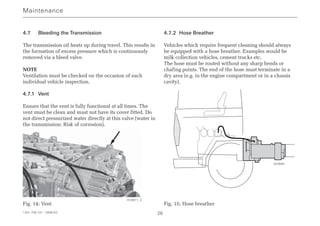
4.7 Bleeding the Transmission . . . . . . . . . . . . . . . . . 26
4.8 Pneumatic System Maintenance . . . . . . . . . . . . 27
4.9 Type Plate . . . . . . . . . . . . . . . . . . . . . . . . . . . . . . 27
Table of Contents
1341 758 101 - 2006-02 5
Technical Data
1341 758 101 - 2006-02 6
1) Approximate value (depends on type of vehicle and vehicle data as well as the prevailing operating conditions).
2) Observe the ZF guidelines for installing mechanical transmissions (1203 765 110) for this point.
3) The turning shaft control connection can be adapted to most installation circumstances encountered in vehicles.
4) For air pressure required, refer to the ZF guidelines for installing mechanical transmissions (1203 765 110)
5) Transmission inclination of between 0 and 3°
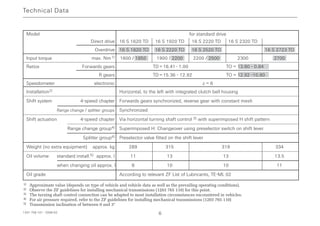
1 Technical Data
Model for standard drive
Direct drive 16 S 1620 TD 16 S 1920 TD 16 S 2220 TD 16 S 2320 TD
Overdrive 16 S 1820 TO 16 S 2220 TO 16 S 2520 TO 16 S 2723 TO
Input torque max. Nm1) 1600 / 1850 1900 / 2200 2200 / 2500 2300 2700
Ratios Forwards gears TD = 16.41 - 1.00 TO = 13.80 - 0.84
R gears TD = 15.36 - 12.92 TO = 12.92 -10.80
Speedometer electronic z = 6
Installation2) Horizontal, to the left with integrated clutch bell housing
Shift system 4-speed chapter Forwards gears synchronized, reverse gear with constant mesh
Range change / splitter groups Synchronized
Shift actuation 4-speed chapter Via horizontal turning shaft control 3) with superimposed H shift pattern
Range change group4) Superimposed H: Changeover using preselector switch on shift lever
Splitter group4) Preselector valve fitted on the shift lever
Weight (no extra equipment) approx. kg 289 315 319 334
Oil volume standard install.5) approx. l 11 13 13 13.5
when changing oil approx. l 8 10 10 11
Oil grade According to relevant ZF List of Lubricants, TE-ML 02
2 Description
2.1 Setup
The ZF-NewEcosplit transmission consists of a 4-speed
section, a range change group, and a splitter group.
2.2 Version
4-speed chapter:
• Synchronized, reverse gear with constant mesh
• Mechanical actuation (turning shaft control)
• Superimposed H shift mechanism
• Servoshift
Range change group, rear-mounted:
• Synchronized
• Changeover with preselector switch on shift lever with
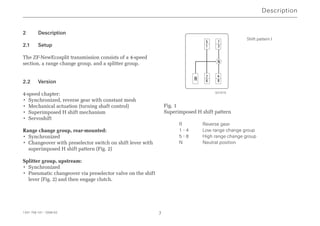
superimposed H shift pattern (Fig. 2)
Splitter group, upstream:
• Synchronized
• Pneumatic changeover via preselector valve on the shift
lever (Fig. 2) and then engage clutch.
Fig. 1
Superimposed H shift pattern
R Reverse gear
1 - 4 Low range change group
5 - 8 High range change group
N Neutral position
Description
1341 758 101 - 2006-02 7
5
1
7
3
2
6
4
8
R
N
027415
Shift pattern I
Fig. 2
Shift lever * superimposed H
2.3 Shift Actuation
Range-Change Group Superimposed H Shift
Mechanism
The shift mechanism is divided into 3 adjacent gates.
In gates 3/4 and 7/8, there is a spring-loaded return to
Neutral function.
The pneumatic changeover of the range change group
from gate 3/4 to gate 5/6 and vice versa is performed by a
preselector switch on the shift lever (Fig. 2).
Fig. 3
The ZF superimposed H-shift shift mechanism
Description
1341 758 101 - 2006-02 8
* Please note any details provided by the vehicle manufacturer.
R
2
4
1
3
N
N
6
8
5
7
range change group
high
low
splitter group
high
low
027416_en
5
1
7
3
2
6
4
8
R
N
027415
Description
1341 758 101 - 2006-02 9
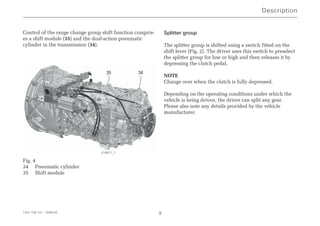
Control of the range change group shift function compris-
es a shift module (35) and the dual-action pneumatic
cylinder in the transmission (34).
Fig. 4
34 Pneumatic cylinder
35 Shift module
Splitter group
The splitter group is shifted using a switch fitted on the
shift lever (Fig. 2). The driver uses this switch to preselect
the splitter group for low or high and then releases it by
depressing the clutch pedal.
NOTE
Change over when the clutch is fully depressed.
Depending on the operating conditions under which the
vehicle is being driven, the driver can split any gear.
Please also note any details provided by the vehicle
manufacturer.
35 34
018971_1
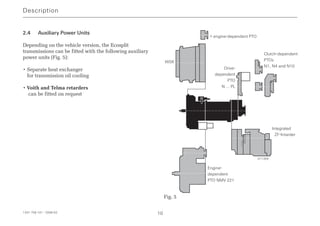
2.4 Auxiliary Power Units
Depending on the vehicle version, the Ecosplit
transmissions can be fitted with the following auxiliary
power units (Fig. 5):
• Separate heat exchanger
for transmission oil cooling
• Voith and Telma retarders
can be fitted on request
Fig. 5
Description
1341 758 101 - 2006-02 10
WSK
+ engine-dependent PTO
Engine-
dependent
PTO NMV 221
Integrated
ZF-Intarder
Drive-
dependent
PTO
N ... PL
Clutch-dependent
PTOs
N1, N4 and N10
011359
3 Operation
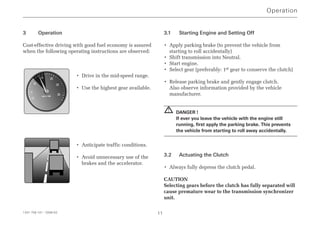
Cost-effective driving with good fuel economy is assured
when the following operating instructions are observed:
• Drive in the mid-speed range.
• Use the highest gear available.
• Anticipate traffic conditions.
• Avoid unnecessary use of the
brakes and the accelerator.
3.1 Starting Engine and Setting Off
• Apply parking brake (to prevent the vehicle from
starting to roll accidentally)
• Shift transmission into Neutral.
• Start engine.
• Select gear (preferably: 1st gear to conserve the clutch)
• Release parking brake and gently engage clutch.
Also observe information provided by the vehicle
manufacturer.
DANGER !
If ever you leave the vehicle with the engine still
running, first apply the parking brake. This prevents
the vehicle from starting to roll away accidentally.
3.2 Actuating the Clutch
• Always fully depress the clutch pedal.
CAUTION
Selecting gears before the clutch has fully separated will
cause premature wear to the transmission synchronizer
unit.
!
Operation
1341 758 101 - 2006-02 11
rpm x 100
5
10
15 20
25
30
0
3.3 Shifting of Transmission
The ZF-Ecosplit transmissions are synchronized
transmissions (synchromesh transmissions). A synchro-
mesh mechanism is one which enables all gears to rotate
in the same direction at synchronous speeds. This system
makes the shift process quicker and more reliable:
• No double-declutching during upshifts,
• No intermediate throttle application and no declutching
when shifting down, even when driving downhill and
in difficult situations.
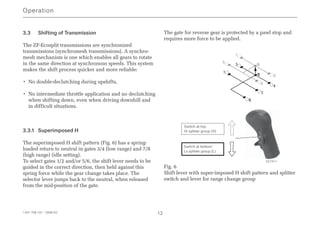
3.3.1 Superimposed H
The superimposed H shift pattern (Fig. 6) has a spring-
loaded return to neutral in gates 3/4 (low range) and 7/8
(high range) (idle setting).
To select gates 1/2 and/or 5/6, the shift lever needs to be
guided in the correct direction, then held against this
spring force while the gear change takes place. The
selector lever jumps back to the neutral, when released
from the mid-position of the gate.
The gate for reverse gear is protected by a pawl stop and
requires more force to be applied.
Fig. 6
Shift lever with super-imposed H shift pattern and splitter
switch and lever for range change group
Operation
1341 758 101 - 2006-02 12
R
2
4
1
3
N
N
6
8
5
7
Switch at top:
Hi splitter group (H)
Switch at bottom:
Lo splitter group (L)
027411
3.3.2 Selecting Gears
CAUTION
• In order to prevent damage from occurring at the
transmission’s synchronization, the clutch should
always be fully depressed.
• During upshifts and downshifts, two gear steps may be
shifted at maximum in one go (e.g. from 4L to 6L).
Shifts encompassing more than two gear steps will lead
to wear at the transmission’s synchronization.
• To prevent transmission and engine damage, only select
the next lowest gear if the maximum speed of the
intended gear is reached through deceleration.
• When operating the PTO, gear changes must never be
undertaken (even changes between splitter groups)
because this will result in transmission synchronizer
unit wear. If a gear change may be required in order to
adapt the vehicle’s speed, then, the PTO must be
disengaged in advance.
Superimposed H
Changing the range change group is effected via a switch
at the shift lever. This means that the driver, if she/he
wishes to shift from 4th gear into the 5th gear in the basic
transmission.
• Must preselect high ratio (high range group) on the
selector switch
• Depress the clutch pedal
• Shift into neutral – at which point the range change
group starts to change over
• Select gate 1/2
• Shift the basic transmission into 1st gear - the range
change group will by now have shifted into high ratio.
• Engage the clutch
• Leave preselector switch in selected range group
NOTE
Only actuate preselector switch if the range change group
is to be engaged immediately afterwards.
Fig. 7
Operation
1341 758 101 - 2006-02 13
R
2
4
1
3
N
N
6
8
5
7
splitter group
high
low 027412_en
CAUTION
Continuously selecting gears with a high level of manual
force will result in increased wear to the synchronizer
components.
CAUTION
In order to prevent damage from occurring at the trans-
mission’s synchronization, change-over to the low range
change group may only be effected as of speeds below
approx. 28 km/h. During travel, the other range group
may only be preselected just before carrying out the next
shift sequence. If the other range group is selected too
early, then, because of the swiftly changing traffic
conditions, unintended gear shifts may occur during the
next gear change and wear will consequently be caused at
the transmission’s synchronization.
Reverse gear
CAUTION
Only select reverse gear when the vehicle is stationary.
• Reverse gear may only be engaged and disengaged
when the clutch is open!
• The clutch should be disengaged when the engine is at
idling speed.
• Only engage reverse gear once the countershaft has
come to a complete stop. If the countershaft is not
stationary, grating will be heard when engaging the
reverse gear.
NOTE
Depending on operating conditions, retardation times will
differ and can be shortened by brief initial synchromesh
engagement, preferably of 1st gear.
• Engage and disengage reverse gear. No grating is
permitted when engaging the reverse gear.
If necessary, extend the waiting time leading to engage-
ment or investigate the separating characteristics of the
clutch (also refer to chapter 4.5).
• Slowly engage clutch.
Operation
1341 758 101 - 2006-02 14
3.4 Engaging the PTOs
3.4.1 Clutch-Dependent PTOs
Operation with vehicle in stationary position and in
motion.
Engagement / Disengagement
• PTO may only be engaged and disengaged when the
clutch is open!
• The clutch should be disengaged when the engine is at
idling speed.
• Only engage PTO once the countershaft has come to a
complete stop. If the countershaft is not stationary,
grating will be heard when engaging the PTO.
NOTE
Depending on operating conditions, retardation times will
differ and can be shortened by brief initial synchromesh
engagement, preferably of 1st gear.
• Engage and disengage PTO. No grating is permitted
when engaging the PTO.
If necessary, extend the waiting time leading to
engagement or investigate the separating characteristics
of the clutch (also refer to chapter 4.5).
• Slowly engage the clutch and increase the speed to
operating speed.
CAUTION
• Gear changes are not permissible when operating the
PTO.
• If the vehicle is parked for an extended period (e.g.
over night), the PTO should always be disengaged.
Gear Interlock (Option)
The gear interlock function becomes necessary if
• the vehicle must not be moved at all while the PTO
engaged,
• PTO engagement must be prevented while vehicle is in
motion.
Operation
1341 758 101 - 2006-02 15
3.4.2 Engine-Dependent PTOs
Activation is not dependent on the vehicle clutch.
• Only engage or disengage when the engine is running:
min. engine speed 600 rpm
max. engine speed 2000 rpm
• The engine-dependent PTO can be operated when the
vehicle is stationary and in motion.
NOTE
The following engine speeds must not be exceeded when
engaging the engine-dependent PTO:
2000 rpm at engine-dependent PTO ratio of 0.98
1300 rpm at engine-dependent PTO ratio of 1.55
depending on the inertia and drag torque to be shifted.
NOTE
Refer to Operating Manual 1315 758 150.
3.5 Parking
• Shift transmission into low range change group
(gears 1 - 4).
• Close parking brake.
Select gear as additional parking protection:
• Vehicle facing uphill: Forward gear!
• Vehicle facing downhill: Reverse gear!
• Heavily laden vehicles should also be secured by
placing chocks under the wheels.
3.6 Tow Starting
Start engine by tow starting in the high range change
group.
CAUTION
• To avoid damaging the transmission, the vehicle may
only be tow started in the high range change group
(gears 5 - 8).
• The vehicle must also not be tow started with reverse
gear selected.
Operation
1341 758 101 - 2006-02 16
3.7 Towing
Vehicles may only be towed under the following
conditions:
• Emergency steering pump fitted
• High range selected, shift lever in neutral position
• Towing distance of max. 100 km
• The max. permissible towing speed should be defined
depending on axle ratio and tire size using the diagram
provided (also refer to Fig. 8).
NOTE
Vehicle manufacturer specifications MUST be observed.
CAUTION
If one of the aforementioned conditions is not satisfied,
the propshaft must always be deflanged from the rear
axle or the stub shafts must be removed in order to
prevent transmission damage from occurring.
If you suspect transmission damage, the propshaft must
also be deflanged from the rear axle or the stub shafts
must be removed.
Fig. 8
Example (reading): iAxle = 6, Rdyn = 0.5 m
Towing speed from diagram:
Vmax = 25 km/h
NOTE
Relevant local legislation relating to max. towing speeds
must be observed.
Operation
1341 758 101 - 2006-02 17
2.0
3.0
4.0
5.0
6.0
7.0
8.0
10 15 20 25 30 35 40 45 50
[i Axle]
V [km/h]
Rdyn 0.5 [m] (z.B. 275/80R22.5)
Rdyn 0.6 [m] (z.B. F24)
Rdyn 0.4 [m] (z.B. 245/70R19.5)
027279_en
3.8 Limp Home Operation
Faults occurring when changing the range change group
(e.g. from gate 3/4 into 5/6 or vice versa) may be due to
one of the following:
• Line damage in the pneumatic system.
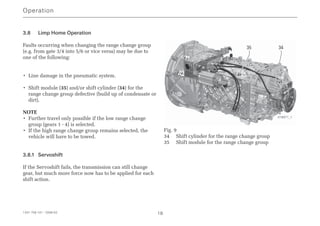
• Shift module (35) and/or shift cylinder (34) for the
range change group defective (build up of condensate or
dirt).
NOTE
• Further travel only possible if the low range change
group (gears 1 - 4) is selected.
• If the high range change group remains selected, the
vehicle will have to be towed.
3.8.1 Servoshift
If the Servoshift fails, the transmission can still change
gear, but much more force now has to be applied for each
shift action.
Fig. 9
34 Shift cylinder for the range change group
35 Shift module for the range change group
Operation
1341 758 101 - 2006-02 18
35 34
018971_1
3.9 Starting Up Vehicle at Low Temperatures
The transmission is filled with oil according to ZF List of
Lubricants TE-ML 02. At outside temperatures of less than
–15 °C, the suitability of the oil should be checked
according to List of Lubricants TE-ML 02. If necessary,
change the oil type in the transmission.
Alternatively, it can be preheated before the engine is
started. This can be done e.g. with warm air which must
not exceed 130 °C on the transmission.
DANGER
When exiting the vehicle with the engine running,
apply the parking brake. This prevents the vehicle
from starting to roll away accidentally.
NOTE
• Refer to chapter 3.1 for starting the engine and setting
off.
• Vehicle manufacturer specifications MUST be observed.
3.9.1 Parking Vehicle at Low Temperatures
When parking the vehicle at outside temperatures of less
than 0 °C, ensure that the low range change group is
selected in the transmission (shift lever in position for
1st gear or in neutral position for gate 3/4).
!
Operation
1341 758 101 - 2006-02 19
4 Maintenance
Regular maintenance increases the transmission’s
operational reliability. It is therefore particularly
important for the maintenance intervals to be observed.
4.1 Transmission Oil
4.1.1 Oil Grade
NOTE
• When filling transmissions, only those oils specified in
the latest version of the ZF List of Lubricants TE-ML 02
are authorized.
• The List of Lubricants can be obtained from all ZF
Service Centers or can be downloaded from the Inter-
net at www.zf.com.
• We recommend that you use ZF-Ecofluid M.
4.1.2 Oil Fill Quantity
Correctly undertaking the oil fill process is crucial for
ensuring the precise oil volume (refer to chapter 4.2.2).
The fill quantity is shown on the type plate (fitted on the
side of the transmission) and in the Technical Data (page 6).
Oil level check (refer to chapter 4.3).
Fill volumes in dm3 for normal installation (0° - 3° inclination)
4.1.3 Oil Change Interval
Refer to ZF lists of lubricants for oil change intervals
TE-ML 02.
NOTE
To ensure that the transmission achieves the required
level of operational safety and reliability, the oil change
intervals must be observed as specified.
Maintenance
1341 758 101 - 2006-02 20
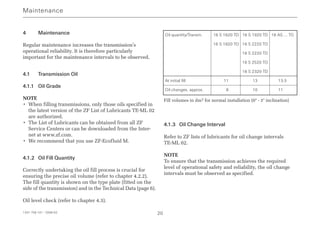
Oil quantity/Transm. 16 S 1620 TD 16 S 1920 TD 16 AS … TO
16 S 1820 TO 16 S 2220 TO
16 S 2220 TD
16 S 2520 TO
16 S 2320 TD
At initial fill 11 13 13.5
Oil changes. approx. 08 10 11.0
4.2 Oil Change
4.2.1 Draining Oil
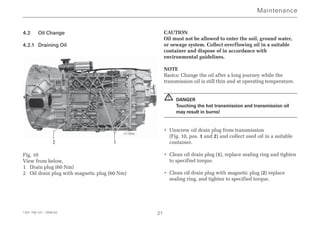
Fig. 10
View from below,
1 Drain plug (60 Nm)
2 Oil drain plug with magnetic plug (60 Nm)
CAUTION
Oil must not be allowed to enter the soil, ground water,
or sewage system. Collect overflowing oil in a suitable
container and dispose of in accordance with
environmental guidelines.
NOTE
Basics: Change the oil after a long journey while the
transmission oil is still thin and at operating temperature.
DANGER
Touching the hot transmission and transmission oil
may result in burns!
• Unscrew oil drain plug from transmission
(Fig. 10, pos. 1 and 2) and collect used oil in a suitable
container.
• Clean oil drain plug (1), replace sealing ring and tighten
to specified torque.
• Clean oil drain plug with magnetic plug (2) replace
sealing ring, and tighten to specified torque.
!
Maintenance
1341 758 101 - 2006-02 21
2 1
017850
4.2.2 Oil Filling
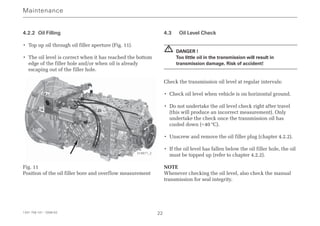
• Top up oil through oil filler aperture (Fig. 11).
• The oil level is correct when it has reached the bottom
edge of the filler hole and/or when oil is already
escaping out of the filler hole.
Fig. 11
Position of the oil filler bore and overflow measurement
4.3 Oil Level Check
DANGER !
Too little oil in the transmission will result in
transmission damage. Risk of accident!
Check the transmission oil level at regular intervals:
• Check oil level when vehicle is on horizontal ground.
• Do not undertake the oil level check right after travel
(this will produce an incorrect measurement). Only
undertake the check once the transmission oil has
cooled down (<40 °C).
• Unscrew and remove the oil filler plug (chapter 4.2.2).
• If the oil level has fallen below the oil filler hole, the oil
must be topped up (refer to chapter 4.2.2).
NOTE
Whenever checking the oil level, also check the manual
transmission for seal integrity.
!
Maintenance
1341 758 101 - 2006-02 22
018971_2
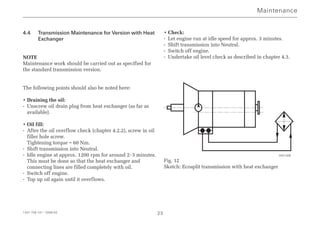
4.4 Transmission Maintenance for Version with Heat
Exchanger
NOTE
Maintenance work should be carried out as specified for
the standard transmission version.
The following points should also be noted here:
• Draining the oil:
- Unscrew oil drain plug from heat exchanger (as far as
available).
• Oil fill:
- After the oil overflow check (chapter 4.2.2), screw in oil
filler hole screw.
Tightening torque = 60 Nm.
- Shift transmission into Neutral.
- Idle engine at approx. 1200 rpm for around 2-3 minutes.
This must be done so that the heat exchanger and
connecting lines are filled completely with oil.
- Switch off engine.
- Top up oil again until it overflows.
• Check:
- Let engine run at idle speed for approx. 3 minutes.
- Shift transmission into Neutral.
- Switch off engine.
- Undertake oil level check as described in chapter 4.3.
Fig. 12
Sketch: Ecosplit transmission with heat exchanger
Maintenance
1341 758 101 - 2006-02 23
000 508
4.5 Checking the Clutch
In order to guarantee the service life and functional
efficiency of synchronizer units, it is essential that the
clutch separates perfectly. This also applies when
engaging fitted clutch-dependent PTOs.
You can check that the clutch is separating perfectly as
follows:
• Engine idling at operating temperature, depress clutch;
• After max. 20 sec.* slowly engage R gear.
Should you hear the selector teeth “grating” (scraping
noise of shift teeth), the clutch must be adjusted and/or
checked.
* Depending on the flywheel disk mass and temperature
Maintenance
1341 758 101 - 2006-02 24
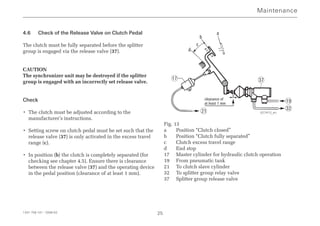
4.6 Check of the Release Valve on Clutch Pedal
The clutch must be fully separated before the splitter
group is engaged via the release valve (37).
CAUTION
The synchronizer unit may be destroyed if the splitter
group is engaged with an incorrectly set release valve.
Check
• The clutch must be adjusted according to the
manufacturer’s instructions.
• Setting screw on clutch pedal must be set such that the
release valve (37) is only activated in the excess travel
range (c).
• In position (b) the clutch is completely separated (for
checking see chapter 4.5). Ensure there is clearance
between the release valve (37) and the operating device
in the pedal position (clearance of at least 1 mm).
Fig. 13
a Position “Clutch closed”
b Position “Clutch fully separated”
c Clutch excess travel range
d End stop
17 Master cylinder for hydraulic clutch operation
19 From pneumatic tank
21 To clutch slave cylinder
32 To splitter group relay valve
37 Splitter group release valve
Maintenance
1341 758 101 - 2006-02 25
37
19
21
17
32
d
c
b
a
clearance of
at least 1 mm
027413_en
1341 758 101 - 2006-02 26
4.7 Bleeding the Transmission
The transmission oil heats up during travel. This results in
the formation of excess pressure which is continuously
removed via a bleed valve.
NOTE
Ventilation must be checked on the occasion of each
individual vehicle inspection.
4.7.1 Vent
Ensure that the vent is fully functional at all times. The
vent must be clean and must not have its cover fitted. Do
not direct pressurized water directly at this valve (water in
the transmission: Risk of corrosion).
Fig. 14; Vent
4.7.2 Hose Breather
Vehicles which require frequent cleaning should always
be equipped with a hose breather. Examples would be
milk collection vehicles, cement trucks etc.
The hose must be routed without any sharp bends or
chafing points. The end of the hose must terminate in a
dry area (e.g. in the engine compartment or in a chassis
cavity).
Fig. 15; Hose breather
Maintenance
023684
018971_3
1341 758 101 - 2006-02 27
4.8 Pneumatic System Maintenance
Condensation builds up in all pneumatic systems. Regular
pneumatic system maintenance is essential to ensure that
condensation, rust, and other impurities do not pass from
the compressed air reservoirs into valves and gear change
cylinders.
The compressed air reservoirs must be drained once a
week (or daily in winter).
NOTE
When draining the compressed air reservoirs, the
compressed air cleaner and water separator should also be
drained if this doesn’t happen automatically.
Note the vehicle manufacturer’s details for this process.
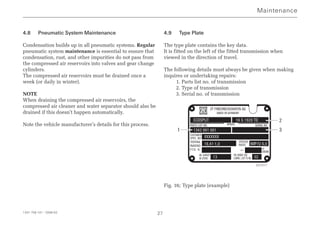
4.9 Type Plate
The type plate contains the key data.
It is fitted on the left of the fitted transmission when
viewed in the direction of travel.
The following details must always be given when making
inquires or undertaking repairs:
1. Parts list no. of transmission
2. Type of transmission
3. Serial no. of transmission
Fig. 16; Type plate (example)
Maintenance
ZF FRIEDRICHSHAFEN AG
MADE IN GERMANY
MODEL
PARTS LIST NO. SERIAL NO.
SPEEDO
RATIO
OIL CAPACIT
IN LITERS
OIL GRADE SEE
LUBRIC. LIST TE-ML
CUSTOMER
SPEC. NO
TOTAL
RATIO
P.T.O. N n =
xn
ENGINE
ECOSPLIT
1342 001 001
16,41-1,0
13 02
IMP/U 6,0
XXXXXXX
011356
16 S 1920 TD 2
3
1
027417

ZF Ecosplit 1341_758_101 Operating Instructions.pdf

  • 1.
    1341 758 101 ZFSynchromesh Transmission 16 S 1620 TD, 16 S 1820 TO 16 S 1920 TD, 16 S 2220 TO 16 S 2220 TD, 16 S 2520 TO 16 S 2320 TD, 16 S 2723 TO Betriebsanleitung Operating Instructions Manuel d’Utilisation Manual de Servicio Istruzioni per l’Uso
  • 2.
    Subject to alterationsin design Copyright by ZF This documentation is protected by copyright. Any reproduction or dissemination in whatever form which does not comply fully with the intended purpose of this documentation is prohibited without the consent of ZF Friedrichshafen AG. Printed in Germany ZF Friedrichshafen AG, MC-C / 2006 Edition: 2006-02
  • 3.
    Preface Your vehicle isfitted with a mechanical synchromesh transmission from the ZF-ECOSPLIT range. The more familiar you are with your ZF transmission, the more cost-effectively you will be able to drive with it. These operating instructions tell you how to make the best use of the technological advantages of the ZF transmission. Therefore please carefully read these operating instruc- tions, and any special instructions given by the vehicle manufacturer, before driving the vehicle for the first time. In order to ensure reliability in service, please note the specifications governing maintenance. The ZF Customer Service specialists are available to assist you in carrying out maintenance work or to help if any other problems arise. Motoring pleasure with ZF transmissions is brought to you by ZF Friedrichshafen AG Nutzfahrzeug- und Sonder-Antriebstechnik Commercial Vehicle and Special Driveline Technology D-88038 Friedrichshafen Phone +49 (0) 7541 77-0 Fax +49 (0) 7541 77-90 80 00 Internet: www.zf.com 1341 758 101 - 2006-02 3
  • 4.
    The following safetyinstructions appear in this manual: NOTE Refers to special processes, techniques, information, etc. CAUTION This is used when incorrect, unprofessional working practices could damage the product. DANGER! This is used when lack of care could lead to personal injury or material damage. THREATS TO THE ENVIRONMENT! Lubricants, consumables, and cleaning agents must not be allowed to enter the soil, ground water, or sewage system. • Ask your local environment agency for safety information on the relevant products and adhere to their requirements. • Collect used oil in a suitably large container. • Dispose of used oil, dirty filters, lubricants, and cleaning agents in accordance with environmental protection guidelines. • When working with lubricants and cleaning agents always refer to the manufacturer’s instructions. ! ! Safety Instructions 4
  • 5.
    Page 1 Technical Data. . . . . . . . . . . . . . . . . . . . . . . . . . . 6 2 Description . . . . . . . . . . . . . . . . . . . . . . . . . . . . . 7 2.1 Setup . . . . . . . . . . . . . . . . . . . . . . . . . . . . . . . . . . . 7 2.2 Version . . . . . . . . . . . . . . . . . . . . . . . . . . . . . . . . . 7 2.3 Shift Actuation . . . . . . . . . . . . . . . . . . . . . . . . . . . 8 2.4 Auxiliary Power Units . . . . . . . . . . . . . . . . . . . . . 10 3 Operation . . . . . . . . . . . . . . . . . . . . . . . . . . . . . . . 11 3.1 Starting Engine and Setting Off . . . . . . . . . . . . . 11 3.2 Actuating the Clutch . . . . . . . . . . . . . . . . . . . . . . 11 3.3 Shifting of Transmission . . . . . . . . . . . . . . . . . . . 12 3.3.1 Transmission Shift Pattern . . . . . . . . . . . . . . . . . 12 3.3.2 Selecting Gears . . . . . . . . . . . . . . . . . . . . . . . . . . . 13 3.4 Engaging the PTOs . . . . . . . . . . . . . . . . . . . . . . . 15 3.4.1 Clutch-Dependent PTOs . . . . . . . . . . . . . . . . . . . 15 3.4.2 Engine-Dependent PTOs . . . . . . . . . . . . . . . . . . . 16 3.5 Parking . . . . . . . . . . . . . . . . . . . . . . . . . . . . . . . . 16 3.6 Tow Starting . . . . . . . . . . . . . . . . . . . . . . . . . . . . 16 3.7 Towing . . . . . . . . . . . . . . . . . . . . . . . . . . . . . . . . . 17 3.8 Limp Home Operation . . . . . . . . . . . . . . . . . . . . 18 3.9 Starting Up the Vehicle at Low Temperatures . . 19 3.9.1 Parking Vehicle at Low Temperatures . . . . . . . . 19 Page 4 Maintenance . . . . . . . . . . . . . . . . . . . . . . . ......... 20 4.1 Transmission Oil . . . . . . . . . . . . . . . . . . . . . . . . . 20 4.1.1 Oil Grade . . . . . . . . . . . . . . . . . . . . . . . . . . . . . . . 20 4.1.2 Oil Fill Quantity . . . . . . . . . . . . . . . . . . . . . . . . . 20 4.1.3 Oil Change Interval . . . . . . . . . . . . . . . . . . . . . . . 20 4.2 Oil Change . . . . . . . . . . . . . . . . . . . . . . . . . . . . . . 21 4.2.1 Draining Oil . . . . . . . . . . . . . . . . . . . . . . . . . . . . . 21 4.2.2 Oil Filling . . . . . . . . . . . . . . . . . . . . . . . . . . . . . . 22 4.3 Oil Level Check . . . . . . . . . . . . . . . . . . . . . . . . . . 22 4.4 Transmission Maintenance for Version With Heat Exchanger . . . . . . . . . . . . . . . . . . . . . . . . . . 23 4.5 Checking the Clutch . . . . . . . . . . . . . . . . . . . . . . 24 4.6 Check of the Release Valve on Clutch Pedal . . . 25 4.7 Bleeding the Transmission . . . . . . . . . . . . . . . . . 26 4.8 Pneumatic System Maintenance . . . . . . . . . . . . 27 4.9 Type Plate . . . . . . . . . . . . . . . . . . . . . . . . . . . . . . 27 Table of Contents 1341 758 101 - 2006-02 5
  • 6.
    Technical Data 1341 758101 - 2006-02 6 1) Approximate value (depends on type of vehicle and vehicle data as well as the prevailing operating conditions). 2) Observe the ZF guidelines for installing mechanical transmissions (1203 765 110) for this point. 3) The turning shaft control connection can be adapted to most installation circumstances encountered in vehicles. 4) For air pressure required, refer to the ZF guidelines for installing mechanical transmissions (1203 765 110) 5) Transmission inclination of between 0 and 3° 1 Technical Data Model for standard drive Direct drive 16 S 1620 TD 16 S 1920 TD 16 S 2220 TD 16 S 2320 TD Overdrive 16 S 1820 TO 16 S 2220 TO 16 S 2520 TO 16 S 2723 TO Input torque max. Nm1) 1600 / 1850 1900 / 2200 2200 / 2500 2300 2700 Ratios Forwards gears TD = 16.41 - 1.00 TO = 13.80 - 0.84 R gears TD = 15.36 - 12.92 TO = 12.92 -10.80 Speedometer electronic z = 6 Installation2) Horizontal, to the left with integrated clutch bell housing Shift system 4-speed chapter Forwards gears synchronized, reverse gear with constant mesh Range change / splitter groups Synchronized Shift actuation 4-speed chapter Via horizontal turning shaft control 3) with superimposed H shift pattern Range change group4) Superimposed H: Changeover using preselector switch on shift lever Splitter group4) Preselector valve fitted on the shift lever Weight (no extra equipment) approx. kg 289 315 319 334 Oil volume standard install.5) approx. l 11 13 13 13.5 when changing oil approx. l 8 10 10 11 Oil grade According to relevant ZF List of Lubricants, TE-ML 02
  • 7.
    2 Description 2.1 Setup TheZF-NewEcosplit transmission consists of a 4-speed section, a range change group, and a splitter group. 2.2 Version 4-speed chapter: • Synchronized, reverse gear with constant mesh • Mechanical actuation (turning shaft control) • Superimposed H shift mechanism • Servoshift Range change group, rear-mounted: • Synchronized • Changeover with preselector switch on shift lever with superimposed H shift pattern (Fig. 2) Splitter group, upstream: • Synchronized • Pneumatic changeover via preselector valve on the shift lever (Fig. 2) and then engage clutch. Fig. 1 Superimposed H shift pattern R Reverse gear 1 - 4 Low range change group 5 - 8 High range change group N Neutral position Description 1341 758 101 - 2006-02 7 5 1 7 3 2 6 4 8 R N 027415 Shift pattern I
  • 8.
    Fig. 2 Shift lever* superimposed H 2.3 Shift Actuation Range-Change Group Superimposed H Shift Mechanism The shift mechanism is divided into 3 adjacent gates. In gates 3/4 and 7/8, there is a spring-loaded return to Neutral function. The pneumatic changeover of the range change group from gate 3/4 to gate 5/6 and vice versa is performed by a preselector switch on the shift lever (Fig. 2). Fig. 3 The ZF superimposed H-shift shift mechanism Description 1341 758 101 - 2006-02 8 * Please note any details provided by the vehicle manufacturer. R 2 4 1 3 N N 6 8 5 7 range change group high low splitter group high low 027416_en 5 1 7 3 2 6 4 8 R N 027415
  • 9.
    Description 1341 758 101- 2006-02 9 Control of the range change group shift function compris- es a shift module (35) and the dual-action pneumatic cylinder in the transmission (34). Fig. 4 34 Pneumatic cylinder 35 Shift module Splitter group The splitter group is shifted using a switch fitted on the shift lever (Fig. 2). The driver uses this switch to preselect the splitter group for low or high and then releases it by depressing the clutch pedal. NOTE Change over when the clutch is fully depressed. Depending on the operating conditions under which the vehicle is being driven, the driver can split any gear. Please also note any details provided by the vehicle manufacturer. 35 34 018971_1
  • 10.
    2.4 Auxiliary PowerUnits Depending on the vehicle version, the Ecosplit transmissions can be fitted with the following auxiliary power units (Fig. 5): • Separate heat exchanger for transmission oil cooling • Voith and Telma retarders can be fitted on request Fig. 5 Description 1341 758 101 - 2006-02 10 WSK + engine-dependent PTO Engine- dependent PTO NMV 221 Integrated ZF-Intarder Drive- dependent PTO N ... PL Clutch-dependent PTOs N1, N4 and N10 011359
  • 11.
    3 Operation Cost-effective drivingwith good fuel economy is assured when the following operating instructions are observed: • Drive in the mid-speed range. • Use the highest gear available. • Anticipate traffic conditions. • Avoid unnecessary use of the brakes and the accelerator. 3.1 Starting Engine and Setting Off • Apply parking brake (to prevent the vehicle from starting to roll accidentally) • Shift transmission into Neutral. • Start engine. • Select gear (preferably: 1st gear to conserve the clutch) • Release parking brake and gently engage clutch. Also observe information provided by the vehicle manufacturer. DANGER ! If ever you leave the vehicle with the engine still running, first apply the parking brake. This prevents the vehicle from starting to roll away accidentally. 3.2 Actuating the Clutch • Always fully depress the clutch pedal. CAUTION Selecting gears before the clutch has fully separated will cause premature wear to the transmission synchronizer unit. ! Operation 1341 758 101 - 2006-02 11 rpm x 100 5 10 15 20 25 30 0
  • 12.
    3.3 Shifting ofTransmission The ZF-Ecosplit transmissions are synchronized transmissions (synchromesh transmissions). A synchro- mesh mechanism is one which enables all gears to rotate in the same direction at synchronous speeds. This system makes the shift process quicker and more reliable: • No double-declutching during upshifts, • No intermediate throttle application and no declutching when shifting down, even when driving downhill and in difficult situations. 3.3.1 Superimposed H The superimposed H shift pattern (Fig. 6) has a spring- loaded return to neutral in gates 3/4 (low range) and 7/8 (high range) (idle setting). To select gates 1/2 and/or 5/6, the shift lever needs to be guided in the correct direction, then held against this spring force while the gear change takes place. The selector lever jumps back to the neutral, when released from the mid-position of the gate. The gate for reverse gear is protected by a pawl stop and requires more force to be applied. Fig. 6 Shift lever with super-imposed H shift pattern and splitter switch and lever for range change group Operation 1341 758 101 - 2006-02 12 R 2 4 1 3 N N 6 8 5 7 Switch at top: Hi splitter group (H) Switch at bottom: Lo splitter group (L) 027411
  • 13.
    3.3.2 Selecting Gears CAUTION •In order to prevent damage from occurring at the transmission’s synchronization, the clutch should always be fully depressed. • During upshifts and downshifts, two gear steps may be shifted at maximum in one go (e.g. from 4L to 6L). Shifts encompassing more than two gear steps will lead to wear at the transmission’s synchronization. • To prevent transmission and engine damage, only select the next lowest gear if the maximum speed of the intended gear is reached through deceleration. • When operating the PTO, gear changes must never be undertaken (even changes between splitter groups) because this will result in transmission synchronizer unit wear. If a gear change may be required in order to adapt the vehicle’s speed, then, the PTO must be disengaged in advance. Superimposed H Changing the range change group is effected via a switch at the shift lever. This means that the driver, if she/he wishes to shift from 4th gear into the 5th gear in the basic transmission. • Must preselect high ratio (high range group) on the selector switch • Depress the clutch pedal • Shift into neutral – at which point the range change group starts to change over • Select gate 1/2 • Shift the basic transmission into 1st gear - the range change group will by now have shifted into high ratio. • Engage the clutch • Leave preselector switch in selected range group NOTE Only actuate preselector switch if the range change group is to be engaged immediately afterwards. Fig. 7 Operation 1341 758 101 - 2006-02 13 R 2 4 1 3 N N 6 8 5 7 splitter group high low 027412_en
  • 14.
    CAUTION Continuously selecting gearswith a high level of manual force will result in increased wear to the synchronizer components. CAUTION In order to prevent damage from occurring at the trans- mission’s synchronization, change-over to the low range change group may only be effected as of speeds below approx. 28 km/h. During travel, the other range group may only be preselected just before carrying out the next shift sequence. If the other range group is selected too early, then, because of the swiftly changing traffic conditions, unintended gear shifts may occur during the next gear change and wear will consequently be caused at the transmission’s synchronization. Reverse gear CAUTION Only select reverse gear when the vehicle is stationary. • Reverse gear may only be engaged and disengaged when the clutch is open! • The clutch should be disengaged when the engine is at idling speed. • Only engage reverse gear once the countershaft has come to a complete stop. If the countershaft is not stationary, grating will be heard when engaging the reverse gear. NOTE Depending on operating conditions, retardation times will differ and can be shortened by brief initial synchromesh engagement, preferably of 1st gear. • Engage and disengage reverse gear. No grating is permitted when engaging the reverse gear. If necessary, extend the waiting time leading to engage- ment or investigate the separating characteristics of the clutch (also refer to chapter 4.5). • Slowly engage clutch. Operation 1341 758 101 - 2006-02 14
  • 15.
    3.4 Engaging thePTOs 3.4.1 Clutch-Dependent PTOs Operation with vehicle in stationary position and in motion. Engagement / Disengagement • PTO may only be engaged and disengaged when the clutch is open! • The clutch should be disengaged when the engine is at idling speed. • Only engage PTO once the countershaft has come to a complete stop. If the countershaft is not stationary, grating will be heard when engaging the PTO. NOTE Depending on operating conditions, retardation times will differ and can be shortened by brief initial synchromesh engagement, preferably of 1st gear. • Engage and disengage PTO. No grating is permitted when engaging the PTO. If necessary, extend the waiting time leading to engagement or investigate the separating characteristics of the clutch (also refer to chapter 4.5). • Slowly engage the clutch and increase the speed to operating speed. CAUTION • Gear changes are not permissible when operating the PTO. • If the vehicle is parked for an extended period (e.g. over night), the PTO should always be disengaged. Gear Interlock (Option) The gear interlock function becomes necessary if • the vehicle must not be moved at all while the PTO engaged, • PTO engagement must be prevented while vehicle is in motion. Operation 1341 758 101 - 2006-02 15
  • 16.
    3.4.2 Engine-Dependent PTOs Activationis not dependent on the vehicle clutch. • Only engage or disengage when the engine is running: min. engine speed 600 rpm max. engine speed 2000 rpm • The engine-dependent PTO can be operated when the vehicle is stationary and in motion. NOTE The following engine speeds must not be exceeded when engaging the engine-dependent PTO: 2000 rpm at engine-dependent PTO ratio of 0.98 1300 rpm at engine-dependent PTO ratio of 1.55 depending on the inertia and drag torque to be shifted. NOTE Refer to Operating Manual 1315 758 150. 3.5 Parking • Shift transmission into low range change group (gears 1 - 4). • Close parking brake. Select gear as additional parking protection: • Vehicle facing uphill: Forward gear! • Vehicle facing downhill: Reverse gear! • Heavily laden vehicles should also be secured by placing chocks under the wheels. 3.6 Tow Starting Start engine by tow starting in the high range change group. CAUTION • To avoid damaging the transmission, the vehicle may only be tow started in the high range change group (gears 5 - 8). • The vehicle must also not be tow started with reverse gear selected. Operation 1341 758 101 - 2006-02 16
  • 17.
    3.7 Towing Vehicles mayonly be towed under the following conditions: • Emergency steering pump fitted • High range selected, shift lever in neutral position • Towing distance of max. 100 km • The max. permissible towing speed should be defined depending on axle ratio and tire size using the diagram provided (also refer to Fig. 8). NOTE Vehicle manufacturer specifications MUST be observed. CAUTION If one of the aforementioned conditions is not satisfied, the propshaft must always be deflanged from the rear axle or the stub shafts must be removed in order to prevent transmission damage from occurring. If you suspect transmission damage, the propshaft must also be deflanged from the rear axle or the stub shafts must be removed. Fig. 8 Example (reading): iAxle = 6, Rdyn = 0.5 m Towing speed from diagram: Vmax = 25 km/h NOTE Relevant local legislation relating to max. towing speeds must be observed. Operation 1341 758 101 - 2006-02 17 2.0 3.0 4.0 5.0 6.0 7.0 8.0 10 15 20 25 30 35 40 45 50 [i Axle] V [km/h] Rdyn 0.5 [m] (z.B. 275/80R22.5) Rdyn 0.6 [m] (z.B. F24) Rdyn 0.4 [m] (z.B. 245/70R19.5) 027279_en
  • 18.
    3.8 Limp HomeOperation Faults occurring when changing the range change group (e.g. from gate 3/4 into 5/6 or vice versa) may be due to one of the following: • Line damage in the pneumatic system. • Shift module (35) and/or shift cylinder (34) for the range change group defective (build up of condensate or dirt). NOTE • Further travel only possible if the low range change group (gears 1 - 4) is selected. • If the high range change group remains selected, the vehicle will have to be towed. 3.8.1 Servoshift If the Servoshift fails, the transmission can still change gear, but much more force now has to be applied for each shift action. Fig. 9 34 Shift cylinder for the range change group 35 Shift module for the range change group Operation 1341 758 101 - 2006-02 18 35 34 018971_1
  • 19.
    3.9 Starting UpVehicle at Low Temperatures The transmission is filled with oil according to ZF List of Lubricants TE-ML 02. At outside temperatures of less than –15 °C, the suitability of the oil should be checked according to List of Lubricants TE-ML 02. If necessary, change the oil type in the transmission. Alternatively, it can be preheated before the engine is started. This can be done e.g. with warm air which must not exceed 130 °C on the transmission. DANGER When exiting the vehicle with the engine running, apply the parking brake. This prevents the vehicle from starting to roll away accidentally. NOTE • Refer to chapter 3.1 for starting the engine and setting off. • Vehicle manufacturer specifications MUST be observed. 3.9.1 Parking Vehicle at Low Temperatures When parking the vehicle at outside temperatures of less than 0 °C, ensure that the low range change group is selected in the transmission (shift lever in position for 1st gear or in neutral position for gate 3/4). ! Operation 1341 758 101 - 2006-02 19
  • 20.
    4 Maintenance Regular maintenanceincreases the transmission’s operational reliability. It is therefore particularly important for the maintenance intervals to be observed. 4.1 Transmission Oil 4.1.1 Oil Grade NOTE • When filling transmissions, only those oils specified in the latest version of the ZF List of Lubricants TE-ML 02 are authorized. • The List of Lubricants can be obtained from all ZF Service Centers or can be downloaded from the Inter- net at www.zf.com. • We recommend that you use ZF-Ecofluid M. 4.1.2 Oil Fill Quantity Correctly undertaking the oil fill process is crucial for ensuring the precise oil volume (refer to chapter 4.2.2). The fill quantity is shown on the type plate (fitted on the side of the transmission) and in the Technical Data (page 6). Oil level check (refer to chapter 4.3). Fill volumes in dm3 for normal installation (0° - 3° inclination) 4.1.3 Oil Change Interval Refer to ZF lists of lubricants for oil change intervals TE-ML 02. NOTE To ensure that the transmission achieves the required level of operational safety and reliability, the oil change intervals must be observed as specified. Maintenance 1341 758 101 - 2006-02 20 Oil quantity/Transm. 16 S 1620 TD 16 S 1920 TD 16 AS … TO 16 S 1820 TO 16 S 2220 TO 16 S 2220 TD 16 S 2520 TO 16 S 2320 TD At initial fill 11 13 13.5 Oil changes. approx. 08 10 11.0
  • 21.
    4.2 Oil Change 4.2.1Draining Oil Fig. 10 View from below, 1 Drain plug (60 Nm) 2 Oil drain plug with magnetic plug (60 Nm) CAUTION Oil must not be allowed to enter the soil, ground water, or sewage system. Collect overflowing oil in a suitable container and dispose of in accordance with environmental guidelines. NOTE Basics: Change the oil after a long journey while the transmission oil is still thin and at operating temperature. DANGER Touching the hot transmission and transmission oil may result in burns! • Unscrew oil drain plug from transmission (Fig. 10, pos. 1 and 2) and collect used oil in a suitable container. • Clean oil drain plug (1), replace sealing ring and tighten to specified torque. • Clean oil drain plug with magnetic plug (2) replace sealing ring, and tighten to specified torque. ! Maintenance 1341 758 101 - 2006-02 21 2 1 017850
  • 22.
    4.2.2 Oil Filling •Top up oil through oil filler aperture (Fig. 11). • The oil level is correct when it has reached the bottom edge of the filler hole and/or when oil is already escaping out of the filler hole. Fig. 11 Position of the oil filler bore and overflow measurement 4.3 Oil Level Check DANGER ! Too little oil in the transmission will result in transmission damage. Risk of accident! Check the transmission oil level at regular intervals: • Check oil level when vehicle is on horizontal ground. • Do not undertake the oil level check right after travel (this will produce an incorrect measurement). Only undertake the check once the transmission oil has cooled down (<40 °C). • Unscrew and remove the oil filler plug (chapter 4.2.2). • If the oil level has fallen below the oil filler hole, the oil must be topped up (refer to chapter 4.2.2). NOTE Whenever checking the oil level, also check the manual transmission for seal integrity. ! Maintenance 1341 758 101 - 2006-02 22 018971_2
  • 23.
    4.4 Transmission Maintenancefor Version with Heat Exchanger NOTE Maintenance work should be carried out as specified for the standard transmission version. The following points should also be noted here: • Draining the oil: - Unscrew oil drain plug from heat exchanger (as far as available). • Oil fill: - After the oil overflow check (chapter 4.2.2), screw in oil filler hole screw. Tightening torque = 60 Nm. - Shift transmission into Neutral. - Idle engine at approx. 1200 rpm for around 2-3 minutes. This must be done so that the heat exchanger and connecting lines are filled completely with oil. - Switch off engine. - Top up oil again until it overflows. • Check: - Let engine run at idle speed for approx. 3 minutes. - Shift transmission into Neutral. - Switch off engine. - Undertake oil level check as described in chapter 4.3. Fig. 12 Sketch: Ecosplit transmission with heat exchanger Maintenance 1341 758 101 - 2006-02 23 000 508
  • 24.
    4.5 Checking theClutch In order to guarantee the service life and functional efficiency of synchronizer units, it is essential that the clutch separates perfectly. This also applies when engaging fitted clutch-dependent PTOs. You can check that the clutch is separating perfectly as follows: • Engine idling at operating temperature, depress clutch; • After max. 20 sec.* slowly engage R gear. Should you hear the selector teeth “grating” (scraping noise of shift teeth), the clutch must be adjusted and/or checked. * Depending on the flywheel disk mass and temperature Maintenance 1341 758 101 - 2006-02 24
  • 25.
    4.6 Check ofthe Release Valve on Clutch Pedal The clutch must be fully separated before the splitter group is engaged via the release valve (37). CAUTION The synchronizer unit may be destroyed if the splitter group is engaged with an incorrectly set release valve. Check • The clutch must be adjusted according to the manufacturer’s instructions. • Setting screw on clutch pedal must be set such that the release valve (37) is only activated in the excess travel range (c). • In position (b) the clutch is completely separated (for checking see chapter 4.5). Ensure there is clearance between the release valve (37) and the operating device in the pedal position (clearance of at least 1 mm). Fig. 13 a Position “Clutch closed” b Position “Clutch fully separated” c Clutch excess travel range d End stop 17 Master cylinder for hydraulic clutch operation 19 From pneumatic tank 21 To clutch slave cylinder 32 To splitter group relay valve 37 Splitter group release valve Maintenance 1341 758 101 - 2006-02 25 37 19 21 17 32 d c b a clearance of at least 1 mm 027413_en
  • 26.
    1341 758 101- 2006-02 26 4.7 Bleeding the Transmission The transmission oil heats up during travel. This results in the formation of excess pressure which is continuously removed via a bleed valve. NOTE Ventilation must be checked on the occasion of each individual vehicle inspection. 4.7.1 Vent Ensure that the vent is fully functional at all times. The vent must be clean and must not have its cover fitted. Do not direct pressurized water directly at this valve (water in the transmission: Risk of corrosion). Fig. 14; Vent 4.7.2 Hose Breather Vehicles which require frequent cleaning should always be equipped with a hose breather. Examples would be milk collection vehicles, cement trucks etc. The hose must be routed without any sharp bends or chafing points. The end of the hose must terminate in a dry area (e.g. in the engine compartment or in a chassis cavity). Fig. 15; Hose breather Maintenance 023684 018971_3
  • 27.
    1341 758 101- 2006-02 27 4.8 Pneumatic System Maintenance Condensation builds up in all pneumatic systems. Regular pneumatic system maintenance is essential to ensure that condensation, rust, and other impurities do not pass from the compressed air reservoirs into valves and gear change cylinders. The compressed air reservoirs must be drained once a week (or daily in winter). NOTE When draining the compressed air reservoirs, the compressed air cleaner and water separator should also be drained if this doesn’t happen automatically. Note the vehicle manufacturer’s details for this process. 4.9 Type Plate The type plate contains the key data. It is fitted on the left of the fitted transmission when viewed in the direction of travel. The following details must always be given when making inquires or undertaking repairs: 1. Parts list no. of transmission 2. Type of transmission 3. Serial no. of transmission Fig. 16; Type plate (example) Maintenance ZF FRIEDRICHSHAFEN AG MADE IN GERMANY MODEL PARTS LIST NO. SERIAL NO. SPEEDO RATIO OIL CAPACIT IN LITERS OIL GRADE SEE LUBRIC. LIST TE-ML CUSTOMER SPEC. NO TOTAL RATIO P.T.O. N n = xn ENGINE ECOSPLIT 1342 001 001 16,41-1,0 13 02 IMP/U 6,0 XXXXXXX 011356 16 S 1920 TD 2 3 1 027417