Creatures of the Sea Mrs. Trager's 8th Grade Internet Class
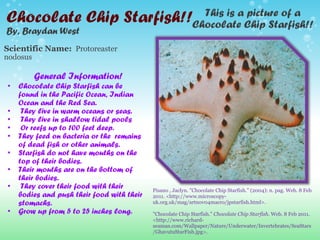
Chocolate Chip Starfish!! By, Braydan West Scientific Name:   Protoreaster nodosus       General Information! Chocolate Chip Starfish can be found in the Pacific Ocean, Indian Ocean and the Red Sea.    They live in warm oceans or seas.   They live in shallow tidal pools   Or reefs up to 100 feet deep. They feed on bacteria or the  remains of dead fish or other animals. Starfish do not have mouths on the top of their bodies. Their mouths are on the bottom of their bodies.   They cover their food with their bodies and push their food with their stomachs.  Grow up from 5 to 25 inches long.   This is a picture of a Chocolate Chip Starfish!!   Pisano , Jaclyn. &quot;Chocolate Chip Starfish.&quot; (2004): n. pag. Web. 8 Feb 2011. <http://www.microscopy-uk.org.uk/mag/artnov04macro/jpstarfish.html>.   &quot;Chocolate Chip Starfish.&quot;  Chocolate Chip Starfish . Web. 8 Feb 2011. <http://www.richard-seaman.com/Wallpaper/Nature/Underwater/Invertebrates/SeaStars/GhavutuStarFish.jpg>.
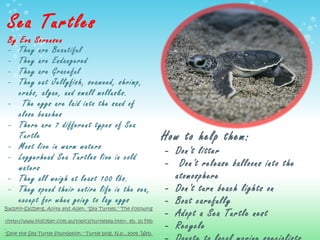
Sea Turtles By Eva Sorensen They are Beautiful They are Endangered They are Graceful They eat Jellyfish, seaweed, shrimp, crabs, algae, and small mollusks.     The eggs are laid into the sand of close beaches There are 7 different types of Sea Turtle Most live in warm waters  Loggerhead Sea Turtles live in cold waters They all weigh at least 100 lbs. They spend their entire life in the sea, except for when going to lay eggs Badskin-Salzberg, Anita and Allen. &quot;Sea Turtles.&quot; The following is a sample of the book: Turtles. N.p., n.d. WSeydenham S. R., Thomas. &quot;Sea Turtles.&quot; animals. N.p., 2008. Web. 10 Feb 2011.    <http://www.kidcyber.com.au/topics/turtlesea.htm>. eb. 10 Feb 2011. <http://www.herpdigest.org/turtles/seaturt.htm>.   &quot;Save the Sea Turtle foundation.&quot; Turtle blog. N.p., 2009. Web. 11 Feb 2011. <http://savetheseaturtle.org/?p=285>. How to help them: Don't litter   Don't release balloons into the atomosphere Don't turn beach lights on Boat carefully Adopt a Sea Turtle nest Recycle Donate to local marine specialists
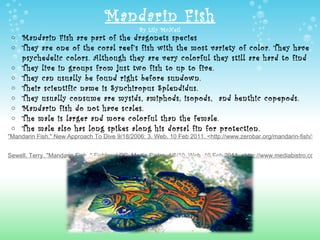
Mandarin Fish By Lily McNeil Mandarin Fish are part of the dragonets species They are one of the coral reef’s fish with the most variety of color. They have psychedelic colors. Although they are very colorful they still are hard to find They live in groups from just two fish to up to five.  They can usually be found right before sundown. Their scientific name is Synchiropus Splendidus.  They usually consume are mysids, amiphods, isopods,  and benthic copepods.  Mandarin fish do not have scales.  The male is larger and more colorful than the female.  The male also has long spikes along his dorsal fin for protection. &quot;Mandarin Fish.&quot; New Approach To Dive 9/18/2006: 3. Web. 10 Feb 2011. <http://www.zerobar.org/mandarin-fish/>.     Sewell, Terry. &quot;Mandarin Fish .&quot; Fishbowl DC. Media Bistro, 4/5/10. Web. 10 Feb 2011. <http://www.mediabistro.com/fishbowldc/>.
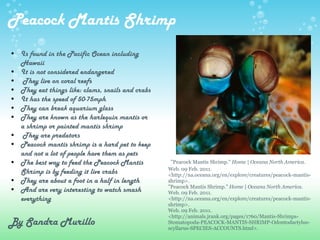
Peacock Mantis Shrimp Is found in the Pacific Ocean including Hawaii  It is not considered endangered   They live on coral reefs They eat things like: clams, snails and crabs It has the speed of 50-75mph They can break aquarium glass  They are known as the harlequin mantis or a shrimp or painted mantis shrimp     They are predators Peacock mantis shrimp is a hard pet to keep and not a lot of people have them as pets The best way to feed the Peacock Mantis Shrimp is by feeding it live crabs They are about a foot in a half in length  And are very interesting to watch smash everything    By Sandra Murillo    &quot;Peacock Mantis Shrimp.&quot;  Home | Oceana North America . Web. 09 Feb. 2011. <http://na.oceana.org/en/explore/creatures/peacock-mantis-shrimp>. &quot;Peacock Mantis Shrimp.&quot;  Home | Oceana North America . Web. 09 Feb. 2011. <http://na.oceana.org/en/explore/creatures/peacock-mantis-shrimp>. Web. 09 Feb. 2011. <http://animals.jrank.org/pages/1760/Mantis-Shrimps-Stomatopoda-PEACOCK-MANTIS-SHRIMP-Odontodactylus-scyllarus-SPECIES-ACCOUNTS.html>.
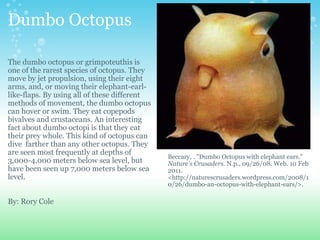
Dumbo Octopus The dumbo octopus or grimpoteuthis is one of the rarest species of octopus. They move by jet propulsion, using their eight arms, and, or moving their elephant-earl-like-flaps. By using all of these different methods of movement, the dumbo octopus can hover or swim. They eat copepods bivalves and crustaceans. An interesting  fact about dumbo octopi is that they eat their prey whole. This kind of octopus can dive  farther than any other octopus. They are seen most frequently at depths of 3,000-4,000 meters below sea level, but have been seen up 7,000 meters below sea level.    By: Rory Cole Beccary, . &quot;Dumbo Octopus with elephant ears.&quot;  Nature's Crusaders . N.p., 09/26/08. Web. 10 Feb 2011. <http://naturescrusaders.wordpress.com/2008/10/26/dumbo-an-octopus-with-elephant-ears/>.
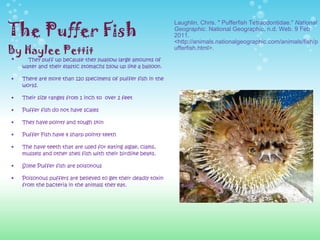
The Puffer Fish By Haylee Pettit      They puff up because they swallow large amounts of water and their elastic stomachs blow up like a balloon.   There are more than 120 specimens of puffer fish in the world.   Their size ranges from 1 inch to  over 2 feet   Puffer fish do not have scales   They have pointy and tough skin   Puffer Fish have 4 sharp pointy teeth   The have teeth that are used for eating algae, clams, mussels and other shell fish with their birdlike beaks.   Some Puffer fish are poisonous   Poisonous puffers are believed to get their deadly toxin from the bacteria in the animals they eat.    Laughlin, Chris. &quot; Pufferfish Tetraodontidae.&quot;  National Geographic . National Geographic, n.d. Web. 9 Feb 2011. <http://animals.nationalgeographic.com/animals/fish/pufferfish.html>.
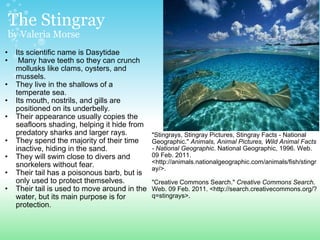
The Stingray by Valeria Morse Its scientific name is Dasytidae   Many have teeth so they can crunch mollusks like clams, oysters, and mussels.  They live in the shallows of a temperate sea.   Its mouth, nostrils, and gills are positioned on its underbelly.   Their appearance usually copies the seafloors shading, helping it hide from predatory sharks and larger rays.  They spend the majority of their time inactive, hiding in the sand.   They will swim close to divers and snorkelers without fear.   Their tail has a poisonous barb, but is only used to protect themselves.   Their tail is used to move around in the water, but its main purpose is for protection. &quot;Stingrays, Stingray Pictures, Stingray Facts - National Geographic.&quot;  Animals, Animal Pictures, Wild Animal Facts - National Geographic . National Geographic, 1996. Web. 09 Feb. 2011. <http://animals.nationalgeographic.com/animals/fish/stingray/>. &quot;Creative Commons Search.&quot;  Creative Commons Search . Web. 09 Feb. 2011. <http://search.creativecommons.org/?q=stingrays>.
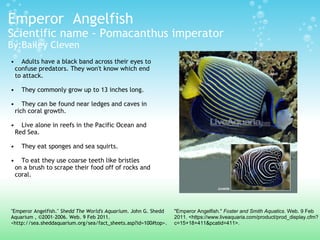
Emperor  Angelfish Scientific name - Pomacanthus imperator By:Bailey Cleven Adults have a black band across their eyes to       confuse predators. They won't know which end      to attack.   They commonly grow up to 13 inches long.    They can be found near ledges and caves in      rich coral growth.    Live alone in reefs in the Pacific Ocean and       Red Sea.  They eat sponges and sea squirts.   To eat they use coarse teeth like bristles      on a brush to scrape their food off of rocks and      coral. &quot;Emperor Angelfish.&quot;  Shedd The World's Aquarium . John G. Shedd Aquarium , ©2001-2006. Web. 9 Feb 2011. <http://sea.sheddaquarium.org/sea/fact_sheets.asp?id=100#top>.  &quot;Emperor Angelfish.&quot;  Foster and Smith Aquatics . Web. 9 Feb 2011. <https://www.liveaquaria.com/product/prod_display.cfm?c=15+18+411&pcatid=411>.
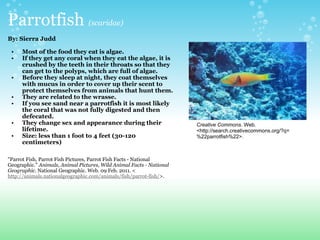
Parrotfish  (scaridae) By: Sierra Judd    Most of the food they eat is algae. If they get any coral when they eat the algae, it is crushed by the teeth in their throats so that they can get to the polyps, which are full of algae.  Before they sleep at night, they coat themselves with mucus in order to cover up their scent to protect themselves from animals that hunt them.  They are related to the wrasse. If you see sand near a parrotfish it is most likely the coral that was not fully digested and then defecated. They change sex and appearance during their lifetime.  Size: less than 1 foot to 4 feet (30-120 centimeters)     &quot;Parrot Fish, Parrot Fish Pictures, Parrot Fish Facts - National Geographic.&quot;  Animals, Animal Pictures, Wild Animal Facts - National Geographic . National Geographic. Web. 09 Feb. 2011. < http://animals.nationalgeographic.com/animals/fish/parrot-fish/ >.  Creative Commons . Web. <http://search.creativecommons.org/?q=%22parrotfish%22>.
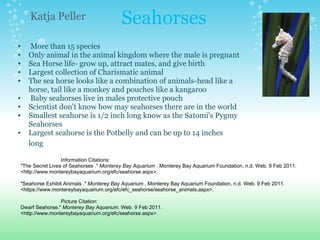
Seahorses    More than 15 species  Only animal in the animal kingdom where the male is pregnant Sea Horse life- grow up, attract mates, and give birth   Largest collection of Charismatic animal   The sea horse looks like a combination of animals-head like a horse, tail like a monkey and pouches like a kangaroo   Baby seahorses live in males protective pouch  Scientist don't know how may seahorses there are in the world  Smallest seahorse is 1/2 inch long know as the Satomi's Pygmy Seahorses   Largest seahorse is the Potbelly and can be up to 14 inches long    Katja Peller                               Information Citations:   &quot;The Secret Lives of Seahorses .&quot;  Monterey Bay Aquarium  . Monterey Bay Aquarium Foundation, n.d. Web. 9 Feb 2011. <http://www.montereybayaquarium.org/efc/seahorse.aspx>.    &quot;Seahorse Exhibit Animals .&quot;  Monterey Bay Aquarium  . Monterey Bay Aquarium Foundation, n.d. Web. 9 Feb 2011. <https://www.montereybayaquarium.org/efc/efc_seahorse/seahorse_animals.aspx>.                                Picture Citation: Dwarf Seahorse.&quot;  Monterey Bay Aquarium . Web. 9 Feb 2011. <http://www.montereybayaquarium.org/efc/seahorse.aspx>. 
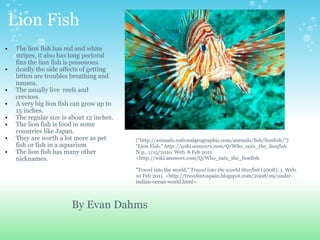
Lion Fish The lion fish has red and white  stripes, it also has long pectoral fins the lion fish is poisonous.   deadly the side affects of getting bitten are troubles breathing and nausea.  The usually live  reefs and  crevices.  A very big lion fish can grow up to 15 inches.  The regular size is about 12 inches. The lion fish is food in some countries like Japan. They are worth a lot more as pet fish or fish in a aquarium The lion fish has many other nicknames.       (&quot;http://animals.nationalgeographic.com/animals/fish/lionfish/&quot;) &quot;Lion Fish.&quot;  http://wiki.answers.com/Q/Who_eats_the_lionfish . N.p., 1/15/2010. Web. 8 Feb 2011. <http://wiki.answers.com/Q/Who_eats_the_lionfish   &quot;Travel into the world.&quot;  Travel into the world Starfish  (2008): 1. Web. 10 Feb 2011. <http://travelintospain.blogspot.com/2008/09/under-indian-ocean-world.html> By Evan Dahms
Freshwater Jellyfish By: Nora Jones Oval-shaped Diameter is 5-25mm   Glassy Whitish or green tinge Short tentacles help with feeding Long tentacles help with swimming  Total number of tentacles is 50 to 500 Have been seen throughout the United States These animals do not harm humans Small fish can be paralyzed by their stings  I nformation Citation: McKercher, Liz, Danny O'Connell, Pam Fuller, and Jim Liebig. United States.  Nonindigenous Aquatic Species-Craspedacusta sowerbyi . , Aug 19, 2009. Web. 9 Feb 2011. <http://nas.er.usgs.gov/queries/FactSheet.aspx?speciesID=1068>.  Picture Citation: &quot;Tiny Jellyfish thrive in Moscow River.&quot;  RT.com . Web. 9 Feb 2011. <http://rt.com/news/sci-tech/tiny-jellyfish-thrive-moscow/>.
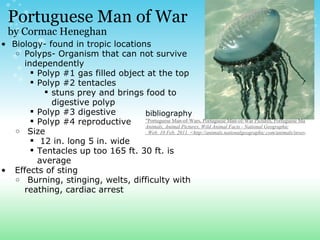
Portuguese Man of War  by Cormac Heneghan Biology- found in tropic locations Polyps- Organism that can not survive independently Polyp #1 gas filled object at the top Polyp #2 tentacles stuns prey and brings food to digestive polyp Polyp #3 digestive Polyp #4 reproductive    Size    12 in. long 5 in. wide Tentacles up too 165 ft. 30 ft. is average   Effects of sting   Burning, stinging, welts, difficulty with reathing, cardiac arrest bibliography &quot;Portuguese Man-of-Wars, Portuguese Man-of-War Pictures, Portuguese Man-of-War Facts - National Geographic.&quot;  Animals, Animal Pictures, Wild Animal Facts - National Geographic . Web. 10 Feb. 2011. <http://animals.nationalgeographic.com/animals/invertebrates/portuguese-man-of-war.html>.
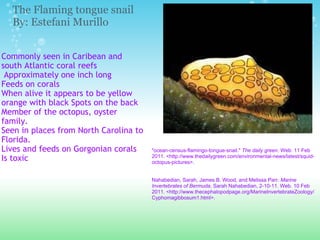
Commonly seen in Caribean and south Atlantic coral reefs   Approximately one inch long  Feeds on corals When alive it appears to be yellow orange with black Spots on the back  Member of the octopus, oyster family. Seen in places from North Carolina to Florida.  Lives and feeds on Gorgonian corals Is toxic    &quot;ocean-census-flamingo-tongue-snail.&quot;  The daily green . Web. 11 Feb 2011. <http://www.thedailygreen.com/environmental-news/latest/squid-octopus-pictures>.      Nahabedian, Sarah, James B. Wood, and Melissa Parr.  Marine Invertebrates of Bermuda . Sarah Nahabedian, 2-10-11. Web. 10 Feb 2011. <http://www.thecephalopodpage.org/MarineInvertebrateZoology/Cyphomagibbosum1.html>.    The Flaming tongue snail By: Estefani Murillo

My Sea Creature Progect

  • 1.
    Creatures of theSea Mrs. Trager's 8th Grade Internet Class
  • 2.
    Chocolate Chip Starfish!!By, Braydan West Scientific Name:  Protoreaster nodosus      General Information! Chocolate Chip Starfish can be found in the Pacific Ocean, Indian Ocean and the Red Sea.    They live in warm oceans or seas.   They live in shallow tidal pools   Or reefs up to 100 feet deep. They feed on bacteria or the  remains of dead fish or other animals. Starfish do not have mouths on the top of their bodies. Their mouths are on the bottom of their bodies.   They cover their food with their bodies and push their food with their stomachs.  Grow up from 5 to 25 inches long. This is a picture of a Chocolate Chip Starfish!!   Pisano , Jaclyn. &quot;Chocolate Chip Starfish.&quot; (2004): n. pag. Web. 8 Feb 2011. <http://www.microscopy-uk.org.uk/mag/artnov04macro/jpstarfish.html>.   &quot;Chocolate Chip Starfish.&quot; Chocolate Chip Starfish . Web. 8 Feb 2011. <http://www.richard-seaman.com/Wallpaper/Nature/Underwater/Invertebrates/SeaStars/GhavutuStarFish.jpg>.
  • 3.
    Sea Turtles ByEva Sorensen They are Beautiful They are Endangered They are Graceful They eat Jellyfish, seaweed, shrimp, crabs, algae, and small mollusks.    The eggs are laid into the sand of close beaches There are 7 different types of Sea Turtle Most live in warm waters  Loggerhead Sea Turtles live in cold waters They all weigh at least 100 lbs. They spend their entire life in the sea, except for when going to lay eggs Badskin-Salzberg, Anita and Allen. &quot;Sea Turtles.&quot; The following is a sample of the book: Turtles. N.p., n.d. WSeydenham S. R., Thomas. &quot;Sea Turtles.&quot; animals. N.p., 2008. Web. 10 Feb 2011.    <http://www.kidcyber.com.au/topics/turtlesea.htm>. eb. 10 Feb 2011. <http://www.herpdigest.org/turtles/seaturt.htm>.   &quot;Save the Sea Turtle foundation.&quot; Turtle blog. N.p., 2009. Web. 11 Feb 2011. <http://savetheseaturtle.org/?p=285>. How to help them: Don't litter   Don't release balloons into the atomosphere Don't turn beach lights on Boat carefully Adopt a Sea Turtle nest Recycle Donate to local marine specialists
  • 4.
    Mandarin Fish ByLily McNeil Mandarin Fish are part of the dragonets species They are one of the coral reef’s fish with the most variety of color. They have psychedelic colors. Although they are very colorful they still are hard to find They live in groups from just two fish to up to five. They can usually be found right before sundown. Their scientific name is Synchiropus Splendidus. They usually consume are mysids, amiphods, isopods,  and benthic copepods. Mandarin fish do not have scales. The male is larger and more colorful than the female. The male also has long spikes along his dorsal fin for protection. &quot;Mandarin Fish.&quot; New Approach To Dive 9/18/2006: 3. Web. 10 Feb 2011. <http://www.zerobar.org/mandarin-fish/>.     Sewell, Terry. &quot;Mandarin Fish .&quot; Fishbowl DC. Media Bistro, 4/5/10. Web. 10 Feb 2011. <http://www.mediabistro.com/fishbowldc/>.
  • 5.
    Peacock Mantis ShrimpIs found in the Pacific Ocean including Hawaii It is not considered endangered   They live on coral reefs They eat things like: clams, snails and crabs It has the speed of 50-75mph They can break aquarium glass They are known as the harlequin mantis or a shrimp or painted mantis shrimp     They are predators Peacock mantis shrimp is a hard pet to keep and not a lot of people have them as pets The best way to feed the Peacock Mantis Shrimp is by feeding it live crabs They are about a foot in a half in length And are very interesting to watch smash everything    By Sandra Murillo   &quot;Peacock Mantis Shrimp.&quot; Home | Oceana North America . Web. 09 Feb. 2011. <http://na.oceana.org/en/explore/creatures/peacock-mantis-shrimp>. &quot;Peacock Mantis Shrimp.&quot; Home | Oceana North America . Web. 09 Feb. 2011. <http://na.oceana.org/en/explore/creatures/peacock-mantis-shrimp>. Web. 09 Feb. 2011. <http://animals.jrank.org/pages/1760/Mantis-Shrimps-Stomatopoda-PEACOCK-MANTIS-SHRIMP-Odontodactylus-scyllarus-SPECIES-ACCOUNTS.html>.
  • 6.
    Dumbo Octopus Thedumbo octopus or grimpoteuthis is one of the rarest species of octopus. They move by jet propulsion, using their eight arms, and, or moving their elephant-earl-like-flaps. By using all of these different methods of movement, the dumbo octopus can hover or swim. They eat copepods bivalves and crustaceans. An interesting  fact about dumbo octopi is that they eat their prey whole. This kind of octopus can dive  farther than any other octopus. They are seen most frequently at depths of 3,000-4,000 meters below sea level, but have been seen up 7,000 meters below sea level.   By: Rory Cole Beccary, . &quot;Dumbo Octopus with elephant ears.&quot; Nature's Crusaders . N.p., 09/26/08. Web. 10 Feb 2011. <http://naturescrusaders.wordpress.com/2008/10/26/dumbo-an-octopus-with-elephant-ears/>.
  • 7.
    The Puffer FishBy Haylee Pettit    They puff up because they swallow large amounts of water and their elastic stomachs blow up like a balloon.   There are more than 120 specimens of puffer fish in the world.   Their size ranges from 1 inch to  over 2 feet   Puffer fish do not have scales   They have pointy and tough skin   Puffer Fish have 4 sharp pointy teeth   The have teeth that are used for eating algae, clams, mussels and other shell fish with their birdlike beaks.   Some Puffer fish are poisonous   Poisonous puffers are believed to get their deadly toxin from the bacteria in the animals they eat.    Laughlin, Chris. &quot; Pufferfish Tetraodontidae.&quot; National Geographic . National Geographic, n.d. Web. 9 Feb 2011. <http://animals.nationalgeographic.com/animals/fish/pufferfish.html>.
  • 8.
    The Stingray byValeria Morse Its scientific name is Dasytidae   Many have teeth so they can crunch mollusks like clams, oysters, and mussels.  They live in the shallows of a temperate sea.   Its mouth, nostrils, and gills are positioned on its underbelly.   Their appearance usually copies the seafloors shading, helping it hide from predatory sharks and larger rays.  They spend the majority of their time inactive, hiding in the sand.   They will swim close to divers and snorkelers without fear.   Their tail has a poisonous barb, but is only used to protect themselves.   Their tail is used to move around in the water, but its main purpose is for protection. &quot;Stingrays, Stingray Pictures, Stingray Facts - National Geographic.&quot; Animals, Animal Pictures, Wild Animal Facts - National Geographic . National Geographic, 1996. Web. 09 Feb. 2011. <http://animals.nationalgeographic.com/animals/fish/stingray/>. &quot;Creative Commons Search.&quot; Creative Commons Search . Web. 09 Feb. 2011. <http://search.creativecommons.org/?q=stingrays>.
  • 9.
    Emperor  Angelfish Scientificname - Pomacanthus imperator By:Bailey Cleven Adults have a black band across their eyes to      confuse predators. They won't know which end      to attack.   They commonly grow up to 13 inches long.    They can be found near ledges and caves in     rich coral growth.    Live alone in reefs in the Pacific Ocean and      Red Sea. They eat sponges and sea squirts.   To eat they use coarse teeth like bristles     on a brush to scrape their food off of rocks and     coral. &quot;Emperor Angelfish.&quot; Shedd The World's Aquarium . John G. Shedd Aquarium , ©2001-2006. Web. 9 Feb 2011. <http://sea.sheddaquarium.org/sea/fact_sheets.asp?id=100#top>.  &quot;Emperor Angelfish.&quot; Foster and Smith Aquatics . Web. 9 Feb 2011. <https://www.liveaquaria.com/product/prod_display.cfm?c=15+18+411&pcatid=411>.
  • 10.
    Parrotfish (scaridae)By: Sierra Judd    Most of the food they eat is algae. If they get any coral when they eat the algae, it is crushed by the teeth in their throats so that they can get to the polyps, which are full of algae. Before they sleep at night, they coat themselves with mucus in order to cover up their scent to protect themselves from animals that hunt them. They are related to the wrasse. If you see sand near a parrotfish it is most likely the coral that was not fully digested and then defecated. They change sex and appearance during their lifetime. Size: less than 1 foot to 4 feet (30-120 centimeters)     &quot;Parrot Fish, Parrot Fish Pictures, Parrot Fish Facts - National Geographic.&quot; Animals, Animal Pictures, Wild Animal Facts - National Geographic . National Geographic. Web. 09 Feb. 2011. < http://animals.nationalgeographic.com/animals/fish/parrot-fish/ >. Creative Commons . Web. <http://search.creativecommons.org/?q=%22parrotfish%22>.
  • 11.
    Seahorses  More than 15 species Only animal in the animal kingdom where the male is pregnant Sea Horse life- grow up, attract mates, and give birth   Largest collection of Charismatic animal  The sea horse looks like a combination of animals-head like a horse, tail like a monkey and pouches like a kangaroo   Baby seahorses live in males protective pouch  Scientist don't know how may seahorses there are in the world  Smallest seahorse is 1/2 inch long know as the Satomi's Pygmy Seahorses  Largest seahorse is the Potbelly and can be up to 14 inches long  Katja Peller                              Information Citations:  &quot;The Secret Lives of Seahorses .&quot; Monterey Bay Aquarium . Monterey Bay Aquarium Foundation, n.d. Web. 9 Feb 2011. <http://www.montereybayaquarium.org/efc/seahorse.aspx>.    &quot;Seahorse Exhibit Animals .&quot; Monterey Bay Aquarium . Monterey Bay Aquarium Foundation, n.d. Web. 9 Feb 2011. <https://www.montereybayaquarium.org/efc/efc_seahorse/seahorse_animals.aspx>.                              Picture Citation: Dwarf Seahorse.&quot; Monterey Bay Aquarium . Web. 9 Feb 2011. <http://www.montereybayaquarium.org/efc/seahorse.aspx>. 
  • 12.
    Lion Fish Thelion fish has red and white  stripes, it also has long pectoral fins the lion fish is poisonous.   deadly the side affects of getting bitten are troubles breathing and nausea.  The usually live  reefs and  crevices.  A very big lion fish can grow up to 15 inches.  The regular size is about 12 inches. The lion fish is food in some countries like Japan. They are worth a lot more as pet fish or fish in a aquarium The lion fish has many other nicknames.       (&quot;http://animals.nationalgeographic.com/animals/fish/lionfish/&quot;) &quot;Lion Fish.&quot; http://wiki.answers.com/Q/Who_eats_the_lionfish . N.p., 1/15/2010. Web. 8 Feb 2011. <http://wiki.answers.com/Q/Who_eats_the_lionfish   &quot;Travel into the world.&quot; Travel into the world Starfish (2008): 1. Web. 10 Feb 2011. <http://travelintospain.blogspot.com/2008/09/under-indian-ocean-world.html> By Evan Dahms
  • 13.
    Freshwater Jellyfish By:Nora Jones Oval-shaped Diameter is 5-25mm   Glassy Whitish or green tinge Short tentacles help with feeding Long tentacles help with swimming Total number of tentacles is 50 to 500 Have been seen throughout the United States These animals do not harm humans Small fish can be paralyzed by their stings I nformation Citation: McKercher, Liz, Danny O'Connell, Pam Fuller, and Jim Liebig. United States. Nonindigenous Aquatic Species-Craspedacusta sowerbyi . , Aug 19, 2009. Web. 9 Feb 2011. <http://nas.er.usgs.gov/queries/FactSheet.aspx?speciesID=1068>. Picture Citation: &quot;Tiny Jellyfish thrive in Moscow River.&quot; RT.com . Web. 9 Feb 2011. <http://rt.com/news/sci-tech/tiny-jellyfish-thrive-moscow/>.
  • 14.
    Portuguese Man ofWar by Cormac Heneghan Biology- found in tropic locations Polyps- Organism that can not survive independently Polyp #1 gas filled object at the top Polyp #2 tentacles stuns prey and brings food to digestive polyp Polyp #3 digestive Polyp #4 reproductive   Size   12 in. long 5 in. wide Tentacles up too 165 ft. 30 ft. is average   Effects of sting   Burning, stinging, welts, difficulty with reathing, cardiac arrest bibliography &quot;Portuguese Man-of-Wars, Portuguese Man-of-War Pictures, Portuguese Man-of-War Facts - National Geographic.&quot; Animals, Animal Pictures, Wild Animal Facts - National Geographic . Web. 10 Feb. 2011. <http://animals.nationalgeographic.com/animals/invertebrates/portuguese-man-of-war.html>.
  • 15.
    Commonly seen inCaribean and south Atlantic coral reefs  Approximately one inch long Feeds on corals When alive it appears to be yellow orange with black Spots on the back  Member of the octopus, oyster family. Seen in places from North Carolina to Florida. Lives and feeds on Gorgonian corals Is toxic    &quot;ocean-census-flamingo-tongue-snail.&quot; The daily green . Web. 11 Feb 2011. <http://www.thedailygreen.com/environmental-news/latest/squid-octopus-pictures>.      Nahabedian, Sarah, James B. Wood, and Melissa Parr. Marine Invertebrates of Bermuda . Sarah Nahabedian, 2-10-11. Web. 10 Feb 2011. <http://www.thecephalopodpage.org/MarineInvertebrateZoology/Cyphomagibbosum1.html>.   The Flaming tongue snail By: Estefani Murillo