wwww.etailingindiaexpo.com
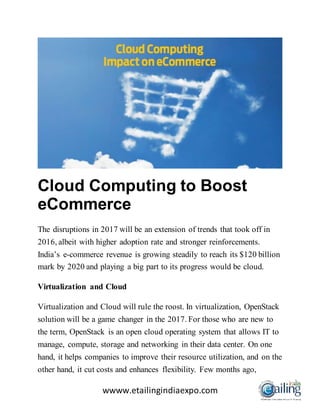
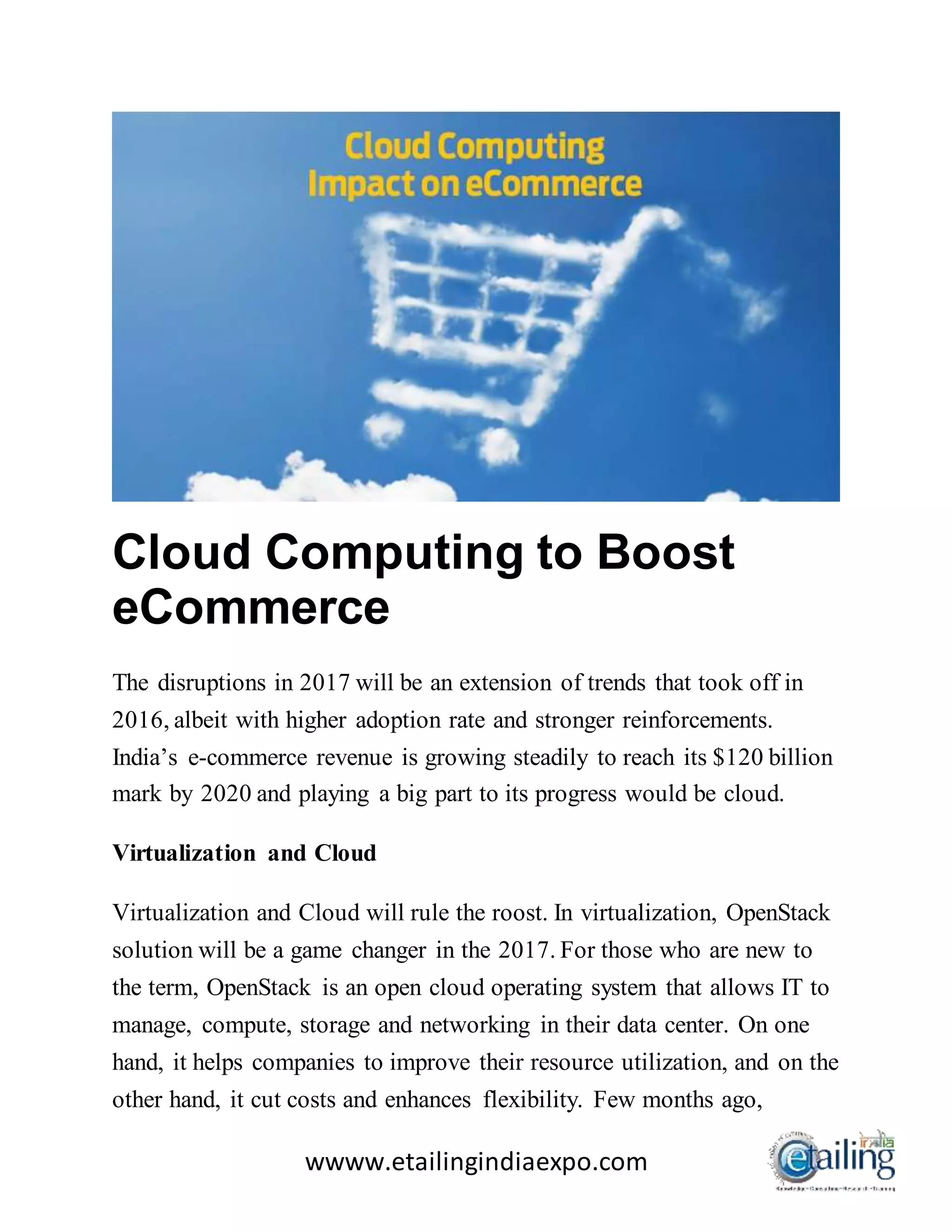
Cloud Computing to Boost
eCommerce
The disruptions in 2017 will be an extension of trends that took off in
2016, albeit with higher adoption rate and stronger reinforcements.
India’s e-commerce revenue is growing steadily to reach its $120 billion
mark by 2020 and playing a big part to its progress would be cloud.
Virtualization and Cloud
Virtualization and Cloud will rule the roost. In virtualization, OpenStack
solution will be a game changer in the 2017. For those who are new to
the term, OpenStack is an open cloud operating system that allows IT to
manage, compute, storage and networking in their data center. On one
hand, it helps companies to improve their resource utilization, and on the
other hand, it cut costs and enhances flexibility. Few months ago,
wwww.etailingindiaexpo.com
Snapdeal launched its own private cloud platform called Snapdeal
Cirrus. “Snapdeal Cirrus is one of the few successful examples globally
of a large hybrid cloud built at a scale of public cloud, purely using open
source technologies like OpenStack and Ceph,” said Rajiv Mangla,
Chief Technology Officer, Snapdeal.
Good Times Ahead for Cloud Firms
The rising demands of graphic-rich applications, thanks to mobility,
implicates datacenters will be tweaked to host and run them with virtual
machines. As a result, most of the Indian IT services company will be
working on intelligent data center in 2016.
As far as cloud is concerned, Gartner made an interesting India-specific
projection some years ago, “In India, cloud services revenue is projected
to have a five-year projected compound annual growth rate (CAGR) of
33.2 percent from 2012 through 2017 across all segments of the cloud
computing market”. Cut to 2016: we can already see how companies are
looking for cloud solutions that can help them to manage their IT
resources easily and effectively, and maximize Returns on Investment.
Cloud Computing and Implications on eCommerce
Cloud provides positive opportunities for e-commerce, but before
adopting it, companies should have a trade-off between costs. E-
commerce and cloud computing can be explained as follow by several
researchers:
 Security of data and transactions
wwww.etailingindiaexpo.com
 Investments tailored to the needs of e-commerce
 Support and technical expertise with better TAT
 Robust and scalable IT infrastructure Enhanced mobility
 High percentage of CAPEX saved and OPEX considerably
reduced
 Good service can help retain long term valued customer
relationships
 Regain focus on its strategic business initiatives
 Tackle majority of issues an online business can face and fool-
proof DR
 Competitive advantage over competitors who have not adopted
cloud technology
 The Google SERP gives a long list of results for ‘Cloud-based
ecommerce solutions’ or ‘SaaS’, confusing and making difficult to
understand the selection of the relevant
 With SaaS, the costs incurred in IT are predictable and lessened as
compared to traditional on-premise IT. This makes electronic retail
brands to adapt the omni channel approach i.e. either they use the
cloud service entirely or complement their existing IT
infrastructure with cloud.
Conclusion
Cloud computing services can support and provide opportunity to Small
and medium Enterprises in general and E-commerce Small and medium
enterprises in specific. However, IT resources and infrastructure need to
be further ramped up. There are several issues and challenges that
wwww.etailingindiaexpo.com
should be taken into consideration while applying cloud. The adoption
decision of cloud computing by Ecommerce SME’s will make
significant changes in the business enterprises.

Cloud Computing to Boost eCommerce

  • 1.
    wwww.etailingindiaexpo.com Cloud Computing toBoost eCommerce The disruptions in 2017 will be an extension of trends that took off in 2016, albeit with higher adoption rate and stronger reinforcements. India’s e-commerce revenue is growing steadily to reach its $120 billion mark by 2020 and playing a big part to its progress would be cloud. Virtualization and Cloud Virtualization and Cloud will rule the roost. In virtualization, OpenStack solution will be a game changer in the 2017. For those who are new to the term, OpenStack is an open cloud operating system that allows IT to manage, compute, storage and networking in their data center. On one hand, it helps companies to improve their resource utilization, and on the other hand, it cut costs and enhances flexibility. Few months ago,
  • 2.
    wwww.etailingindiaexpo.com Snapdeal launched itsown private cloud platform called Snapdeal Cirrus. “Snapdeal Cirrus is one of the few successful examples globally of a large hybrid cloud built at a scale of public cloud, purely using open source technologies like OpenStack and Ceph,” said Rajiv Mangla, Chief Technology Officer, Snapdeal. Good Times Ahead for Cloud Firms The rising demands of graphic-rich applications, thanks to mobility, implicates datacenters will be tweaked to host and run them with virtual machines. As a result, most of the Indian IT services company will be working on intelligent data center in 2016. As far as cloud is concerned, Gartner made an interesting India-specific projection some years ago, “In India, cloud services revenue is projected to have a five-year projected compound annual growth rate (CAGR) of 33.2 percent from 2012 through 2017 across all segments of the cloud computing market”. Cut to 2016: we can already see how companies are looking for cloud solutions that can help them to manage their IT resources easily and effectively, and maximize Returns on Investment. Cloud Computing and Implications on eCommerce Cloud provides positive opportunities for e-commerce, but before adopting it, companies should have a trade-off between costs. E- commerce and cloud computing can be explained as follow by several researchers:  Security of data and transactions
  • 3.
    wwww.etailingindiaexpo.com  Investments tailoredto the needs of e-commerce  Support and technical expertise with better TAT  Robust and scalable IT infrastructure Enhanced mobility  High percentage of CAPEX saved and OPEX considerably reduced  Good service can help retain long term valued customer relationships  Regain focus on its strategic business initiatives  Tackle majority of issues an online business can face and fool- proof DR  Competitive advantage over competitors who have not adopted cloud technology  The Google SERP gives a long list of results for ‘Cloud-based ecommerce solutions’ or ‘SaaS’, confusing and making difficult to understand the selection of the relevant  With SaaS, the costs incurred in IT are predictable and lessened as compared to traditional on-premise IT. This makes electronic retail brands to adapt the omni channel approach i.e. either they use the cloud service entirely or complement their existing IT infrastructure with cloud. Conclusion Cloud computing services can support and provide opportunity to Small and medium Enterprises in general and E-commerce Small and medium enterprises in specific. However, IT resources and infrastructure need to be further ramped up. There are several issues and challenges that
  • 4.
    wwww.etailingindiaexpo.com should be takeninto consideration while applying cloud. The adoption decision of cloud computing by Ecommerce SME’s will make significant changes in the business enterprises.