CLOUD DISCOVERY
     AN INTRODUCTION TO CLOUD COMPUTING


Chapter 6: Planning for the Cloud


       By: Alain Charpentier
Table of content
• Technical consideration
  – What application to move to the Cloud, Security
    considerations, Compliance
    considerations, Performance
    considerations, Migration considerations
• External Business consideration
  – What about sunk cost?, Vendor lock-in
• Internal Business consideration
  – Shifting IT responsibilities, Objections
The driver of the Cloud revolution
• Virtualization – The ability to increase computing
  efficiency
• Democratization of Computing – Bringing enterprise
  scale infrastructure to small and medium businesses
• Scalability and fast provisioning – Bringing web scale
  IT at a rapid pace
• Commoditization of infrastructure – Enabling IT to
  focus on the strategic aspects of its role
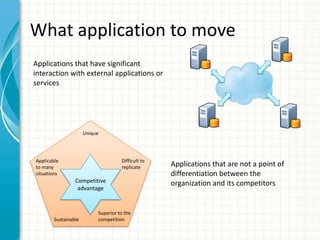
What application to move
Applications that have significant
interaction with external applications or
services


                      Unique


Applicable                           Difficult to
to many                              replicate      Applications that are not a point of
situations                                          differentiation between the
                 Competitive                        organization and its competitors
                  advantage


                           Superior to the
        Sustainable        competition
Security & Compliance
• Organizations should be aware that security is a
  partnership between the vendor and the user. They
  should therefore clearly ascertain which aspects of
  security are the responsibility of the vendor and
  which are the responsibility of the user.
• Depending on the type of industry your organization
  is involved in, there are a number of different
  compliance requirements which may need to be
  met. Examples of these include PCI, HIPAA, GAAP,
  SOX, and IFRS.
Performance & Migration
• Performance
   – It is importantly to accurately assess the performance requirements.
     For example an application with high database transfer rates, very
     high CPU or RAM requirements may be either difficult, or cost
     prohibitive, to move to the Cloud.
• Migration
   – The bandwidth cost of moving significant amounts of data to the
     Cloud
   – The time taken to transfer data in the migration process
   – In the case of an application, the business process involved in a
     migration (downtime, business continuity, training etc.)
Architecting for the Cloud
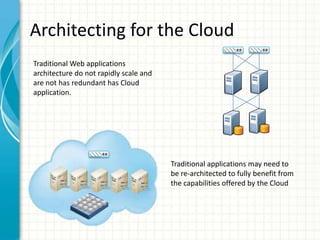
Traditional Web applications
architecture do not rapidly scale and
are not has redundant has Cloud
application.


                                        Traditional applications may need to
                                        be re-architected to fully benefit from
                                        the capabilities offered by the Cloud
External Business Consideration
• Sunk cost
   – It may make sense for organizations to look to a gradual move to the
     Cloud. For an example, where existing applications and infrastructure
     are being well utilized, an approach that sees excess capacity
     delivered from the Cloud can be seen as appropriate.
• Planning for variability
   – The rapid scaling and the on-demand pricing model of the Cloud can
     bring great business benefits but new skills may need to be develop
     within IT to effectively manage the Cloud.
• Vendor lock-in
   – Cloud Computing provider tends to be much more transparent when
     it comes to lock in and so organizations should be able to accurately
     gauge the risks.
Internal Business Consideration
• Shifting IT responsibilities
   – As with previous technological shifts, we believe this change in IT
     responsibilities actually provides opportunities for IT staff. While
     Cloud Computing certainly limits the opportunities for some skills, it
     offers up some new ones in the areas of Cloud
     management, application customization and agile development
• Formal qualification
   – There is a distinct lack of formal Cloud Computing qualifications.
     Whereas IT staff can choose from a plethora of formal, specialist
     training for traditional IT, in the Cloud world this is not the case.
     While this is not surprising given the relative newness of the
     Cloud, nonetheless end users feel uncomfortable with the lack of
     certification
QUESTIONS ?

Coud discovery chap 6

  • 1.
    CLOUD DISCOVERY AN INTRODUCTION TO CLOUD COMPUTING Chapter 6: Planning for the Cloud By: Alain Charpentier
  • 2.
    Table of content •Technical consideration – What application to move to the Cloud, Security considerations, Compliance considerations, Performance considerations, Migration considerations • External Business consideration – What about sunk cost?, Vendor lock-in • Internal Business consideration – Shifting IT responsibilities, Objections
  • 3.
    The driver ofthe Cloud revolution • Virtualization – The ability to increase computing efficiency • Democratization of Computing – Bringing enterprise scale infrastructure to small and medium businesses • Scalability and fast provisioning – Bringing web scale IT at a rapid pace • Commoditization of infrastructure – Enabling IT to focus on the strategic aspects of its role
  • 4.
    What application tomove Applications that have significant interaction with external applications or services Unique Applicable Difficult to to many replicate Applications that are not a point of situations differentiation between the Competitive organization and its competitors advantage Superior to the Sustainable competition
  • 5.
    Security & Compliance •Organizations should be aware that security is a partnership between the vendor and the user. They should therefore clearly ascertain which aspects of security are the responsibility of the vendor and which are the responsibility of the user. • Depending on the type of industry your organization is involved in, there are a number of different compliance requirements which may need to be met. Examples of these include PCI, HIPAA, GAAP, SOX, and IFRS.
  • 6.
    Performance & Migration •Performance – It is importantly to accurately assess the performance requirements. For example an application with high database transfer rates, very high CPU or RAM requirements may be either difficult, or cost prohibitive, to move to the Cloud. • Migration – The bandwidth cost of moving significant amounts of data to the Cloud – The time taken to transfer data in the migration process – In the case of an application, the business process involved in a migration (downtime, business continuity, training etc.)
  • 7.
    Architecting for theCloud Traditional Web applications architecture do not rapidly scale and are not has redundant has Cloud application. Traditional applications may need to be re-architected to fully benefit from the capabilities offered by the Cloud
  • 8.
    External Business Consideration •Sunk cost – It may make sense for organizations to look to a gradual move to the Cloud. For an example, where existing applications and infrastructure are being well utilized, an approach that sees excess capacity delivered from the Cloud can be seen as appropriate. • Planning for variability – The rapid scaling and the on-demand pricing model of the Cloud can bring great business benefits but new skills may need to be develop within IT to effectively manage the Cloud. • Vendor lock-in – Cloud Computing provider tends to be much more transparent when it comes to lock in and so organizations should be able to accurately gauge the risks.
  • 9.
    Internal Business Consideration •Shifting IT responsibilities – As with previous technological shifts, we believe this change in IT responsibilities actually provides opportunities for IT staff. While Cloud Computing certainly limits the opportunities for some skills, it offers up some new ones in the areas of Cloud management, application customization and agile development • Formal qualification – There is a distinct lack of formal Cloud Computing qualifications. Whereas IT staff can choose from a plethora of formal, specialist training for traditional IT, in the Cloud world this is not the case. While this is not surprising given the relative newness of the Cloud, nonetheless end users feel uncomfortable with the lack of certification
  • 10.