Cloud Computing
ISACA Conference 2012


Mariana Carroll


                        ©2012 Deloitte. All rights reserved
Objectives


    •   Technology trends of today
    •   Cloud computing fundamentals
    •   The stages of the cloud computing journey
    •   Business and technology impact of cloud computing
    •   Cloud computing services can create new opportunities for business and IT
    •   Develop new ways of addressing the challenges and leveraging the
        opportunities presented by cloud computing


1                                                                       ©2012 Deloitte. All rights reserved
Technology Trends
Elevate IT for digital business
Tech Trends 2012


                                  Insert video – see separate file


For more information please visit:
http://www.deloitte.com/view/en_ZA/za/services/consulting/techno
logy/fa3b707dcaff7310VgnVCM1000001956f00aRCRD.htm


3                                                                    ©2012 Deloitte. All rights reserved
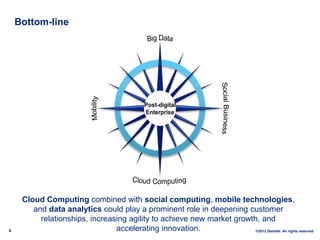
Bottom-line


                                               Post-digital
                                               Enterprise


     Cloud Computing combined with social computing, mobile technologies,
        and data analytics could play a prominent role in deepening customer
          relationships, increasing agility to achieve new market growth, and
4                               accelerating innovation.                ©2012 Deloitte. All rights reserved
Cloud Computing
Fundamentals
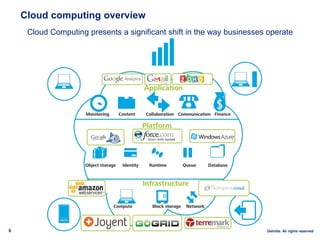
Cloud computing overview
     Cloud Computing presents a significant shift in the way businesses operate


6                                                                   ©2012 Deloitte. All rights reserved
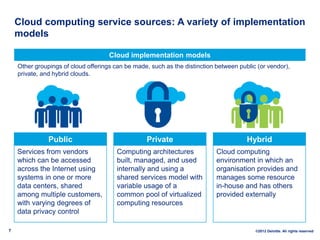
Cloud computing service sources: A variety of implementation
    models

                                     Cloud implementation models
    Other groupings of cloud offerings can be made, such as the distinction between public (or vendor),
    private, and hybrid clouds.


               Public                             Private                              Hybrid
    Services from vendors               Computing architectures             Cloud computing
    which can be accessed               built, managed, and used            environment in which an
    across the Internet using           internally and using a              organisation provides and
    systems in one or more              shared services model with          manages some resource
    data centers, shared                variable usage of a                 in-house and has others
    among multiple customers,           common pool of virtualized          provided externally
    with varying degrees of             computing resources
    data privacy control

7                                                                                         ©2012 Deloitte. All rights reserved
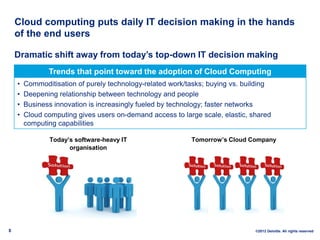
Cloud computing puts daily IT decision making in the hands
    of the end users

    Dramatic shift away from today’s top-down IT decision making
               Trends that point toward the adoption of Cloud Computing
    •   Commoditisation of purely technology-related work/tasks; buying vs. building
    •   Deepening relationship between technology and people
    •   Business innovation is increasingly fueled by technology; faster networks
    •   Cloud computing gives users on-demand access to large scale, elastic, shared
        computing capabilities

               Today’s software-heavy IT                   Tomorrow’s Cloud Company
                     organisation


8                                                                              ©2012 Deloitte. All rights reserved
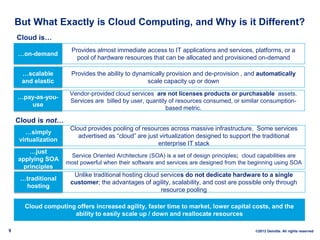
But What Exactly is Cloud Computing, and Why is it Different?
    Cloud is…
                       Provides almost immediate access to IT applications and services, platforms, or a
    …on-demand
                         pool of hardware resources that can be allocated and provisioned on-demand

     …scalable         Provides the ability to dynamically provision and de-provision , and automatically
     and elastic                                   scale capacity up or down
                      Vendor-provided cloud services are not licenses products or purchasable assets.
    …pay-as-you-
                      Services are billed by user, quantity of resources consumed, or similar consumption-
       use
                                                          based metric.

    Cloud is not…
                      Cloud provides pooling of resources across massive infrastructure. Some services
      …simply
                         advertised as “cloud” are just virtualization designed to support the traditional
    virtualization
                                                       enterprise IT stack
        …just
                      Service Oriented Architecture (SOA) is a set of design principles; cloud capabilities are
    applying SOA
                     most powerful when their software and services are designed from the beginning using SOA
      principles
                       Unlike traditional hosting cloud services do not dedicate hardware to a single
     …traditional
                      customer; the advantages of agility, scalability, and cost are possible only through
      hosting
                                                        resource pooling

      Cloud computing offers increased agility, faster time to market, lower capital costs, and the
                     ability to easily scale up / down and reallocate resources

9                                                                                            ©2012 Deloitte. All rights reserved
Overview of the journey
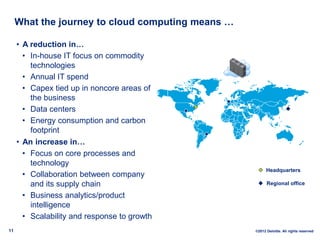
What the journey to cloud computing means …

     • A reduction in…
       • In-house IT focus on commodity
         technologies
       • Annual IT spend
       • Capex tied up in noncore areas of
         the business
       • Data centers
       • Energy consumption and carbon
         footprint
     • An increase in…
       • Focus on core processes and
         technology
                                                         Headquarters
       • Collaboration between company
         and its supply chain                            Regional office

       • Business analytics/product
         intelligence
       • Scalability and response to growth
11                                                 ©2012 Deloitte. All rights reserved
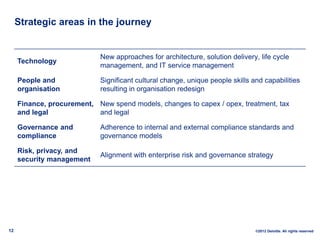
Strategic areas in the journey


                             New approaches for architecture, solution delivery, life cycle
     Technology
                             management, and IT service management

     People and              Significant cultural change, unique people skills and capabilities
     organisation            resulting in organisation redesign

     Finance, procurement, New spend models, changes to capex / opex, treatment, tax
     and legal             and legal

     Governance and          Adherence to internal and external compliance standards and
     compliance              governance models

     Risk, privacy, and
                             Alignment with enterprise risk and governance strategy
     security management


12                                                                              ©2012 Deloitte. All rights reserved
Market perspectives
Now and next
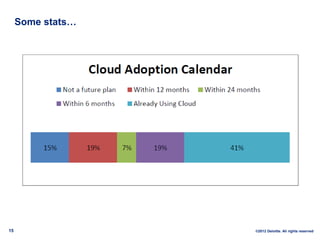
Some stats…

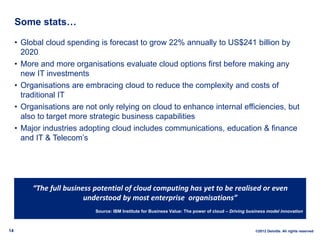
     • Global cloud spending is forecast to grow 22% annually to US$241 billion by
       2020
     • More and more organisations evaluate cloud options first before making any
       new IT investments
     • Organisations are embracing cloud to reduce the complexity and costs of
       traditional IT
     • Organisations are not only relying on cloud to enhance internal efficiencies, but
       also to target more strategic business capabilities
     • Major industries adopting cloud includes communications, education & finance
       and IT & Telecom’s


          “The full business potential of cloud computing has yet to be realised or even
                          understood by most enterprise organisations”
                             Source: IBM Institute for Business Value: The power of cloud – Driving business model innovation


14                                                                                                     ©2012 Deloitte. All rights reserved
Some stats…


15                 ©2012 Deloitte. All rights reserved
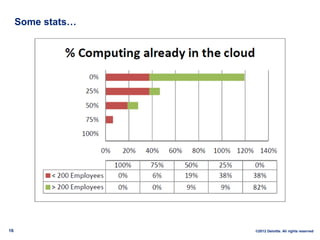
Some stats…


16                 ©2012 Deloitte. All rights reserved
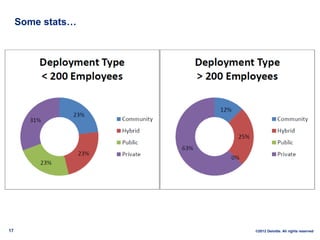
Some stats…


17                 ©2012 Deloitte. All rights reserved
What are other large companies doing at this time?

     • Moving development, testing, and integration of major systems to cloud
       infrastructure as a service
     • For smaller functions and services, deploying cloud systems to replace on-site
       major system implementations of older “stand-alone” systems
     • “Decoupling” the major systems stacks using a “best-of-breed” approach, taking
       into account new software now available on a SaaS subscription delivery model
     • Consolidating major application platforms onto single cloud-based
       infrastructures, while removing “edge” services to other cloud vendors when
       possible
     • Understanding their major system roadmaps, working with vendors to influence
       the product direction to map to their customer priorities
     • Taking a hard look at their end-to-end IT architectures, to determine their
       long-range plans for a more fully “cloud-enabled” business architecture and
       customer services

       Many enterprises with large systems are taking the first steps to make their cloud
             plans “actionable,” to position themselves for strategic advantage

18                                                                           ©2012 Deloitte. All rights reserved
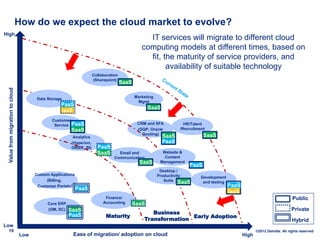
How do we expect the cloud market to evolve?
High
                                                                                                 IT services will migrate to different cloud
                                                                                               computing models at different times, based on
                                                                                                 fit, the maturity of service providers, and
                                                                                                       availability of suitable technology
                                                                     Collaboration
                                                                     (Sharepoint)
                                                                                     SaaS
 Value from migration to cloud


                                        Data Storage                                        Marketing
                                                                                             Mgmt
                                                   PaaS
                                                   IaaS                                            SaaS

                                               Customer
                                                Service PaaS                                 CRM and SFA           HR/Talent
                                                        SaaS                                 (GQP, Oracle        /Recruitment
                                                                                               Quoting)                      SaaS
                                                         Analytics                                        SaaS
                                                        (Hyperion,                                        PaaS
                                                        OBIEE, BI)     PaaS
                                                                       SaaS       Email and               Website &
                                                                                Communication              Content
                                                                                              SaaS       Management
                                                                                                                      PaaS
                                                                                                         Desktop /
                                       Custom Applications                                              Productivity       Development
                                            (Billing,                                                      Suite SaaS       and testing
                                        Customer Portals)                                                                                 PaaS
                                                             PaaS
                                                                                                                                          IaaS
                                                                           Finance/                                                                                           Public
                                             Core ERP                     Accounting        SaaS
                                             (OM, SC)   SaaS                                                                                                                 Private
                                                                                                   Business
                                                        PaaS                Maturity                           Early Adoption
                                                                                                Transformation                                                               Hybrid
Low
 19                                                                                                                                                     ©2012 Deloitte. All rights reserved
                                 Low                     Ease of migration/ adoption on cloud                                                    High
New Opportunities
For Business and IT
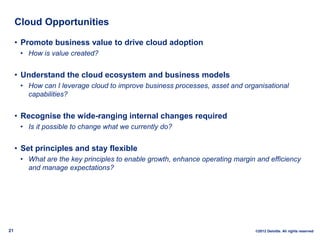
Cloud Opportunities

     • Promote business value to drive cloud adoption
      • How is value created?


     • Understand the cloud ecosystem and business models
      • How can I leverage cloud to improve business processes, asset and organisational
        capabilities?


     • Recognise the wide-ranging internal changes required
      • Is it possible to change what we currently do?


     • Set principles and stay flexible
      • What are the key principles to enable growth, enhance operating margin and efficiency
        and manage expectations?


21                                                                            ©2012 Deloitte. All rights reserved
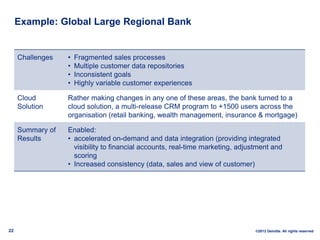
Example: Global Large Regional Bank


     Challenges   •   Fragmented sales processes
                  •   Multiple customer data repositories
                  •   Inconsistent goals
                  •   Highly variable customer experiences

     Cloud        Rather making changes in any one of these areas, the bank turned to a
     Solution     cloud solution, a multi-release CRM program to +1500 users across the
                  organisation (retail banking, wealth management, insurance & mortgage)

     Summary of   Enabled:
     Results      • accelerated on-demand and data integration (providing integrated
                    visibility to financial accounts, real-time marketing, adjustment and
                    scoring
                  • Increased consistency (data, sales and view of customer)


22                                                                              ©2012 Deloitte. All rights reserved
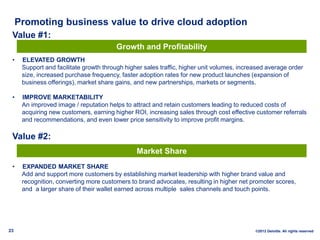
Promoting business value to drive cloud adoption
 Value #1:
                                        Growth and Profitability
 •    ELEVATED GROWTH
      Support and facilitate growth through higher sales traffic, higher unit volumes, increased average order
      size, increased purchase frequency, faster adoption rates for new product launches (expansion of
      business offerings), market share gains, and new partnerships, markets or segments.

 •    IMPROVE MARKETABILITY
      An improved image / reputation helps to attract and retain customers leading to reduced costs of
      acquiring new customers, earning higher ROI, increasing sales through cost effective customer referrals
      and recommendations, and even lower price sensitivity to improve profit margins.

 Value #2:
                                                Market Share
 •    EXPANDED MARKET SHARE
      Add and support more customers by establishing market leadership with higher brand value and
      recognition, converting more customers to brand advocates, resulting in higher net promoter scores,
      and a larger share of their wallet earned across multiple sales channels and touch points.


23                                                                                          ©2012 Deloitte. All rights reserved
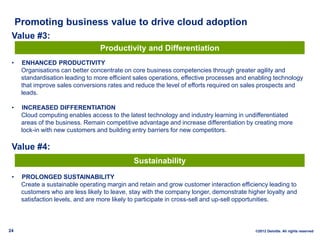
Promoting business value to drive cloud adoption
 Value #3:
                                  Productivity and Differentiation
 •    ENHANCED PRODUCTIVITY
      Organisations can better concentrate on core business competencies through greater agility and
      standardisation leading to more efficient sales operations, effective processes and enabling technology
      that improve sales conversions rates and reduce the level of efforts required on sales prospects and
      leads.

 •    INCREASED DIFFERENTIATION
      Cloud computing enables access to the latest technology and industry learning in undifferentiated
      areas of the business. Remain competitive advantage and increase differentiation by creating more
      lock-in with new customers and building entry barriers for new competitors.

 Value #4:
                                               Sustainability
 •    PROLONGED SUSTAINABILITY
      Create a sustainable operating margin and retain and grow customer interaction efficiency leading to
      customers who are less likely to leave, stay with the company longer, demonstrate higher loyalty and
      satisfaction levels, and are more likely to participate in cross-sell and up-sell opportunities.


24                                                                                         ©2012 Deloitte. All rights reserved
Addressing challenges &
leveraging opportunities
What’s next
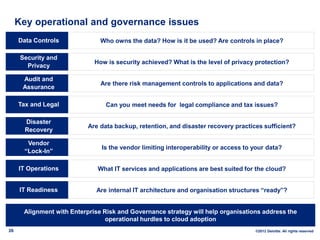
Key operational and governance issues
     Data Controls              Who owns the data? How is it be used? Are controls in place?

      Security and
                              How is security achieved? What is the level of privacy protection?
        Privacy

      Audit and
                                Are there risk management controls to applications and data?
      Assurance

     Tax and Legal                Can you meet needs for legal compliance and tax issues?

       Disaster
                            Are data backup, retention, and disaster recovery practices sufficient?
       Recovery

        Vendor
                                Is the vendor limiting interoperability or access to your data?
       “Lock-In”

     IT Operations             What IT services and applications are best suited for the cloud?


     IT Readiness             Are internal IT architecture and organisation structures “ready”?


       Alignment with Enterprise Risk and Governance strategy will help organisations address the
                                  operational hurdles to cloud adoption
26                                                                                   ©2012 Deloitte. All rights reserved
Summary & Close
Cloud is here to stay…


                      Education is key!


        It is important to scale up on our knowledge of cloud computing to
            leveraging the multitude of opportunities while addressing the
                                     challenges.


28                                                               ©2012 Deloitte. All rights reserved
Contact information


     For additional information, please contact:


     Dr. Mariana Carroll
     Leader - Cloud Computing Centre of Excellence
     Risk Advisory | Deloitte & Touché
     Mobile: +27 (0)83 333 5536
     mcarroll@deloitte.co.za


29                                                   ©2012 Deloitte. All rights reserved
Copyright © 2011 Deloitte Development LLC. All rights reserved.
Member of Deloitte Touche Tohmatsu Limited

cloud computing - isaca conference 2012

  • 1.
    Cloud Computing ISACA Conference2012 Mariana Carroll ©2012 Deloitte. All rights reserved
  • 2.
    Objectives • Technology trends of today • Cloud computing fundamentals • The stages of the cloud computing journey • Business and technology impact of cloud computing • Cloud computing services can create new opportunities for business and IT • Develop new ways of addressing the challenges and leveraging the opportunities presented by cloud computing 1 ©2012 Deloitte. All rights reserved
  • 3.
    Technology Trends Elevate ITfor digital business
  • 4.
    Tech Trends 2012 Insert video – see separate file For more information please visit: http://www.deloitte.com/view/en_ZA/za/services/consulting/techno logy/fa3b707dcaff7310VgnVCM1000001956f00aRCRD.htm 3 ©2012 Deloitte. All rights reserved
  • 5.
    Bottom-line Post-digital Enterprise Cloud Computing combined with social computing, mobile technologies, and data analytics could play a prominent role in deepening customer relationships, increasing agility to achieve new market growth, and 4 accelerating innovation. ©2012 Deloitte. All rights reserved
  • 6.
  • 7.
    Cloud computing overview Cloud Computing presents a significant shift in the way businesses operate 6 ©2012 Deloitte. All rights reserved
  • 8.
    Cloud computing servicesources: A variety of implementation models Cloud implementation models Other groupings of cloud offerings can be made, such as the distinction between public (or vendor), private, and hybrid clouds. Public Private Hybrid Services from vendors Computing architectures Cloud computing which can be accessed built, managed, and used environment in which an across the Internet using internally and using a organisation provides and systems in one or more shared services model with manages some resource data centers, shared variable usage of a in-house and has others among multiple customers, common pool of virtualized provided externally with varying degrees of computing resources data privacy control 7 ©2012 Deloitte. All rights reserved
  • 9.
    Cloud computing putsdaily IT decision making in the hands of the end users Dramatic shift away from today’s top-down IT decision making Trends that point toward the adoption of Cloud Computing • Commoditisation of purely technology-related work/tasks; buying vs. building • Deepening relationship between technology and people • Business innovation is increasingly fueled by technology; faster networks • Cloud computing gives users on-demand access to large scale, elastic, shared computing capabilities Today’s software-heavy IT Tomorrow’s Cloud Company organisation 8 ©2012 Deloitte. All rights reserved
  • 10.
    But What Exactlyis Cloud Computing, and Why is it Different? Cloud is… Provides almost immediate access to IT applications and services, platforms, or a …on-demand pool of hardware resources that can be allocated and provisioned on-demand …scalable Provides the ability to dynamically provision and de-provision , and automatically and elastic scale capacity up or down Vendor-provided cloud services are not licenses products or purchasable assets. …pay-as-you- Services are billed by user, quantity of resources consumed, or similar consumption- use based metric. Cloud is not… Cloud provides pooling of resources across massive infrastructure. Some services …simply advertised as “cloud” are just virtualization designed to support the traditional virtualization enterprise IT stack …just Service Oriented Architecture (SOA) is a set of design principles; cloud capabilities are applying SOA most powerful when their software and services are designed from the beginning using SOA principles Unlike traditional hosting cloud services do not dedicate hardware to a single …traditional customer; the advantages of agility, scalability, and cost are possible only through hosting resource pooling Cloud computing offers increased agility, faster time to market, lower capital costs, and the ability to easily scale up / down and reallocate resources 9 ©2012 Deloitte. All rights reserved
  • 11.
  • 12.
    What the journeyto cloud computing means … • A reduction in… • In-house IT focus on commodity technologies • Annual IT spend • Capex tied up in noncore areas of the business • Data centers • Energy consumption and carbon footprint • An increase in… • Focus on core processes and technology Headquarters • Collaboration between company and its supply chain Regional office • Business analytics/product intelligence • Scalability and response to growth 11 ©2012 Deloitte. All rights reserved
  • 13.
    Strategic areas inthe journey New approaches for architecture, solution delivery, life cycle Technology management, and IT service management People and Significant cultural change, unique people skills and capabilities organisation resulting in organisation redesign Finance, procurement, New spend models, changes to capex / opex, treatment, tax and legal and legal Governance and Adherence to internal and external compliance standards and compliance governance models Risk, privacy, and Alignment with enterprise risk and governance strategy security management 12 ©2012 Deloitte. All rights reserved
  • 14.
  • 15.
    Some stats… • Global cloud spending is forecast to grow 22% annually to US$241 billion by 2020 • More and more organisations evaluate cloud options first before making any new IT investments • Organisations are embracing cloud to reduce the complexity and costs of traditional IT • Organisations are not only relying on cloud to enhance internal efficiencies, but also to target more strategic business capabilities • Major industries adopting cloud includes communications, education & finance and IT & Telecom’s “The full business potential of cloud computing has yet to be realised or even understood by most enterprise organisations” Source: IBM Institute for Business Value: The power of cloud – Driving business model innovation 14 ©2012 Deloitte. All rights reserved
  • 16.
    Some stats… 15 ©2012 Deloitte. All rights reserved
  • 17.
    Some stats… 16 ©2012 Deloitte. All rights reserved
  • 18.
    Some stats… 17 ©2012 Deloitte. All rights reserved
  • 19.
    What are otherlarge companies doing at this time? • Moving development, testing, and integration of major systems to cloud infrastructure as a service • For smaller functions and services, deploying cloud systems to replace on-site major system implementations of older “stand-alone” systems • “Decoupling” the major systems stacks using a “best-of-breed” approach, taking into account new software now available on a SaaS subscription delivery model • Consolidating major application platforms onto single cloud-based infrastructures, while removing “edge” services to other cloud vendors when possible • Understanding their major system roadmaps, working with vendors to influence the product direction to map to their customer priorities • Taking a hard look at their end-to-end IT architectures, to determine their long-range plans for a more fully “cloud-enabled” business architecture and customer services Many enterprises with large systems are taking the first steps to make their cloud plans “actionable,” to position themselves for strategic advantage 18 ©2012 Deloitte. All rights reserved
  • 20.
    How do weexpect the cloud market to evolve? High IT services will migrate to different cloud computing models at different times, based on fit, the maturity of service providers, and availability of suitable technology Collaboration (Sharepoint) SaaS Value from migration to cloud Data Storage Marketing Mgmt PaaS IaaS SaaS Customer Service PaaS CRM and SFA HR/Talent SaaS (GQP, Oracle /Recruitment Quoting) SaaS Analytics SaaS (Hyperion, PaaS OBIEE, BI) PaaS SaaS Email and Website & Communication Content SaaS Management PaaS Desktop / Custom Applications Productivity Development (Billing, Suite SaaS and testing Customer Portals) PaaS PaaS IaaS Finance/ Public Core ERP Accounting SaaS (OM, SC) SaaS Private Business PaaS Maturity Early Adoption Transformation Hybrid Low 19 ©2012 Deloitte. All rights reserved Low Ease of migration/ adoption on cloud High
  • 21.
  • 22.
    Cloud Opportunities • Promote business value to drive cloud adoption • How is value created? • Understand the cloud ecosystem and business models • How can I leverage cloud to improve business processes, asset and organisational capabilities? • Recognise the wide-ranging internal changes required • Is it possible to change what we currently do? • Set principles and stay flexible • What are the key principles to enable growth, enhance operating margin and efficiency and manage expectations? 21 ©2012 Deloitte. All rights reserved
  • 23.
    Example: Global LargeRegional Bank Challenges • Fragmented sales processes • Multiple customer data repositories • Inconsistent goals • Highly variable customer experiences Cloud Rather making changes in any one of these areas, the bank turned to a Solution cloud solution, a multi-release CRM program to +1500 users across the organisation (retail banking, wealth management, insurance & mortgage) Summary of Enabled: Results • accelerated on-demand and data integration (providing integrated visibility to financial accounts, real-time marketing, adjustment and scoring • Increased consistency (data, sales and view of customer) 22 ©2012 Deloitte. All rights reserved
  • 24.
    Promoting business valueto drive cloud adoption Value #1: Growth and Profitability • ELEVATED GROWTH Support and facilitate growth through higher sales traffic, higher unit volumes, increased average order size, increased purchase frequency, faster adoption rates for new product launches (expansion of business offerings), market share gains, and new partnerships, markets or segments. • IMPROVE MARKETABILITY An improved image / reputation helps to attract and retain customers leading to reduced costs of acquiring new customers, earning higher ROI, increasing sales through cost effective customer referrals and recommendations, and even lower price sensitivity to improve profit margins. Value #2: Market Share • EXPANDED MARKET SHARE Add and support more customers by establishing market leadership with higher brand value and recognition, converting more customers to brand advocates, resulting in higher net promoter scores, and a larger share of their wallet earned across multiple sales channels and touch points. 23 ©2012 Deloitte. All rights reserved
  • 25.
    Promoting business valueto drive cloud adoption Value #3: Productivity and Differentiation • ENHANCED PRODUCTIVITY Organisations can better concentrate on core business competencies through greater agility and standardisation leading to more efficient sales operations, effective processes and enabling technology that improve sales conversions rates and reduce the level of efforts required on sales prospects and leads. • INCREASED DIFFERENTIATION Cloud computing enables access to the latest technology and industry learning in undifferentiated areas of the business. Remain competitive advantage and increase differentiation by creating more lock-in with new customers and building entry barriers for new competitors. Value #4: Sustainability • PROLONGED SUSTAINABILITY Create a sustainable operating margin and retain and grow customer interaction efficiency leading to customers who are less likely to leave, stay with the company longer, demonstrate higher loyalty and satisfaction levels, and are more likely to participate in cross-sell and up-sell opportunities. 24 ©2012 Deloitte. All rights reserved
  • 26.
    Addressing challenges & leveragingopportunities What’s next
  • 27.
    Key operational andgovernance issues Data Controls Who owns the data? How is it be used? Are controls in place? Security and How is security achieved? What is the level of privacy protection? Privacy Audit and Are there risk management controls to applications and data? Assurance Tax and Legal Can you meet needs for legal compliance and tax issues? Disaster Are data backup, retention, and disaster recovery practices sufficient? Recovery Vendor Is the vendor limiting interoperability or access to your data? “Lock-In” IT Operations What IT services and applications are best suited for the cloud? IT Readiness Are internal IT architecture and organisation structures “ready”? Alignment with Enterprise Risk and Governance strategy will help organisations address the operational hurdles to cloud adoption 26 ©2012 Deloitte. All rights reserved
  • 28.
  • 29.
    Cloud is hereto stay… Education is key! It is important to scale up on our knowledge of cloud computing to leveraging the multitude of opportunities while addressing the challenges. 28 ©2012 Deloitte. All rights reserved
  • 30.
    Contact information For additional information, please contact: Dr. Mariana Carroll Leader - Cloud Computing Centre of Excellence Risk Advisory | Deloitte & Touché Mobile: +27 (0)83 333 5536 mcarroll@deloitte.co.za 29 ©2012 Deloitte. All rights reserved
  • 31.
    Copyright © 2011Deloitte Development LLC. All rights reserved. Member of Deloitte Touche Tohmatsu Limited