Mehmet Gonullu 2013©
    mgonullu@gmail.com
http://www.mgonullu.com
A model for enabling
 ubiquitous, convenient, on-demand
 network access to a shared pool of
 configurable computing resources
 (e.g., networks, servers, storage, applicatio
 ns, and services) that can be rapidly
 provisioned and released with minimal
 management effort or service provider
 interaction (NIST, 2011)
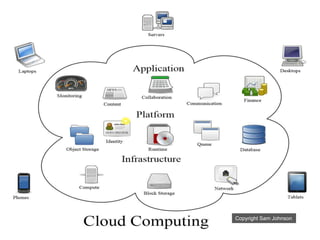
Copyright Sam Johnson
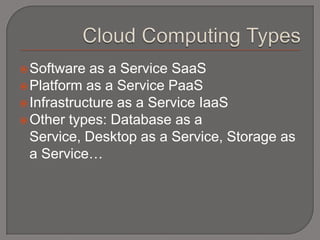
 Software  as a Service SaaS
 Platform as a Service PaaS
 Infrastructure as a Service IaaS
 Other types: Database as a
  Service, Desktop as a Service, Storage as
  a Service…
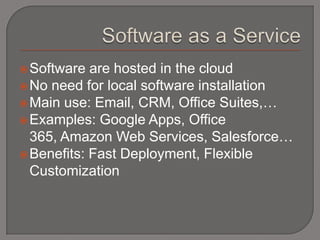
 Software  are hosted in the cloud
 No need for local software installation
 Main use: Email, CRM, Office Suites,…
 Examples: Google Apps, Office
  365, Amazon Web Services, Salesforce…
 Benefits: Fast Deployment, Flexible
  Customization
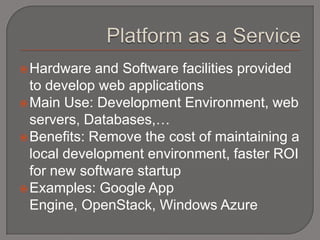
 Hardware   and Software facilities provided
  to develop web applications
 Main Use: Development Environment, web
  servers, Databases,…
 Benefits: Remove the cost of maintaining a
  local development environment, faster ROI
  for new software startup
 Examples: Google App
  Engine, OpenStack, Windows Azure
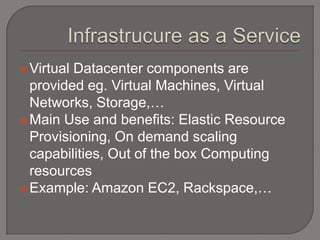
 VirtualDatacenter components are
  provided eg. Virtual Machines, Virtual
  Networks, Storage,…
 Main Use and benefits: Elastic Resource
  Provisioning, On demand scaling
  capabilities, Out of the box Computing
  resources
 Example: Amazon EC2, Rackspace,…
 Private cloud: in-house managed cloud
  intended for a single enterprise use
 Public cloud: Used by cloud services
  providers
 Community cloud: group of private clouds
  shared between 2 or more organization
 Hybrid Cloud: a combination of clouds
  from the above types
 Data Protection over the cloud
 Availability of cloud computing providers
 Legalization
 Security Standards are held with providers
 SaaS  remains the fast growing one with
  more companies offering competitive
  prices for enterprise software solutions
 IaaS is also continuing to grow with IT
  outsourcing booming and organizations
  looking for higher ToC and ROI.
 PaaS is allowing more startups to appear
  and pursue their places with big players
   NIST http://csrc.nist.gov/publications/nistpubs/800-
    145/SP800-145.pdf
   Wikipedia: http://en.wikipedia.org/wiki/Cloud_computing
   TechTarget:
    http://www.computerweekly.com/news/2240089111/Top-
    five-cloud-computing-security-issues
   Cisco: http://blogs.cisco.com/smallbusiness/the-top-5-
    security-risks-of-cloud-computing/
   Technet:
    http://blogs.technet.com/b/privatecloud/archive/2012/04/0
    4/what-is-infrastructure-as-a-service-iaas.aspx

Cloud computing in a nutshell

  • 1.
    Mehmet Gonullu 2013© mgonullu@gmail.com http://www.mgonullu.com
  • 2.
    A model forenabling ubiquitous, convenient, on-demand network access to a shared pool of configurable computing resources (e.g., networks, servers, storage, applicatio ns, and services) that can be rapidly provisioned and released with minimal management effort or service provider interaction (NIST, 2011)
  • 3.
  • 4.
     Software as a Service SaaS  Platform as a Service PaaS  Infrastructure as a Service IaaS  Other types: Database as a Service, Desktop as a Service, Storage as a Service…
  • 5.
     Software are hosted in the cloud  No need for local software installation  Main use: Email, CRM, Office Suites,…  Examples: Google Apps, Office 365, Amazon Web Services, Salesforce…  Benefits: Fast Deployment, Flexible Customization
  • 6.
     Hardware and Software facilities provided to develop web applications  Main Use: Development Environment, web servers, Databases,…  Benefits: Remove the cost of maintaining a local development environment, faster ROI for new software startup  Examples: Google App Engine, OpenStack, Windows Azure
  • 7.
     VirtualDatacenter componentsare provided eg. Virtual Machines, Virtual Networks, Storage,…  Main Use and benefits: Elastic Resource Provisioning, On demand scaling capabilities, Out of the box Computing resources  Example: Amazon EC2, Rackspace,…
  • 8.
     Private cloud:in-house managed cloud intended for a single enterprise use  Public cloud: Used by cloud services providers  Community cloud: group of private clouds shared between 2 or more organization  Hybrid Cloud: a combination of clouds from the above types
  • 9.
     Data Protectionover the cloud  Availability of cloud computing providers  Legalization  Security Standards are held with providers
  • 10.
     SaaS remains the fast growing one with more companies offering competitive prices for enterprise software solutions  IaaS is also continuing to grow with IT outsourcing booming and organizations looking for higher ToC and ROI.  PaaS is allowing more startups to appear and pursue their places with big players
  • 11.
    NIST http://csrc.nist.gov/publications/nistpubs/800- 145/SP800-145.pdf  Wikipedia: http://en.wikipedia.org/wiki/Cloud_computing  TechTarget: http://www.computerweekly.com/news/2240089111/Top- five-cloud-computing-security-issues  Cisco: http://blogs.cisco.com/smallbusiness/the-top-5- security-risks-of-cloud-computing/  Technet: http://blogs.technet.com/b/privatecloud/archive/2012/04/0 4/what-is-infrastructure-as-a-service-iaas.aspx