Cloud computing
Paper Presentation
PRASANTH
GOVERNMENT ARTS
AND SCIENCE COLLEGE
ARIYALUR,
3rd Bsc-Computer Science
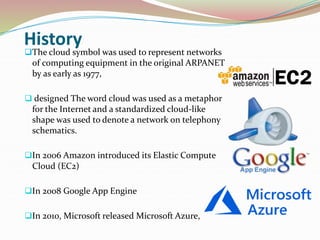
History
The cloud symbol was used to represent networks
of computing equipment in the original ARPANET
by as early as 1977,
 designed The word cloud was used as a metaphor
for the Internet and a standardized cloud-like
shape was used to denote a network on telephony
schematics.
In 2006 Amazon introduced its Elastic Compute
Cloud (EC2)
In 2008 Google App Engine
In 2010, Microsoft released Microsoft Azure,
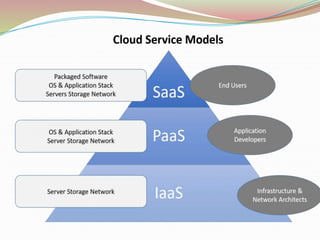
SaaS - Example
The capability provided to the consumer is to use the provider's
applications running on a cloud infrastructure.
The applications are accessible from various client devices through
either a thin client interface, such as a web browser (e.g., web-based
email), or a program interface.
The consumer does not manage or control the underlying cloud
infrastructure including network, servers, operating systems, storage,
Even individual application capabilities, with the possible exception
of limited user-specific application configuration settings.
Saas provider Google drive,Facebook,G-Mail, DropBox, Youtube,
amazondrive, compology, JioCloud
PaaS
The capability provided to the consumer is to deploy onto the cloud
infrastructure consumer-created or acquired applications created using
programming languages,
libraries, services, and tools supported by the provider.
The consumer does not manage or control the underlying cloud
infrastructure including network,web servers, operating systems, or
storage,server,data base,
but has control over the deployed applications and possibly
configuration settings for the application-hosting environment.
With some PaaS offers like Microsoft Azure, Oracle Cloud Platform
and Google App Engine,
IaaS
"Infrastructure as a service" (IaaS) refers to online services that provide high-
level APIs used to dereference various low-level details of underlying network
infrastructure like physical computing resources, location, data partitioning,
scaling, security,
A hypervisor, such as Xen, Oracle VirtualBox, Oracle VM, KVM, VMware
ESX/ESXi, or Hyper-V, LXD, runs the virtual machines as guests.
IaaS clouds often offer additional resources such as a virtual-machine disk-
image library, raw block storage, file or object storage, firewalls, load
balancers, IP addresses, virtual local area networks (VLANs), and software
bundle
IaaS-cloud providers supply these resources on-demand from their large pools
of equipment installed in data centers. For wide-area connectivity,
Deployment models
Private
Private cloud is cloud infrastructure
operated solely for a single
organization,
Public
A cloud is called a "public cloud"
when the services are rendered over a
network that is open for public use.
Public cloud services may be free.
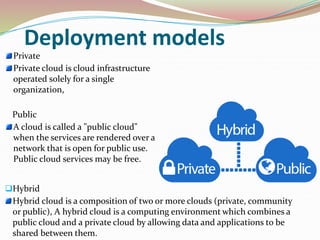
Hybrid
Hybrid cloud is a composition of two or more clouds (private, community
or public), A hybrid cloud is a computing environment which combines a
public cloud and a private cloud by allowing data and applications to be
shared between them.
Cloud computing Advantages
Cost efficiency – The biggest reason behind shifting to cloud computing is
that it takes considerably lesser cost than an on-premise technology. Now the
companies need not store the data in disks anymore as the Cloud offers
enormous space available saving money and resources of the companies.
High Speed – Cloud computing lets you deploy the service quickly in fewer
clicks. This quick deployment lets you get the resources required for your
system within fewer minutes.
Excellent accessibility – Storing the information in cloud allows you to access
it anywhere, anytime regardless of the machine making it highly accessible and
flexible technology of present times.
Back-up and restore data – Once the data is stored in Cloud, it is easier to get
the back-up and recovery of that, which is quite a time taking process on-
premise.
Cloud computing Disadvantages
Security issues – At time storing data in cloud may pose serious challenge of
information theft in front of the company. Though advanced security measures
are deployed on cloud, still storing a confidential data in cloud can be a risky
affair.
Low bandwidth – At times the bandwidth is low as many users are accessing
cloud at the same time which causes its bandwidth to go down. With less speed
the benefits of cloud computing cannot be realized.
Flexibility issues – The cloud services run on remote servers which make it
hard for the companies to have control over software and hardware. The services
at times do not run the way it should.
Incompatibility – Since entire infrastructure gets virtualized, incompatibility
issues may arise at times that may pose serious challenges on the way of smooth
running of services.
Thank you
Any qustion

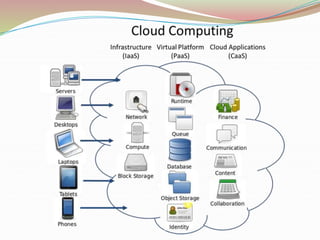
Cloud computing

  • 1.
    Cloud computing Paper Presentation PRASANTH GOVERNMENTARTS AND SCIENCE COLLEGE ARIYALUR, 3rd Bsc-Computer Science
  • 3.
    History The cloud symbolwas used to represent networks of computing equipment in the original ARPANET by as early as 1977,  designed The word cloud was used as a metaphor for the Internet and a standardized cloud-like shape was used to denote a network on telephony schematics. In 2006 Amazon introduced its Elastic Compute Cloud (EC2) In 2008 Google App Engine In 2010, Microsoft released Microsoft Azure,
  • 5.
    SaaS - Example Thecapability provided to the consumer is to use the provider's applications running on a cloud infrastructure. The applications are accessible from various client devices through either a thin client interface, such as a web browser (e.g., web-based email), or a program interface. The consumer does not manage or control the underlying cloud infrastructure including network, servers, operating systems, storage, Even individual application capabilities, with the possible exception of limited user-specific application configuration settings. Saas provider Google drive,Facebook,G-Mail, DropBox, Youtube, amazondrive, compology, JioCloud
  • 6.
    PaaS The capability providedto the consumer is to deploy onto the cloud infrastructure consumer-created or acquired applications created using programming languages, libraries, services, and tools supported by the provider. The consumer does not manage or control the underlying cloud infrastructure including network,web servers, operating systems, or storage,server,data base, but has control over the deployed applications and possibly configuration settings for the application-hosting environment. With some PaaS offers like Microsoft Azure, Oracle Cloud Platform and Google App Engine,
  • 7.
    IaaS "Infrastructure as aservice" (IaaS) refers to online services that provide high- level APIs used to dereference various low-level details of underlying network infrastructure like physical computing resources, location, data partitioning, scaling, security, A hypervisor, such as Xen, Oracle VirtualBox, Oracle VM, KVM, VMware ESX/ESXi, or Hyper-V, LXD, runs the virtual machines as guests. IaaS clouds often offer additional resources such as a virtual-machine disk- image library, raw block storage, file or object storage, firewalls, load balancers, IP addresses, virtual local area networks (VLANs), and software bundle IaaS-cloud providers supply these resources on-demand from their large pools of equipment installed in data centers. For wide-area connectivity,
  • 8.
    Deployment models Private Private cloudis cloud infrastructure operated solely for a single organization, Public A cloud is called a "public cloud" when the services are rendered over a network that is open for public use. Public cloud services may be free. Hybrid Hybrid cloud is a composition of two or more clouds (private, community or public), A hybrid cloud is a computing environment which combines a public cloud and a private cloud by allowing data and applications to be shared between them.
  • 9.
    Cloud computing Advantages Costefficiency – The biggest reason behind shifting to cloud computing is that it takes considerably lesser cost than an on-premise technology. Now the companies need not store the data in disks anymore as the Cloud offers enormous space available saving money and resources of the companies. High Speed – Cloud computing lets you deploy the service quickly in fewer clicks. This quick deployment lets you get the resources required for your system within fewer minutes. Excellent accessibility – Storing the information in cloud allows you to access it anywhere, anytime regardless of the machine making it highly accessible and flexible technology of present times. Back-up and restore data – Once the data is stored in Cloud, it is easier to get the back-up and recovery of that, which is quite a time taking process on- premise.
  • 10.
    Cloud computing Disadvantages Securityissues – At time storing data in cloud may pose serious challenge of information theft in front of the company. Though advanced security measures are deployed on cloud, still storing a confidential data in cloud can be a risky affair. Low bandwidth – At times the bandwidth is low as many users are accessing cloud at the same time which causes its bandwidth to go down. With less speed the benefits of cloud computing cannot be realized. Flexibility issues – The cloud services run on remote servers which make it hard for the companies to have control over software and hardware. The services at times do not run the way it should. Incompatibility – Since entire infrastructure gets virtualized, incompatibility issues may arise at times that may pose serious challenges on the way of smooth running of services.
  • 11.
  • 12.